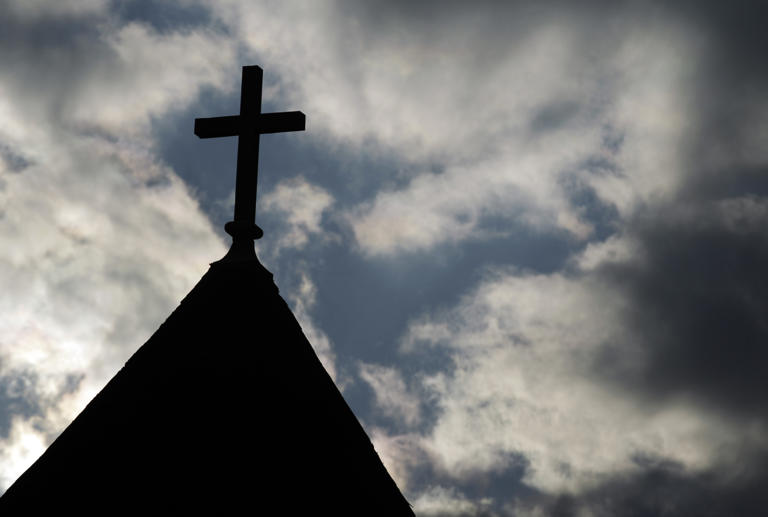
Showing posts with label Nationalism. Show all posts

Friday, September 11, 2026

Mistakes, mistrust and misdirection: 25 years after 9/11, its dark legacy continues to unfold


The initial heroism, goodwill and unity of 9/11 gave way to discord at home and diminished moral authority abroad.’ Illustration: Guardian Design

The world’s most powerful country responded to the worst terrorist attack in its history by inflicting terror of its own – around the world, and at home

David Smith in Washington
Fri 11 Sep 2026 02.00 EDT

As clear as that cloudless September morning, Jenna Jacobs McPartland remembers the moment everything changed. “I was cleaning the bathroom and watching the Today show in the background and nine months pregnant,” the 52-year-old recalls by phone. “I think they were showing ‘Today throws a wedding’ when the news broke in.”

A plane had hit the north tower of the World Trade Center in New York. McPartland did not know that her husband, Ariel Jacobs, was attending a conference at its Windows on the World restaurant. “I called his office to say, ‘Hey, turn on the TV. Do you guys know what’s going on?’ His assistant said, ‘Oh my God, Jenna, he’s there.’ The whole world disappeared and there was this sort of hollow collapsing feeling.”

Ariel Jacobs did not live to see his son, Gabriel, born six days after September 11, 2001. McPartland, then living in Briarcliff Manor, New York, would marry twice more, set up a grief support charity, and become a chef and restaurateur. Each 9/11 anniversary, she has a picnic at the cemetery where a few pieces of bone from her late husband are buried.

Speaking from Fairfield, Connecticut, McPartland says: “Ari was an incredibly joyful person who cherished his life. I made a conscious choice to honour him by living as joyfully as I can. It’s not always easy. I still cry pretty frequently. If there’s a movie with a building getting blown up, or if I’m reading a book and they casually mention ‘post 9-11 this’ or whatever, it catches me off guard. The grief finds a place to live in the heart, and you visit it.”


View of smoke from the collapse of the World Trade Center’s South Tower, in the wake of the September 11 terrorist attacks, as seen from Exchange Place, Jersey City, New Jersey, September 11, 2001. Photograph: Michael J Powell/Getty Images

McPartland and other victims’ families have learned to live with that grief over the past 25 years. But America writ large has struggled to carry the weight of the worst terrorist attack in its history. The world’s most powerful nation responded by inflicting terror of its own, betraying its history as a safe harbour for immigrants, and pitting Americans against one another. The initial heroism, goodwill and unity of 9/11 gave way to discord at home and diminished moral authority abroad.

McPartland adds: “It makes me incredibly sad and bordering on angry that the death of my husband has been invoked to cause more violence. It is the othering of people that got him killed in the first place and, when we Americans fail to learn that lesson and choose collectively as a nation to other people, whether it’s immigrants or other nations, that is a deepening of that tragedy that is sickening and unfathomable to me.”

Friday, August 21, 2026

A nation under God: Rebuilding in Nehemiah


By Stephen Hair 
Maranatha Bible Church
 
Aug 19, 2026 Updated 

Anyone who is concerned about the proper effects of Christianity upon a nation knows the name of William Wilberforce, the power behind the abolition of slavery in the British Empire in the year 1807. Wilberforce was elected to Parliament from the county of Hull in 1780 at the age of 21. He was converted to Christ in 1785 through the witness of his old schoolmaster from Hull, Isaac Milner. Shortly after that, partly through the influence of the converted former slave trader John Newton and partly through others, Wilberforce began his long campaign against slavery.

Wilberforce’s first parliamentary bill was to “discuss” abolition. It was introduced in the House of Commons by his friend, Prime Minister William Pitt, in 1788, and it passed. But when the bill came up for discussion at the next session of Parliament in 1789, it was hotly opposed by the commercial lobby that backed slavery, and the move to limit the abuse was defeated.

In 1791 Wilberforce, now backed by a coalition of like-minded men known as the Clapham Sect, tried again, but again he was defeated. It was the same in 1792. There were times when public opinion ran in Wilberforce’s favor. At other times, as in the eyes of the French Revolution, opinion was against any change at all. After the fall of Robespierre in France in 1796, the mood of the country turned toward abolition, but when the abolition bill reached the House of Commons in that year, it was again defeated.

So also in 1798, 1799, 1800, and 1801.

It was not until February 4, 1807, that the abolition document finally passed the House of Lords, and not until February 22, 1807, that it passed the Commons. Nineteen years had gone by. Men had grown old in the cause. Some had died. Yet when news of the abolition of the slave trade reached Wilberforce late on the evening of February 22, the reformer looked into the face of his old friend and fellow abolitionist, Henry Thorton, and said, “Well, Henry, what shall we abolish next?”

Monday, August 03, 2026

The Summer of Taking Christian Nationalism Seriously


MEGAN FOWLER

Presbyterians and Lutherans, among others, voted at annual conventions to study how to respond to the political movement.


CHRISTIANITY TODAY
JULY 30, 2026
Sollina Images / Getty


At denominational gatherings across the country this summer, one topic of conversation has been a near constant: Christian nationalism.

Denominations discuss and debate a wide range of subjects at their annual conventions, occasionally making headlines, as Southern Baptists did in June with a vote to ban women from preaching. But among Baptists, Presbyterians, and other evangelical groups, a quieter work has been underway in committees and working groups as churches grapple with how to address growing efforts to marry Christianity with the tools of government.

At its annual synod in June, the Christian Reformed Church (CRC) voted to form a Christian nationalism study committee that will present a report in 2028. The same month, the Presbyterian Church in America (PCA) heard a partial report from a Christian nationalism study committee it created last year and approved the group continuing its work for another year.

Such projects, which on their face might seem like academic exercises, have met resistance within some denominations, in part stemming from disagreements over whether Christian nationalism is a serious theological problem or a passing fad.

The Christian Reformed Church narrowly approved—by a 93–84 vote—a resolution to form its study committee. The group will define the term Christian nationalism, examine how different forms of the teaching have appeared throughout church history, and guide CRC churches on what it means for them.

The goal of the resolution is, in part, to reject “theological frameworks that conflate ecclesial identity with national identity.”

Thursday, July 24, 2025

Christian family kicked out of their home for refusing to convert

Story by Jordan King 


File photo of St. Francis Xavier Catholic Church in Henryville, Ind., Saturday, taken on March 3, 2012.© AP

A Christian family has been barred from their village in India after refusing to convert to Hinduism, an international Christian human rights organization has reported.

A man identified only as Vikram, his wife and their five children had lived in their Hindu-majority village in the Indian state of Chhattisgarh for years before villagers stormed their home and kicked them out on June 16, the International Christian Concern (ICC) said.

Christians are facing persecution in India, according to the ICC and other organizations, amid a push for India to become a Hindu nation.

Newsweek has contacted India's Ministry of Minority Affairs for comment via email.
The Context

This expulsion highlights intensifying religious pressures in India, where Hindu nationalist groups and politicians increasingly advocate for a Hindu-majority identity and stricter legal boundaries for religious minorities.

Forced conversions, social boycotts, and anti-conversion laws have contributed to a climate of fear among Christian communities—particularly in states such as Chhattisgarh, where such policies are most aggressively enforced.

There were 160 reports of violent attacks against Christians in India last year, the European Centre for Law and Justice reported in March, including attacks on church and prayer meetings and physical assaults.

Saturday, January 18, 2025

Gods, Guns and Missionaries — exploding the myth of a singular, ‘true’ Hinduism

Manu S Pillai’s deft exploration of four centuries of the faith reveals its underlying complexities 


Hindu devotees offer prayers during Laksha Deepotsava, the festival of hundred thousand lights, at the Shri Panchalinga Nageshwara temple in Bengaluru in November © Getty Images


A book about Hinduism which begins with a maharaja’s cows sounds a little like a Rudyard Kipling tale, replete with spices, mystery and “backward” traditions. But in the hands of Manu S Pillai, Madho Singh II’s journey from Jaipur in the west of India to imperial London for Edward VII’s coronation in 1902 becomes the gateway to a deft exploration of what Hinduism actually means as a faith. Drawing on the lives of missionaries, maharajas and men of the Dutch, French and British East India Companies, Pillai builds the story of a system marked by adaptability, dynamism and compromise rather than ossified archaisms.

Hinduism is often imagined as a monolith of arcane and ancient rituals, in spite of the efforts of external invaders. In India itself, the image of a “faith under siege” is a core part of the Hindu nationalist rhetoric wielded by the Bharatiya Janata party — a party that has now led the world’s most populous nation for more than a decade.  
------

He argues that even before the arrival of imperial powers, Hinduism was hardly a settled affair, emerging instead from “[Brahmins’] negotiations with a bewildering variety of counter-thoughts and alternate visions”. India’s priestly class was not unified, adds Pillai, adapting to local traditions ranging from sun worship to matrilineal succession as needed.

---------

The message throughout is that Hinduism is a living tradition defined more by variation than a singularity of thought and that those who would come to call themselves “Hindus” were more than passive subjects. Priests and potentates reshaped their beliefs in ways deemed more acceptable or sophisticated, consciously rewriting older texts to remove imagery considered embarrassing for the mores of the time. Their discussions with colonial powers were not merely those of vassals lapping up to masters, but of reflective thinkers adapting to a shifting world.


Read the whole article @ Source

Sunday, March 12, 2017

Rep. Steve King: ‘We can’t restore our civilization with somebody else’s babies’


Congressman Steve King has a history of stirring controversy. (Chris Keane/Reuters/File)


yahoo.com |


Iowa Rep. Steve King is facing a fierce backlash over a tweet critics say is an open embrace of white nationalism.

On Sunday, King retweeted a political cartoon featuring Geert Wilders, a Dutch politician whose anti-Muslim rhetoric and blown-out hairstyle have drawn plenty of comparisons to Donald Trump. The cartoon depicts Wilders, chairman of the far-right Party for Freedom and a member of the Dutch parliament, plugging a hole in the wall protecting “Western Civilization” as a flood of water bearing the star-and-crescent symbol of Islam comes crashing over the top.

“Wilders understands that culture and demographics are our destiny,” King wrote on Twitter. “We can’t restore our civilization with somebody else’s babies.”

It isn’t entirely clear whose “babies” King was referring to, and his office did not immediately respond to a request for comment.

However, Wilders recently thanked a different cartoonist for “an excellent cartoon” urging Europe to “stop Islamization.”

“We must indeed stop the Islamization of our societies!” he wrote.

King’s tweet was retweeted by David Duke, former grand wizard of the Ku Klux Klan.

“Sanity reigns supreme in Iowa’s 4th congressional district,” Duke tweeted, adding: “GOD BLESS STEVE KING!!!”

Evan McMullin, the former independent U.S. presidential candidate, was quick to condemn King’s tweet.

“GOP Congressman @SteveKingIA promotes the un-American ideas of white nationalism,” McMullin tweeted. “Will any Republican congressmen condemn his bigotry?”


California Rep. Ted Lieu, a Democrat, also condemned King’s message.


King is no stranger to stirring controversy.

In early 2008, King predicted that al-Qaida would be “dancing in the streets” if Barack Obama became president, in part because of Obama’s middle name, Hussein.

“His middle name does matter,” King said. “It matters because they read a meaning into that.”

In 2012, King defended his Republican colleague Todd Akin’s controversial suggestion that women couldn’t get pregnant from rape, saying he hadn’t heard of such cases.

“Well I just haven’t heard of that being a circumstance that’s been brought to me in any personal way,” King said. “And I’d be open to discussion about that subject matter.”

And during the 2016 Republican National Convention in Cleveland, King wondered aloud what contributions nonwhite citizens have made to society.

“This ‘old white people’ business does get a little tired,” King said in an appearance on MSNBC. “I’d ask you to go back through history and figure out, where are these contributions that have been made by these other categories of people … where did any other subgroup of people contribute more to civilization?”

King is also well-versed in the Trump administration’s controversial rhetoric.

Last week, King told the New York Times that he believes in the existence of a “deep state” that’s attempting to undermine President Trump.

“We are talking about the emergence of a deep state led by Barack Obama, and that is something that we should prevent,” King told the Times. “The person who understands this best is Steve Bannon.”

King added that Trump “needs to purge the leftists within the administration that are holdovers from the Obama administration, because it appears that they are undermining his administration and his chances of success.”


Wednesday, October 16, 2013

Golden Dawn extreme nationalism


oakwoodNS

Published on May 24, 2013

A member of the Greek parliament from the far right party Golden Dawn has urged desperate people in the country to "kill those who are responsible for their problems" rather than commit suicide. He defines "those who are responsible" as bankers.

Ilias Panagiotaros made the comments during an interview for the Dateline show broadcast by Australian network SBC.

"Golden Dawn aspires to become like Hezbollah as a second government for the benefit of Greek citizens," he added.

Despite Australian Prime Minister Julia Gillard's insistence that "these types of policies have no place in Australia", Panagiotaros insisted that members of the Golden Dawn will visit the country.
.
.

Tuesday, November 30, 2010

COMECE Bishops concerned about rise of populist movements in Europe

Assessment
We notice a significant increase of movements and tendencies with "populist" characteristics in countries throughout the EU.

This phenomenon is very complex: it has a variety of manifestations, from certain forms of regionalism to nationalism and also extremism; it spans from the left to the right of the political spectrum. Nevertheless, there are striking similarities: a simplified presentation of problems and solutions, the search for scapegoats, the instrumentalised distinction between ‘them' and ‘us'.

A concern for Christians
We are deeply concerned because this phenomenon tends:
- to divide societies and undermine social cohesion and solidarity
-to discriminate against the weakest in society: minorities which are labelled as scapegoats
- to offer the illusion of simplistic solutions to complex problems

We recall that populism is the very opposite of the European idea, which has its roots in the notion of solidarity.

We regret that even some Christians are tempted to follow these trends. Populism is truly incompatible with the universal vocation of the Church.

A commitment
Being faithful to our vocation, we will continue :
- to promote intercultural dialogue in fraternity and truth
- to encourage Christians to further civil and social engagement at the service of their neighbour
- to reinforce our efforts in education for responsibility

We realise the uncertainty and insecurity of the present time. Yet we call upon Christians to resist the pull of populism and to swim against the tide: the Gospel calls us to do this today as it did former generations. Not in order to engage in a battle of cultures or ideologies, but rather to lay down the principles that are at the root of everything: the steadfast dignity of every human person - as so loved and wished for by God - and the common good, which reminds us time and again to show solidarity and to love our neighbour.

Source
.