Showing posts with label Ganoun Diop. Show all posts

Wednesday, January 25, 2023

Symposium explores how religious communities can be agents of change in securing wellbeing and sustainability


NEWS
Symposium explores how religious communities can be agents of change in securing wellbeing and sustainability


More than 600 people attended the Ninth Annual Symposium on the Role of Religion and Faith-based Organizations in International Affairs, held online on 24 January. Exploring the theme “Securing People’s Wellbeing and Planetary Sustainability,” the symposium was organized by the World Council of Churches (WCC) and a coalition of faith-based and UN partners. The event featured UN officials, representatives of international faith-based organizations, and other experts on climate change, disarmament, and other relevant topics.


Rev. Dr. Liberato C. Bautista (third from left), Assistant General Secretary for United Nations and International Affairs, General Board of Church and Society of The United Methodist Church, served as chair of the 2023 Symposium Planning Team. In this photo taken during the concluding session of the symposium, he is accompanied by Ms. Nika Saeedi (fourth from left), global focal point on Religion, Mental Health and Psychosocial Support, and Hate Speech for UNDP, Mr. Jonathan Granoff (first from left), Senior Advisor and Representative to the United Nations of the Permanent Secretariat of the World Summit of Nobel Peace Laureates, and Dr. Ganoune Diop, Director, Public Affairs and Religious Liberty, Seventh-day Adventist Church. Photo:
WCC
25 January 2023


WCC central committee moderator Bishop Dr Heinrich Bedford-Strohm, who spoke at the symposium, noted that religion reaches not only people’s heads but also their hearts. “That is why religious communities are so important in issues like human wellbeing and planetary sustainability that are highly linked to our attitudes and lifestyles and can only be successfully pushed if political change is connected with a change of heart,” he said. “All together we want to secure people’s wellbeing and planetary sustainability as religious communities.”

On a personal note, Bedford-Strohm said this task comes closer to him when he thinks of his 3-year-old grandson. “I love him deeply,” he said. “He will be as old as I am now, in the year 2081. As every grandfather, I want him to have at least as good a life as I have now.”

Bedford-Strohm said he is convinced that churches and religious communities in general are the ideal agents of global civil society. “They are deeply rooted in local congregations and at the same time live in a global horizon by affirming their belief in a God who has created heaven and earth,” he said.

Many UN officials and civil society leaders reflected on why faith actors are critical players.

Ulrika Modéer, UN assistant secretary-general and director of the Bureau of External Relations and Advocacy for the United Nations Development Programme (UNDP), spoke on how gender inequality intersects with human insecurity.

“The rise of hate speech, radicalization, inequality, and political extremism are undoubtedly among the most pressing threats to human security, pushing back development gains by decades with a significant implication on women and girls,” she said. “Not to forget that at the current rate of progress, it may take close to 300 years to achieve full gender equality.

Faith actors are a critical player, she said. “Historically, many faith actors have extended vital social services to local communities, especially humanitarian relief, health, and education,” Modéer said. “In fact, in many countries, they are the dominant civil society actors.”
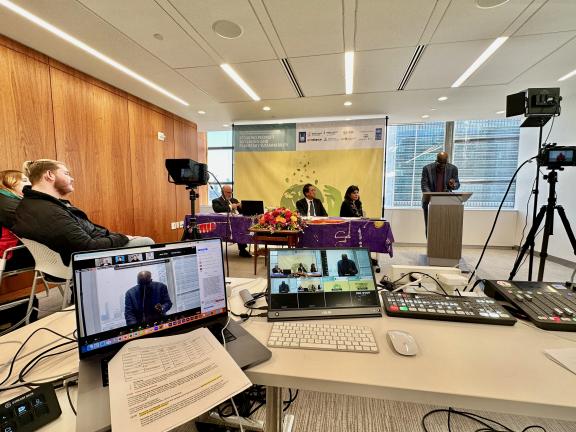


Some moderators and speakers took part of the symposium from a studio hub set especially for the event at the Church Center for the United Nations in New York City. Photo:
WCC

Discussions laid bare a variety of existential threats to human and planetary security, among them the threat of nuclear weapons.

Ambassador Sergio Duarte, a retired Brazilian ambassador and former UN High Representative for Disarmament Affairs, spoke on disarmament. “It has become commonplace to identify climate change and the existence of nuclear weapons as the two greatest existential threats to human life and civilization upon our planet,” he said. “We know that we cannot completely control the cosmic forces that shape our climate, but by working together we may avert disaster. Disarmament, on the other hand, depends entirely on our ability to muster the necessary political will.”

Speakers and participants also highlighted key learnings that relate to work for human security and the roles different actors can play. The symposium addressed, in concrete ways, the development of unity, solidarity, international cooperation, and global coordinated action necessary to make human security real.

Dr Ganoune Diop, director of public affairs for the World Headquarters of the Seventh-day Adventist Church and secretary general of the International Religious Liberty Association, reflected on envisioning and building a better future. “Nearly every area of human experience is connected to the undergirding issue of human security,” noted Diop. "From threats to personal security, to collective predicaments, to regional, national rifts in human solidarity, to needed global security, human security is in fact a lens through which to look at various aspects of human experience.”

WCC Director for International Affairs Peter Prove who attended the event in person remarked that “after 9 years, the Annual Symposium has become a fixture in the agenda of faith-based and UN partners in New York, and a key forum for the expression and development of shared priorities in the international agenda.”

The WCC’s participation in the promotion of all editions of the symposium has been facilitated by the Ecumenical Office to the United Nations, the WCC and ACT Alliance’s focal point for advocacy initiatives at the United Nations headquarters in New York City.

Learn more about the 9th Annual Symposium on the Role of Religion and Faith-Based Organizations in International Affairs

Watch the recording of the event

Ecumenical Office to the United Nations


Source

Friday, March 04, 2022

Religious Freedom: A Multifaceted Gift to Humanity


MARCH 4, 2022

Ganoune Diop, Ph.D


There is more to religious freedom than meets the eye. While belief in religious freedom is as old as religion itself, it has only been in the last 250 years that nation states and the international community have more clearly expressed their commitments to preserving this fundamental human freedom. “The American experiment,” written into constitutional guarantees in 1789-1791, clearly articulated a key understanding of this freedom by formally separating church and state, and forbidding legislatures to make any “law respecting an establishment of religion, or prohibiting the free exercise thereof.” Other constitutions soon reflected similar understandings, but the consensus about religious freedom took longer to develop in the international community.

One catalyzing organization in the development of that international consensus has been the International Religious Liberty Association (IRLA), which has a fascinating history and story. dating from its charter in 1893. The context that prompted the creation of this religious liberty association was proposed legislation in the United States Senate that would have directly violated the constitutional guarantees of the First Amendment.

In 1888, Adventist leaders opposed two bills introduced in the US senate by Senator Henry W. Blair of New Hampshire. The first bill called for a promotion of Sunday, understood as the Lord’s Day, a day of rest, whose observance the bill was supposed to impose as a national requirement. The second bill proposed a constitutional amendment requiring the nation’s public school to teach the ‘principles of the Christian religion.’

One of the leaders among Seventh-day Adventist pioneers, Alonzo, T, Jones, a future editor of the Adventist Review, even testified to the Congress to stop Sunday law and the proposed provision to make America into a Christian nation. It was, as he clearly described it, a religious liberty issue.

One year later in 1889, Seventh-day Adventists created an association in order to promote religious liberty. It was called “The National Religious Liberty Association.” This movement was amplified in 1893 when the association expanded to become the International Religious Liberty Association.

Engaging political and religious actors at the beginning of Seventh-day Adventist church existence became a deliberate choice. Some would say that doing so was a necessity if the Seventh-day Adventist church was to be credible and relevant in the public space. Promoting religious liberty was meant to benefit all. Seventh-day Adventists understand religious liberty as a universal human right that cannot be restricted to a group at the exclusion of others.

Friday, January 14, 2022

Prominent News Leaders Discuss Racism in Mainstream Media


NEWS PROVIDED BY
G20 Interfaith Forum
January 13, 2022, 22:20 GMT


G20 Interfaith Forum

Systemic racism in the media against Black people, Indigenous People, and People of Color (BIPOC communities) will be discussed at an upcoming webinar.

A different way of relating to all human beings, grounded on a new paradigm that affirms the dignity of all humans in solidarity, is urgently needed for a better world.”

Dr. Ganoune Diop

NEW YORK CITY, NEW YORK, USA, January 13, 2022 /EINPresswire.com/ -- The Anti-Racism Initiative of the G20 Interfaith Forum, the world’s leading organization focused on the intersection of faith and policy, is gathering experts from the media, academia, and religion to discuss systemic racism in the media against Black people, Indigenous People and People of Color (BIPOC communities) at an upcoming webinar.

Dr. Ganoune Diop, Director of Public Affairs and Religious Liberty at the Seventh-day Adventist Church, said the issue is a critical one:

“One of the greatest challenges of our time is the revisiting of what it means to be human and humane. How we view and speak of others can contribute to life, saving lives and healing. The perpetuation of the myth of racial hierarchy and the use of narratives and visuals to demean black people, indigenous people and people of color (BIPOC) have been indulged in or deliberately promoted in media outlets. A different way of relating to all human beings grounded on a new paradigm that affirms the dignity of all humans in solidarity, is urgently needed for a better world. Exploring pathways to a decent way of being human will be the focus of this webinar.”

Keisha Bush, author of “No Heaven For Good Boys,” echoed the sentiment, emphasizing the need for lasting change in media portrayals:

"American media has been, and still is, a vehicle of sociopolitical propaganda, reinforcing stereotypes and the demonization of activism, equity, and inclusion at every level of our society. Due to the current collective energies for equity, once again, the pressure to move the needle is building, but to have genuine lasting change there needs to be a complete dismantling of the current supremacist structures to see real diversity, equity, and inclusion across the media."

Milton Allimadi, publisher of blackstarnews.com, connected current racism in the media to historical colonialism:

"Historically, and globally, non-European people were demonized in order to justify their exploitation and sanitize abuses against them during conquest. The worst manifestations were slavery and colonialism. In our contemporary era, White supremacy is an ideology that denies the humanity of non-Europeans, and tries to curtail their access to the resources they need to exist or to live fulfilling lives. It's important to understand how demonization originated in media in order to tackle our contemporary challenges and chart a better future."

Both Nisrin Elamin, a professor at Bryn Mawr College, and Ben Dotsei Malor, Chief Editor at UN News, pointed to media portrayals of Africa as ready examples of this racism:

“Racism in the mainstream media manifests itself in a variety of ways, and is perhaps best exemplified by its coverage of Africa,” Elamin said. “Coverage of the continent is characterized by systematic under-reporting, stereotypical, one-dimensional portrayals of African life, a lack of nuanced and historically grounded analyses of African issues and a construction of expertise that justifies foreign intervention and undermines the sovereignty, knowledge and agency of African analysts and communities. This shapes not only US public opinion and policy-making, but has broad-reaching implications for how knowledge about Africa is reproduced.”

“Recently, scientists in Botswana and South Africa, through diligent, admirable, and excellent work, managed to identify the omicron variant of the coronavirus, and within hours Western media made it look as if this would be classified as the ‘African variant’. Within hours, instead of hailing and applauding these scientist for being vigilant, open, and transparent, travel bans were imposed on South Africa and eight other Southern African nations,” Malor said. “A similar thing happened with the 2014 Ebola outbreak in three West African nations, with Western media coverage causing tourists to avoid Kenya and South Africa, thousands of miles away – with no cases of ebola. There is still, in many Western media circles, a tendency (of laziness and lack of common humanity) to lump the continent of Africa together as ‘one country’. The distinctions among the continent’s 54 nations need to be clearly stated in any media coverage of the continent in order to avoid the economic costs of such reportage.”

The virtual meeting will take place on Jan 20, 2022 at 2 pm EST, and will aim to unweave the threads that are currently used to justify racism in the media, in addition to debunking destructive interpretations of religious texts that perpetuate racism. Register for the free webinar at https://bit.ly/Racism-in-the-Media

Speakers will include experts from the media, academia, and religion:
• Dr. Ganoune Diop
– Director, Public Affairs and Religious Liberty, Seventh-day Adventist Church

• Milton Allimadi – Assistant Professor of Journalism, Columbia University; Publisher, blackstarnews.com
• Keisha Bush – Writer and Artist, Author of No Heaven for Good Boys
• Ben Dotsei Malor – Chief Editor, UN News, UN Headquarters, New York
• Nisrin Elamin – Assistant Professor of International Studies, Bryn Mawr College

About the G20 Process

The Group of Twenty, or G20, is the premier forum for international economic cooperation, bringing together the leaders of Earth’s most prosperous economies. Collectively, G20 nembers represent around 80 percent of the world’s economic output, two-thirds of the global population and three-quarters of international trade. Throughout the year, representatives from G20 countries gather to discuss financial and socioeconomic issues as well as broader humanitarian issues targeted by the UN’s Sustainable Development Goals.

About the G20 Interfaith Forum

The G20 Interfaith Forum seeks global solutions by collaborating with religious thought leaders and political representatives to help shape the overall G20 agenda. It draws on the vital roles that religious institutions and beliefs play in world affairs, reflecting a rich diversity of institutions, ideas, and values. Through its extensive network of networks, it helps prioritize key global policy goals and point toward practical means of implementation
at every level of society.

For more information, please visit www.g20interfaith.org.