Showing posts with label 118th Congress. Show all posts
Showing posts with label 118th Congress. Show all posts
Tuesday, July 23, 2024


Friday, March 08, 2024
Saturday, March 02, 2024
Reps. Ilhan Omar, Pramila Jayapal make unannounced trip to Cuba: Axios
By Al Mayadeen English
Source: Axios
28 Feb 2024 15:57
The visit has drawn fire from Republican lawmakers.

Congressional Progressive Caucus Chair Rep. Pramila Jayapal, D-Wash., left, speaks about the threat of default as Rep. Ilhan Omar, D-Minn., during a news conference, on May 24, 2023, in Washington. (AP)
It has been confirmed to Axios by a spokesperson for the Congressional Progressive Caucus (CPC) that two CPC leaders made an unannounced trip to Cuba while the House was on recess last week.
Initially reported by the Miami Herald, spokesperson Mia Jacobs stated that Reps. Pramila Jayapal (D-Wash.) and Ilhan Omar (D-Minn.), the chair and deputy chair of the CPC, respectively, met with "people from across Cuban society and government officials to discuss human rights and the U.S.-Cuba bilateral relationship," Jacobs said.
Both Jayapal and Omar are public critics of the American economic embargo on Cuba.
Even though US lawmakers occasionally travel to Cuba, those trips are usually open and overt in American and Cuban governments and news.
The Miami Herald reported that Cuban state media "traditionally highlight American lawmakers going to the island, usually framing their visit as a gesture of 'solidarity' with the Cuban people or support for ending the U.S. embargo".
On X, Rep. Nicole Malliotakis (R-NY) said, "It's outrageous that Members of Congress would visit a country that jails, abuses, and murders their citizens and supports Iran, Russia, and Communist China against our interests."
After the news went public, Rep. Carlos Gimenez (R-Fla.) said, "Communist Cuba must remain on the List of State Sponsors of Terrorism."
Earlier in January, a group of 160 lawyers, mostly American, called on US President Joe Biden to remove Cuba from the so-called "State Sponsors of Terrorism" (SSOT) list.
"Given the tremendous economic, social, humanitarian, and commercial effect placement on the SSOT list has had for the Cuba people, maintaining it for such pretextual reasons continues to be a stain on U.S. foreign policy," the letter considered.
The Reagan administration first placed Cuba on the SSOT list in 1982, after which Cuba witnessed decades of US sanctions, assassination attempts, and subversion to topple Cuban leader Fidel Castro.
In 2015, then-US President Barack Obama removed Cuba from the list. However, relations deteriorated under his successor Donald Trump, who reinforced sanctions on the Caribbean island nation.
Source
Tuesday, November 07, 2023
Monday, October 23, 2023
Tuesday, October 03, 2023

Wednesday, July 26, 2023
Thursday, July 20, 2023
Tuesday, July 11, 2023
Tuesday, June 20, 2023
Friday, January 06, 2023
Survey: Religiously, Congress doesn’t reflect America
By PETER SMITH
January 4, 2023
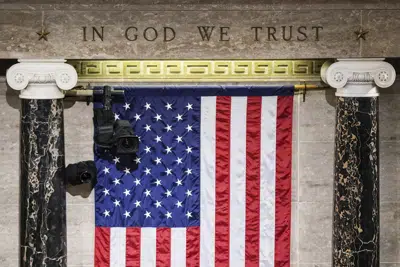
Religiously speaking, the incoming 118th Congress looks like America — that is, the America of decades past, rather than today.
Congress is far more Christian, and religious overall, than today’s general population.
Even though nearly three in 10 Americans claim no religious affiliation — a rate that has steadily risen in recent years — only two of the 534 incoming members of Congress publicly identify as such.
Those are among the conclusions of an analysis by Pew Research Center of the 118th Congress, which was expected to start this week pending a House leadership vote.
The Congress “remains largely untouched by two trends that have long marked religious life in the United States: a decades-long decline in the share of Americans who identify as Christian, and a corresponding increase in the percentage who say they have no religious affiliation,” said the Pew report, released Tuesday. It was based on a CQ Roll Call survey of members of Congress.
Nearly 88% of members of Congress identify as Christian, compared with only 63% of U.S. adults overall. That includes 57% of congresspersons who identify as Protestant and 28% as Catholic, both higher than national rates. Also, 6% of members of Congress identify as Jewish, compared with 2% of the overall population.
While 29% Americans claim no religious affiliation, they’d have to squint to see themselves reflected in Congress. The only overtly non-religious members are U.S. Rep. Jared Huffman, D-Calif., who identifies as humanist, and Sen. Kyrsten Sinema, independent of Arizona, who says she’s religiously unaffiliated.
Pew listed 20 other members of Congress as having unknown religious affiliations, either because they declined to answer CQ Roll Call’s query or because the answers are otherwise muddled (such as in the case of New York Republican George Santos, along with much else in his background).
Historically, lacking a religious identity was seen as a political liability.
Only 60% of Americans told a Gallup survey in 2019 that they’d be willing to vote for an atheist — fewer than would vote for gays or lesbians or various religious or ethnic groups.
But Huffman said he experienced no political blowback.
“If anything, there’s a political upside,” he said. “People appreciate the fact that I’m just being honest.”
He said many colleagues in Congress find religion to be politically useful, “particularly across the aisle, how so many of them exploit and weaponize religion but seem to be totally divorced from any authentic connection to the religion they’re weaponizing.”
The ranks of Christians in Congress has dipped only slightly over the decades, though it’s a different story with the general population. Since 2007, Christians have gone from 78% to 63% of the population, while the non-affiliated rose from 16% to 29%, according to Pew. The trend line is even more dramatic when looking back to 1990, when nearly nine in 10 Americans identified as Christian, while less than one in 10 identified as non-religious, according to researchers at Trinity College in Connecticut.
In some ways, the two political parties conform to perception.
The Republican congressional delegation is a staggering 99% Christian, with the rest Jewish or unknown. Republicans — who have long embraced Christian expressions in their political functions and where an aggressive form of Christian nationalism has become more mainstream — include 69% Protestants, 25% Catholics and 5% other Christians (such as Mormon and Orthodox).
Democrats have more religious diversity, at about 76% Christian (including 44% Protestant, 31% Catholic and 1.5% Orthodox) and 12% Jewish. They have about 1% each of Buddhist, Hindu, Muslim and Unitarian Universalist representation.
But Democrats’ paucity of openly non-affiliated members contrasts starkly with a constituency to which it owes much.
Religiously unaffiliated voters opted overwhelmingly for Democrats candidates in the 2022 midterms. They voted for Democrats over Republicans by more than a 2 to 1 margin in House races, according to AP VoteCast, an expansive survey of more than 94,000 voters nationwide. And in some bellwether races, the unaffiliated went as high as 4 to 1 for Democrats.
“The fact that the (Democratic) leadership doesn’t reflect an open, secular identity is paradoxical, but I think it’s the nature of realpolitik,” said Phil Zuckerman, professor of sociology and secular studies at Pitzer College in Claremont, California. He said Democrats know that non-religious voters align with them on the issues, but party leaders also don’t want to alienate other, more religious parts of the party’s base, particularly Black Protestants.
Party leaders “speak to the politics of secular people but don’t want to take on the identity,” he said.
Zuckerman added that conservative Christians face the “branding problem” similar to what atheists once faced. Many voters, he said, have reacted against Christian nationalism, and young voters in particular are alienated by conservative Christian stances against LGBTQ people, while many voters of all ages have reacted against Christian nationalism.
He cited a prominent incident in 2020 when authorities forcibly cleared Black Lives Matter protesters in Lafayette Park in Washington, after which President Donald Trump walked to a nearby church and held up a Bible.
“When Trump held up that Bible in front of that church in D.C., he did more damage to the Christian brand than Hitchens and Dawkins and Harris combined,” Zuckerman said, referring to popular atheist authors.
In 2018, Huffman helped found the Congressional Freethought Caucus. It had a roster of about 15 members in the previous Congress.
“It’s people of different religious perspectives, but what brings us together is a common belief that there should be a bright line of separation between church and state and that we should make public policy based on facts and reason and science, and not religion,” he said.
He predicted that in time, more members of Congress would identify with secular values.
“It’s going to be a trailing reflection of this change that has been happening for a couple of decades now,” he said. ”It takes a while for politicians to figure out that it’s OK to do things like this.”
The Pew report analyzed one short of Congress’ capacity of 535 because one member, Rep. A. Donald McEachin, D-Va., died in November after being re-elected.
___
Associated Press religion coverage receives support through the AP’s collaboration with The Conversation US, with funding from Lilly Endowment Inc. The AP is solely responsible for this content.
Religiously speaking, the incoming 118th Congress looks like America — that is, the America of decades past, rather than today.
Congress is far more Christian, and religious overall, than today’s general population.
Even though nearly three in 10 Americans claim no religious affiliation — a rate that has steadily risen in recent years — only two of the 534 incoming members of Congress publicly identify as such.
Those are among the conclusions of an analysis by Pew Research Center of the 118th Congress, which was expected to start this week pending a House leadership vote.
The Congress “remains largely untouched by two trends that have long marked religious life in the United States: a decades-long decline in the share of Americans who identify as Christian, and a corresponding increase in the percentage who say they have no religious affiliation,” said the Pew report, released Tuesday. It was based on a CQ Roll Call survey of members of Congress.
Nearly 88% of members of Congress identify as Christian, compared with only 63% of U.S. adults overall. That includes 57% of congresspersons who identify as Protestant and 28% as Catholic, both higher than national rates. Also, 6% of members of Congress identify as Jewish, compared with 2% of the overall population.
While 29% Americans claim no religious affiliation, they’d have to squint to see themselves reflected in Congress. The only overtly non-religious members are U.S. Rep. Jared Huffman, D-Calif., who identifies as humanist, and Sen. Kyrsten Sinema, independent of Arizona, who says she’s religiously unaffiliated.
Pew listed 20 other members of Congress as having unknown religious affiliations, either because they declined to answer CQ Roll Call’s query or because the answers are otherwise muddled (such as in the case of New York Republican George Santos, along with much else in his background).
Historically, lacking a religious identity was seen as a political liability.
Only 60% of Americans told a Gallup survey in 2019 that they’d be willing to vote for an atheist — fewer than would vote for gays or lesbians or various religious or ethnic groups.
But Huffman said he experienced no political blowback.
“If anything, there’s a political upside,” he said. “People appreciate the fact that I’m just being honest.”
He said many colleagues in Congress find religion to be politically useful, “particularly across the aisle, how so many of them exploit and weaponize religion but seem to be totally divorced from any authentic connection to the religion they’re weaponizing.”
The ranks of Christians in Congress has dipped only slightly over the decades, though it’s a different story with the general population. Since 2007, Christians have gone from 78% to 63% of the population, while the non-affiliated rose from 16% to 29%, according to Pew. The trend line is even more dramatic when looking back to 1990, when nearly nine in 10 Americans identified as Christian, while less than one in 10 identified as non-religious, according to researchers at Trinity College in Connecticut.
In some ways, the two political parties conform to perception.
The Republican congressional delegation is a staggering 99% Christian, with the rest Jewish or unknown. Republicans — who have long embraced Christian expressions in their political functions and where an aggressive form of Christian nationalism has become more mainstream — include 69% Protestants, 25% Catholics and 5% other Christians (such as Mormon and Orthodox).
Democrats have more religious diversity, at about 76% Christian (including 44% Protestant, 31% Catholic and 1.5% Orthodox) and 12% Jewish. They have about 1% each of Buddhist, Hindu, Muslim and Unitarian Universalist representation.
But Democrats’ paucity of openly non-affiliated members contrasts starkly with a constituency to which it owes much.
Religiously unaffiliated voters opted overwhelmingly for Democrats candidates in the 2022 midterms. They voted for Democrats over Republicans by more than a 2 to 1 margin in House races, according to AP VoteCast, an expansive survey of more than 94,000 voters nationwide. And in some bellwether races, the unaffiliated went as high as 4 to 1 for Democrats.
“The fact that the (Democratic) leadership doesn’t reflect an open, secular identity is paradoxical, but I think it’s the nature of realpolitik,” said Phil Zuckerman, professor of sociology and secular studies at Pitzer College in Claremont, California. He said Democrats know that non-religious voters align with them on the issues, but party leaders also don’t want to alienate other, more religious parts of the party’s base, particularly Black Protestants.
Party leaders “speak to the politics of secular people but don’t want to take on the identity,” he said.
Zuckerman added that conservative Christians face the “branding problem” similar to what atheists once faced. Many voters, he said, have reacted against Christian nationalism, and young voters in particular are alienated by conservative Christian stances against LGBTQ people, while many voters of all ages have reacted against Christian nationalism.
He cited a prominent incident in 2020 when authorities forcibly cleared Black Lives Matter protesters in Lafayette Park in Washington, after which President Donald Trump walked to a nearby church and held up a Bible.
“When Trump held up that Bible in front of that church in D.C., he did more damage to the Christian brand than Hitchens and Dawkins and Harris combined,” Zuckerman said, referring to popular atheist authors.
In 2018, Huffman helped found the Congressional Freethought Caucus. It had a roster of about 15 members in the previous Congress.
“It’s people of different religious perspectives, but what brings us together is a common belief that there should be a bright line of separation between church and state and that we should make public policy based on facts and reason and science, and not religion,” he said.
He predicted that in time, more members of Congress would identify with secular values.
“It’s going to be a trailing reflection of this change that has been happening for a couple of decades now,” he said. ”It takes a while for politicians to figure out that it’s OK to do things like this.”
The Pew report analyzed one short of Congress’ capacity of 535 because one member, Rep. A. Donald McEachin, D-Va., died in November after being re-elected.
___
Associated Press religion coverage receives support through the AP’s collaboration with The Conversation US, with funding from Lilly Endowment Inc. The AP is solely responsible for this content.
Subscribe to:
Posts (Atom)