Showing posts with label OMB. Show all posts

Monday, February 03, 2025

Jeffries lays out war plan for Democrats to take on Trump


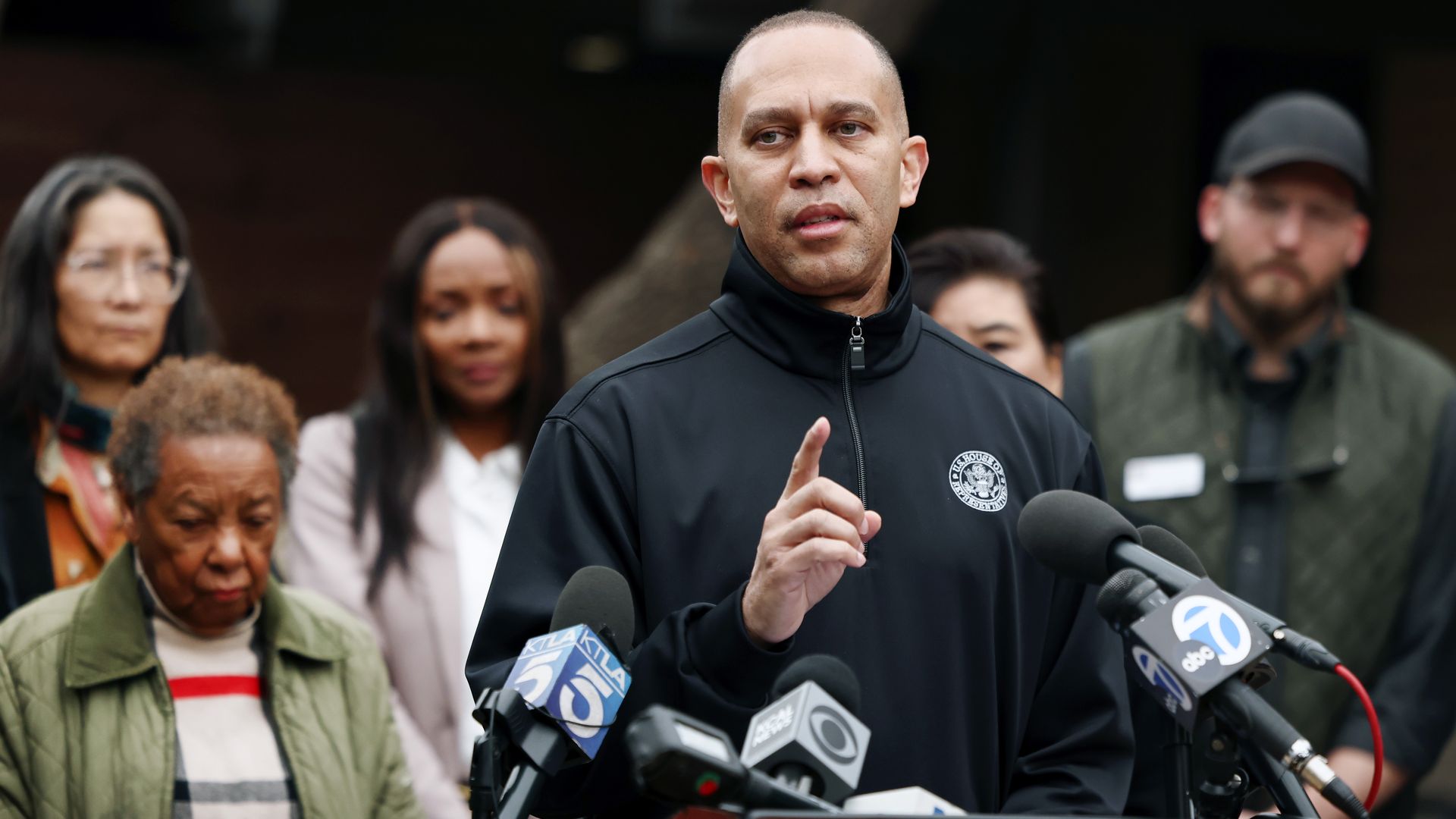
House Minority Leader Hakeem Jeffries speaks at a press conference in Altadena, Calif., on Jan. 30. Photo: Mario Tama/Getty Images


Andrew Solender

House Minority Leader Hakeem Jeffries (D-N.Y.) on Monday unveiled a 10-part plan for House Democrats' efforts to counter many of President Trump's moves to upend the federal bureaucracy.

Why it matters: There has been rising tension between Democratic lawmakers and the party's grassroots over how the minority party, which has very little real power, can combat the new administration's most inflammatory moves.

Driving the news: In a "dear colleague" letter to House Democrats, Jeffries vowed to use a March 14 federal funding deadline as leverage to prevent Trump from freezing or diverting congressionally appropriated funds.
  • "I have made clear to House Republican leadership," he wrote, that "any effort to steal taxpayer money from the American people ... must be choked off in the upcoming government funding bill, if not sooner."
  • That is in direct response to a now-rescinded Office of Management and Budget memo that ordered federal grants and loans frozen, leading to widespread confusion and locking states out of the Medicaid portal.
  • Jeffries also said Democrats will introduce a bill to prevent "unlawful access" to the Treasury Department's payment system after Elon Musk's Department of Government Efficiency reportedly obtained forced access to it over the objections of top officials.
Between the lines: With Republicans commanding a razor-thin majority in the House, Democrats believe Speaker Mike Johnson (R-La.) will be forced to go to them to fund the government and raise the debt ceiling.
  • That would give them the opportunity to try to temper what they see as the excesses of the GOP trifecta now governing Washington, D.C.
  • Some Republicans had hoped to include the debt ceiling in the massive party-line fiscal bill they are planning, but Johnson has signaled it will likely have to be passed on a bipartisan basis.
Zoom in: On top of those moves, Jeffries previewed a continuation of the public messaging campaign that Democrats credit for the rescission of the OMB memo.
  • He urged members, for example, to reach out to canvass their districts for constituents affected by Trump's actions, saying he plans to hold a tele-town hall Monday night.
  • He also wrote that Democrats on the House Oversight and Judiciary committees will lay out for their colleagues ongoing lawsuits to prevent some Trump acts like firing inspectors general and purging the civil service.

Monday, August 27, 2012

U.S. Debt On Track to Hit $16 Trillion Within Week


National Debt Clock

(CNSNews.com) - The federal government’s debt could hit an unprecedented $16 trillion this week while the Republican Party is holding its national convention in Tampa, Fla.

On Monday afternoon, at the opening of the convention. the Republicans will try to draw attention to the mounting debt by unveiling a debt clock in the Tampa Bay Times Forum, where the convention will be held.
At an event in Waterloo, Iowa, earlier this month President Obama highlighted his own efforts to deal with the debt.

"I'll make sure government does its part to reduce our debt and our deficits," the president said. "We've cut out already a trillion dollars' worth of spending we don't need. And we can do more. I want to make government efficient. We've got to make sure that your tax dollars are being well spent. But we can't bring down our deficit and our debt just by asking us to get rid of things that open up opportunity to Americans.

"So instead," said Obama, "we're asking folks like me to go back to the rates we paid under Bill Clinton--which, by the way, was a time when we created 23 million new jobs, went from deficit to surplus, and we created a whole lot of millionaires to boot."

At the close of business on Thursday, Aug. 23, according to the U.S. Treasury, the federal government’s debt stood at $15,976,519,029,144.14. That left it $23,480,970,855.86 short of the $16 trillion mark.

So far in this fiscal year (from Oct. 1 through Aug. 23), the debt has grown by an average of $3,616,398,477.40 per calendar day ($1,186,178,700,586.99 divided by 328 days). Were the debt to grow at that pace in the week following last Thursday’s close of $15.976 trillion, it would hit $16 trillion this Thursday--the day Mitt Romney is scheduled to give his speech accepting the Republican presidential nomination.

However, the debt does not grow in a steady, unbroken daily pace. Instead, it expands and retracts from day to day during the business week depending on the value of the bonds the U.S. Treasury sells and redeems. On a day that the Treasury derives more revenue from selling bonds than it pays out to redeem bonds, the debt increases.

Last Wednesday, for example, the debt actually declined by almost $9.7 billion--from $15,970,134,937,605.00 to $15,960,468,522,111.20—as the Treasury redeemed bonds of greater value than it sold. However, on Thursday, the debt increased by slightly more than $16 billion, ending that day at $15,976,519,029,144.14.

Also, the Treasury does not report the value of the debt reached at the close of any business day until 4:00 pm on the following business day. For example, the value of the government’s debt as of the close of business on Friday will not be officially reported by the Treasury until 4:00 pm on Monday—and the value of the debt as of the close of business this Thursday will not be reported until 4:00 pm this Friday.

George H.W. Bush. Barack Obama, George W. Bush, Bill Clinton, Jimmy Carter

President George W. Bush met with President-elect Barack Obama and former Presidents George H.W. Bush, Bill Clinton and Jimmy Carter in the Oval Office on Jan. 7, 2009. (AP Photo/File Photo)

Since Obama took office on Jan. 20, 2009, the debt has increased $5,349,641,980,231.06. That is as much as the entire debt accumulated by the United States from the founding of the country in 1776 until Feb. 28, 1997, when President Bill Clinton was in his second term.

Thus, under Obama, the debt has increased more than under all presidents from George Washington through George H.W. Bush combined.

During President George W. Bush’s two terms in office, the debt increased $4,899,100,310,608.44. That is also more than all the debt accumulated by all previous presidents from George Washington through George H.W. Bush combined.

Nonetheless, the $5,349,641,980,231.06 in new debt accumulated in less than four years under Obama is more than the $4,899,100,310,608.44 in new debt accumulated in eight full years under George W. Bush.

According to data reported by the IRS earlier this year, there were 81,890,189 tax returns filed for 2009 that showed taxable income. That means the total debt of the United States now equals $195,096.86 for each 2009 federal taxpayer.

The $5,349,641,980,231.06 in new debt accumulated just during Obama's time in office equals about $65,327 per taxpayer.

John Boehner at Peter G. Peterson Foundation fiscal summit

House Speaker John Boehner speaks at the Peter G. Peterson Foundation’s 2012 fiscal summit in Washingon on Tuesday, May 15, 2012 (AP Photo)


The Republicans won a majority in the House of Representatives in the November 2010 election. However, the Republican-controlled House did not gain a veto over federal spending until March 4, 2011, when a continuing resolution passed by a lame-duck Congress in December 2010 expired. Since March 4, 2011, the government has been funded by a series of spending deals made between House Speaker John Boehner, Senate Majority Leader Harry Reid and President Barack Obama.

Since the first Boehner-Obama spending deal, which took effect on March 4, 2011, the debt has increased by $1,793,891,844,263.11. That equals about $21,906.07 per taxpayer.

President Obama proposed a fiscal 2013 budget that, according to the Congressional Budget Office, called for $6.39 trillion in deficit spending in the ten years from fiscal 2013 through fiscal 2022. During those ten years, according to CBO’s analysis, the annual deficit would never drop below $488 billion, a level it would hit in 2017. Under Obama’s budget proposal, according to CBO, annual deficits would start to grow again after 2017, hitting $510 billion in 2018, $602 billion in 2019, $638 billion in 2020, $678 billion in 2021, and $728 billion in 2022.

In fiscal 2008, according to the White House Office of Management and Budget, the federal government spent $2.982 trillion. In fiscal 2012, it will spend an estimated $3.795 trillion

Source

.

Wednesday, June 23, 2010

Orszag Leaves, Red Ink Remains


Now that the Obama Administration is going to see its sexiness quotient go down, it is time to consider just what Peter Orszag’s legacy to the nation is. Unfortunately, in considering that legacy, we see that the bad outweighs the good.

As Jonathan Weisman notes, the most obvious Orszagian legacy is a debt of $1 trillion. That’s right; trillion. With a T. The natural consequences of that debt will be higher interest rates, a decreased capacity to borrow when we really need to borrow, and a coming era of austerity that will lead to economic stagnation, and even recession, as we grapple with the debt that Orszag and the Obama Administration bequeathed to us. The parlous fiscal situation in which we find ourselves could have been avoided if only we chose not to implement a stimulus that isn’t working, and a health care plan we plainly cannot afford. To be sure, the Bush Administration’s fiscal policy did not help matters, but the current Administration will outspend its predecessor–and put the country even more deeply in the hole as a consequence–by a significant amount. It’s impossible for the current Administration to blame its predecessor for the budgetary morass; indeed, blame cannot even be transferred with a straight face anymore.

Just as lamentable is Orszag’s record as a cheerleader for health care reform. While he helped successfully drive the effort to change the health care system, he did so at the expense of actually instituting good policy. As James Pethokoukis writes, the drive for health care reform was fueled by massive amounts of intellectual dishonesty which we will all pay for:
. . . Orszag made the case to the president that reducing healthcare costs was an important element to slashing the long-term budget deficit. More importantly, he persuaded Obama the U.S. healthcare system was so inefficient, overall spending could be restrained while also providing near-universal health insurance coverage. In effect, “bending the curve” was a free lunch. Or at least close enough for government work.

It was an audacious claim, mostly based on a single controversial academic study. Republicans never bought into the theory, and neither did Orszag’s successor at the Congressional Budget Office, Uncle Sam’s fiscal scorekeeper. In the end, Obama was forced to cut future Medicare spending and raise taxes to make the numbers balance out — at least on paper. Few Washington observers think those cuts will happen, meaning that the budget deficit could explode if Orszag’s novel theories don’t pan out. And even if the cuts occur, many budget hawks were counting on them to make Medicare sustainable over the long-term, not create a new entitlement.

Speaking of intellectual dishonesty, in what parallel universe is it acceptable to introduce a budget that neglects to mention a whopping $3.6 trillion in liabilities? Again, this would be trillion. With a T. Any business that pulled such a stunt would have found itself answering to people called “prosecutors,” and “class action attorneys.” One doesn’t wish Peter Orszag legal trouble–despite the manifest policy failings he is responsible for, he certainly seems like a nice guy–but it is worth noting that after leaving the Office of Management and Budget, Orszag will land some cushy, remunerative position in a think tank, or a private sector company, or both. Is this the price one pays for perpetrating budgetary fraud and chicanery upon the United States of America?

Orszag’s announced departure as Budget Director has set off speculation as to who his successor will be. Whoever ends up taking the job will need a strong sense of duty and patriotism, a strong stomach, and just the right amount of insanity to want to try to whittle around the gigantic budget deficit, and the truly terrifying national debt left to use by Orszag, and by the President he has served. About the only thing that we can hope for is that whatever sexiness quotient the next Budget Director lacks, he or she will make up for with a commitment to responsible policymaking. After having had to put up with Peter Orszag’s bad calls on the budget, and on health care reform, we are due for some competence at the Office of Management and Budget.
Is it possible that we will get competence? Possibly; Orszag has set the bar so low, that his successor will have to work extra hard to fail to clear it. Of course, the setting of that low bar is the source of many of our problems, now isn’t it?
.

.