Showing posts with label El Salvador. Show all posts

Sunday, January 11, 2026

Baptizing the lie about ICE and the killing of Renee Nicole Good


by James T. Keane
January 9, 2026


People gather around a makeshift memorial honoring Renee Nicole Good on Jan. 8 in Minneapolis, near the site where she was fatally shot. Credit: AP Photo/Tom Baker


“The nuns were not just nuns. The nuns were also political activists.”

These infamous words were spoken in 1980 by Jeane Kirkpatrick, one of the top foreign policy advisors to incoming President Ronald Reagan, after the brutal murder of four American women, three of them nuns, by government forces in El Salvador. The four—Maryknoll sisters Maura Clarke and Ita Ford, Ursuline sister Dorothy Kazel and lay missionary Jean Donovan—had been raped, killed and dumped in a shallow grave on Dec. 2, 1980, by soldiers of the Salvadoran National Guard on orders from higher up.

Ms. Kirkpatrick sensed, correctly, that such a savage crime might turn public opinion against the massive military and economic aid the United States was providing to the brutal junta ruling El Salvador. So why not put the responsibility on the unarmed, defenseless nuns instead? After all, they were already dead.

A few months later, U.S. Secretary of State Alexander Haig took that gambit and ran with it, stating that any investigation of the killings was “a complex issue. The facts on this are not clear enough for anyone to draw up a definitive conclusion.”

He had thoughts of his own, though. Maybe the nuns were to blame for their own murder:

Sunday, March 16, 2025

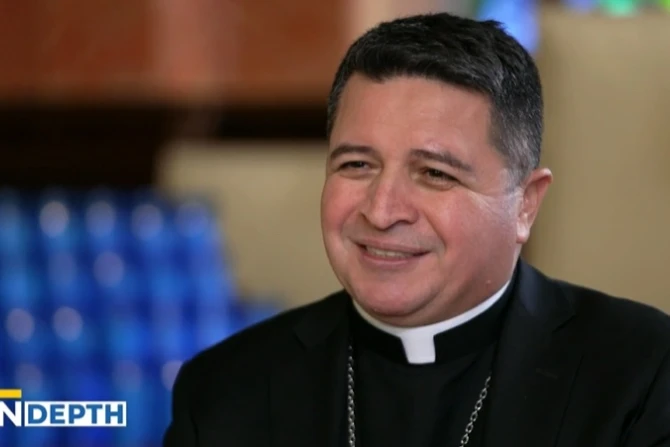
Salvadoran-born Bishop Evelio Menjivar: Migrants ‘make the United States a great nation’


Bishop Evelio Menjivar speaks with “EWTN News in Depth” on Friday, March 14, 2025. | Credit: “EWTN News in Depth”


By Tessa Gervasini

Washington, D.C. Newsroom, Mar 15, 2025 / 07:00 am

Evelio Menjivar came to the United States as an undocumented immigrant in 1990. Today he serves as an auxiliary bishop of Washington, D.C., and is the first Salvadoran U.S. bishop in an archdiocese that is home to over 200,000 of his former countrymen.

In an interview with “EWTN News in Depth,” Menjivar shared his conviction that immigrants “make the United States a great nation” and “make society better.”

After years of “blue-collar jobs,” upon his arrival to the U.S., Menjivar felt a calling to the priesthood and was ordained in 2004. He served as a parish priest in Washington for almost two decades until Pope Francis appointed him auxiliary bishop in 2022.

“I came here when I was 20 with a great desire to work hard, to go to school, to contribute to the well-being of this great nation that became my home country,” Menjivar told Montse Alvarado, EWTN News president and COO.

Menjivar said he attempted to enter the country three times before making it to Los Angeles. He explained: “I don’t feel proud that I crossed the border without documents.”

“But it is a testimony that many people cross the border with good intentions,” he said.

“Most immigrants come here because they do not find any other option in their countries and they put their own lives at risk. But once we enter here, we contribute with our own talents, with our own energy,” he told Alvarado.

Saturday, May 23, 2015

Pope’s Focus on Poor Revives Scorned Theology


EUROPE


MAY 23, 2015


Archbishop Óscar Romero, assassinated in 1980, was beatified on Saturday in San Salvador after many years of stalling by conservative Catholic officials. CreditMeridith Kohut for The New York Times


VATICAN CITY — Six months after becoming the first Latin American pontiff, Pope Francis invited an octogenarian priest from Peru for a private chat at his Vatican residence. Not listed on the pope’s schedule, news of the September 2013 meeting with the priest, Gustavo Gutiérrez, quickly leaked out — and was just as quickly interpreted as a defining shift in the Roman Catholic Church.

Father Gutiérrez is a founder of liberation theology, the Latin American movement embracing the poor and calling for social change, which conservatives once scorned as overtly Marxist and the Vatican treated with hostility.

Now, Father Gutiérrez is a respected Vatican visitor, and his writings have been praised in the official Vatican newspaper. Francis has brought other Latin American priests back into favor and often uses language about the poor that has echoes of liberation theology.


RELATED COVERAGE


And then came Saturday, when throngs packed San Salvador for the beatification ceremony of the murdered Salvadoran archbishop Óscar Romero, leaving him one step from sainthood.


Salvadoran followers of Archbishop Romero, who focused on marginalized communities, visited Carmen Ayala Lopez, 80. CreditMeridith Kohut for The New York Times


The first pope from the developing world, Francis has placed the poor at the center of his papacy. In doing so, he is directly engaging with a theological movement that once sharply divided Catholics and was distrusted by his predecessors, Pope John Paul II and Pope Benedict XVI. Even Francis, as a young Jesuit leader in Argentina, had qualms.

Now, Francis speaks of creating “a poor church for the poor” and is seeking to position Catholicism closer to the masses — a spiritual mission that comes as he is also trying to revive the church in Latin America, where it has steadily lost ground to evangelical congregations.

For years, Vatican critics of liberation theology and conservative Latin American bishops helped stall the canonization process for Archbishop Romero, even though many Catholics in the region regard him as a towering moral figure: an outspoken critic of social injustice and political repression who was assassinated during Mass in 1980. Francis broke the stalemate.

“It is very important,” Father Gutiérrez said. “Somebody who is assassinated for this commitment to his people will illuminate many things in Latin America.”

The beatification is the prelude to what is likely to be a defining period of Francis’ papacy, with trips to South America, Cuba and the United States; the release of a much-awaited encyclical on environmental degradationand the poor; and a meeting in Rome to determine whether and how the church will change its approach to issues like homosexuality, contraception and divorce.

By advancing the campaign for Archbishop Romero’s sainthood, Francis is sending a signal that the allegiance of his church is to the poor, who once saw some bishops as more aligned with discredited governments, many analysts say. Indeed, Archbishop Romero was regarded as a popular saintin El Salvador even as the Vatican blocked his canonization process.

“It is not liberation theology that is being rehabilitated,” said Michael E. Lee, an associate professor of theology at Fordham University who has written extensively about liberation theology. “It is the church that is being rehabilitated.”

Liberation theory includes a critique of the structural causes of poverty and a call for the church and the poor to organize for social change. Mr. Lee said it was a broad school of thought: Movements differed in different countries, with some more political in nature and others less so. The broader movement emerged after a major meeting of Latin American bishops in Medellín, Colombia, in 1968 and was rooted in the belief that the plight of the poor should be central to interpreting the Bible and to the Christian mission.

But with the Cold War in full force, some critics denounced liberation theology as Marxist, and a conservative backlash quickly followed. At the Vatican, John Paul II, the Polish pope who would later be credited for helping topple the Soviet Union, became suspicious of the political elements of the new Latin American movements.

“All that rhetoric made the Vatican very nervous,” said Ivan Petrella, an Argentine lawmaker and scholar of liberation theology. “If you were coming from behind the Iron Curtain, you could smell some communism in there.”

John Paul reacted by appointing conservative bishops in Latin America and by supporting conservative Catholic groups such as Opus Dei and the Legionaries of Christ, which opposed liberation theology. In the 1980s, Cardinal Joseph Ratzinger — later to become Pope Benedict XVI, but then the Vatican’s enforcer of doctrine — issued two statements on liberation theology. The first was very critical, but the second was milder, leading some analysts to wonder if the Vatican was easing up.

From his 1973 appointment as head of the Jesuits in Argentina, Francis, then 36 and known as Jorge Mario Bergoglio, was viewed as deeply concerned with the poor. But religious figures who knew him then say Francis, like much of Argentina’s Catholic establishment, thought liberation theology was too political. Critics also blamed him for failing to prevent the kidnapping and torture of two priests sympathetic to liberation theology.

Some in the church hierarchy considered Francis divisive and autocratic in his 15 years leading the Jesuits. The church authorities sent him into what amounted to stretches of exile, first in Germany and then in Córdoba, Argentina, a period in which he later described having “a time of great interior crisis.”

He practiced spiritual exercises and changed his leadership style to involve greater dialogue. When he was named archbishop of Buenos Aires, his focus became those left behind by Argentina’s economic upheaval.

“With the end of the Cold War, he began to see that liberation theology was not synonymous with Marxism, as many conservatives had claimed,” said Paul Vallely, author of “Pope Francis: Untying the Knots.” Argentina’s financial crisis in the early years of the 21st century also shaped his views, as he “began to see that economic systems, not just individuals, could be sinful,” Mr. Vallely added.

Since becoming pope, Francis has expressed strong criticism of capitalism, acknowledging that globalization has lifted many people from poverty but saying it has also created great disparities and “condemned many others to hunger.” He has warned, “Without a solution to the problems of the poor, we cannot resolve the problems of the world.”

In Argentina, some critics are unconvinced that Francis’ outspokenness about the poor represents an embrace of liberation theology. “He never took the reins of liberation theology because it’s radical,” said Rubén Rufino Dri, who worked in the late 1960s and 1970s with a group of priests active in the slums of Buenos Aires.

To him, Francis’ decision to expedite Archbishop Romero’s beatification was a political one, part of what Mr. Rufino Dri views as a “superficial transformation” of the Catholic Church as it competes in Latin America with secularism as well as other branches of Christianity.

“It’s a populist maneuver by a great politician,” he said.

Others offered a more nuanced view. José María di Paola, 53, a priest who is close to Francis and once worked with him among the poor of Buenos Aires, said the beatification reflected a broader push by Francis to reduce the Vatican’s focus on Europe. “It’s part of a process to bring an end to the church’s Eurocentric interpretation of the world and have a more Latin American viewpoint,” he said.

Father di Paola added that while Francis had never proposed evangelizing under the banner of liberation theology during his time in Argentina, his commitment to the poor should not be questioned. “Francis’ passage through the slums of the capital influenced him later as a bishop and pope,” he said. “Experiencing the life values of the poor transformed his heart.”

As pope, Francis has expanded the roles of centrists sympathetic to liberation theology, such as Cardinal Óscar Rodríguez Maradiaga of Honduras, in contrast to the clout once wielded in Latin America by conservative cardinals like Alfonso López Trujillo of Colombia, who died in 2008.

“Trujillo represented the thinking that liberation theology was a Trojan horse in which communism would enter the church, something that is finally coming undone with Pope Francis,” said Leonardo Boff, 76, a prominent Brazilian theologian who has written on liberation theology.

Many analysts note that John Paul and Benedict never outright denounced liberation theology and slowly started to pivot in their views. In 2012, Benedict reopened Archbishop Romero’s beatification case. Cardinal Gerhard Müller, a staunch conservative who heads the Congregation for the Doctrine of the Faith, the Vatican’s enforcer of doctrine, became a proponent of liberation theology after working in Peru, where he met Father Gutiérrez. The two men have since written books together.

“There was no rehabilitation because there was never a ‘dehabilitation,’ ” Father Gutiérrez said, contesting the idea that liberation theology was ever cast out of the church. “In past years, there was talk of condemnation, and people believed it. What there was was a critical dialogue, which had difficult moments but which really was clarified over time.”

Francis often urges believers to act on behalf of the poor, saying if they do, they will be transformed. For those who knew Archbishop Romero in El Salvador, this transformation was notable. Once considered a conservative, he began to change in the mid-1970s, when he was the bishop of a rural diocese where government soldiers had massacred peasants. Shortly after he became archbishop of San Salvador, he was horrified when a close friend, a Jesuit priest, was murdered, and he soon began to speak out against government terror and repression.

“He began to surprise people,” said Jon Sobrino, a prominent liberation theologian who became close to Archbishop Romero and credited his transformation to his embrace of the poor

“They made him be different, be more radical, like Jesus,” Father Sobrino said. “He drew near to them, and they approached him, asking for help in their suffering. That was what changed him.”

In 2007, Father Sobrino had his own clash with the Vatican when the doctrinal office disputed some of his writings. He refused to alter them and described the freeze on Archbishop Romero’s beatification as Vatican hostility.

“It has taken a new pope to change the situation,” he said.


Jim Yardley reported from Vatican City, and Simon Romero from Rio de Janeiro. Elisabeth Malkin and Gene Palumbo contributed reporting from San Salvador, and Jonathan Gilbert from Buenos Aires.


.

Tuesday, January 14, 2014

6 evangelical church members shot to death by suspected gang members in rural El Salvador


Published January 12, 2014
Associated Press


SAN SALVADOR, El Salvador – Officials in El Salvador say six members of an evangelical church were shot to death in a rural western province by suspected gang members.

The federal prosecutor's office says the victims, ranging in age from 16 to 54, were riddled with bullets Saturday night in Ahuachapan state near the border with Guatemala. There are no details on why they were targeted.

Heavily armed gangs control much of El Salvador and are blamed for the Central American country's high murder rate.

Three members of the 18th Street Gang were killed in a separate incident in central El Salvador over the weekend.

The 18th Street and the Mara Salvatrucha are the country's the two biggest gangs. They signed a truce in March 2012 designed to cut the violence.

 
Source
.

Sunday, August 26, 2012

Quake of 7.4 magnitude hits off El Salvador coast-USGS

Mon Aug 27, 2012 1:23am EDT

(Adds tsunami warning for Pacific nations)

Aug 27 (Reuters) - A major earthquake of 7.4 magnitude hit in the Pacific Ocean about 78 miles (125 km) off the coast of El Salvador late Sunday night, the U.S. Geological Survey said.

No destructive Pacific-wide tsunami is expected, and there is no tsunami threat to Hawaii, the Pacific Tsunami Warning Center said.

The center said, however, that although it did not know if a tsunani had been generated, a warning was in effect for Costa Rica, Nicaragua, El Salvador, Honduras, Guatemala, Panama and Mexico.

The earthquake struck 74 miles (120 km) south of Usulutan, El Salvador, at a depth of 33 miles, the Geological Survey said.

There were no immediate reports of damage to coastal areas or to shipping.

(Reporting by Philip Barbara; Editing by Robert Birsel)


Source


Tuesday, March 22, 2011

In Central America, Obama's worries closer to home


AP – U.S. President Barack Obama and first lady Michelle Obama attend their official state dinner offered

Jim Kuhnhenn, Associated Press – Tue Mar 22, 3:10 am ET

SANTIAGO, Chile – After days of promoting the international ties that bind, President Barack Obama shifts his Latin American tour to a closer neighbor and the more sensitive U.S. policy interests of immigration, narcotics wars and gun trafficking.

The president pivots Tuesday from stops in Brazil and Chile for El Salvador, where he will meet with President Mauricio Funes. Washington is growing increasingly concerned about rising crime south of the U.S. border, and El Salvador is hardly immune. It has seen murder rates rise amid an influx of drugs and displaced traffickers from crackdowns in Colombia and Mexico.

El Salvador also has one of Central America's highest rates of emigration, especially to the United States. About 2.8 million Salvadoran immigrants living in the United States sent home $3.5 billion last year, so laws that crack down on immigrants can significantly affect the Salvadoran economy.

Obama can offer little to fix El Salvador's devastating crime and fragile economy. Fiscal pressures have limited the amount of money the federal government can provide as part of its drug-fighting efforts, and congressional politics have made it difficult to restart talks about overhauling the nation's immigration laws.

Before leaving Chile, Obama will have one more face-to-face session with President Sebastian Pinera.

In a broad-ranging speech that spelled out his policy in Latin America, Obama called on the region's rising economies to take more responsibility and play a larger role both in the region and around the globe.

He also described U.S. initiatives in Latin America to help curb the proliferation of drugs. Congress approved $1.8 billion for the so-called Merida Initiative to fight drugs in Mexico. After complaints that Central America was shortchanged, Congress created a separate Central America Regional Security Initiative with a total of $248 million so far. Central American leaders say that has not been enough.

Obama also prodded the region to fight poverty, lauding countries that have pushed more of their population into the middle class.

"We'll never break the grip of the cartels and the gangs unless we also address the social and economic forces that fuel criminality," he said Monday.

Funes, who despite being elected with support from former Marxist guerillas has charted a moderate course in El Salvador, agrees with Obama that all countries in the region need to contribute to a solution.

Some Central American leaders have expressed annoyance that Obama chose to meet with Funes instead of a broader group of Central American leaders. But Latin America policy experts said it was important for Obama to endorse Funes' pragmatic approach despite the leftist inclinations of his party.

Funes said he would raise the issue of security with Obama in regional terms. "Security cannot be seen as exclusively an issue in El Salvador, or Guatemala or Nicaragua," he said recently. "Central American countries all suffer from the same problem."

Obama conceded Monday that the United States also bearsLink a burden when it comes to gun trafficking.

"Every gun or gunrunner that we take off the streets is one less threat to the families and communities of the Americas," he said.

But Obama, in calling for a new discussion on guns, recently declined to endorse the very gun control measures he had supported in the past.

Source
.

Sunday, November 08, 2009

Government: 40 dead in El Salvador flooding

AP
posted: 29 MINUTES AGOcomments:

SAN SALVADOR, El Salvador -Forty people have died in El Salvador following three days of heavy rains, Interior Minister Humberto Centeno said Sunday.

Centeno told a news conference that the deaths happened in at least five of the 14 provinces of the mountainous Central American country, where it has been raining since Thursday.
Centeno said at least two dozen of the deaths happened in the central San Vicente province. He did not provide details.

Hurricane Ida passed through Nicaragua on Thursday, slamming the country's Atlantic coast, and damaging or destroying about 500 homes, as well as roads and bridges.

The rains in El Salvador were caused by a low pressure system off the country's Pacific coast, and while the presence of Ida in the Caribbean may have played some indirect role in helping steer the system, the deaths are not directly linked to the hurricane, said Dave Roberts, a Navy hurricane specialist at the U.S. National Hurricane Center in Miami, Florida.

"Because Ida is in the northwest Caribbean, there is a very large weakness in the steering currents in the middle levels of the atmosphere that's making this thing move on shore near El Salvador from the eastern Pacific," he said. "If there were deaths associated with this rainfall amount in El Salvador, I would not link it to Ida."

Ida is a Category 1 hurricane with 90-mph (145-kph) winds and is passing close to Mexico's Yucatan peninsula.


Source: http://news.aol.com/article/government-40-dead-in-el-salvador/758013

.