Showing posts with label communications. Show all posts
Showing posts with label communications. Show all posts
Wednesday, June 03, 2026


Thursday, May 28, 2026
Friday, November 07, 2025
Monday, February 24, 2025
Broadcasting from the Heart of the Church
Broadcasting from the Heart of the Church
The Order donates a new mobile broadcasting unit to the Vatican on eve of the Jubilee 2025
2/10/2025

The Order donates a new mobile broadcasting unit to the Vatican on eve of the Jubilee 2025
2/10/2025
Cardinal Marcello Semeraro, prefect of the Vatican’s Dicastery for the Causes of Saints, is accompanied by Supreme Knight Patrick Kelly as he blesses a new mobile broadcasting unit outside St. Peter’s Basilica in Rome on Dec. 21. (Photo by Vatican Media)
The Knights of Columbus recently donated a state-of-the-art mobile broadcasting unit to the Vatican’s Dicastery for Communication, unveiling the vehicle in Rome just days before Pope Francis inaugurated the Jubilee Year 2025.
The new broadcasting van was blessed by Cardinal Marcello Semeraro during a Dec. 21 ceremony attended by Supreme Knight Patrick Kelly, staff of the Dicastery for Communication, including Paolo Ruffini, prefect, and others.
In an interview with Vatican News that day, the supreme knight said the new mobile broadcasting unit will not only help bring the voice of Pope Francis to a wider audience but will “deliver the message of Jesus Christ from the Vatican to Catholics and all people of goodwill around the world.”
The Knights of Columbus recently donated a state-of-the-art mobile broadcasting unit to the Vatican’s Dicastery for Communication, unveiling the vehicle in Rome just days before Pope Francis inaugurated the Jubilee Year 2025.
The new broadcasting van was blessed by Cardinal Marcello Semeraro during a Dec. 21 ceremony attended by Supreme Knight Patrick Kelly, staff of the Dicastery for Communication, including Paolo Ruffini, prefect, and others.
In an interview with Vatican News that day, the supreme knight said the new mobile broadcasting unit will not only help bring the voice of Pope Francis to a wider audience but will “deliver the message of Jesus Christ from the Vatican to Catholics and all people of goodwill around the world.”
Wednesday, November 27, 2024
Prefect of Vatican Communications: This is our time to shape the world

File photo of Paolo Ruffini, Prefect of the Dicastery for Communication
VATICAN
Prefect of Vatican Communications: This is our time to shape the world
Inaugurating the first national Catholic media conference in India organized by Salesians, the Prefect of the Dicastery for Communication reflects on our responsibility to share and communicate truth and shape our time in the best of ways.
By Linda Bordoni
As a revolution takes place in the world of communications, the Prefect of the Vatican Dicastery for Communication asked, “Are Catholic communicators ready to respond to the challenge of creating a community, a platform, of mutual sharing and collaboration” as a means to share truth and build a better world?
Speaking at the launch of the first national Catholic media conference taking place in Bangalore, India, on 23-24 November, Paolo Ruffini noted “We live in a time of passage: A revolution is taking place in the world of communication.”
This is our time
Highlighting the urgency of action, he said: “This is our time. (…) We are shaping it through what we do and through what we fail to do.”
The event, “ILLUMINAIRE: Nurturing Digital Stewardship in the Era of Artificial Intelligence,” aims to explore the impact of social media and artificial intelligence on the lives of consecrated people while promoting their responsible and ethical use.
Ruffini noted that “it is not only a matter of navigating the digital sea,” which, he said would not exist without people who have the responsibility to shape the world by telling and sharing the truth.
“Sharing is the keyword.”
He encouraged his audience to create a network in which to share stories and build relationships and to make use of artificial intelligence – which he said can be enormously useful but potentially harmful – without losing humanity, but “becoming more mature as human beings.”
He explained that the development of artificial intelligence in communication can help strengthen relationships between individuals or increase loneliness, “depriving each of us of the warmth that only true communication can provide.”
Responsibility in using AI
Ruffini expressed his confidence that AI may be used to foster equality – not “new classes based on informational dominance” grounded in new forms of exploitation thanks to “the possession of algorithms and the extraction of data from the inexhaustible mine of our lives.”
“The basic question is about humans, not machines; the relationship between humans, not algorithms,” he said.
Posing the question “Are we ready for this challenge?” Ruffini said, “We all know the power of the means of communication to draw out the best in every person.”
“Communication may be the instrument to build a better world, or it may continue to foment misunderstandings, resentments, enmity,” he said, noting that “No investment is too great for spreading the truth and triggering dynamics of good in our stories.”
Unity in diversity
Recalling Pope Francis’ encouragement never to be discouraged and to always foster synergy and collaboration between all members of the human family, Ruffini called for commitment “in building a communication based on relationship and on humanity to combat the virus of division.”
“In a time when so many are tempted to build a new tower of Babel, we are called to serve this miracle of unity in diversity,” he said, "We need to help one another to make it work."
“In a time when so many are tempted to build a new tower of Babel, we are called to serve this miracle of unity in diversity.”
Digital communication, he concluded, allows us to be connected in a way which was unheard of before, and he expressed confidence that from the gathering, “viable pathways to creating a community, a platform, of mutual sharing and collaboration,” will stem.
P.S.
Friday, July 06, 2018
Pope Appoints Award-Winning Lay Journalist as Head of Vatican Communications
Posted by Edward Pentin on Thursday Jul 5th, 2018 at 11:55 AM
NEWS ANALYSIS: Paolo Ruffini has broad experience in press, television and radio, as well as being the nephew of the late Cardinal Ernesto Ruffini.

Pope Francis has appointed a respected, award-winning lay journalist to head the Dicastery for Communication, replacing Msgr. Dario Edoardo Vigano who had overseen many reforms but was forced to resign earlier this year after the “Lettergate” scandal.
Paolo Ruffini, who becomes the first ever layman to head a Vatican dicastery, was born in Palermo, Sicily, and from 2014 until his appointment today was director of the Italian bishops’ conference television channel, TV2000.
Prior to that, he held leading roles within the Italian state television channel RAI Tre (where according to one report his record was “indisputable” and “could not be faulted”), and then the national commercial television station, LA7.
Ruffini, 61, began his career in 1978 as a reporter for Mattino di Napoli, before moving to Rome and joining the national daily Il Messaggero in the 1980s. He married in 1986, and eventually became deputy editor of the newspaper in 1996. That same year, he became director of Giornale Radio Rai, a state-run radio station, where he created special editions dedicated to culture, medicine, science and the environment.
Pope Francis has appointed a respected, award-winning lay journalist to head the Dicastery for Communication, replacing Msgr. Dario Edoardo Vigano who had overseen many reforms but was forced to resign earlier this year after the “Lettergate” scandal.
Paolo Ruffini, who becomes the first ever layman to head a Vatican dicastery, was born in Palermo, Sicily, and from 2014 until his appointment today was director of the Italian bishops’ conference television channel, TV2000.
Prior to that, he held leading roles within the Italian state television channel RAI Tre (where according to one report his record was “indisputable” and “could not be faulted”), and then the national commercial television station, LA7.
Ruffini, 61, began his career in 1978 as a reporter for Mattino di Napoli, before moving to Rome and joining the national daily Il Messaggero in the 1980s. He married in 1986, and eventually became deputy editor of the newspaper in 1996. That same year, he became director of Giornale Radio Rai, a state-run radio station, where he created special editions dedicated to culture, medicine, science and the environment.
Saturday, May 05, 2018
Saturday, February 18, 2017
Catholic-Jesuit Control of the Mainstream Media

Notice when TIME Magazine named Pope Francis their "person of the year" for 2013, all of the major media corporations chimed in to praise the decision. This is the same mainstream media known for mocking and attacking Christianity, yet they show immense respect and adoration for the pope and the Catholic hierarchy.
Have you ever wondered why the Illuminati owned and controlled media glorify promiscuity, homosexuality, pornography, murder and violence, yet mock and attack Christianity—almost always depicting Christians in a negative light? It will start to make sense to you when you realize that most of the top executives who control the mainstream media are Jesuit-trained alumni and members of Catholic orders. They are the Vatican's propaganda ministers.
Let's look at the following list compiled in 2009:
#1: Time Warner
The owner is Jeff Bewkes. Until recently, the head was Richard Parsons, an associate of the Rockefellers, who are Papal Cohorts of the Jesuits.
#2: The Walt Disney Company
The man in charge is Robert Iger, but Director Emeritus is Roy Disney, who is a Papal Knight in the Roman Catholic Order of St. Gregory the Great. Also notable is the fact that since 1996, a man named Leo J. O'Donovan, S.J. has been on the board of the company. O'Donovan is a Jesuit priest and the former President of Georgetown University.
#3: Viacom
The man in charge of Viacom is Sumner Rothstein, who is trained by Jesuits at Georgetown University; another Jesuit-trained Zionist. Viacom's Senior Executive Vice President and Chief Administrative Officer, Thomas E. Dooley, is Roman Catholic, trained at the devoutly Roman Catholic St. John's University.
#4: News Corp & 21st Century Fox
Rupert Murdoch is a Knight of Malta, a Knight of St Gregory the Great, and a Knight of the Equestrian Order. He is the founder, Chairman and CEO of global media holding company News Corporation, the world's second-largest media conglomerate, and its successors News Corp and 21st Century Fox after the conglomerate split. He also owns several mainstream newspapers in Australia, New Zealand and the United Kingdom. Jose Maria Aznar, the former President of Spain and a staunch Roman Catholic, is a director of News Corp. Another director of News Corp is Viet Dinh, the Roman Catholic law professor at the Jesuit Georgetown University who was the chief architect of the Patriot Act.
#5: CBS Corporation
CBS is owned by Viacom, which we've already covered. One of the directors of CBS Corporation, Joseph A. Califano, Jr., is a Roman Catholic man who was Jesuit-trained at the College of the Holy Cross in Massachusetts. Califano is a Papal Knight of Malta. Another of their directors, Charles K. Gifford, is Chairman Emeritus of the Bank of America, which is 51% owned by the Jesuits and was founded by a Knight of Malta (A.P. Gianni). Another director is Robert D. Walter, who is Roman Catholic.
#6: Cox Enterprises
Cox Enterprises' founder was a supporter of the League of Nations and a supporter of Jesuit coadjutor Woodrow Wilson.
#7: NBC Universal
NBC Universal's president is Jeff Zucker, and it's Vice Chairman, Bob Wright, is a Roman Catholic man who was Jesuit-trained at the College of the Holy Cross. NBC Universal has close ties to the Blackstone Group, which is run by Peter G. Peterson, whose wife has been honored at a number of Jesuit universities, and Stephen Schwarzman, a member of the Papal Skull & Bones Society and a close friend of Cardinal Egan.
#8: Gannett
A major director at Gannet is Louis Boccardi, a Roman Catholic man who was Jesuit-trained at Fordham University, the Jesuit university of New York (The Papal Capitol of the USA).
#9: Clear Channel
Clear Channel is owned by Bain Capitol. The Vice President of Bain Capitol is Lisa Claussen, a Roman Catholic woman who was Jesuit-trained at Boston College. The Chief Financial Officer of Bain Capitol is Jay Corrigan, a Roman Catholic man who was Jesuit-trained at Fordham University. The Managing Director of Bain Capitol is Dewey Awad, a Roman Catholic man who was Jesuit-trained at Georgetown University. The Executive Vice President of Bain Capitol, Patrick Lebreton, is a Roman Catholic man who was Jesuit-trained at Georgetown University. Another executive at Bain is Phillip Carter, a Roman Catholic man who was Jesuit-trained at Boston College. Another executive at Bain is Amit Chandra, a Roman Catholic man who was Jesuit-trained at Boston College. Another executive at Bain is Susan Levine, who was Jesuit-trained at Georgetown University.
#10: McGraw-Hills Companies
Robert J. Bahash, the Executive Vice President and Chief Financial Officer, is Roman Catholic, trained at the Roman Catholic Mount St. Mary's University.
#11: Hearst Corporation
Hearst is run by the Knights of Malta, a Vatican military order that has been called 'the Pope's militia' since its founding. It was founded by William Randolph Hearst, a Knight of Malta. The Nationwide Head of The Hearst Newspaper Group and the Vice President of the Hearst Corporation is Bob Danzig, a Knight of Malta. A director of Hearst Corporation and Executive Vice President of Hearst Magazines is Raymond J. Petersen, a Knight of Malta.
#12: The Washington Post Company
The Washington Post Company is run by Donald E. Graham, a member of the Jesuit/Vatican-controlled Bilderberg Group, which was founded by Joseph Retinger, a Jesuit priest and Knight of Malta, and Prince Bernhard, a Knight of Malta. The Senior Vice President of The Washington Company is Veronica Dillon, a Roman Catholic woman who was Jesuit-trained at Fordham University. A director, Anne M. Mulcahy, is a Roman Catholic woman, trained at a Jesuit-run Roman Catholic college.
#13: The New York Times Company
The Vice President and Assistant Controller of the NY Times Company is Vincenzo DiMaggio, a Roman Catholic man.
#14: E.W. Scripps Company
The Vice President of Corporate Communications and Investor Relations is Timothy A. King, who was Jesuit-trained at Georgetown College. The Chief Compliance & Ethics Officer is Mary Denise Kuprionis, a member of the board of trustees of a private Roman Catholic college (College of Mount St. Joseph). E. John Wolfzorn, the Treasurer for E.W. Scripps, is Roman Catholic.
#15: Thomson Reuters
Reuters (like most media) is controlled by the Papacy's CFR. Further, the CFR is controlled by the Royal Institute of International Affairs (RIIA), which is controlled by the Vatican's Club of Rome.
#16: Freedom Communications
A major director at Freedman Communications is Raymond C. H. Bryan, who was Jesuit-trained at Fordham University.
#17: A&E Television Networks
A&E is owned by Hearst, which we've already seen is run by the Vatican's Knights of Malta.
Jesuit Control of the Entertainment Industry
Have you ever wondered why Illuminati puppets in the music industry, whose lyrics promote promiscuity, materialism, foul language, drug use, criminality and violence, wear crosses and use the all-seeing eye symbol?
They are Jesuit coadjutors working for the Vatican. They are promised fortune and fame in exchange for helping to tear down traditional moral constructs in order to socially re-engineer humanity for the establishment of a Luciferian New World Order. Their job is to help the Jesuits collapse America from within by destroying the family unit and morally corrupting the youth. They influence the youth to oppose Bible-based morality by making everything that is anti-Biblical appear "cool" and "progressive." All of the Jesuit agents in the music industry wear crosses and use Catholic symbolism to show their allegiance to the Jesuit Order, not because they are Christians.
Click here to see over 100 photos of music industry superstars using Catholic-Jesuit symbolism.
Source
Thursday, October 29, 2015
The Internet is getting less and less free
The Switch
By Brian Fung October 28

(Amanda Slater / Flickr)
Surveillance, attacks on digital speech, outright censorship and imprisonment are making the Internet less and less free, an annual Freedom House study has concluded.
The organization's latest Internet freedom report marks the fifth year in a row that digital civil liberties around the world have been curtailed. Of the 65 countries Freedom House looked at, 29 percent are considered "not free," while even fewer — 27 percent — are said to have a "free" Internet.
In other words, there are now more countries with an un-free Internet than there are countries with a free Internet. (Last year's rankings showed 19 countries as "free" and 15 as "not free.")

(Freedom House)
Some surprising findings: France's score dropped by four points, one of the most dramatic declines of the past year. That's due in part to what Freedom House said was a "problematic" crackdown on free speech and a rise in government surveillance after the attacks on the staff of the newspaper Charlie Hebdo.
Cuba's standing, on the other hand, rose by eight points amid warming relations with the United States and a decision by state telecom operators to slash the price of Internet access in half. Even though the cost of Internet in Cuba is still prohibitively high for many, the Obama administration recently made it legal for U.S. Internet providers to start doing business there, opening a door to better, faster, cheaper broadband — if the Cuban government cooperates.
In the United States and Europe, political battles over encrypted Internet traffic cast a shadow over the free and open Web, according to Freedom House. Tech companies have accused law enforcement of trying to undermine user privacy and security by demanding that they install "back doors" into their software; authorities argue that the concessions are necessary to fight crime and terrorism.
Freedom House calculates its index as a composite of several factors, such as the amount of access to Internet a country enjoys, the extent to which authorities restrict content on the Web, and whether the government punishes Internet users.

Brian Fung covers technology for The Washington Post, focusing on telecommunications and the Internet. Before joining the Post, he was the technology correspondent for National Journal and an associate editor at the Atlantic.
Source
.
Monday, March 16, 2015
Thirty percent of U.S. adults try to shield cyber info: poll
WASHINGTON Mon Mar 16, 2015 1:34pm EDT
(Reuters) - Thirty percent of adults in the United States have taken steps to hide their information from government surveillance programs monitoring phone and electronic communications, a Pew Research Center survey said on Monday.
About a quarter, or 22 percent, said they had changed use of various technology platforms “a great deal” or “somewhat” since Edward Snowden, a former National Security Agency contractor, disclosed the surveillance programs in mid-2013, the Pew survey showed.
"We find that a portion of the population is adjusting some activity at least in some simple ways like changing their privacy settings and being a bit more discreet in the things they say and search for,” said Lee Rainie, director of Internet, science, and technology research at the Pew Research Center.
Eighty-seven percent of Americans have heard at least something about the monitoring programs, the survey showed.
Among that group, 17 percent said they had changed privacy settings on social media to shield information from the government.
Fifteen percent have avoided certain software applications, and 15 percent have used social media less often.
Fifty-seven percent of those surveyed said it was unacceptable for the government to monitor the communications of U.S. citizens.
But about four in five it was acceptable to monitor communications of suspected terrorists. Sixty percent said it was OK to monitor the communications of U.S. and foreign leaders.
Overall, 52 percent of Americans described themselves as “very concerned” or “somewhat concerned” about the government monitoring programs. Nearly half said they were “not very concerned” or “not at all concerned.”
Rainey was to release the findings in a presentation at the South By Southwest Conference in Austin, Texas.
The Pew survey comprised 475 adults and was carried out between Nov. 26, 2014, and Jan. 3. The sampling error is 5.6 percentage points.
(Reporting by Ian Simpson; Editing by Grant McCool)
.
Wednesday, July 02, 2014
Privacy and Civil Liberties Oversight Board Releases Report on Section 702 Surveillance (Full Text)

Photo (Courtesy) http://www.hldataprotection.com/files/2014/03/panelists.jpg {http://www.hldataprotection.com/2014/03/articles/news-events/hogan-lovells-participates-in-the-privacy-and-civil-liberties-oversight-board-hearing-on-section-702-of-the-foreign-intelligence-surveillance-act/}

By Ryan Goodman
Wednesday, July 2, 2014 at 8:04 AM
On Tuesday evening, the Privacy and Civil Liberties Oversight Board (PCLOB)—an independent body within the Executive Branch—released a major report concerning the National Security Agency’s electronic surveillance program under section 702 of the Foreign Act Surveillance Act. (The full text of the report entitled, “Report on the Surveillance Program Operated Pursuant to Section 702 of the Foreign Intelligence Surveillance Act,” is available here).
The report, released at 9pm EST on Tuesday night, is labeled a “pre-release copy of the report,” which the Board wanted to make “available for members of the press and public to preview the Board’s findings and recommendations.” The report will become official after the Board formally votes on it on Wednesday morning, according to an announcement on the organization’s website.
[For earlier coverage at Just Security on the section 702 program, see here.]
The Executive Summary of the Report contains a section on “Legal Analysis,” a section on “Policy Analysis,” and 10 specific recommendations. Those sections of the Executive Summary are excerpted in full below.
I. Overview of the Report
…
B. Legal Analysis
The Board’s legal analysis of the Section 702 program includes an evaluation of whether it comports with the terms of the statute, an evaluation of the Fourth Amendment issues raised by the program, and a discussion of the treatment of non-U.S. persons under the program.
In reviewing the program’s compliance with the text of Section 702, the Board has assessed the operation of the program overall and has separately evaluated PRISM and upstream collection. On the whole, the text of Section 702 provides the public with transparency into the legal framework for collection, and it publicly outlines the basic structure of the program. The Board concludes that PRISM collection is clearly authorized by the statute and that, with respect to the “about” collection, which occurs in the upstream component of the program, the statute can permissibly be interpreted as allowing such collection as it is currently implemented.
The Board also concludes that the core of the Section 702 program — acquiring the communications of specifically targeted foreign persons who are located outside the United States, upon a belief that those persons are likely to communicate foreign intelligence, using specific communications identifiers, subject to FISA court–approved targeting rules and multiple layers of oversight — fits within the “totality of the circumstances” standard for reasonableness under the Fourth Amendment, as that standard has been defined by the courts to date. Outside of this fundamental core, certain aspects of the Section 702 program push the program close to the line of constitutional reasonableness. Such aspects include the unknown and potentially large scope of the incidental collection of U.S. persons’ communications, the use of “about” collection to acquire Internet communications that are neither to nor from the target of surveillance, and the use of queries to search for the communications of specific U.S. persons within the information that has been collected. With these concerns in mind, this Report offers a set of policy proposals designed to push the program more comfortably into the sphere of reasonableness, ensuring that the program remains tied to its constitutionally legitimate core.
Finally, the Board discusses the fact that privacy is a human right that has been recognized in the International Covenant on Civil and Political Rights (“ICCPR”), an international treaty ratified by the U.S. Senate, and that the treatment of non-U.S. persons in U.S. surveillance programs raises important but difficult legal and policy questions. Many of the generally applicable protections that already exist under U.S. surveillance laws apply to U.S. and non-U.S. persons alike. The President’s recent initiative under Presidential Policy Directive 28 on Signals Intelligence (“PPD-28”) will further address the extent to which non-U.S. persons should be afforded the same protections as U.S. persons under U.S. surveillance laws.Because PPD-28 invites the PCLOB to be involved in its implementation, the Board has concluded that it can make its most productive contribution in assessing these issues in the context of the PPD-28 review process.
C. Policy Analysis
The Section 702 program has enabled the government to acquire a greater range of foreign intelligence than it otherwise would have been able to obtain — and to do so quickly and effectively. Compared with the “traditional” FISA process under Title I of the statute, Section 702 imposes significantly fewer limits on the government when it targets foreigners located abroad, permitting greater flexibility and a dramatic increase in the number of people who can realistically be targeted. The program has proven valuable in the government’s efforts to combat terrorism as well as in other areas of foreign intelligence. Presently, over a quarter of the NSA’s reports concerning international terrorism include information based in whole or in part on Section 702 collection, and this percentage has increased every year since the statute was enacted. Monitoring terrorist networks under Section 702 has enabled the government to learn how they operate, and to understand their priorities, strategies, and tactics. In addition, the program has led the government to identify previously unknown individuals who are involved in international terrorism, and it has played a key role in discovering and disrupting specific terrorist plots aimed at the United States and other countries.
The basic structure of the Section 702 program appropriately focuses on targeting non-U.S. persons reasonably believed to be located abroad. Yet communications of, or concerning, U.S. persons can be collected under Section 702, and certain features of the program implicate privacy concerns. These features include the potential scope of U.S. person communications that are collected, the acquisition of “about” communications, and the use of queries that employ U.S. person identifiers.
The Board’s analysis of these features of the program leads to certain policy recommendations.
The government is presently unable to assess the scope of the incidental collection of U.S. person information under the program. For this reason, the Board recommends several measures that together may provide insight about the extent to which communications involving U.S. persons or people located in the United States are being acquired and utilized.
With regard to the NSA’s acquisition of “about” communications, the Board concludes that the practice is largely an inevitable byproduct of the government’s efforts to comprehensively acquire communications that are sent to or from its targets. Because of the manner in which the NSA conducts upstream collection, and the limits of its current technology, the NSA cannot completely eliminate “about” communications from its collection without also eliminating a significant portion of the “to/from” communications that it seeks. The Board includes a recommendation to better assess “about” collection and a recommendation to ensure that upstream collection as a whole does not unnecessarily collect domestic communications.
The Report also assesses the impact of queries using “United States person identifiers.” At the NSA, for example, these queries can be performed if they are deemed “reasonably likely to return foreign intelligence information.” No showing of suspicion that the U.S. person is engaged in any form of wrongdoing is required, but procedures are in place to prevent queries being conducted for improper purposes. The Board includes two recommendations to address the rules regarding U.S. person queries.
Overall, the Board finds that the protections contained in the Section 702 minimization procedures are reasonably designed and implemented to ward against the exploitation of information acquired under the program for illegitimate purposes. The Board has seen no trace of any such illegitimate activity associated with the program, or any attempt to intentionally circumvent legal limits. But the applicable rules potentially allow a great deal of private information about U.S. persons to be acquired by the government. The Board therefore offers a series of policy recommendations to ensure that the program appropriately balances national security with privacy and civil liberties.
II. Recommendations
A. Targeting and Tasking
Recommendation 1: The NSA’s targeting procedures should be revised to (a) specify criteria for determining the expected foreign intelligence value of a particular target, and (b) require a written explanation of the basis for that determination sufficient to demonstrate that the targeting of each selector is likely to return foreign intelligence information relevant to the subject of one of the certifications approved by the FISA court. The NSA should implement these revised targeting procedures through revised guidance and training for analysts, specifying the criteria for the foreign intelligence determination and the kind of written explanation needed to support it. We expect that the FISA court’s review of these targeting procedures in the course of the court’s periodic review of Section 702 certifications will include an assessment of whether the revised procedures provide adequate guidance to ensure that targeting decisions are reasonably designed to acquire foreign intelligence information relevant to the subject of one of the certifications approved by the FISA court. Upon revision of the NSA’s targeting procedures, internal agency reviews, as well as compliance audits performed by the ODNI and DOJ, should include an assessment of compliance with the foreign intelligence purpose requirement comparable to the review currently conducted of compliance with the requirement that targets are reasonably believed to be non-U.S. persons located outside the United States.
B. U.S. Person Queries
Recommendation 2: The FBI’s minimization procedures should be updated to more clearly reflect the actual practice for conducting U.S. person queries, including the frequency with which Section 702 data may be searched when making routine queries as part of FBI assessments and investigations. Further, some additional limits should be placed on the FBI’s use and dissemination of Section 702 data in connection with non–foreign intelligence criminal matters.
Recommendation 3: The NSA and CIA minimization procedures should permit the agencies to query collected Section 702 data for foreign intelligence purposes using U.S. person identifiers only if the query is based upon a statement of facts showing that it is reasonably likely to return foreign intelligence information as defined in FISA. The NSA and CIA should develop written guidance for agents and analysts as to what information and documentation is needed to meet this standard, including specific examples.
C. FISA Court Role
Recommendation 4: To assist in the FISA court’s consideration of the government’s periodic Section 702 certification applications, the government should submit with those applications a random sample of tasking sheets and a random sample of the NSA’s and CIA’s U.S. person query terms, with supporting documentation. The sample size and methodology should be approved by the FISA court.
Recommendation 5: As part of the periodic certification process, the government should incorporate into its submission to the FISA court the rules for operation of the Section 702 program that have not already been included in certification orders by the FISA court, and that at present are contained in separate orders and opinions, affidavits, compliance and other letters, hearing transcripts, and mandatory reports filed by the government. To the extent that the FISA court agrees that these rules govern the operation of the Section 702 program, the FISA court should expressly incorporate them into its order approving Section 702 certifications.
D. Upstream and “About” Collection
Recommendation 6: To build on current efforts to filter upstream communications to avoid collection of purely domestic communications, the NSA and DOJ, in consultation with affected telecommunications service providers, and as appropriate, with independent experts, should periodically assess whether filtering techniques applied in upstream collection utilize the best technology consistent with program needs to ensure government acquisition of only communications that are authorized for collection and prevent the inadvertent collection of domestic communications.
Recommendation 7: The NSA periodically should review the types of communications acquired through “about” collection under Section 702, and study the extent to which it would be technically feasible to limit, as appropriate, the types of “about” collection.
E. Accountability and Transparency
Recommendation 8: To the maximum extent consistent with national security, the government should create and release, with minimal redactions, declassified versions of the FBI’s and CIA’s Section 702 minimization procedures, as well as the NSA’s current minimization procedures.
Recommendation 9: The government should implement five measures to provide insight about the extent to which the NSA acquires and utilizes the communications involving U.S. persons and people located in the United States under the Section 702 program. Specifically, the NSA should implement processes to annually count the following: (1) the number of telephone communications acquired in which one caller is located in the United States; (2) the number of Internet communications acquired through upstream collection that originate or terminate in the United States; (3) the number of communications of or concerning U.S. persons that the NSA positively identifies as such in the routine course of its work; (4) the number of queries performed that employ U.S. person identifiers, specifically distinguishing the number of such queries that include names, titles, or other identifiers potentially associated with individuals; and (5) the number of instances in which the NSA disseminates non-public information about U.S. persons, specifically distinguishing disseminations that includes names, titles, or other identifiers potentially associated with individuals. These figures should be reported to Congress in the NSA Director’s annual report and should be released publicly to the extent consistent with national security.
F. Efficacy
Recommendation 10: The government should develop a comprehensive methodology for assessing the efficacy and relative value of counterterrorism programs
Source
.
Wednesday, December 18, 2013
Jettison NSA phone database, panel to tell Obama
Ending the NSA's massive phone database is just one recommendation in a report from the White House's surveillance review panel that is set to be released today, reports The Washington Post.

by Carrie Mihalcik
December 18, 2013 11:52 AM PST
 (Credit: NSA)
 A report from the White House surveillance review board, which is set to be released later today, recommends the US National Security Agency end its surveillance program that collects virtually all Americans' phone records, The Washington Post reported Wednesday.
Ending the NSA's massive phone database is just one of "a set of sweeping technical reforms" aimed at restoring public confidence in US surveillance programs, reported the Post, citing "individuals briefed" on the report from the five-member Review Group on Intelligence and Communications Technologies.
Instead of the NSA holding onto phone records, phone companies or a third party would keep track of that data, reported the Post. Previous reports have suggested this would effectively end the NSA's controversial bulk collection of data because the agency would have to meet a higher stand of proof to get information from phone companies. NSA officials have said this would hamper their speed and effectiveness because it would require searching multiple, separate databases.
The panel also recommended barring the NSA from several practices, including asking companies for "backdoor" access to encrypted communication and "undermining global encryption standards," according to the Post's sources.
Related posts
'Pardon Snowden' one tech exec tells Obama: report
Tech leaders push Obama to 'move aggressively' on surveillance reform
Snowden: Dear Brazil, the NSA is watching you
Judge: NSA phone snooping likely unconstitutional
NSA divided over possible amnesty deal for Snowden
The review panel also suggested putting a different agency in charge of the government's classified computer systems, reported the Post, in order to "separate a clearly defensive mission from the offensive side of [the] NSA."
The panel, which was appointed by President Obama in the wake of disclosures made this summer by former NSA contractor Edward Snowden, submitted more than 40 recommendations to the president on Friday. The White House had originally intended to release the report in January along with the president's decisions on how to respond. However, Press Secretary Jay Carney on Wednesday said they would be releasing the report early.
"While we had intended to release the review group's full report in January, given inaccurate and incomplete reports in the press about the report's content, we felt that it was important to let people see the full report to draw their own conclusions," said Carney, according to The Hill.
The review board's report is set to be released as pressure to reform NSA surveillance programs appear to be coming to a head. Just Monday, a federal judge issued a preliminary ruling that the NSA's bulk collection of US citizens' phone records could violate the Fourth Amendment. Tech executives -- including Apple CEO Tim Cook, Facebook COO Sheryl Sandberg, Google Chairman Eric Schmidt, Yahoo CEO Marissa Mayer, and others -- also visited Obama this week and urged him to "move aggressively" on NSA reforms.
Source
.
Wednesday, July 03, 2013
National Security Agency has pushed to “rethink and reapply” its treatment of the Fourth Amendment since before 9/11
JUNE 10, 2013
by Lauren Harper
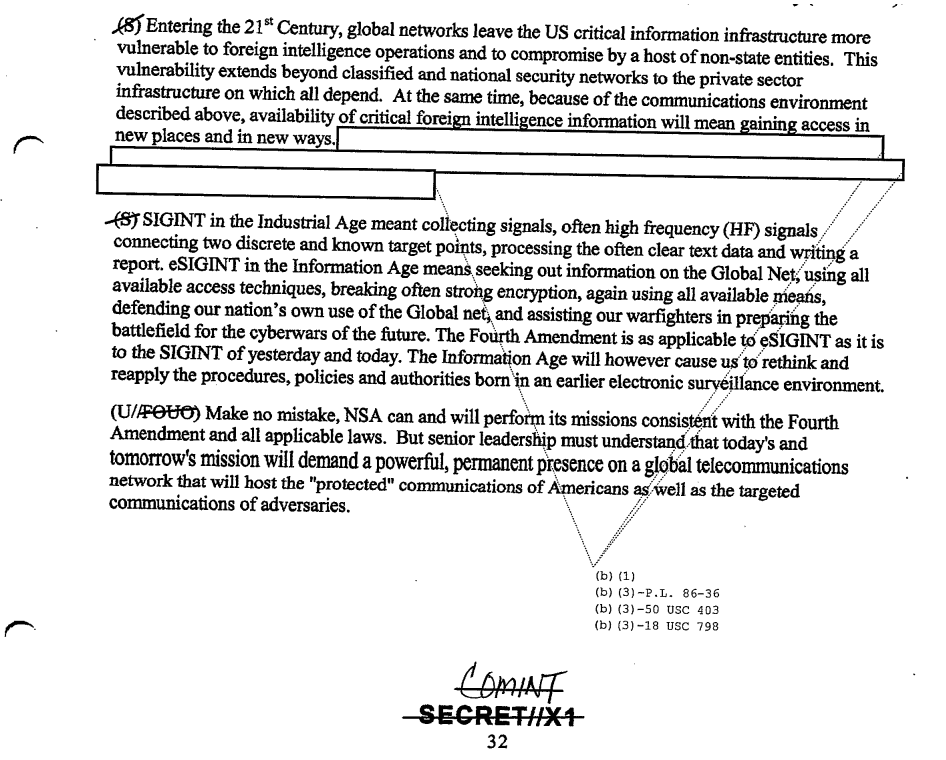
“The Fourth Amendment is as applicable to eSIGINT as it is to the SIGINT of yesterday and today. The Information Age will however cause us to rethink and reapply the procedures, policies and authorities born in an earlier electronic surveillance environment.”
The National Security Agency (NSA) has been pushing to “rethink and reapply” its application of the Fourth Amendment since before 9/11. This was necessary, it argued, to attain a “powerful, permanent presence on a global telecommunications network.”
According to a declassified document posted by the National Security Archive and featured in a recent Politico article, in addition to attempting to re-frame the way we think of our right to privacy, the NSA has also received a robust infusion of funds after 9/11, paving the way for the Orwellian surveillance state Edward Snowden helped reveal. In light of recent events, the declassified record on the NSA is especially enlightening. Jeffrey T. Richelson’s recent posting of 98 newly declassified government documents tracing the Agency’s wide range of cyber activities, concerns, and attitudes since the Clinton administration is a must read. Some of the most notable revelations found in the declassified documents include:
- The NSA’s push to “rethink and reapply” the nature of the Fourth Amendment as early as 2001.
- The estimation that by January 2001, 60% of the Presidential Daily Briefings were based upon SIGINT, a percentage that has surely increased over the last decade.
- The NSA’s goal to selectively increase production of information from the global network.
- And the NSA’s quest to deploy tools efficiently to sort, process, move and store information.
Give the National Security Agency analysts some credit, though. They did correctly predict the queasiness of many Americans to having the entirety of their digital lives captured and stored:
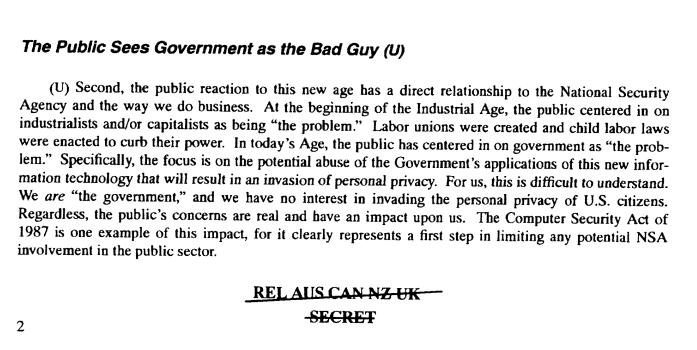
A paragraph from a declassified Secret NSA document from 1997 laments the public’s interpretation of the government, specifically the NSA, as the bad guy, quoting, “Specifically, the focus is on the potential abuse of the Government’s applications of this new information technology that will result in an invasion of personal privacy.” Notice the only countries the document was released to were Australia, Canada, New Zealand and the UK – all members of the ECHELON Network.
Delve deeper into the declassified NSA documents for yourself here and here, and trace the path the NSA took to avoid becoming “the bad guy.”
.
Tuesday, June 18, 2013
The Deeper Meaning of Mass Spying in America
The Deeper Meaning of Mass Spying in America
Tuesday, 18. June 2013 by Dr James Petras
The Politics Behind the Police State

The exposure of the Obama regime’s use of the National Security Agency to secretly spy on the communications of hundreds of millions of US and overseas citizens has provoked world-wide denunciations.
In the United States, despite widespread mass media coverage and the opposition of civil liberties organizations, there has not been any mass protest. Congressional leaders from both the Republican and Democratic Parties, as well as top judges, approved of the unprecedented domestic spy program.. Even worse, when the pervasive spy operations were revealed, top Senate and Congressional leaders repeated their endorsement of each and every intrusion into all electronic and written communication involving American citizens. President Obama and his Attorney General Holder openly and forcefully defended the NSA’s the universal spy operations. Read more ?
.
In the United States, despite widespread mass media coverage and the opposition of civil liberties organizations, there has not been any mass protest. Congressional leaders from both the Republican and Democratic Parties, as well as top judges, approved of the unprecedented domestic spy program.. Even worse, when the pervasive spy operations were revealed, top Senate and Congressional leaders repeated their endorsement of each and every intrusion into all electronic and written communication involving American citizens. President Obama and his Attorney General Holder openly and forcefully defended the NSA’s the universal spy operations. Read more ?
.
Sunday, June 09, 2013
Meet Edward Snowden: NSA PRISM Whistleblower

LeakSourceNews
Published on Jun 9, 2013
06/09/2013
Edward Snowden, the source behind the Guardian's NSA files talks to Glenn Greenwald in Hong Kong about his motives for the biggest intelligence leak in a generation.
http://www.guardian.co.uk/world/2013/...
Q&A http://www.guardian.co.uk/world/2013/...
LIVE UPDATES http://www.guardian.co.uk/world/2013/...
____________________
http://LeakSource.wordpress.com
https://twitter.com/LeakSourceNews
Published on Jun 9, 2013
06/09/2013
Edward Snowden, the source behind the Guardian's NSA files talks to Glenn Greenwald in Hong Kong about his motives for the biggest intelligence leak in a generation.
http://www.guardian.co.uk/world/2013/...
Q&A http://www.guardian.co.uk/world/2013/...
LIVE UPDATES http://www.guardian.co.uk/world/2013/...
____________________
http://LeakSource.wordpress.com
https://twitter.com/LeakSourceNews
.
National Cyber Security Alliance and LGBT Technology Partnership Launch Internet Safety Initiative for LGBT Community
New collaboration includes June 13 Twitter chat on LGBT cyber safety issues in honor of Internet Safety Month and LGBT Pride Month
WASHINGTON, May 16, 2013 /PRNewswire-USNewswire/ -- The National Cyber Security Alliance (NCSA), a non-profit public-private partnership focused on helping all digital citizens stay safer and more secure online, today announced a new collaboration initiative with the LGBT Technology Partnership to encourage greater awareness about cybersecurity and safety issues for Lesbian, Gay, Bisexual and Transgender communities.
(Logo: http://photos.prnewswire.com/prnh/20120911/DC71739LOGO)
The LGBT Technology Partnership works to provide a centralized, national presence for the many LGBT organizations and groups that are impacted by telecommunications, cable and technology policies. The organization also serves as a strong unified voice ensuring that policy implementation at the local, state and federal levels address the unique needs of the LGBT community.
While the NCSA has worked to educate all digital users about staying safe online for over a decade, the organization has increased its focus on more closely targeting specific populations with uniquely tailored awareness messages. This ongoing effort includes working with the LGBT Technology Partnership in creating an LGBT cyber education toolkit with fact sheets, tip sheets and posters that incorporate STOP. THINK. CONNECT. messaging.
The first tip sheet, "What LGBT Communities Should Know About Online Safety" is available athttp://www.staysafeonline.org/stay-safe-online/resources/what-lgbt-communities-should-know-about-online-safety-tip-sheet. Both organizations will also hold a Twitter Chat about LGBT cyber safety issues on June 13th in honor of Internet Safety Month and LGBT Pride Month. For more information, visit www.stopthinkconnect.org/twitterchats. More information about joint NCSA/LGBT Technology Partnership efforts is available at: http://lgbttechpartnership.org/about-us/supporters/.
In addition to collaborating with the National Cyber Security Alliance, the LGBT Technology Partnership has also signed on as an official partner of STOP. THINK. CONNECT., the national cybersecurity education and awareness campaign. To learn more about the STOP. THINK. CONNECT. Partner program, visit: http://www.stopthinkconnect.org/get-involved/partner-program/
"The Internet pervades our daily lives like never before and for specific populations such as the LGBT community, the Web is an integral tool to stay connected," said Michael Kaiser, executive director of the National Cyber Security Alliance. "Everyone with access to the Internet should be well educated about the importance of online safety and we believe that education and awareness is best received when it comes from a trusted a source. Our collaboration with the LGBT Technology Partnership allows for the dissemination of online safety and security practices via an organization with strong ties to their community. Since the LGBT community typically ranks among the earliest adopters of new technologies, it is critical that they have cutting edge information to make them safer and more secure online."
"We are excited about our partnership with National Cyber Security Alliance and developing LGBT specific tips about staying safer online," said Christopher Wood, co-founder of the LGBT Technology Partnership. "The LGBT Technology Partnership's mission is to make sure LGBT communities are aware of the significant benefits but also the underlying challenges that come with the early adoption of new technologies. We are working with organizations like NSCA to make technological experiences safer for all communities."
There is an increased need for ongoing cybersecurity education in LGBT communities through awareness initiatives. Past research has shown that an increased focus on cyber security awareness in the LGBT community is a necessity in a society where:
- 59 percent of gay men and 58 percent of lesbians are more likely to say they rely on technology to help manage their hectic lifestyles ("2012 LGBT Community Survey," Community Marketing Inc.)
- 27 percent of gay men (mainly 18-29 year olds) and 18 percent of lesbians are early adopters of new technology products within their peer lifestyle networks ("2012 LGBT Community Survey," Community Marketing Inc.)
- Smartphone ownership among gay and lesbian consumers is almost a third more than the national average, with 87 percent LGBT smartphone owners compared to a 62 percent national average of smartphone owners ("2012 LGBT Community Survey," Community Marketing Inc.)
For more details about the new partnership or LGBT cyber education materials, visit: www.staysafeonline.org.
About The National Cyber Security Alliance
The National Cyber Security Alliance is a non-profit organization. Through collaboration with the government, corporate, non-profit and academic sectors, the mission of the NCSA is to educate and empower a digital citizenry to use the Internet securely and safely protecting themselves and the technology they use and the digital assets we all share. NCSA board members include: ADP, AT&T, Bank of America, Comcast, EMC Corporation, ESET, Facebook, Google, Intel, McAfee, Microsoft, PayPal, Science Applications International Corporation (SAIC), Symantec, Trend Micro, Verizon and Visa. Visit www.staysafeonline.orgfor more information and join us on Facebook at www.facebook.com/staysafeonline.
About LGBT Technology Partnership
About LGBT Technology Partnership
The LGBT (Lesbian, Gay, Bisexual, & Transgender) Technology Partnership encourages the continued early adoption and use of cutting-edge, new and emerging technologies by providing information, education and strategic outreach for LGBT communities. We are a national, nonpartisan group of LGBT organizations and high technology companies whose mission is to engage with critical technology and public policy leaders for strategic discussion at all levels. The Partnership ensures that cable, telecommunications and high technology issues of specific concern to LGBT communities are addressed in public policy conversations. Visit www.LGBTTechPartnership.org for additional information, follow us on Twitter @LGBTTech and like us on Facebook at www.facebook.com/LGBTTechPartnership. For press inquiries please call +1.703.594.9391 or visitwww.LGBTTechPartnership.org/contact-us/press.
SOURCE National Cyber Security Alliance
RELATED LINKS
http://www.staysafeonline.org
SOURCE National Cyber Security Alliance
RELATED LINKS
http://www.staysafeonline.org
.
Monday, May 20, 2013
Black Box in the Desert

Some estimate the facility will be capable of storing 5 zettabytes of data
Duration 9:17
Date Apr 25, 2013
P.S. I tried on several occasions to get the embed code to post it here, but I kept copying
.
.
.
Wednesday, May 08, 2013
U.S. Is Weighing Wide Overhaul of Wiretap Laws
By CHARLIE SAVAGE
Published: May 7, 2013
WASHINGTON — The Obama administration, resolving years of internal debate, is on the verge of backing a Federal Bureau of Investigation plan for a sweeping overhaul of surveillance laws that would make it easier to wiretap people who communicate using the Internet rather than by traditional phone services, according to officials familiar with the deliberations.

Christopher Gregory/The New York Times
Robert S. Mueller III, the F.B.I. director, second from left, during a Senate Judiciary Committee hearing in March.
The F.B.I. director, Robert S. Mueller III, has argued that the bureau’s ability to carry out court-approved eavesdropping on suspects is “going dark” as communications technology evolves, and since 2010 has pushed for a legal mandate requiring companies like Facebook and Google to build into their instant-messaging and other such systems a capacity to comply with wiretap orders. That proposal, however, bogged down amid concerns by other agencies, like the Commerce Department, about quashing Silicon Valley innovation.
While the F.B.I.’s original proposal would have required Internet communications services to each build in a wiretapping capacity, the revised one, which must now be reviewed by the White House, focuses on fining companies that do not comply with wiretap orders. The difference, officials say, means that start-ups with a small number of users would have fewer worries about wiretapping issues unless the companies became popular enough to come to the Justice Department’s attention.
Still, the plan is likely to set off a debate over the future of the Internet if the White House submits it to Congress, according to lawyers for technology companies and advocates of Internet privacy and freedom.
“I think the F.B.I.’s proposal would render Internet communications less secure and more vulnerable to hackers and identity thieves,” said Gregory T. Nojeim of the Center for Democracy and Technology. “It would also mean that innovators who want to avoid new and expensive mandates will take their innovations abroad and develop them there, where there aren’t the same mandates.”
Andrew Weissmann, the general counsel of the F.B.I., said in a statement that the proposal was aimed only at preserving law enforcement officials’ longstanding ability to investigate suspected criminals, spies and terrorists subject to a court’s permission.
“This doesn’t create any new legal surveillance authority,” he said. “This always requires a court order. None of the ‘going dark’ solutions would do anything except update the law given means of modern communications.”
A central element of the F.B.I.’s 2010 proposal was to expand the Communications Assistance for Law Enforcement Act — a 1994 law that already requires phone and network carriers to build interception capabilities into their systems — so that it would also cover Internet-based services that allow people to converse. But the bureau has now largely moved away from that one-size-fits-all mandate.
Instead, the new proposal focuses on strengthening wiretap orders issued by judges. Currently, such orders instruct recipients to provide technical assistance to law enforcement agencies, leaving wiggle room for companies to say they tried but could not make the technology work. Under the new proposal, providers could be ordered to comply, and judges could impose fines if they did not. The shift in thinking toward the judicial fines was first reported by The Washington Post, and additional details were described to The New York Times by several officials who spoke on the condition of anonymity.
Under the proposal, officials said, for a company to be eligible for the strictest deadlines and fines — starting at $25,000 a day — it must first have been put on notice that it needed surveillance capabilities, triggering a 30-day period to consult with the government on any technical problems.
Such notice could be the receipt of its first wiretap order or a warning from the attorney general that it might receive a surveillance request in the future, officials said, arguing that most small start-ups would never receive either.
Michael Sussman, a former Justice Department lawyer who advises communications providers, said that aspect of the plan appeared to be modeled on a British law, the Regulation of Investigatory Powers Act of 2000.
Foreign-based communications services that do business in the United States would be subject to the same procedures, and would be required to have a point of contact on domestic soil who could be served with a wiretap order, officials said.
Albert Gidari Jr., who represents technology companies on law enforcement matters, criticized that proposed procedure. He argued that if the United States started imposing fines on foreign Internet firms, it would encourage other countries, some of which may be looking for political dissidents, to penalize American companies if they refused to turn over users’ information.
“We’ll look a lot more like China than America after this,” Mr. Gidari said.
The expanded fines would also apply to phone and network carriers, like Verizon and AT&T, which are separately subject to the 1994 wiretapping capacity law. The FBI hasargued that such companies sometimes roll out system upgrades without making sure that their wiretap capabilities will keep working.
The 1994 law would be expanded to cover peer-to-peer voice-over-Internet protocol, or VoIP — calls between computers that do not connect to the regular phone network. Such services typically do not route data packets through any central hub, making them difficult to intercept.
The F.B.I. has abandoned a component of its original proposal that would have required companies that facilitate the encryption of users’ messages to always have a key to unscramble them if presented with a court order. Critics had charged that such a law would create back doors for hackers. The current proposal would allow services that fully encrypt messages between users to keep operating, officials said.
In November 2010, Mr. Mueller toured Silicon Valley and briefed executives on the proposal as it then existed, urging them not to lobby against it, but the firms have adopted a cautious stance. In February 2011, the F.B.I.’s top lawyer at the time testified about the “going dark” problem at a House hearing, emphasizing that there was no administration proposal yet. Still, several top lawmakers at the hearing expressed skepticism, raising fears about innovation and security.
A version of this article appeared in print on May 8, 2013, on page A1 of the New York edition with the headline: U.S. Weighing Wide Overhaul Of Surveillance.
The F.B.I. director, Robert S. Mueller III, has argued that the bureau’s ability to carry out court-approved eavesdropping on suspects is “going dark” as communications technology evolves, and since 2010 has pushed for a legal mandate requiring companies like Facebook and Google to build into their instant-messaging and other such systems a capacity to comply with wiretap orders. That proposal, however, bogged down amid concerns by other agencies, like the Commerce Department, about quashing Silicon Valley innovation.
While the F.B.I.’s original proposal would have required Internet communications services to each build in a wiretapping capacity, the revised one, which must now be reviewed by the White House, focuses on fining companies that do not comply with wiretap orders. The difference, officials say, means that start-ups with a small number of users would have fewer worries about wiretapping issues unless the companies became popular enough to come to the Justice Department’s attention.
Still, the plan is likely to set off a debate over the future of the Internet if the White House submits it to Congress, according to lawyers for technology companies and advocates of Internet privacy and freedom.
“I think the F.B.I.’s proposal would render Internet communications less secure and more vulnerable to hackers and identity thieves,” said Gregory T. Nojeim of the Center for Democracy and Technology. “It would also mean that innovators who want to avoid new and expensive mandates will take their innovations abroad and develop them there, where there aren’t the same mandates.”
Andrew Weissmann, the general counsel of the F.B.I., said in a statement that the proposal was aimed only at preserving law enforcement officials’ longstanding ability to investigate suspected criminals, spies and terrorists subject to a court’s permission.
“This doesn’t create any new legal surveillance authority,” he said. “This always requires a court order. None of the ‘going dark’ solutions would do anything except update the law given means of modern communications.”
A central element of the F.B.I.’s 2010 proposal was to expand the Communications Assistance for Law Enforcement Act — a 1994 law that already requires phone and network carriers to build interception capabilities into their systems — so that it would also cover Internet-based services that allow people to converse. But the bureau has now largely moved away from that one-size-fits-all mandate.
Instead, the new proposal focuses on strengthening wiretap orders issued by judges. Currently, such orders instruct recipients to provide technical assistance to law enforcement agencies, leaving wiggle room for companies to say they tried but could not make the technology work. Under the new proposal, providers could be ordered to comply, and judges could impose fines if they did not. The shift in thinking toward the judicial fines was first reported by The Washington Post, and additional details were described to The New York Times by several officials who spoke on the condition of anonymity.
Under the proposal, officials said, for a company to be eligible for the strictest deadlines and fines — starting at $25,000 a day — it must first have been put on notice that it needed surveillance capabilities, triggering a 30-day period to consult with the government on any technical problems.
Such notice could be the receipt of its first wiretap order or a warning from the attorney general that it might receive a surveillance request in the future, officials said, arguing that most small start-ups would never receive either.
Michael Sussman, a former Justice Department lawyer who advises communications providers, said that aspect of the plan appeared to be modeled on a British law, the Regulation of Investigatory Powers Act of 2000.
Foreign-based communications services that do business in the United States would be subject to the same procedures, and would be required to have a point of contact on domestic soil who could be served with a wiretap order, officials said.
Albert Gidari Jr., who represents technology companies on law enforcement matters, criticized that proposed procedure. He argued that if the United States started imposing fines on foreign Internet firms, it would encourage other countries, some of which may be looking for political dissidents, to penalize American companies if they refused to turn over users’ information.
“We’ll look a lot more like China than America after this,” Mr. Gidari said.
The expanded fines would also apply to phone and network carriers, like Verizon and AT&T, which are separately subject to the 1994 wiretapping capacity law. The FBI hasargued that such companies sometimes roll out system upgrades without making sure that their wiretap capabilities will keep working.
The 1994 law would be expanded to cover peer-to-peer voice-over-Internet protocol, or VoIP — calls between computers that do not connect to the regular phone network. Such services typically do not route data packets through any central hub, making them difficult to intercept.
The F.B.I. has abandoned a component of its original proposal that would have required companies that facilitate the encryption of users’ messages to always have a key to unscramble them if presented with a court order. Critics had charged that such a law would create back doors for hackers. The current proposal would allow services that fully encrypt messages between users to keep operating, officials said.
In November 2010, Mr. Mueller toured Silicon Valley and briefed executives on the proposal as it then existed, urging them not to lobby against it, but the firms have adopted a cautious stance. In February 2011, the F.B.I.’s top lawyer at the time testified about the “going dark” problem at a House hearing, emphasizing that there was no administration proposal yet. Still, several top lawmakers at the hearing expressed skepticism, raising fears about innovation and security.
A version of this article appeared in print on May 8, 2013, on page A1 of the New York edition with the headline: U.S. Weighing Wide Overhaul Of Surveillance.
......
Thursday, January 31, 2013
Social Networks: portals of truth and faith; new spaces for evangelization

As the 2013 World Communications Day draws near, I would like to offer you some reflections on an increasingly important reality regarding the way in which people today communicate among themselves. I wish to consider the development of digital social networks which are helping to create a new "agora", an open public square in which people share ideas, information and opinions, and in which new relationships and forms of community can come into being.
These spaces, when engaged in a wise and balanced way, help to foster forms of dialogue and debate which, if conducted respectfully and with concern for privacy, responsibility and truthfulness, can reinforce the bonds of unity between individuals and effectively promote the harmony of the human family. The exchange of information can become true communication, links ripen into friendships, and connections facilitate communion. If the networks are called to realize this great potential, the people involved in them must make an effort to be authentic since, in these spaces, it is not only ideas and information that are shared, but ultimately our very selves.
The development of social networks calls for commitment: people are engaged in building relationships and making friends, in looking for answers to their questions and being entertained, but also in finding intellectual stimulation and sharing knowledge and know-how. The networks are increasingly becoming part of the very fabric of society, inasmuch as they bring people together on the basis of these fundamental needs. Social networks are thus nourished by aspirations rooted in the human heart.
The culture of social networks and the changes in the means and styles of communication pose demanding challenges to those who want to speak about truth and values. Often, as is also the case with other means of social communication, the significance and effectiveness of the various forms of expression appear to be determined more by their popularity than by their intrinsic importance and value. Popularity, for its part, is often linked to celebrity or to strategies of persuasion rather than to the logic of argumentation. At times the gentle voice of reason can be overwhelmed by the din of excessive information and it fails to attract attention which is given instead to those who express themselves in a more persuasive manner. The social media thus need the commitment of all who are conscious of the value of dialogue, reasoned debate and logical argumentation; of people who strive to cultivate forms of discourse and expression which appeal to the noblest aspirations of those engaged in the communication process. Dialogue and debate can also flourish and grow when we converse with and take seriously people whose ideas are different from our own. "Given the reality of cultural diversity, people need not only to accept the existence of the culture of others, but also to aspire to be enriched by it and to offer to it whatever they possess that is good, true and beautiful" (Address at the Meeting with the World of Culture, Bélem, Lisbon, 12 May 2010).
The challenge facing social networks is how to be truly inclusive: thus they will benefit from the full participation of believers who desire to share the message of Jesus and the values of human dignity which his teaching promotes. Believers are increasingly aware that, unless the Good News is made known also in the digital world, it may be absent in the experience of many people for whom this existential space is important. The digital environment is not a parallel or purely virtual world, but is part of the daily experience of many people, especially the young. Social networks are the result of human interaction, but for their part they also reshape the dynamics of communication which builds relationships: a considered understanding of this environment is therefore the prerequisite for a significant presence there.
The ability to employ the new languages is required, not just to keep up with the times, but precisely in order to enable the infinite richness of the Gospel to find forms of expression capable of reaching the minds and hearts of all. In the digital environment the written word is often accompanied by images and sounds. Effective communication, as in the parables of Jesus, must involve the imagination and the affectivity of those we wish to invite to an encounter with the mystery of God’s love. Besides, we know that Christian tradition has always been rich in signs and symbols: I think for example of the Cross, icons, images of the Virgin Mary, Christmas cribs, stained-glass windows and pictures in our churches. A significant part of mankind’s artistic heritage has been created by artists and musicians who sought to express the truths of the faith.
In social networks, believers show their authenticity by sharing the profound source of their hope and joy: faith in the merciful and loving God revealed in Christ Jesus. This sharing consists not only in the explicit expression of their faith, but also in their witness, in the way in which they communicate "choices, preferences and judgements that are fully consistent with the Gospel, even when it is not spoken of specifically" (Message for the 2011World Communications Day). A particularly significant way of offering such witness will be through a willingness to give oneself to others by patiently and respectfully engaging their questions and their doubts as they advance in their search for the truth and the meaning of human existence. The growing dialogue in social networks about faith and belief confirms the importance and relevance of religion in public debate and in the life of society.
For those who have accepted the gift of faith with an open heart, the most radical response to mankind’s questions about love, truth and the meaning of life – questions certainly not absent from social networks – are found in the person of Jesus Christ. It is natural for those who have faith to desire to share it, respectfully and tactfully, with those they meet in the digital forum. Ultimately, however, if our efforts to share the Gospel bring forth good fruit, it is always because of the power of the word of God itself to touch hearts, prior to any of our own efforts. Trust in the power of God’s work must always be greater than any confidence we place in human means. In the digital environment, too, where it is easy for heated and divisive voices to be raised and where sensationalism can at times prevail, we are called to attentive discernment. Let us recall in this regard that Elijah recognized the voice of God not in the great and strong wind, not in the earthquake or the fire, but in "a still, small voice" (1 Kg 19:11-12). We need to trust in the fact that the basic human desire to love and to be loved, and to find meaning and truth – a desire which God himself has placed in the heart of every man and woman – keeps our contemporaries ever open to what Blessed Cardinal Newman called the "kindly light" of faith.
Social networks, as well as being a means of evangelization, can also be a factor in human development. As an example, in some geographical and cultural contexts where Christians feel isolated, social networks can reinforce their sense of real unity with the worldwide community of believers. The networks facilitate the sharing of spiritual and liturgical resources, helping people to pray with a greater sense of closeness to those who share the same faith. An authentic and interactive engagement with the questions and the doubts of those who are distant from the faith should make us feel the need to nourish, by prayer and reflection, our faith in the presence of God as well as our practical charity: "If I speak in the tongues of men and of angels, but have not love, I am a noisy gong or a clanging cymbal" (1 Cor 13:1).
In the digital world there are social networks which offer our contemporaries opportunities for prayer, meditation and sharing the word of God. But these networks can also open the door to other dimensions of faith. Many people are actually discovering, precisely thanks to a contact initially made online, the importance of direct encounters, experiences of community and even pilgrimage, elements which are always important in the journey of faith. In our effort to make the Gospel present in the digital world, we can invite people to come together for prayer or liturgical celebrations in specific places such as churches and chapels. There should be no lack of coherence or unity in the expression of our faith and witness to the Gospel in whatever reality we are called to live, whether physical or digital. When we are present to others, in any way at all, we are called to make known the love of God to the furthest ends of the earth.
I pray that God’s Spirit will accompany you and enlighten you always, and I cordially impart my blessing to all of you, that you may be true heralds and witnesses of the Gospel. "Go into all the world and preach the Gospel to the whole creation" (Mk 16:15).
From the Vatican, 24 January 2013, Feast of Saint Francis de Sales.
BENEDICTUS PP. XVI
[00116-02.01] [Original text: Italian]
.
Monday, November 19, 2012
Mainstream Media Now Openly Admits The FBI And CIA Are Reading All Your Emails
 |
| Add caption |
Sunday, November 18, 2012 by: J. D. Heyes
For years, those of us who have tried to warn the American public that Big Brother monitors all Internet users were demonized, vilified and ridiculed.
Now, the mainstream media has proven us correct.
“The U.S. government — and likely your own government, for that matter — is either watching your online activity every minute of the day through automated methods and non-human eavesdropping techniques, or has the ability to dip in as and when it deems necessary — sometimes with a warrant, sometimes without,” ZDNet reported earlier this month. “That tin-foil hat really isn’t going to help. Take it off, you look silly.”
The Petraeus case
Where’s the proof that the government has this capability?
You might recall a fellow by the name of (retired) Gen. David Petraeus. He’s been in the news lately.
This four-star general-turned-CIA chief just resigned his post after news broke that he had engaged in an extra-marital affair with is biographer, herself a West Point graduate and former Army officer.
What led to this shocking discovery was Petraeus’ use, of all things, Google’s online email service, Gmail.
According to federal law, mind you, authorities are not legally permitted to electronically snoop around in your email box.
“The government can’t just wander through your emails just because they’d like to know what you’re thinking or doing,” Stewart Baker, a former assistant secretary at the Homeland Security Department who’s now in private law practice, told The Associated Press. “But if the government is investigating a crime, it has a lot of authority to review people’s emails.”
Or, in the case of the CIA, if the agency wants to track a suspect ostensibly for “national security” purposes. Ditto the NSA.
The wrangling of Petraeus’ email account has certainly landed him in a world of trouble, but his story has also, once again, ignited a new the debate over when, how and why governments and law enforcement agencies alike are able to access the email accounts of ordinary citizens – even if they head up the most powerful spy agency in the world.
Granted, experts say “the little people” needn’t worry much about having their online presence tracked. Agencies like the CIA generally tend to have bigger fish to fry, so to speak. But nevertheless, the technology to pilfer email accounts at will obviously exists.
“Forget ECHELON, or signals intelligence, or the interception of communications by black boxes installed covertly in data centers,” writes Zack Whittaker for ZDNet. “Intelligence agencies and law enforcement bodies can access – thanks to the shift towards Web-based email services in the cloud – but it’s not as exciting or as Jack Bauer-esque as one may think or hope for.”
(Editor’s Note: ECHELON, for those who are unfamiliar with it, is the name of “a global Communications Interception (COMINT) system created by the United States, the United Kingdom, Canada, Australia and New Zealand to routinely and indiscriminately monitor and record all forms of electronic communications worldwide (both military and civilian) and overseen by the National Security Agency,” according to one published description of the program.)
How the top CIA official got busted
When he set up his private Gmail account, Petraeus used a pseudonym and composed email messages but never sent them. They were instead saved as drafts. His lover, Paula Broadwell, would then log in under the same account, read the drafts then reply to them in the same manner – as a draft, without actually sending the message.
The exchanges would not be sent across the networks through Google’s data centers, which would make it nearly impossible for the NSA or any other ELINT (electronic intelligence) agency (like Britain’s GCHQ or the Israeli Mossad) to “read” the messages while they are in transit between accounts.
Other sinister operators – terrorists, pedophiles and the like – have been known to use the same trick to avoid detection, ZDNet reported.
“But surely IP addresses are logged and noted? When emails are sent and received, yes. But the emails were saved in draft and therefore were not sent. However, Google may still have a record of the IP addresses of those who logged into the account,” the report said.
In the end, the FBI used a little-know law called the Stored Communications Act, which is part of the Electronic Communications Privacy Act, as the basis for getting a warrant to view Petraeus’ private Gmail account. And that’s how agents found the stored messages that were never actually sent.
“Once it knew Ms. Broadwell was the sender of the threatening messages, the FBI got a warrant that gave it covert access to the anonymous email account,” the BBC’s Mark Ward reported.
Now, the mainstream media has proven us correct.
“The U.S. government — and likely your own government, for that matter — is either watching your online activity every minute of the day through automated methods and non-human eavesdropping techniques, or has the ability to dip in as and when it deems necessary — sometimes with a warrant, sometimes without,” ZDNet reported earlier this month. “That tin-foil hat really isn’t going to help. Take it off, you look silly.”
The Petraeus case
Where’s the proof that the government has this capability?
You might recall a fellow by the name of (retired) Gen. David Petraeus. He’s been in the news lately.
This four-star general-turned-CIA chief just resigned his post after news broke that he had engaged in an extra-marital affair with is biographer, herself a West Point graduate and former Army officer.
What led to this shocking discovery was Petraeus’ use, of all things, Google’s online email service, Gmail.
According to federal law, mind you, authorities are not legally permitted to electronically snoop around in your email box.
“The government can’t just wander through your emails just because they’d like to know what you’re thinking or doing,” Stewart Baker, a former assistant secretary at the Homeland Security Department who’s now in private law practice, told The Associated Press. “But if the government is investigating a crime, it has a lot of authority to review people’s emails.”
Or, in the case of the CIA, if the agency wants to track a suspect ostensibly for “national security” purposes. Ditto the NSA.
The wrangling of Petraeus’ email account has certainly landed him in a world of trouble, but his story has also, once again, ignited a new the debate over when, how and why governments and law enforcement agencies alike are able to access the email accounts of ordinary citizens – even if they head up the most powerful spy agency in the world.
Granted, experts say “the little people” needn’t worry much about having their online presence tracked. Agencies like the CIA generally tend to have bigger fish to fry, so to speak. But nevertheless, the technology to pilfer email accounts at will obviously exists.
“Forget ECHELON, or signals intelligence, or the interception of communications by black boxes installed covertly in data centers,” writes Zack Whittaker for ZDNet. “Intelligence agencies and law enforcement bodies can access – thanks to the shift towards Web-based email services in the cloud – but it’s not as exciting or as Jack Bauer-esque as one may think or hope for.”
(Editor’s Note: ECHELON, for those who are unfamiliar with it, is the name of “a global Communications Interception (COMINT) system created by the United States, the United Kingdom, Canada, Australia and New Zealand to routinely and indiscriminately monitor and record all forms of electronic communications worldwide (both military and civilian) and overseen by the National Security Agency,” according to one published description of the program.)
How the top CIA official got busted
When he set up his private Gmail account, Petraeus used a pseudonym and composed email messages but never sent them. They were instead saved as drafts. His lover, Paula Broadwell, would then log in under the same account, read the drafts then reply to them in the same manner – as a draft, without actually sending the message.
The exchanges would not be sent across the networks through Google’s data centers, which would make it nearly impossible for the NSA or any other ELINT (electronic intelligence) agency (like Britain’s GCHQ or the Israeli Mossad) to “read” the messages while they are in transit between accounts.
Other sinister operators – terrorists, pedophiles and the like – have been known to use the same trick to avoid detection, ZDNet reported.
“But surely IP addresses are logged and noted? When emails are sent and received, yes. But the emails were saved in draft and therefore were not sent. However, Google may still have a record of the IP addresses of those who logged into the account,” the report said.
In the end, the FBI used a little-know law called the Stored Communications Act, which is part of the Electronic Communications Privacy Act, as the basis for getting a warrant to view Petraeus’ private Gmail account. And that’s how agents found the stored messages that were never actually sent.
“Once it knew Ms. Broadwell was the sender of the threatening messages, the FBI got a warrant that gave it covert access to the anonymous email account,” the BBC’s Mark Ward reported.
Sources:
http://www.zdnet.com
http://finance.yahoo.com
http://actionamerica.org/echelon/echelonwhat.html
.
Subscribe to:
Posts (Atom)