Showing posts with label Satellite. Show all posts

Wednesday, August 19, 2026

At the start of 2019, fewer than 2,000 active satellites circled Earth...

At the start of 2019, fewer than 2,000 active satellites circled Earth. By June 2026 there were 15,711 — and nearly two out of every three belonged to a single constellation: SpaceX's Starlink.

A June 2026 traffic index counted nearly eight times as many working satellites as existed at the start of 2019, with Starlink making up 65.97 percent.


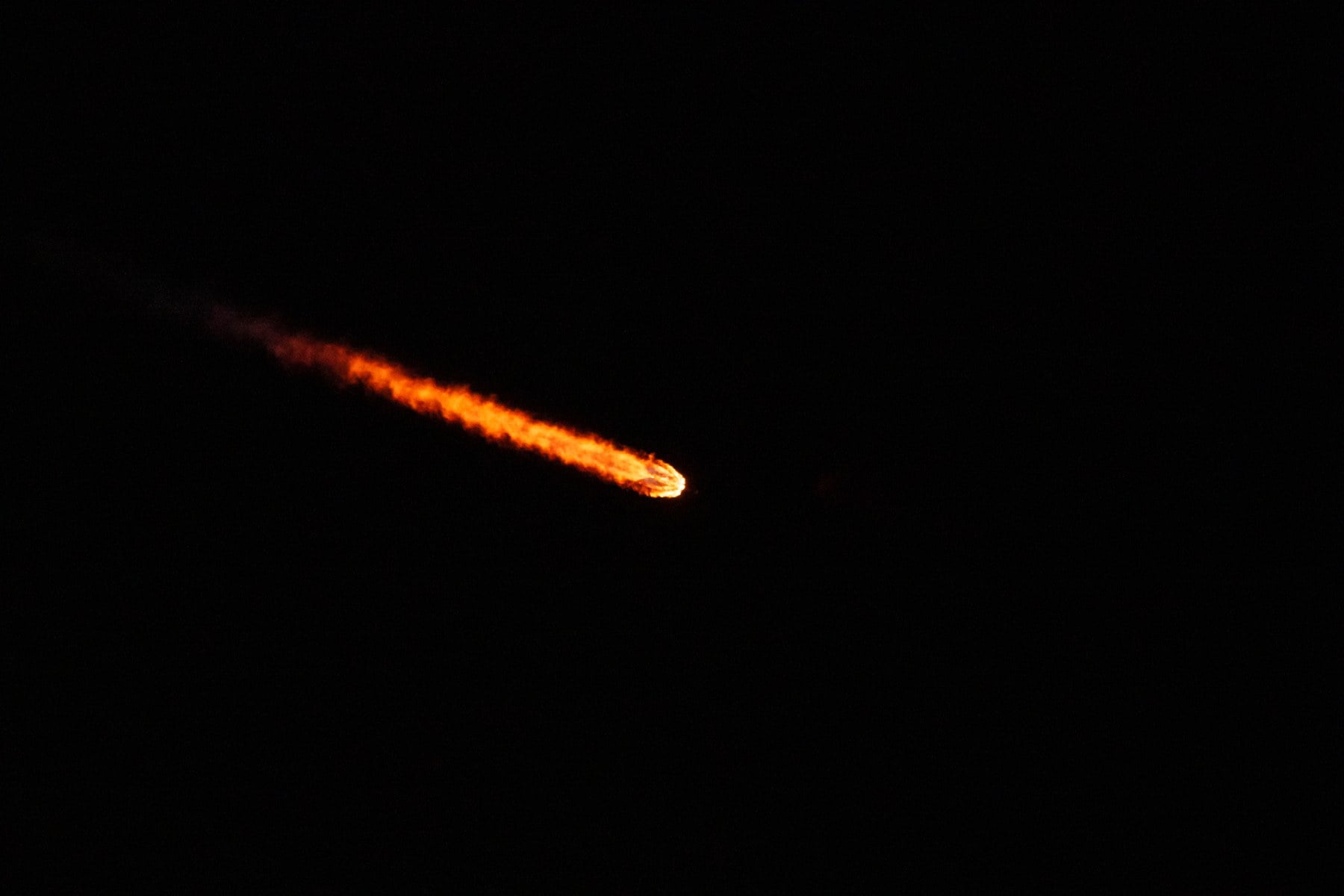
A Falcon 9 rocket carrying the Starlink 6-78 mission launches from Launch Complex 39A at Kennedy Space Center, Florida, on Nov. 20, 2025. Credit: U.S. Space Force photo by Gwendolyn Kurzen, public domain.


By Deep Field · Edited by Lachlan Brown

Published August 17, 2026 · How we edit


Look Up’s quarterly space index, released on 2 June 2026, counted 15,711 active satellites in Earth orbit. It assigned 10,365 of them to SpaceX’s Starlink constellation. That is 65.97 percent, making “nearly two out of every three” the arithmetic of this particular catalog.

The same index put the active population below 2,000 at the start of 2019. The total had therefore grown almost eightfold in a little more than seven years. That interval is unusually revealing because the first full batch of 60 Starlink satellites launched in May 2019.

These are dated operational counts, not permanent facts. “Active” is judged from tracking and operational evidence, and different catalogs can reach different totals. The June numbers should be read as a coherent snapshot from one provider, not a universally standardized census.

The 15,711 figure came from a commercial traffic index

Look Up is a French space-situational-awareness company operating tracking radars and a data platform called SYNAPSE. Its second-quarter 2026 index, produced with the French magazine Le Point, reported 15,711 active satellites as of the start of June. The previous edition three months earlier had counted 14,389.

That is an increase of 1,322 active spacecraft in roughly one quarter. The index attributed 3,320 new active Starlinks to the preceding year, while also recording growth in Chinese fleets. It listed China at 1,286 active satellites, including the developing Qian Fan and GuoWang systems, and Eutelsat OneWeb at 651.

The denominator matters. The report was counting working satellites, not every human-made object overhead. It separately said that more than 33,000 cataloged objects were being tracked, including active payloads, rocket bodies and debris. A piece of fragmentation debris does not become a satellite in the 15,711 total simply because it circles Earth.

Tuesday, March 04, 2014

Facebook Wants to Build 11,000 Drones to Bring Internet to Africa


Rise of the Drones


All drones everywhere.


By Jordyn Taylor 3/04 9:43am


Check out this atmospheric satellite a.k.a. FACEBOOK DRONE. (Screengrab: YouTube)

It’s a bird! It’s a plane! Nope — it’s a Facebook drone.

The social media site reportedly wants to use drones to bring Internet connection to the two thirds of the world that still lack connectivity, starting with parts of Africa. The initiative is part of the internet.org project, which Facebook backs.

To do so, Facebook could have bought some individual drones. Instead, overachievers that they are, they bought a drone company. According to TechCrunch, Facebook is shelling out $60 million to acquire Titan Aerospace, a company that makes “atmospheric satellites” — basically, solar-powered drones capable of staying in the sky for up to five years.

Facebook is specifically interested in building 11,000 of Titan Aerospace’s “Solara 60″ aircraft, TechCrunch reported. The company’s site indicates the Solara aircraft have a bunch of communications abilities, which we expect will be useful for Facebook’s mission.

According to this comprehensive YouTube video, the Solara 60 can complete most of the same functions as an orbital satellite, but is cheaper and more versatile. It can also stay at an altitude of 20km for up to five years, without ever having to come back down and refuel. Fancy.

TechCrunch specified that Titan Aerospace’s products would only be used for the internet.org initiative, which means that if you’re reading this now, a fleet of Facebook drones probably won’t be coming to a sky near you.

Check out Titan Aerospace’s Solara 50 and 60 aircraft:


Source 
.

Wednesday, January 15, 2014

Adventist News Network + Eutelsat—Five Years And Access To A Wider Audience

Satnews Daily
January 15th, 2014

Adventist News Network + Eutelsat—Five Years And Access To A Wider Audience (SatBroadcasting™—Content)


[SatNews] A new satellite contract for the Seventh-day Adventist television channel in Beirut significantly expands the footprint of church media in Northern Africa and the Middle East.

Hope Channel Al Waad this month entered a five-year contract with satellite Eutelsat 7 West A, a move network officials say introduces a message of hope to a wider audience of Arabic, Turkish and Farsi speakers in the region.The French-based satellite provider Eutelsat operates Eutelsat 7 West A in close cooperation with the Egyptian satellite provider Nilesat, the largest satellite provider in the Middle East. The 2011 launch of Eutelsat 7 West A marked part of the provider’s efforts to boost broadcasting in the Middle East, Gulf States, North Africa and Northwest Africa.

Viewers using the Nilesat satellite can now reset their channel lineup to receive Adventist television in their homes. Satellite is the most common broadcast distribution method in the Middle East.

“We have been praying for this development for many years,” said Al Waad Director Amir Ghali, adding that the channel’s “peaceful, non-partisan programming” has been well received in the region since its launch in 2010.

Al Waad programs address topics such as health, education and family. The channel derives its name from the Arabic word for “promise,” offering what Ghali called “the promise of hope” to the region.

The Adventist Church infosite is located at: http://www.adventist.org/en/


Source
.

Sunday, December 15, 2013

'Nothing is beyond our reach,' National Reconnaissance Office's new logo claims


Published December 06, 2013
FoxNews.com


The logo for the latest secret mission by the National Reconnaissance Office has raised a few eyebrows. (NRO)


In preparation for launch, the NROL-39 payload is transported and mated to its Atlas V booster at Vandenberg's Space Launch Complex-3. (ULA)

Next Slide Previous Slide


The U.S. National Reconnaissance Office launched a new spy satellite Thursday evening on mission NROL-39 -- and the new logo and tagline are quite an eye opener.

The new logo features a giant, world-dominating octopus, its sucker-covered tentacles encircling the planet while it looks on with determination, a steely glint in its enormous eye. The logo carries a five-word tagline: “Nothing is beyond our reach.”

Christopher Soghoian, principal technologist and senior policy analyst with the ACLU, raised a quizzical eyebrow at the new slogan.

“Advice to @ODNIgov: You may want to downplay the massive dragnet spying thing right now. This logo isn't helping,” he wrote.

An agency spokeswoman told Forbes that there's a very good reason for the symbol: The octopus is intelligent, and therefore a good emblem for an intelligence agency.

“NROL-39 is represented by the octopus, a versatile, adaptable, and highly intelligent creature. Emblematically, enemies of the United States can be reached no matter where they choose to hide,” said Karen Furgerson, a spokeswoman for the NRO. “‘Nothing is beyond our reach’ defines this mission and the value it brings to our nation and the warfighters it supports, who serve valiantly all over the globe, protecting our nation.”

'You may want to downplay the massive dragnet spying thing right now. This logo isn't helping.'

- Christopher Soghoian, senior policy analyst with the ACLU

The NROL-39 mission was classified, as are nearly all missions and satellites launched by the secretive NRO. It was carried aloft by a United Launch Alliance rocket from the Vandenberg Air Force Base in California at 11:13 p.m. PST, according to NASAspaceflight.com. Because the launch trajectory matched that used by other launches, it was likely carrying a third satellite for the agency’s radar reconnaissance fleet, the site said.

Along with its secretive payload, the rocket also carried the Government Experimental Multi-Satellite (GEMSat) payload, which contained 12 “nanosatellites” that will perform a variety of science missions.

The NRO mission is to design, build, launch, and maintain America’s intelligence satellites.

"Whether creating the latest innovations in satellite technology, contracting with the most cost-efficient industrial supplier, conducting rigorous launch schedules, or providing the highest-quality products to our customers, we never lose focus on who we are working to protect: our Nation and its citizens," its website says.

That include those with eight arms.


Source
.

Sunday, January 15, 2012

Jesuit priest and professor of theology at the College of the Holy Cross

Today, I turned on the radio to listen to the news and what I got instead was Jesuit indoctrination. Boy, those guys are being promoted even when you're not looking, or listening as in this case.

As I listened to the local Public Radio station (NPR) there was a program on called Bob Edwards Weekend from PRI; While listening I experienced another 'wonderful' vignette on how selfless the Jesuits are, and how dedicated they are to help the disadvantaged people of society. What propaganda?


This reminds my of Adolph Hitler's Propaganda Chief - Joseph Goebbels' quote:

"If you repeat a lie often enough, it becomes the truth".


Arsenio.


THE BOB EDWARDS SHOW SCHEDULE

Friday, January 13, 2012

Doyle McManus, Washington columnist for the Los Angeles Times joins Bob to discuss the latest political news. Next, while most of the nation was shocked at the death of Martin Luther King Jr., Jesuit priest and professor of theology at the College of the Holy Cross canvassed the East Coast in search of African American students to admit to the university, students who would play their part in America’s racial integration. Diane Brady’s book Fraternity tells this story from the perspective of the students who would later become defense attorneys and activists, a Supreme Court Justice, and winner of the Pulitzer Prize in Literature. Then, in this week’s installment of our ongoing series This I Believe, we hear the essay of Dave Stewart. After Stewart grew tired of his career in manufacturing, he bought a farm in New Hampshire. He grows vegetables and raises, chickens, sheep, pigs, and cows. Stewart’s grandfather was a dairy farmer, and now he has found the same pleasure in the simple routines of milking and grazing.

Source: http://www.bobedwardsradio.com/bes/

Visit Bob Edwards Weekend on PRI’s website to find local stations that air the program.

The Bob Edwards Show

The Bob Edwards Show is an American radioprogram presented by Sirius XM Satellite Radio every weekday morning at 8 a.m. Eastern, with repeats at 8 a.m. Central, 7 a.m. Pacific, 6 p.m. Mountain, and the next morning at 7 a.m. Eastern. The program can be heard on the XM Public Radio station at XM channel 121 and Sirius channel 205, and is also available 24/7 on XM Radio Online and Sirius Internet Radio.

The show is hosted by Bob Edwards, a Peabody Award-winning member of the National Radio Hall of Fame. Edwards was once the co-host of National Public Radio's All Things Considered, and hosted NPR's Morning Edition from the first episode to April 30, 2004 when he was re-assigned to another position within NPR, despite email objections from more than fifty thousand listeners. Edwards left his new assignment almost immediately, as Hugh Panero, CEO of XM Radio, offered Edwards a daily show.

The Bob Edwards Show continues the tradition of interviewing interesting people in all walks of life that Edwards exemplified on Morning Edition, but now in long form. Edwards told the NewsHour with Jim Lehrer's Terrance Smith, "The longest interview I could do on the air for Morning Edition was eight minutes. Now I can interview someone for up to an hour. So it's a freer, more open, more relaxed and enjoyable conversation. The program's really about conversation." The show's first broadcast was on October 4, 2004, staffed by experienced public radio veterans. The first program included weekly political commentatorWashington Post columnist David S. Broder, USA Today Supreme Court reporter Joan Biskupic, formerCBS News anchor Walter Cronkite, and Eugene Robinson, author of Last Dance in Havana.

In 2006, interviews with musicians earned The Bob Edwards Show the Deems Taylor Award from ASCAP. The program also received a Gabriel Award from the Catholic Academy for Communication Arts Professionals for an interview with Father Gregory Boyle, a Jesuit priest who works with Latino gang members in east Los Angeles. The show earned a second Gabriel Award in 2007 for "Exploding Heritage," a documentary about mountaintop removal coal mining in Appalachia. "Exploding Heritage" also received the National Press Club's Robert L. Kozic Award for environmental reporting, a New York Festivals Gold World Medal for best program on the environment, and an award from the Society of Environmental Journalists. In 2008, The Bob Edwards Show received an Edward R. Murrow Award from the Radio-Television News Directors Association and a New York Festivals/United Nations Gold Award for a documentary called "The Invisible--Children Without Homes." "The Invisible" also was honored by the Journalism Center on Children and Families and by the Catholic Academy for Communication Arts Professionals. In 2009, the show received a Sigma Delta Chi Award from the Society of Professional Journalists for the documentary, "Stories from Third Med: Surviving a Jungle ER." The documentary also earned a Gabriel Award.

XM Radio also produces the compilation program Bob Edwards Weekend, distributed by Public Radio International for use by "terrestrial" public radio stations. It premiered on January 7-8, 2006, consisting of re-edited interviews from the weekday program. Bob Edwards Weekend is also available online via podcastat the program's website.


Description above from the Wikipedia article The Bob Edwards Show,..

Sunday, December 25, 2011

Russia Botches Another Rocket Launch

Irene Klotz
Analysis by Irene Klotz
Fri Dec 23, 2011 03:46 PM ET


Three hours before a new crew arrived at the International Space Station on Friday, bringing the outpost back up to full staff for the first time in months, Russia racked up its fifth launch accident within a year.

A Soyuz-2 rocket carrying a military communications satellite failed to reach orbit after blastoff from the Plesetsk space center in northern Russia. The botched launch is again due to an upper-stage engine problem.

Though the motor is different from the one used on the Soyuz rockets that fly Progress cargo and Soyuz capsules to the station, the trend is troubling.

NEWS: Russian Space Station Cargo Ship Crashes

"There are problems," Vladimir Popovkin, head of the Russian space agency Roscosmos, said through a translator at a press conference at the Russian Mission Control Center outside Moscow and broadcast on NASA Television following the arrival of the new space station crew.

"There is aging of many resources. We need to optimize everything. We need to modernize," Popovkin said.
"It’s also aging of human resources," he added. "Given the troubles we had in the '90s, quite a lot of people left and nobody came to replace them."

NASA said the Soyuz-2 accident is "unlikely to have any effect on operations to the International Space Station," agency spokesman Joshua Buck told Discovery News.

ANALYSIS: Failed Russian Spacecraft Headed Back to Earth

A trio of astronauts arrived at the space station at 10:19 a.m. EST Friday. Russian cosmonaut Oleg Kononenko, NASA's Don Pettit and the European Space Agency's Andre Kuipers blasted off from the Baikonur Cosmodrome in Kazakhstan on Wednesday.

Russian launch troubles had kept the station short-staffed for most of the past three months. Crew flights to the station were delayed while Russian engineers scrambled to find and fix the cause of an Aug. 24 Soyuz rocket failure that claimed a Progress cargo ship. The rocket is virtually identical to one used to fly Soyuz crew capsules.

That accident was traced to contamination or a blockage in a fuel line. Russia beefed up its inspection and quality control systems and resumed flying on Oct. 30.

Kononenko, Pettit and Kuipers join station commander Dan Burbank and two cosmonauts, who have been aboard the outpost since Nov. 16.

The string of launch accidents include the Nov. 9 flight of Phobos-Grunt, an ambitious mission to return soil samples from the Martian moon Phobos. The probe was left stranded in Earth orbit after an upper-stage rocket failed to fire to send the spacecraft on its way to Mars. It is expected to crash back into Earth’s atmosphere between Jan. 9 and 16.

Other launch accidents include two Proton rocket failures in December 2010 and August; and the February failure of a Rokot vehicle.

Popovkin took over as the head of Roscosmos in April.


Source

P.S.
While they are launching military communication satellites they are entertaining U.S. Space Program NASA Astronauts on the INTERNATIONAL Space Station.  What a farce?  And these NASA Astronauts have no way of getting to it or back to Earth except through the Russian Soyuz program.  Do you see what I see?   


Thursday, May 07, 2009

Eye in the sky


Huma Siddiqui
Posted: 2009-05-04 00:42:37+05:30 IST
Updated: May 04, 2009 at 0042 hrs IST


: For intelligence communities around the world, outer space is fast becoming a high-ground, hide-and-seek arena. Spy satellites are the new tools to keep a watchful eye on any sort of subversive activities that threaten to disrupt peace in their respective territories. With the recent successful launch of radar satellite called Risat-2, India has joined the growing list of nations seeking round-the-clock surveillance through spy satellites.

The Indian security forces had been seeking such capability for a long time and the need to procure one quickly was precipitated after the Mumbai attacks. Risat-2 will also provide India the capability to track incoming hostile ballistic missiles. The satellite is capable of taking high-resolution photographs through clouds, in darkness and via camouflage, enhancing real-time intelligence-gathering capabilities. The key to the new technology is high processing speed. The new satellite’s systems can process data at speeds that are 1,000 times faster than a personal computer. Access to the high-tech surveillance tools would, for the first time, allow security and law-enforcement agencies to see high-resolution images and data, which would allow them, for example, to identify terror staging areas, a gang safehouse, or possibly even a building being used by would-be terrorists. Unlike electronic eavesdropping, which is subject to legislative and some judicial control, the use of spy satellites is largely uncharted territory.

Space analysts inform that for more than 40 years, spy satellites have hovered miles above the Earth, and have become increasingly powerful. When they were first launched in the early 1960s, spy satellites were the pride and joy of the US and Soviet militaries. In fact, analysts credit satellite photos—and their accurate information about air force bombers, missiles and navies—for calming tensions during the Cold War.

Be it satellites from the US, Russia, China, Israel or Germany, these pass over every spot on the face of the Earth twice a day, grabbing digital snapshots of places that the intelligence agencies and the military establishments want to see. While the areas of interests could be diverse—mass graves in Bosnia, missile fields in China or Russia, or the environmental disasters in the form of tsunami or tornadoes—the spy satellites have managed to provide a steady stream of black-and-white images.

Take for instance the ‘visible light’ satellites, the most recent of which resemble the Hubble Space Telescope and were built at the Lockheed Martin facility in the US. They are known as ‘keyhole-class’ satellites. They have a resolution of 5 to 6 inches, which means that they can distinguish an object that small on the ground.

Until a few years ago, satellite imagery, even though the downlink was digital, had to be converted to film—because physically, the intelligence community didn’t have the bandwidth to move it. So much so that during the US military operation Desert Storm in the Middle East, an airplane had to fly the pictures to Saudi Arabia. Thanks to rapid technology advances, digital data has permitted US intelligence and military agencies to combine visible light imagery with other imagery to make a two-dimensional image multi-dimensional. More importantly, it is now possible to transmit digital imagery to users around the world.

Such 3-D capabilities can even help intelligence agencies determine what a terrorist or drug lord’s intentions might be. For example, if intelligence agencies know that a suspected terrorist has rented an eighth-floor apartment in a particular building, they can order a 3-D re-creation of that neighbourhood. This is possible by simply flying a reconnaissance satellite 80 feet above the ground. And by freezing the view in front of the suspect’s apartment, intelligence agencies can keep a close watch on the suspect’s activities.

Buoyed by the prospects, the Obama administration has recently approved the purchase of new spy satellites. It has also decided to buy more commercial imagery from the private sector to plug immediate gaps in satellite coverage. Interestingly, the US has developed a spy satellite with the capability to move around in space in order to inspect satellites that have malfunctioned and possibly spy on other countries’ spy satellites as well.

Earlier this year, the US department of defence disclosed it has developed two covert inspection satellites that have the ability to assess damage to a failed geostationary satellite. These satellites also have the ability to attack satellites made by other countries. No wonder, the Chinese government is concerned about such developments. It sees the development as a new US intelligence tool that could theoretically also enable a sneak anti-satellite attack in geosynchronous orbit.

The Germans too are basking in the success of their new reconnaissance satellite-based system, which is capable of carrying out independent military operations. The SAR-Lupe system is based on a special radar technology called synthetic aperture radar (SAR) that provides high-definition images under any weather or light conditions. The system, which achieved full operational capability at the end of 2008, has catapulted the German armed forces into a leading position in radar-based reconnaissance. This new reconnaissance capacity has drastically reduced Germany’s dependence on other countries in the field of security policy. The spy satellites will provide images that can be retrieved by radar day or night and under any weather conditions. Germany has become the third country in the world after the US and Russia to deploy its own spatial radar reconnaissance.

In the long run, there might be no place on Earth where we will be able to avoid surveillance.
.
.
.

Saturday, February 14, 2009

Orbital Collision: Please Pick Up the Nearest Black Courtesy Phone


February 12th, 2009


So, an Iridium satellite just happened to collide with a defunct Russian military satellite…

You’re about to learn how the sausage gets made, and, before we begin, you should know that it’s not pretty.

I don’t know the whole story about Iridium, but it has got to be one of the spookiest tales of them all.

In November 1998, Motorola activated the Iridium communications network, a constellation of low-earth orbit satellites that provides wireless telecom and data services to any location on the planet. The cost to build the system? About $5 billion. By August 1999, unable to sign up enough customers—because of extremely high handset costs and per minute usage fees—Iridium was facing bankruptcy.

(If you know of a more complete account of what happened next, please let me know about it.)

Iridium executive Dan Colussy put together a group of “private investors” to buy the Iridium system. According to Iridium:

In December 2000, a group of private investors led by Dan Colussy organized Iridium Satellite LLC. Iridium Satellite LLC acquired the operating assets of the bankrupt Iridium LLC including the satellite constellation, the terrestrial network, Iridium real property and intellectual capital.

How much did this group of private investors pay for the system that cost about $5 billion to build?

$25 million. That’s a discount of about 99.5% off the build cost.

Who were those private investors who just happened to be at the right place at the right time? I’ll be buggered if I know, but someone, somewhere probably knows.

But guess what happened next.

This is U.S. Department of Defense Press Release Number, 729-00, 26 December 2000:

DEPARTMENT OF DEFENSE ANNOUNCES CONTRACT FOR IRIDIUM COMMUNICATIONS SERVICES

The Department of Defense, through its Defense Information Systems Agency, last night awarded Iridium Satellite LLC of Arnold, Md., a $72 million contract for 24 months of satellite communications services. This contract would provide unlimited airtime for 20,000 government users over the Iridium satellite network.

The contract includes options which, if exercised, would bring the cumulative value of this contract to $252 million and extend the period of performance to December 2007.

The Department has taken this action because the Iridium system offers state-of-the-art technology. It features on-satellite signal processing and inter-satellite crosslinks allowing satellite-mode service to any open area on earth. It provides mobile, cryptographically secure telephone services to small handsets anywhere on the globe, pole-to-pole, 24 hours a day. The system and its DoD enhancements will provide handheld service currently not available.

Since the Navy has a requirement more than twice as large as the current capability, the Department of Defense needs the capacity Iridium uniquely offers small unit operations in areas without satellite constellation coverage or during periods when various assets are being used in other contingencies. Special Forces operations, combat search and rescue activities and polar communications will also be enhanced. Iridium will provide a unique resource to enhance DoD mobile satellite communications requirements.

“Iridium will not only add to our existing capability, it will provide a commercial alternative to our purely military systems. This may enable real civil/military dual use, keep us closer to the leading edge technologically, and provide a real alternative for the future,” said Dave Oliver, principal deputy undersecretary of Defense (Acquisition, Technology and Logistics).

Iridium Satellite LLC is now purchasing the operating assets of Iridium LLC and its existing subsidiaries, pursuant to a Nov. 22, 2000 order of the U.S. Bankruptcy Court for the Southern District of New York. Under the agreement, Iridium Satellite LLC will purchase all of the existing assets of Iridium LLC, including its constellation of low-orbiting satellites and its satellite control network, and will have Boeing operate the system. The new “bulk rate” service agreement offered and accepted by the Department stands to provide the same critical augmentation capability at substantially cheaper rates.

Early next year, Iridium will offer a classified capability. Classified service will not only be provided for users already registered to the DoD gateway, but will also be extended to new users from DoD, other federal agencies, and selected allied governments.

Woh! Wait a minute. The General Accounting Office tried to investigate, but while those spooky birds continued to fly, a big black National Security blanket fell from above and shut down the GAO with regard to the DoD and Iridium:

The U.S. General Accounting Office (GAO) is investigating the Department of Defense’s recently signed contract for satellite telephone services from Iridium Satellite LLC. Globalstar LP filed a protest with GAO shortly after the Pentagon announced the agreement with Iridium, because no competition was held for the telecommunications contract. GAO placed a hold on the Iridium contract pending its investigation, but the Pentagon was able to have the hold lifted by citing national security reasons. The GAO investigation has a 100-day limit.

Had enough? We’re just getting started.

This is from USA Today:

When the bankruptcy judge offered one last chance for a buyer to step in, nobody could put together a deal that made all parties happy — except for Dan Colussy, who for the previous 10 years had run United Nuclear, a company that refurbished aircraft and made nuclear reactors for submarines. “Basically, he was retired but viewed it as a shameful waste to see an extremely valuable asset done away with,” says Picasso, who Colussy hired to run Iridium.

So Colussy and a group of investors offered $25 million for a system that cost Motorola and its partners $5 billion to build. That’s one-half cent on the dollar. It’s like picking up a $150,000 Porsche 911 for $750. Or getting a $425-a-night room at the Ritz-Carlton in Laguna Nigel, Calif., for $2.

The last time anybody consummated a deal like that, the French wound up with just $15 million for the Louisiana Purchase, which is probably the underlying reason they’re ticked off at us.

In an odd twist, the new Iridium is 24% owned by an investment firm controlled by Prince Khalid bin Abdullah bin Abdulrahman of Saudi Arabia.

The prince used to own a minority chunk of the old Iridium in partnership with the Saudi Binladen Group, the company run by Osama bin Laden’s family. So in a way, some of the money that gave a start to the world’s most notorious terrorist partly funded a communications system helping the U.S. military blast Saddam’s army. Now that’s globalization.

Can you hear me now?

No? Ok, let’s try again.

Alvin B. (”Buzzy”) Krongard, Former Investment Banking and CIA Veteran, Joins Iridium Satellite Board Of Directors:

BETHESDA, Md., Aug. 9 /PRNewswire/ — Iridium Satellite is pleased to announce that Alvin B. (”Buzzy”) Krongard has joined its Board of Directors. Buzzy Krongard is the former Chief Executive Officer and Chairman of the Board of Alex.Brown Incorporated, the nation’s oldest investment banking firm. In addition, Krongard served as Vice Chairman of the Board of Bankers Trust, in addition to holding other financial industry posts. He also served as Counselor to the Director of the U.S. Central Intelligence Agency (CIA), then as Executive Director of the CIA from 2001 to 2004.

Iridium, as the only provider of truly global satellite voice and data communications, helps government organizations and businesses around the world communicate where there are no other forms of communication available. Iridium is the only mobile satellite communications service that provides complete pole-to-pole coverage of the earth, making it ideal for remote and backup communications. As such, Iridium has experienced substantial business growth in providing services for mission critical communications, as well as for response to natural and manmade disasters. Iridium is tapping top-level counsel as it expands its Board. The company announced its appointment of Tom Ridge, Former Director of the U.S. Department of Homeland Security, to its Board in June.

“Iridium is at a pivotal point in growing its business and expanding its services,” said Dan A. Colussy, CEO and Chairman, Iridium Satellite. “With Buzzy’s deep knowledge base in investment banking and his unmatched experience with the intelligence community, we look forward to his direction as we expand our financial resources and further serve our important customer base.”


“I look forward to sharing my investment banking background, as well as my insight into the communications needs of the intelligence community, as an Iridium Board member,” said Mr. Krongard. “I am impressed with the unique aspects of the Iridium network and the power it brings to bear on the Global War On Terrorism (GWOT), homeland defense and other related operations. Iridium has an important customer base to serve and I am pleased to assist.”

Other related operations?

Like, growing tomatoes?

Oh sure. British intelligence had worked out a covert operation that was tasked with teaching the Taliban “farming and irrigation” techniques. Part of this back-to-the-land plan, for the producers of 95% of the global opium supplies, included training the Taliban, “To use secure satellite phones, so they could communicate directly with UK officials.”

Never mind all of that, because all’s well that ends well for “the biggest project failure in history”: Nine-Year Iridium Bankruptcy Saga Over for Motorola:

A judge has finally ruled that Motorola has nothing to pay over the bankruptcy of its Iridium satellite venture in 1999, described as the biggest project failure in history.

The satellites are still in use, with current owner, Iridium Satellite, claiming to have around 250,000 subscribers. A creditors’ committee had been seeking more than $4bn in damages against Motorola, which backed the original Iridium plan to cover the globe with 66 satellites providing phone coverage.

Founded in 1992, Iridium launched its service in 1998, but went into Chapter 11 bankruptcy in 1999, unable to sell enough subscriptions to the expensive service, in the face of competition from GSM mobile-phone services.

Yep, so that’s all I know about Iridium. And now back to our regularly scheduled broadcast.

I’m going to bold just one paragraph below about the, “accident.” I’ll let you do the math on the rest.

Via: Wall Street Journal:

A commercial satellite owned by a U.S. company was destroyed in a collision with a defunct Russian military satellite in what NASA said was the first such accident in orbit, raising new concerns about the dangers of space debris.

The crash, which happened Tuesday in low-earth orbit, involved one of the satellites owned by closely held Iridium Satellite LLC and a crippled Russian military satellite that apparently stopped functioning years ago, according to U.S. government and satellite-industry officials.

The collision created two large clouds of debris floating roughly 480 miles above Siberia, and prompted space scientists and engineers to assess the likelihood of further collisions.

The accident could have implications for U.S. space budgets and policy, partly because it comes amid a Pentagon campaign to increase spending on systems to protect U.S. high-tech space hardware by keeping better track of the thousands of pieces of debris and other satellites circling the earth.

As more and more satellites are blasted into orbit, the challenges of keeping them from hitting debris or each other are growing. Military planners also worry about enemies jamming, disabling or potentially even ramming U.S. satellites.

Industry officials say Iridium has identified the Russian craft as a Cosmos series satellite launched in 1993, weighing more than a ton and including an onboard nuclear reactor. A collision could release nuclear residue, though experts have argued for years that the chance of radioactive debris surviving a fall through the atmosphere and reaching inhabited areas is very small.

More than 220 active commercial satellites now orbit the globe, in addition to hundreds of military, spy and scientific satellites. Commercial satellites provide businesses with everything from data and video transmissions to support for automated bank teller systems and consumer navigation devices.

The Russian craft was being monitored by Pentagon organizations that keep track of space debris in order to prevent in-orbit collisions from damaging or destroying both commercial and government satellites. The National Aeronautics and Space Administration and the Pentagon track more than 10,000 pieces of high-speed debris, some no larger than a football.

Cosmos satellites have been designed for various uses, from spy missions to missile-warning systems to secure military communications. They have caused a number of scary incidents over the years, including a 1991 collision between one defunct model and debris from another; a near-collision with the space shuttle the same year; and another that crashed into Canadian wilderness in 1978.

Pentagon officials will face a barrage of questions about how they missed such an impending collision with an intact satellite, according to Tim Farrar, a satellite consultant familiar with Iridium. Commercial satellites are “routinely repositioned to avoid potential collision with smaller pieces of debris,” said Mr. Farrar.

Pentagon brass, satellite industry executives and NASA leaders for years have publicly expressed concern about the dangers of orbital debris. But the odds of a direct hit between satellites were considered so small as to be basically unthinkable. The ground-based and space-based reconnaissance tools available to the Pentagon generally were considered adequate to keep close track of larger objects.

Recently, large U.S. and European operators began reviewing contingency plans to move some telecommunications satellites away from a pair of malfunctioning satellites.

Space collision worries gained momentum in January 2007, when the Chinese government used a relatively simple antisatellite weapon to knock down one of its aged weather satellites.

NASA said there have been four earlier instances of accidental collisions in orbit, generally involving rocket parts and other debris. None involved a full-size satellite.

When satellites reach the end of their useful lives they often are parked in remote orbits where they are unlikely to endanger working satellites. But if a satellite’s onboard computers or other systems fail, or it runs out of battery power, it can be difficult for ground operators to maintain control. Without such orders from the ground, satellites can act unpredictably over months.

Iridium, of Bethesda, Md., uses more than 60 satellites to provide voice and data services for about 300,000 subscribers globally. It said the collision has “minimal impact” on service due to its backup capacity.