Showing posts with label Baptist. Show all posts

Saturday, August 08, 2026

HIV-positive pastor shocks community, charged with abuse of 14-year-old boy...


HIV-positive pastor shocks community, charged with abuse of 14-year-old boy: 'Jesus don't like that'


By Samantha Kamman, Christian Post Reporter Thursday, August 06, 2026


Polk County Florida Sheriff Grady Judd details the charges against Timothy Chaneyfield, a pastor accused of sexually abusing a 14-year-old boy, during a press conference on Aug. 4, 2026. | YouTube/Polk Sheriff


An HIV-positive Florida pastor is accused of sexually abusing a 14-year-old boy he met on a dating app
, after allegedly going online to target children. The case has left residents shocked and horrified.

Timothy Chaneyfield, 42, the pastor at St. James United American Free Will Baptist Church in Winter Haven
, is facing several charges and was transferred to the Polk County Jail, Polk County Sheriff Grady Judd said during a press conference Tuesday. He is being held on a bond of over $350,000.

Chaneyfield faces the following charges: three counts of lewd battery of a minor, three counts of interfering with custody of a minor, one count of unlawful use of a two-way communication device, three counts of traveling to meet a minor, four counts of an HIV-infected person having sex without informing a partner, one count of possession of cannabis, and five counts of possession of drug paraphernalia.

Judd said investigators spoke with members of the St. James church, who were “shocked” and said, “they had absolutely no idea their pastor was like that.” The investigation revealed that Chaneyfield had gone online searching for children and met the 14-year-old boy through a dating app.

According to the Polk County Sheriff's Office (PCSO), the investigation began on July 28 after a cyber tip from the National Center for Missing and Exploited Children. The tip came from Instagram, where Chaneyfield and the victim continued chatting after meeting on the dating app.

“And then Timothy Chaneyfield picked him up in front of his neighborhood on three different occasions,” Judd said. “And on those three different occasions, he wasn't preaching, but he was messing around.”

Investigators said Chaneyfield picked up the victim on three consecutive days at the entrance to his subdivision, drove him to his house in Winter Haven and sexually abused him.

The pastor allegedly told the victim during a phone call that he wanted to continue having sex with him. He also told the boy he had to travel to Baltimore; investigators later learned he was presiding over a funeral there.

Wednesday, June 13, 2018

The First Baptist Church in America wishes Muslims a 'blessed' Eid (an Islamic holiday).


Eid Mubarak or (Arabic: عيد مبارك‎) is a traditional Muslim greeting reserved for use on the festivals of Eid al-Adha and Eid al-Fitr. Eid means "celebration" and refers to the occasion itself, and Mubarak means "blessed"; for example, performing the Eid prayer. So Eid, meaning “celebration,” and Mubarak, meaning “Blessed” literally translates to wishing your friends a blessed holiday. In the social sense, people usually celebrate Eid al-Fitr after Ramadan and Eid-al-Adha in the month of Dhul Haj (12th and Final Islamic month), greetings like "Eid Mubarak". Some state this exchange of greetings is a cultural tradition and not part of any religious obligation. However, it is only used during the celebration of the two Muslim holidays.[1][2] Children get a day off school if it is before or on a school day.


The First Baptist Church in America is the First Baptist Church of Providence, Rhode Island, also known as the First Baptist Meetinghouse. It is the oldest Baptist church congregation in the United States, founded by Roger Williams in Providence, Rhode Island in 1638. The present church building was erected in 1774–75 and held its first meetings in May 1775. It is located at 75 North Main Street in Providence's College Hill neighborhood and is a National Historic Landmark.


Source: Wikipedia

Photo credit:  Arsenio A. Lembert Jr. 6-13-18, Providence, RI.


Saturday, June 02, 2018

Adjunct Professor Holly Hollman has been named the recipient of the 16th Annual Religious Liberty Dinner National Award


General Counsel and Associate Executive Director, Baptist Joint Committee for Religious Liberty; Adjunct Professor of Law

K. Hollyn Hollman


B.A., Wake Forest; J.D., University of Tennessee


Holly Hollman is general counsel and associate executive director of the Baptist Joint Committee for Religious Liberty in Washington, D.C., where she provides legal analysis of church-state issues that arise before Congress and the courts through publications, speaking engagements, and congressional testimony. Professor Hollman leads the organization’s amicus involvement in religious liberty cases, including more than 35 amicus briefs in the U.S. Supreme Court and other courts since 2001. She regularly consults with the media and makes presentations at conferences, congressional staff briefings, educational institutions, and denominational gatherings. Established in 1936, the Baptist Joint Committee works through education and advocacy to protect the free exercise of religion and defend against its establishment by government.

Prior to joining the Baptist Joint Committee, Professor Hollman worked as a labor and employment attorney at McGuireWoods in Washington, D.C., and Waller Lansden Dortch & Davis in Nashville, Tennessee, where she represented employers in federal and state courts and provided day-to-day advice to management clients in all aspects of employment law.

Professor Hollman earned a B.A. in politics cum laude from Wake Forest University and a J.D. from the University of Tennessee College of Law, where she was a member of the Tennessee Law Review and the National Moot Court Team.


In The News

May 22, 2018  


Adjunct Professor Holly Hollman has been named the recipient of the 16th Annual Religious Liberty Dinner National Award.  The award will be presented on May 22, 2018.


Sunday, March 19, 2017

What Does The Bible Say About Cremation?


Pastor's Corner


What Does The Bible Say About Cremation?


Isaiah 55:8-9

   For my thoughts are not your thoughts, neither are your ways my ways, saith the Lord. [9] For as the heavens are higher than the earth, so are my ways higher than your ways, and my thoughts than your thoughts.


Does the Bible support cremation for the believer or teach burial? A careful examination of Scriptural evidence along with earnest prayer should lead us to an understanding of God's will.

Cremation has been practiced for thousands of years and was a method that was used by the Greeks and other ancient empires. When the Romans eventually adopted Christianity as their state religion, cremation was replaced by Christian burial. Early church saints did not practice cremation because of its pagan influence. Cremation was even prohibited by the Catholic Church in the late nineteenth century. Some other ancient cultures such as the Egyptians carefully embalmed their precious dead in preparation for an afterlife. During the new millennium however, cremation has become more popular here in America. Cremation seems to be a sensible answer to the limited number of available gravesites and the rising cost of burial. Before we draw a conclusion on this important subject, let us consider what the Bible has to say. 


I. The Patriarchs of the Bible were "careful." 

Genesis 3:19

   In the sweat of thy face shalt thou eat bread, till thou return unto the ground; for out of it wast thou taken: for dust thou art, and unto dust shalt thou return.

A. Dust to dust, not dust to ashes. 

The Lord God formed man out of the dust of the ground and breathed life into him. We are to return unto dust or to the dust. I believe this to mean that we are to be buried in the dust or dirt and not necessarily turned into dust. 

Tuesday, July 07, 2015

N.C. lawmakers lift ban on Sunday hunting

Monday, July 6, 2015

Social Issues


“Sunday is for rest — rest not just for man but also animals,” Christian Action League head Mark Creech said of compromise legislation to allow firearm hunting on Sunday but not during the morning worship hour.


By Bob Allen

Baptists in North Carolina opposed to ending the state’s ban on Sunday hunting got some accommodation in a compromise measure passed by the legislature that prohibits hunting with a firearm between 9:30 a.m. and 12:30 p.m. on Sundays, hours when most rural congregations gather for Bible study and worship.

Mark Creech

Mark Creech, head of the Christian Action League — an interdenominational public policy organization representing conservative Christian groups including the Baptist State Convention of North Carolina — called the final version of the bill sent to the governor June 30 a “partial victory for us.”


“The Christian Action League appreciates the sensitivity and respect shown by lawmakers in adding this provision,” said Creech, who broke with fellow conservatives in the National Rifle Association to oppose lifting North Carolina’s century-and-a-half ban on Sunday hunting. “Moreover, without such a provision, I am concerned other Sunday laws already on the books that show deference to the churches could be jeopardized.

Creech, a former Southern Baptist pastor, said many people today view any effort to defend a special observance of the Lord’s Day as old-fashioned, puritanical and impractical in today’s complex economy.

“But the fact is, if we have no concern for setting aside one day a week for special worship and focus on the things of God, we’re not likely to honor the Lord the other six days of the week,” Creech wrote in a commentary. “If we are concerned about using all the days properly, we should also be concerned about using the Lord’s Day right.”
Despite arguments to the contrary, Creech submitted that “if we are to reconnect with our spiritual moorings, if our nation is to once again be restored to its former glory, if we are truly to maintain our heritage, it will involve a return to honoring and keeping the Lord’s Day.”

Creech said Sunday rest is intended “not just for man” but for animals as well.

“Man and nature run on a seven-day clock,” he said. “One day is essential for rewinding. Sunday is for worship — a time to be still and listen for the voice God — a time to break away from our focus on the temporal and give ourselves to those things eternal — a time to concentrate on character building — a time to make certain we are adequately concerned for God’s business and not just our own.”

This legislation by no means outlaws the Lord’s Day or destroys it, but it does add an additional distraction by law that simply allows it to go by default,” Creech said. “Human experience has shown us the importance of the Lord’s Day. We do not live by bread alone, neither are we the sum total of our amusements and indulgences. We live by a right relationship to God and in obedience to his commands.

The Baptist Faith and Message describes the Lord’s Day as “a Christian institution for regular observance.”

It commemorates the resurrection of Christ from the dead and should include exercises of worship and spiritual devotion, both public and private,” the official confessional statement of the Southern Baptist Convention says in Article 8. “Activities on the Lord's Day should be commensurate with the Christian's conscience under the Lordship of Jesus Christ.”
While most attention to revisions to the Baptist Faith in Message in 2000 focused on narrowing parameters regarding the role of women in the church and home, the reworded article on the Lord’s Day softened language used in 1925 and 1963 versions saying Sunday should be characterized “by refraining from worldly amusements, and resting from secular employments, work of necessity and mercy only being excepted.

Previous story:

Sunday hunting proposal divides churches, gun lobby in North Carolina

.

Saturday, May 02, 2015

Baptist Pastors Won’t Hear Ben Carson after Young Pastors Object

PEOPLE; THEOLOGY

Concerns over theology and politics lead likely presidential candidate to back out of major Southern Baptist conference.


Bob Smietana 

[ POSTED 4/24/2015 02:13PM ]


GAGE SKIDMORE / FLICKR


Ben Carson, a retired neurosurgeon turned pundit, has backed out of plans to speak at a major gathering of evangelical pastors this summer.

Carson, who will likely run for president, had been scheduled to appear in June at the annual Southern Baptist Pastors Conference in Columbus, Ohio.

But a group of young ministers, known as Baptist21, raised concerns this week about his appearance.

The mostly Calvinist preachers objected to the beliefs of Carson’s booming Seventh-day Adventist Church—including the claim that worshiping on Sunday is sin and the idea that sinners who are barred from heaven will be annihilated rather than sent to hell.

They also objected to a statement made on Easter by Carson that Jews, Christians, and Muslims are all God’s children.

“Certainly, we do not all worship the same God—we worship the Trinity whom Muslims and Jews would deny,” leaders of Baptist21 wrote on their blog. “And, the idea that we are all God’s children is at best the type of liberalism the Conservative Resurgence sought to address, and at worst, it is universalism.”

Politics also played a role in Carson’s withdrawal.

Jonathan Akin, a leader of Baptist21 and pastor of Fairview Church near Nashville, said he was concerned about Southern Baptists being too closely tied to the Republican Party.

“I’d suggest that we not invite any politicians to speak in the future,” he said in a phone interview.

That concerned was echoed on the Baptist21 blog.

“We are concerned because in our evangelical climate it is often easy to confuse what it means to be a follower of Christ with what it means to be a patriotic American,” the blog read.

Several Southern Baptist professor weighed in as well on Twitter.

“Stop inviting politicians and wanna-bees!” tweeted Kevin Smith, a professor at Southern Baptist Theological Seminary (SBTS) in Louisville. Denny Burk, a blogger and professor at Boyce College, the undergraduate arm of SBTS, also tweeted his support.

Willy Rice, pastor of Calvary Baptist Church in Clearwater and president of the pastor’s conference, said Carson’s appearance had become problematic. The decision to withdraw was mutual.

“It had become a distraction,” Rice said in a phone interview. “He didn’t need that and we didn’t need that.”

Rice posted a blog on Friday, explain his rationale for inviting Carson.

“He has spoken at the National Prayer Breakfast twice (the only other person to do so was Billy Graham); he was a frequent guest of James Dobson; he has spoken at several Southern Baptist churches for major events,” he wrote. “He loves Southern Baptists and considers them friends. I believe most Southern Baptists equally respect and appreciate him.”

Rice said that Carson was not a candidate for president when he was first invited to the conference and that he still is not a candidate.

“It now appears likely that he will announce his candidacy and, though he has never held political office nor to my knowledge engaged in a political campaign, many have voiced their objections at having a declared candidate speak at our conference,” he said.

Politicians have spoken at the Southern Baptist pastors conference and the Southern Baptist Convention’s annual meeting in the past.

Mike Huckabee, a former governor of Arkansas and former Southern Baptist pastor, spoke at the conference in 2009 and in 2013.

CT recently explored how Adventists, growing at a rate of 1 million members each year, have been wrestling with their identity, trying to keep their distinctive beliefs while also moving closer to other evangelicals.

A Seventh-day Adventist church in Alabama recently even started a Sunday service as an outreach event.

“There has been a continuing tension about whether [Adventists] see themselves as distinct, or as one among many evangelical denominations with a few special emphases,” said David Neff, former CT editor and a former Adventist minister, told CT. “There’s a dynamic that moves back and forth between those poles.”


RELATED TOPICS:Adventists; Politics; Southern Baptists
POSTED:April 24, 2015 at 2:13PM
Gleanings aggregates what others are reporting. Learn more.


.

Tuesday, April 07, 2015

New World Order Bible Versions (Full Movie)


Published on Mar 24, 2014


SUPPORT THE FILMMAKERS! ORDER NEW DVD TODAY
http://framingtheworld.bigcartel.com/...

PAUL WITTENBERGER COLLECTION
http://framingtheworld.bigcartel.com/...

GET A FREE DVD!
http://framingtheworld.bigcartel.com/...

PLEASE NOTE: Bible International does not endorse or support this film in any way and does not agree with the film.

STATES PROJECT UPDATE
Steven Anderson and I have sent to 27 states so far. Hundreds of DVD's have gone around the country but we still have many to go. We currently have 3 states on the table - Kansas, Louisiana and Iowa. I have created options so people can buy partial states. So prices range from $108 - $495. Please consider supporting the STATES PROJECT and help this movie get into the hands of every Baptist Pastor in America!

STATES PROJECT: BUY KANSAS
http://framingtheworld.bigcartel.com/...

STATES PROJECT: BUY LOUISIANA
http://framingtheworld.bigcartel.com/...

STATES PROJECT: BUY IOWA
http://framingtheworld.bigcartel.com/...

STATES PROJECT UPDATE!
https://www.youtube.com/watch?v=9sRKM...

Support "New World Order Bible Versions" STATES PROJECT
https://www.youtube.com/watch?v=oftGB...
.

Sunday, August 17, 2014

The “Wall of Separation”

To address a disturbing trend in the United States of America recently exemplified by statements made by Rick Santorum (Lawyer and ex-Senator from Pennsylvania) in interviews during the 2012 Presidential Campaign.   
For this horrendous ignorance of American Civil Liberties and History, and to educate those that promote this rationale I post the following article:


There is much public confusion today over the phrase, “wall of separation,” in terms of describing the official relationship between church and state in the United States of America. Many conservative Christians, intent upon denying that the concept has any relevance in the founding of America (so as to argue that America was founded as a Christian nation), claim or infer that Thomas Jefferson coined the term a decade after the enactment of the First Amendment.

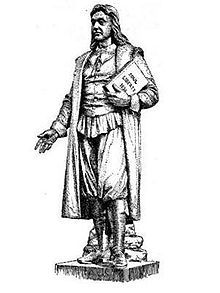
In reality, however, the use of the precise phrase dates back to Roger Williams (illustration), the first Baptist in America, in the early 17th century. Williams used the phrase in 1644 (“Mr. Cotton’s Letter Lately Printed, Examined and Answered”) to describe the Baptist belief that church and state should be kept separate. A strong advocate of freedom of conscience, Williams’ insisted that the state should not intrude into the free exercise of religion, and that religion should be disestablished from government.

Why did Roger Williams want to build a “wall of separation” between church and state? From the fifth century through the Reformation, church and state ruled together, and the marriage consistently produced wars, destruction, killings, and intense persecutions of those who did not embrace state religion. Yet there was more. Williams realized, as had the first generation of Baptists before him (the Baptist faith emerged in 1609 in Amsterdam, Holland), that state religion – even in the guise of Christianity – was false religion. True religion, according to Baptists, was voluntary and came from a free conscience, as taught by Christ. State operated or approved religion, therefore, was the enemy of genuine faith.

Persecuted for his beliefs (and nearly to the point of death) by the Puritan (Congregational) state church of New England, Williams purchased land from Native Americans and founded Providence Plantations (now the city of Providence, Rhode Island) in 1636, and eight years later was instrumental in the establishment of the colony of Rhode Island.

Providence, initially, and then Rhode Island, were founded on the principles of freedom of conscience, full religious liberty, and separation of church and state. The rise and advocacy of these principles was a radical development in the history of colonial America, and Williams and his fellow Baptists in particular were considered, by other Christians, to be liberals, heretics, and infidels.


The generations of Baptists in America who followed Roger Williams continued fighting for the separation of church and state. Christian government officials in both the northern and southern colonies persecuted the heretical sect. Baptists, who refused to pay taxes to the state church and refused to baptize their infants (as the law required), were beaten, whipped, jailed, stoned, shot, waterboarded, and had their lands confiscated. In some cases, church state officials accused Baptist parents of child abuse for not baptizing their infants into the state religion, and in punishment took their children away from them.

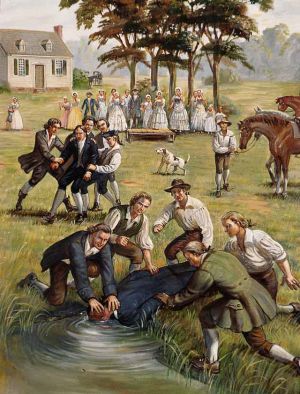
The persecution of Baptists was not isolated. Between 1768 and 1776, roughly one-half of all Virginia Baptist preachers served time in jail for preaching in public, refusing to pay taxes, or otherwise defying the theocratic Anglican government in Virginia. In the painting above, Virginia Baptist minister David Barrow is being waterboarded in 1778 by Virginia’s church-state officials, for his heretical views.

In the 1770s, as America rebelled against Great Britain, most colonies were yet ruled by church states. Even as colonial governments and politicians proclaimed political freedom from England, they denied religious freedom to Baptists.

Yet, Baptist patriots proved valuable in the fight against Great Britain, and soon Baptists in Virginia were able to acquire new, powerful allies in the fight to separate church and state. Among their allies were Virginians James Madison and Thomas Jefferson. Virginia Baptists, most visibly represented by the popular evangelist John Leland, worked alongside the efforts of Madison and Jefferson to secure Jefferson’s 1786 Virginia Statute for Religious Freedom, which separated church and state in colonial Virginia and secured religious liberty for citizens.

Five years later, in 1791, American Baptists’ nearly two centuries-old campaign for church state separation was finally realized in the enactment of the First Amendment of the Bill of Rights to the United States Constitution. Stating that “Congress shall make no law respecting an establishment of religion, or prohibiting the free exercise thereof,” the United States became the world’s first secular nation by enacting the Baptist vision of a “wall of separation” between church and state. As Baptists had long advocated, the First Amendment forbade government from interfering with religious expression (free exercise clause) and forbade the government from establishing or incorporating religion into government (establishment clause).

By 1833, thanks to the still tireless efforts of Baptists, the last vestiges of church state union at the state level were finally eradicated (Massachusetts was the last state to do so).

While Baptists of the late 18th and early 19th centuries – no longer persecuted by church state officials – rejoiced in living under a secular government in which church and state were legally and effectually separated, many conservative Christians (of former official state churches)remained opposed to America’s secular government, and insisted that God would punish America.

Most Christians of the founding era of America understood that the primary Founding Fathers (with one exception) were not Christian in the traditional sense of the word. In the larger context, few Americans (about 10%)attended church in the 1780s, and the primary Founding Fathers were no exception. Indeed, most of the primary Founding Fathers were deists (that is, they philosophically embraced a concept of a distant deity or supreme being, but rejected the divinity of Christ and the Bible).

If one enlarges the definition of “Founding Fathers” to include dozens or even several hundred prominent men who played various roles in the establishment of the American nation, the number of Christians (measured by affiliation) increases, as most were representatives of or leaders within theocratic colonies/states.

That the founding fathers resisted intense pressure by church state leaders to include references to God and Christianity in the U. S. Constitution, and then enacted separation of church and state in the First Amendment, did not sit well with many Christians who once had been the recipient of special government privileges. (Modern attempts, by conservative Christians in America, to reconstruct the primary Founding Fathers as evangelical Christians would have baffled conservative Christians of the late 18th century.)

Thomas Jefferson, by virtue of his prominent role in paving the way for the enactment of separation of church and state in the First Amendment (modeled after Jefferson’s 1786 aforementioned Virginia Statute of Religious Freedom), came to be especially despised by many conservative Christians of the early 19th century.

While Baptists greatly appreciated Jefferson (who in 1802 wrote a now-famous letter of response to praise from and a petition of Danbury Baptists of Connecticut, voicing the Baptist “wall of separation” metaphor to describe the First Amendment’s separation of church and state), many other Christians considered the president a heretic, infidel, and even an atheist.

Today, many conservative Christians place their faith in the myth that America was founded as a Christian nation, arguing that since the words “wall of separation” of church and state are not mentioned in the U. S. Constitution, the concept does not exist.

American Christians living in the 1780s and 1790s would have considered this argument to be ludicrous. They, living witnesses to the founding of America, well understood that America was established as a secular democracy with the separation of church and state (although not all appreciated this state of affairs).


>

Sunday, July 27, 2014

EXCLUSIVE: HHS Bankrolled Catholic and Baptist Church from 2010 to 2013 to Prepare for Obama’s 2014 Invasion!


By Eric Odom278
11:16 pm July 10, 2014


A month or two ago news broke that Obama’s HHS was calling for private contractors to help transport illegal aliens throughout the interior United States. What made this already big news even bigger is the fact that the original call for proposals came out in January, long before the bulk of the illegal alien surge began.

The breaking news you’re about to read is ten times bigger, because the following proves the Obama administration was bankrolling America’s churches back in 2010. And the tens of millions were flowing in to prepare for the invasion currently underway.

The following is a small taste of what’s out there in grant records. This is just the tip of the iceberg, folks.

Between Dec 2010 and Nov 2013, the Catholic Charities Diocese of Galveston received $15,549,078 in federal grants from Health & Human Services for “Unaccompanied Alien Children Project” with a program description of “Refugee and Entry Assistance.”

Last year, the Catholic Charities Diocese of Fort Worth received $350,000 from Department of Homeland Security for “citizenship and education training” with a program description of “citizenship and immigration services.”

Between September 2010 and September 2013, the Catholic Charities of Dallas received $823,658 from the Department of Homeland Security for “Citizenship Education Training” for “refugee and entrant assistance.”

From Dec 2012 to January 2014, Baptist Child & Family Services received $62,111,126 in federal grants from Health & Human Services for “Unaccompanied Alien Children Program.”

Any questions?

Document about Unaccompanied Alien Children Project located here.

H/T Terri Harris Hill for the tip and initial research.

.

Saturday, June 21, 2014

National Baptist convention draws 40,000 to Dallas, including civil rights leader Jesse Jackson


By Stephanie Embree

sembree@dallasnews.com
2:42 pm on June 18, 2014 | Permalink


The Rev. George W. Waddles Sr. is president of the Congress.

The convention center in downtown Dallas has become home to 40,000 people in town for the National Baptist Congress of Christian Education.

Church leaders, including the Rev. Jesse Jackson, will join Baptists from all 50 states, the Caribbean islands, Germany and Africa for one of the largest African-American meetings this year.

“We are a Christian body, and our overall objective is to follow the biblical direction and make disciples,” said the Rev. George W. Waddles Sr., president of the National Baptist Congress.

Through Saturday, members can attend over 300 morning classes dealing with topics such as Christian doctrine and how to be an effective deacon. In the afternoons, there are youth or children rallies and lectures from leaders who will address issues facing church members.


The Rev. Jesse Jackson will speak tonight. (AP photo)

Waddles said the convention aims to teach church leaders and members how to “be more faithful to the call of Christ,” and how to build a family and community on a foundation of faith.

Jackson, the civil rights leader who worked with Martin Luther King Jr., is speaking at a scholarship banquet where college students will be presented with the Dream Makers Scholarship. The program, a partnership with Office Depot, has distributed over $300,000 in the last four years.

The National Baptist Congress, which represents around 7,000 churches in the U.S. and abroad, chose to hold its convention in Dallas after being invited by local reverends. Waddles said that Dallas has been more welcoming than cities they’ve visited in the past.

“There are two things I want the citizens of Dallas to know,” he said. “The first is that we are a diverse group. There’s no one mold that fits us except that we believe in the Lord. The second is that we come as witnesses of the Lord Jesus Christ. We don’t come to offend anybody or shove it down their throats.”


.

Monday, March 03, 2014

The “Wall of Separation”


There is much public confusion today over the phrase, “wall of separation,” in terms of describing the official relationship between church and state in the United States of America. Many conservative Christians, intent upon denying that the concept has any relevance in the founding of America (so as to argue that America was founded as a Christian nation), claim or infer that Thomas Jefferson coined the term a decade after the enactment of the First Amendment.

In reality, however, the use of the precise phrase dates back to Roger Williams (illustration), the first Baptist in America, in the early 17th century. Williams used the phrase in 1644 (“Mr. Cotton’s Letter Lately Printed, Examined and Answered”) to describe the Baptist belief that church and state should be kept separate. A strong advocate of freedom of conscience, Williams’ insisted that the state should not intrude into the free exercise of religion, and that religion should be disestablished from government.

Why did Roger Williams want to build a “wall of separation” between church and state? From the fifth century through the Reformation, church and state ruled together, and the marriage consistently produced wars, destruction, killings, and intense persecutions of those who did not embrace state religion. Yet there was more. Williams realized, as had the first generation of Baptists before him (the Baptist faith emerged in 1609 in Amsterdam, Holland), that state religion – even in the guise of Christianity – was false religion. True religion, according to Baptists, was voluntary and came from a free conscience, as taught by Christ. State operated or approved religion, therefore, was the enemy of genuine faith.

Persecuted for his beliefs (and nearly to the point of death) by the Puritan (Congregational) state church of New England, Williams purchased land from Native Americans and founded Providence Plantations (now the city of Providence, Rhode Island) in 1636, and eight years later was instrumental in the establishment of the colony of Rhode Island.

Providence, initially, and then Rhode Island, were founded on the principles of freedom of conscience, full religious liberty, and separation of church and state. The rise and advocacy of these principles was a radical development in the history of colonial America, and Williams and his fellow Baptists in particular were considered, by other Christians, to be liberals, heretics, and infidels.


The generations of Baptists in America who followed Roger Williams continued fighting for the separation of church and state. Christian government officials in both the northern and southern colonies persecuted the heretical sect. Baptists, who refused to pay taxes to the state church and refused to baptize their infants (as the law required), were beaten, whipped, jailed, stoned, shot, waterboarded, and had their lands confiscated. In some cases, church state officials accused Baptist parents of child abuse for not baptizing their infants into the state religion, and in punishment took their children away from them.

The persecution of Baptists was not isolated. Between 1768 and 1776, roughly one-half of all Virginia Baptist preachers served time in jail for preaching in public, refusing to pay taxes, or otherwise defying the theocratic Anglican government in Virginia. In the painting above, Virginia Baptist minister David Barrow is being waterboarded in 1778 by Virginia’s church-state officials, for his heretical views.

In the 1770s, as America rebelled against Great Britain, most colonies were yet ruled by church states. Even as colonial governments and politicians proclaimed political freedom from England, they denied religious freedom to Baptists.

Yet, Baptist patriots proved valuable in the fight against Great Britain, and soon Baptists in Virginia were able to acquire new, powerful allies in the fight to separate church and state. Among their allies were Virginians James Madison and Thomas Jefferson. Virginia Baptists, most visibly represented by the popular evangelist John Leland, worked alongside the efforts of Madison and Jefferson to secure Jefferson’s 1786 Virginia Statute for Religious Freedom, which separated church and state in colonial Virginia and secured religious liberty for citizens.

Five years later, in 1791, American Baptists’ nearly two centuries-old campaign for church state separation was finally realized in the enactment of the First Amendment of the Bill of Rights to the United States Constitution. Stating that “Congress shall make no law respecting an establishment of religion, or prohibiting the free exercise thereof,” the United States became the world’s first secular nation by enacting the Baptist vision of a “wall of separation” between church and state. As Baptists had long advocated, the First Amendment forbade government from interfering with religious expression (free exercise clause) and forbade the government from establishing or incorporating religion into government (establishment clause).

By 1833, thanks to the still tireless efforts of Baptists, the last vestiges of church state union at the state level were finally eradicated (Massachusetts was the last state to do so).

While Baptists of the late 18th and early 19th centuries – no longer persecuted by church state officials – rejoiced in living in a secular nation that had separated church and state, many conservative Christians (of former official state churches) remained opposed to America’s secular government, and insisted that God would punish America.

Most Christians of the founding era of America understood that the primary Founding Fathers (with one exception) were not Christian in the traditional sense of the word. In the larger context, few Americans (about 10%) attended church in the 1780s, and the primary Founding Fathers were no exception. Indeed, most of the primary Founding Fathers were deists (that is, they philosophically embraced a concept of a distant deity or supreme being, but rejected the divinity of Christ and the Bible).

If one enlarges the definition of “Founding Fathers” to include dozens or even several hundred prominent men who played various roles in the establishment of the American nation, the number of Christians (measured by affiliation) increases, as most were representatives of or leaders within theocratic colonies/states.

That the founding fathers resisted intense pressure by church state leaders to include references to God and Christianity in the U. S. Constitution, and then enacted separation of church and state in the First Amendment, did not sit well with many Christians who once had been the recipient of special government privileges. (Modern attempts, by conservative Christians in America, to reconstruct the primary Founding Fathers as evangelical Christians would have baffled conservative Christians of the late 18th century.)

Thomas Jefferson, by virtue of his prominent role in paving the way for the enactment of separation of church and state in the First Amendment (modeled after Jefferson’s 1786 aforementioned Virginia Statute of Religious Freedom), came to be especially despised by many conservative Christians of the early 19th century.

While Baptists greatly appreciated Jefferson (who in 1802 wrote a now-famous letter of response to praise from and a petition of Danbury Baptists of Connecticut, voicing the Baptist “wall of separation” metaphor to describe the First Amendment’s separation of church and state), many other Christians considered the president a heretic, infidel, and even an atheist.

Today, many conservative Christians place their faith in the myth that America was founded as a Christian nation, arguing that since the words “wall of separation” of church and state are not mentioned in the U. S. Constitution, the concept does not exist.

American Christians living in the 1780s and 1790s would have considered this argument to be ludicrous. They, living witnesses to the founding of America, well understood that America was established as a secular democracy with the separation of church and state (although not all appreciated this state of affairs).


Source
.

Saturday, February 22, 2014

Fitzgerald: Anti-casino clergy are minding their business


Photo by: Jacob Belcher

MAKING THEIR VOICES HEARD: Father George Szal, S.M., foreground, pastor of Immaculate Conception church, and Pastor Nick Granitsas from First Congregational Church of Revere are opposed to a proposed casino in Revere.


Saturday, February 22, 2014


By: Joe Fitzgerald

This one’s for George Szal, who pastors Immaculate Conception Church, and for Rabbi Joseph Berman of Temple B’Nai Israel, and for Nick Granitsas, who shepherds The First Congregational Church, and for Imam Sherif Shabaka of the Egyptian Association, all Revere clergymen who have felt a moral imperative to oppose casino gambling in their city, warning of its toxic nature.

Bringing their ministries beyond the walls of the places they’ve been led to serve, they call gambling what it is, a disaster for many families.

They are indeed “noble souls,” a term that echoes from history.

In this month that celebrates black history, do you, too, wonder what Dr. Martin Luther King Jr. might think if he could peek in on what’s happening to our society today?

Much would please him, and much would likely break his heart.

But the guessing here is that he’d have looked upon Szal, Berman, Granitsas and Shabaka with great favor.

A third-generation Baptist preacher, King bemoaned the passivity of the clergy who act as if the answer to empty pews is to play it safe at the pulpit.

“I have wept over the laxity of the church,” he said. “I felt the white ministers, priests and rabbis of the south would be some of our strongest allies; instead, all too many have been more cautious than courageous, and have remained silent behind the anesthetizing security of stained-glass windows.

“I have heard so many ministers say, ‘Those are social issues with which the Gospel has no real concern.’
We are moving toward the exit of the twentieth century with a religious community largely adjusted to the status quo, standing as a taillight behind other community agencies, rather than a headlight.

“I have looked at beautiful churches with lofty spires pointing heavenward and found myself wondering, ‘What kind of people worship here?’ The contemporary church is often a weak, ineffectual voice with an uncertain sound. Far from being disturbed by the presence of the church, the power structure of the average community is consoled by the church’s silent sanction of things as they are.

Power structure? That sounds a lot like those carpet-bagging high-rollers now wishing the Revere clergy would mind its business, which is rather ironic. Do they not realize the business of the church is to be its brother’s keeper?

“I am thankful,” King went on, “that some noble souls have broken loose from the paralyzing chains of conformity (and) left their secure congregations with the faith that right defeated is stronger than evil triumphant.”

He’d have found such noble souls in Revere this morning.


Source
.

Monday, July 08, 2013

Satanic graffiti found on Gastonia church


Crime


Credit: NBC Charlotte


by AMY COWMAN / NBC Charlotte

Posted on June 13, 2013 at 12:42 PM

Updated Thursday, Jun 13 at 5:52 PM


GASTONIA, N.C. -- Vandals strike a Gastonia church spray painting hateful words and images. This happened the same week that children are at Covenant Baptist Church for vacation bible school.

"Can't understand why anybody would do something like this? How much did they accomplish," questioned Pastor Olin Byrum.

A blanket covers up the graffiti in the back of Covenant Baptist Church in Gastonia. Vandals wrote an expletive word and then God plus an upside down cross. Pastor Olin Byrum says it's very disheartening.

"We're trying to reach out to people, share Christ with others, and now we have to spend time doing things like that," said Byrum.

It's spray painted on the back of the church where the kids play on the playground. All this week they've had vacation bible school for the children.

"Fortunately they haven't been back here, so, and hadn't even wanted to come back here, so I guess that's good for us; we've kept them busy.”

The church has already tried twice to clean the graffiti off with no luck so far. Pastor Byrum says he just wants the people responsible to come forward, take responsibility and they are forgiven.

"I just can't understand why you'd do something like that, of course there's no hate, God loves them, we love them hopefully they'll repent and see the error of their ways," Byrum expressed.

Vacation Bible school continues Friday, meanwhile they say they believe they'll have to sandblast the wall to get the graffiti off.

So far no arrests have been made in the case.


.

Monday, July 01, 2013

Baptist World Alliance: annual gathering


Mon, July 1, 12am – Sun, July 7, 12am

Where - Ocho Rios, Jamaica

Calendar - Religion calendar

Created by - religionnewsservice@gmail.com

Description  - Contact: Emmett Dunn at 703-790-8980; email: emmett(at)bwanet.org; website: www.bwanet.org


.
.


Thursday, February 02, 2012

Bishop Eddie Long is crowned 'king in God's government' (VIDEO)

Bishop Eddie Long is crowned 'king in God's government' (VIDEO)

'King' Eddie Long

Bishop Eddie Long, the subject of sexual allegations made by male members of New Birth Missionary Baptist Church, is making headlines again. This time it's because video of one of his church services has gone viral.

Long has recently started performing church services again after briefly stepping down as head pastor from the church due to a sex scandal and subsequent divorce from his wife. This Sunday, however, he invited a special guest, Rabbi Ralph Messer. The church televised a very special edition of worship service as the rabbi crowned the bishop as "king".

WATCH THE VIDEO OF THE CEREMONY HERE

In this 14 minute-long video clip, Messer reveals to church members a priceless 312-year-old scroll apparently recovered from Auschwitz after World War II. After introducing Long, he says, "He was brought through the slaves, raised up in a city, and God now wants to release a new anointing."

At around the five-minute mark, Messer wraps an emotional Eddie Long in the scroll. After more prayer and being fully wrapped in the scroll, which is said to be done for kings in Israel as a Jewish ritual, four men from the church proceed to "raise him up from a commoner to a kinship." Long is paraded around the church stage so that members are able to applaud their new king.


Source


Tuesday, January 31, 2012

Finding the Fullness of Faith

Finding the Fullness of Faith
[2006]

Starring: Steve Ray
Director: ------


In this exciting DVD, Baptist convert Stephen Ray shares deep insights and effective arguments to win over even the hardest of hearts. You'll be swept away as this best-selling author and apologist shares his journey to Catholicism and investigates the primary stumbling blocks of those who vehemently oppose the Church, the issues of salvation and the Papacy.

Stephen Ray was raised in a devout, loving, Baptist family. Always a zealous instructor of Sacred Scripture, he nearly fell off his chair when a close friend, an Evangelical pastor, converted to Catholicism.

Steve and his wife Janet began a personal pilgrimage that would radically change their lives. After serious study and much prayer, the Rays became convinced that the Roman Catholic Church was the Church founded by Christ almost 2000 years ago. They also realized that Catholicism faithfully and fully continued the Apostolic teaching as understood by the Fathers, the Councils and gloriously preserved through the See of Peter.

Run Time: 86 Minutes
Current Reviews: 1

This product was added to our catalog on Wednesday 23 July, 2008.

Source


.

Tuesday, January 24, 2012

Grand Rapids pastor charged with embezzlement to keep preaching

6:59 AM, January 24, 2012

A West Michigan pastor who authorities say embezzled from his church plans to preach there on Sunday.

The Rev. Arthur Pearson Sr. of Pilgrim Rest Missionary Baptist Church in Grand Rapids was charged in December with embezzlement. A separate civil lawsuit claims he misappropriated up to $237,000 since 2008.

The Grand Rapids Press reports Pearson's lawyer Jerry Ashford says he expects Pearson to preach following a judge's decision Monday.

Kent County Circuit Court Judge Dennis Leiber said he had no authority to decide whether Pearson should be on church property. Leiber kept in place conditions of a Dec. 30 preliminary injunction including no access to church finances.

Bernard Schaefer, an attorney for church trustees, says it will be up to church members, trustees and Pearson to work out details.


.

Saturday, December 04, 2010

What Does The Bible Teach About A Woman's Role In The Church, Home and Government?

General Conference SDA - Inter-American Division
.Commissioning Ceremony
Commissioning Ceremony
Martinique, Nov. 6, 2010 [Photo: Libna Stevens]

-------------------

Pastor David L. Brown, Ph.D.
1996 David L. Brown


In 1963 Betty Freidan s book, The Feminine Mystique, was published and it popped the lid off "Pandoras Box" releasing the Womans Liberation Movement. American culture has not been the same since. Womans lib has touched every facet of American culture and now it is increasingly coming into the evangelical and fundamental church.

This past year my aunt Mildred died. She was one of the almost 4,000 ordained and licensed women in the Assemblies of God.

I was brought up in the United Methodist Church. I remember on more than one occasion having a woman preacher in the pulpit. In fact, there are 4,743 women "clergy" in the ranks of the United Methodists today. One of them pastors the Methodist church in this town.

Our family briefly vacationed in Florida this past winter. We stayed with a retired Christian friend. I had been the assistant pastor of this womans husband back in the early 70s. We attended church with her the Sunday we were there. It was a Southern Baptist Church. I was shocked when a woman got up and preached the sermon. Upon doing some research I find that there are about 1000 ordained Southern Baptist women clergy despite a 1984 Convention resolution stating that the Scripture "excludes women from pastoral leadership." In a September 1993 meeting of the SBC Executive Committee, a measure to expel congregations for ordaining women was rejected unanimously.

The Presbyterian Church (U.S.A.) has 2,419 female leaders. In 1979 the United Presbyterian Church, forerunner of the Presbyterian Church U.S.A., adopted a resolution REQUIRING the congregations to elect women elders. This politically correct denomination also voted to ban the ordination of any man who opposed women clergy and gave such men 10 years to change their minds or get out (EP News Service, June 21, 1980).

The United Church of Christ has 1,803 female leaders while the Evangelical Lutheran Church in America has 1,358 ordained women.

The Episcopal Church in the United States, which approved women's ordination in 1976, has more than 1,000. The Episcopalians ordained the first Anglican female bishop in 1989. The General Synod of the "mother church" in England endorsed the concept of female priests in 1993. In 1991 Queen Elizabeth paved the way for female priests by appointing a woman as one of her royal chaplains in Scotland.

The Lutheran Church-Missouri Synod, though more conservative than other Lutheran bodies, is beginning to allow women to preach in regular worship services. A survey showed that about 1,000 LCMS clergymen maintain that the Bible is not opposed to the ordination of women (Christian News, Feb. 13, 1989).

The focus of this study is going to be, What Does The Bible Teach About A Womans Role In The Church? If you read the April 8, 96 issue of Christianity Today you might be convinced woman preachers are OK. Is that true?

I think a good place to begin is to point out the fact that...

THE LORD LOVES WOMEN AS MUCH AS HE DOES MEN

Linda and I recently attended a biblical counseling seminar. One of the topics that Dr. Ed Bulkley was addressing was the biblical chain of command and how it related to men and women. He shared a little statement that may be helpful to you, it was to me -- In soul men and women are equal (Gal. 3:28). In role & function there are differences (Eph 5:23; 1 Tim 2:12).

Galatians 3:28 There is neither Jew nor Greek, there is neither bond nor free, there is neither male nor female: for ye are all one in Christ Jesus.

This verse points out the fact that the spiritual standing of every human being regardless of nationality, class or gender is the same. I like the way one author put it, "the ground is level at the cross. Women matter as much as men..." That is true when our spiritual standing is in focus! And that is clear to see from the life and ministry of Jesus Christ and the apostles.

Jesus taught woman and was ministered to by them --
Luke 10:38-42 Now it came to pass, as they went, that he entered into a certain village: and a certain woman named Martha received him into her house. 39 And she had a sister called Mary, which also sat at Jesus' feet, and heard his word. 40 But Martha was cumbered about much serving, and came to him, and said, Lord, dost thou not care that my sister hath left me to serve alone? bid her therefore that she help me. 41 And Jesus answered and said unto her, Martha, Martha, thou art careful and troubled about many things: 42 But one thing is needful: and Mary hath chosen that good part, which shall not be taken away from her.

Jesus was supported financially by women --
Luke 8:3 And Joanna the wife of Chuza Herod's steward, and Susanna, and many others, which ministered unto him of their substance.

Women were among the first to be saved --
Acts 16:13-15 And on the sabbath we went out of the city by a river side, where prayer was wont to be made; and we sat down, and spake unto the women which resorted thither. 14 And a certain woman named Lydia, a seller of purple, of the city of Thyatira, which worshipped God, heard us: whose heart the Lord opened, that she attended unto the things which were spoken of Paul. 15 And when she was baptized, and her household, she besought us, saying, If ye have judged me to be faithful to the Lord, come into my house, and abide there. And she constrained us.

Lydia was one of the first European converts to Christ.

I refer you back to an earlier quote -- "the ground is level at the cross." There is no difference in the spiritual standing between men and woman. A Christian woman has as much access to God as a man does. God cares about his children regardless of their nationality, race or gender.

THE ROLES OF MEN AND WOMEN ARE DIFFERENT

Though the spiritual standing of men and women are the same before God, he has ordained that men assume the leadership role in the church and home and that women assume the support role. From the dawn of creation men and women were created for different roles, that is clear. Gen 2:18 & 20-24 show that God created Eve from Adam to be his "help meet" (helper or aid).

Genesis 2:21-24 And the LORD God caused a deep sleep to fall upon Adam, and he slept: and he took one of his ribs, and closed up the flesh instead thereof; 22 And the rib, which the LORD God had taken from man, made he a woman, and brought her unto the man. 23 And Adam said, This is now bone of my bones, and flesh of my flesh: she shall be called Woman, because she was taken out of Man. 24 Therefore shall a man leave his father and his mother, and shall cleave unto his wife: and they shall be one flesh.

Note that the support role of women was established before the fall. (See 1 Cor. 11:7-9 for further support). The role of a wife is to support her husband, to make him successful.

Now, if man had not sinned, he would always have ruled with wisdom and love; if the woman had not sinned, she would always have obeyed with humility and meekness. But both Eve and Adam sinned. Turn to --

Genesis 3:16-17 Unto the woman he said, I will greatly multiply thy sorrow and thy conception; in sorrow thou shalt bring forth children; and thy desire shall be to thy husband, and he shall rule over thee. 17 And unto Adam he said, Because thou hast hearkened (obeyed) unto the voice of thy wife, and hast eaten of the tree, of which I commanded thee, saying, Thou shalt not eat of it: cursed is the ground for thy sake; in sorrow shalt thou eat of it all the days of thy life;

The first role reversal in the marital relationship came when Eve submitted to the serpent and not God or her husband and when Adam obeyed Eve and not God. As a result God said that the husband would rule over his wife and she was to submit to his headship. The word rule means to govern or to have dominion.

Now, perhaps you are wondering what does this have to do with the church and the womans role in the church.

A WOMANS ROLE IN THE CHURCH

To answer that question we need to look at -- 1 Timothy 2:11-14 Let the woman learn in silence with all subjection. 12 But I suffer not (do not allow) a woman to teach, nor to usurp authority over the man, but to be in silence. 13 For Adam was first formed, then Eve. 14 And Adam was not deceived, but the woman being deceived was in the transgression.

These verses do not leave much to the imagination. First, a woman could and should be a learner. But she is not to teacher or preach the Word to men. That would obviously preclude a woman from being a pastor or deacon. Titus 2:4 clarifies that a woman can teach women and children.

I will conclude todays message by turning your attention to 1 Corinthians 14:34-35 Let your women keep silence (to hold their peace) in the churches: for it is not permitted (given liberty) unto them to speak (preach, speak); but they are commanded to be under obedience, as also saith the law. 35 And if they will learn any thing, let them ask their husbands at home: for it is a shame for women to speak in the church.

Biblically, a woman can neither be a pastor or deacon in the church. Neither is she to teach the Word to men. Having said that, I want to make it clear that woman are important to the church and do important things. Their ministry is to revolve around support, service and ministry to woman and children.

The woman who fulfills the role God established for her is not inferior but is a Godly woman.

WHAT HAPPENS WHEN MEN FAIL TO LEAD?

God has established in His Word that men are to be the leaders in the home, church and society. The Biblical role of women is a support role. But what happens when men fail to fulfill their leadership obligation? There is a very sobering passage of scripture that answers this question, Isaiah 3:1-12. There are two verses in this passage that I want to look at -- Verses 4 & 12 And I will give children to be their princes, and babes shall rule over them. As for my people, children are their oppressors, and women rule over them. O my people, they which lead thee cause thee to err, and destroy the way of thy paths.

These verses indicate that when men fail to lead as they should then women and children will fill the vacuum. When that happens the results are disastrous. God sends judgment when he is disobeyed. There are several biblical examples to support this. Queen Jezebel is one example (1 Kings 18, 19 & 21) of a woman who usurped her husbands authority. She persecuted the prophets of God and put a price on Elijahs head. As for child oppressors, consider for a moment the rule of Manasseh. He was installed as king at age 12. His reign was long and wicked (696-642 B.C.) and the Lord blames him for the downfall of Judah (2 Kings 21:10-16).

I want to make it clear. Gods perfect will is for men to lead in government, in the home and in the church. It is Gods perfect will for women to assume the support roles in the home, church and perhaps the government not the leadership roles. When men are strong and obedient to Gods commands, there is not a serious problem with what the women, particularly when the women are obedient to Gods will. But when men are weak, lazy or cowardly, there are going to be problems. When men are not obeying God and not being spiritually what they are supposed to be, God responds in judgment by allowing a role reversal to take place, that is dominant women and oppressive children.

Thats why there are major problems in homes, churches and government in our day. Thats why the youth crime rate is going ballistic. Thats why women are "wearing the pants" in the family and the church. Thats why more women are being elected to public office.

How Do You Explain Deborah?
Perhaps there are those who are wondering, "If you really believe that men are to be in the leadership roles and women in the support roles, then how do you explain Deborah (Judges 4:4-5)? Why did God make Deborah a judge in Israel?" The answer is not difficult. God's perfect will is for men to lead, but when men will not assume their responsibilities, God uses women. The men in Deborah's day were weak and chicken-hearted. Barak, the captain of the armies of Israel, proves this to be true. He refused to go into battle unless Deborah went with him. Deborah had to remind him that God had said it is time to fight. Deborah had to encourage and challenge him to go. Deborah had to go with him!

"And Barak said unto her, If thou wilt go with me, then I will go: but if thou wilt not go with me, then I will not go" Judges 4:8

Deborah clearly realized that this was neither right nor natural for her to have the leadership position. She even tells Barak it would result in shame upon his name. "And she said, I will surely go with thee; notwithstanding the journey that thou takest shall not be for thine honour; FOR THE LORD SHALL SELL SISERA INTO THE HAND OF A WOMAN..." Judges 4:9.

Obviously it was a period in Israel's history during which God could find no man to do His will, so He used a brave, willing woman.

The root problem in Deborah's day was spiritual apostasy. Where there is spiritual apostasy in a nation, a church, or a home, God sends his judgment by rendering the men powerless against their enemies. He removes discernment and true wisdom from their thinking.

This is exactly what is happening in our nation today. We are under Gods judgment because our leaders are weak and godless. Thats why parents cannot control our little children, and women are in places of leadership where they should not be. It is God's judgment because of the apostate condition of professing Christendom. Just as Israel in Deborah's day was in bondage to their enemies because of their apostasy so America is walking down that same path. Men, we need to get back to the Biblical chain of command --

1 Corinthians 11:3 But I would have you know, that the head of every man is Christ; and the head of the woman is the man; and the head of Christ is God.

Men, we need to be the kind but firm leaders in our homes and churches that God has ordained in His Word. Colossians 3:19 gives husbands an important command -- In doing a word study of the phrase be not bitter I found the idea is, dont treat your wife harshly which makes her bitter. Thats good advice.

HOW CAN WOMEN SERVE CHRIST & HIS CHURCH?

While it is clear that women are not to be preachers, deacons, teachers or spiritual leaders because that would place them in a leadership role over men (1 Tim 2:11-14 & 1 Cor 14:34-35) there are other things that women can and should do.

Women can teach & evangelize other women
Titus 2:3-5 The aged women likewise, that they be in behaviour as becometh holiness, not false accusers, not given to much wine, teachers of good things; 4 That they may teach the young women to be sober, to love their husbands, to love their children, 5 To be discreet, chaste, keepers at home, good, obedient to their own husbands, that the word of God be not blasphemed.

Mature Christian women are to disciple the younger woman teaching them to exercise self-control (be sober), to be affectionate to their own husbands, to be fond of their children, to be self-restrained in their passions and desires (discreet), modest and focused sexually only on her own husband (chaste), domestic, a stayer at home, upright in character (good), and obedient to her husband.

Further, women can and should minister the word to other women as well. Turn to Acts 21:8-11. In this passage we will see that Philip the evangelist had 4 unmarried daughters that ministered the word of God. Some point to this passage as evidence that women can be preachers, but the context shows differently. Paul and his helpers stayed with Philip and his family. But when God wanted to reveal something to Paul prophetically, he did not use any of Philips daughters. He used a male prophet from another city named Agabus. This shows us that the girls ministry must have been with among other women. Lets read the passage.

And the next day we that were of Paul's company departed, and came unto Caesarea: and we entered into the house of Philip the evangelist, which was one of the seven; and abode with him. 9 And the same man had four daughters, virgins, which did prophesy. 10 And as we tarried there many days, there came down from Judaea a certain prophet, named Agabus. 11 And when he was come unto us, he took Paul's girdle, and bound his own hands and feet, and said, Thus saith the Holy Ghost, So shall the Jews at Jerusalem bind the man that owneth this girdle, and shall deliver him into the hands of the Gentiles.

Women can assist and serve in the church in a variety of areas
Romans 16:1-2 I commend unto you Phebe our sister, which is a servant of the church which is at Cenchrea: 2 That ye receive her in the Lord, as becometh saints, and that ye assist her in whatsoever business she hath need of you: for she hath been a succourer of many, and of myself also.

The word translated servant is the Greek word diakonos (dee-ak'-on-os). It literally means to run on errands; an attendant, a waiter at table or in other serving duties. The word in the masculine gender is diakoneo(s) (dee-ak-on-eh'-o) appears in the New Testament about 68 times and is translated serve, minister, administer every time but 5. Five times the word refers to the office of a deacon that can only be held by men (1 Tim 3:8-13; Acts 6:1-7). I bring this up because there are some who try to say that Phebe held the office of a deacon. She did not. She was a servant, a helper around the church and she succoured (assisted, helped or was hospitable) to many, including Paul.

Turn to 1 Timothy 5:9-10 Let not a widow be taken into the number under threescore years old, having been the wife of one man, 10 Well reported of for good works; if she have brought up children, if she have lodged strangers, if she have washed the saints' feet, if she have relieved the afflicted, if she have diligently followed every good work.

You might wonder why I have turned you to this passage. This passage gives the qualifications for widows that were considered worthy of regular support by the local church. She was to have a history of good works, been a faithful mother, been hospitable to strangers, been willing to serve fellow Christians in menial ways, as well as help those who are in distress. In short, she has a history of diligent labor for the Lord.

Acts 9:36-39 gives us the example of this kind of woman. Her name was Tabitha or Dorcas. She had made clothes for many of the believers. May the Lord raise up many Godly women like Dorcas in this church. Women with a servants heart.

Women can share the gospel in a private context
Priscilla and Aquila shared the Gospel with Apollos privately. It was a team effort but it is clear from the passage that she took part (Acts 18:26). I believe the Bible allows women can share the gospel in a non-public context with a man if the opportunity presents itself as long as 1) it is done with the husbands permission 2) it is done discreetly and 3) as long as she avoids the appearance of evil.

Further, women can be involved in support roles in church or missionary work. Philippians 4:2-4 I beseech Euodias, and beseech Syntyche, that they be of the same mind in the Lord. 3 And I entreat thee also, true yokefellow, help those women which laboured with me in the gospel, with Clement also, and with other my fellowlabourers, whose names are in the book of life. 4 Rejoice in the Lord alway: and again I say, Rejoice.

I will conclude by saying I praise the Lord for all the women who follow the Biblical model. May God increase your number. Likewise I praise the Lord for men who are striving to be what they should be spiritually. We need you. We need MORE of you.

E-mail: FirstBaptistChurchOC@gmail.com
.
Source
.