Showing posts with label Baptists. Show all posts

Monday, June 15, 2026

How True Christianity and Christian Persecution Now Hinge on Bending the Knee to Trump


Ep134: How True Christianity and Christian Persecution Now Hinge on Bending the Knee to Trump

Thursday, June 11, 2026 — You're listening to Highest Power: Church + State, a weekly podcast from Baptist News Global, hosted by Rick Pidcock. Support faith-based journalism at baptistnews.com.


Tuesday, June 09, 2026

Southern Baptists Want to Shrink First Amendment Protections


As messengers to the Southern Baptist Convention gather in Orlando, Florida, this week, they will debate several significant issues, including an effort to further restrict women from serving in ministry or even talking publicly about Scripture. And those gathered at the annual convention of the nation’s largest Protestant denomination will also consider several resolutions through which to sound off on key issues like assisted suicide, antisemitism, and immigration. But it’s the proposed resolution on “the 250th anniversary of the United States” that caught my eye for its rhetorical sleight of hand.

At first glance, the resolution seems like a good effort to particularly highlight “the Baptist contribution to religious liberty” during this year’s Semiquincentennial celebrations. It’s much milder in its “God and country” mixing than I expected, acknowledges the nation has often been wrong (including with slavery), and insists that we should protect “religious liberty for all people.”

But there’s a sneaky way the First Amendment’s religious clauses are summarized: “which guarantees the free exercise of religion and prohibits the establishment of a state church.” While it correctly uses the Constitutional language for protecting “the free exercise” of religion, it misquotes the other clause. The First Amendment prohibits “an establishment of religion,” but the resolution instead says it stops “the establishment of a state church.” That’s not the same thing.

Sunday, March 29, 2026

Pray for ‘freedom in Christ, freedom of religion’ in Iran


March 11, 2026 By Benjamin Hawkins


Benjamin Hawkins, editor of The Pathway

Missouri Baptist and Southern Baptist leaders alike have called for prayer amid rising conflicts in the Middle East. God has been moving in Iran for many years, and He is continuing to work for the salvation of men and women in the region.

Last year, as tensions with Iran began to rise, I spoke with my friend Ayman Ibrahim, who serves as a professor of Islamic Studies at the Southern Baptist Theological Seminary. Christianity is expanding in the region, he told me.

“I know that Christians are growing in number in Iran, but we have no real significant statistics,” he said. “We don’t know if it is 5 million,”—a high estimate according to some—”or more, or less. I don’t know. However, we know that Muslims in Iran are abandoning Islam in droves. Some of those … are running to Christ. There is no doubt about that. And I know that the church in Iran, even if it’s persecuted and it’s marginalized, they are doing a very good job.”


Screenshot of IMB map

In 2022, Ibrahim wrote an article for The Gospel Coalition that may help us get a picture of the spiritual state in Iran—and, potentially, of the opportunity for gospel impact in the region:

“Consider Iran’s Muslims: In September 2020, findings from an academic study of Iran’s secular shift appeared in The Conversation. Droves of Iranians are abandoning Islam. While Iran’s official census claims 99.5 percent of the population is Muslim, the survey found only 40 percent of Iranians identified as Muslim. If true, this suggests Iran may no longer be a Muslim-majority country.”

Thursday, January 01, 2026

Project 2025 Bingo: An update

Analysis Mara Richards Bim | December 30, 2025


With the current administration’s effort to “flood the zone” and obfuscate their illegal and immoral shenanigans, one would be forgiven for forgetting the origins of what has become known as Project 2025.

Project 2025, technically called “The Mandate for Leadership,” was released in time for the 2024 election. It was a policy document created by the Heritage Foundation that offered the next Republican president a blueprint to enact from Day One.

The document was so deeply troubling that Donald Trump infamously distanced himself from it, saying he’d never read it and had no interest in it. Yet, within days of his reelection, he hired the key architects of the plan to hold positions of power within his administration — chief among them Russell Vought.

The plan was and remains so troubling for so many because it advocates not for smaller government but for a larger government used like a sledgehammer to bend the will of the people toward the autocratic vision of a few.

“It’s time to revisit Project 2025 and see what was (and wasn’t) on our Bingo cards.”

Friday, June 30, 2023

Southern Baptists uphold expulsion of churches with women pastors – but the debate’s not just about gender

In Southern Baptist history, rules on women and sexuality are often entwined. A scholar writes about the first congregation to be expelled from the SBC over LGBTQ+ issues


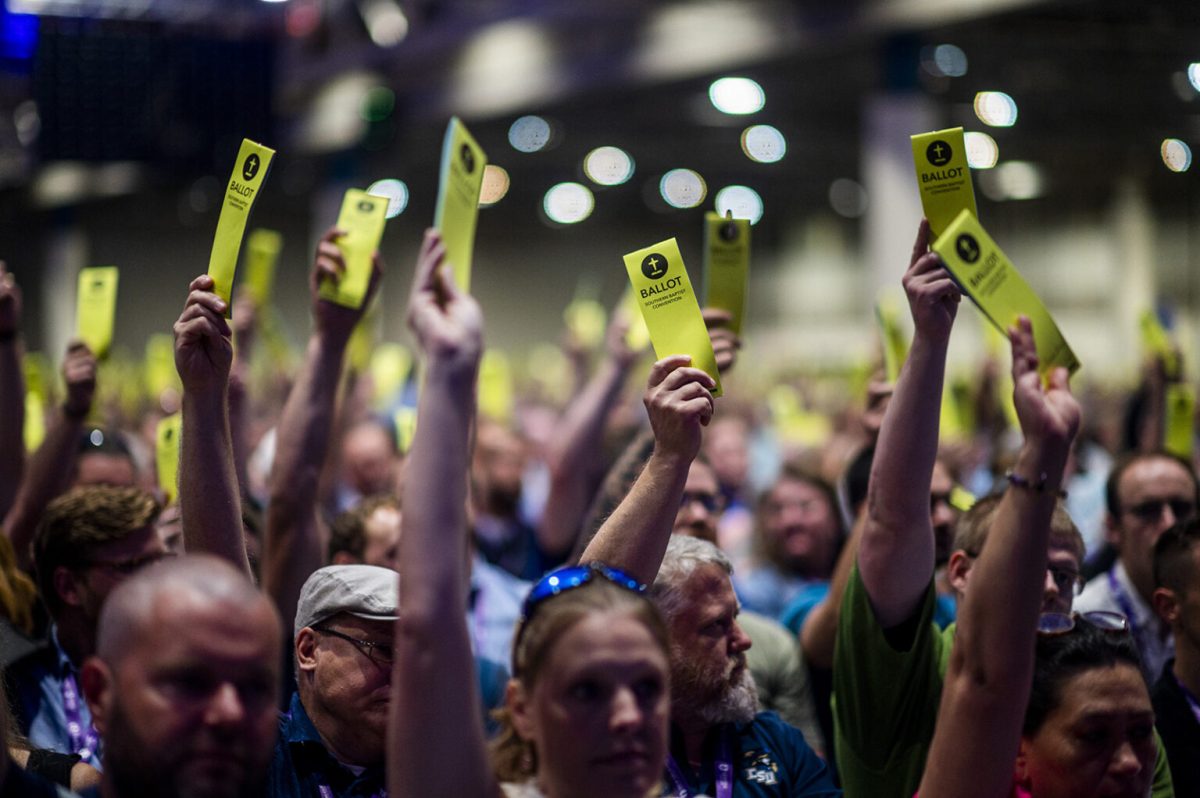
Attendees, or ‘messengers,’ hold up their ballots during the Southern Baptist Convention’s annual meeting in 2022. AP Photo/Jae C. Hong


June 27, 2023 


The Southern Baptist Convention, the largest Protestant group in the United States, overwhelmingly voted to uphold its Executive Committee’s expulsion of two congregations with women pastors on June 14, 2023, during their annual convention.

SBC messengers, as convention delegates are called, also put forward an amendment to make churches’ membership within the denomination contingent upon prohibiting women pastors, which will be voted on next year.

Media coverage of this debate has focused on gender. However, as a scholar of Baptists in the U.S., I believe an underlying conversation about sexuality has also shaped the church’s opposition to women preaching.

A denomination’s decisions about one social issue often influence its position on others, as I have written about with sociologist Gerardo Marti. We argue that the SBC’s stance on issues of gender and sexuality have not always been just about fidelity to their interpretation of scripture. Rather, the SBC uses these issues to differentiate itself from other, more progressive denominations.

My recent book, “Binkley: A Congregational History,” examines the history of one of the first congregations to be expelled from the SBC over the issue of sexuality, in 1992.
Gay and called

In 1990, a Duke Divinity School student named John Blevins, who was openly gay, began attending the Olin T. Binkley Memorial Baptist Church in Chapel Hill, North Carolina. After his first year of Divinity School, he approached the church about the possibility of being ordained.

Friday, October 05, 2018

Baptist leader promotes balanced view of religious liberty before Senate panel


Bob Allen | October 3, 2018


A Baptist church-state specialist warned a Senate panel Oct. 2 against “a growing misunderstanding and sometimes willful distortion” of the constitutional right to free exercise of religion.

Amanda Tyler, executive director of the Baptist Joint Committee for Religious Liberty, told the Senate Judiciary subcommittee on the Constitution that the other religion clause contained in First Amendment – prohibiting an establishment of religion — is equally important, but often under-appreciated. 


Amanda Tyler testifies before senators at a hearing on religious liberty threats at home and around the world. (BNG photo/Cherilyn Crowe) 


Tyler, one of three witnesses testifying at Tuesday’s hearing on religious liberty threats around the world, said the trajectory of recent court rulings regarding the separation of church and state – including one by Supreme Court hopeful Brett Kavanaugh – “tends to ignore the Establishment Clause.”

In a 2015 dissenting opinion from a decision the U.S. Appeals Court in the District of Columbia, Kavanaugh said the contraceptive mandate in Obamacare created a “substantial burden” on employers with religious objections to paying for coverage for services they deem immoral.

Substantial burden is the first of a three-prong test established in the Religious Freedom Restoration Act, a federal law passed in 1993 with support of a wide range of faith groups brought together by the Baptist Joint Committee. After determining there is a substantial burden, the law says, government must have a compelling interest before infringing on sincere religious belief, and that interest has to be advanced by the least restrictive means.

Tyler said the problem with Kavanaugh’s dissent – as well as the 2014 Supreme Court case that allowed the owners of the 500-store Hobby Lobby craft store chain to deny health coverage of contraception to more than 13,000 employees – appears to be “a conflation of sincerity and sincerely held religious belief with substantial burden.”

“The courts aren’t really delving into the substantial burden, which is the first part of that balancing test, before moving to have the government show a compelling government interest,” said Tyler, an attorney and former congressional aide. “Instead, it’s almost as if there is an automatic exemption that’s given whenever a claim is raised.” 


Amanda Tyler talks with Sen. Ted Cruz, chairman of the Judiciary Committee subcommittee on the Constitution. (BNG photo/Cherilyn Crowe.) 


Tyler said under RFRA “it is right for claimants to be able to raise their free exercise rights,” but “there must be a balancing with the rights of others as well.”

Tyler said the 5-4 Supreme Court decision siding with the evangelical Christian family that owns Hobby Lobby tilted the scale.

“When you read the court’s opinion, they really gloss over the entire substantial burden question and just say that those beliefs are sincerely held,” Tyler said. “We would be better served if courts would engage in a discussion about what constitutes a substantial burden.”

Tyler said granting special rights to one group at the expense of someone else contributes to polarization in a pluralistic society.

“I do agree that American unity around and support for religious freedom is in jeopardy right now,” she said, “and one way to restore it is to restore our commitment to defending both the no-establishment clause and the free-exercise clause of the First Amendment.”

Tyler also cautioned senators to “beware of the use of the term religious liberty to promote bad policy,” such as President Trump’s campaign to destroy the Johnson Amendment, the provision that prevents charitable organizations which benefit from tax-exempt status from engaging in partisan electioneering.

“I do agree that American unity around and support for religious freedom is in jeopardy right now, and one way to restore it is to restore our commitment to defending both the no-establishment clause and the free-exercise clause of the First Amendment.”

Tyler said the law, criticized in recent years by conservative pastors who claim it limits their right to speak freely from the pulpit, was on the books and non-controversial for more than 60 years.

“It just separates partisan campaigning from our 501(c)3 sector,” she said. “As campaigns have become more constant in our culture and as billions of dollars are being spent in campaigning, I think that’s been a good thing, to keep our houses of worship and other 501(c)3s non-partisan.”

“You know, sometimes our non-profit communities are some of the last places that we can go and not hear a political ad,” Tyler said. “They’re also some of the last places that are not divided by how we vote.”

Tyler said houses of worship and their leaders “are not seeing a restriction on religious liberty under current law.”

“They are still able to speak out on political issues – no matter how controversial – without being in fear of losing their tax-exempt status,” she said. “They’re also able to engage in non-partisan ways in campaigning. And in their private capacity – without using tax-exempt resources – they can endorse candidates and even run for office themselves.”

“Every religious denomination to address the issue is united in their support for current law,” Tyler said. “Changing the law would fundamentally change their non-partisan character, distract them from their core mission and threaten their independence.”



Saturday, June 09, 2018

#MeToo goes to church: Southern Baptists face a reckoning over treatment of women


"Many women have experienced horrific abuses within the power structures of our Christian world," Beth Moore, an evangelical teacher, wrote in a letter. 

by Alex Johnson / Jun.08.2018 / 4:35 AM ET / Updated Jun.08.2018 / 1:26 PM ET


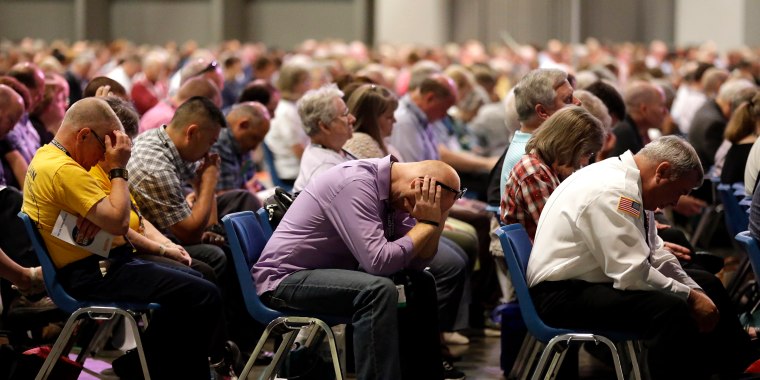
People pray during the annual meeting of the Southern Baptist Convention on June 14, 2016, in St. Louis.
Jeff Roberson / AP file


The Southern Baptist Convention, the country's largest evangelical denomination, is headed for a showdown over its treatment of women that could not only have far-reaching ramifications for the church but also influence the broader secular #MeToo movement.

At its annual meeting next week in Dallas, delegates called "messengers" will decide whether to approve a resolution acknowledging that, throughout the church's history, male leaders and members of the church "wronged women, abused women, silenced women, objectified women."

"The #MeToo moment has come to American evangelicals," Albert Mohler, president of the flagship Southern Baptist Theological Seminary, wrote last month. "And I am called to deal with it as a Christian, as a minister of the Gospel, as a seminary and college president, and as a public leader."

The convention is meeting in the wake of several widely publicized scandals in which prominent Southern Baptist leaders have been accused of or have admitted inappropriate behavior toward women.

"Many women have experienced horrific abuses within the power structures of our Christian world," Beth Moore, a prominent evangelical teacher in Houston, wrote in an open letter last month.

Most recently, the Southwestern Baptist Theological Seminary in nearby Fort Worth fired Paige Patterson, a pre-eminent figure in the denomination's conservative resurgence in recent decades, who had been its president since 2003.

Thursday, May 31, 2018

The Baptist Apocalypse


By Ross Douthat


Opinion Columnist
May 30, 2018


People praying at last year’s Southern Baptist Convention.CreditMatt York/Associated Press


Among Trump-supporting religious believers, the long odds he overcame to win the presidency are often interpreted as a providential sign: Only God could have put Donald Trump in the White House, which means he must be there for some high and holy purpose.

The trouble with this theory is that it’s way too simplistic about what kind of surprises an interventionist deity might have in mind. Such a God might, for instance, offer political success as a temptation rather than a reward — or use an unexpected presidency not to save Americans but to chastise them.

We’re a long way from any final judgment on God’s purposes in the Trump era. But so far the Trump presidency has clearly been a kind of apocalypse — not (yet) in the “world-historical calamity” sense of the word, but in the original Greek meaning: an unveiling, an uncovering, an exposure of truths that had heretofore been hidden.

That exposure came first for the Republican Party’s establishment, who were revealed as something uncomfortably close to liberal caricature in their mix of weakness, cynicism and power worship. It came next for the technocrats and the data nerds of the Democratic Party, who were revealed as ineffectual, clueless and self-regarding in opposing Trump’s clown-car campaign. And then it came for a range of celebrated media men, from Harvey Weinstein to Matt Lauer, who found that in the backlash against Trump’s misogyny their own sins were suddenly exposed.


Sunday, December 17, 2017

Pastors: ‘Draw near to throne of grace,’ set aside time to rest


December 17, 2017


After some 50 years as a preacher — including more than 38 of those years as pastor of Lakeview Baptist Church, Auburn — Al Jackson believes every pastor will have three lifelong “companions” for which he must seek the help of God to manage.

“These (companions) are unwanted but necessary for our sanctification and growth in Christ-likeness,” he said.

“Your first companion as a pastor is fatigue,” he told those attending Shelby Baptist Association’s monthly pastors conference Nov. 7. “Gospel ministry is hard work. … The fatigue we face is physical, emotional, spiritual and mental.

“I read that (the late) Herschel Hobbs once said that a one-hour sermon was the equivalent of a 15-mile walk. Of course, there aren’t many one-hour sermons anymore but many pastors preach in multiple services on Sundays and this takes a toll.”

Finding rest

Jackson pointed to John 4 and Mark 4 where Jesus was fatigued and set aside time to rest. Ministers must find a Sabbath other than Sunday to rest, Jackson said. For him it’s normally Friday — a day he guards.

“I’ve learned to say ‘no’ to some requests that aren’t vital or that others can do, unless this is an emergency, of course,” he said. “I do this in order to pace myself and be faithful to Jesus. And I take every single day of annual leave our church offers me to recharge my batteries.”

Jackson said fighting fatigue includes eating wisely and doing some type of exercise.

The second companion is criticism, he said.

Criticism may be minimal in some seasons and expansive in other seasons but it’s never far away from any leader.

“Jesus was often criticized, so it’s part of the territory when we follow Him,” Jackson said, noting the antidote for criticism is to “draw near to the throne of grace” for God’s mercy and help, as Hebrews 4 teaches.

“And the third unwanted companion is discouragement,” he said. “Jesus was discouraged in John 6 so it’s not a sin to be disappointed. It’s part of our humanness.”

Pastors pour their lives into others, encouraging, nurturing and discipling, and sometimes the work seems fruitless, Jackson said. (Michael J. Brooks)


Wednesday, June 15, 2016

Baptist pastor doubles down post-Orlando: They deserved to die


JUN 15, 2016 9:22 AM EDT U.S.

CBS NEWS


SACRAMENTO -- A pastor at the center of a controversial video praising the massacre of 49 people in an Orlando gay nightclub is standing by his sermon.

Baptist Pastor Roger Jimenezspoke to CBS Sacramento a day after his widely scorned remarks -- which included him saying Orlando was safer because so many gay people died and that he wished "they finished the job" -- drew widespread condemnation.

Jimenez says that despite how many hateful messages are made public, he's privately received messages of support from Baptists and other Christians that thank him for "finally" speaking out.

The video that caused the initial controversy from the Verity Baptist Church's YouTube page has since been removed by YouTube as a violation of the site's policy against hate speech.

The pastor claims he's not trying to incite hate, or advocating for arming up and killing gay people, despite saying in the Sunday sermon hours after the Orlando massacre, "If we lived in a righteous government, they should round them all up and put them up against a firing wall, and blow their brains out."

Instead, he says the deaths shouldn't be mourned because if the victims were gay, then the Bible calls them sinners, and they deserved to die.

California law makes it a crime for any person to threaten to commit an act resulting in death or great bodily injury. Local law enforcement says because Jimenez didn't specifically threaten anyone, his statements are considered to fall under First Amendment protections and are not a hate crime.

"As far as the Bible is concerned, they crossed a line. The sin they performed is worthy of death," he said. "I realize our society doesn't take that, but that's what the bible says. If someone does something that's worthy of death and they end up dying, I'm not gonna mourn them."

He also doubled down on his remarks that Orlando was safer because of their deaths.

"Absolutely I think they are safer now because of these deaths, and the reason I think that is because I believe all of these homosexuals are pedophiles, and the Bible--see our culture and our society puts them in these categories--gay, lesbian, whatever, but that's not found in scripture. And I understand the world does not want to accept that, that's fine. I'm saying as a Christian, the Bible puts people in two categories: normal/natural, unnatural," Jimenez said.

Jimenez bases that last portion on a passage from the book of Romans, a New Testament epistle from the apostle Paul that is separate from the Gospels and the teachings of Jesus Christ. The book is commonly referred to as biblical proof against gays and gay marriage.

Scientific research has repeatedly struck down the bigoted assertion that gay people are more likely to be pedophiles.

Many Sacramento-area pastors say they feel betrayed by this man of the cloth.

Dr. Phillip Goudeax of Calvary Christian Center says Jimenez's hateful sermon is embarrassing to the Christian faith.

"It's really about walking in love and grace and passion and mercy. It's about compassion," he said. "My heart was broken. Nobody deserves to be murdered."


.