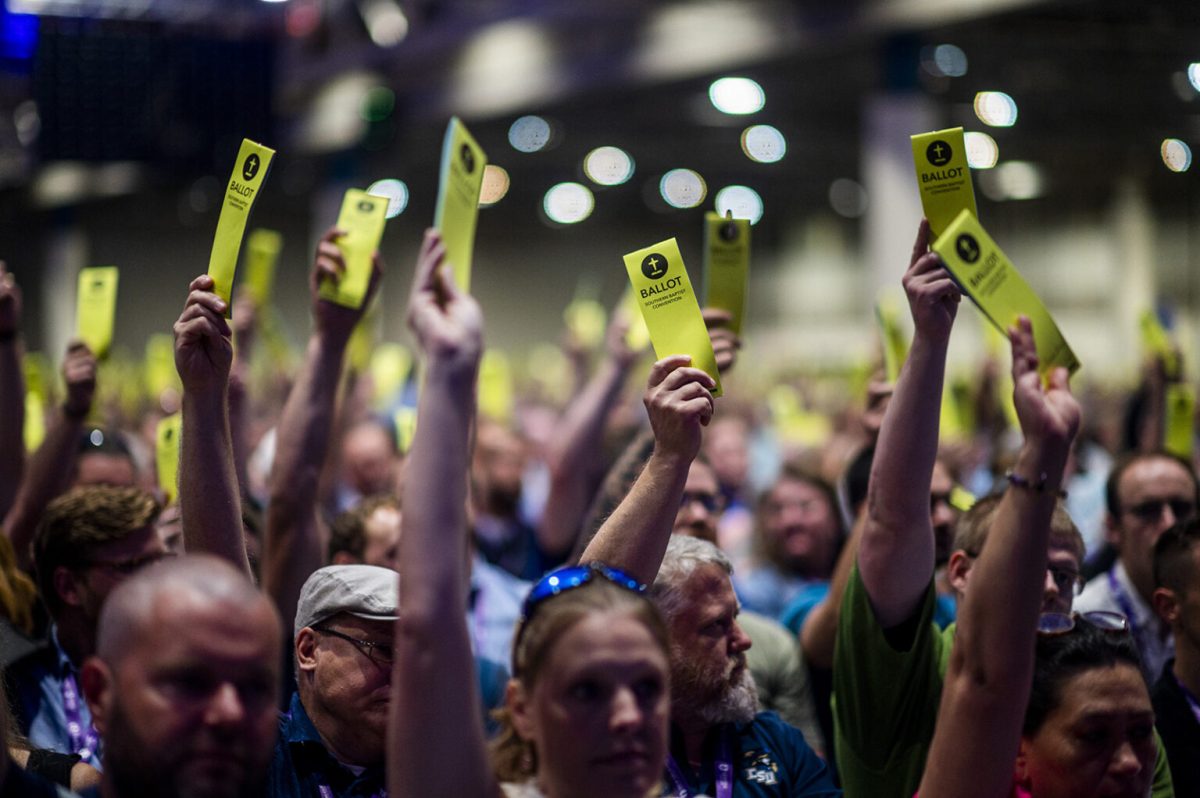
As messengers to the Southern Baptist Convention gather in Orlando, Florida, this week, they will debate several significant issues, including an effort to further restrict women from serving in ministry or even talking publicly about Scripture. And those gathered at the annual convention of the nation’s largest Protestant denomination will also consider several resolutions through which to sound off on key issues like assisted suicide, antisemitism, and immigration. But it’s the proposed resolution on “the 250th anniversary of the United States” that caught my eye for its rhetorical sleight of hand.
At first glance, the resolution seems like a good effort to particularly highlight “the Baptist contribution to religious liberty” during this year’s Semiquincentennial celebrations. It’s much milder in its “God and country” mixing than I expected, acknowledges the nation has often been wrong (including with slavery), and insists that we should protect “religious liberty for all people.”
But there’s a sneaky way the First Amendment’s religious clauses are summarized: “which guarantees the free exercise of religion and prohibits the establishment of a state church.” While it correctly uses the Constitutional language for protecting “the free exercise” of religion, it misquotes the other clause. The First Amendment prohibits “an establishment of religion,” but the resolution instead says it stops “the establishment of a state church.” That’s not the same thing.
Creating an official state church is an example of an establishment of religion, but it’s not the only way to establish religion. If you were to diagram the statements “establishment of a state church” and “establishment of religion,” the first one would be a smaller circle completely within the latter. But there would be other areas within the larger circle not covered by the “state church” circle.
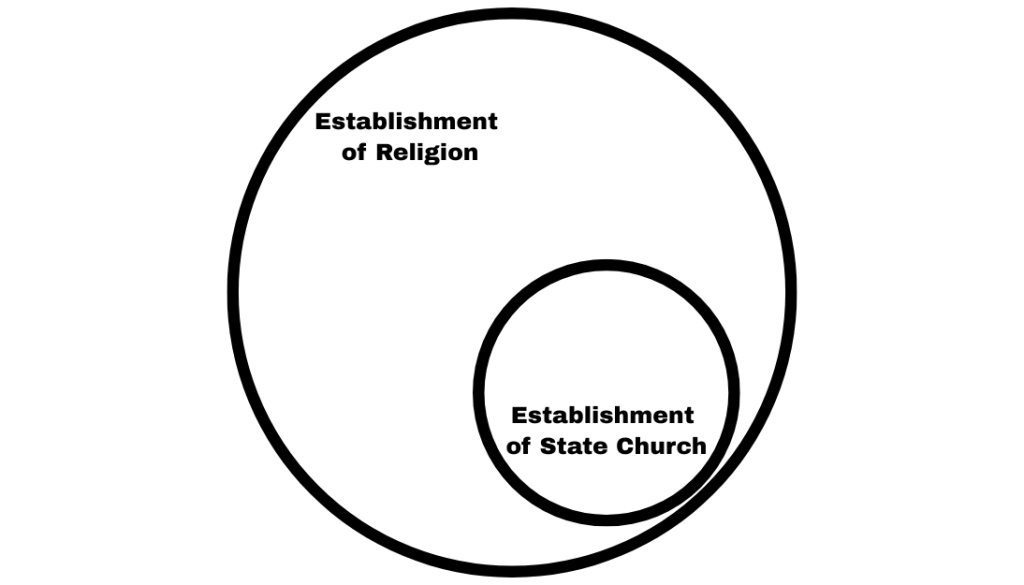
So while it’s good to oppose the creation of a state church, that’s not enough — nor does it accurately describe what colonial Baptists and others pushed for during the founding era that led to the ratification of the First Amendment.
Let’s consider, for instance, John Leland. He’s cited affirmingly in the proposed resolution and, as a contemporary and acquaintance of James Madison and Thomas Jefferson, was part of the push for the First Amendment. In his 1791 sermon “The Rights of Conscience Inalienable,” we find a broader assessment of what religious disestablishment meant for him. He did criticize having a state church, but also attacked British practices like religious tests for office, using government funds for sectarian preaching, and requiring those receiving an army commission to “receive the sacrament of the Lord’s supper.” On other occasions, he also criticized legislative chaplains (something James Madison also argued, and he knew a thing or two about the original intent of the Constitution). The SBC resolution is quiet about such establishment and, with its deliberately narrow establishment language, would seem to be okay with these practices that Leland called “evil.”
“The fondness of magistrates to foster Christianity has done it more harm than all the persecutions ever did. Persecution, like a lion, tears the saints to death but leaves Christianity pure; state establishment of religion, like a bear, hugs the saints but corrupts Christianity and reduces it to a level with state policy,” Leland argued in an 1804 essay.
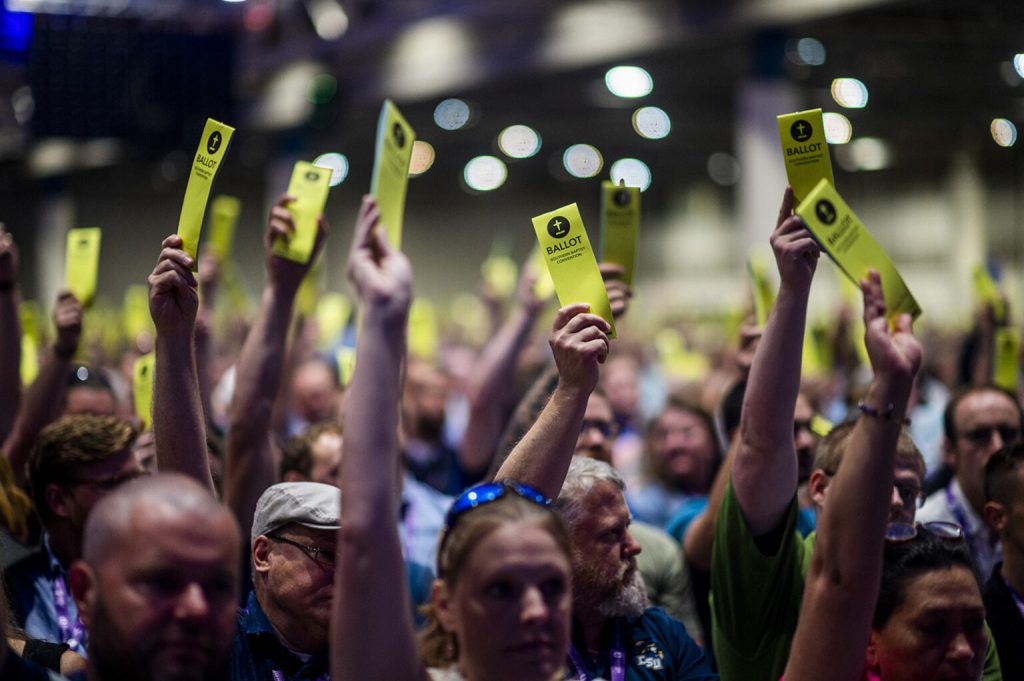
Messengers vote during the Southern Baptist Convention annual meeting in New Orleans, Louisiana, on June 13, 2023. (Emily Kask/Religion News Service)
The SBC’s Resolutions Committee spent hours crafting, parsing, and editing the wording in their proposed statements. The language about the “establishment of a state church” was not an accidental misquoting but a deliberate rewriting of the First Amendment. It echoes rhetoric from Christian Nationalist voices like pseudo-historian David Barton, who has for years tried to pare down the scope of the Constitution’s No Establishment Clause. In doing so, the SBC is not just chipping away at the wall separating church and state but also excising part of the historic Baptist witness.
Words matter. So while the SBC might be resolved to open the door for more Christian Nationalism by seeking some establishment of religion, the voices of Leland, Isaac Backus, Roger Williams, and others remind us to advocate for more than just stopping an official state church. If we shrink the protections of the First Amendment, we reduce the safeguards for our nation and churches.


No comments:
Post a Comment