Showing posts with label commonwealth. Show all posts

Saturday, May 16, 2026

From Rerum Novarum to Today: Pope Leo XIV Prepares to Add His Voice to the Church’s Social Teaching


Hannah Brockhaus
via EWTN
15.05.26


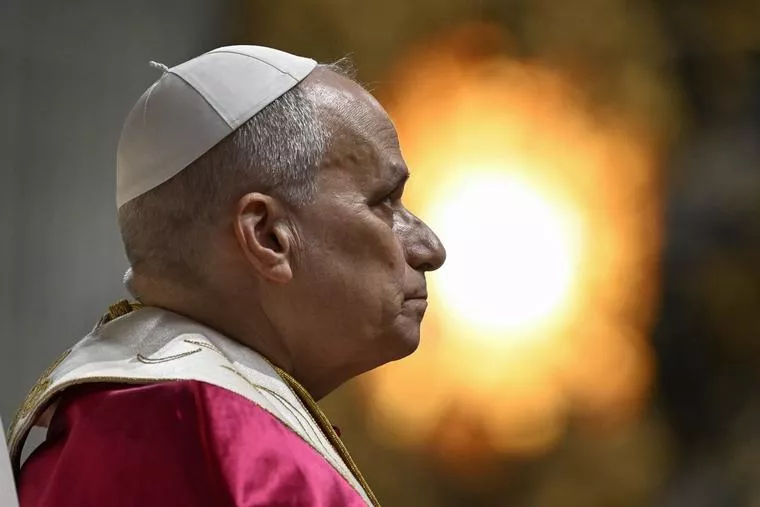
Pope Leo XIV presides over the Prayer Vigil for Peace in St. Peter’s Basilica on April 11, 2026. (photo: Simone Risoluti / Vatican Media)

During his recent apostolic trip to Cameroon, the Pope called on Catholic university students from central Africa to be ‘pioneers of a new humanism in the context of the digital revolution.’

With the publication of his first encyclical just around the corner, Pope Leo XIV is poised to add his voice to the Church’s tradition of social teaching, reflecting on what it means to be human in the midst of a digital revolution.

According to reports, the encyclical — a papal letter to the Church — will be called Magnifica Humanitas, Latin for “Magnificent Humanity.” It is expected to present the Pope’s moral guidance on how to approach artificial intelligence.

As Leo himself indicated in the first days of his pontificate, he will follow in the steps of his predecessor and namesake, Pope Leo XIII, whose encyclical Rerum Novarum, “Of New Things,” is widely considered the first in a long line of social encyclicals produced in the modern era of the papacy.

Catholic social teaching from the late 19th century to today is the Church’s attempt “to articulate itself in constantly new and evolving conditions,” said Anna Rowlands, a theologian and professor of Catholic social thought at Durham University in the United Kingdom.

Wednesday, August 24, 2016

Catholic Order disowns honours awards to Caribbean leaders


Published on August 23, 2016


Screenshot of the “real” Sacred Military Constantinian Order of Saint George website at constantinianorder.org


By Caribbean News Now contributor

MADRID, Spain -- In a press statement on Saturday, the Sacred Military Constantinian Order of Saint George, a Catholic institution based in Spain, disowned what it described as the purported exchanges of decorations between the Constantinian Order and certain Caribbean states, which have been extensively reported in recent weeks by Caribbean News Nowand Britain’s Mail on Sunday newspaper.

The Order’s grand chancellor also disavowed any links with British public relations consultant Anthony Bailey and his “dear friend” Baroness Patricia Scotland, the Commonwealth secretary general.

Scotland has been accused of trying to win support from Commonwealth heads of government during her campaign for the post of secretary general with offers of bogus honours and charitable donations from the Constantinian Order, of which she was purportedly a prominent member.

Those honoured included the prime minister and president of Dominica, who later officially nominated Scotland as their country's candidate for the top Commonwealth post, despite the fact she has not lived there since she was two years old.

“Three articles published in The Mail on Sunday and other online journals have commented on the purported exchanges of decorations between the Constantinian Order and certain Caribbean states. These articles have also referred to Sir /Mr Anthony Bailey, OBE, as having ‘revived’ the Order in the UK, as being the Order’s delegate and as having been responsible for these exchanges. The grand chancery of the Order wishes to make it clear that the Order has never exchanged decorations with any state, that Sir / Mr Anthony Bailey is not now, nor has ever been an officer of the Order or a member thereof, and nor has Baroness Scotland, also referred to in these articles,” the Order said in its statement.

The Order purportedly revived in the UK by Bailey is described on its website as the “Delegation for Great Britain and Ireland”; however, in a follow up email, Guy Stair Sainty, vice-grand chancellor of the Order, said it has no connection with Bailey, his business activities or the order of which he is described as "delegate".


Screenshot of Anthony Bailey’s “revived” Constantinian Order website at constantinian.uk.org, self-described as the “Delegation for Great Britain and Ireland”. Standing fifth from right next to Bailey is the Governor General of Antigua and Barbuda, Sir Rodney Williams
Sainty explained that the Constantinian Order concentrates primarily on its Catholic mission and never "exchanges" it's membership with anyone for any reason, since the would be contrary to the statutes and character of the Order as a Catholic, chivalric, confraternal institution.


“Neither are we interested in expensive entertainments nor in constant publicity, which is why we have not issued any public statement until now, when the good name of our Order has repeatedly been the subject of so much critical commentary,” he added.

Sainty went on to note that the grant of awards for "’interfaith’ services or whatever” to the likes of President Assad of Syria and former President Saleh of Yemen and various state officials in other countries, including the Caribbean, has no worth.

“The self-evident conflict of interest between Mr Bailey's role as a businessman apparently acting on behalf of states for fees, yet exchanging decorations of this controversial Constantinian Order … and then claiming awards in return would appear to be entirely contrary to the spirit of this ancient Catholic institution,” he said.

Following allegations that Bailey used promises of donations and unofficial Constantinian Order honours to obtain a knighthood in Antigua and Barbuda, Prime Minister Gaston Browne has indicated that the knighthood awarded to Bailey is now under “review”.  Two of Bailey’s friends who were knighted with him in Antigua have already had their honours revoked pending an investigation.
Browne said that all three knighthoods had been arranged prior to his Antigua and Barbuda Labour Party (ABLP) coming to power in June 2014.

“By the time we came to office, this was a fait accompli and we honoured the arrangements without any knowledge of the prior discussions,” he said.

Browne is understood to have referred the matter to the local Honours Committee but the governor general, Sir Rodney Williams, who chairs the committee, asked that the review be deferred and, some three months later, little or no action appears to have been taken.

Williams is said to have been the beneficiary of “wining and dining” in London and a paid trip to Rome in November last year to meet the pope at the expense of the Constantinian Order “delegation” and/or Bailey. Williams is married to Sandra Scotland-Williams, a cousin of Baroness Scotland.

Sainty said that the information regarding the status of the Constantinian Order was sent to the governor-general of Antigua and Barbuda on July 11, 2016, to assist him in his review of the awards.

Meanwhile, after allegations surfaced that Bailey also obtained a knighthood from Grenada in similar circumstances, The Mail on Sunday reported over the weekend that this honour is to be rescinded after questions of its legality were raised.

Bailey had reportedly arranged four knighthoods for himself and his cronies in one day from the country, despite only two being allowed per year by law.

Following a cabinet meeting last Tuesday, Grenadian foreign minister Nickolas Steele announced that the award had been rescinded following “legal evaluation and interpretation”.

Bailey was given the knighthood last year, apparently in exchange for promised donations and reciprocal honours from his unrecognised “delegation” of the Constantinian Order.

This award followed meetings between Bailey, Baroness Scotland and the prime minister of Grenada, Dr Keith Mitchell, during which investment on the island was promised.


(L-R): Baroness Patricia Scotland; Grenada Prime Minister, Dr Keith Mitchell; and Anthony Bailey


Sunday, August 18, 2013

Puerto Rico to Renew Debate on Political Status

SAN JUAN, Puerto Rico August 17, 2013 (AP)


The party of Puerto Rico's governor is pushing for a constitutional assembly to help resolve the U.S. territory's political status.

Members of the Popular Democratic Party expect to debate the issue Sunday at their annual convention.

The proposal states that a constitutional assembly should be held if President Barack Obama's administration does not present a Congress-approved measure to resolve the status within a year.

The White House is seeking $2.5 million to finance a future plebiscite that the U.S. attorney general would have to approve before it goes to voters. The announcement earlier this year followed disagreements about the results of a nonbinding, two-part referendum held in November.

Puerto Rico also held nonbinding referendums in 1967, 1993 and 1998, with statehood never garnering a clear majority.


Source
.

Sunday, November 06, 2011

Commonwealth to lift law banning monarchs from marrying Catholics


Monday, 31 October 2011 10:02
Written by Catholic News Service
The law that bans a British monarch from marrying a Catholic is to be lifted after more than 300 yearsThe law that bans a British monarch from marrying a Catholic is to be lifted after more than 300 years

MANCHESTER, England - The law that bans a British monarch from marrying a Catholic is to be lifted after more than 300 years.

The reforms were announced following the unanimous agreement of the 16 nations that have Queen Elizabeth II as their constitutional head of state.

But they will not include the repeal of a Catholic becoming monarch because allegiance to the pope might conflict with the sovereign's role as the supreme governor of the Church of England.

The changes will also see the end of the ancient tradition of male primogeniture, the rule under which boys take precedence in the line to the throne over elder sisters.

The reforms will be included in the next British program of parliamentary business to be unveiled in November, while New Zealand will lead a working group to coordinate their implementation in other Commonwealth countries affected.

The announcement, made at an Oct. 28 summit of Commonwealth heads of government in Perth, Australia, was welcomed by Catholic leaders in Britain.

"This will eliminate a point of unjust discrimination against Catholics and will be welcomed not only by Catholics but far more widely," said Archbishop Vincent Nichols of Westminster, president of the Bishops' Conference of England and Wales.

"At the same time I fully recognize the importance of the position of the established church (Anglican) in protecting and fostering the role of faith in our society today," he said in an Oct. 28 statement.

Cardinal Keith O'Brien of St Andrews and Edinburgh, president of the Scottish bishops' conference, said Oct. 28 that he was pleased to note the process had started to repeal aspects of the laws.

"I look forward to studying the detail of the proposed reforms and their implications in due course," the cardinal said.

In recent years there have been 11 attempts to reform the laws on royal succession, but none has made any meaningful progress, partly because of the difficulty in reforming laws across 16 jurisdictions.

But British Prime Minister David Cameron was able to announce the changes after he won the support of the leaders of Canada, Australia, New Zealand, Jamaica, Antigua and Barbuda, Belize, Papua New Guinea, St. Christopher and Nevis, St. Vincent and the Grenadines, Tuvalu, Barbados, Grenada, Solomon Islands, St. Lucia and the Bahamas -- who would also have to amend their laws.

Announcing the reforms, Cameron, leader of the center-right Conservative Party, said: "Let me be clear, the monarch must be in communion with the Church of England because he or she is the head of that church.

"But it is simply wrong they should be denied the chance to marry a Catholic if they wish to do so," he said. "After all, they are already quite free to marry someone of any other faith."

He said the idea that a younger son should become monarch instead of an elder daughter simply because he is a man was "at odds with the modern countries that we have become."

The reforms may entail amendments to nine acts, including the 1689 Bill of Rights, the 1701 Act of Settlement and the 1772 Royal Marriages Act.

The laws brought to a close centuries of religious turmoil that began in the 1530s when King Henry VIII took the English Catholic Church into schism so he could nullify his marriage to Catherine of Aragon and marry Anne Boleyn, his mistress.

They were brought into force following the deposing of openly Catholic King James II, Britain's last Catholic monarch, in the bloodless coup of 1688, which came to be known as "the Glorious Revolution."

After James' Protestant sister Anne, his successor, failed to produce an heir, the throne was given to Electress Sophia of Hanover, Germany, from whom the reigning House of Windsor is descended.

The abolition of the rule of male primogeniture will apply only to the descendants of Prince Charles, but it will mean that if the first-born child of the Duke and Duchess of Cambridge -- William and Kate -- is a girl, then she will ascend the throne ahead of any younger brothers.


Source

Thursday, October 27, 2011

Protesters expected to clash with police in Perth

October 28, 2011 - 9:32AM


Police are expected to clash with anti-capitalist protesters in Perth this morning as the Queen officially prepares to open the Commonwealth Heads of Government Meeting.

Around 1000 demonstrators are expected to descend on the city as the Queen delivers her address to Commonwealth nations, Fairfax radio reported.

With the centre of Perth virtually in lockdown, protesters have vowed to break through security barricades and bring matrasses and tents as they prepare to stay for the long-haul.

Authororities have already warned the demonstrators to keep the peace as thousands of police will not hesitate to use tough CHOGM laws to turn them away.

The Gillard government said it wanted this Commonwealth meeting one to be remembered but obviously for the right reasons.

CHOGM will officially launch at 10am today when as 53 leaders of Commonwealth nations will descent on Perth's Convention and Exhibition Centre.

Interstate police have been flown in to boost numbers and ensure security. Police are expected to have a large present at Forrest Chase in the city's centre, where protesters are readying to march through the city.

A two-year study on the relevance of the Commonwealth will dominate today's discussions with the member nations.

Thursday, November 26, 2009

UN, France push climate at Commonwealth summit


The 53-nation Commonwealth has given Sarkozy the rare opportunity to address the event


By Marc Burleigh (AFP) – 3 hours ago

PORT OF SPAIN — UN chief Ban Ki-moon and French President Nicolas Sarkozy are to fire early shots in a global climate debate to start in earnest next month by dominating a Commonwealth summit opening in Trinidad on Friday.

The 53-nation Commonwealth has given the two leaders, both non-members, the rare opportunity to address the event out of a determination to influence the December 7-18 climate talks to take place in Copenhagen.

Britain's Queen Elizabeth II, the titular head of the Commonwealth, was to officially open the three-day summit before the leaders hear from Ban, Sarkozy and another non-member, Danish Prime Minister Lars Loekke Rasmussen.

Their presence underlined an important quality of the Commonwealth: its diversity.

The organization represents two billion people -- a third of the planet's population -- and acts as a sort of microcosm for the different positions between developed and developing countries to be presented at Copenhagen.Facts: The Commonwealth

Politically and industrially hefty countries such as Britain, India, Australia, South Africa and Canada have seats alongside states such as Vanuatu, Tuvalu and Lesotho, whose points of view are often ignored on the international stage -- but which are directly threatened by rising sea levels and other global warming phenomena.

The Commonwealth "allows the world's small countries to have their voice heard," a spokesman for the body, Eduardo del Buey, told AFP.Related article: Commonwealth seeks makeover

The summit's host, Trinidad and Tobago Prime Minister Patrick Manning said on Thursday that Ban, Sarkozy and Rasmussen had been invited when "there was some concern about the way negotiations were going ahead of Copenhagen next month."

He acknowledged there had also been a suggestion of inviting US President Barack Obama but that went nowhere.

Just a few weeks ago, the Copenhagen meeting was described as all but doomed because of a perceived inability to reach a deal under which developed and big developing countries would commit to big cuts in greenhouse gas emissions.

But this week, Obama announced he would be going to Copenhagen with an offer to curb US emissions by 17 percent by 2020, and China spoke, somewhat confusingly, of using 40- to 45-percent less carbon per unit of gross domestic product.

China and the United States are the world's two biggest emitters of greenhouse gases, so the statements were seen as significant, even if questions remained over how effective they would be.

Sarkozy hailed their moves late Thursday in northern Brazil, where he met with Brazilian President Luiz Inacio Lula da Silva and senior representatives from other South American countries that span the vast Amazon river basin for other preparatory climate talks.

"The latest statements by Barack Obama and China's leaders are extremely encouraging in making Copenhagen a success," said Sarkozy.

Sarkozy and Lula have made a pact to present a common position in Copenhagen, one based on getting wealthier countries to pay developing ones to preserve their environment and make up for economic disadvantage caused by cutting greenhouse gases.

Brazil has also pledged "voluntary" carbon output cuts of 36 to 39 percent by 2020.
.
.
.

Queen Elizabeth II's visit to Trinidad is prelude to global climate talks


TRINIDAD AND TOBAGO

Queen Elizabeth II has arrived in Trinidad and Tobago for a meeting with global leaders on the issue of climate change.


BY JACQUELINE CHARLES
jcharles@MiamiHerald.com


Britain's Queen Elizabeth II arrived in Trinidad and Tobago on Thursday to a wave of enthusiasm but also concern as some world leaders wonder if they can reach an agreement on climate change ahead of an upcoming international summit, and some in the Caribbean question whether they should remain tethered to the British monarch.

The queen's rare visit to the region -- her third to oil-rich Trinidad since 1966 -- comes as the Commonwealth Heads of Government hold meetings in Port of Spain through Sunday. Climate change is expected to dominate discussions among 50 of the 53 self-governing members of the former British empire.

The summit will also feature French President Nicolas Sarkozy, Danish Prime Minister Lars Lokke Rasmussen and U.N. Secretary General Ban Ki-moon. Although none heads a Commonwealth nation, the four have been invited to help forge an agreement on climate change before the U.N.-sponsored Climate Change Summit in Copenhagen, Denmark, next month. That gathering is expected to attract at least 65 world leaders, including President Barack Obama.

``Already, this is turning out to be one of the largest major gatherings of political leaders and heads of governments before next month's summit in Copenhagen,'' said Ben Malor, a spokesman for Ban.

``This is an opportunity where the Secretary General is going to drive up the momentum toward Copenhagen, asking and urging the leaders to make sure success is achieved in Copenhagen because failure would be too costly.''

Malor said Ban will have bilateral meetings with several of the 39 Commonwealth leaders who will be in Trinidad. He will also participate in an executive session on climate change on Friday, as well as discussions on small island developing states, which are being heavily impacted by rising sea levels. There also will be a separate meeting with Australia's prime minister and the least developed countries of the world, focusing on economies and livelihoods.

Earlier this week, the Australian government proposed a pledge of $46 million to assist Grenada and other Caribbean countries in areas including climate-change mitigation, agriculture and small-business development. Australia is seeking to develop stronger ties with the Caribbean.

A RAISED PROFILE

This is the second time this year that Trinidad and Tobago, a natural gas- and petroleum-rich eastern Caribbean nation, is at the center of a diplomatic gathering of huge significance.

In April, the country hosted Latin American leaders along with Obama and U.S. Secretary of State Hillary Clinton during the Fifth Summit of the Americas.

``We have the opportunity to positively influence its outcome,'' Trinidad and Tobago Prime Minister Patrick Manning said about his tiny twin-island nation's big role in the climate-change talks. ``Trinidad and Tobago is doing its utmost to advance the process that could result in a global agreement on this crucial matter affecting all of humanity.''

Just as in April, security measures will be tight throughout Trinidad, where traffic around Port of Spain will be rerouted and hundreds of Caribbean troops will keep a close watch over leaders, including India's Prime Minister Manmohan Singh, fresh from an official visit to the White House this week.

One Commonwealth leader who won't be traveling to Port of Spain: the president of the small West African country of Gambia, who in September threatened to kill human-rights workers.

On Thursday, the queen and her husband, His Royal Highness, Prince Phillip, The Duke of Edinburgh were greeted at Piarco International Airport by schoolchildren waving the Union Jack. The queen wore an apple-green dress, matching high-brimmed hat, and black gloves and pumps. Later, as crowds lined the street for a glimpse, she laid a wreath at Memorial Park in Port of Spain. She also attended a black-tie state dinner hosted by Trinidad and Tobago's president.

As the head of the Commonwealth of Nations, Queen Elizabeth, 83, is expected to deliver a keynote address on Friday as she officially opens the gathering. She is also scheduled to host a luncheon for newly elected Commonwealth leaders while her husband jets off to Tobago. This is the 60th anniversary of the founding of the Commonwealth, which represents 2 billion people.

The queen's last visit to Trinidad was in 1985. This recent visit comes the same week that voters in St. Vincent and the Grenadines, a former British colony, went to the polls to decide on a new constitution that would remove the queen as head of state. In the end, voters opted to keep the queen, with nearly 56 percent of voters rejecting the referendum.

Leaders in the tiny eastern Caribbean nation wanted to join Trinidad and Tobago and Guyana, which both long ago dropped the queen as head of state but remained members of the Commonwealth.

For leaders in all three nations, as well as most of their counterparts in the 15-member mostly English-speaking Caribbean Community bloc known as CARICOM, the Commonwealth meeting comes at an opportune time. Leading up to the meeting, CARICOM launched a campaign on climate change in the region to sensitize citizens to the dangers to coral reefs, coastal barriers and marine ecosystems.

CONTENTION

But they also have more than climate change on their minds. The former British colonies oppose a new airfare tax launched by the United Kingdom. The tax designed to help cut carbon emissions would raise airfare to the tourism-dependent Caribbean by as much as 50 percent next year while keeping taxes to the U.S. low.

In addition to the airfare tax, the leaders plan to push for reforms among international financial institutions to help middle-income nations have access to badly needed funds in the global economic crisis.

Information from The Associated Press was used in this report.


Source:http://www.miamiherald.com/news/americas/haiti/v-fullstory/story/1353497.html
.