Showing posts with label military indulstrial complex. Show all posts

Tuesday, October 07, 2025

The Shadow Government: Its Identification and Analysis

THE SHADOW GOVERNMENT: ITS IDENTIFICATION AND ANALYSIS 

by Richard J. Boylan, Ph.D.

This is a summary report on those elements of that clandestine organizational network, (which we shall label the Shadow Government), which serves as a kind of "parallel government" to the official elected and appointed government of this country. It includes those elements known to the author with sufficient certainty that they can be positively identified, and their known or reliably reported functions described. It is distinctly possible that there are other elements, (particularly in the realms of the "Black Budget" and "Special Operations",) which have eluded our study, and are not named here.

Just as with the official government, the Shadow Government has functional branches. However, unlike the official government, the purpose of the none-executive branches of the Shadow Government is simply to distribute various functions, but not to achieve a system of checks and balances, as was supposed to happen constitutionally between the executive, legislative and judicial branches of the U.S. Government. That is because the Shadow Government is a creature of a powerful elite, who need not fear being dominated by an instrument of their own creation.

In the Shadow Government five branches may be identified. These branches are: the Executive Branch, the Intelligence Branch, the War Department, the Weapons Industry Branch, and the Financial Department.

Wednesday, February 24, 2016

To Wipe Out Terror, The US Is Now Bombing Seven Different Countries


American warplanes dropped more than 20,000 bombs last year on ISIS, al-Qaeda and Taliban targets. They show no signs of slowing down


By Shane Dixon Kavanaugh on Feb 22, 2016 at 5:42 PM


(llustration: Diana Quach / Vocativ)


An American bombing raid in Libya on Friday signaled a potentially deepening involvement in the latest front of the U.S. military campaign against the Islamic State—and underscored the expansion of U.S. airstrikes as a tool to combat Islamist terror groups around the globe.

U.S. aircraft are now targeting jihadists in seven countries from North Africa to Afghanistan. And ISIS militants aren’t the only extremists in the crosshairs of American warplanes and drones. The U.S. is also still hunting al-Qaeda operatives and Taliban fighters where these jihadists pose security threats to U.S. allies and interests.
More How Many Civilians Has The U.S. Coalition Killed Bombing ISIS?

American aircraft fired at least 23,144 bombs and missiles in 2015 alone,according to data compiled by Micah Zenko, an expert on U.S. military planning and operations who is a senior fellow at the Council on Foreign Relations. The Pentagon shows no signs of slowing down the strikes this year: U.S.-led warplanes and drones dropped more than 2,800 bombs in January, recent military statistics show.


More than 95 percent of these American airstrikes have focused on ISIS targets in Syria and Iraq, at a cost of billions of dollars. Targets in other nations have been under steady fire as well, however. U.S. drones continue to pick off members of al-Qaeda affiliates in Somalia, Pakistan and Yemen. In Afghanistan, fighter jets fired weapons at Taliban, ISIS and al-Qaeda militants nearly 1,000 times in the last year, according to CFR data.

U.S. officials regularly highlight the success of these strikes. They kill militant leaders, such as ISIS’ infamous Jihadi John, and level massive terrorist training camps, like one belonging to al-Qaeda in Afghanistan that was blown to bits in October. Pentagon officials also credit the relentless bombing campaign in Syria and Iraq with stopping ISIS’ expansion there.
More Bad Intel, Kill Chains And Other Shocking Facts From The Drone Papers

But the civilian toll in these attacks can be high, analysts and monitoring groups say. A United Nations report last year alleged that U.S. drone strikes in Yemen had killed more civilians than al-Qaeda operatives. In September, an American warplane fired on a charity hospital in northern Afghanistan, killing 30 patients and staff and wounding dozens more.

The airstrikes in Libya last week appear to have had mixed results. At least 40 ISIS militants were said to have been killed, but two Serbian embassy staffers who had been taken hostage by the terror group in November were also reportedly killed.


.

Tuesday, May 27, 2014

Military Plans To Test Brain Implants To Fight Mental Disorders


by JON HAMILTON
May 27, 2014 2:07 AM ET


Listen to the StoryMorning Edition3 min 47 sec
Playlist
DownloadTranscript


The Defense Advanced Research Projects Agency, or DARPA, is launching a $26 million program to help military personnel with psychiatric disorders using electronic devices implanted in the brain.

The goal of the five-year program is to develop new ways of treating problems including depression, anxiety and post-traumatic stress disorder, all of which are common among service members who fought in Iraq or Afghanistan.

"We've seen far too many times where military personnel have neuropsychiatric disorders and there's very few options," says Justin Sanchez, a program manager at DARPA.

DARPA is known for taking on big technological challenges, from missile defense to creating a business plan for interstellar travel. In 2013, the agency announced it would play a big role in President Obama's initiative to explore the human brain.

The new program will fund development of high-tech implanted devices able to both monitor and electrically stimulate specific brain circuits. The effort will be led by scientists at the University of California, San Francisco and Massachusetts General Hospital.

Related NPR Stories

 Shots - Health News
How Military Research On Anthrax Could Lead To A Weapon Against Gluten
 

All Tech ConsideredA Contest To Build A Disaster-Ready Robot


All Tech ConsideredWhen Robots Can Kill, It's Unclear Who Will Be To Blame


Simple brain stimulation devices are already used to help patients with problems including Parkinson's disease. But DARPA wants something much more sophisticated, Sanchez says.

"While those devices have been shown to be effective, they are very much built on concepts from the cardiac pacemaker industry," he says. "And we know that the brain is very different than the heart."

Working With Epilepsy, Parkinson's Patients

The UCSF team will begin its work by studying volunteers who already have probes in their brains as part of treatment for epilepsy or Parkinson's disease.

That will allow researchers to "record directly from the brain at a level of resolution that's never (been) done before," says Eddie Chang, a neurosurgeon at UCSF.

By monitoring the electrical activity of brain cells, the researchers will be able to study how brain circuits behave in real time, Chang says. And because many of the volunteers also have depression, anxiety and other problems, it should be possible to figure out how these conditions have changed specific circuits in the brain, Chang says.

"If we are able to understand how the circuit has gone awry, that may give us some very critical clues as to how we may be able to reverse that," he says.

Once the scientists have those clues, they hope to design tiny electronic implants that can stimulate the cells in faulty brain circuits. "We know that once you start putting stimulation into the brain, the brain will change in response," Chang says.

That sort of change, known as plasticity, is what allows the brain to learn and adapt throughout our lives. And a device that can deliver the right kind of stimulation to the right brain cells should be able to "heal" malfunctioning brain circuits, Chang says.

At first, the DARPA program will focus on patients with depression, anxiety, and symptoms of PTSD. Later, the plan calls for treating conditions including chronic pain and even traumatic brain injury.


.
.

Wednesday, November 20, 2013

The U.S. Secret State and the Internet: “Dirty Secrets” and “Crypto Wars” from “Clipper Chip” and ECHELON to PRISM


By Tom Burghardt
Global Research, November 10, 2013


Back in the 1990s, security researchers and privacy watchdogs were alarmed by government demands that hardware and software firms build “backdoors” into their products, the millions of personal computers and cell phones propelling communication flows along the now-quaint “information superhighway.”

Never mind that the same factory-installed kit that allowed secret state agencies to troll through private communications also served as a discrete portal for criminal gangs to loot your bank account or steal your identity.

To make matters worse, instead of the accountability promised the American people by Congress in the wake of the Watergate scandal, successive US administrations have worked assiduously to erect an impenetrable secrecy regime backstopped by secret laws overseen by secret courts which operate on the basis of secret administrative subpoenas, latter day lettres de cachet.

But now that all their dirty secrets are popping out of Edward Snowden’s “bottomless briefcase,” we also know the “Crypto Wars” of the 1990s never ended.

Documents published by The Guardian and The New York Times revealed that the National Security Agency “actively engages the US and IT industries” and has “broadly compromised the guarantees that internet companies have given consumers to reassure them that their communications, online banking and medical records would be indecipherable to criminals or governments.”


“Those methods include covert measures to ensure NSA control over setting of international encryption standards,” The Guardian disclosed, along with “the use of supercomputers to break encryption with ‘brute force’, and–the most closely guarded secret of all–collaboration with technology companies and internet service providers themselves.”

According to The New York Times, NSA “had found ways inside some of the encryption chips that scramble information for businesses and governments, either by working with chipmakers to insert back doors or by surreptitiously exploiting existing security flaws, according to the documents.”

In fact, “vulnerabilities” inserted “into commercial encryption systems” would be known to NSA alone. Everyone else, including commercial customers, are referred to in the documents as “adversaries.”

The cover name for this program is Project BULLRUN. An agency classification guide asserts that “Project BULLRUN deals with NSA’s abilities to defeat the encryption used in specific network communication technologies. BULLRUN involves multiple sources, all of which are extremely sensitive. They include CNE [computer network exploitation], interdiction, industry relationships, collaboration with other IC entities, and advanced mathematical techniques.”

In furtherance of those goals, the agency created a “Commercial Solutions Center (NCSC) to leverage sensitive, cooperative relationships with industry partners” that will “further NSA/CSS capabilities against encryption used in network communications technologies,” and already “has some capabilities against the encryption used in TLS/SSL. HTTPS, SSH, VPNs, VoIP, WEBMAIL, and other network communications technologies.”

Time and again, beginning in the 1970s with the publication of perhaps the earliest NSA exposé by Ramparts Magazine, we learned that when agency schemes came to light, if they couldn’t convince they resorted to threats, bribery or the outright subversion of the standard setting process itself, which destroyed trust and rendered all our electronic interactions far less safe.

Tunneling underground, NSA, telcos and corporate tech giants worked hand-in-glove to sabotage what could have been a free and open system of global communications, creating instead the Frankenstein monster which AT&T whistleblower Mark Klein denounced as a “Big Brother machine.”

The Secret State and the Internet

Five years after British engineer Tim Berners-Lee, Belgian computer scientist Robert Cailliau and their team at CERN developed a system for assembling, and sharing, hypertext documents via the internet, which they dubbed the World Wide Web, in 1994 the Clinton administration announced it would compel software and hardware developers to install what came to known as the “Clipper Chip” into their products.

The veritable explosion of networked communication systems spawned by the mass marketing of easy-to-use personal computers equipped with newly-invented internet browsers, set off a panic amongst political elites.

How to control these seemingly anarchic information flows operating outside “normal” channels?

In theory at least, those doing the communicating–academics, dissidents, journalists, economic rivals, even other spies, hackers or “terrorists” (a fungible term generally meaning outsider groups not on board with America’s imperial goals)–were the least amenable users of the new technology and would not look kindly on state efforts to corral them.

As new communication systems spread like wildfire, especially among the great unwashed mass of “little people,” so too came a stream of dire pronouncements that the internet was now a “critical national asset” which required close attention and guidance.

President Clinton’s Commission on Critical Infrastructure Protection released a report that called for a vast increase in funding to protect US infrastructure along with one of the first of many “cyberwar” tropes that would come to dominate the media landscape.

“In the cyber dimension,” the report breathlessly averred, “there are no boundaries. Our infrastructures are exposed to new vulnerabilities–cyber vulnerabilities–and new threats–cyber threats. And perhaps most difficult of all, the defenses that served us so well in the past offer little protection from the cyber threat. Our infrastructures can now be struck directly by a variety of malicious tools.”

And when a commercial market for cheap, accessible encryption software was added to the mix, security mandarins at Ft. Meade and Cheltenham realized the genie would soon be out of the bottle.

After all they reasoned, NSA and GCHQ were the undisputed masters of military-grade cryptography who had cracked secret Soviet codes which helped “win” the Cold War. Were they to be out maneuvered by some geeks in a garage who did not share or were perhaps even hostile to the “post-communist” triumphalism which had decreed America was now the world’s “indispensable nation”?

Technological advances were leveling the playing field, creating new democratic space in the realm of knowledge creation accessible to everyone; a new mode for communicating which threatened to bypass entrenched power centers, especially in government and media circles accustomed to a monopoly over the Official Story.

US spies faced a dilemma. The same technology which created a new business model worth hundreds of billions of dollars for US tech corporations also offered the public and pesky political outliers across the political spectrum, the means to do the same.

How to stay ahead of the curve? Why not control the tempo of product development by crafting regulations, along with steep penalties for noncompliance, that all communications be accessible to our guardians, strictly for “law enforcement” purposes mind you, by including backdoors into commercially available encryption products.

Total Information Awareness 1.0

Who to turn to? Certainly such hush-hush work needed to be in safe hands.

The Clinton administration, in keeping with their goal to “reinvent government” by privatizing everything, turned to Mykotronx, Inc., a California-based company founded in 1983 by former NSA engineers, Robert E. Gottfried and Kikuo Ogawa, mining gold in the emerging information security market.

Indeed, one of the firm’s top players was Ralph O’Connell, was described in a 1993 document published by Computer Professionals for Social Responsibility (CPSR) as “the father of COMSEC” and the “Principle NSA Technical Contact” on Clipper and related cryptography projects.

A 1993 Business Wire release quoted the firm’s president, Leonard J. Baker, as saying that Clipper was “a good example of the transfer of military technology to the commercial and general government fields with handsome cost benefits. This technology should now pay big dividends to US taxpayers.”

It would certainly pay “big dividends” to Mykotronx’s owners.

Acquired by Rainbow Technologies in 1995, and eventually by Military-Industrial-Surveillance Complex powerhouse Raytheon in 2012, at the time the Los Angeles Times reported that “Mykotronx had been privately held, and its owners will receive 1.82 million shares of Rainbow stock–making the deal worth $37.9 million.”

The Clipper chip was touted by the administration as a simple device that would protect the private communications of users while also allowing government agents to obtain the keys that unlocked those communications, an early manifestation of what has since become know as law enforcement’s alleged “going dark” problem.

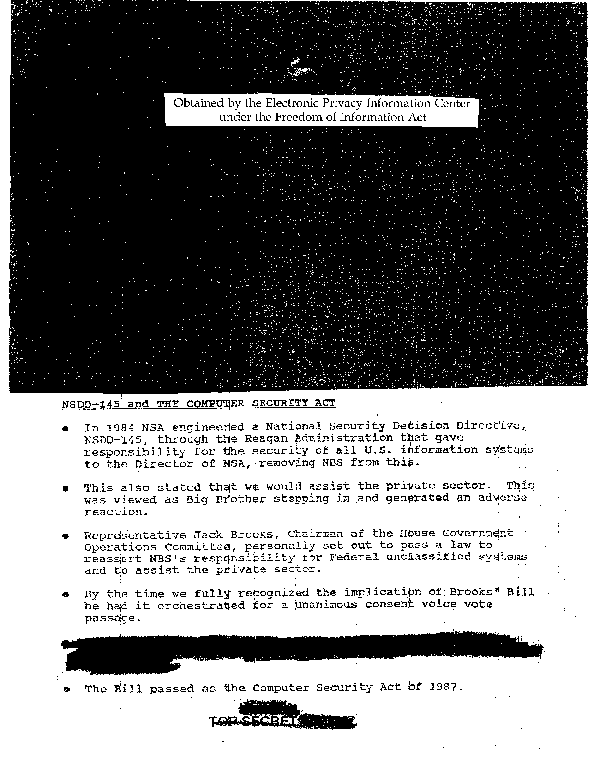
Under color of a vague “legal authorization” that flew in the face of the 1987 Computer Security Act (CSA), which sought to limit the role of the National Security Agency in developing standards for civilian communications systems, the administration tried an end-run around the law through an export ban on Clipper-free encryption devices overseen by the Commerce Department.

This wasn’t the first time that NSA was mired in controversy over the watering down of encryption standards. During the development of the Data Encryption Standard (DES) by IBM in the 1970s, the agency was accused of forcing developers to implement changes in the design of its basic cipher. There were strong suspicions these changes had weakened the algorithm to such a degree that one critical component, the S-box, had been altered and that a backdoor was inserted by NSA.

Early on, the agency grasped CSA’s significance and sought to limit damage to global surveillance and economic espionage programs such as ECHELON, exposed by British and New Zealand investigative journalists Duncan Campbell and Nicky Hager.

Before the 1987 law was passed however, Clinton Brooks, a Special Assistant to NSA Director Lieutenant General William Odom, wrote a Top Secret Memorandum which stated: “In 1984 NSA engineered a National Security Decision Directive, NSDD-145, through the Reagan Administration that gave responsibility for the security of all US information systems to the Director of NSA, removing NBS [National Bureau of Standards] from this.”

Conceived as a follow-on to the Reagan administration’s infamous 1981 Executive Order 12333, which trashed anemic congressional efforts to rein-in America’s out-of-control spy agencies, NSDD-145 handed power back to the National Security Agency and did so to the detriment of civilian communication networks.

Scarcely a decade after Senator Frank Church warned during post-Watergate hearings into government surveillance abuses, that NSA’s “capability at any time could be turned around on the American people, and no American would have any privacy left, such is the capability to monitor everything: telephone conversations, telegrams, it doesn’t matter . . . there would be no place to hide,” the agency was at it with a vengeance.

“This [NSDD-145] also stated,” Brooks wrote, “that we would assist the private sector. This was viewed as Big Brother stepping in and generated an adverse reaction” in Congress that helped facilitate passage of the Act.

Engineered by future Iran-Contra felon, Admiral John Poindexter, President Reagan’s National Security Adviser who would later serve as President George W. Bush’s Director of DARPA’s Information Awareness Office, the Pentagon satrapy that brought us the Total Information Awareness program, NSDD-145 stated that the “Director, National Security Agency is designated the National Manager for Telecommunications and Automated Information Systems Security.”

NSA’s new mandate meant that the agency would “act as the government focal point for cryptography, telecommunications systems security, and automated information systems security.”

Additionally, NSA would “conduct, approve, or endorse research and development of techniques and equipment for telecommunications and automated information systems security for national security information.”

But it also authorized the agency to do more than that, granting it exclusive authority to “review and approve all standards, techniques, systems and equipments for telecommunications and automated information systems security.” As well, NSA was directed to “enter into agreements for the procurement of technical security material and other equipment, and their provision to government agencies, where appropriate, to private organizations, including government contractors, and foreign governments.”

In other words, NSA was the final arbiter when it came to setting standards for all government and private information systems; quite a coup for the agency responsible for standing-up Project MINARET, the Cold War-era program that spied on thousands of antiwar protesters, civil rights leaders, journalists and members of Congress, as recently declassified documents published by the National Security Archive disclosed.

NSA Games the System

Although the Computer Security Act passed unanimously by voice vote in both Houses of Congress, NSA immediately set-out to undercut the law and did so by suborning the National Bureau of Standards, now the National Institute of Standards and Technology (NIST).

The battle over the Clipper Chip would be the template for future incursions by the agency for the control, through covert infiltration, of regulatory bodies overseeing civilian communications.

According to the Clinton White House, Clipper “would provide Americans with secure telecommunications without compromising the ability of law enforcement agencies to carry out legally authorized wiretaps.”

Neither safe nor secure, Clipper instead would have handed government security agencies the means to monitor all communications while giving criminal networks a leg up to do the same.

In fact, as the Electronic Privacy Information Center (EPIC) discovered in documents unearthed through the Freedom of Information Act, the underlying algorithm deployed in Clipper, Skipjack, had been developed by NSA.

Cryptography expert Matt Blaze wrote a now famous 1994 paper on the subject before the algorithm was declassified, Protocol Failure in the Escrowed Encryption Standard: “The EES cipher algorithm, called ‘Skipjack’, is itself classified, and implementations of the cipher are available to the private sector only within tamper-resistant modules supplied by government-approved vendors. Software implementations of the cipher will not be possible. Although Skipjack, which was designed by the US National Security Agency (NSA), was reviewed by a small panel of civilian experts who were granted access to the algorithm, the cipher cannot be subjected to the degree of civilian scrutiny ordinarily given to new encryption systems.”

This was precisely as NSA and the Clinton administration intended.

A partially declassified 1993 NSA memo noted that “there will be vocal public doubts expressed about having a classified algorithm in the device we propose for the US law enforcement problem, the CLIPPER chip, we recommend the following to address this.” We don’t know what those agency recommendations were, however; more than 20 years after the memo was written they remain secret.

The memo continued: “If such people agree to this clearance and non disclosure process, we could go over the algorithm with them to let them develop confidence in its security, and we could also let them examine the detail design of the CLIPPER chip made for the US law enforcement problem to assure themselves that there were no trapdoors or other techniques built in. This would likely require crypto-mathematicians for the algorithm examination and microelectronics chip design engineers for the chip examination.”

But the extreme secrecy surrounding Skipjack’s proposed deployment in commercial products was the problem. Even if researchers learned that Clipper was indeed the government-mandated backdoor they feared, non-disclosure of these facts, backed-up by the threat of steep fines or imprisonment would hardly assure anyone of the integrity of this so-called review process.

“By far, the most controversial aspect of the EES system,” Blaze wrote, “is key escrow.”


“As part of the crypto-synchronization process,” Blaze noted, “EES devices generate and exchange a ‘Law Enforcement Access Field’ (LEAF). This field contains a copy of the current session key and is intended to enable a government eavesdropper to recover the cleartext.”

“The LEAF copy of the session key is encrypted with a device-unique key called the ‘unit key,’ assigned at the time the EES device is manufactured. Copies of the unit keys for all EES devices are to be held in ‘escrow’ jointly by two federal agencies that will be charged with releasing the keys to law enforcement under certain conditions.”

What those conditions were however, was far from clear. In fact, as we’ve since learned from Snowden’s cache of secret documents, even when the government seeks surveillance authorization from the FISA court, the court must rely on government assurances that dragnet spying is critical to the nation’s security. Such assurances, FISA court judge Reggie B. Walton noted, were systematically “misrepresented” by secret state agencies.

That’s rather rich considering that Walton presided over the farcical “trial” that upheld Bush administration demands to silence FBI whistleblower Sibel Edmonds under the state secrets privilege. Edmonds, a former contract linguist with the Bureau charged that top FBI officials had systematically covered-up wrongdoing at its language division and had obstructed agents’ attempts to roll-up terrorist networks before and after the 9/11 provocation, facts attested to by FBI whistleblower Coleen Rowley in her 2002 Memo to then-FBI Director Robert Mueller.

In 2009, Walton wrote that “The minimization procedures proposed by the government in each successive application and approved and adopted as binding by the orders of the FISC have been so frequently and systemically violated that it can fairly be said that this critical element of the overall BR regime has never functioned effectively.”

“The Court,” Walton averred, “must have every confidence that the government is doing its utmost to ensure that those responsible for implementation fully comply with the Court’s orders. The Court no longer has such confidence.”

Predating those critical remarks, a heavily-redacted 1993 Memo to then-Special Assistant to the President and future CIA chief, George Tenet, from FBI Director William Sessions noted that NSA “has developed a new encryption methodology and computer chip which affords encryption strength vastly superior to DES [Digital Encryption Standard], yet which allows for real time decryption by law enforcement, acting pursuant to legal process. It is referred to as ‘Clipper’.”

[Two redacted paragraphs] “if the devices are modified to include the ‘Clipper’ chip, they would be of great value to the Federal, state and local law enforcement community, especially in the area of counter narcotics, investigations, where there is a requirement to routinely communicate in a secure fashion.”

But even at the time Sessions’ memo was written, we now know that AT&T provided the Drug Enforcement Administration “routine access” to “an enormous AT&T database that contains the records of decades of Americans’ phone calls,” The New York Times reported, and had done so since 1987 under the auspices of DEA’s Hemisphere Project.

Furthermore, in the wake of Snowden revelations we also learned that listening in on the conversations of drug capos is low on NSA’s list of priorities. However, programs like X-KEYSCORE and TEMPORA, which copies all data flowing along fiber optic cables, encrypted and unencrypted alike, at petabyte scales, is supremely useful when it comes to building profiles of internet users by intelligence agencies.

This was an implicit goal of Clinton administration maneuvers to compel developers to insert Clipper into their product designs.

According to Sessions, “the ‘Clipper’ methodology envisions the participation of three distinct types of parties.” [Redacted] It is proposed that the second party, the two custodians of the ‘split’ key infostructure [sic], be comprised of two disinterested and trustworthy non law enforcement Government agencies or entities. Although, such decision and selection are left for the Administration, a list of reccommended [sic] agencies and entities has been prepared (and included in the text), [redacted]. This party would administer and oversee all facets of the ‘Clipper’ program and methodology.”

Based on NSDD-145′s mandate, one can assume “this party” would be NSA, the agency that designed the underlying algorithm that powered Clipper.

The Sessions memo averred: “The Clipper chip provides law enforcement access by using a special chip key, unique to each device. In the AT&T TSD 3600, a unique session key is generated, external to the Clipper chip for each call.”


“This session key,” the memo explained, “is given to the chip to control the encryption algorithm. A device unique ‘chip key’ is programmed into each Clipper at the time of manufacture. When two TSD 3600s go to secure operation, the device gives out its identification (ID) number and the session key encrypted in its chip key.”

Underlining a key problem with Clipper technology Sessions noted, “Anyone with access to the chip key for that identified device will be able to recover the session key and listen to the transmission simultaneously with the intended receiver. This design means that the list of chip keys associated with the chip ID number provides access to all Clipper secured devices, and thus the list must be carefully generated and protected. Loss of the list would preclude legitmate [sic] access to the encrypted information and compromise of the list could allow unauthorized access.”

In fact, that “anyone” could include fabulously wealthy drug gangs or bent corporations with the wherewithal to buy chip keys from suborned government key escrow agents!

Its ubiquity would be a key selling-point for universal deployment. The memo explained, “the NSA developed chip based ‘Clipper’ solution works with hardware encryption applications, such as those which might be used with regard to certain telecommunications and computers devices,” which of course would allow unlimited spying by “law enforcement.”

Such vulnerabilities built into EES chip keys by design not only enabled widespread government monitoring of internet and voice traffic, but with a few tweaks by encryption-savvy “rogues” could be exploited by criminal organizations.

In his 1994 paper Blaze wrote that “a rogue system can be constructed with little more than a software modification to a legal system. Furthermore, while some expertise may be required to install and operate a rogue version of an existing system, it is likely that little or no special skill would be required to install and operate the modified software.”

“In particular,” Blaze noted, “one can imagine ‘patches’ to defeat key escrow in EES-based systems being distributed over networks such as the Internet in much the same way that other software is distributed today.”

In the intervening years since Blaze observed how easy it would be to compromise key escrow systems by various bad actors, governments or criminals take your pick, the proliferation of malware powered botnets that infect hundreds of thousands of computers and smart phones every day–for blanket surveillance, fraud, or both–is a fact of life.

It didn’t help matters when it emerged that “escrow agents” empowered to unlock encrypted communications would be drawn from the National Institute of Standards and Technology and the Automated Services Division of the Treasury Department, government outposts riddled with “No Such Agency” moles.

As EPIC pointed out, “Since the enactment of the Computer Security Act, the NSA has sought to undercut NIST’s authority. In 1989, NSA signed a Memorandum of Understanding (MOU) which purported to transfer back to NSA the authority given to NIST.”

The MOU required that NIST request NSA’s “assistance” on all matters related to civilian cryptography. In fact, were NIST and NSA representatives on the Technical Working Group to disagree on standards, the ultimate authority for resolving disputes would rest solely with the Executive Branch acting through the President, the Secretary of Defense and the National Security Council, thus undercutting the clear intent of Congress when they passed the 1987 Computer Security Act.

EPIC noted:


“The memorandum effectively returned to NSA many of the powers rejected by the Computer Security Act. The MOU contained several key goals that were to NSA’s benefit, including: NSA providing NIST with ‘technical security guidelines in trusted technology, telecommunications security, and personal identification that may be used in cost-effective systems for protecting sensitive computer data;’ NSA ‘initiating research and development programs in trusted technology, telecommunications security, cryptographic techniques and personal identification methods’; and NSA being responsive to NIST ‘in all matters related to cryptographic algorithms and cryptographic techniques including but not limited to research, development, evaluation, or endorsement’.”

A critique of the Memorandum in 1989 congressional testimony by the General Accounting Office (GAO) emphasized: “At issue is the degree to which responsibilities vested in NIST under the act are being subverted by the role assigned to NSA under the memorandum. The Congress, as a fundamental purpose in passing the act, sought to clearly place responsibility for the computer security of sensitive, unclassified information in a civil agency rather than in the Department of Defense. As we read the MOU, it would appear that NIST has granted NSA more than the consultative role envisioned in the act.”

Five years after the GAO’s critical appraisal, NSA’s coup was complete.

“In 1994,” EPIC noted,


“President Clinton issued Presidential Decision Directive (PDD-29). This directive created the Security Policy Board, which has recommended that all computer security functions for the government be merged under NSA control.”

Since PDD-29 was issued matters have only gotten worse. In fact, NIST is the same outfit exposed in Snowden documents published by The Guardian and The New York Times that allowed NSA to water down encryption and build backdoors into the Dual EC DRBG standard adopted by the Institute in 2006.

“Eventually, NSA became the sole editor.”

Besieged by widespread opposition, the Clinton administration was out maneuvered in the court of public opinion and by 1996 had abandoned Clipper. However, this proved to be a pyrrhic victory for security-minded researchers and civil libertarians as we have since learned from Edward Snowden’s revelations.

Befitting a military-intelligence agency, the dark core of America’s deep state, NSA was fighting a long war–and they were playing for keeps.


Source
.

Sunday, March 03, 2013

Screen Propaganda, Hollywood and the CIA


Selected Articles
By Julie Lévesque

Global Research, February 28, 2013


“One of the most pervasive trends in 21st century western culture has become somewhat of an obsession in America. It’s called “Hollywood history”, where the corporate studio machines in Los Angeles spend hundreds of millions of dollars in order to craft and precisely tailor historical events to suit the prevailing political paradigm.” (Patrick Henningsen, Hollywood History: CIA Sponsored “Zero Dark Thirty”, Oscar for “Best Propaganda Picture”)

Black Hawk Dawn, Zero Dark Thirty and Argo, those are only a few major recent productions showing how today’s movie industry promotes US foreign policy. But the motion picture has been used for propaganda since the beginning of the 20th century and Hollywood’s cooperation with the Department of Defense, the CIA and other government agencies is no modern trend.

With Michelle Obama awarding Ben Affleck’s Argo the Oscar for best movie, the industry showed how close it is to Washington. According to Soraya Sepahpour-Ulrich, Argo is a propaganda film concealing the ugly truth about the Iranian hostage crisis and designed to prepare the American public for an upcoming confrontation with Iran:

Foreign policy observers have long known that Hollywood reflects and promotes U.S. policies (in turn, is determined by Israel and its supporters). This fact was made public when Michelle Obama announced an Oscar win for “Argo” – a highly propagandist, anti-Iran film. Amidst the glitter and excitement, Hollywood and White House reveal their pact and send out their message in time for the upcoming talks surrounding Iran’s nuclear program [...]

Hollywood has a long history of promoting US policies. In 1917, when the United States entered World War I, President Woodrow Wilson’s Committee on Public Information (CPI) enlisted the aid of America ’s film industry to make training films and features supporting the ‘cause’. George Creel, Chairman of the CPI believed that the movies had a role in “carrying the gospel of Americanism to every corner of the globe.”

The pact grew stronger during World War II […] Hollywood ’s contribution was to provide propaganda. After the war, Washington reciprocated by using subsidies, special provisions in the Marshall Plan, and general clout to pry open resistant European film markets […]

As Hollywood and the White House eagerly embrace “Argo” and its propagandist message, they shamelessly and deliberately conceal a crucial aspect of this “historical” event. The glitter buries the all too important fact that the Iranian students who took over the U.S. Embassy in Tehran , proceeded to reveal Israel ’s dark secret to the world. Documents classified as “SECRET” revealed LAKAM’s activities. Initiated in 1960, LAKAM was an Israeli network assigned to economic espionage in the U.S. assigned to “the collection of scientific intelligence in the U.S. for Israel ’s defense industry” (Soraya Sepahpour-Ulrich Oscar to Hollywood’s “Argo”: And the Winners are … the Pentagon and the Israel Lobby)

For a real account of the Iranian hostage crisis, a CIA covert operation, Global Research recommends reading Harry V. Martin’s article published in 1995: The Real Iranian Hostage Story from the Files of Fara Mansoor:

Fara Mansoor is a fugitive. No, he hasn’t broken any laws in the United States. His crime is the truth. What he has to say and the documents he carries are equivalent to a death warrant for him, Mansoor is an Iranian who was part of the “establishment” in Iran long before the 1979 hostage taking. Mansoor’s records actually discount the alleged “October Surprise” theory that the Ronald Reagan-George Bush team paid the Iranians not to release 52 American hostages until after the November 1980 Presidential elections [...]

With thousands of documents to support his position, Mansoor says that the “hostage crisis” was a political “management tool” created by the pro-Bush faction of the CIA, and implemented through an a priori Alliance with Khomeini’s Islamic Fundamentalists.” He says the purpose was twofold:
To keep Iran intact and communist-free by putting Khomeini in full control.
To destablize the Carter Administration and put George Bush in the White House. (Harry V. Martin, The Real Iran Hostage Crisis: A CIA Covert Op)

Zero Dark Thirty is another great silver screen propaganda piece which spurred outrage earlier this year. It exploits the horrific events of 9/11 to present torture as an effective and necessary evil:

Zero Dark Thirty is disturbing for two reasons. First and foremost, it leaves the viewer with the erroneous impression that torture helped the CIA find bin Laden’s hiding place in Pakistan. Secondarily, it ignores both the illegality and immorality of using torture as an interrogation tool.

The thriller opens with the words “based on first-hand accounts of actual events.” After showing footage of the horrific 9/11 attacks, it moves into a graphic and lengthy depiction of torture. The detainee “Ammar” is subjected to waterboarding, stress positions, sleep deprivation, and confined in a small box. Responding to the torture, he divulges the name of the courier who ultimately leads the CIA to bin Laden’s location and assassination. It may be good theater, but it is inaccurate and misleading. (Marjorie Cohn, “Zero Dark Thirty”: Torturing the Facts)

Earlier this year the Golden Globe awards made some analysts criticize Hollywood’s dark “celebration of the police state” and argue that the real Golden Globe winner was the military-industrial complex:

Homeland won best TV series, best TV actor and actress. It IS a highly entertaining show which actually portrays some of the flaws of the MIIC system.

Argo won best movie and best director. It glorifies the CIA and Ben Affleck spoke with the highest praise for the CIA.

And best actress went to Jessica Chastain of Zero Dark Thirty, a movie that has been vilified for propagandizing the use of torture.

***

The Military Industrial Intelligence Complex is playing a more and more pervasive role in our lives. In the next few years we’ll be seeing movies that focus on the use of drone technology in police and spy work in the USA. We’ve already been seeing movies that show how spies can violate every aspect of our privacy– of the most intimate parts of our lives. By making movies and TV series that celebrate these cancerous extensions of the police state Hollywood and the big studios are normalizing the ideas they present us with– lying to the public, routinely creating fraudulent stories as covers for what’s really going on. (Rob Kall cited in Washington’s Blog, The CIA and Other Government Agencies Dominate Movies and Television)

All these troublesome Hollywood connections have been examined in an in-depth report Global Research published in January 2009: Lights, Camera… Covert Action: The Deep Politics of Hollywood. The article lists a great number of movies in part scripted for propaganda purposes by the Defense Department, the CIA and other government agencies. It is interesting to note that this year’s Oscar-winning director Ben Affleck cooperated with the CIA in 2002 as he starred in The Sum of All Fears.

Authors Matthew Alford and Robbie Graham explain that compared to the CIA, the Department of Defense “has an ‘open’ but barely publicized relationship with Tinsel Town” which, “whilst morally dubious and barely advertised, has at least occurred within the public domain.” Alford and Graham cite a 1991 CIA report revealing the sprawling influence of the agency, not only in the movie business but also in the media where it “has relationships with reporters from every major wire service, newspaper, news weekly, and television network in the nation.” It was not until 1996 that the CIA announced it “would now openly collaborate on Hollywood productions, supposedly in a strictly ‘advisory’ capacity”:

The Agency’s decision to work publicly with Hollywood was preceded by the 1991 “Task Force Report on Greater CIA Openness,” compiled by CIA Director Robert Gates’ newly appointed ‘Openness Task Force,’ which secretly debated –ironically– whether the Agency should be less secretive. The report acknowledges that the CIA “now has relationships with reporters from every major wire service, newspaper, news weekly, and television network in the nation,” and the authors of the report note that this helped them “turn some ‘intelligence failure’ stories into ‘intelligence success’ stories, and has contributed to the accuracy of countless others.” It goes on to reveal that the CIA has in the past “persuaded reporters to postpone, change, hold, or even scrap stories that could have adversely affected national security interests” [...]

Espionage novelist Tom Clancy has enjoyed an especially close relationship with the CIA. In 1984, Clancy was invited to Langley after writing The Hunt for Red October, which was later turned into the 1990 film. The Agency invited him again when he was working on Patriot Games(1992), and the movie adaptation was, in turn, granted access to Langley facilities. More recently,The Sum of All Fears (2002) depicted the CIA as tracking down terrorists who detonate a nuclear weapon on US soil. For this production, CIA director George Tenet gave the filmmakers a personal tour of the Langley HQ; the film’s star, Ben Affleck also consulted with Agency analysts, and Chase Brandon served as on-set advisor.

The real reasons for the CIA adopting an “advisory” role on all of these productions are thrown into sharp relief by a solitary comment from former Associate General Counsel to the CIA, Paul Kelbaugh. In 2007, whilst at a College in Virginia, Kelbaugh delivered a lecture on the CIA’s relationship with Hollywood, at which a local journalist was present. The journalist (who now wishes to remain anonymous) wrote a review of the lecture which related Kelbaugh’s discussion of the 2003 thriller The Recruit, starring Al Pacino. The review noted that, according to Kelbaugh, a CIA agent was on set for the duration of the shoot under the guise of a consultant, but that his real job was to misdirect the filmmakers, the journalist quoted Kelbaugh as saying [...] Kelbaugh emphatically denied having made the public statement. (Matthew Alford and Robbie Graham, Lights, Camera… Covert Action: The Deep Politics of Hollywood)

During the Cold War the CIA’s Psychological Strategy Board (PSB) agent Luigi G. Luraschi was a Paramount executive. He “had secured the agreement of several casting directors to subtly plant ‘well dressed negroes’ into films, including ‘a dignified negro butler’ who has lines ‘indicating he is a free man’”. The purpose of these changes was “to hamper the Soviets’ ability to exploit its enemy’s poor record in race relations and served to create a peculiarly anodyne impression of America, which was, at that time, still mired in an era of racial segregation.” (Ibid.)

The latest award-winning movie productions show that the Manichean view of the world put forward by the US foreign policy agenda has not changed since the Cold War. The Hollywood-CIA alliance is alive and well and still portrays America as the “leader of the free world” fighting “evil” around the world:

The interlocking of Hollywood and national security apparatuses remains as tight as ever: ex-CIA agent Bob Baer told us, “There’s a symbiosis between the CIA and Hollywood” […] Baer’s claims are given weight by the Sun Valley meetings, annual get-togethers in Idaho’s Sun Valley in which several hundred of the biggest names in American media –including every major Hollywood studio executive– convene to discuss collective media strategy for the coming year. (Ibid.)

Global Research offers its readers a list of articles on this topic.

Contrary to the Hollywood film industry, Global Research is not subject to any influence from the US intelligence apparatus and works to provide you the truth rather than fiction and propaganda.

We rely solely on the support of our readers to continue the fight for truth and justice. If you want to contribute to independent research become a Global Research member or make a Donation! Your support is very much appreciated.


.

Tuesday, January 08, 2013

The four business gangs that run the US


December 31, 2012


Ross Gittins
The Sydney Morning Herald's Economics Editor


Illustration: Michael Mucci.

IF YOU'VE ever suspected politics is increasingly being run in the interests of big business, I have news: Jeffrey Sachs, a highly respected economist from Columbia University, agrees with you - at least in respect of the United States.

In his book, The Price of Civilisation, he says the US economy is caught in a feedback loop. ''Corporate wealth translates into political power through campaign financing, corporate lobbying and the revolving door of jobs between government and industry; and political power translates into further wealth through tax cuts, deregulation and sweetheart contracts between government and industry. Wealth begets power, and power begets wealth,'' he says.

Sachs says four key sectors of US business exemplify this feedback loop and the takeover of political power in America by the ''corporatocracy''.

First is the well-known military-industrial complex. ''As [President] Eisenhower famously warned in his farewell address in January 1961, the linkage of the military and private industry created a political power so pervasive that America has been condemned to militarisation, useless wars and fiscal waste on a scale of many tens of trillions of dollars since then,'' he says.

Second is the Wall Street-Washington complex, which has steered the financial system towards control by a few politically powerful Wall Street firms, notably Goldman Sachs, JPMorgan Chase, Citigroup, Morgan Stanley and a handful of other financial firms.

These days, almost every US Treasury secretary - Republican or Democrat - comes from Wall Street and goes back there when his term ends. The close ties between Wall Street and Washington ''paved the way for the 2008 financial crisis and the mega-bailouts that followed, through reckless deregulation followed by an almost complete lack of oversight by government''.

Third is the Big Oil-transport-military complex, which has put the US on the trajectory of heavy oil-imports dependence and a deepening military trap in the Middle East, he says.

''Since the days of John D. Rockefeller and the Standard Oil Trust a century ago, Big Oil has loomed large in American politics and foreign policy. Big Oil teamed up with the automobile industry to steer America away from mass transit and towards gas-guzzling vehicles driving on a nationally financed highway system.''

Big Oil has consistently and successfully fought the intrusion of competition from non-oil energy sources, including nuclear, wind and solar power.

It has been at the side of the Pentagon in making sure that America defends the sea-lanes to the Persian Gulf, in effect ensuring a $US100 billion-plus annual subsidy for a fuel that is otherwise dangerous for national security, Sachs says.

''And Big Oil has played a notorious role in the fight to keep climate change off the US agenda. Exxon-Mobil, Koch Industries and others in the sector have underwritten a generation of anti-scientific propaganda to confuse the American people.''

Fourth is the healthcare industry, America's largest industry, absorbing no less than 17 per cent of US gross domestic product.

''The key to understanding this sector is to note that the government partners with industry to reimburse costs with little systematic oversight and control,'' Sachs says. ''Pharmaceutical firms set sky-high prices protected by patent rights; Medicare [for the aged] and Medicaid [for the poor] and private insurers reimburse doctors and hospitals on a cost-plus basis; and the American Medical Association restricts the supply of new doctors through the control of placements at medical schools.

''The result of this pseudo-market system is sky-high costs, large profits for the private healthcare sector, and no political will to reform.''

Now do you see why the industry put so much effort into persuading America's punters that Obamacare was rank socialism? They didn't succeed in blocking it, but the compromised program doesn't do enough to stop the US being the last rich country in the world without universal healthcare.

It's worth noting that, despite its front-running cost, America's healthcare system doesn't leave Americans with particularly good health - not as good as ours, for instance. This conundrum is easily explained: America has the highest-paid doctors.

Sachs says the main thing to remember about the corporatocracy is that it looks after its own. ''There is absolutely no economic crisis in corporate America.

''Consider the pulse of the corporate sector as opposed to the pulse of the employees working in it: corporate profits in 2010 were at an all-time high, chief executive salaries in 2010 rebounded strongly from the financial crisis, Wall Street compensation in 2010 was at an all-time high, several Wall Street firms paid civil penalties for financial abuses, but no senior banker faced any criminal charges, and there were no adverse regulatory measures that would lead to a loss of profits in finance, health care, military supplies and energy,'' he says.

The 30-year achievement of the corporatocracy has been the creation of America's rich and super-rich classes, he says. And we can now see their tools of trade.

''It began with globalisation, which pushed up capital income while pushing down wages. These changes were magnified by the tax cuts at the top, which left more take-home pay and the ability to accumulate greater wealth through higher net-of-tax returns to saving.''

Chief executives then helped themselves to their own slice of the corporate sector ownership through outlandish awards of stock options by friendly and often handpicked compensation committees, while the Securities and Exchange Commission looked the other way. It's not all that hard to do when both political parties are standing in line to do your bidding, Sachs concludes.

Fortunately, things aren't nearly so bad in Australia. But it will require vigilance to stop them sliding further in that direction.

Twitter: @1Ross Gittins


Source 

.

Thursday, November 15, 2012

5 US generals in trouble rock military culture

Published: November 14, 2012 Updated 21 hours ago


FILE - This Oct. 1, 2008 file photo shows Army Gen. William E. "Kip" Ward, Commander of U.S. Africa Command, speaking at the Pentagon. A senior U.S. official says Defense Secretary Leon Panetta has demoted, Ward, the former head of U.S. Africa Command who was accused of spending thousands of dollars on lavish travel and other unauthorized expenses.
Haraz N. Ghanbari, File — AP Photo


Related Links:
Linkhttp://www.twitter.com/robertburnsAP
Linkhttp://twitter.com/lbaldor

Story Photos:


By LOLITA C. BALDOR and ROBERT BURNS — Associated Press


WASHINGTON — When Defense Secretary Leon Panetta pointedly warned young troops last spring to mind their ways, he may have been lecturing the wrong audience.

The culture of military misconduct starts at the top.

At least five current and former U.S. generals at the rank of one-star or higher have been reprimanded or investigated for possible misconduct in the past two weeks - a startling run of embarrassment for a military whose stock among Americans rose so high during a decade of war that its leaders seemed almost untouchable.

From adultery and malfeasance to potentially inappropriate emails, the four-star foibles have rocked the military establishment and shocked the Obama administration even as it wrestles with a host of international challenges and a postelection redo of its national security team.

The missteps suggest the possibility that the senior officer corps - including many who led or sent thousands of troops into battle since 2001 - are troubled by the same strains that sent suicide, sexual assault and stress disorder rates soaring among the rest of the force.

At a deeper level, it may reflect the old adage about the military: Rank has its privileges. Do the generals suffer from arrogance and entitlement, borne from years in a military culture that endows them with unquestioned respect, even reverence? Are they so dazzled by their own standing that they become blind to their moral code?

These questions recall a 2007 essay by Lt. Col. Paul Yingling, then an active-duty Army officer, who stunned his superiors by writing of a "crisis in American generalship" - a condemnation of their intellectual and moral failings. He cited an accountability double standard in the military.

"As matters stand now," he wrote, "a private who loses a rifle suffers far greater consequences than a general who loses a war."

In fact, protectionism among the military's high ranking officers has long been a complaint, as forces see young troops or lower-ranking officers lose rank, money or jobs over missteps that they believe would be overlooked if done by a three- or four-star.

Asked about the possible demotion of a fellow four-star general, Army Chief of Staff Gen. Ray Odierno noted that losing a star could cost someone $1 million over the life of their retirement. No private would have to pay such a high cost, he said. Army Joint Chiefs of Staff Gen. Martin Dempsey recommended to Panetta that Gen. William 'Kip' Ward be spared the demotion for lavish, unauthorized spending.

Others, however, say the generals' stumbles are just a microcosm of people as a whole and not necessarily typical of the higher ranking military.

"You're not describing a general officer corps, you're describing a human condition," said Anthony Cordesman, a national security expert at the Center for Strategic and International Studies. "Whenever people are in hierarchical structures they develop a sense of entitlement, and they do, on occasion, abuse it."

The generals on the hot seat in recent weeks include several top U.S. military commanders.

- CIA Director David Petraeus, the former four-star general and top commander in Afghanistan, resigned as spy chief after the FBI uncovered evidence that he was having an extramarital affair with his biographer, Paula Broadwell. Petraeus has acknowledged the affair.

- Ward, former head of U.S. Africa Command, was demoted and ordered to repay more than $82,000 for inappropriate and lavish spending on travel. A Ward spokesman said the general was not motivated by personal gain.

- Brig. Gen. Jeffrey Sinclair is facing multiple sexual misconduct charges, including forcible sodomy, involving five women, including female officers who served with him. The initial hearing is over, but there has not yet been a decision on whether to proceed to a court-martial.

- Gen. John Allen, top U.S. commander in Afghanistan, is under investigation for potentially inappropriate communications with Florida socialite Jill Kelley, whose name surfaced during the Petraeus investigation. Allen says he has done nothing wrong.

- Adm. James Stavridis, Supreme Allied Commander of NATO, was cautioned by Navy Secretary Ray Mabus to exercise better oversight of his staff after an investigation into travel and expense questions, including a trip to a wine dinner in France. Stavridis was cleared of any misconduct.

Stephen Biddle, a military expert at George Washington University who has advised American commanders in Iraq and Afghanistan, said it's hard to judge whether misconduct like adultery is more prevalent among American generals today than in decades past, or whether it has simply become more difficult for adulterers to keep their secret.

"It clearly was never zero," he said, noting the widespread belief that Gen. Dwight D. Eisenhower had an extramarital affair while in the Army.

Today's military faces a troubling combination of misbehavior at both ends of the rank spectrum.

Concerns about troop behavior hit new heights after a series of widely publicized episodes in Afghanistan: the mistaken burning of Qurans, images of Marines urinating on insurgents' corpses and an alleged rampage by a soldier now on trial for the deaths of 16 Afghan civilians.

It was in that context that Panetta counseled troops last May to watch their step.

"These days, it takes only seconds - seconds - for a picture, a photo, to suddenly become an international headline," Panetta told soldiers at Fort Benning, Ga. "And those headlines can impact the mission that we're engaged in, they can put your fellow service members at risk, they can hurt morale, they can damage our standing in the world and they can cost lives."

The warnings from Panetta and other top military leaders - including the Marine Corps commandant, Gen. James Amos - reflected a worry that the military has let its standards erode and its discipline falter, even as the burdens and sacrifices of war have begun to ease with the end of the Iraq war and a winding down in Afghanistan.

Some military analysts see a broader problem among American generals and the institutions that develop, promote and manage them.

In an essay adapted from his new book, "The Generals," author Thomas Ricks wrote in the November issue of The Atlantic magazine that mediocrity is pervasive among the ranks of today's military leaders.

"Ironically, our generals have grown worse as they have been lionized more and more by a society now reflexively deferential to the military," Ricks wrote.

---

Burns reported from Perth, Australia.

Follow Robert Burns on Twitter at http://www.twitter.com/robertburnsAP.

Follow Lolita C. Baldor on Twitter at http://twitter.com/lbaldor.

Source
.

Sunday, August 26, 2012

From Bug Drones to Disease Assassins, Super Weapons Rule U.S. War Game

By David Axe Author

August 24, 2012 6:30 am


Sailors train for chemical and biological warfare. Photo: U.S. Navy


With tensions mounting, a cabal of American military officers, intelligence agents, scientists, industry officials and theoreticians gather at a secure facility within the Defense Department’s oldest base. Their mission: to plot America’s response to the bio-weapon threat. The ideas — some good, some bad, a few downright horrifying — flow freely.


Sunday, January 15, 2012

The Jesuits Against the United States of Israel

This is an expose of the Militia of Zeus and Minerva!

The Jesuits were founded in 1540 for 1 reason: destroy the blessed Reformation. The United States of Israel was not in existence back then but we are now their FINAL TARGET.

Loyola statue in the Vatican.

Ignatius LIEola was co-founder of the Jesuits with Francis Borgia, the great-grandson of Pope Alexander VI.

In this statue in the Vatican, Loyola can be seen holding the Jesuit Constitutions while he tramples underfoot a Christian with a Bible . . . and a serpent!!

No one who visits the Vatican can miss the statue of LIEola.
No one who visits the Vatican can miss the statue of Loyola.

It is beyond belief that this visual aid was not removed at the beginning of the ecumenical movement in 1962!

The White Pope and the Black Pope.

Jesuit general Adolfo Nicolás is the successor of Ignatius Loyola.

He is the éminence grise behind White Pope Benedict XVI.

He also commands at the Pentagon.

Jesuit headquarters in Rome.

Jesuit generals appoint Popes and then get rid of the uncooperative ones.... Since the official founding of the Jesuits by Pope Paul III in 1540, there has been a total of 46 White Popes and only 30 Black Popes!!

Peter de Smet was the best known U.S. Jesuit of the 19th century!!

Peter De Smet, S.J., was the best known U.S. Jesuit of the 19th century....He is little known today because his pre-1870 hatred of the U.S. is considered an anachronism due to the fact that the Jesuits desperately need the military might of the U.S. in order to recover the Pope's temporal power.

Peter De Smet (1801-1873) at age 37.

Black Robe Pierré Jean De Smet was the Jesuits' agent on the Great Plains and the Pacific Northwest.

He hated the pioneers with a passion and sought to exterminate them using his Indian "converts."

Peter De Smet in 1872.

He traveled to Europe 19 times to seek finances but he never encouraged Latin Church members to emigrate to the U.S.

Everything changed after 1870. Before that time, in the U.S., the intelligent people knew perfectly well that Rome was just a political system disguised as a religion. Christians were doing their utmost to win the Pope's followers to Christ and the Jesuits feared losing this large source of manpower:

At this period in his life (1860), Father De Smet earnestly discouraged migration to America. As he saw the vast numbers of Catholics coming to these shores, and no possibility of supplying them with teachers, he felt that they could not long withstand the influence of Protestantism and that apostasy would exceed the number of conversions. He also advised some of his more intimate friends not to send their children here on account of the total change from the life to which they were accustomed. In Europe they were to a large degree born to their station in life. They would not work in well where boys commenced at the very foot of the ladder, doing the commonest service for the sake of getting a start. Their language would furthermore be against them until they could gain a command of English; and on the whole they would stand little show in competition with the universal adaptability of the American boy. (De Smet, Life, Letters, & Travels, pp. 116-117).

All that changed after 1870. The Fall of the Papal States and the liberation of Rome was the most earth shattering event since the blessed Reformation of 1517. The immigration floodgates opened up!

Statue of Liberty.
Statue of Liberty.

The Statue of Liberty welcoming immigrants was officially unveiled in 1886.

The Ellis Island immigrant processing station was opened in 1892.

Until its closing in 1954, over 12 million immigrants arrived in the country. Most of them were members of the Papal Church.

Ellis Island National Monument.

Most of these immigrants were in violation of the Bull of Pope Alexander VI because none of them obtained a license from the king of Spain.

On the statue is a plaque with a poem by Emma Lazarus containing these words:

Give me your tired, your poor,
Your huddled masses yearning to breathe free,
The wretched refuse of your teeming shore.
Send these, the homeless, tempest-tost to me,
I lift my lamp beside the golden door!

How did these teeming millions become WRETCHED REFUSE? Obviously, they were born to their station in life and there was no possibility of any amelioration!

It is an alarming fact that 1/3 of the U.S. population can trace their ancestry to the immigrants who first arrived in America at Ellis Island before dispersing to points all over the country. Serfs for centuries, the immigrants were used to giving blind obedience to the Papacy and very few of them believed in keeping the Sabbath Day holy.

Despite the millions of immigrants, it was not enough to send Cardinal Al Smith to the White House in 1928. As revenge for that defeat, the Jesuits gave us the Great Depression and World War II.

A. P. Giannini and the Bank of Italy

Amadeo Peter Giannini—son of an Italian immigrant—was born in the fateful year of 1870. In 1885 he began his career as a fruit and vegetable commission merchant on the docks of San Francisco.

In 1904 he opened the Bank of Italy in San Francisco.

A. P. Giannini (1870-1949),
at age 30.

The juggernaut that is known today as the Bank of America got its start in San Francisco in 1904.

Founder A. P. Giannini was the son of a poor Italian immigrant who came to seek his fortune in California.

A. P. Giannini as president of the Bank of America.

The California gold rush of 1849 was a magnet that attracted people from all over the world. In 1863, Luigi Giannini—father-of A. P.— left his small poverty stricken village in Italy to seek his fortune in the Golden State.

Very few struck it rich and many returned home. Those that remained behind were not given free land as in other states. The vast feudal estates from the Mexican occupation were kept intact and fell into the hands of monopolists:
Through the instrumentality of the Mexican land grants the colonial character of landownership in Spanish-California was carried over, and actually extended, after the American occupation. By the terms of the cession of California to the United States it was provided that previously issued Mexican land grants would be respected. Under Spanish rule only about thirty land grants had been made, but, in 1846, when the United States took possession, over eight million acres of California land were held by some eight hundred Mexican grantees. The connivers, Mexican and American, had rushed through huge grants on the eve of American occupation. Most of these grants were vague, running merely for so many leagues within certain natural boundaries, and, in the confusion of the period, they were imperfectly registered. Many of the grants had never been surveyed, and thus the bars were down for all manner of fraud. Speculators emerged from dusty archives with amazing documents. The grants, purporting to be conveyed by these documents, assumed all sorts of fantastic shapes - for the purpose of roping in the improvements of settlers and the best land. (McWilliams, Factories in the Field, pp. 12-13).

It seems that California was the home of illegal monopolies long before the Bank of Italy.

U.S. citizens did have something in common with the Italian immigrants. They both mistrusted banks. Giannini had a Herculean task in separating his Italians from their money:

Giannini knew from the start that persuading North Beach Italians to deposit their savings in his bank would be an uphill battle. In addition to their preference for dealing strictly in gold, most were deeply suspicious of banks and lacked confidence in the people who either owned or managed them. North Beach Italians had ample reason for their distrust of financial institutions. Back in 1878, for example, a small neighborhood bank, the French Mutual, went into bankruptcy, wiping out the hard-earned savings of scores of Italian depositors. This calamity left a deep impression on the collective memory of the community. Rather than put their trust in a bank, most North Beach residents preferred to keep their savings safely at home, where it was hoarded in cans, jars, and mattresses. (Bonadio, A. P. Giannini, Banker of America, p. 30).

Every state except California outlawed branch banking and interstate banking was strictly prohibited.

Bank of Italy, San Francisco.

The Bank of Italy was determined to expand throughout California.

The first branch bank was opened in San Jose in 1909.

Everywhere it was greeted with suspicion and hostility but nothing could stop the juggernaut.

Bank of Italy, San Jose.

Bank employees were called "missionaries".

The same relentless spirit that drove missionary Peter De Smet now possessed Giannini:

The fear and resentment of Giannini's opposition was not difficult to understand. By the early 1920s the Bank of Italy had emerged as an immensely powerful force in the state. A crucial factor was the activity of the bank's Italian Department, which Giannini had established some years earlier and then placed under the direction of Armando Pedrini. Sharing the department's duties and responsibilities with Pedrini was Robert Paganini, a young, energetic, and demanding North Beach businessman who had owned an Italian-language newspaper in Sacramento before joining Bank of Italy. Paganini directed the activities of the department's corps of handpicked solicitors, or "missionaries" as they were called, all of them Italians, whose job was to turn every Italian resident of California into a depositor and stockholder in the Bank of Italy. (Bonadio, A. P. Giannini, Banker of America, p. 76).

By 1928 Giannini had conquered California and his next big move was to conquer Wall Street.

The Bank of Italy became the Bank of America in 1928

The Wall Street bank that Giannini chose for his takeover bid was the successor to the corrupt 1st Bank of the United States which lost its charter in 1811:

Sometime toward the end of 1927 Belden found the kind of large, well-connected bank he felt certain Giannini was looking for: the 116-year-old Bank of America, successor to the Bank of the United States, which had been founded in 1812 and later grew to financial prominence as one of the leading banks of New York. Located at 66 Wall Street, Bank of America occupied the lower five floors of its own thirty-two story, spiral-topped skyscraper that the New York Times had described as "the best known in greater New York and an architecture purely American." Although in recent years Bank of America had experienced serious losses, it was still valuable property, primarily because of its historic reputation and eight city branches with total deposits of $l00 million. (Bonadio, A. P. Giannini, Banker of America, p. 118).

The first bank of the United States was chartered by Congress in 1791. The charter was to last for 20 years.

Alexander Hamilton
(1755-1804).

Secretary of the Treasury Alexander Hamilton conned Congress and President Washington into chartering a bank modeled after the Bank of England.

The object of the bank was to bankrupt the pioneers and prevent the western expansion of the U.S.

Facade of the First Bank of the U.S. in Philadelphia.

Congress refused to renew the bank charter when it expired in 1811. The bank then changed its name to protect the guilty and became known as the Bank of America with headquarters in New York City:

One of the three other banks incorporated in 1812 was organized by the New York stockholders of the Bank of the United States who, wishing to obtain a charter under which the business of the Bank's New York office might be continued, applied for incorporation as the Bank of America. The capital would be $6,000,000, including $5,000,000 of Bank of the United States stock. It would be the largest bank in the States and a gain for New York over Philadelphia in the financial and commercial rivalry that had arisen between them. Being mainly Federalist and possessed of so much capital, the bank was sure to be opposed both by the Republicans who had a legislative majority, and by the existing banks in New York. (Hammond, Banks and Politics in America, p. 162).

War soon followed with England and President Madison renewed the bank charter in 1816.

President Andrew Jackson
President Jackson (1767 -1845).
President from 1829 to1837.

The 2nd Bank of the United States was more corrupt than its predecessor.

Nicholas Biddle was president.

President Jackson fought a titanic battle with the hyda-headed monster and finally slew it.

Jackson slaying the hydra-headed monster of the Second Bank of the United States.

He distributed its funds to the states and thereby laid the foundation for the economic expansion of the country.

President Jackson's unflinching determination and unwavering patriotism prevailed over Biddle and his Bank. President Jackson called the Bank a monster and was determined to pull all its teeth. He said:

I am ready with the screws to draw every tooth and then the stumps.

And President Jackson did exactly as he promised. When he left office, the U.S. had a Constitutional currency consisting of silver and gold coins. Our hero called paper money "RAG MONEY" and this is what he said about it:

The paper-money system and its natural associations—monopoly and exclusive privileges—have already struck their roots too deep in the soil, and it will require all your efforts to check its further growth and to eradicate the evil.

California was the land of monopoly and exclusive privileges long before it became part of the United States so it was rich soil for the Bank of America.

Hollywood and the Bank of America

The movie industry in Hollywood actually became a branch office of the Bank of Italy a.k.a. Bank of America. Hollywood movies led the moral decline of the nation. Western movies distorted the image of the Christian pioneers and gangster movies glorified crime and corruption.

Hollywood became a branch of the Bank of America in 1930.

In 1930, Hollywood became a branch of the Bank of America when Giannini became a major studio financier.

Hollywood played a major rôle in the collapse of Christian morals in the U.S. and around the world.

Giannini with movie mogul Joseph Schench and director Cecil B. De Mille.

Taking advantage of the Great Depression, Giannini jumped right in as a major studio financier:

With Hollywood desperately in need of financing, Giannini moved quickly to increase Bank of America's presence in an industry of enormous importance to the economic vitality of Los Angeles. As early as 1930, he authorized a loan of $3 million for two of Hollywood's most aggressive producers, Darryl F. Zanuck and Joseph Schenck, to form a new production company, which became 20th Century-Fox two years later. Schenck, who sat on Bank of America's board of directors, persuaded Giannini that Zanuck's drive and talent as a movie producer was justification enough to make loans available to him. With $400,000 in Bank of Italy money, Zanuck worked furiously to rush six films into production, including such financial successes as The Bowery, The House of Rothschild, Cardinal Richelieu, and Bulldog Drummond Strikes Back. By the end of the decade 20th Century-Fox had expanded into a $60 million studio and was turning out some of Hollywood's biggest box-office attractions. (Bonadio, A. P. Giannini, Banker of America, p. 118).

Khazar Joseph Schenck was a major movie mogul and he launched the film career of actress Marilyn Monroe.

Gone with the Wind poster.

The 1939 blockbuster movie Gone with the Wind was based on the book by Margaret Mitchell.

In the movie, the Confederates were the HEROES, while the brave Union soldiers were the VILLIANS!!

At that time, the producer had to get special permission from the censor to use the curse word DAMN in the movie!!

Giannini on the set of Gone with the Wind with Vivien Leigh.

In 1939 the Bank of America panicked when a book entitled Factories in the Field was published. The book was about the exploitation of migrant farm workers, and the ownership of the mega-farms by Bank of America:

When one realizes that approximately 50 per cent of the farm lands in Central and Northern California are controlled by one institution—the Bank of America—the irony of these "embittered" farmers deeding their "homes" against strikers becomes apparent. (McWilliams, Factories in the Field, p. 233).

The 2 books were published within months of each other. Unlike Steinbeck, McWilliams was not an employee of the Bank of America.

Author Carey McWilliams (1905-1980).
Author Carey McWilliams
(1905-1980).

Lawyer Carey McWilliams was very concerned about the growth of FASCISM in California.

In 1939, he wrote a book entitled Factories in the Field about the exploitation of farm labor.

The public relations conscious Bank of America PANICKED.

Author John Steinbeck (1902-1968).
Author John Steinbeck
(1902-1968).

The bank countered by publishing a FICTION book by John Steinbeck entitled Grapes of Wrath.

Grapes of Wrath soon became a bestseller and was made into a movie in 1940. As expected, the book by Carey McWilliams was soon forgotten.

Grapes of Wrath by Steinbeck.

The fictional Grapes of Wrath quickly became a bestseller and was made into a movie by Darryl F. Zanuck in 1940.

As expected, Factories in the Field was forgotten.

It was a great victory for the public relations department of the Bank of America.

Grapes of Wrath starring Henry Fonda was made into a movie in 1940.

The list of Jesuit Bank of America produced Hollywood movies denigrating the Christian Faith is legion. We can only cover a few.

Inherit the Wind was a parody of the Biblical story of Creation.

The 1960 hit movie Inherit the Wind was based on the 1925 Scopes "Monkey" Trial.

It ridiculed the Genesis account of creation.

The 1960 movie Elmer Gantry was about sawdust salvation or a drunken "Christian" traveling salesman who seduces a psychic female tent evangelist.

Elmer Gantry was about sex, sin, and salvation.

Elmer Gantry was based on a 1927 FICTION novel by Sinclair Lewis. Gantry, and ex-seminary student, becomes a skeptic when he is required to believe that Joshua made the sun stand still. At the end of the book, Gantry finds "salvation" in the Latin Church.

The Hollywood Western movies were no better. According to Hollywood, the center of town in the Old West was the SALOON . . . and not the CHURCH!

The Military-Banking Complex

In his farewell address to the U.S. people, President Eisenhower warned of the military-industrial complex. He wasn't very far off the mark and the real danger is the military-banking complex:

In the councils of government, we must guard against the acquisition of unwarranted influence, whether sought or unsought, by the military-industrial complex. (President Eisenhower's Farewell Address).

The War of Independence with Great Britain began over the stationing of a standing army in Boston.

The giant Pentagon standing army headquarters in Washington City!!

The behemoth Bank of Italy a.k.a. Bank of America has come a long way from the waterfront of San Francisco.

The Pentagon has ONE goal and that is to follow Napoleon and Hitler in the attempted conquest of Russia.

Bank of America headquarters in Charlotte, North Carolina.

The restoration of the Pope's temporal power would automatically follow the conquest of Russia!!

A standing army and a banking monopoly go hand in hand. It wasn't until after the founding of the Bank of England in 1694 that Great Britain began to maintain a standing army.

The best way to beat the Pope's fanatics whether Latin or Muslim is to be always ready to die as President Lincoln advised:

But I see no other safeguard against those murderers but to be always ready to die, as Christ advises it. As we must all die sooner or later, it makes very little difference to me whether I die from a dagger plunged through my heart or from an inflammation of the lungs. (Chiniquy, Fifty Years in the Church of Rome, pp. 706-707).

This expose is continued on the Jesuit/Indian War Against the United States of Israel.


References

Bonadio, Felice A. A. P. Giannini, Banker of America. University of California Press, 1994.

De Smet, Peter. Life, letters and Travels of Father Pierre-Jean de Smet, S.J., 1801-1873.

Hammond, Bray. Banks and Politics in America from the Revolution to the Civil War. Princeton University Press. 1957.

Laveille, E, The Life of Father De Smet, S.J. Loyola University Press. Chicago, Illinois, 1981.

McWilliams, Carey,Factories in the Field. The Story of Migratory Farm Labor in California. Little, Brown & Co., Boston, 1939.

Richardson, Peter. American Prophet: The Life and Work of Carey McWilliams. University of Michigan Press. Ann Arbor, Michigan, 2005.


Copyright © 2010 by Niall Kilkenny


Source