Showing posts with label WITCHCRAFT. Show all posts
Showing posts with label WITCHCRAFT. Show all posts
Saturday, August 22, 2026
Saturday, May 23, 2026
Friday, April 10, 2026
Tuesday, March 17, 2026
From Witchcraft to Worship

From Witchcraft to Worship
Elena hopes the Adventist message will increase her skill in the secret arts—but it changes her life!
In the picturesque village of Santa Ana, Honduras, surrounded by lush vegetation and majestic mountains, lived a woman known for her deep knowledge of witchcraft. From a young age, Elena Morales had shown a special ability to connect with the supernatural, learning the ancient rituals and spells from her grandmother, a renowned traditional healer. Now, at 62 years old, Elena herself had become the regional witch doctor. People from all around Santa Ana came to her not only for their health problems, but for help with their love lives and financial prosperity.
One January afternoon, a group of Seventh-day Adventists arrived in Elena’s neighborhood and organized a series of talks and community activities. Although she felt skeptical, Elena’s curiosity drove her to attend one of the meetings. Perhaps these presentations could increase her knowledge in the secret arts of magic and sorcery! Then she could bring in more money through her witchcraft business.
Elena listened attentively to the Bible teachings about health and spiritual well-being. What surprised and impacted her the most was the hope of redemption that the Bible offered. For the first time in her life, she longed for change and inner renewal. The warmth of the church members and the care they expressed stirred her heart in a way that rituals and spells never had. She had never been loved like this—not by anyone. The people’s genuine interest in her showed her a picture of divine love, convincing her that their God loved and cared for her deeply.
Elena’s life did not change immediately. For weeks, she attended meetings and Bible studies, struggling internally between her old way of life and the new way presented to her. The pastor plainly stated that the way to God would be filled with trials and temptations. She learned that Satan, man’s adversary, like a lion hunting his prey, would not easily let go his hold. Elena had many doubts and questions, but she also experienced new revelations and spiritual comfort. Gradually, she began to feel an inner peace she had never known before. Friends and neighbors noticed her softening spirit, and some were moved to join her at the Adventist meetings.
Saturday, November 23, 2024
Thursday, January 18, 2024

Sunday, December 04, 2022
Why paganism and witchcraft are making a comeback
Opinion, Analysis, Essays
CULTURE & LIFESTYLE
On a recent trip to Salem, Massachusetts, I overheard the same question: Is magic really real? For me, the answer is yes.
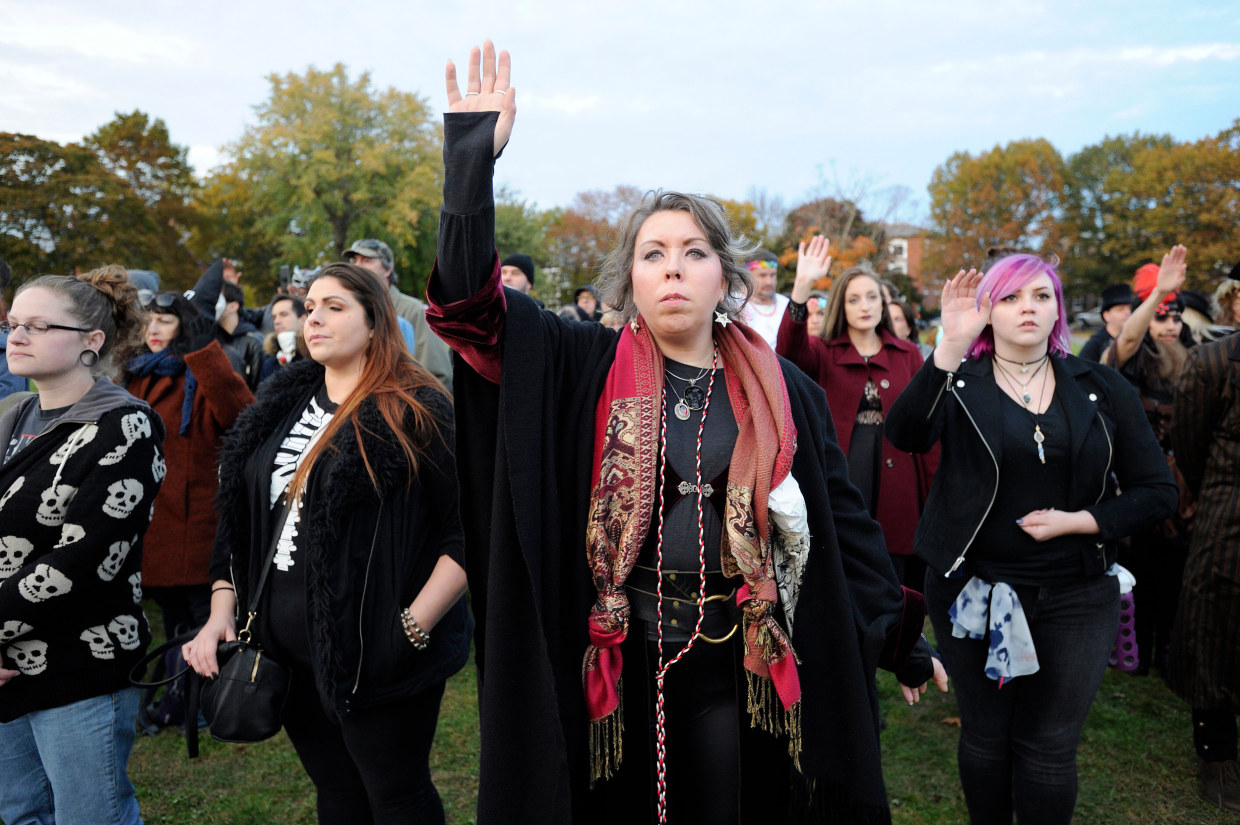
Witches take part in the Witches' Magic Circle in Salem, Mass., on Oct. 31, 2018. Joseph Prezioso / AFP via Getty Images file
Oct. 30, 2022, 7:00 AM EDT
Oct. 30, 2022, 7:00 AM EDT
By Antonio Pagliarulo, author of the forthcoming “The Evil Eye: The History, Mystery, and Magic of the Quiet Curse”
Two weeks ago in the run-up to Halloween, I visited Salem, Massachusetts, for the first time since the pandemic began. In renewing my annual Halloween pilgrimage, I was bowled over by what I found in the Witch City: bigger crowds, longer lines and a wider and welcome array of merchandise geared toward many different religious traditions and ethnic identities.
Amid the curious crowds in black capes and conical hats, bags overflowing with DIY spell kits and candles to enhance prosperity, I overheard the same question: Is magic really real?
Witchcraft, which includes Wicca, paganism, folk magic and other New Age traditions, is one of the fastest-growing spiritual paths in America.
For me, the answer is yes.
I am one of a million-plus Americans who — whether proudly, secretly or dabbling through the power of consumerism — practice some form of witchcraft. Witchcraft, which includes Wicca, paganism, folk magic and other New Age traditions, is one of the fastest-growing spiritual paths in America.
In 1990, Trinity College in Connecticut estimated there were 8,000 adherents of Wicca. In 2008, the U.S. Census Bureau figure was 342,000. A 2014 Pew Research Center study increased that projection several times over in assessing that 0.4% of Americans identified as pagan, Wiccan or New Age. (Most modern pagan worship, of which Wicca is one type, draws on pre-Christian traditions in revering nature.) By 2050, it said, the number of Americans practicing “other religions” — faiths outside Judaism, Christianity, Islam, Hinduism and Buddhism — would triple “due largely to switching into other religions (such as Wicca and pagan religions).”
The precise number of witches in America is difficult to determine because many practitioners are solitary and, either by choice or circumstance, do not openly identify as such. But the growth is evident, especially to those who’ve made it their life’s work to study the community.
“It’s clearly increasing,” said Helen A. Berger, who spoke to me on the phone last week. Berger is one of the foremost academic experts on contemporary witchcraft and paganism in America and draws knowledge about its appeal from surveys she’s co-conducted on the pagan community.
Thursday, December 01, 2022
Sunday, November 18, 2018
Number of Witches in U.S. on the Rise, May Surpass 1.5 Million

By Michael W. Chapman | November 16, 2018 | 5:59 PM EST

A report in the Christian Postcontends that the number of witches (and Wiccans) has dramatically increased since the 1990s, to the degree that there may be at least 1.5 million witches in the United States, which is higher than the 1.4 million mainline Presbyterians.
"[T]he practice of witchcraft has grown significantly in recent decades; those who identify as witches has risen concurrently with the rise of the 'witch aesthetic,'" reported the Christian Post in October, citing data from Quartz, a Trinity College study, and the Pew Research Center.
Between 1990 and 2008, the number of Wiccans in the United States grew from 8,000 to 340,000, according to three religious surveys conducted by Trinity College in Connecticut. In addition, the Pew Research Center reported in 2014 that 0.4% of the population -- 1 to 1.5 million Americans -- "identify as Wicca or Pagan."

"It makes sense that witchcraft and the occult would rise as society becomes increasingly postmodern," author Julie Roys, formerly of Moody Radio, told the Christian Post. "The rejection of Christianity has left a void that people, as inherently spiritual beings, will seek to fill."
Roys added that witchcraft is especially attractive to Millenials because it has been "effectively repackaged."
"No longer is witchcraft and paganism satanic and demonic," said Roys. "[I]t's a 'pre-Christian tradition' that promotes 'free thought' and 'understanding of earth and nature.'"
A report in the Christian Postcontends that the number of witches (and Wiccans) has dramatically increased since the 1990s, to the degree that there may be at least 1.5 million witches in the United States, which is higher than the 1.4 million mainline Presbyterians.
"[T]he practice of witchcraft has grown significantly in recent decades; those who identify as witches has risen concurrently with the rise of the 'witch aesthetic,'" reported the Christian Post in October, citing data from Quartz, a Trinity College study, and the Pew Research Center.
Between 1990 and 2008, the number of Wiccans in the United States grew from 8,000 to 340,000, according to three religious surveys conducted by Trinity College in Connecticut. In addition, the Pew Research Center reported in 2014 that 0.4% of the population -- 1 to 1.5 million Americans -- "identify as Wicca or Pagan."
"It makes sense that witchcraft and the occult would rise as society becomes increasingly postmodern," author Julie Roys, formerly of Moody Radio, told the Christian Post. "The rejection of Christianity has left a void that people, as inherently spiritual beings, will seek to fill."
Roys added that witchcraft is especially attractive to Millenials because it has been "effectively repackaged."
"No longer is witchcraft and paganism satanic and demonic," said Roys. "[I]t's a 'pre-Christian tradition' that promotes 'free thought' and 'understanding of earth and nature.'"
Monday, June 13, 2016
New York's oldest witchcraft store still casting its spell after 34 years
New York's oldest witchcraft store still casting its spell after 34 years
Need some supernatural aid to change your luck? Enchantments in the East Village offers candles, books and incense to work some positive magic

Stacy Rapp, a witch and owner of Enchantments, with a resident cat. Photograph: Simon Leigh for the Guardian
Olga Oksman in New York
Saturday 11 June 2016 06.00 EDTLast modified on Saturday 11 June 201615.14 EDT
Enchantments, the oldest witchcraft store in New York, has not been open for an hour but already it’s buzzing. A middle-aged man in a neat blue dress shirt, cellphone clipped to his belt is in the back of the shop, talking to one of the employees who carves custom candles for spells. He needs luck, he explains, to close a business deal. The deal could fall apart even after a contract is signed, so the spell had to last, he carefully explains.
As the employee – perched on a stool under a sign that reads “The Witch Is In” – starts to carve intricate symbols into a huge pillar candle for the businessman, shop owner Stacy Rapp, enters in a whirlwind. A slender energetic woman, her arms and chest covered in intricate tattoos of pentagrams to ravens and her vibrant pink hair covered in a black bandanna, she seems incapable of standing still for more than a few minutes. Her arms are full of plants for the shop’s back garden, where ritual sabbaths, open to the community, are held eight times a year.
After 34 years in business in the East Village, with the recession and the rising rents of gentrification claiming so many small businesses, Enchantments’ survival might make anyone believe in magic. The carved candles are the shop’s specialty and bestselling item, but the shop also offers a fully stocked apothecary with everything from mugwort to rosehips, an entire binder of custom oils and incense and a large selection of books. Behind a glass case in front of the cash register are a variety of tarot cards and silver occult jewelry, a shelf of statuettes of gods and goddesses of every ilk adorns one side of the shop and behind the front door, a small altar is tucked out of the way of customers’ feet.
Olga Oksman in New York
Saturday 11 June 2016 06.00 EDTLast modified on Saturday 11 June 201615.14 EDT
Enchantments, the oldest witchcraft store in New York, has not been open for an hour but already it’s buzzing. A middle-aged man in a neat blue dress shirt, cellphone clipped to his belt is in the back of the shop, talking to one of the employees who carves custom candles for spells. He needs luck, he explains, to close a business deal. The deal could fall apart even after a contract is signed, so the spell had to last, he carefully explains.
As the employee – perched on a stool under a sign that reads “The Witch Is In” – starts to carve intricate symbols into a huge pillar candle for the businessman, shop owner Stacy Rapp, enters in a whirlwind. A slender energetic woman, her arms and chest covered in intricate tattoos of pentagrams to ravens and her vibrant pink hair covered in a black bandanna, she seems incapable of standing still for more than a few minutes. Her arms are full of plants for the shop’s back garden, where ritual sabbaths, open to the community, are held eight times a year.
After 34 years in business in the East Village, with the recession and the rising rents of gentrification claiming so many small businesses, Enchantments’ survival might make anyone believe in magic. The carved candles are the shop’s specialty and bestselling item, but the shop also offers a fully stocked apothecary with everything from mugwort to rosehips, an entire binder of custom oils and incense and a large selection of books. Behind a glass case in front of the cash register are a variety of tarot cards and silver occult jewelry, a shelf of statuettes of gods and goddesses of every ilk adorns one side of the shop and behind the front door, a small altar is tucked out of the way of customers’ feet.

Carmen Pouerie carves candles at Enchantments occult shop in New York. Photograph: Simon Leigh for the Guardian
The shop does not perform spells, Rapp tells me, after leading me to a quiet backroom away from the heady smell of the incense. The shop provides supplies that people use to perform a spell. Enchantments strictly sells supplies for good magic, Rapp explains, which is one reason to which she attributes its continuing success. The shop puts out positive energy, so positive energy comes back to it, she explains. The bestsellers are uncrossing candles, candles that have been specially carved to remove a block in luck or life, to help people get unstuck when things are not going right. The candles, which in addition to uncrossing can be carved for everything from love to money, sell briskly, with an average of 25 to 30 large $30 pillar candles purchased each day. Books on the occult are the second bestselling item, Rapp says with a smile, glad that in the modern age people still like to read a physical book.

Spellbound: why witchcraft is enchanting a new generation of teenage girls
Customers cut across genders, ages and professions. “We get doctors, lawyers, bartenders, people who have been practicing pagans for 20 years and people who have never done any of this before in their life,” says Rapp. Part of the popularity of witchcraft comes from people looking for a spiritual practice that gives them a measure of control, explains Rapp.
That need for control may also be the reason the shop is not greatly affected by economic downturns. If anything, having a variety of spells focused on drawing money can have an appeal in uncertain times. “I think with the current economic times people are looking for something that has a much more active feel to it, like I can make things happen as opposed to some random force in the universe can make things happen,” Rapp explains. The shop also sells a variety of small candles and tiny packets of incense for a few dollars to cater to smaller budgets, like for those who come to the shop for help with finding a job.
Nothing can be created out of thin air, Rapp says, so lighting a candle or burning some incense won’t manifest a million dollars, but it can help give a boost to a job search, she explains. “The idea of magic is that it is a proactive spirituality,” says Rapp.
Rapp also attributes part of witchcraft’s appeal to its emphasis on strong female role models which can often be lacking in other spiritual practices. “It is much more balanced in terms of male and female energy and you have strong female energies,” says Rapp.
Not everyone is charmed by the pink-haired witch of East 9th Street and her egalitarian spiritual musings. People have called the shop in the past to tell employees that they are going to hell and are in league with the devil, says Rapp. When an article on the shop ran alongside photos of Rapp years ago, men would call the shop proposing to marry her in order to save her soul. “I was young back then,” Rapp says with a twinkle of amusement in her eye. Fortunately the phone calls are not too frequent these days. “There is no listing for witchcraft stores on Yelp,” Rapp points out, so people have to really be looking for the shop to find it. As I leave the store, a mother and daughter, both in elegant floral print dresses wait for their candles to be carved, and a young couple enters to look around. It seems people who know what to look for have no trouble finding Enchantments.
The shop does not perform spells, Rapp tells me, after leading me to a quiet backroom away from the heady smell of the incense. The shop provides supplies that people use to perform a spell. Enchantments strictly sells supplies for good magic, Rapp explains, which is one reason to which she attributes its continuing success. The shop puts out positive energy, so positive energy comes back to it, she explains. The bestsellers are uncrossing candles, candles that have been specially carved to remove a block in luck or life, to help people get unstuck when things are not going right. The candles, which in addition to uncrossing can be carved for everything from love to money, sell briskly, with an average of 25 to 30 large $30 pillar candles purchased each day. Books on the occult are the second bestselling item, Rapp says with a smile, glad that in the modern age people still like to read a physical book.
Spellbound: why witchcraft is enchanting a new generation of teenage girls
Customers cut across genders, ages and professions. “We get doctors, lawyers, bartenders, people who have been practicing pagans for 20 years and people who have never done any of this before in their life,” says Rapp. Part of the popularity of witchcraft comes from people looking for a spiritual practice that gives them a measure of control, explains Rapp.
That need for control may also be the reason the shop is not greatly affected by economic downturns. If anything, having a variety of spells focused on drawing money can have an appeal in uncertain times. “I think with the current economic times people are looking for something that has a much more active feel to it, like I can make things happen as opposed to some random force in the universe can make things happen,” Rapp explains. The shop also sells a variety of small candles and tiny packets of incense for a few dollars to cater to smaller budgets, like for those who come to the shop for help with finding a job.
Nothing can be created out of thin air, Rapp says, so lighting a candle or burning some incense won’t manifest a million dollars, but it can help give a boost to a job search, she explains. “The idea of magic is that it is a proactive spirituality,” says Rapp.
Rapp also attributes part of witchcraft’s appeal to its emphasis on strong female role models which can often be lacking in other spiritual practices. “It is much more balanced in terms of male and female energy and you have strong female energies,” says Rapp.
Not everyone is charmed by the pink-haired witch of East 9th Street and her egalitarian spiritual musings. People have called the shop in the past to tell employees that they are going to hell and are in league with the devil, says Rapp. When an article on the shop ran alongside photos of Rapp years ago, men would call the shop proposing to marry her in order to save her soul. “I was young back then,” Rapp says with a twinkle of amusement in her eye. Fortunately the phone calls are not too frequent these days. “There is no listing for witchcraft stores on Yelp,” Rapp points out, so people have to really be looking for the shop to find it. As I leave the store, a mother and daughter, both in elegant floral print dresses wait for their candles to be carved, and a young couple enters to look around. It seems people who know what to look for have no trouble finding Enchantments.
Sunday, February 24, 2013
Theosophy
No longer contained within secret societies populated with select occultists, theosophy is not only out in the open -- its occult teachings are being promoted as a unifying global spirituality by UN leaders, globalist educators, and the U.S. educational establishment both at the state and national level. Perhaps only the top leaders realize that these teachings are based on occult messages received by medium (channeler) Alice Bailey from her "Tibetan" spirit guide Djwhal Khul (DK) and other "ascended masters" within the theosophical "angelic" hierarchy.
Read more
/
/
Thursday, February 21, 2013
Court: Calif. may have to hire Wiccan chaplains
2:45p.m. EST February 20, 2013
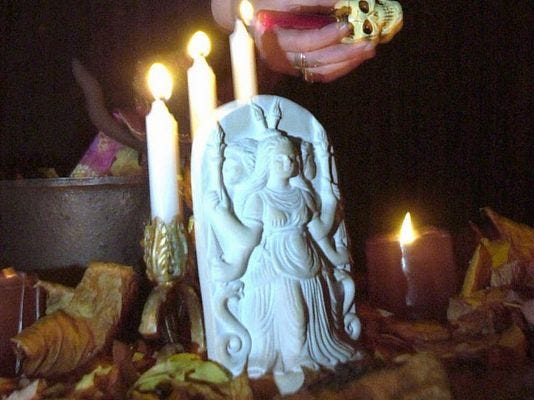
Byron Ballard, a high priestess in the dianic tradition of Wicca, performing the ceremony of Calling the Quarters during a Sabbat service.(Photo: John Coutlakis, GPN)
STORY HIGHLIGHTS
Calif. may have as many as 2,000 Wiccan prisoners
Currently, 5 religions have full-time prison chaplains
Minister says Calif. Department of Corrections misunderstands Wicca
SAN FRANCISCO (AP) — California prisons hire full-time chaplains and spiritual leaders to serve Catholic, Muslim, Jewish, Protestant and Native American inmates.
On Tuesday, a federal appeals court gave new life to a decades-long battle by Wiccan inmates for access to their own full-time chaplain.
The 9th U.S. Circuit Court of Appeals overturned a trial judge's dismissal of a Wiccan prisoner lawsuit seeking the same rights as the five other religious practices. The appeals court said the Wiccan prisoners make a compelling argument that the California Department of Corrections and Rehabilitation may be unconstitutionally showing preference to the five religions in violation of the 1st Amendment.
The appeals court ruled that the trial court judge was wrong to dismiss the case almost immediately after it was filed without delving deeper into the evidence. For instance, the court said it could be that a Wiccan chaplain could be needed only at the Chowchilla prison rather than throughout the 33-prison statewide system of 150,000 inmates.
The appeals court also warned that the CDCR may still be able to show that the Wiccans don't have enough worshipers or critical needs for a full-time chaplain. It ordered the trial court judge to reconsider the case.
"There are certainly enough Wiccan prisoners to merit their own chaplain," said Gary Friedman, a spokesman for the American Correctional Chaplains Association. "I hope this leads to the hiring of more chaplains to represent even more minority faith groups."
The number of Wiccan inmates is in dispute. A CDCR survey reported 183 Wiccan prisoners in 2007 after recording about twice that number in 2002.
But Patrick McCollum, a leading Wiccan minister who has led the Wiccan prisoner fight for full-time chaplains for 20 years, puts the number at about 2,000 system wide. McCollum said many Wiccans prisoners were afraid to answer the CDCR survey for fear of reprisals. He also argued that a survey should be conducted by a neutral party with no ties to the CDCR.
McCollum, who volunteers as a Wiccan chaplain in California prisoners and who lost his own lawsuit against the CDCR in 2011, says he believes the CDCR opposes hiring a full-time chaplain because of a misunderstanding of the religion's beliefs.
Wicca is a pagan religion that worships nature and involves witchcraft.
"People have a lot of misconception about Wiccans," McCollum said. "It has nothing to do with Satan."
The CDCR declined comment, citing pending litigation. In court papers, its lawyers argue that its opposition is based strictly on numbers, pointing out that other minority faith groups are also without full-time chaplains. The court papers also argued that Wiccans are served by the full-time chaplains and volunteers like McCollum.
California deputy attorney general Kenneth Roost argued in the court papers that "the Constitution permits prisons to employ chaplains to accommodate inmates' religions needs, and does not require prisons to hire chaplains representative of all inmates' religions."
Still, the appeals court said that if the Wiccans claims do hold up then "the prison administration has created staff chaplain positions for five conventional faiths, but fails to employ any neutral criteria in evaluating whether a growing membership in minority religions warrants a reallocation of resources."
Source
.
.
Friday, February 08, 2013
North Miami Beach Police Department Employees Fired Over Plan To Put Santeria Curse On City Manager

First Posted: 11/30/2011 3:10 pm Updated: 01/30/2012 4:12 am
Two North Miami Beach Police Department employees have been fired for plotting to put a Santeria curse on the city manager.
Officer Elizabeth Torres, a 24-year veteran of the police department, and Yvonne Rodriguez, an office manager for police chief Larry Gomer, were caught plotting to use birdseed to cast a spell to make Lyndon Bonner "go away" in August before a round of planned departmental layoffs.
Torres told Rodriguez she had previous success with the curse, having made her son and daughter move out by sprinkling it on the front porch of their home, according to the police report.
Investigators say the pair were upset with the "negative climate" in the department, and hatched a plan to similarly curse Bonner by gaining access to his office. Torres admitted to police that she brought the birdseed to Rodriguez, then approached janitor Esther Villanueva, asking her to sprinkle the birdseed in Bonner's office as she cleaned.
The two were busted when Villanueva reported the incident to a supervisor. Though Torres confessed to the plan, she told investigators it was just a superstitious idea and the pair meant no harm.
"It was kind of a joke, kind of a superstition," she said, according to interview transcripts. "It did have bases in religious knowledge I had from before...As misguided as it may seem, this idea popped into my head, and I thought, 'Well, it can't hurt anybody.'"
Fortunately for Bonner, University of Miami Religious Studies professor Michelle Maldonado agrees.
"Ultimately, the city manager really doesn't have anything to worry about. In Santeria, you can't just spread bird seed and make the supernatural do what you want it to do," she told WSVN.
The pair, who were fired last week, can appeal their terminations.
.
Thursday, March 01, 2012
Witchcraft is growing threat to children in Britain, warn police

A boy accused of being 'child witch' is exorcised in a church in Kinshasa Photo: Gwenn Dubourthoumieu/AFP/Getty Images
By Nick Britten and Victoria Ward10:04PM GMT 01 Mar 2012
The warning was issued as a couple from the Democratic Republic of Congo were found guilty of murdering the woman’s 15-year-old brother during an “exorcism ceremony”.
The Metropolitan Police yesterday said it had investigated 83 “faith-based” child abuse cases involving witchcraft in the past 10 years but believed it was still an “under-reported, hidden crime”.
Children’s charities and campaigners urged communities to report abuse and said social workers must be firmer in confronting abuse in immigrant groups.
Kristy Bamu, 15, was relentlessly tortured and eventually drowned in a bath on Christmas Day 2010 by his sister, Magalie, and her partner, Eric Bikubi. The killers are facing life sentences.
They believed he had cast spells on another child and punished him with increasing viciousness. The teenager “begged to die” because he was in such pain after three days of being attacked with knives, sticks, metal bars and a hammer and chisel, suffering 130 separate injuries.
Among the cases that have come to light are four murders, including that of Victoria Climbié in 2000, the case that first raised awareness of the problem in Britain.
Detectives warned that while they were investigating around eight cases a year, they believed many more incidents went unreported.
Det Supt Terry Sharpe, the Metropolitan Police’s lead on Project Violet, a team set up to tackle religious-based child abuse, said: “The intelligence from the community is that it’s far more prevalent than the reports we are getting.”
The NSPCC said: “We must not be afraid to challenge these communities to out the wrongdoers within them. Sadly, this deeply disturbing case is not a one-off incident. “
The Victoria Climbié Trust, which was set up after the death of the eight year-old, said that, while the number of children affected was relatively low, the impact was significant. “The reality is that no one really knows the full extent across the many communities for whom traditional belief systems are the norm,” said director Mor Dioum.
The charity Trust for London said some officials may be unsure how to deal with abuse cases linked to witchcraft and spirit possession.
“Those working with children need to remember that no faith or culture promotes cruelty to children and not be afraid to intervene if someone is wrongly using belief as an excuse to harm children.”
Many cases involve immigrants from African countries such as the DRC, where witchcraft is widely practised, and are nurtured by an increasing number of African churches.
Kristy had come to London with his two brothers and two sisters from Paris to stay with their sister and her boyfriend for Christmas, but within hours Bikubi, 28, had accused them of bringing kindoki – a form of witchcraft – into his home.
Two sisters, aged 20 and 11, were beaten but escaped further attacks after “confessing” to being witches.
Kristy was singled out because, in sheer terror, he wet himself. He was struck in the mouth with a hammer, had bottles and tiles smashed over his head and his ear twisted with pliers.
In what prosecutors called “a staggering act of depravity and cruelty”, the siblings, who included a 13-year-old boy and an autistic brother aged 22, were made to join in the torture.
At one point, Bikubi, 28, a football coach from Newham, east London, told the youngsters to jump out of the window to see if they could fly.
One of the victims, Kelly Bamu, said: “They started talking about kindoki, witchcraft and this and that. It was as if they were obsessed by witchcraft.”
The Old Bailey heard that emergency services were greeted with a horrific scene when they were called to the eight-floor flat following Kristy’s death. In the blood-spattered flat, police found his brothers and sisters “hysterical, terrified and soaking wet,” the court heard.
Tuesday, March 30, 2010
Asheville Mother Grove Goddess Temple to celebrate spring equinox

ASHEVILLE — After making it through the harsh winter, people in Western North Carolina are looking forward to the warm sun of spring. Some are preparing to celebrate the season's change with an ecumenical ritual.
Saturday officially marks the first day of spring, being the day of the spring equinox.Members of Mother Grove Goddess Temple will celebrate at 7 p.m. Saturday with A Breath of Appalachian Spring: A Ritual in Celebration of the Spring Equinox, in the parish hall of the Episcopal Cathedral of All Souls in Biltmore Village.
Saturday's event is open to all faith traditions, said Byron Ballard, wiccan priestess and a member of the temple. Mother Grove “isn't a wiccan group, though some of us are wiccans,” she said.
“Mother Grove is an outgrowth of the work of several people in the goddess/earth religions community,” Ballard said. “Its goal is to create a permanent sanctuary, where people of all faith traditions may openly and safely celebrate the divine feminine, the goddess.”
Wicca is a modern religion built on the ancient agricultural religions of Europe, she explained. “Wiccans may also refer to themselves as witches.”
Jill Boyer is a co-founder and priestess with Mother Grove. She says she looks forward to celebrating “with my celebrants and community, having time to celebrate something that is very important to me and the ritual aspects themselves.”
Boyer believes people have an ancient and human need for ritual and celebration in groups, and to acknowledge the changing of the seasons.
The celebration will consist of raising a circle, singing, “whistling up the wind” and flying prayers written on paper airplanes. Ballard will lead the ritual, explaining that it is a joyful expression of the beginning of spring and coming together as a community.
Nonperishable food items will be collected at the event for the Mother Grove Cornucopia Project food drive.
“Last year, as part of the celebration, we asked people to write a prayer or wish on a piece of paper and fold it into an airplane,” Ballard said. “We spent about five minutes flying planes around the room. Then we asked people to pick up a plane that was not theirs, take it home with them and pray for that person.”
Ballard said that “whistling up the wind” is an old English and Appalachian tradition. March is usually the windiest month, so the element of wind will be emphasized at the celebration. One person will whistle while three others honor the elements of earth, fire and water.
“It's a lovely holiday for children,” Ballard said. “The first chance to get out and see what's growing, to welcome baby chicks and lambs, to taste the first little green bits of chickweed. All pagan and wiccan holidays are family-friendly. Many Earth religionists choose to honor their spiritual traditions as a family group.”.
.
Source: http://www.citizen-times.com/article/20100319/LIVING/303190029
.
.
.
.
Source: http://www.citizen-times.com/article/20100319/LIVING/303190029
.
.
TEO 3000
Monday, March 22nd, 2010
Episcopal Organization? Meet your future:
After making it through the harsh winter, people in Western North Carolina are looking forward to the warm sun of spring. Some are preparing to celebrate the season’s change with an ecumenical ritual.
You mean some kind of joint Catholic-Protestant-Orthodox thing? Nope.
Members of Mother Grove Goddess Temple will celebrate at 7 p.m. Saturday with A Breath of Appalachian Spring: A Ritual in Celebration of the Spring Equinox, in the parish hall of the Episcopal Cathedral of All Souls in Biltmore Village.
And nothing says “Welcome, spring!” quite like a fake religion performing its strange ceremonies inside the cathedral of another fake religion.
Saturday’s event is open to all faith traditions, said Byron Ballard, wiccan priestess and a member of the temple. Mother Grove “isn’t a wiccan group, though some of us are wiccans,” she said.
Noted.
“Mother Grove is an outgrowth of the work of several people in the goddess/earth religions community,” Ballard said. “Its goal is to create a permanent sanctuary, where people of all faith traditions may openly and safely celebrate the divine feminine, the goddess.”
This is badly needed what with all the witches the Christian right burns in the United States all the time. What are you looking at me like that for? You know it’s true.
Anyway, exactly how are they going to celebrate Katharine Jefferts Schori the divine feminine, the goddess? With “ancient” rituals like these.
The celebration will consist of raising a circle, singing, “whistling up the wind” and flying prayers written on paper airplanes. Ballard will lead the ritual, explaining that it is a joyful expression of the beginning of spring and coming together as a community.
If I’m not mistaken, the pagan Celts used paper airplanes to pray to their gods. But why do all this in the first place?
Jill Boyer is a co-founder and priestess with Mother Grove. She says she looks forward to celebrating “with my celebrants and community, having time to celebrate something that is very important to me and the ritual aspects themselves.”
Boyer believes people have an ancient and human need for ritual and celebration in groups, and to acknowledge the changing of the seasons.
Inventing gods. Performing weird rituals devoid of meaningful content for no particular reason other than emotion. I’d say TEO’s just about there.
.
.
Saturday, January 23, 2010
Wicca's Invitation

Posted by David Virtue on 2010/1/20 8:10:00
Pagan practices are meeting with an increasingly receptive audience in the Episcopal Church. Is it the consequence of an unmet need?
by Jeff Walton
January 14, 2010
The monthly meditation had a playful air about it.
"A crone is an old woman. A crone is a witch. A crone is a wise woman. Which one will you be, my friend? Which one I?"
Wrapped around a rite for "croning", the meditation embraced a history of mystical women and offered prayers to "Mothering God" and "Eternal Wisdom." But the article was not in a new age publication or Wiccan blog: it was on the pages of the September newsletter of the Episcopal Diocese of Washington.
Entitled "Crone Power", the meditation innocuously sat opposite a story about choosing a children's Bible and next to a column on St. Jerome. The newsletter quickly drew the attention of Anglican bloggers, many of whom found the placement of what appeared to be a Wiccan ritual to be jarring in an official church publication. But intentionally or not, the publication and placement of the rite were reflective of a new reality: one in which practices drawn from or inspired by pagan belief, including witchcraft, are increasingly finding acceptance within the ranks of the Episcopal Church.
"Croning rituals have been a part of modern day witchcraft since [English occultist] Gerald Gardner invented it in the 1950s," explains Catherine Sanders, author of Wicca's Charm: Understanding the Spiritual Hunger Behind the Rise of Modern Witchcraft and Pagan Spirituality. Sanders, an evangelical Christian, spent several years researching pagan practices and witnessed their incorporation into the church during the writing of her book. Sanders said that croning, the practice of honoring a woman who has gone through menopause, became more popular in the 1970s with the women's movement.
"Most of the mainline denominations had people within them experimenting with pagan rituals," Sanders said. "A lot of these people were searching for a way to affirm what they were going through in their lives."
While the croning ritual was notable for its prominence in a diocesan newsletter, such pagan-inspired practices are not new in the Episcopal Church. In 2005, Pennsylvania Episcopal priest Bill Melnyk was outed as a Druid (he belonged to the Order of Bards, Ovates, and Druids) after posting a druid ritual to an Episcopal Church Women's website. Melnyk, who had taken the name "Oakwyse," was forced to resign by his bishop.
Pagan influences in women's spirituality were also a prominent part of the "Reimagining" movement that appeared among some mainline Protestant feminists in the early 1990s. The Reimagining movement encouraged worshippers to refer to God as a feminine deity known as "Sophia," loosely based on the Greek concept of the wisdom of God. Controversy eventually subsided after denominational leaders, responding to pressure from traditionalists, distanced themselves from the Reimagining liturgies.
The diocese of Washington itself has a track record of embracing mystical rites, most recently hosting a Native American "smudging" ceremony at the National Cathedral. During an interfaith conference,Sacred Circles: a Celebration of Women's Spirituality, smoking tobacco was offered to the spirits of the four cardinal directions.
Crone Power
The author of the rite that appeared in the Washington Window was herself far from the traditional images of covens and witchcraft. An older parishioner at St. Alban's Church, Helma Lanyi arrived from the Roman Catholic Church ten years ago after taking issue with Catholicism's hierarchy and patriarchy.
Situated near the highest point in Washington, D.C., next to the prestigious school of the same name that educates many of Washington's elite, St. Alban's is more reflective of the reserved and upper-class mainstream of the Episcopal Church, rather than the fringe congregations that have previously entertained pagan ideas and practices. Its rector was recently elected to become the new bishop of the Episcopal Diocese of Georgia.
"I had become aware for a while that it's really not cool in our society to be an older woman," Lanyi said. "At one point I picked up a book on crones. That describes very much the whole pagan point of view about being an older woman."
Lanyi, a first generation immigrant from Germany, found the topic interesting. Nevertheless, it did not appeal to her as a Christian.
"I'm really not into Earth mother thinking," the St. Alban's parishioner explained. Among other concerns that she had with pagan practices, Lanyi did not like the portrayal of female power as superior to male power. But the idea of croning seemed to resonate along with a book she had read by liberal Catholic nun Joan Chittister. Lanyi saw being older as a gift, and she had grown tired of what she saw as a cultural expectation to hide one's age.
"Why is the joy of life considered to be something that it isn't part of [life] for women when they are older?" Lanyi asked. "I felt that God hasn't taken his concern away from me now that I am older. Why should that only be between me and God?"
In her words, Lanyi wanted to be "properly an old lady without being out of the picture." So she investigated croning further. Normally engaged with her work as co-chair of the Episcopal Peace Fellowship at St. Alban's, Lanyi visited Wiccan websites that her daughter had found, complete with a variety of croning rituals.
"It blended perfectly with my nonviolence training and interest," Lanyi said of some of her folk religion readings. Lanyi found in folk religion an element which "emphasized the more female elements of being non-judgmental." The St. Alban's parishioner saw those elements as being compatible with Christianity as she understood it.
"That's what Jesus came for, working together and everyone is equal," Lanyi claimed. "Jesus came not to go against all of that [folk religion], the same way he didn't go against the Jewish religion, Jesus came to affirm our nature."
But whereas Lanyi found value in folk religion, some of the Wiccan croning rituals themselves were wild and over the top.
"I couldn't see asking people to do that in my living room," the elderly German laughed. She decided that authoring her own rite was the best way to proceed.
"I pretty much made it up, that ritual doesn't exist anywhere as I know it," Lanyi explained. "I thought it was a little like baptism rituals, this idea of asking questions: what are you seeking, what do you want?"
She wrote her ritual a little bit tongue in cheek, she admitted. Then, last year, Lanyi gathered seven friends and performed the rite. They stood in a circle, one lighting a candle and placing it on a center table. They took turns reading the poem "Woman's Work," by Maya Angelou, as a sign of solidarity with all women. Then they invited the newest crone-to-be into the circle.
"What we read in these Wiccan rituals that my daughter shared with me, they used dirt or soil, and that didn't make sense, so we used a hand-woven stole," Lanyi added. She recalled the rite in her article:
She [the new crone] tells us of the phases of her life up until now. The others ask her: "What is it you are seeking for this phase of your life as a crone?"
She answers: "I seek wisdom." We say in unison: "Mothering God, grant her Crone Wisdom."
We ask: "Beside wisdom, what is it you are seeking?" She answers: "I seek judgment." We reply: "Mothering God, grant her Crone Judgment."
Finally we ask: "Besides wisdom and judgment, what is it you are seeking?" She says: "I seek Joy." We respond: "Mothering God, grant her Crone Joy."
We take turns anointing her forehead with special oil and present her with a stole, or wreath, inviting her to go forth into the world and share her Crone power.
We pray: Eternal Wisdom, source of our being and center of all our longing, In you our sister has lived to a strong age: A woman of dignity and wit, in loving insight now a blessed crone. May the phase into which she has entered bear the marks of your spirit. May she ever be borne up by the fierce and tender love of friends and by You, most intimate friend; and clothed in your light, grow in grace as she advances in years, For your love's sake.
"I wanted to indicate that this was now a passage, now a part of life," Lanyi said. "It meant a lot to us, most of us were of that age."
An Unmet Need
After years of researching Wicca, Sanders has empathy for women like Lanyi that have looked to pagan ritual.
"There definitely is a hunger," Sanders explained. The author observed that croning rituals tend to draw older women, while younger women seek rituals involving nature. Many times, the rituals grew out of desire to be recognized or acknowledged.
"Older women have a lot of wisdom, and they do have a special place in our society," Sanders said. "But the fact that our society has this view that women need to make themselves better (through things like plastic surgery), that's the result of sin and the fall."
"A lot of these women are looking to affirm something that they don't think is being met," Saunders said. Quoting author Arthur Lindsley of the C.S. Lewis Institute, Sanders surmises that sometimes "people are interested in neopaganism because of the unpaid bills of the church."
One example that Sanders cites is the church's lack of a response to miscarriage or stillbirth. While the Episcopal Church has historically offered no rite acknowledging these traumas, Wicca does.
"The problem that exists with a lot of these pagan rituals is that they don't bring the redeeming life of Jesus into them," Sanders said. "They're all about the participants, and that is where the problem lies."
For such needs to be properly addressed within the Christian Church, rites made for them have to be about what Christians believe, Sanders says. "It has to focus on Jesus and what he did for humankind."
The evangelical author notes that many of the pagan rituals do not focus on a personal God, since they presuppose a god revealed or contained only in natural forces.
"As Christians, we just go so much further than that," Sanders says. "It's perfectly fine to have a service of worship to praise Him for His creation. There can be a certain need for churches to do more of this thing, but not pagan rituals that stop short of praising God and that step outside of Christian theology."
Additionally, Sanders has concerns about feminized language that can be found in such rituals, including Lanyi's croning rite.
Lanyi said that the Washington Window editor "did come back to me to ask if I could make it more Christian." In her published meditation, Lanyi backed the feminized wording with references to Christian women in the Celtic tradition such as Hild, Ita, and Brigid. She also cited the 14th century writer Julian of Norwich, who described God as a Mother. Lanyi labels all these Christian women crones, along with Catholic school pioneer Mother Seton and Mother Theresa of Calcutta.
"In calling God Mother, the thing that is confusing for pagans or Wiccans is that we are 'part of that' but in Christianity, we are not part of God, he is wholly separate," Sanders explained. She noted that mothers give birth, a trait ascribed to the goddess in the mainline Reimagining movement. In contrast, Scripture does not describe God as possessing reproductive organs or giving birth, traits common in depictions of pagan deities.
"Obviously God is not human, he is wholly other," Sanders said. "In calling God father, that's what Jesus did. He didn't call God his mother or she, he called him he."
Sanders says that the draw toward such feminized depictions of God sometimes comes from the personal history of the practitioner.
"You have these women that are very hurt, upset because of a relationship with their father, but Christianity says God can heal you of past hurts through the redeeming love of Christ," Sanders said. During the course of her research, Sanders also found that difficult marriages or encounters with a pastor that were unsatisfactory could also leave a woman wounded and drawn to Wicca.
A Service of Remembrance
Some churches are taking notice of the need for spiritual acknowledgement of events like miscarriage. At the Falls Church, an Anglican parish in suburban Washington, D.C., the pastoral care staff worked on a liturgy of remembrance for a special All Saints' Day service. Sensing a need for women who had experienced losses through miscarriage, abortion, stillbirth, or early childhood death, the 275-year-old parish began the service in 2008.
"It wasn't about us, it was all about the redeeming work of Christ," Sanders said. "The subject of the ceremony was to remember the children and what happened to the parents there, but it was all focused on God and deeply rooted in Scripture."
"It was very much about glorifying God," the author said. "It marked the loss, but it pointed to Jesus Christ." The special All Saints' Day service proved extremely popular, with the sanctuary reaching full capacity. The pastoral care staff plans to repeat the service this year.
Rev. Nicholas Lubelfeld, an Episcopal Priest on staff at the Falls Church, explained a distinction between the church's All Saints' service and pagan rituals.
"It's one thing to try to conform our lives to God's will; it's another thing to try to shoehorn God into our goals and aspirations," Lubelfeld said. The priest said that the difference was between prayer through Jesus Christ and bringing God "into play into our plans."
"Who's agenda is it?" Lubelfeld asked. "My need is what I bring to God, but I don't try to shoehorn him into my plan -- magic has as its aim the securing of a particular end; prayer has the end of bringing our hopes and fears to God."
"It would be good for churches to consider ways to honor who God created us to be, the things we are experiencing," Sanders said. But Sanders added that if rituals do not point to Jesus, they don't have a place in the church.
"The Gospel is the best answer for those people," Sanders said. "As a result of sin, we don't honor women the way we should, and therefore they are reaching out. These are people that are in our midst that are hurting, and if it means reading up on these rituals, that will help us understand where they are coming from."
"In modern 21st century America, we think we know what we need, and that's a dangerous place to be in," Sanders said. "We need to constantly glorify him."
Since publication of her croning rite, Lanyi has received a subdued response.
"I'm aware that this may be not entirely what people are used to," Lanyi said. "Women my age have come to me and said, 'I loved your article'-- but not a lot. I'm not sure if they know what to think of it."
----Jeff Walton is Communications Manager and Anglican Staffer for the Institute on Religion & Democracy.The following article originally appeared in Forward in Christ Magazine, and is reproduced with permission.
by Jeff Walton
January 14, 2010
The monthly meditation had a playful air about it.
"A crone is an old woman. A crone is a witch. A crone is a wise woman. Which one will you be, my friend? Which one I?"
Wrapped around a rite for "croning", the meditation embraced a history of mystical women and offered prayers to "Mothering God" and "Eternal Wisdom." But the article was not in a new age publication or Wiccan blog: it was on the pages of the September newsletter of the Episcopal Diocese of Washington.
Entitled "Crone Power", the meditation innocuously sat opposite a story about choosing a children's Bible and next to a column on St. Jerome. The newsletter quickly drew the attention of Anglican bloggers, many of whom found the placement of what appeared to be a Wiccan ritual to be jarring in an official church publication. But intentionally or not, the publication and placement of the rite were reflective of a new reality: one in which practices drawn from or inspired by pagan belief, including witchcraft, are increasingly finding acceptance within the ranks of the Episcopal Church.
"Croning rituals have been a part of modern day witchcraft since [English occultist] Gerald Gardner invented it in the 1950s," explains Catherine Sanders, author of Wicca's Charm: Understanding the Spiritual Hunger Behind the Rise of Modern Witchcraft and Pagan Spirituality. Sanders, an evangelical Christian, spent several years researching pagan practices and witnessed their incorporation into the church during the writing of her book. Sanders said that croning, the practice of honoring a woman who has gone through menopause, became more popular in the 1970s with the women's movement.
"Most of the mainline denominations had people within them experimenting with pagan rituals," Sanders said. "A lot of these people were searching for a way to affirm what they were going through in their lives."
While the croning ritual was notable for its prominence in a diocesan newsletter, such pagan-inspired practices are not new in the Episcopal Church. In 2005, Pennsylvania Episcopal priest Bill Melnyk was outed as a Druid (he belonged to the Order of Bards, Ovates, and Druids) after posting a druid ritual to an Episcopal Church Women's website. Melnyk, who had taken the name "Oakwyse," was forced to resign by his bishop.
Pagan influences in women's spirituality were also a prominent part of the "Reimagining" movement that appeared among some mainline Protestant feminists in the early 1990s. The Reimagining movement encouraged worshippers to refer to God as a feminine deity known as "Sophia," loosely based on the Greek concept of the wisdom of God. Controversy eventually subsided after denominational leaders, responding to pressure from traditionalists, distanced themselves from the Reimagining liturgies.
The diocese of Washington itself has a track record of embracing mystical rites, most recently hosting a Native American "smudging" ceremony at the National Cathedral. During an interfaith conference,Sacred Circles: a Celebration of Women's Spirituality, smoking tobacco was offered to the spirits of the four cardinal directions.
Crone Power
The author of the rite that appeared in the Washington Window was herself far from the traditional images of covens and witchcraft. An older parishioner at St. Alban's Church, Helma Lanyi arrived from the Roman Catholic Church ten years ago after taking issue with Catholicism's hierarchy and patriarchy.
Situated near the highest point in Washington, D.C., next to the prestigious school of the same name that educates many of Washington's elite, St. Alban's is more reflective of the reserved and upper-class mainstream of the Episcopal Church, rather than the fringe congregations that have previously entertained pagan ideas and practices. Its rector was recently elected to become the new bishop of the Episcopal Diocese of Georgia.
"I had become aware for a while that it's really not cool in our society to be an older woman," Lanyi said. "At one point I picked up a book on crones. That describes very much the whole pagan point of view about being an older woman."
Lanyi, a first generation immigrant from Germany, found the topic interesting. Nevertheless, it did not appeal to her as a Christian.
"I'm really not into Earth mother thinking," the St. Alban's parishioner explained. Among other concerns that she had with pagan practices, Lanyi did not like the portrayal of female power as superior to male power. But the idea of croning seemed to resonate along with a book she had read by liberal Catholic nun Joan Chittister. Lanyi saw being older as a gift, and she had grown tired of what she saw as a cultural expectation to hide one's age.
"Why is the joy of life considered to be something that it isn't part of [life] for women when they are older?" Lanyi asked. "I felt that God hasn't taken his concern away from me now that I am older. Why should that only be between me and God?"
In her words, Lanyi wanted to be "properly an old lady without being out of the picture." So she investigated croning further. Normally engaged with her work as co-chair of the Episcopal Peace Fellowship at St. Alban's, Lanyi visited Wiccan websites that her daughter had found, complete with a variety of croning rituals.
"It blended perfectly with my nonviolence training and interest," Lanyi said of some of her folk religion readings. Lanyi found in folk religion an element which "emphasized the more female elements of being non-judgmental." The St. Alban's parishioner saw those elements as being compatible with Christianity as she understood it.
"That's what Jesus came for, working together and everyone is equal," Lanyi claimed. "Jesus came not to go against all of that [folk religion], the same way he didn't go against the Jewish religion, Jesus came to affirm our nature."
But whereas Lanyi found value in folk religion, some of the Wiccan croning rituals themselves were wild and over the top.
"I couldn't see asking people to do that in my living room," the elderly German laughed. She decided that authoring her own rite was the best way to proceed.
"I pretty much made it up, that ritual doesn't exist anywhere as I know it," Lanyi explained. "I thought it was a little like baptism rituals, this idea of asking questions: what are you seeking, what do you want?"
She wrote her ritual a little bit tongue in cheek, she admitted. Then, last year, Lanyi gathered seven friends and performed the rite. They stood in a circle, one lighting a candle and placing it on a center table. They took turns reading the poem "Woman's Work," by Maya Angelou, as a sign of solidarity with all women. Then they invited the newest crone-to-be into the circle.
"What we read in these Wiccan rituals that my daughter shared with me, they used dirt or soil, and that didn't make sense, so we used a hand-woven stole," Lanyi added. She recalled the rite in her article:
She [the new crone] tells us of the phases of her life up until now. The others ask her: "What is it you are seeking for this phase of your life as a crone?"
She answers: "I seek wisdom." We say in unison: "Mothering God, grant her Crone Wisdom."
We ask: "Beside wisdom, what is it you are seeking?" She answers: "I seek judgment." We reply: "Mothering God, grant her Crone Judgment."
Finally we ask: "Besides wisdom and judgment, what is it you are seeking?" She says: "I seek Joy." We respond: "Mothering God, grant her Crone Joy."
We take turns anointing her forehead with special oil and present her with a stole, or wreath, inviting her to go forth into the world and share her Crone power.
We pray: Eternal Wisdom, source of our being and center of all our longing, In you our sister has lived to a strong age: A woman of dignity and wit, in loving insight now a blessed crone. May the phase into which she has entered bear the marks of your spirit. May she ever be borne up by the fierce and tender love of friends and by You, most intimate friend; and clothed in your light, grow in grace as she advances in years, For your love's sake.
"I wanted to indicate that this was now a passage, now a part of life," Lanyi said. "It meant a lot to us, most of us were of that age."
An Unmet Need
After years of researching Wicca, Sanders has empathy for women like Lanyi that have looked to pagan ritual.
"There definitely is a hunger," Sanders explained. The author observed that croning rituals tend to draw older women, while younger women seek rituals involving nature. Many times, the rituals grew out of desire to be recognized or acknowledged.
"Older women have a lot of wisdom, and they do have a special place in our society," Sanders said. "But the fact that our society has this view that women need to make themselves better (through things like plastic surgery), that's the result of sin and the fall."
"A lot of these women are looking to affirm something that they don't think is being met," Saunders said. Quoting author Arthur Lindsley of the C.S. Lewis Institute, Sanders surmises that sometimes "people are interested in neopaganism because of the unpaid bills of the church."
One example that Sanders cites is the church's lack of a response to miscarriage or stillbirth. While the Episcopal Church has historically offered no rite acknowledging these traumas, Wicca does.
"The problem that exists with a lot of these pagan rituals is that they don't bring the redeeming life of Jesus into them," Sanders said. "They're all about the participants, and that is where the problem lies."
For such needs to be properly addressed within the Christian Church, rites made for them have to be about what Christians believe, Sanders says. "It has to focus on Jesus and what he did for humankind."
The evangelical author notes that many of the pagan rituals do not focus on a personal God, since they presuppose a god revealed or contained only in natural forces.
"As Christians, we just go so much further than that," Sanders says. "It's perfectly fine to have a service of worship to praise Him for His creation. There can be a certain need for churches to do more of this thing, but not pagan rituals that stop short of praising God and that step outside of Christian theology."
Additionally, Sanders has concerns about feminized language that can be found in such rituals, including Lanyi's croning rite.
Lanyi said that the Washington Window editor "did come back to me to ask if I could make it more Christian." In her published meditation, Lanyi backed the feminized wording with references to Christian women in the Celtic tradition such as Hild, Ita, and Brigid. She also cited the 14th century writer Julian of Norwich, who described God as a Mother. Lanyi labels all these Christian women crones, along with Catholic school pioneer Mother Seton and Mother Theresa of Calcutta.
"In calling God Mother, the thing that is confusing for pagans or Wiccans is that we are 'part of that' but in Christianity, we are not part of God, he is wholly separate," Sanders explained. She noted that mothers give birth, a trait ascribed to the goddess in the mainline Reimagining movement. In contrast, Scripture does not describe God as possessing reproductive organs or giving birth, traits common in depictions of pagan deities.
"Obviously God is not human, he is wholly other," Sanders said. "In calling God father, that's what Jesus did. He didn't call God his mother or she, he called him he."
Sanders says that the draw toward such feminized depictions of God sometimes comes from the personal history of the practitioner.
"You have these women that are very hurt, upset because of a relationship with their father, but Christianity says God can heal you of past hurts through the redeeming love of Christ," Sanders said. During the course of her research, Sanders also found that difficult marriages or encounters with a pastor that were unsatisfactory could also leave a woman wounded and drawn to Wicca.
A Service of Remembrance
Some churches are taking notice of the need for spiritual acknowledgement of events like miscarriage. At the Falls Church, an Anglican parish in suburban Washington, D.C., the pastoral care staff worked on a liturgy of remembrance for a special All Saints' Day service. Sensing a need for women who had experienced losses through miscarriage, abortion, stillbirth, or early childhood death, the 275-year-old parish began the service in 2008.
"It wasn't about us, it was all about the redeeming work of Christ," Sanders said. "The subject of the ceremony was to remember the children and what happened to the parents there, but it was all focused on God and deeply rooted in Scripture."
"It was very much about glorifying God," the author said. "It marked the loss, but it pointed to Jesus Christ." The special All Saints' Day service proved extremely popular, with the sanctuary reaching full capacity. The pastoral care staff plans to repeat the service this year.
Rev. Nicholas Lubelfeld, an Episcopal Priest on staff at the Falls Church, explained a distinction between the church's All Saints' service and pagan rituals.
"It's one thing to try to conform our lives to God's will; it's another thing to try to shoehorn God into our goals and aspirations," Lubelfeld said. The priest said that the difference was between prayer through Jesus Christ and bringing God "into play into our plans."
"Who's agenda is it?" Lubelfeld asked. "My need is what I bring to God, but I don't try to shoehorn him into my plan -- magic has as its aim the securing of a particular end; prayer has the end of bringing our hopes and fears to God."
"It would be good for churches to consider ways to honor who God created us to be, the things we are experiencing," Sanders said. But Sanders added that if rituals do not point to Jesus, they don't have a place in the church.
"The Gospel is the best answer for those people," Sanders said. "As a result of sin, we don't honor women the way we should, and therefore they are reaching out. These are people that are in our midst that are hurting, and if it means reading up on these rituals, that will help us understand where they are coming from."
"In modern 21st century America, we think we know what we need, and that's a dangerous place to be in," Sanders said. "We need to constantly glorify him."
Since publication of her croning rite, Lanyi has received a subdued response.
"I'm aware that this may be not entirely what people are used to," Lanyi said. "Women my age have come to me and said, 'I loved your article'-- but not a lot. I'm not sure if they know what to think of it."
----Jeff Walton is Communications Manager and Anglican Staffer for the Institute on Religion & Democracy.The following article originally appeared in Forward in Christ Magazine, and is reproduced with permission.
..
.


I have not troubled Israel; but thou, and thy father's house
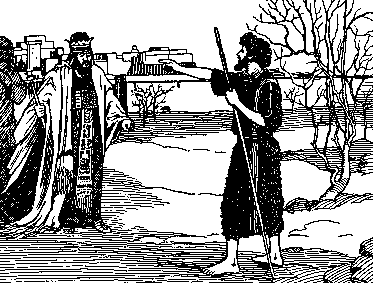
1 Kings 18
1And it came to pass after many days, that the word of the LORD came to Elijah in the third year, saying, Go, shew thyself unto Ahab; and I will send rain upon the earth.
2And Elijah went to shew himself unto Ahab. And there was a sore famine in Samaria.
3And Ahab called Obadiah, which was the governor of his house. (Now Obadiah feared the LORD greatly:
4For it was so, when Jezebel cut off the prophets of the LORD, that Obadiah took an hundred prophets, and hid them by fifty in a cave, and fed them with bread and water.)
5And Ahab said unto Obadiah, Go into the land, unto all fountains of water, and unto all brooks: peradventure we may find grass to save the horses and mules alive, that we lose not all the beasts.
6So they divided the land between them to pass throughout it: Ahab went one way by himself, and Obadiah went another way by himself.
7And as Obadiah was in the way, behold, Elijah met him: and he knew him, and fell on his face, and said, Art thou that my lord Elijah?
8And he answered him, I am: go, tell thy lord, Behold, Elijah is here.
9And he said, What have I sinned, that thou wouldest deliver thy servant into the hand of Ahab, to slay me?
10As the LORD thy God liveth, there is no nation or kingdom, whither my lord hath not sent to seek thee: and when they said, He is not there; he took an oath of the kingdom and nation, that they found thee not.
11And now thou sayest, Go, tell thy lord, Behold, Elijah is here.
12And it shall come to pass, as soon as I am gone from thee, that the Spirit of the LORD shall carry thee whither I know not; and so when I come and tell Ahab, and he cannot find thee, he shall slay me: but I thy servant fear the LORD from my youth.
13Was it not told my lord what I did when Jezebel slew the prophets of the LORD, how I hid an hundred men of the LORD's prophets by fifty in a cave, and fed them with bread and water?
14And now thou sayest, Go, tell thy lord, Behold, Elijah is here: and he shall slay me.
15And Elijah said, As the LORD of hosts liveth, before whom I stand, I will surely shew myself unto him to day.
16So Obadiah went to meet Ahab, and told him: and Ahab went to meet Elijah.
17And it came to pass, when Ahab saw Elijah, that Ahab said unto him, Art thou he that troubleth Israel?
18And he answered, I have not troubled Israel; but thou, and thy father's house, in that ye have forsaken the commandments of the LORD, and thou hast followed Baalim.
19Now therefore send, and gather to me all Israel unto mount Carmel, and the prophets of Baal four hundred and fifty, and the prophets of the groves four hundred, which eat at Jezebel's table.
20So Ahab sent unto all the children of Israel, and gathered the prophets together unto mount Carmel.
21And Elijah came unto all the people, and said, How long halt ye between two opinions? if the LORD be God, follow him: but if Baal, then follow him. And the people answered him not a word.
22Then said Elijah unto the people, I, even I only, remain a prophet of the LORD; but Baal's prophets are four hundred and fifty men.
23Let them therefore give us two bullocks; and let them choose one bullock for themselves, and cut it in pieces, and lay it on wood, and put no fire under: and I will dress the other bullock, and lay it on wood, and put no fire under:
24And call ye on the name of your gods, and I will call on the name of the LORD: and the God that answereth by fire, let him be God. And all the people answered and said, It is well spoken.
25And Elijah said unto the prophets of Baal, Choose you one bullock for yourselves, and dress it first; for ye are many; and call on the name of your gods, but put no fire under.
26And they took the bullock which was given them, and they dressed it, and called on the name of Baal from morning even until noon, saying, O Baal, hear us. But there was no voice, nor any that answered. And they leaped upon the altar which was made.
27And it came to pass at noon, that Elijah mocked them, and said, Cry aloud: for he is a god; either he is talking, or he is pursuing, or he is in a journey, or peradventure he sleepeth, and must be awaked.
28And they cried aloud, and cut themselves after their manner with knives and lancets, till the blood gushed out upon them.
29And it came to pass, when midday was past, and they prophesied until the time of the offering of the evening sacrifice, that there was neither voice, nor any to answer, nor any that regarded.
30And Elijah said unto all the people, Come near unto me. And all the people came near unto him. And he repaired the altar of the LORD that was broken down.
31And Elijah took twelve stones, according to the number of the tribes of the sons of Jacob, unto whom the word of the LORD came, saying, Israel shall be thy name:
32And with the stones he built an altar in the name of the LORD: and he made a trench about the altar, as great as would contain two measures of seed.
33And he put the wood in order, and cut the bullock in pieces, and laid him on the wood, and said, Fill four barrels with water, and pour it on the burnt sacrifice, and on the wood.
34And he said, Do it the second time. And they did it the second time. And he said, Do it the third time. And they did it the third time.
35And the water ran round about the altar; and he filled the trench also with water.
36And it came to pass at the time of the offering of the evening sacrifice, that Elijah the prophet came near, and said, LORD God of Abraham, Isaac, and of Israel, let it be known this day that thou art God in Israel, and that I am thy servant, and that I have done all these things at thy word.
37Hear me, O LORD, hear me, that this people may know that thou art the LORD God, and that thou hast turned their heart back again.
38Then the fire of the LORD fell, and consumed the burnt sacrifice, and the wood, and the stones, and the dust, and licked up the water that was in the trench.
39And when all the people saw it, they fell on their faces: and they said, The LORD, he is the God; the LORD, he is the God.
40And Elijah said unto them, Take the prophets of Baal; let not one of them escape. And they took them: and Elijah brought them down to the brook Kishon, and slew them there.
41And Elijah said unto Ahab, Get thee up, eat and drink; for there is a sound of abundance of rain.
42So Ahab went up to eat and to drink. And Elijah went up to the top of Carmel; and he cast himself down upon the earth, and put his face between his knees,
43And said to his servant, Go up now, look toward the sea. And he went up, and looked, and said, There is nothing. And he said, Go again seven times.
44And it came to pass at the seve
nth time, that he said, Behold, there ariseth a little cloud out of the sea, like a man's hand. And he said, Go up, say unto Ahab, Prepare thy chariot, and get thee down that the rain stop thee not.
45And it came to pass in the mean while, that the heaven was black with clouds and wind, and there was a great rain. And Ahab rode, and went to Jezreel.
46And the hand of the LORD was on Elijah; and he girded up his loins, and ran before Ahab to the entrance of Jezreel.
45And it came to pass in the mean while, that the heaven was black with clouds and wind, and there was a great rain. And Ahab rode, and went to Jezreel.
46And the hand of the LORD was on Elijah; and he girded up his loins, and ran before Ahab to the entrance of Jezreel.
Tuesday, October 06, 2009
Christians coming against astrology, horoscopes,or any spirit of divination

Globaalne
Christians coming against astrology, horoscopes,or any spirit of divination
Ühised huvid - Religioon & vaimsus
What does God say about those who consult with astrologers and use astrology for guidance in their lives? It's in the Bible, Isaiah 47:13-15 NIV. "All the counsel you have received has only worn you out. Let your astrologers come forward, those stargazers who make predictions month by month, let them save you from what is coming upon you. Surely they are like stubble; the fire will burn them up. They cannot even save themselves from the flame…Each of them goes on in his error; there is not one that can save you."
Astrology is a divination art, which teaches that the relative positioning in the sky of the Sun, Moon and planets has an influence upon individuals and upon the course of human affairs. The actual word for astrology in the Hebrew language literally means, ‘divining the heavens'. Divination is the act of foretelling future events, or of revealing secret knowledge, by means of signs and omens or other supernatural agency. God prohibits the practice of divination. It's in the Bible, Leviticus 19:26 NIV. "Do not practice divination or sorcery."
When the Israelites were about to enter the Promised Land of Canaan, God warned them not to practice it. It's in the Bible, Deuteronomy 18:9, 12 & 14 NIV. "Do not learn to imitate the detestable ways of the nations there…The nations you will dispossess listen to those who practice sorcery or divination. But as for you, the Lord your God has not permitted you to do so…Anyone who does these things is detestable to the Lord."
Divination is actually regarded to be a grave sin. It's in the Bible, 1 Samuel 15:23 NIV. "Rebellion is like the sin of divination, and arrogance like the evil of idolatry."
When King Nebuchadnezzar had a dream, he summoned the magicians, sorcerers and astrologers to tell him what he had dreamed. How did they respond? It's in the Bible, Daniel 2:10 NIV. "The astrologers answered the king, ‘There is not a man on earth who can do what the king asks! No king, however great and mighty, has ever asked such a thing of any magician or enchanter or astrologer.' "
The astrologers of Babylon were unable to help the King with this troublesome dream. However, God had blessed his prayerful prophet Daniel with the true gifts of the Holy Spirit, and he was brought before the king to interpret the dream. It's in the Bible, Daniel 2:27-28 NKJ. "Daniel answered in the presence of the king, and said, ‘The secret which the king has demanded, the wise men, the astrologers, the magicians, and the soothsayers cannot declare to the king. But there is a God in heaven who reveals secrets, and He has made known to King Nebuchadnezzar what will be in the latter days. Your dream, and the visions of your head upon your bed, were these…'" With God’s anointing, Daniel was able to describe and explain the king's prophetic dream.
Astrology is becoming popular, with many people regarding it to be a source of wise counsel. What does God say about those who consult with astrologers and use astrology as guidance for their lives? It's in the Bible, Isaiah 47:13-15 NIV. "All the counsel you have received has only worn you out. Let your astrologers come forward, those stargazers who make predictions month by month, let them save you from what is coming upon you. Surely they are like stubble; the fire will burn them up. They cannot even save themselves from the flame… Each of them goes on in his error; there is not one that can save you."
In this first mention of astrology in the Bible, God is speaking to the people of ancient pagan Babylon. Middle East archaeology has confirmed that astrology did indeed originate in the nation of Babylon, now called the country of Iraq. Cuneiform tablets have been excavated depicting horoscope charts dating from the 5th Century BC and earlier. Astrology is a divination art which teaches that the relative positioning in the sky of the Sun, Moon and planets has an influence upon individuals and upon the course of human affairs. In our modern times, just like in ancient Babylon, a growing number of people are utilizing the services of astrology consultants.
In the Book of Daniel, there is narrated a profound event in the life of Nebuchadnezzar, the King of Babylon. The king had a very disturbing dream, and he wanted to understand its meaning. Daniel 2:2 NIV, informs us, "So the king summoned the magicians, enchanters, sorcerers and astrologers to tell him what he had dreamed."
The astrologers, also known as 'Chaldeans', were part of the king's circle of so-called 'wise men' who practiced divination. The actual word for astrology in the Hebrew language literally means, 'divining the heavens'. Divination is the act of foretelling future events, or of revealing secret knowledge, by means of signs and omens or other supernatural agency. The practice of pagan divination is prohibited by God. It's in the Bible, Leviticus 19:26 NIV, "Do not practice divination or sorcery."
Divination was common among the pagan peoples of the Bible lands. When the Israelites were about to enter the Promised Land of Canaan, God warned them not to practice it. Says Deuteronomy 18:9, 12 & 14 NIV, "Do not learn to imitate the detestable ways of the nations there… The nations you will dispossess listen to those who practice sorcery or divination. But as for you, the Lord your God has not permitted you to do so… Anyone who does these things is detestable to the Lord." Divination is actually regarded to be a grave sin. Declares 1 Samuel 15:23 NIV, "Rebellion is like the sin of divination, and arrogance like the evil of idolatry."
For curiosity and amusement, millions of ordinary citizens read the daily horoscopes published in mass-circulation newspapers. Is it okay to have this kind of casual 'fun' interest in astrology? What counsel does the Bible give on this type of issue? In 1 Thessalonians 5:22 KJV, God emphatically states that we should "abstain from all appearance of evil."
King Nebuchadnezzar had asked his astrologers and other wizards to tell him his dream and interpret its meaning. How did they respond? Daniel 2:10 NIV, informs us, "The astrologers answered the king, 'There is not a man on earth who can do what the king asks! No king, however great and mighty, has ever asked such a thing of any magician or enchanter or astrologer.' "
The astrologers of Babylon were unable to help the King with his troublesome dream. However, God had blessed his prayerful prophet Daniel with the true gifts of the Holy Spirit, and he was brought before the king to interpret the dream. The Bible says in Daniel 2:27-28 NKJ, "Daniel answered in the presence of the king, and said, 'The secret which the king has demanded, the wise men, the astrologers, the magicians, and the soothsayers cannot declare to the king. But there is a God in heaven who reveals secrets, and He has made known to King Nebuchadnezzar what will be in the latter days. Your dream, and the visions of your head upon your bed, were these…' " With God's anointing, Daniel was able to then describe and explain the king's great prophetic dream.
If there is a need to understand perplexing situations in our lives, we are wise to shun the error and evil of astrology divination; but rather let us know that "there is a God in heaven who reveals secrets." Like Daniel, in prayer we can turn to God for help. And in the Bible, we have the assured counsel of His truth.
Witchcraft
The practice of witchcraft is forbidden by God. It's in the Bible, Deuteronomy 18:9-13, NIV. "When you enter the land the Lord your God is giving you, do not learn to imitate the detestable ways of the nations there. Let no one be found among you who sacrifices his son or daughter in the fire, who practices divination or sorcery, interprets omens, engages in witchcraft, or casts spells, or who is a medium or spiritist or who consults the dead. Anyone who does these things is detestable to the Lord, and because of these detestable practices the Lord your God will drive out those nations before you. You must be blameless before the Lord your God."
Those who practice witchcraft will not inherit the kingdom of God. It's in the Bible, Galatians 5:19-21, NIV. "The acts of the sinful nature are obvious: sexual immorality, impurity and debauchery; idolatry and witchcraft; …drunkenness, orgies, and the like. I warn you, as I did before, that those who live like this will not inherit the kingdom of God."
The future is known only by God, not witches. It's in the Bible, Isaiah 8:19, TLB. "So why are you trying to find out the future by consulting witches and mediums. Don't listen to their whisperings and mutterings. Can the living find out the future from the dead? Why not ask your God?"
.
.
Wednesday, August 19, 2009
Who Burned the Witches?

by Sandra Miesel
8/08/09
Since the Enlightenment, rationalists have liked to cite witch burning as a prime example of medieval ignorance and religious (usually Catholic) bigotry run amok. (Leftists today still denounce it as a cynical plot by the strong against the weak.) Writing history that way was simple: Historians catalogued horrors, disparaged religion (or at least someone else's religion), and celebrated the triumph of science and liberal government. The history of witchcraft seemed a settled issue in 1969 when Hugh Trevor-Roper published his classic essay, "The European Witch-Craze of the Sixteenth and Seventeenth Centuries."
But a clamor of new voices has since reopened the controversy. Members of the growing neopagan revival -- 200,000 strong in America today -- claim witches burned during the great witch-hunt as their martyred forebears. In 2000, a consortium of pagan leaders demanded a special apology from Pope John Paul II on the Jubilee Day of Pardon. They mourned a "pagan Holocaust" of nine million secret nature-worshippers exterminated by Christians 500 years ago under the Inquisition.
Sixty years ago, one of the neopagan movement's founders, Gerald Gardner, coined the term "the Burning Times" to describe this time of persecution. Although Gardner's historical expertise has since been questioned, neopagan proponents Margot Adler and Starhawk (nee Miriam Simos) are still preaching Gardner's teachings because, they say, "invented history is satisfying myth."
Nine million women burned is a figure conveniently larger than the Jewish Shoah, yet it was actually invented out of whole cloth by American feminist Matilda Joslyn Gage in 1893. Radical feminists have made much of this mass "gynecide," as antipornography activist Andrea Dworkin has called it. The feminists see witches as the natural enemy of patriarchy, rallying around them as Old Leftists did around the leaders of the Spanish Republic. For them, as for pagans, playing the politics of victimization strengthens solidarity.
Meanwhile, those of a Green stripe, a group that overlaps with the pagans and radical feminists, charge that suppressing witchcraft deprived medieval people of alternative medicine and estranged them from ancient Earth wisdom. In their 1973 book, Witches, Midwives, and Nurses: A History of Women Healers, feminist and environmentalist writers Barbara Ehrenreich and Deirdre English argued that witches were actually midwives targeted by their rivals, male physicians. Ecofeminist Carolyn Merchant has blamed patriarchal science for "the death of Nature" in her book of that title.
Although the general public has yet to notice, recent academic research has largely demolished both the old Enlightenment certainties and the new neopagan theories. Archival studies conducted in different regions of Europe over the last few decades have more accurately measured who killed how many of whom under what circumstances. Using the tools of anthropology and psychology, historians have reconstructed the social context in which the witch-hunts happened. They have a clearer picture now of how witchcraft theories developed and on what intellectual basis.
A Multitude Of Myths
For example, historians have now realized that witch-hunting was not primarily a medieval phenomenon. It peaked in the 17th century, during the rationalist age of Descartes, Newton, and St. Vincent de Paul. Persecuting suspected witches was not an elite plot against the poor; not was practicing witchcraft a mode of peasant resistance. Catholics and Protestants hunted witches with comparable vigor. Church and state alike tried and executed them. It took more than pure Reason to end the witch craze.
Nor were witches secret pagans serving an ancient Triple Goddess and Horned God, as the neopagans claim. In fact, no witch was ever executed for worshipping a pagan deity. Matilda Gage's estimate of nine million women burned is more than 200 times the best current estimate of 30,000 to 50,000 killed during the 400 years from 1400 to 1800 -- a large number but no Holocaust. And it wasn't all a burning time. Witches were hanged, strangled, and beheaded as well. Witch-hunting was not woman-hunting: At least 20 percent of all suspected witches were male. Midwives were not especially targeted; nor were witches liquidated as obstacles to professionalized medicine and mechanistic science.
This revised set of facts should not entirely comfort Catholics, however. Catholics have been misled -- at times deliberately misled -- about the Church's role in the witch-hunts by apologists eager to present the Church as innocent of witches' blood so as to refute the Enlightenment theory that witch-burning was almost entirely a Catholic phenomenon. Catholics should know that the thinking that set the great witch-hunt in motion was developed by Catholic clerics before the Reformation.
But the great witch-hunt was nonetheless remarkably slow in coming. Many cultures around the world believed for millennia -- and still believe -- in witches. In typical folklore, past and present, witches are night-flying evildoers who inflict harm on others by supernatural means, such as curses, the evil eye, and magic substances. Witchcraft is usually thought of as an innate power, unlike sorcery, whose magical spells must be learned. What Christianity uniquely added to those traditional beliefs was Satan. God's enemies were said to join Satan's band of demons through a pact and worship him at monstrous bacchanals called "sabbats," where they parodied the liturgy.
The Church inherited Roman and Germanic laws regarding maleficent magic, laws that treated witchcraft as a crime. But to St. Augustine, concrete witchcraft consisted of idolatry and illusion rather than harm to others. Following Augustine, an anonymous ninth-century text, Canon Episcopi, became part of the Church's canon law, declaring that belief in the reality of night-flying witches was heresy because there was no such thing as an actual witch. Although the idolatry and heresy associated with witchcraft resided only in the will, not in actual deeds, they were nevertheless sinful, Augustine wrote. Punishment was in order -- but not burning.
The High Middle Ages of the twelfth and 13th centuries saw the bloody suppression of heretics, notably the Cathars in Provence. Measures against Jews, magicians, and sexual deviants also grew harsher. These groups were associated with a stereotyped set of blasphemies, orgies, and outrages, including infanticide and cannibalism. Starting in 1232, the papal Inquisition dispatched roving specialists to detect and punish heretics outside existing legal systems.
Then, the idea that witchcraft was a reality rather than a heretical illusion suddenly made a comeback. The inquisitors who had cut their teeth on heretics were devouring accused witches as well by the end of the Middle Ages. This was not simply a matter of shifting scapegoats to suit market demand. In a society that feared supernatural menaces working through human conspiracies, the sinister folk figure of the esoterically schooled magician apparently fused with that of the petty village wise-woman or cunning man to create the new phenomenon of the diabolical witch.
After the first wisps of this change in the late 14th century, the flames burst forth around 1425 in the Savoy region, in what is now southeast France, and in the canton of Valais in Switzerland, near the borders of France and Italy. About 500 more witch trials followed before the Reformation began in 1517.
The Witch-Hunter's Baedeker
Meanwhile, witch-hunters' manuals multiplied, most notably the infamous Malleus Maleficarum (Hammer of Witches), published in 1486. Its authors, Jacob Sprenger and Heinrich Kraemer, were experienced Dominican inquisitors who had burned 48 witches in one diocese alone and had obtained a papal bull approving their mission. Reversing the old principle of the Canon Episcopi, Sprenger and Kraemer proclaimed that not believing in the reality of witches was heresy. Witches regularly did physical as well as spiritual harm to others, they wrote, and allegiance to the devil defined witchcraft. Sprenger and Kraemer exhorted secular authorities to fight witches by any means necessary.
Malleus Maleficarum (notice the feminine possessive of "witches") was a vicious misogynist tract. It depicted women as the sexual playmates of Satan, declaring: "All witchcraft comes from carnal lust, which is in women insatiable." Ironically, Sprenger also had a deep devotion to Mary. He helped to shape the modern rosary and founded the first rosary confraternity.
Malleus Maleficarum did not cover its ground completely, failing to discuss the actual pact that witches made with the devil, the sabbat, familiars (imps in animal form who aided witches), and night-flying. But those elements did not always appear in witchcraft cases. By itself, the Malleus started no new witch-panics, but it was freely used by later witchcraft writers, Protestant and Catholic alike. The Spanish inquisitors were nearly alone in scoffing at its lack of sophistication.
The demonologists who absorbed the Malleus were highly cultured men, such as the Protestant Jean Bodin, "the Aristotle of the 16th century," and his contemporary, the Jesuit classicist Martin del Rio. Those theoreticians pounded home the principle of the crimen exceptum: Because witchcraft was so vile an offense, accused witches had no legal rights. "Not one witch in a million would be accused or punished," Bodin boasted, "if the procedure were governed by ordinary rules." Anyone who defended accused witches or denied their crimes deserved the same punishment as witches, Bodin wrote.
Socially elite persecutors, demonologists, and judges relentlessly hunted witches with the zeal of modern revolutionaries pursuing a political utopia. No cost was too great, because witch-hunting served the greater good of Christendom, in their view. They believed that witchcraft inverted society's key values, disturbed godly order, challenged the divine right of kings -- the ancient doctrine that rulers derive their right to rule from God -- and diminished the majesty of God. It was thought that witch-hunting saved souls and averted the wrath of God by purging society of evil as the End Times loomed.
Commoners, by contrast, simply wanted relief from the evildoers of folklore who, they believed, were harming them, their children, their cattle, and their crops. It was grassroots complaints that started most witch-hunts. If authorities were too slow to act, peasants were capable of lynching suspected neighbors.
Although maleficium -- physical harm -- loomed much larger than diabolism in common people's accusations against suspected witches, their folk beliefs cross-fertilized the learned ones of Bodin and others in complex ways. Through sermons, gossip, trial accounts, and luridly illustrated "witch-books" (especially popular in Germany), everyone learned what witches did and how to detect them.
Witches Everywhere
The 30,000 to 50,000 casualties of the European witch-hunts were not distributed uniformally through time or space, even within particular jurisdictions. Three-quarters of Europe saw not a single trial. Witch persecution spread outward from its first center in alpine Italy in the early 15th century, guttering out in Poland, where witchcraft laws were finally repealed in 1788. The center had generally stopped trying witches before the peripheries even started.
The Spanish Road stretching from Italy to the Netherlands was also a "witch-road." The Catholic-ruled Spanish Netherlands (today's Belgium) saw far worse persecutions than the Protestant-ruled United Provinces of the Netherlands, which had stopped burning convicted witches by 1600. There were early panics in the German cities of Brandenburg and Mecklenburg, as well as in Lorraine, France, and parts of Switzerland and Scotland. The Rhineland and Southwest Germany suffered severe outbreaks, with German ecclesiastical territories hit hardest. Three-quarters of all witchcraft trials took place in the Catholic-ruled territories of the Holy Roman Empire. But Catholic Portugal, Castile and Spanish-ruled Italy, and the Orthodox lands of Eastern Europe saw virtually none. The panic in Salem, Massachusetts, was as bad as anything in England, but there seem to have been no executions in the Latin colonies of the New World.
The regional tolls demonstrated the patchwork pattern of witch-hunting. The town of Baden, Germany, for example, burned 200 witches from 1627 to 1630, more than all the convicted witches who perished in Sweden. The tiny town of Ellwangen, Germany, burned 393 witches from 1611 to 1618, more than Spain and Portugal combined ever executed. The Catholic prince-bishop of Wurzburg, Germany, burned 600 witches from 1628 to 1631, more witches than ever died in Protestant Sweden, Norway, Finland, and Iceland combined. The Swiss canton of Vaud executed about 1,800 witches from 1611 to 1660, compared with Scotland's toll of between 1,300 and 1,500 and England's toll of 500. The claim of some Catholic apologists that Elizabeth I executed 800 witches a year is gross slander. In Southwest Germany alone, 3,229 people were executed for witchcraft between 1562 and 1684 -- more than were executed for any reason by the Spanish, Portuguese, and Roman Inquisitions between 1500 and 1800. (All three of these Inquisitions burned fewer than a dozen witches in total.)
The most-dreaded lay witch-hunter was Nicholas Remy, attorney general of Lorraine, who boasted of sending 900 persons to the stake in a single decade (1581-1591). But the all-time grand champion exterminator of witches was Ferdinand von Wittelsbach, Catholic prince-archbishop of Cologne, Germany, who burned 2,000 members of his flock during the 1630s.
Let no one argue that witch-hunting was a predominantly Protestant activity. Both Catholic and Protestant lands saw light and heavy hunts. Demonologists and critics alike came from both religious camps.
Regional Influences
Local factors, not religious loyalties, determined the severity of witch persecutions. Roman law on the continent was harsher than English common law. Prosecuting maleficium alone, as England and Scandinavia did, yielded fewer victims than prosecuting diabolism (Scotland and Germany) or white magic (Lorraine and France). Unlimited torture in Germany induced more confessions than the limited torture in the Franche-Comte region in France. English third-degree methods such as sleep-deprivation were also effective ways of raising the number of convictions.
Ignoring denunciations procured through torture preserved Denmark from Germany's dreadful chain-reaction panics in which accused witches would in turn finger other witches. "Spectral evidence" from accusers' dreams was a significant prosecution device in Salem. Finding a witch's mark insensitive to pricking "or a witch's teat," on which familiars allegedly fed, secured convictions in Scotland and England; uncertainty about the credibility of witch's marks won acquittals in Geneva. Child witnesses -- often-malicious liars -- proved deadly in Sweden, the Basque country in Spain, Germany, and England (the hysteria resembled that surrounding the sex-abuse charges brought against U.S. day-care centers during the 1980s).
Professional witch-finders had dire impact. The best known of these freelance accusers was England's Matthew Hopkins, who doomed up to 200 people from 1645 through 1647. But special inquisitors or investigative committees were also lethal. Local judges were usually harsher than professional jurists from outside the community. Reviews of convictions by central authorities spared accused witches in Denmark, France, Sweden, and Austria. An informal appeal from ministers outside Salem halted the panic there.
Witch-hunting was typically part of broader campaigns to repress unruly behavior and impose religious orthodoxies. The hunt played out in a world of shrinking opportunities for ordinary folk. Early modern village economies were often zero-sum games, where the death of a cow could ruin a family. Peasants were locked into face-to-face contact with their neighbor-enemies. Feuds could last for generations.
The poorest and most common targets of the witch-hunts, social subordinates and even children sometimes turned the tables by accusing their wealthy superiors of witchcraft.
Women were more prominent than men at witchcraft trials, both as accused and as accusers. Not only did Sprenger's image of women as the more lustful and malicious sex generate suspicions; the fact that women had a lower social status than men made them easier to accuse. In most regions, about 80 percent of the alleged witches killed were female. Women were then as likely to be accused witches as men were to be saints or violent criminals. That was because women typically fought with curses instead of steel. Although the stereotype did not always fit, the British witch was usually seen as irascible, aggressive, unneighborly, and often repulsive -- hardly the gentle healer of neopagan fantasy. Her colorful curses could blight everything down to "the little pig that lieth in the sty." She magnified her powers to frighten others and extort favors. If she could not be loved, she meant to be feared.
Alternatively, the witches of Lorraine were said to be "fine and crafty, careful not to quarrel with people or threaten them." Effusive compliments were signs of suspected witchcraft in Lorraine, and suppressed anger could be ominous. Being innocent of the impossible crimes associated with witchcraft did not necessarily mean that witch-hunt victims were "nice." Some were prostitutes, beggars, or petty criminals. Austria's Zauberjaeckl trials (1675-1690) punished as witches people who were actually dangerous felons. The Magic Jacket Society prosecuted in those trials was a Baroque version of the Hell's Angels, recruiting waifs whom it controlled through black magic, sodomy, and conjurations with mice. The prince-archbishop of Salzburg, Austria, graciously forbade executing members of the society who were under the age of twelve. But 200 others were put to death.
Panic And Torture
Witch-hunting could be endemic or epidemic. Its dynamics varied. Small panics (fewer than 20 victims) tended to occur in villages worried about maleficium. Their victims were often poor, obnoxious persons whose removal the rest of the community applauded.
If small panics fed on long-smoldering fears about neighbors, large ones exploded without warning, killing people of all classes and conditions and rupturing social bonds. The worst examples of this were in Germany, where unlimited use of torture (in defiance of imperial law) produced an ever-expanding wave of denunciations. To object was to court death.
Large witch-panics started with the usual obscure suspects and worked up the social scale to prosperous citizens, reputable matrons, high-ranking clerics, town officials, and even judges. The longer a panic lasted, the higher was the proportion of male and wealthy victims.
According to the Dutch Jesuit Cornelius van Loos, confiscations from suspected witches in large panics could "coin gold and silver from human blood," Youngsters were legally old enough to burn as soon as they could distinguish "gold from an apple." Children as young as nine were burned in Wurzburg, including the bishop's nephew, and boys ages three and four were imprisoned as Satan's catamites.
Some of the German trials were marred by collusion, bribes, and rape. Unspeakable tortures were routine -- 17 different kinds were authorized by "the Saxon lawgiver," Benedikt Carpzov, during the 17th century. Confessing "without torture" in Germany meant without torture that drew blood. Nearly all who underwent this broke, even the blameless.
Yet witches sometimes did turn themselves in and confess spontaneously, the equivalent of today's "suicide by police." The same melancholy, frustration, and despair that they claimed had driven them into the devil's arms brought them willingly to the stake. They had apparently come to believe the wish-fulfillment fantasies of pleasure and revenge enacted in the theaters of their minds. Nevertheless, they still hoped to save their souls through pain.
A few brave men spoke up for justice. In 1563, Johann Weyer, a Protestant court physician, drew attention to the cruelty of the trials and the mental incompetence of many of the accused. English country gentleman Reginald Scot mocked witchcraft as popish nonsense in 1584. In 1631, the Jesuit Friedrich von Spec, confessor to witches burned at Mainz, proclaimed them innocent victims. Van Loos, witness to the horrors of witchcraft trials at Trier, had his manuscript confiscated in 1592 before it could be published and was himself imprisoned and banished.
Ironically, a Spanish inquisitor named Alonso Salazar y Frias mounted the most dramatic challenge to witch-hunting. In 1609, a panic among French Basques in the western Pyrenees on the Bay of Biscay spilled over into the Navarra region in Spain, where six accused witches went to the stake. But Salazar, who had been a judge in that trial, became skeptical as the panic widened to engulf 1,800 suspects, 1,500 of them children. Basque witches' confessions included such incredible details as familiars in the form of costumed toads that child-witches herded with little crooks during sabbats.
Salazar cross-checked testimony, had supposed magic substances tested, and applied logic to conclude that the alleged witches were simply an artifact of witch-hunting. "There were neither witches nor bewitched until they were talked and written about," he reported in 1610. With stubborn practice, Salazar wrested a decision from his superiors that freed the accused in 1614. The Spanish Inquisition never executed another witch; nor did it permit secular authorities to do so after an outbreak in Catalonia that saw more than 300 witches hanged between 1616 and 1619. What could have erupted into Europe's worst witch-panic was extinguished by one man.
Cooling Ashes
Slowly, the critics were vindicated, and ashes cooled all across Europe during the 18th century. This was no simple triumph of Enlightenment wisdom. Witch beliefs persisted -- as they do today -- but witches no longer faced stakes, gallows, or swords. The great witch-panics had left a kind of psychic weariness in their wake. Realizing that innocents had been cruelly sent to their deaths, people no longer trusted their courts' judgments. As Montaigne had written 200 years earlier, "It is putting a very high price on one's conjectures to have a man roasted alive because of them."
After a 20th century unmatched for bloodshed, the world today is in no position to disparage early modern Europe. Witch-hunts have much in common with our own political purges, imagined conspiracies, and rumors of ritualized child abuse. Our capacity to project enormities on the enemy Other is as strong as ever.
The truth about witch-hunting is worth knowing for its own sake. But the issue has added significance for Catholics because it has provided ammunition for rationalists, pagans, and radical feminists to attack the Church. It is helpful to know that the number of victims has been grossly exaggerated, and that the reasons for the persecutions had as much to do with social factors as with religious ones.
But although Catholics have been fed comforting errors by overeager apologists about the Church's part in persecuting witches, we must face our own tragic past. Fellow Catholics, to whom we are forever bound in the communion of saints, did sin grievously against people accused of witchcraft. If our historical memory can be truly purified, then the smoke from the Burning Times can finally disperse.
--------------------------------------------------------------------------------
Sandra Miesel is a writer and medievalist. This article originally appeared in the October 2001 issue of Crisis Magazine.
Source: http://insidecatholic.com/Joomla/index.php?option=com_content&task=view&id=6627&Itemid=48
8/08/09
Since the Enlightenment, rationalists have liked to cite witch burning as a prime example of medieval ignorance and religious (usually Catholic) bigotry run amok. (Leftists today still denounce it as a cynical plot by the strong against the weak.) Writing history that way was simple: Historians catalogued horrors, disparaged religion (or at least someone else's religion), and celebrated the triumph of science and liberal government. The history of witchcraft seemed a settled issue in 1969 when Hugh Trevor-Roper published his classic essay, "The European Witch-Craze of the Sixteenth and Seventeenth Centuries."
But a clamor of new voices has since reopened the controversy. Members of the growing neopagan revival -- 200,000 strong in America today -- claim witches burned during the great witch-hunt as their martyred forebears. In 2000, a consortium of pagan leaders demanded a special apology from Pope John Paul II on the Jubilee Day of Pardon. They mourned a "pagan Holocaust" of nine million secret nature-worshippers exterminated by Christians 500 years ago under the Inquisition.
Sixty years ago, one of the neopagan movement's founders, Gerald Gardner, coined the term "the Burning Times" to describe this time of persecution. Although Gardner's historical expertise has since been questioned, neopagan proponents Margot Adler and Starhawk (nee Miriam Simos) are still preaching Gardner's teachings because, they say, "invented history is satisfying myth."
Nine million women burned is a figure conveniently larger than the Jewish Shoah, yet it was actually invented out of whole cloth by American feminist Matilda Joslyn Gage in 1893. Radical feminists have made much of this mass "gynecide," as antipornography activist Andrea Dworkin has called it. The feminists see witches as the natural enemy of patriarchy, rallying around them as Old Leftists did around the leaders of the Spanish Republic. For them, as for pagans, playing the politics of victimization strengthens solidarity.
Meanwhile, those of a Green stripe, a group that overlaps with the pagans and radical feminists, charge that suppressing witchcraft deprived medieval people of alternative medicine and estranged them from ancient Earth wisdom. In their 1973 book, Witches, Midwives, and Nurses: A History of Women Healers, feminist and environmentalist writers Barbara Ehrenreich and Deirdre English argued that witches were actually midwives targeted by their rivals, male physicians. Ecofeminist Carolyn Merchant has blamed patriarchal science for "the death of Nature" in her book of that title.
Although the general public has yet to notice, recent academic research has largely demolished both the old Enlightenment certainties and the new neopagan theories. Archival studies conducted in different regions of Europe over the last few decades have more accurately measured who killed how many of whom under what circumstances. Using the tools of anthropology and psychology, historians have reconstructed the social context in which the witch-hunts happened. They have a clearer picture now of how witchcraft theories developed and on what intellectual basis.
A Multitude Of Myths
For example, historians have now realized that witch-hunting was not primarily a medieval phenomenon. It peaked in the 17th century, during the rationalist age of Descartes, Newton, and St. Vincent de Paul. Persecuting suspected witches was not an elite plot against the poor; not was practicing witchcraft a mode of peasant resistance. Catholics and Protestants hunted witches with comparable vigor. Church and state alike tried and executed them. It took more than pure Reason to end the witch craze.
Nor were witches secret pagans serving an ancient Triple Goddess and Horned God, as the neopagans claim. In fact, no witch was ever executed for worshipping a pagan deity. Matilda Gage's estimate of nine million women burned is more than 200 times the best current estimate of 30,000 to 50,000 killed during the 400 years from 1400 to 1800 -- a large number but no Holocaust. And it wasn't all a burning time. Witches were hanged, strangled, and beheaded as well. Witch-hunting was not woman-hunting: At least 20 percent of all suspected witches were male. Midwives were not especially targeted; nor were witches liquidated as obstacles to professionalized medicine and mechanistic science.
This revised set of facts should not entirely comfort Catholics, however. Catholics have been misled -- at times deliberately misled -- about the Church's role in the witch-hunts by apologists eager to present the Church as innocent of witches' blood so as to refute the Enlightenment theory that witch-burning was almost entirely a Catholic phenomenon. Catholics should know that the thinking that set the great witch-hunt in motion was developed by Catholic clerics before the Reformation.
But the great witch-hunt was nonetheless remarkably slow in coming. Many cultures around the world believed for millennia -- and still believe -- in witches. In typical folklore, past and present, witches are night-flying evildoers who inflict harm on others by supernatural means, such as curses, the evil eye, and magic substances. Witchcraft is usually thought of as an innate power, unlike sorcery, whose magical spells must be learned. What Christianity uniquely added to those traditional beliefs was Satan. God's enemies were said to join Satan's band of demons through a pact and worship him at monstrous bacchanals called "sabbats," where they parodied the liturgy.
The Church inherited Roman and Germanic laws regarding maleficent magic, laws that treated witchcraft as a crime. But to St. Augustine, concrete witchcraft consisted of idolatry and illusion rather than harm to others. Following Augustine, an anonymous ninth-century text, Canon Episcopi, became part of the Church's canon law, declaring that belief in the reality of night-flying witches was heresy because there was no such thing as an actual witch. Although the idolatry and heresy associated with witchcraft resided only in the will, not in actual deeds, they were nevertheless sinful, Augustine wrote. Punishment was in order -- but not burning.
The High Middle Ages of the twelfth and 13th centuries saw the bloody suppression of heretics, notably the Cathars in Provence. Measures against Jews, magicians, and sexual deviants also grew harsher. These groups were associated with a stereotyped set of blasphemies, orgies, and outrages, including infanticide and cannibalism. Starting in 1232, the papal Inquisition dispatched roving specialists to detect and punish heretics outside existing legal systems.
Then, the idea that witchcraft was a reality rather than a heretical illusion suddenly made a comeback. The inquisitors who had cut their teeth on heretics were devouring accused witches as well by the end of the Middle Ages. This was not simply a matter of shifting scapegoats to suit market demand. In a society that feared supernatural menaces working through human conspiracies, the sinister folk figure of the esoterically schooled magician apparently fused with that of the petty village wise-woman or cunning man to create the new phenomenon of the diabolical witch.
After the first wisps of this change in the late 14th century, the flames burst forth around 1425 in the Savoy region, in what is now southeast France, and in the canton of Valais in Switzerland, near the borders of France and Italy. About 500 more witch trials followed before the Reformation began in 1517.
The Witch-Hunter's Baedeker
Meanwhile, witch-hunters' manuals multiplied, most notably the infamous Malleus Maleficarum (Hammer of Witches), published in 1486. Its authors, Jacob Sprenger and Heinrich Kraemer, were experienced Dominican inquisitors who had burned 48 witches in one diocese alone and had obtained a papal bull approving their mission. Reversing the old principle of the Canon Episcopi, Sprenger and Kraemer proclaimed that not believing in the reality of witches was heresy. Witches regularly did physical as well as spiritual harm to others, they wrote, and allegiance to the devil defined witchcraft. Sprenger and Kraemer exhorted secular authorities to fight witches by any means necessary.
Malleus Maleficarum (notice the feminine possessive of "witches") was a vicious misogynist tract. It depicted women as the sexual playmates of Satan, declaring: "All witchcraft comes from carnal lust, which is in women insatiable." Ironically, Sprenger also had a deep devotion to Mary. He helped to shape the modern rosary and founded the first rosary confraternity.
Malleus Maleficarum did not cover its ground completely, failing to discuss the actual pact that witches made with the devil, the sabbat, familiars (imps in animal form who aided witches), and night-flying. But those elements did not always appear in witchcraft cases. By itself, the Malleus started no new witch-panics, but it was freely used by later witchcraft writers, Protestant and Catholic alike. The Spanish inquisitors were nearly alone in scoffing at its lack of sophistication.
The demonologists who absorbed the Malleus were highly cultured men, such as the Protestant Jean Bodin, "the Aristotle of the 16th century," and his contemporary, the Jesuit classicist Martin del Rio. Those theoreticians pounded home the principle of the crimen exceptum: Because witchcraft was so vile an offense, accused witches had no legal rights. "Not one witch in a million would be accused or punished," Bodin boasted, "if the procedure were governed by ordinary rules." Anyone who defended accused witches or denied their crimes deserved the same punishment as witches, Bodin wrote.
Socially elite persecutors, demonologists, and judges relentlessly hunted witches with the zeal of modern revolutionaries pursuing a political utopia. No cost was too great, because witch-hunting served the greater good of Christendom, in their view. They believed that witchcraft inverted society's key values, disturbed godly order, challenged the divine right of kings -- the ancient doctrine that rulers derive their right to rule from God -- and diminished the majesty of God. It was thought that witch-hunting saved souls and averted the wrath of God by purging society of evil as the End Times loomed.
Commoners, by contrast, simply wanted relief from the evildoers of folklore who, they believed, were harming them, their children, their cattle, and their crops. It was grassroots complaints that started most witch-hunts. If authorities were too slow to act, peasants were capable of lynching suspected neighbors.
Although maleficium -- physical harm -- loomed much larger than diabolism in common people's accusations against suspected witches, their folk beliefs cross-fertilized the learned ones of Bodin and others in complex ways. Through sermons, gossip, trial accounts, and luridly illustrated "witch-books" (especially popular in Germany), everyone learned what witches did and how to detect them.
Witches Everywhere
The 30,000 to 50,000 casualties of the European witch-hunts were not distributed uniformally through time or space, even within particular jurisdictions. Three-quarters of Europe saw not a single trial. Witch persecution spread outward from its first center in alpine Italy in the early 15th century, guttering out in Poland, where witchcraft laws were finally repealed in 1788. The center had generally stopped trying witches before the peripheries even started.
The Spanish Road stretching from Italy to the Netherlands was also a "witch-road." The Catholic-ruled Spanish Netherlands (today's Belgium) saw far worse persecutions than the Protestant-ruled United Provinces of the Netherlands, which had stopped burning convicted witches by 1600. There were early panics in the German cities of Brandenburg and Mecklenburg, as well as in Lorraine, France, and parts of Switzerland and Scotland. The Rhineland and Southwest Germany suffered severe outbreaks, with German ecclesiastical territories hit hardest. Three-quarters of all witchcraft trials took place in the Catholic-ruled territories of the Holy Roman Empire. But Catholic Portugal, Castile and Spanish-ruled Italy, and the Orthodox lands of Eastern Europe saw virtually none. The panic in Salem, Massachusetts, was as bad as anything in England, but there seem to have been no executions in the Latin colonies of the New World.
The regional tolls demonstrated the patchwork pattern of witch-hunting. The town of Baden, Germany, for example, burned 200 witches from 1627 to 1630, more than all the convicted witches who perished in Sweden. The tiny town of Ellwangen, Germany, burned 393 witches from 1611 to 1618, more than Spain and Portugal combined ever executed. The Catholic prince-bishop of Wurzburg, Germany, burned 600 witches from 1628 to 1631, more witches than ever died in Protestant Sweden, Norway, Finland, and Iceland combined. The Swiss canton of Vaud executed about 1,800 witches from 1611 to 1660, compared with Scotland's toll of between 1,300 and 1,500 and England's toll of 500. The claim of some Catholic apologists that Elizabeth I executed 800 witches a year is gross slander. In Southwest Germany alone, 3,229 people were executed for witchcraft between 1562 and 1684 -- more than were executed for any reason by the Spanish, Portuguese, and Roman Inquisitions between 1500 and 1800. (All three of these Inquisitions burned fewer than a dozen witches in total.)
The most-dreaded lay witch-hunter was Nicholas Remy, attorney general of Lorraine, who boasted of sending 900 persons to the stake in a single decade (1581-1591). But the all-time grand champion exterminator of witches was Ferdinand von Wittelsbach, Catholic prince-archbishop of Cologne, Germany, who burned 2,000 members of his flock during the 1630s.
Let no one argue that witch-hunting was a predominantly Protestant activity. Both Catholic and Protestant lands saw light and heavy hunts. Demonologists and critics alike came from both religious camps.
Regional Influences
Local factors, not religious loyalties, determined the severity of witch persecutions. Roman law on the continent was harsher than English common law. Prosecuting maleficium alone, as England and Scandinavia did, yielded fewer victims than prosecuting diabolism (Scotland and Germany) or white magic (Lorraine and France). Unlimited torture in Germany induced more confessions than the limited torture in the Franche-Comte region in France. English third-degree methods such as sleep-deprivation were also effective ways of raising the number of convictions.
Ignoring denunciations procured through torture preserved Denmark from Germany's dreadful chain-reaction panics in which accused witches would in turn finger other witches. "Spectral evidence" from accusers' dreams was a significant prosecution device in Salem. Finding a witch's mark insensitive to pricking "or a witch's teat," on which familiars allegedly fed, secured convictions in Scotland and England; uncertainty about the credibility of witch's marks won acquittals in Geneva. Child witnesses -- often-malicious liars -- proved deadly in Sweden, the Basque country in Spain, Germany, and England (the hysteria resembled that surrounding the sex-abuse charges brought against U.S. day-care centers during the 1980s).
Professional witch-finders had dire impact. The best known of these freelance accusers was England's Matthew Hopkins, who doomed up to 200 people from 1645 through 1647. But special inquisitors or investigative committees were also lethal. Local judges were usually harsher than professional jurists from outside the community. Reviews of convictions by central authorities spared accused witches in Denmark, France, Sweden, and Austria. An informal appeal from ministers outside Salem halted the panic there.
Witch-hunting was typically part of broader campaigns to repress unruly behavior and impose religious orthodoxies. The hunt played out in a world of shrinking opportunities for ordinary folk. Early modern village economies were often zero-sum games, where the death of a cow could ruin a family. Peasants were locked into face-to-face contact with their neighbor-enemies. Feuds could last for generations.
The poorest and most common targets of the witch-hunts, social subordinates and even children sometimes turned the tables by accusing their wealthy superiors of witchcraft.
Women were more prominent than men at witchcraft trials, both as accused and as accusers. Not only did Sprenger's image of women as the more lustful and malicious sex generate suspicions; the fact that women had a lower social status than men made them easier to accuse. In most regions, about 80 percent of the alleged witches killed were female. Women were then as likely to be accused witches as men were to be saints or violent criminals. That was because women typically fought with curses instead of steel. Although the stereotype did not always fit, the British witch was usually seen as irascible, aggressive, unneighborly, and often repulsive -- hardly the gentle healer of neopagan fantasy. Her colorful curses could blight everything down to "the little pig that lieth in the sty." She magnified her powers to frighten others and extort favors. If she could not be loved, she meant to be feared.
Alternatively, the witches of Lorraine were said to be "fine and crafty, careful not to quarrel with people or threaten them." Effusive compliments were signs of suspected witchcraft in Lorraine, and suppressed anger could be ominous. Being innocent of the impossible crimes associated with witchcraft did not necessarily mean that witch-hunt victims were "nice." Some were prostitutes, beggars, or petty criminals. Austria's Zauberjaeckl trials (1675-1690) punished as witches people who were actually dangerous felons. The Magic Jacket Society prosecuted in those trials was a Baroque version of the Hell's Angels, recruiting waifs whom it controlled through black magic, sodomy, and conjurations with mice. The prince-archbishop of Salzburg, Austria, graciously forbade executing members of the society who were under the age of twelve. But 200 others were put to death.
Panic And Torture
Witch-hunting could be endemic or epidemic. Its dynamics varied. Small panics (fewer than 20 victims) tended to occur in villages worried about maleficium. Their victims were often poor, obnoxious persons whose removal the rest of the community applauded.
If small panics fed on long-smoldering fears about neighbors, large ones exploded without warning, killing people of all classes and conditions and rupturing social bonds. The worst examples of this were in Germany, where unlimited use of torture (in defiance of imperial law) produced an ever-expanding wave of denunciations. To object was to court death.
Large witch-panics started with the usual obscure suspects and worked up the social scale to prosperous citizens, reputable matrons, high-ranking clerics, town officials, and even judges. The longer a panic lasted, the higher was the proportion of male and wealthy victims.
According to the Dutch Jesuit Cornelius van Loos, confiscations from suspected witches in large panics could "coin gold and silver from human blood," Youngsters were legally old enough to burn as soon as they could distinguish "gold from an apple." Children as young as nine were burned in Wurzburg, including the bishop's nephew, and boys ages three and four were imprisoned as Satan's catamites.
Some of the German trials were marred by collusion, bribes, and rape. Unspeakable tortures were routine -- 17 different kinds were authorized by "the Saxon lawgiver," Benedikt Carpzov, during the 17th century. Confessing "without torture" in Germany meant without torture that drew blood. Nearly all who underwent this broke, even the blameless.
Yet witches sometimes did turn themselves in and confess spontaneously, the equivalent of today's "suicide by police." The same melancholy, frustration, and despair that they claimed had driven them into the devil's arms brought them willingly to the stake. They had apparently come to believe the wish-fulfillment fantasies of pleasure and revenge enacted in the theaters of their minds. Nevertheless, they still hoped to save their souls through pain.
A few brave men spoke up for justice. In 1563, Johann Weyer, a Protestant court physician, drew attention to the cruelty of the trials and the mental incompetence of many of the accused. English country gentleman Reginald Scot mocked witchcraft as popish nonsense in 1584. In 1631, the Jesuit Friedrich von Spec, confessor to witches burned at Mainz, proclaimed them innocent victims. Van Loos, witness to the horrors of witchcraft trials at Trier, had his manuscript confiscated in 1592 before it could be published and was himself imprisoned and banished.
Ironically, a Spanish inquisitor named Alonso Salazar y Frias mounted the most dramatic challenge to witch-hunting. In 1609, a panic among French Basques in the western Pyrenees on the Bay of Biscay spilled over into the Navarra region in Spain, where six accused witches went to the stake. But Salazar, who had been a judge in that trial, became skeptical as the panic widened to engulf 1,800 suspects, 1,500 of them children. Basque witches' confessions included such incredible details as familiars in the form of costumed toads that child-witches herded with little crooks during sabbats.
Salazar cross-checked testimony, had supposed magic substances tested, and applied logic to conclude that the alleged witches were simply an artifact of witch-hunting. "There were neither witches nor bewitched until they were talked and written about," he reported in 1610. With stubborn practice, Salazar wrested a decision from his superiors that freed the accused in 1614. The Spanish Inquisition never executed another witch; nor did it permit secular authorities to do so after an outbreak in Catalonia that saw more than 300 witches hanged between 1616 and 1619. What could have erupted into Europe's worst witch-panic was extinguished by one man.
Cooling Ashes
Slowly, the critics were vindicated, and ashes cooled all across Europe during the 18th century. This was no simple triumph of Enlightenment wisdom. Witch beliefs persisted -- as they do today -- but witches no longer faced stakes, gallows, or swords. The great witch-panics had left a kind of psychic weariness in their wake. Realizing that innocents had been cruelly sent to their deaths, people no longer trusted their courts' judgments. As Montaigne had written 200 years earlier, "It is putting a very high price on one's conjectures to have a man roasted alive because of them."
After a 20th century unmatched for bloodshed, the world today is in no position to disparage early modern Europe. Witch-hunts have much in common with our own political purges, imagined conspiracies, and rumors of ritualized child abuse. Our capacity to project enormities on the enemy Other is as strong as ever.
The truth about witch-hunting is worth knowing for its own sake. But the issue has added significance for Catholics because it has provided ammunition for rationalists, pagans, and radical feminists to attack the Church. It is helpful to know that the number of victims has been grossly exaggerated, and that the reasons for the persecutions had as much to do with social factors as with religious ones.
But although Catholics have been fed comforting errors by overeager apologists about the Church's part in persecuting witches, we must face our own tragic past. Fellow Catholics, to whom we are forever bound in the communion of saints, did sin grievously against people accused of witchcraft. If our historical memory can be truly purified, then the smoke from the Burning Times can finally disperse.
--------------------------------------------------------------------------------
Sandra Miesel is a writer and medievalist. This article originally appeared in the October 2001 issue of Crisis Magazine.
Source: http://insidecatholic.com/Joomla/index.php?option=com_content&task=view&id=6627&Itemid=48
.
Subscribe to:
Posts (Atom)