.
AND THE THIRD ANGEL FOLLOWED THEM, SAYING WITH A LOUD VOICE, IF ANY MAN WORSHIP THE BEAST AND HIS IMAGE, AND RECEIVE HIS MARK IN HIS FOREHEAD, OR IN HIS HAND. *** REVELATION 14:9
Tuesday, September 10, 2024
Thursday, September 05, 2024
Pope says battling climate change and religious extremism a common cause

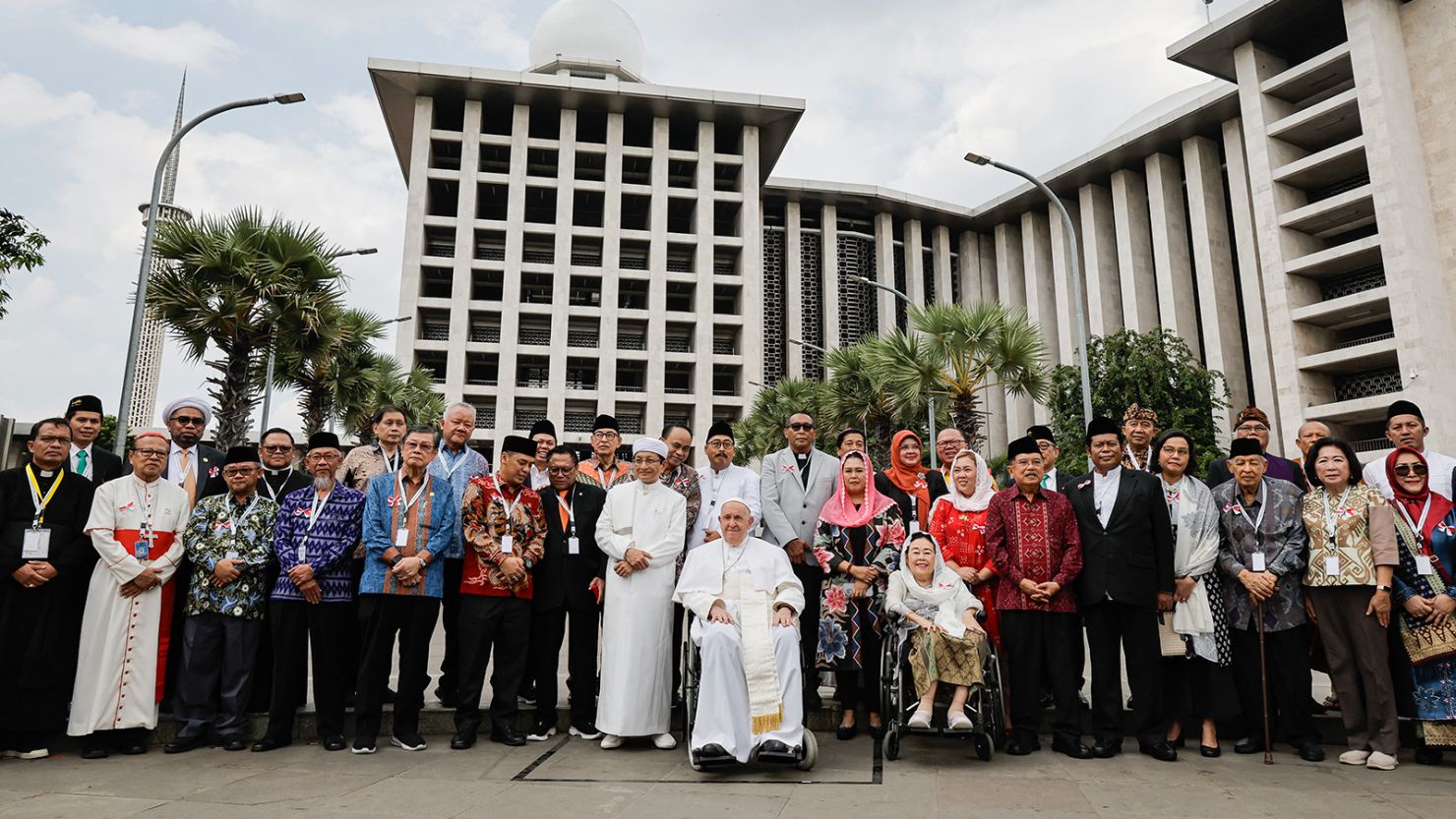
On visit to Southeast Asia’s largest mosque, Pope says battling climate change and religious extremism a common cause
Updated 2:32 AM EDT, Thu September 5, 2024
Jakarta, IndonesiaCNN —
Since his papacy began in 2013, Pope Francis has signaled his intention to build bridges with other faiths. The global growth of Islam, and the rise of extremism across religions, also made this an urgent priority.
On Thursday, in the biggest mosque in the world’s largest Muslim-majority nation, the pontiff used a joint statement with Indonesia’s Grand Imam Nasaruddin Umar to pinpoint “two serious crises” facing the world: dehumanization and climate change.
“The global phenomenon of dehumanization is marked especially by widespread violence and conflict, frequently leading to an alarming number of victims,” said the statement, signed in the sprawling capital Jakarta.
“It is particularly worrying that religion is often instrumentalized in this regard, causing suffering to many, especially women, children and the elderly,” it continued. “The role of religion, however, should include promoting and safeguarding the dignity of every human life.”
On climate change, the declaration stated that “human exploitation of creation” had led to “various destructive consequences such as natural disasters, global warming and unpredictable weather patterns,” and an “obstacle to the harmonious coexistence of peoples.”
Monday, September 02, 2024
Pope Francis arrives at Jakarta airport | REUTERS
Reuters
#Pope #PopeFrancis #Jakarta
Sunday, November 13, 2022
Saturday, September 29, 2018
Sunday, December 28, 2014
'Not Again': AirAsia Plane Disappears, Months After MH370 Went Missing
Another Asian airliner has gone missing: AirAsia flight QZ8501 lost contact with air traffic control at 7:24 a.m. local time on Sunday, AirAsia reported about four hours after the plane disappeared en route to Singapore.
(For context for American readers, flight QZ8501 disappeared at 7:24 p.m. EST on Saturday in the United States.)
AirAsia is a private airline based in Malaysia, and the country already has suffered two major aviation catastrophes this year.
In March 2014, Malaysia Airlines flight MH370 lost contact with air traffic control when it was about several hundred miles north of Singapore. Rescuers still have been unable to find any traces of flight MH370, or its 239 passengers and crew, despite an unprecedented search effort.
In April 2014, or one month after MH370 went missing, AirAsia’s CEO was forced to apologize after the company’s in-flight magazine suggested that AirAsia’s own well-trained pilots would never lose a plane.
AirAsia was forced to apologize for this article in its in-flight magazine, after MH370 went missing.
AirAsia said the magazine was printed before MH370 disappeared, and was not intended as a commentary on its rival airline.
In July 2014, Malaysia Airline flight MH17 was shot down over Ukraine, killing nearly 300 passengers and crew.
Details on AirAsia Flight QZ8501
Sunday’s missing AirAsia flight was traveling between Surabaya, in Indonesia, and Singapore. There were 155 passengers and seven crew on board the Airbus A320-200, officials have said.
The plane was operated by Indonesia AirAsia, a joint venture with Air Asia proper. (The company has several affiliates, including AirAsia India and AirAsia X.) Indonesia AirAsia has a fleet of 30 Airbus A320s.
An AirAsia official told the media on Sunday that the plane had requested “an unusual route” before air traffic control lost contact with QZ8501 over the Java Sea. However, an Indonesia Transport Ministry spokesperson later clarified that the pilot’s request was permission to change altitude due to bad weather, Steve Herman reported for the Voice of America.
“At the present time we unfortunately have no further information,” according to AirAsia’s statement. “At this time, search and rescue operations are in progress and AirAsia is cooperating fully and assisting the rescue service.”
After releasing its statement to reporters, AirAsia immediately changed the appearance of its various social media accounts. On AirAsia’s Facebook account, for instance, the company swapped out its usual bright red logo in favor of a muted gray logo, and changed the background of its Facebook from a festive holiday theme to a shrouded, all-black bar.
Malaysians were “shocked” by the news of a third potential lost airliner this year, the Malaysian Insider reported, and tens of thousand of people around the globe took to social media to express their surprise and sorrow.
“Another plane went missing,” one Malaysian tweeted. “Ya Allah not again.”
“Pray for QZ8501.”
Thursday, July 04, 2013
A Hindu Goddess Arrives To Bless Embassy Row
by NPR STAFF
June 30, 2013 7:20 AM
Listen to the Story
Weekend Edition Sunday
2 min 38 sec
Playlist
Download
Transcript
The goddess Saraswati now looks down upon Embassy Row in Washington, D.C.Sarah Ventre/NPR
Embassy Row — otherwise known as Massachusetts Avenue — in Washington, D.C., is decorated with flags of every nation, flying in front of impressive embassy buildings.
In front of the embassies, there are often statues of national heroes. Winston Churchill graces the grounds of the British Embassy. Outside the Indian Embassy, Mahatma Gandhi looks as though he's in full stride, clad in loincloth and sandals.
And now, there's a Hindu goddess. Saraswati just arrived. She stands in a garden in front of Indonesia's embassy, glowing white and gold, with her four arms upraised.
Indonesian Ambassador Dino Patti Djalal says the goal was to stand out from the other embassies.
"I think this is exactly what we wanted to do with Massachusetts Avenue," he says, "add something that would jazz it up."
Saraswati is the goddess of learning and wisdom, Djalal says. At her feet are three children studying. It was crafted by three Balinese sculptors in three weeks.
Her expression is beatific. "This would be the same expression that you would see in Hindu goddesses throughout Bali," Djalal says. "A face of calm ... blessing those who are seeing her."
Although Indonesia is home to the largest population of Muslims in the world, Djalal chose a symbol of the Hindu religion for the embassy in Washington.
"One of the most famous, if not the most famous, islands in Indonesia is Bali," he says. "And Bali is a Hindu enclave in Muslim-majority Indonesia. And I think it says a lot about our respect for religious freedom that the statue in front of the country with the largest Muslim population is a Hindu statue."
Thursday, October 11, 2012
6.7 earthquake rocks Indonesia’s eastern province of Maluku; no reports of injuries
By Associated Press, Updated: Thursday, October 11, 11:15 PM
.
Friday, May 18, 2012
Religious freedom festival in Indonesia recognizes government, faith leaders
Thursday, April 26, 2012
Indonesia bans American beef over mad cow scare
Wednesday, April 11, 2012
8.6 Magnitude Earthquake Strikes North Sumatra
Wed Apr 11, 2012 07:42 AM ET
UPDATE (7:33 a.m. ET): An aftershock of magnitude 8.2 has struck at 16.4 km (10 miles) deep - at 617 km (383 miles) south southwest of the coast of Banda Aceh. We are continuing to monitor the situation. Follow sea level changes here.
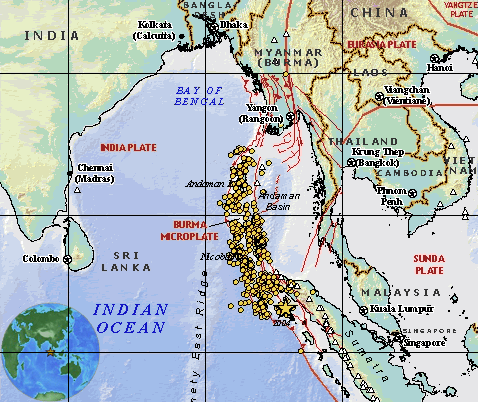
A magnitude 8.6 earthquake struck North Sumatra, Indonesia, at 2:38 p.m. local time today. First estimated as a magnitude 8.7 by the U.S. Geological Survey, the earthquake originated 22.9 km (14.2 miles) below the Earth's crust and struck 434 kilometers (270 miles) southwest of the coast of Banda Aceh, the capital of Indonesia's Aceh province.
NEWS: Hidden Fault Amplified 2004 Tsunami
A tsunami watch and warning was put into effect for the Indian Ocean, immediately after the event. The power is out in Banda Aceh, where residents have moved to high ground, reported Sutopo Purwo Nugroho, a spokesman for the Indonesian National Disaster Management Agency.
The island of Simeulue, Prih Harjadi, and other coastal areas of Aceh are also on alert.
India has taken caution on Andaman and Nicobar Islands, where authorities have ordered people to move out of low-lying areas, CNN reported.
However the geophysics of today's quake do not indicate a repeat of Indonesia's 2004 earthquake is in progress. The magnitude 9.1 earthquake that struck in 2004 and triggered a tsunami that killed more than 200,000 people in 14 countries was a subduction megathrust earthquake closer to shore (250 kilometers south-southeast of Banda Aceh).
Today's temblor appears to have ripped along a transform fault, tearing the seafloor as opposed to popping it apart. Though local tsunami waves are a considerable risk, with calculations showing Simeulue could receive waves as high as 6 meters (20 feet) the widespread tsunami damage seen in 2004 is not anticipated.
IMAGES: Earthquake location map (USGS) Indian Ocean warning in effect (PTWC)
Source
Sunday, November 13, 2011
6.6.-magnitude quake hits eastern Indonesia
(IStockPhoto)
(AP)JAKARTA, Indonesia - A strong earthquake hit waters off eastern Indonesia on Monday, sending people along coastlines fleeing to high ground in panic. Officials said, however, there was no threat of a tsunami.
The quake had a preliminary magnitude of 6.6 and was centered 12 miles (20 kilometers) beneath the Molucca Sea, the U.S. Geological Survey said.
Many people in Ternate, the town in North Maluku province that was closest to the epicenter, ran from their homes and offices as the ground rattled beneath them, said George Rajaloa, a resident.
"I ran with everyone else," he said.
Fearing a tsunami, those living near the beach also fled to high ground.
But Suhardjono, from the Indonesian meteorological and geophysics agency, said there was no danger of a seismically triggered wave.
Indonesia straddles a series of fault lines that make the vast island nation prone to volcanic and seismic activity.
A giant quake off the country on Dec. 26, 2004, triggered a tsunami in the Indian Ocean that killed 230,000 people, half of them in Indonesia's westernmost province of Aceh.
Source
Wednesday, October 26, 2011
Global Christian Forum Meeting in Manado, Indonesia 4- 7 October, 2011
3 October, 2011
UNIQUE GLOBAL GATHERING BRINGS UNPRECEDENTED NUMBERS OF CHURCH LEADERS TOGETHER FROM ACROSS BREADTH AND DEPTH OF WORLD CHRISTIANITY
A unique gathering of the leaders reflecting the breadth and depth of world Christianity will begin in Indonesia beginning tomorrow, 4 October.
The Global Christian Forum (GCF) meeting at Manado on the Indonesian island of Sulawesi will bring together all the great streams of modern Christian faith: Anglican, Charismatic, Evangelical, Roman Catholic, Orthodox, Pentecostal, Protestant, Roman Catholic, mega churches and many contemplative communities.
The meeting comes at a time of dramatic shifts in world Christianity. The last two decades have seen the majority of Christians living in the ‘global south’, while much institutional strength for traditional Christianity remains in Europe and North America, but with declining church attendances.
In what is only the second such Global Christian Forum gathering - the first being in Kenya in 2007- the GCF will have over 300 representatives from every continent on the globe and every Christian tradition from 81 countries.
Coming together in unprecedented numbers and variety, leaders representing 12 world Christian communions and 9 global ecumenical organizations, including the World Council of Churches, the World Evangelical Alliance and the Pentecostal World Fellowship, will sit side by side with national councils of churches, evangelical organizations and mega church leaders from around the world.
The Vatican will be represented through representative of the Pontifical Council for Promotion of Christian Unity.
The Salvation Army, Seventh Day Adventists, Society of Friends and Syrian Orthodox Church leaders will all be there.
Meeting around the theme ‘Life Together in Jesus Christ, Empowered by the Holy Spirit’, the church leaders will explore ‘what the Spirit is saying to the churches’ today. Each participant will tell the story of what is happening in their own context. Members of the convention will also discuss the future directions of the GCF, which has always maintained non-institutional structures and practice.
To complete the picture there will be a sessions on ‘trends and changes in world Christianity and sharing of statistical research complied through the Atlas of Global Christianity.
The global changes in Christianity is one of the reasons why Indonesia was chosen as the venue of the 2nd Global Christian Forum, as it is the world’s largest Muslim nation but with significant religious diversity, including a large Christian population.
The worship life of the gathering will reflect the various traditions of delegates. It will be facilitated of Father Ghislain, from the Taize community in France.
- Second Global Christian Forum news will be made public through the GFC communications office. Daily updates will be sent to religious media publications and post on the GFC website:
MEDIA CONTACT: Kim Cain, Communications secretary: kimcain101@gmail.com.au
Wednesday, October 05, 2011
Indonesia tells tourists to stay clear of volcano
JAKARTA, Indonesia (AP) — Authorities are warning tourists and fishermen to stay more than a mile (two kilometers) from a smoking Indonesian volcano known as “Child of Krakatoa.”
The volcano in the Sunda Strait, 80 miles (130 kilometers) west of the capital, Jakarta, was created by the same tectonic forces that led to the 1883 Krakatoa eruption that killed tens of thousands of people.
Its “child,” growing five yards (meters) a year, is now 1,320 feet (400 meters) tall and popular among hikers.
Gede Suantika of the Center for Volcanology says the mountain’s alert level was raised to the second-highest level last week after the number of volcanic tremors soared from 200 a day to 7,200.
Suantika said Tuesday that he worries a powerful burst could shoot incandescent rocks down its slopes and far into the ocean.
Monday, September 05, 2011
6.6-magnitude quake hits Indonesia
(AFP)
5 September 2011
JAKARTA — A 6.6-magnitude earthquake hit the northern part of Indonesia’s Sumatra island on Tuesday, the US Geological Survey said.
The quake struck at 12:55 am (1755 GMT on Monday) at a depth of 52 kilometres (30 miles), USGS said, with its epicentre around 400 kilometres (250 miles) southeast of Banda Aceh.
The Hawaii-based Pacific Tsunami Warning Center said the quake was too far inland to generate a tsunami.
Indonesia sits on the Pacific “Ring of Fire”, where the meeting of continental plates causes high seismic activity, and Sumatra is particularly prone to earthquakes.
Aceh was devastated when a 9.1-magnitude quake off Sumatra in December 2004 triggered a huge tsunami which killed more than 220,000 people around the Indian Ocean.
USGS initially gave a magnitude of 6.5 for Tuesday’s quake.
Source
Monday, May 16, 2011
Airbus forced into emergency landing in Singapore
• Firefighters douse jet, with no reporters of injuries
Associated Press
guardian.co.uk, Monday 16 May 2011 07.46 BST
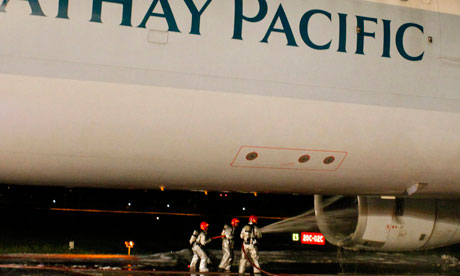
The engine on a Cathay Pacific Airbus A330-300 has caught fire in mid-air, forcing the plane to make an emergency landing in Singapore. No one was injured in the incident.
Flight CX715 took off from Singapore heading to the Indonesian capital, Jakarta, at 1:12am on Monday, but soon turned around after engine trouble and landed at 1:57am, Singapore's Changi Airport said in a statement.
Firefighters extinguished the fire and normal flight operations resumed on the runway about an hour later, the airport said.
It was the second time in six months an Airbus had to make an emergency landing in Singapore because of engine problems. A Qantas A380 turned around shortly after takeoff on 4 November when one of its Rolls-Royce Trent 900 engines disintegrated.
The airport would not say how many passengers were on board the flight or what kind of engines the plane used. A spokesman for Hong Kong-based Cathay Pacific was not available for comment.
.
Source
.
Wednesday, November 10, 2010
Transcript: Obama Speech at the University of Indonesia Jakarta

I am so glad that I made it to Indonesia, and that Michelle was able to join me. We had a couple of false starts this year, but I was determined to visit a country that has meant so much to me. Unfortunately, it’s a fairly quick visit, but I look forward to coming back a year from now, when Indonesia hosts the East Asia Summit.
Before I go any further, I want to say that our thoughts and prayers are with all of those Indonesians affected by the recent tsunami and volcanic eruptions – particularly those who have lost loved ones, and those who have been displaced. As always, the United States stands with Indonesia in responding to this natural disaster, and we are pleased to be able to help as needed. As neighbors help neighbors and families take in the displaced, I know that the strength and resilience of the Indonesian people will pull you through once more.
Let me begin with a simple statement: Indonesia is a part of me. I first came to this country when my mother married an Indonesian man named Lolo Soetoro. As a young boy, I was coming to a different world. But the people of Indonesia quickly made me feel at home.
Jakarta looked very different in those days. The city was filled with buildings that were no more than a few stories tall. The Hotel Indonesia was one of the few high rises, and there was just one brand new shopping center called Sarinah. Betchaks outnumbered automobiles in those days, and the highway quickly gave way to unpaved roads and kampongs.
We moved to Menteng Dalam, where we lived in a small house with a mango tree out front. I learned to love Indonesia while flying kites, running along paddy fields, catching dragonflies, and buying satay and baso from the street vendors. Most of all, I remember the people – the old men and women who welcomed us with smiles; the children who made a foreigner feel like a neighbor; and the teachers who helped me learn about the wider world.
Because Indonesia is made up of thousands of islands, hundreds of languages, and people from scores of regions and ethnic groups, my times here helped me appreciate the common humanity of all people. And while my stepfather, like most Indonesians, was raised a Muslim, he firmly believed that all religions were worthy of respect. In this way, he reflected the spirit of religious tolerance that is enshrined in Indonesia’s Constitution, and that remains one of this country’s defining and inspiring characteristics.
I stayed here for four years – a time that helped shape my childhood; a time that saw the birth of my wonderful sister, Maya; and a time that made such an impression on my mother that she kept returning to Indonesia over the next twenty years to live, work and travel – pursuing her passion of promoting opportunity in Indonesia’s villages, particularly for women and girls. For her entire life, my mother held this place and its people close to her heart.
So much has changed in the four decades since I boarded a plane to move back to Hawaii. If you asked me – or any of my schoolmates who knew me back then – I don’t think any of us could have anticipated that I would one day come back to Jakarta as President of the United States. And few could have anticipated the remarkable story of Indonesia over these last four decades.
The Jakarta that I once knew has grown to a teeming city of nearly ten million, with skyscrapers that dwarf the Hotel Indonesia, and thriving centers of culture and commerce. While my Indonesian friends and I used to run in fields with water buffalo and goats, a new generation of Indonesians is among the most wired in the world – connected through cell phones and social networks. And while Indonesia as a young nation focused inward, a growing Indonesia now plays a key role in the Asia Pacific and the global economy.
This change extends to politics. When my step-father was a boy, he watched his own father and older brother leave home to fight and die in the struggle for Indonesian independence. I’m happy to be here on Heroes Day to honor the memory of so many Indonesians who have sacrificed on behalf of this great country.
When I moved to Jakarta, it was 1967, a time that followed great suffering and conflict in parts of this country. Even though my step-father had served in the Army, the violence and killing during that time of political upheaval was largely unknown to me because it was unspoken by my Indonesian family and friends. In my household, like so many others across Indonesia, it was an invisible presence. Indonesians had their independence, but fear was not far away.
In the years since then, Indonesia has charted its own course through an extraordinary democratic transformation – from the rule of an iron fist to the rule of the people. In recent years, the world has watched with hope and admiration, as Indonesians embraced the peaceful transfer of power and the direct election of leaders. And just as your democracy is symbolized by your elected President and legislature, your democracy is sustained and fortified by its checks and balances: a dynamic civil society; political parties and unions; a vibrant media and engaged citizens who have ensured that – in Indonesia -- there will be no turning back.
But even as this land of my youth has changed in so many ways, those things that I learned to love about Indonesia – that spirit of tolerance that is written into your Constitution; symbolized in your mosques and churches and temples; and embodied in your people – still lives on. Bhinneka Tunggal Ika – unity in diversity. This is the foundation of Indonesia’s example to the world, and this is why Indonesia will play such an important role in the 21st century.
So today, I return to Indonesia as a friend, but also as a President who seeks a deep and enduring partnership between our two countries. Because as vast and diverse countries; as neighbors on either side of the Pacific; and above all as democracies – the United States and Indonesia are bound together by shared interests and shared values.
Yesterday, President Yudhoyono and I announced a new, Comprehensive Partnership between the United States and Indonesia. We are increasing ties between our governments in many different areas, and – just as importantly – we are increasing ties among our people. This is a partnership of equals, grounded in mutual interests and mutual respect.
With the rest of my time today, I’d like to talk about why the story I just told – the story of Indonesia since the days when I lived here – is so important to the United States, and to the world. I will focus on three areas that are closely related, and fundamental to human progress – development, democracy, and religion.
First, the friendship between the United States and Indonesia can advance our mutual interest in development.
When I moved to Indonesia, it would have been hard to imagine a future in which the prosperity of families in Chicago and Jakarta would be connected. But our economies are now global, and Indonesians have experienced both the promise and perils of globalization: from the shock of the Asian financial crisis in the 1990s to the millions lifted out of poverty. What that means – and what we learned in the recent economic crisis – is that we have a stake in each other’s success.
America has a stake in an Indonesia that is growing, with prosperity that is broadly shared among the Indonesian people – because a rising middle class here means new markets for our goods, just as America is a market for yours. And so we are investing more in Indonesia, our exports have grown by nearly 50 percent, and we are opening doors for Americans and Indonesians to do business with one another.
America has a stake in an Indonesia that plays its rightful role in shaping the global economy. Gone are the days when seven or eight countries could come together to determine the direction of global markets. That is why the G-20 is now the center of international economic cooperation, so that emerging economies like Indonesia have a greater voice and bear greater responsibility. And through its leadership of the G-20’s anti-corruption group, Indonesia should lead on the world stage and by example in embracing transparency and accountability.
America has a stake in an Indonesia that pursues sustainable development, because the way we grow will determine the quality of our lives and the health of our planet. That is why we are developing clean energy technologies that can power industry and preserve Indonesia’s precious natural resources – and America welcomes your country’s strong leadership in the global effort to combat climate change.
Above all, America has a stake in the success of the Indonesian people. Underneath the headlines of the day, we must build bridges between our peoples, because our future security and prosperity is shared. That is exactly what we are doing – by increased collaboration among our scientists and researchers, and by working together to foster entrepreneurship. And I am especially pleased that we have committed to double the number of American and Indonesian students studying in our respective countries – we want more Indonesian students in our schools, and more American students to come study in this country, so that we can forge new ties that last well into this young century.
These are the issues that really matter in our daily lives. Development, after all, is not simply about growth rates and numbers on a balance sheet. It’s about whether a child can learn the skills they need to make it in a changing world. It’s about whether a good idea is allowed to grow into a business, and not be suffocated by corruption. It’s about whether those forces that have transformed the Jakarta that I once knew –technology and trade and the flow of people and goods – translate into a better life for human beings, a life marked by dignity and opportunity.
This kind of development is inseparable from the role of democracy.
Today, we sometimes hear that democracy stands in the way of economic progress. This is not a new argument. Particularly in times of change and economic uncertainty, some will say that it is easier to take a shortcut to development by trading away the rights of human beings for the power of the state. But that is not what I saw on my trip to India, and that is not what I see in Indonesia. Your achievements demonstrate that democracy and development reinforce one another.
Like any democracy, you have known setbacks along the way. America is no different. Our own Constitution spoke of the effort to forge a “more perfect union,” and that is a journey we have travelled ever since, enduring Civil War and struggles to extend rights to all of our citizens. But it is precisely this effort that has allowed us to become stronger and more prosperous, while also becoming a more just and free society.
Like other countries that emerged from colonial rule in the last century, Indonesia struggled and sacrificed for the right to determine your destiny. That is what Heroes Day is all about – an Indonesia that belongs to Indonesians. But you also ultimately decided that freedom cannot mean replacing the strong hand of a colonizer with a strongman of your own.
Of course, democracy is messy. Not everyone likes the results of every election. You go through ups and downs. But the journey is worthwhile, and it goes beyond casting a ballot. It takes strong institutions to check the concentration of power. It takes open markets that allow individuals to thrive. It takes a free press and an independent justice system to root out abuse and excess, and to insist upon accountability. It takes open society and active citizens to reject inequality and injustice.
These are the forces that will propel Indonesia forward. And it will require a refusal to tolerate the corruption that stands in the way of opportunity; a commitment to transparency that gives every Indonesian a stake in their government; and a belief that the freedom that Indonesians have fought for is what holds this great nation together.
That is the message of the Indonesians who have advanced this democratic story – from those who fought in the Battle of Surabaya 55 years ago today; to the students who marched peacefully for democracy in the 1990s, to leaders who have embraced the peaceful transition of power in this young century. Because ultimately, it will be the rights of citizens that will stitch together this remarkable Nusantara that stretches from Sabang to Merauke – an insistence that every child born in this country should be treated equally, whether they come from Java or Aceh; Bali or Papua.
That effort extends to the example that Indonesia sets abroad. Indonesia took the initiative to establish the Bali Democracy Forum, an open forum for countries to share their experiences and best practices in fostering democracy. Indonesia has also been at the forefront of pushing for more attention to human rights within ASEAN. The nations of Southeast Asia must have the right to determine their own destiny, and the United States will strongly support that right. But the people of Southeast Asia must have the right to determine their own destiny as well. That is why we condemned elections in Burma that were neither free nor fair. That is why we are supporting your vibrant civil society in working with counterparts across this region. Because there is no reason why respect for human rights should stop at the border of any country.
Hand in hand, that is what development and democracy are about – the notion that certain values are universal. Prosperity without freedom is just another form of poverty. Because there are aspirations that human beings share – the liberty of knowing that your leader is accountable to you, and that you won’t be locked up for disagreeing with them; the opportunity to get an education and to work with dignity; the freedom to practice your faith without fear or restriction.
Religion is the final topic that I want to address today, and – like democracy and development – it is fundamental to the Indonesian story.
Like the other Asian nations that I am visiting on this trip, Indonesia is steeped in spirituality – a place where people worship God in many different ways. Along with this rich diversity, it is also home to the world’s largest Muslim population – a truth that I came to know as a boy when I heard the call to prayer across Jakarta.
Just as individuals are not defined solely by their faith, Indonesia is defined by more than its Muslim population. But we also know that relations between the United States and Muslim communities have frayed over many years. As President, I have made it a priority to begin to repair these relations. As a part of that effort, I went to Cairo last June, and called for a new beginning between the United States and Muslims around the world – one that creates a path for us to move beyond our differences.
I said then, and I will repeat now, that no single speech can eradicate years of mistrust. But I believed then, and I believe today, that we have a choice. We can choose to be defined by our differences, and give in to a future of suspicion and mistrust. Or we can choose to do the hard work of forging common ground, and commit ourselves to the steady pursuit of progress. And I can promise you – no matter what setbacks may come, the United States is committed to human progress. That is who we are. That is what we have done. That is what we will do.
We know well the issues that have caused tensions for many years – issues that I addressed in Cairo. In the 17 months that have passed we have made some progress, but much more work remains to be done.
Innocent civilians in America, Indonesia, and across the world are still targeted by violent extremists. I have made it clear that America is not, and never will be, at war with Islam. Instead, all of us must defeat al Qaeda and its affiliates, who have no claim to be leaders of any religion – certainly not a great, world religion like Islam. But those who want to build must not cede ground to terrorists who seek to destroy. This is not a task for America alone. Indeed, here in Indonesia, you have made progress in rooting out terrorists and combating violent extremism.
In Afghanistan, we continue to work with a coalition of nations to build the capacity of the Afghan government to secure its future. Our shared interest is in building peace in a war-torn land – a peace that provides no safe-haven for violent extremists, and that provides hope for the Afghan people.
Meanwhile, we have made progress on one of our core commitments - our effort to end the war in Iraq. 100,000 American troops have left Iraq. Iraqis have taken full responsibility for their security. And we will continue to support Iraq as it forms an inclusive government and we bring all of our troops home.
In the Middle East, we have faced false starts and setbacks, but we have been persistent in our pursuit of peace. Israelis and Palestinians restarted direct talks, but enormous obstacles remain. There should be no illusions that peace and security will come easy. But let there be no doubt: we will spare no effort in working for the outcome that is just, and that is in the interest of all the parties involved: two states, Israel and Palestine, living side by side in peace and security.
The stakes are high in resolving these issues, and the others I have spoken about today. For our world has grown smaller and while those forces that connect us have unleashed opportunity, they also empower those who seek to derail progress. One bomb in a marketplace can obliterate the bustle of daily commerce. One whispered rumor can obscure the truth, and set off violence between communities that once lived in peace. In an age of rapid change and colliding cultures, what we share as human beings can be lost.
But I believe that the history of both America and Indonesia gives us hope. It’s a story written into our national mottos. E pluribus unum – out of many, one. Bhinneka Tunggal Ika – unity in diversity. We are two nations, which have travelled different paths. Yet our nations show that hundreds of millions who hold different beliefs can be united in freedom under one flag. And we are now building on that shared humanity – through the young people who will study in each other’s schools; through the entrepreneurs forging ties that can lead to prosperity; and through our embrace of fundamental democratic values and human aspirations..
Earlier today, I visited the Istiqlal mosque – a place of worship that was still under construction when I lived in Jakarta. I admired its soaring minaret, imposing dome, and welcoming space. But its name and history also speak to what makes Indonesia great. Istiqlal means independence, and its construction was in part a testament to the nation’s struggle for freedom. Moreover, this house of worship for many thousands of Muslims was designed by a Christian architect.
Such is Indonesia’s spirit. Such is the message of Indonesia’s inclusive philosophy, Pancasila. Across an archipelago that contains some of God’s most beautiful creations, islands rising above an ocean named for peace, people choose to worship God as they please. Islam flourishes, but so do other faiths. Development is strengthened by an emerging democracy. Ancient traditions endure, even as a rising power is on the move.
That is not to say that Indonesia is without imperfections. No country is. But here can be found the ability to bridge divides of race and region and religion – that ability to see yourself in all individuals. As a child of a different race coming from a distant country, I found this spirit in the greeting that I received upon moving here: Selamat Datang. As a Christian visiting a mosque on this visit, I found it in the words of a leader who was asked about my visit and said, “Muslims are also allowed in churches. We are all God’s followers.”
That spark of the divine lies within each of us. We cannot give in to doubt or cynicism or despair. The stories of Indonesia and America tell us that history is on the side of human progress; that unity is more powerful than division; and that the people of this world can live together in peace. May our two nations work together, with faith and determination, to share these truths with all mankind.
.
Source
Tuesday, November 09, 2010
Obama Launches Historic Speech at University of Indonesia
November 10, 2010
Jakarta. United States President Barack Obama said on Wednesday that Muslim-majority Indonesia’s national philosophy of unity between people of different faiths and ethnic backgrounds was an inspiration to the world.
“This is the foundation of Indonesia’s example to the world, and this is why Indonesia will play such an important role in the 21st century,” Obama said in a speech at the University of Indonesia during a visit to Jakarta.
Obama also reiterated his determination to push past obstacles to peace in the Middle East, saying the United States has been persistent in the pursuit of peace, despite a history of false starts and setbacks.
The president says enormous obstacles remain, but the United States was committed to overcoming them.
He said the US would spare no effort to reach the goal of two states — Israel and Palestine — living side by side in peace.
In a speech that praised Indonesia, he also reiterated his call for a new beginning between the US and Muslim world.
Some of the 7,500 people that packed that 5,000-seat capacity Balairung UI, University of Indonesia's main function hall, were up at the wee hours of the morning to gather at Parkir Timur Senayan in South Jakarta, where chartered buses were provided to ferry them to the Depok campus. No cars were allowed inside the campus for the event.
Among the hundreds who were at Senayan by 5 a.m., given a blue wristband as they boarded the buses, were Jakarta Globe columnist and Metro TV anchor Desi Anwar; former Miss Indonesia Nadine Chandrawinata; former spokesman of the late President Abdurrahman Wahid, Wimar Witoelar; political analyst Imam Prasodjo and senior journalists such as RCTI chief editor Arief Suditomo.
Special guests seen seated at the VIP section of the hall included former President BJ Habibie, Women Empowerment Minister Linda Gumelar, Education Minister M Nuh and Sports and Youth Affairs Minister Andi Mallarangeng.
Agencies/JG
Source
Related:
Obama lauds Indonesia as a model of religious tolerance - 17 minutes ago
The address at the University of Indonesia was considered a highlight of Obama's ... In his speech Wednesday, Obama reflected on his years in Indonesia, ...
.
Obama Visits Indonesia’s Istiqlal Mosque
November 10, 2010
United States President Barack Obama and the first lady, Michelle Obama, walking with Grand Imam Yaqub during a visit to Istiqlal Mosque in Jakarta on Wednesday. Obama is expected to deliver a speech on US-Indonesian relations in a follow-up to last year’s appeal to the Muslim world from Cairo at the University of Indonesia later today. (AP Photo/Charles Dharapak)
Jakarta. President Barack Obama visited Southeast Asia’s biggest mosque on Wednesday as he prepared to deliver a speech on US-Indonesian relations in a follow-up to last year’s appeal to the Muslim world from Cairo.
Obama’s speech aims to engage Indonesians in their embrace of democracy and the free market following the fall of the Suharto dictatorship in 1998, as well as following on the themes of religious tolerance of his Cairo address.
The much-anticipated visit to the Istiqlal Mosque and speech at the University of Indonesia were the last stops on Obama’s twice-postponed visit to Indonesia.
Imam Haji Mustapha Ali Yaqub led Obama and First Lady Michelle — looking elegant in a silky flowing chartreuse pant suit and beige head covering adorned with gold beads — around the vast, domed structure in central Jakarta.
The Indonesia leg of Obama’s Asian tour is expected to be cut short as Obama tries to outrace a cloud of volcanic ash spewing out by Mount Merapi in Central Java, which has severely disrupted air travel across the region.
Obama arrived in Indonesia on Tuesday and told reporters he was “deeply moved” to return to the country of his childhood.
He marvelled at the transformation of the sleepy city of Jakarta he once knew into a bustling metropolis and noted the country’s parallel evolution from authoritarianism to democracy and a burgeoning alliance with Washington.
“It’s wonderful to be here although I have to tell you that when you visit a place that you spent time in as a child, as the president it’s a little disorientating,” he said. “The landscape has changed completely, when I first came here it was in 1967 and people were on becaks ... a bicycle rickshaw thing.”
Indonesia was the second stop on Obama’s Asia tour, after India, and he will travel on to South Korea for the G20 summit on Wednesday and end his trip in Yokohama, Japan for the APEC summit.
In Jakarta he admitted the task he set in last year’s Cairo speech of forging a “new beginning” with Islam remained incomplete and there was “a lot more work to do.”
“We don’t expect that we are going to completely eliminate some of the misunderstandings and mistrust that have developed over a long period of time, but we do think that we’re on the right path,” he told reporters at a joint press conference with Indonesian President Susilo Bambang Yudhoyono.
Agence France-Presse
Source
.
Thursday, October 28, 2010
Indonesian volcano's spiritual caretaker dies
MOUNT MERAPI, Indonesia (AP) — For 33 years, Maridjan spoke to Mount Merapi, believing he could appease its unpredictable spirits by throwing offerings of rice, clothes and chickens into the volcano's gaping crater.
Many villagers took his word — not that of government officials or seismologists — as the last on when it would erupt. And the 83-year-old did appear to predict the volcano's latest eruption — which killed 33 people this week — but did not heed the warning himself.
As Merapi began spewing 1,800 degree Fahrenheit (1,000 Celsius) gases and thousands of villagers streamed down the mountain's slopes, Maridjan refused to budge, and more than a dozen people stayed, and perished, with him.
His rigid body was found Wednesday, prostrate on the ground in the typical Islamic prayer position and caked in heavy white soot.
On Thursday, high-profile politicians, soap opera stars, singers and hundreds of family and followers flocked to his funeral on the slopes of the mountain that had been entrusted to his care by a late king. Televisions crews and reporters jostled for position with family and friends, who reached their hands through the crowds for a chance to touch the coffin as it was carried to the grave.
Mourners kneeled by the open grave to pray as his body was lowered into the ground. They then covered the body with soil and piled cut orchids on the mound.
"I never thought he was going to leave us in such a way," said Prabukusumo, the brother of the sultan in the nearby court city of Yogyakarta who is now tasked with choosing his successor. "He's lived through so many, much bigger eruptions. I'm still in shock."
But a friend said Maridjan seemed to be expecting his death.
When asked by his close friend, Wansafyudin, days before the eruption if it might not be better to leave, he refused, according to the English-language Jakarta Globe newspaper.
"My time to die in this place has almost come," he reportedly said.
Indonesia, the world's largest archipelago, is located on the so-called "Ring of Fire," a series of fault lines that are prone to earthquakes and volcanic activity stretching from the Western Hemisphere through Japan and Southeast Asia.
Merapi is one of the world's most active mountains.
When he was 50, Maridjan inherited the position of "key holder" of the mountain from his father, receiving the official appointment from the sultan of Yogyakarta.
The mystical practice persists in Indonesia, even though most of the country's 237 million people are Muslims. Islam is a relatively new arrival to the country and, in many areas, coexists with older traditions that have their roots in animist, Hindu or Buddhist belief.
Maridjan was believed by many to have the ability to speak directly to the mountain and led ceremonies every year to hold back its lava flows by throwing rice, clothes and chickens into its dome.
Many villagers saw him as a hero, believing him over government officials and seismologists when it came to determining Merapi's danger levels. But he was a constant source of frustration for those tasked with overseeing evacuations.
Every time he refused to head down the mountain, he set a bad example for others, putting their lives at risk, they said.
Among the 14 other people found dead in and around his home, halfway up the mountain, was an Indonesian Red Cross volunteer who was trying to persuade him to leave.
"People should follow calls from district heads, village chiefs and other officials," said former Vice President Jusuf Kalla, who now heads the aid agency. "Merapi disasters threaten the safety of villagers as well as volunteers who come to save them."
But far from serving as a cautionary tale, Maridjan's death and Merapi's continuing eruption has made many villagers only yearn for his quick replacement.
"I'm more afraid than ever," said Prapto Wiyono, a 60-year-old farmer from the village of Pangukrejo, who was among thousands of people crammed in an emergency shelters. "Who's going to tell us now what's going on with Merapi?"
Associated Press reporters Andi Jatmiko and Elisabeth Oktofani contributed to this report from Mount Merapi.
Source
.