Showing posts with label QEII. Show all posts

Friday, September 09, 2022

Operation Unicorn: what happens after the Queen’s death in Scotland?


Show captionThe Queen


The contingency plans for the Queen dying at Balmoral were leaked a while ago


Thu 8 Sep 2022 14.06 EDT

Share on Facebook
Share on Twitter
Share via Email

The logistics of Operation London Bridge, the formal plans drawn up to deal with the death of the head of state, provided for the eventuality that she would die at Balmoral, which has long been one of her favourite places.

Operation Unicorn, the codename for the plans in Scotland, leaked some time ago and indicated it is likely her coffin will temporarily rest at the Palace of Holyroodhouse, having been taken there by road two days after her death.


From left: Prince William, Prince Andrew, Sophie, Countess of Wessex, and Edward, Earl of Wessex, arrive at Balmoral. Photograph: Jeff J Mitchell/Getty

Plans are also thought to include a ceremonial procession along the Royal Mile in Edinburgh to St Giles’ Cathedral, where a service is expected to be attended by the royal family before a 24-hour period of lying at rest, which would be open to the public.

The coffin is likely to be flown back to London, where it will be taken to Buckingham Palace before the big ceremonial procession in the capital planned for “D+5” (D-day plus five days) of the 10-day funeral plans, which will involve the Queen lying in state.

‘She’s always been there’: palace tourists on the Queen’s health

The Queen spent most of her summers on her highland estate in Aberdeenshire, with members of her family traditionally staying there from July into September and October. Balmoral, like Sandringham, is a private residence of the Queen rather than a royal residence belonging to the crown estate.

Years of royal memories were forged there, including family barbecues, where the Duke of Edinburgh did the cooking and the Queen the washing-up.

After Philip and Princess Elizabeth married in 1947, they spent part of their honeymoon at Birkhall – a hunting lodge on the Balmoral estate bought by Prince Albert for Queen Victoria in 1852, and handed down through generations of royals.


Friday, June 03, 2011

QE2 Didn't Help the Economic Recovery - Why Would QE3?

by: Cullen Roche June 2, 2011

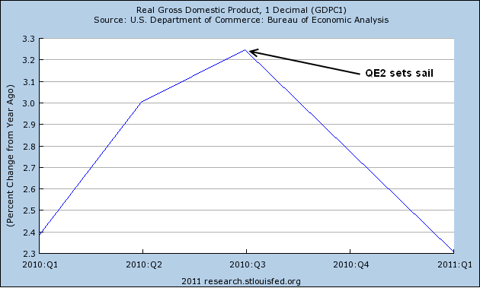
We’re now nearing the end of QE2 and some concrete conclusions can be made. I’ll save my overall analysis of the program until after its conclusion, but I think the impact of QE2 can be pretty much summed up with the following chart.


Economic growth peaked with QE2′s inception
Real GDP peaked as soon as QE2 began. Now, this shouldn’t be shocking to anyone who has been reading pragcap over the duration of this program. From its onset I said QE2 would do nothing for the real economy. In fact, operationally, it could do nothing. But its impacts actually appear to have been damaging to bottom line growth. How so? QE2 helped contribute to a massive surge in speculation in commodity prices.

You see, QE2 didn’t monetize anything. It didn’t cause the money supply to explode. It didn’t really do anything except cause a great deal of confusion and generate an enormous amount of speculation in financial markets that now appears to be contributing to turmoil and strife around the globe. Operationally, it is no different than what the Fed does at the short end when they implement monetary policy. The important distinction, however, is that this policy was implemented incorrectly. Instead of targeting price they targeted size. And the results in the bond market speak for themselves. Rates have meandered up and down and up and down without a care in the world for the Fed’s $600B purchase program. In other words, the program had no impact on rates.

Aside from targeting rates, the program was intended to generate a portfolio rebalancing effect. I won’t repeat the comments I’ve made in the past or those of Richard Koo, but the portfolio rebalancing effect is essentially a form of putting the cart before the horse. Creating nominal wealth without an accompanying real effect that results in real economic growth is very misguided and the worst form of ponzi finance.

Where we saw a real impact was in commodity prices, general price speculation and the financing pyramid. I believe the BOJ has written the finest piece of research detailing this speculative effect. The pass through effect from commodity prices is a contributing factor in the declining real GDP. Inflation has risen marginally due to commodity price increases and the underlying real economy has remained stagnant. In other words, QE2 caused margin compression without helping spur growth. This helped create the disequilibrium I have often discussed. The result is the current air pocket in the economy.

Critics of this analysis are likely to claim that we don’t know what would have happened to the economy without QE2. This is true of course. What we do know is that the economy was growing at 3.3% at the time QE2 was initiated, ISM surged to 57 just days after the announcement and climbed to 58 as the program was beginning. In other words, we can confirm, definitively that the economy wasn’t collapsing as QE2 was beginning, but weakened as the program progressed.

So, the only question left is – if the evidence appears to point to the fact that QE2 didn’t help the economic recovery then why in the world would anyone even consider QE3?


Source

Thursday, November 26, 2009

UN, France push climate at Commonwealth summit


The 53-nation Commonwealth has given Sarkozy the rare opportunity to address the event


By Marc Burleigh (AFP) – 3 hours ago

PORT OF SPAIN — UN chief Ban Ki-moon and French President Nicolas Sarkozy are to fire early shots in a global climate debate to start in earnest next month by dominating a Commonwealth summit opening in Trinidad on Friday.

The 53-nation Commonwealth has given the two leaders, both non-members, the rare opportunity to address the event out of a determination to influence the December 7-18 climate talks to take place in Copenhagen.

Britain's Queen Elizabeth II, the titular head of the Commonwealth, was to officially open the three-day summit before the leaders hear from Ban, Sarkozy and another non-member, Danish Prime Minister Lars Loekke Rasmussen.

Their presence underlined an important quality of the Commonwealth: its diversity.

The organization represents two billion people -- a third of the planet's population -- and acts as a sort of microcosm for the different positions between developed and developing countries to be presented at Copenhagen.Facts: The Commonwealth

Politically and industrially hefty countries such as Britain, India, Australia, South Africa and Canada have seats alongside states such as Vanuatu, Tuvalu and Lesotho, whose points of view are often ignored on the international stage -- but which are directly threatened by rising sea levels and other global warming phenomena.

The Commonwealth "allows the world's small countries to have their voice heard," a spokesman for the body, Eduardo del Buey, told AFP.Related article: Commonwealth seeks makeover

The summit's host, Trinidad and Tobago Prime Minister Patrick Manning said on Thursday that Ban, Sarkozy and Rasmussen had been invited when "there was some concern about the way negotiations were going ahead of Copenhagen next month."

He acknowledged there had also been a suggestion of inviting US President Barack Obama but that went nowhere.

Just a few weeks ago, the Copenhagen meeting was described as all but doomed because of a perceived inability to reach a deal under which developed and big developing countries would commit to big cuts in greenhouse gas emissions.

But this week, Obama announced he would be going to Copenhagen with an offer to curb US emissions by 17 percent by 2020, and China spoke, somewhat confusingly, of using 40- to 45-percent less carbon per unit of gross domestic product.

China and the United States are the world's two biggest emitters of greenhouse gases, so the statements were seen as significant, even if questions remained over how effective they would be.

Sarkozy hailed their moves late Thursday in northern Brazil, where he met with Brazilian President Luiz Inacio Lula da Silva and senior representatives from other South American countries that span the vast Amazon river basin for other preparatory climate talks.

"The latest statements by Barack Obama and China's leaders are extremely encouraging in making Copenhagen a success," said Sarkozy.

Sarkozy and Lula have made a pact to present a common position in Copenhagen, one based on getting wealthier countries to pay developing ones to preserve their environment and make up for economic disadvantage caused by cutting greenhouse gases.

Brazil has also pledged "voluntary" carbon output cuts of 36 to 39 percent by 2020.
.
.
.

Queen Elizabeth II's visit to Trinidad is prelude to global climate talks


TRINIDAD AND TOBAGO

Queen Elizabeth II has arrived in Trinidad and Tobago for a meeting with global leaders on the issue of climate change.


BY JACQUELINE CHARLES
jcharles@MiamiHerald.com


Britain's Queen Elizabeth II arrived in Trinidad and Tobago on Thursday to a wave of enthusiasm but also concern as some world leaders wonder if they can reach an agreement on climate change ahead of an upcoming international summit, and some in the Caribbean question whether they should remain tethered to the British monarch.

The queen's rare visit to the region -- her third to oil-rich Trinidad since 1966 -- comes as the Commonwealth Heads of Government hold meetings in Port of Spain through Sunday. Climate change is expected to dominate discussions among 50 of the 53 self-governing members of the former British empire.

The summit will also feature French President Nicolas Sarkozy, Danish Prime Minister Lars Lokke Rasmussen and U.N. Secretary General Ban Ki-moon. Although none heads a Commonwealth nation, the four have been invited to help forge an agreement on climate change before the U.N.-sponsored Climate Change Summit in Copenhagen, Denmark, next month. That gathering is expected to attract at least 65 world leaders, including President Barack Obama.

``Already, this is turning out to be one of the largest major gatherings of political leaders and heads of governments before next month's summit in Copenhagen,'' said Ben Malor, a spokesman for Ban.

``This is an opportunity where the Secretary General is going to drive up the momentum toward Copenhagen, asking and urging the leaders to make sure success is achieved in Copenhagen because failure would be too costly.''

Malor said Ban will have bilateral meetings with several of the 39 Commonwealth leaders who will be in Trinidad. He will also participate in an executive session on climate change on Friday, as well as discussions on small island developing states, which are being heavily impacted by rising sea levels. There also will be a separate meeting with Australia's prime minister and the least developed countries of the world, focusing on economies and livelihoods.

Earlier this week, the Australian government proposed a pledge of $46 million to assist Grenada and other Caribbean countries in areas including climate-change mitigation, agriculture and small-business development. Australia is seeking to develop stronger ties with the Caribbean.

A RAISED PROFILE

This is the second time this year that Trinidad and Tobago, a natural gas- and petroleum-rich eastern Caribbean nation, is at the center of a diplomatic gathering of huge significance.

In April, the country hosted Latin American leaders along with Obama and U.S. Secretary of State Hillary Clinton during the Fifth Summit of the Americas.

``We have the opportunity to positively influence its outcome,'' Trinidad and Tobago Prime Minister Patrick Manning said about his tiny twin-island nation's big role in the climate-change talks. ``Trinidad and Tobago is doing its utmost to advance the process that could result in a global agreement on this crucial matter affecting all of humanity.''

Just as in April, security measures will be tight throughout Trinidad, where traffic around Port of Spain will be rerouted and hundreds of Caribbean troops will keep a close watch over leaders, including India's Prime Minister Manmohan Singh, fresh from an official visit to the White House this week.

One Commonwealth leader who won't be traveling to Port of Spain: the president of the small West African country of Gambia, who in September threatened to kill human-rights workers.

On Thursday, the queen and her husband, His Royal Highness, Prince Phillip, The Duke of Edinburgh were greeted at Piarco International Airport by schoolchildren waving the Union Jack. The queen wore an apple-green dress, matching high-brimmed hat, and black gloves and pumps. Later, as crowds lined the street for a glimpse, she laid a wreath at Memorial Park in Port of Spain. She also attended a black-tie state dinner hosted by Trinidad and Tobago's president.

As the head of the Commonwealth of Nations, Queen Elizabeth, 83, is expected to deliver a keynote address on Friday as she officially opens the gathering. She is also scheduled to host a luncheon for newly elected Commonwealth leaders while her husband jets off to Tobago. This is the 60th anniversary of the founding of the Commonwealth, which represents 2 billion people.

The queen's last visit to Trinidad was in 1985. This recent visit comes the same week that voters in St. Vincent and the Grenadines, a former British colony, went to the polls to decide on a new constitution that would remove the queen as head of state. In the end, voters opted to keep the queen, with nearly 56 percent of voters rejecting the referendum.

Leaders in the tiny eastern Caribbean nation wanted to join Trinidad and Tobago and Guyana, which both long ago dropped the queen as head of state but remained members of the Commonwealth.

For leaders in all three nations, as well as most of their counterparts in the 15-member mostly English-speaking Caribbean Community bloc known as CARICOM, the Commonwealth meeting comes at an opportune time. Leading up to the meeting, CARICOM launched a campaign on climate change in the region to sensitize citizens to the dangers to coral reefs, coastal barriers and marine ecosystems.

CONTENTION

But they also have more than climate change on their minds. The former British colonies oppose a new airfare tax launched by the United Kingdom. The tax designed to help cut carbon emissions would raise airfare to the tourism-dependent Caribbean by as much as 50 percent next year while keeping taxes to the U.S. low.

In addition to the airfare tax, the leaders plan to push for reforms among international financial institutions to help middle-income nations have access to badly needed funds in the global economic crisis.

Information from The Associated Press was used in this report.


Source:http://www.miamiherald.com/news/americas/haiti/v-fullstory/story/1353497.html

.