Showing posts with label Sarkozy. Show all posts

Sunday, January 29, 2012

Sarkozy announces 0.1 percent transaction tax from August


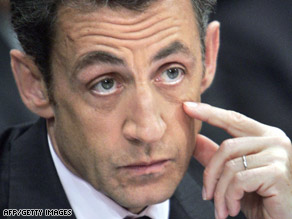
France's President Nicolas Sarkozy gets ready prior to the start of the one hour-long television interview (AFP/POOL, Lionel Bonaventure)

Sarkozy said he hoped to "create a shock" with the controversial "Robin Hood" tax and inspire other European countries to follow his lead, despite vocal opposition from other EU leaders.

He said in a television interview that the tax would enable French companies to keep jobs at home instead of outsourcing them abroad.

Advocates of the tax see it as a potentially significant revenue generator as well as a penalty against speculation, but critics say it could cause investors to pull their money out of countries applying it.

Some governments have in recent years taken up the campaign but most now intend to use the so-called "Robin Hood tax" to help reduce their budget deficits rather than embark on specific social programmes.

France and its major eurozone partners have supported the idea of the tax but now seem divided on how to approach the issue, with the major players in the bloc Germany and Italy advising caution.

Britain is opposed to transaction taxes being implemented across the 27-member EU bloc.


Fuente
.

Thursday, November 03, 2011

Papandreou faces Merkel, Sarkozy in tense pre-G20 meeting in Cannes (raw video)


Uploaded by on Nov 2, 2011

This footage, showing German Chancellor Angela Merkel and French President Nicolas Sarkozy at the table with Greek Prime Minister Giorgos Papandreou and Greek Finance Minister Venizelos, was made available on Wednesday evening by the audiovisual services of the European Union. The meeting, in which Germany and France were seeking an explanation of Papandreou's plans for a referendum in Greece on the euro rescue package agreed in Brussels last week, took place ahead of tomorrow's G20 meeting in Cannes, France.


P.S.

G20 A.K.A. Cannes Film Festival; Another publicity stunt on a global scale: SMILE!

Wednesday, August 17, 2011

Sarkzoy, Merkel invite Van Rompuy to head eurozone


EU president Herman Van Rompuy has been asked to chair a body of eurozone leaders (AFP/File, Georges Gobet)


(AFP) – 16 hours ago

PARIS — France's President Nicolas Sarkozy and German Chancellor Angela Merkel sent a joint letter Wednesday to EU president Herman Van Rompuy inviting him to chair a body of eurozone leaders.

The pair said they hope to strengthen coordinated financial planning within the 17-nation single currency bloc in the face of the current sovereign debt crisis and want the former Belgian prime minister on board.

"The euro is the foundation of our economic success and the symbol of the political unification of our continent," the zone's two most powerful leaders said, in a joint statement drawn up after they held talks on Tuesday.

"France and Germany propose to reinforce once more the governance of the eurozone within the framework of existing treaties," they wrote, proposing that eurozone leaders elect a president for a two-and-a-half year mandate.

"We have expressed our hope that you could assume this role," they added.

Eurozone finance ministers already meet regularly in what is known as the Eurogroup, and which is chaired by Luxembourg's Prime Minister Jean-Claude Juncker.

European financial markets and the euro exchange rate have been gripped by uncertainty as one eurozone member after another has begun to struggle to cope with mounting government debt, threatening the unification project.

Markets had looked to Merkel and Sarkozy's Paris summit for reassurance, and many observers had hoped that they would endorse the idea of issuing a common "eurobond" to pool member states' debts.

But the pair stopped short of a measure that would have angered German taxpayers by giving them a greater share of the burden of supporting weaker economies like Greece, calling instead for tougher fiscal discipline.

European Commission President Jose Manuel Barroso nevertheless called Tuesday's meeting an "important political contribution by the leaders of the two largest euro area economies."


Source
.

Sunday, January 31, 2010

Leaders in Davos Admit Drop in Trust

Davos 2010


Chris Ratcliffe/Bloomberg News
Panelists at the World Economic Forum in Davos, Switzerland, included Zhu Min of the People's Bank of China, on the big screen.

Related
Davos 2010: In Davos, Bankers Look for Closer Bond With Policy Makers (January 30, 2010)


Miro Kuzmanovic/Reuters
Protesters outside the Davos forum tried to protect themselves against the Swiss police force's water cannons on Saturday.

There was general relief that the financial system had been pulled back from the abyss glimpsed by many speakers at Davos a year ago. As the chairman of the British bank HSBC, Stephen K. Green, put it, “We’re in a better place than we were then” although “there has been a huge breakdown in trust.”

Over the first four days of mostly closed-door meetings at the World Economic Forum, bankers, central bankers and politicians reached no consensus on the best way forward to regulate markets or banks. Like many bankers, Mr. Green acknowledged “political initiatives on both sides of the Atlantic,” but was not ready to cede the terrain to politicians. “It is very important,” he said, “that we don’t throw the baby out with the bathwater.”

Members of the financial services industry seemed ruefully aware of how far they had sunk in public regard. Commenting on whether private equity companies would support an Obama administration proposal on bank regulation, David M. Rubenstein, managing director of the buyout firm Carlyle Group, quipped, “Our position is unsure because we’re afraid if we come out in favor, it won’t pass.”

Perhaps the billionaire investor and philanthropist George Soros summed up the ambivalence most succinctly. “You want to keep regulation to a minimum,” he said, “because it is worse than markets. But you can’t do without it.”

And so, from President Nicolas Sarkozy of France, who urged creation of a new international monetary system and even a new reserve currency to replace the dollar, to angry representatives from trade unions, to the white businessmen in suits who still dominate this snow-kissed gathering, the one certainty seemed to be continued uncertainty.

Many influential participants said that the financial crisis, rescue and search for solutions that the world had experienced in the last three years were without precedent. That complicates the search for solutions — how do we define when we are out of the mess? — and, in the West, increases pressure on politicians like President Obama to ease the widespread pain.

Mr. Obama’s recent blasts at Wall Street, coupled with a State of the Union address focused on Main Street and jobs, provided a backdrop to the discussions here. The only senior administration official in attendance, Mr. Obama’s chief economic adviser, Lawrence H. Summers, evoked one reason for Mr. Obama’s priorities before a packed audience on Saturday, noting that, in the United States, one in five men aged 25 to 54 is now jobless. Although the United States economy grew strongly in the last quarter of 2009, persistent unemployment has created a situation he described as “a statistical recovery and a human recession.”

It is “reasonable” to expect that to decline to one in seven or eight as the economy recovers, he said. But it is far from the 95 percent employment of American men that age in the mid-1960s.

Contrast that with the buoyant presentation, in the same discussion, by Zhu Min, deputy governor of the People’s Bank of China. “China had a good year,” Mr. Zhu opened, before rattling off statistics that boggle even economists’ minds: for instance, a 200-million ton overcapacity in steel production, roughly equal to the 198 million tons produced in the 27-nation European Union in 2008.

The Chinese delegation this year, the biggest in 40 years of the Davos gathering, was led by Li Keqiang, the vice premier widely tipped to be the next prime minister. Their appearance exuded much more confidence than even two years ago, a reflection of what many participants here said was a clear shift of power east, particularly to China.

The effect of that shift, and whether it will lead to cooperation or confrontation, concerns policy makers in the West, particularly the United States. China suggested that trust might be the answer here, too.

“Between Chinese people and American and Western people, we lack mutual understanding,” said Cheng Siwei, a former Chinese politician and a co-chairman of the International Finance Forum, a Beijing-based think tank. The only way to “keep this relationship stable,” he said, is “to build mutual trust.”

But as power has shifted toward China and South Asia, the Europeans, Americans and Japanese have watched their economies decline or stall sharply. Rebuilding mutual trust will be ever more difficult amid fears that such pain will continue and that the current generation entering the work force is likely to be less prosperous than its parents.

Much of the world is concerned about the shift, and unsure what to expect. “In the transition phase from a superpower-dominated world to a multipolar world you will see a lot of uncertainty and you will see a lot of volatility,” said Josef Ackermann, chairman of Deutsche Bank.

Part of the difficulty, it emerged from several discussions here, is that despite globalization and growing interconnectedness, finding solutions has fallen largely to individual nations, companies and banks.

Banding together in the Group of 20 that has emerged to take the place of the Group of 7 as the body to control the direction of the world economy, politicians and economists are supposed to produce policy suggestions by June, ahead of the Group of 20’s meeting in Seoul, South Korea, in November, its first meeting in Asia.

Whether that group, far from the jobless workers in the United States and Europe, can ease their pain is unclear. But, Mr. Ackermann said, “We all know something has to happen quickly to restore confidence in the system.”

Jack Ewing and Katrin Bennhold contributed reporting.
.
.
,

Wednesday, December 09, 2009

Sarkozy and Brown call for global market changes

Page last updated at 01:13 GMT, Thursday, 10 December 2009

The leaders say only global change will restore confidence in banking


British PM Gordon Brown and French President Nicolas Sarkozy have issued a joint call for urgent global reform of financial markets.

Writing in the Wall Street Journal, they say a one-off tax on bank bonuses should be "considered a priority".

The two leaders say it is "simply not acceptable" for taxpayers to cover the cost of bank failures but not benefit from their successes.

The article comes as EU leaders prepare to meet for a summit in Brussels.

It also follows the announcement in a pre-Budget report by UK finance minister Alistair Darling of a one-off supertax on banker bonuses.

'Proper regulation'

The BBC's Jonny Dymond, in the Belgian capital, says the joint article at times reads like a call to arms.

People rightly want a post-crisis banking system which puts their needs first

Sarkozy/Brown joint article


In it, Mr Sarkozy and Mr Brown say the financial crisis has made them "recognise that we are now in an economy which is no longer national but global, so financial standards must also be global".

"We must ensure that through proper regulation, the financial sector operates on a level playing field globally."

They say there is an "urgent need for a new compact between global banks and the society they serve".

"A compact that ensures the benefits of good economic times flow not just to bankers but to the people they serve; that makes sure that the financial sector fosters economic growth."

Various proposals to reform the sector "deserve examination", they said, but a one-off tax on high bonuses paid to bankers "should be considered a priority".

"People rightly want a post-crisis banking system which puts their needs first. To achieve that, nothing less than a global change is required," the leaders wrote.

France and the UK have been at odds recently over European banking.

Mr Sarkozy appeared to boast that the appointment of Frenchman Michel Barnier to oversee European banking reform was a defeat for Britain.

Mr Sarkozy and Mr Brown cancelled a meeting last week but are set to meet on Thursday on the sidelines of the EU summit.

On Wednesday, Mr Darling announced plans for a one-off supertax of 50% on banker bonuses, to be applied to payments over £25,000.

The new tax - which would be paid by banks and not individuals - is designed to discourage institutions from paying large bonuses to employees in the wake of the major taxpayer support they have received in the financial crisis.


Source: http://news.bbc.co.uk/2/hi/business/8405125.stm

.

Wednesday, December 02, 2009

We are in charge now, Sarkozy tells the City

From The Times December 2, 2009

We are in charge now, Sarkozy tells the City

Francis Elliott, Suzy Jagger, Martin Waller and David Charter


(Ian Langsdon/EPA) to not show image description -->
Nicolas Sarkozy


Alistair Darling has delivered a blunt warning to the EU’s new French finance chief against meddling with the City of London.

As Nicolas Sarkozy gloated over impending curbs on the City, the Chancellor said that such moves would drive financial services out of Europe.

The French President’s glee at the appointment of Michel Barnier as Commissioner for the Single Market took on an edge of menace yesterday when he said that unfettered City practices must end.

“Do you know what it means for me to see for the first time in 50 years a French European commissioner in charge of the internal market, including financial services, including the City [of London]?" he said yesterday.


Related Links
A strong City is not just good for Britain
President Sarkozy attacks City of London
Diplomatic Disservice


"I want the world to see the victory of the European model, which has nothing to do with the excesses of financial capitalism," he said.

His implicit threat was just what Downing Street had feared when Mr Barnier, formerly an agriculture minister, was given the portfolio last week.

Mr Darling, writing in The Times today, says that it would be a “recipe for confusion” if firms were supervised by the EU as well as national watchdogs and that Britain would not accept new laws that could lead to taxpayers picking up the bill for bailouts ordered by Brussels.

He rejects claims that the economic crisis was the fault of the “Anglo-Saxon” model, pointing out that French and German banks were among the biggest creditors of the failed US insurance giant AIG.

Terry Smith, a prominent banker, said that the threat of increased regulation was already threatening the City’s future.

“I’ve never seen so much work going on by companies, individuals and teams of people to evaluate relocation out of the UK,” he said.
.

Source: http://www.timesonline.co.uk/tol/news/politics/article6939895.ece
.
.

Thursday, November 26, 2009

UN, France push climate at Commonwealth summit


The 53-nation Commonwealth has given Sarkozy the rare opportunity to address the event


By Marc Burleigh (AFP) – 3 hours ago

PORT OF SPAIN — UN chief Ban Ki-moon and French President Nicolas Sarkozy are to fire early shots in a global climate debate to start in earnest next month by dominating a Commonwealth summit opening in Trinidad on Friday.

The 53-nation Commonwealth has given the two leaders, both non-members, the rare opportunity to address the event out of a determination to influence the December 7-18 climate talks to take place in Copenhagen.

Britain's Queen Elizabeth II, the titular head of the Commonwealth, was to officially open the three-day summit before the leaders hear from Ban, Sarkozy and another non-member, Danish Prime Minister Lars Loekke Rasmussen.

Their presence underlined an important quality of the Commonwealth: its diversity.

The organization represents two billion people -- a third of the planet's population -- and acts as a sort of microcosm for the different positions between developed and developing countries to be presented at Copenhagen.Facts: The Commonwealth

Politically and industrially hefty countries such as Britain, India, Australia, South Africa and Canada have seats alongside states such as Vanuatu, Tuvalu and Lesotho, whose points of view are often ignored on the international stage -- but which are directly threatened by rising sea levels and other global warming phenomena.

The Commonwealth "allows the world's small countries to have their voice heard," a spokesman for the body, Eduardo del Buey, told AFP.Related article: Commonwealth seeks makeover

The summit's host, Trinidad and Tobago Prime Minister Patrick Manning said on Thursday that Ban, Sarkozy and Rasmussen had been invited when "there was some concern about the way negotiations were going ahead of Copenhagen next month."

He acknowledged there had also been a suggestion of inviting US President Barack Obama but that went nowhere.

Just a few weeks ago, the Copenhagen meeting was described as all but doomed because of a perceived inability to reach a deal under which developed and big developing countries would commit to big cuts in greenhouse gas emissions.

But this week, Obama announced he would be going to Copenhagen with an offer to curb US emissions by 17 percent by 2020, and China spoke, somewhat confusingly, of using 40- to 45-percent less carbon per unit of gross domestic product.

China and the United States are the world's two biggest emitters of greenhouse gases, so the statements were seen as significant, even if questions remained over how effective they would be.

Sarkozy hailed their moves late Thursday in northern Brazil, where he met with Brazilian President Luiz Inacio Lula da Silva and senior representatives from other South American countries that span the vast Amazon river basin for other preparatory climate talks.

"The latest statements by Barack Obama and China's leaders are extremely encouraging in making Copenhagen a success," said Sarkozy.

Sarkozy and Lula have made a pact to present a common position in Copenhagen, one based on getting wealthier countries to pay developing ones to preserve their environment and make up for economic disadvantage caused by cutting greenhouse gases.

Brazil has also pledged "voluntary" carbon output cuts of 36 to 39 percent by 2020.
.
.
.

Tuesday, March 31, 2009

Sarkozy walkout threats at G-20, reports say

updated 1 hour, 13 minutes ago


French President Nicolas Sarkozy seeks "stronger rules" for international commerce, a spokesman says.


PARIS, France (CNN) -- French President Nicolas Sarkozy wants a "real transformation" of international financial regulations out of this week's G-20 summit in London, a spokesman said Tuesday amid reports that Sarkozy will walk out of the gathering if he's not satisfied.

"President Sarkozy thinks that this summit is of the utmost importance for the whole world," Sarkozy spokesman Jean-David Levitte said Tuesday. "We cannot fail."

The G-20 -- financial leaders from 19 nations and the European Union -- begins meeting Thursday in London. The global monetary crisis is expected to be the central issue.

News outlets throughout Europe on Tuesday were reporting that Sarkozy would leave the summit or otherwise disrupt it if he doesn't feel members are seriously addressing business regulation, a crackdown on tax havens and other matters related to the world market. iReport.com: Do you live in a G-20 nation? Share your story

Top aides to the president would not directly confirm his plans, but suggested in several reports that Sarkozy is considering some sort of action.

"A basic rule with nuclear deterrence is that you do not say at what point you will use the weapon," Xavier Musca, Sarkozy's deputy chief of staff, told the London Times.

Levitte said Sarkozy wants to see "better rules, stronger rules" governing international commerce. That would include monitoring bonuses and salaries of financiers, overseeing accounting of major institutions and better monitoring of countries where corporations are able to establish home offices to avoid paying taxes in G-20 nations. Watch faces of the economic crisis in France »

"All this is very technical in nature, but if we act decisively it means a real transformation of the way capitalism is functioning," Levitte said. "And hopefully, we will make sure through these decisions that what happened will not happen again."

Simon Johnson, the former chief economist with the International Monetary Fund, dismissed the potential for a walkout by France, saying the threat likely was leaked as an act of showmanship as the summit approaches.

"It would be a disaster. It would be taken very badly by financial markets," said Johnson, now an economics professor at MIT. "I'm sure it's done for a domestic audience -- a little bit of chest-beating."

Johnson said that it's folly to expect many sweeping changes out of the summit. On his blog, The Baseline Scenario, he writes that an outline of the meeting's goals shows that "the G-20 punts on most of the big issues."

But he pointed to a handful of possibilities -- including the chance that the group will go along with a U.S. plan that would dramatically increase funding for the IMF. The IMF works to stabilize the economies in poor and developing countries by providing loans and through other means.

"It's better than nothing -- it's better than a kick in the teeth," he said. "That's the spirit with which you should approach these things.

"You don't usually get summits with drastic results."

On Tuesday, British Prime Minister Gordon Brown said G-20 leaders need to reshape the global economy to reflect world values.

"Instead of a globalization that threatens to become values-free and rules-free, we need a world of shared global rules founded on shared global values," Brown said.

U.S. President Barack Obama arrived in London for the summit on Tuesday, making his first visit to Europe since taking office. View the Obama itinerary of his trip to Europe »

There, he'll pitch on the world stage the economic-recovery package he recently pushed through Congress.

"I think it's likely that we will come out of the G-20 with very broad agreement on measures that have to be taken to address the global recession," White House spokesman Robert Gibbs told reporters on Air Force One.

Afterward Obama will visit France, Germany, the Czech Republic and Turkey to wrap up an eight-day trip.


Tuesday, February 17, 2009

G-20 needs joint efforts, not talk of a 'new order'


Nicolas Sarkozy (Pool photo by Benoit Tessier)


POLITICUS
G-20 needs joint efforts, not talk of a 'new order'


By John Vinocur
Published: February 16, 2009


PARIS: Nicolas Sarkozy talks of a meeting to "remake capitalism."

Giulio Tremonti, Italy's finance minister, only a little less bombastically - his country's shrillest register is always held in reserve for Silvio Berlusconi - has called for "new rules so that a new world economic order" can be born.

That sounds messianic. And it's a problem.

When it comes to looking toward the G-20 summit meeting April 2 in London, where Barack Obama will meet with the representatives of 19 of the global economy's greatest powers, the misery of having no game-turning solution for the international economic and financial crisis is creating an over-compensating language of excessive expectations, illusion, and it's-not-my-responsibility positioning.

Officially, the London summit's goals are reasonable and far from being written in letters of flame. Its logo shows a shadowy picture of a darkened earth viewed from outer space, with just the trace of a beacon glimmering from what looks like Britain. Underneath are the modest aims - Stability, Growth and Jobs.

Today in Europe
Kosovo marks 1 year since independence declaration
New effort to win EU acceptance for genetically modified crops
Papal decisions touch off global firestorm among Catholics
.
Nice work if you can get them, even small doses. But what happens when Sarkozy tells the world, as he did once again at the Munich Security Conference on Feb. 7, that the summit's purpose is "remaking capitalism?"

You run the risk, especially in Europe where Sarkozy commands attention, of diverting attention away from the national efforts needed to right wounded economies and devaluing the practical steps the summit may achieve. Not to mention creating the allure of a global ideological struggle.

Listen to this from Henri Guaino, the French president's special counselor, who writes Sarkozy's most important speeches, and who expects the G-20's concrete results will include "the moralization of world finance."

Talking to French reporters about the summit, he said: "It will be an important step in the remaking of capitalism. In this new economic game, the state will have a greater role to play. Never before has the question of our civilization been posed as clearly! Remaking capitalism, that's a policy for civilization!"

In another, less illuminated register, Angela Merkel has called for the establishment of a charter of good practice for international finance and the creation of a world economic council as an oversight body.

It's not beyond imagination to think that Gordon Brown could support Merkel's grand idea, but a British prime minister chairing a G-20 meeting - wanting above all to save London's place as Europe's free-wheeling financial center - could hardly insist on a binding international control mechanism that would diminish London's allure.

Obama is in a parallel situation. He knows an irreplaceable part of his campaign financing came from Wall Street. And that America, traditionally, feels vastly cozier with capitalism's risk-taking, laissez-faire element than Europe.

(Mitch McConnell, the Republican Senate leader, a Kentuckian, was totally at ease last week in cursing the new president's $787 billion economic stimulus package as the "Europeanization of America.")

So re-read Obama's Inaugural Address. He tells Americans and the world the question is not "whether the market is a force for good or ill. Its power to generate wealth and expand freedom is unmatched."

"This crisis has reminded us that without a watchful eye, the market can spin out of control."

Yet there's no reference in the speech to the enforced international control of markets that would reach beyond the Western players to somehow take in Saudi Arabia, China, Russia, India and Brazil.

Now look at Treasury Secretary Timothy Geithner's carefully worded statement on that "watchful eye" distributed after the meeting of finance ministers from the G-7, or the West's leading industrial countries, in Rome on Saturday.

In it, Geithner said, "We need to begin the process of comprehensive reform of our financial system and the international finance system.... While this is a responsibility of national governments, our markets are global and therefore national efforts cannot be fully effective without international cooperation to implement higher standards."

Greater joint efforts - but hardly the stuff, concerning capitalism, of revolution or rebirth, or, you might say, of dramatic change.

The phrases recognizing the prime "responsibility of national governments" and the enhancement of "national efforts" - which sound like America saying it will be the sole judge of its market prerogatives - will not enchant those in Europe (cf. Guaino) who insist on seeing Obama's victory in part as a "revolt against Wall Street and pressure to be done with an era."

That's not at all to say nothing significant can happen in London. Rather the opposite.

Another French view of what might take place at the summit involves the G-20 bringing greater unification of international accounting rules, closer regulation of tax havens, hedge funds, and (why not?) the remuneration of bankers. Agreements might also touch on rating agencies, an area whose total control by American institutions has brought deep criticism.

This French voice even suggested last week that all the "new order" talk - save us, please - is really a matter of searching out domestic political cover.

In France, Germany and Italy, where the label capitalist has never been an easy one to wear, right-of-center politicians in power have reached for I-share-your-rage positions to hold off the left during a year in which they face either national or European parliamentary elections.
In normal times, that would be political business as usual. But this is a different moment, one of disappearing points of reference. There is a swelling sense of helplessness, and near total uncertainty about where the right answers lie.

In the next month, at preparatory meetings and debates running up to the G-20 summit, possible calls for moral crusades to purify economics and finance, or just fiddling at the edges of their deep problems, seem sure to make things worse.

.
.

Thursday, January 29, 2009

Leaders Seek Global Financial Regulator


Europe January 9, 2009, 8:23PM EST


Leaders Seek Global Financial Regulator


Angela Merkel and Nicholas Sarkozy call for a new economic body similar to the U.N. Security Council—and warn the U.S. not to stand in the way


German Chancellor Angela Merkel and French President Nicholas Sarkozy have warned the US not to block attempts to build an international financial regulator, calling for a new economic body similar to the UN's Security Council.

"I've always in my political life been a supporter of a close alliance with the United States but let's be clear: in the 21st century, a single nation can no longer say what we must do or what we must think," said Mr Sarkozy at an international symposium in Paris on Thursday (8 January), shortly before US president-elect Barack Obama enters office.

The French leader had originally called the Paris meeting – "New World, New Capitalism" – a global "summit," but limited his ambitions after few international leaders deigned to attend.

"We'll take our decisions on 2 April in London," he went on, referring to an upcoming meeting of the G20. "Perhaps the United States will join us in this change."

Ms Merkel, also in attendance at the conference, echoed the French president's warning to Washington.

"No country can act alone in this day and age, not even the United States, however powerful they may be," she said, Deutsche Welle reports.

She said that hopes that out of the economic crisis, governments can construct a new architecture for managing global capitalism.

"Our response [to the economic crisis] must be more than a few rules," she said. "The crisis is an opportunity to create an international architecture of institutions."

Global economic charter

The chancellor said the world needs an "economic council" in the United Nations as well as the existing body that deals with security matters.

"It is possible that alongside the [UN] Security Council, we could also have an economic council," she said, adding that alongside the UN Charter, an economic sustainability charter "for a long-term reasonable economy" should be drafted establishing rules for global financial governance.

"Our response must be more than a few rules," she added. "The crisis is an opportunity to create an international architecture of institutions."

The centre-right German leader also warned businesses there was no returning to laissez-faire approaches by governments once the crisis has passed.

"Once everything is going better, the financial markets will tell us: 'you politicians don't need to get involved because everything is working again'," she said, according to the Guardian. "I will stay firm, we must not repeat the mistakes of the past."

Mr Sarkozy warned that capitalism could collapse if it is not restructured. "Either we re-found capitalism or we destroy it," he said. "Purely financial capitalism has perverted the logic of capitalism...it is amoral. It is a system where the logic of the market excuses everything."

Former UK prime minister Tony Blair, a co-sponsor of the symposium, echoed the European leaders: "what is unavoidable in the longer term is a recasting of the system of international supervision."

"We have mid-20th-century international institutions governing a 21st century world," he added. "The reform of the IMF, the World Bank, the financial regulatory system [is] long overdue."

The meeting came as Germany announced it is to inject a further €10 billion into Commerzbank, in return for a 25 percent stake in the bank, while France offered another €10.5 billion for its six main banks.

Provided by EUobserver—For the latest EU related news