Showing posts with label christian nationalism. Show all posts
Showing posts with label christian nationalism. Show all posts
Sunday, May 17, 2026


Thursday, May 14, 2026
Trump administration will join a prayer gathering criticized for promoting Christian nationalism
Some critics call the Rededicate 250 event an effort to “hijack” U.S. history with a false, Christian nationalist narrative — one they say fuses American and Christian identities and threatens a constitutional separation of church and state.

FILE – President Donald Trump speaks during the National Prayer Breakfast, at the Capitol in Washington, Feb. 6, 2025. (AP Photo/Evan Vucci, File)
By Associated Press
By Associated Press
PUBLISHED: May 14, 2026 at 11:16 AM EDT | UPDATED: May 14, 2026 at 11:23 AM EDT
By PETER SMITH
President Donald Trump and several top administration officials are joining with a cast of mostly conservative Christian clergy this Sunday on the National Mall in Washington for a prayer gathering billed as a “rededication of our country as One Nation Under God” upon America’s 250th birthday.
But some critics call the Rededicate 250 event an effort to “hijack” U.S. history with a false, Christian nationalist narrative — one they say fuses American and Christian identities and threatens a constitutional separation of church and state.
The daylong program is being organized by a nonprofit called Freedom 250. Its website describes it as a public-private partnership “leading the presidential programming for America’s 250th anniversary,” which culminates with the anniversary of the Declaration of Independence on July 4.
Congressional Democrats have questioned the organization’s structure and finances, which they see as a Trump-controlled end run around a separate commission charted by Congress a decade ago to prepare semiquincentennial events.
Top Republican officials promote event
Organizers expect thousands of people to attend Rededicate 250, which will include worship music, prayers and speeches from Cabinet heads and other Republican officials, along with religious leaders and others. Trump and several other speakers are addressing the crowd by video, while others will speak in person. The scheduled participants include Secretary of State Marco Rubio, Defense Secretary Pete Hegseth and House Speaker Mike Johnson, R-La.
“Our founders knew two simple truths,” Hegseth said in a promotional video for the event featuring a montage of Cabinet secretaries.
“Our rights don’t come from government, they come from God. And a nation is only as strong as its faith,” added Hegseth, whose use of Christian rhetoric to justify the U.S. and Israel’s war against Iran and in other official settings has drawn scrutiny.
Saturday, February 07, 2026
Friday, January 30, 2026
Tuesday, December 09, 2025
“A Counterfeit Kingdom”: Adventists Confront Christian Nationalism at Religious Liberty Summit
Natalie Bruzon| November 25, 2025| Reports![]()
Just days after writing about Adventism and Christian nationalism, I was sitting in the newly-built Paradise Adventist church. The compound—completed this year after the congregation’s previous building was destroyed in the 2018 Camp Fire, the deadliest wildfire in California history—stands as a testament to the community’s resilience. Still, I doubted whether the large sanctuary would fill. Butte County, recently reshaped by California’s Prop 50 redistricting, is a traditionally Republican stronghold in an otherwise Democratic state; in 2024, it voted red on nearly every ballot measure, including for US President Donald Trump.
Yet on November 15, three Adventist scholars made the case not only that our theology still has something vital to say about religious liberty, but also that the current administration poses real dangers to the separation of church and state. The Religious Liberty Summit—hosted by the Church State Council—was less a political conference and more a return to basic Adventism, a reminder that our roots and prophetic identity were always meant to prepare us for precisely this moment.

Just days after writing about Adventism and Christian nationalism, I was sitting in the newly-built Paradise Adventist church. The compound—completed this year after the congregation’s previous building was destroyed in the 2018 Camp Fire, the deadliest wildfire in California history—stands as a testament to the community’s resilience. Still, I doubted whether the large sanctuary would fill. Butte County, recently reshaped by California’s Prop 50 redistricting, is a traditionally Republican stronghold in an otherwise Democratic state; in 2024, it voted red on nearly every ballot measure, including for US President Donald Trump.
Yet on November 15, three Adventist scholars made the case not only that our theology still has something vital to say about religious liberty, but also that the current administration poses real dangers to the separation of church and state. The Religious Liberty Summit—hosted by the Church State Council—was less a political conference and more a return to basic Adventism, a reminder that our roots and prophetic identity were always meant to prepare us for precisely this moment.
Attendees fill the sanctuary for the Religious Liberty Summit on November 15 at the Paradise Adventist Church in Paradise, California. Image: Natalie Bruzon/Spectrum
Devon and Dawn Horning—local to Paradise since 2010—were the duo responsible for bringing the Religious Liberty Summit to the Paradise Church. Devon described his long-standing interest in religious liberty: “I have had this very big interest in separation of church and state and how that relates to current events,” he said, adding that studying “liberty of conscience and Roger Williams and the history of the Adventist Church” has shaped his convictions.
Devon and Dawn Horning—local to Paradise since 2010—were the duo responsible for bringing the Religious Liberty Summit to the Paradise Church. Devon described his long-standing interest in religious liberty: “I have had this very big interest in separation of church and state and how that relates to current events,” he said, adding that studying “liberty of conscience and Roger Williams and the history of the Adventist Church” has shaped his convictions.
Thursday, November 20, 2025
Christ the Christian Nationalist Sunday?
Brian Kaylor
Nov 18, 2025
On Thursday (Nov. 13), the Michigan House of Representatives passed a resolution to officially declare Nov. 23 as “Christ the King Sunday” in the Mitten State. The resolution, which passed without debate on a voice vote that did not seem to draw any opposition, declares that the lawmakers “honor and acknowledge Christ’s Kingship within every aspect of life.”
“We encourage Michiganders to join in reflection, service, and acts of kindness that honor the moral and spiritual values exemplified by Christ the King,” the resolution adds.
The resolution also quotes Daniel 7:14, but with an edit to insert the word “Christ” into the verse written centuries before the birth of Jesus. The passage declares that the “son of man” will have “dominion” over all nations.
Republican state Rep. Josh Schriver, who sponsored the resolution, declared in his brief remarks in the House chamber that Christ the King Sunday is a time “to remember that moral truth stands above political power.” He added that the day should remind people that “freedom depends on something deeper than government. It depends on the conscious virtue of its citizens and our bedrock of faith.” Schriver therefore insisted our public life and the lawmakers in the chamber need “a unity like no other in him.”
Despite his rhetoric about unity, Schriver’s a controversial far-right politician. He defended as “patriots” the fake electors in Michigan who tried to overturn Donald Trump’s 2020 loss in the state. He voted against an effort to recognize Juneteenth as a state holiday, voted against a ban on child marriage, and voted against several bills to address child sexual abuse in the aftermath of the conviction of Larry Nassar for sexually assaulting gymnasts and other young girls in Michigan. He’s also attacked transgender rights, called for same-sex marriage to be “illegal again,” and urged a ban on birth control.
Thursday, October 30, 2025
Saturday, September 13, 2025
Sunday, August 10, 2025
Saturday, May 10, 2025
Thursday, September 26, 2024
What America’s history can teach us about debates on religious freedom and its importance for democracy

The decline in church attendance has not resulted in a diminished Christian presence in American public life. selimaksan/E+ via Getty images.
Published: September 25, 2024 8:27am EDT
Author
Author

Dean and Wake Forest Professor of the Humanities, Wake Forest University
Disclosure statement
Corey D. B. Walker does not work for, consult, own shares in or receive funding from any company or organization that would benefit from this article, and has disclosed no relevant affiliations beyond their academic appointment.
Disclosure statement
Corey D. B. Walker does not work for, consult, own shares in or receive funding from any company or organization that would benefit from this article, and has disclosed no relevant affiliations beyond their academic appointment.
Wake Forest University provides funding as a member of The Conversation US.
Supporters of both major U.S. political parties tend to claim their presidential candidate is the “real” Christian or the “better” Christian or just the “true” Christian.
For a majority of white evangelical protestants, Trump is the good Christian. Christians for Kamala, a newly created group of self-identified Christians who support the Democratic nominee, say that her campaign embodies the “compassionate heart of Jesus and his teachings.”
Yet, most American adults agree that religion should be separate from government. This widely shared belief is a cornerstone of religious freedom. As a scholar of religious freedom, I have studied the complex and ever-evolving role of religion in American politics. I argue that this election year, while the Christian character of each candidate is discussed everywhere, religious freedom, one of the core freedoms of American democracy, is not.
The case of Ezra Stiles Ely
America’s history of religious freedom is filled with stories that are instructive for our current moment. One such instructive lesson comes from the early 19th century.
Friday, July 26, 2024
Sunday, March 17, 2024
Friday, February 09, 2024
Church and State Separation Is Breaking Down Before Our Eyes
OUR TRUE HERITAGE
One of us, a non-believing member of Congress, went to the recent National Prayer Breakfast. Christian nationalists moved it to the Capitol for the first time.
Rep. Jared Huffman
Andrew L. Seidel
Updated Feb. 08, 2024 6:28PM EST / Published Feb. 08, 2024 6:09PM EST
OPINION
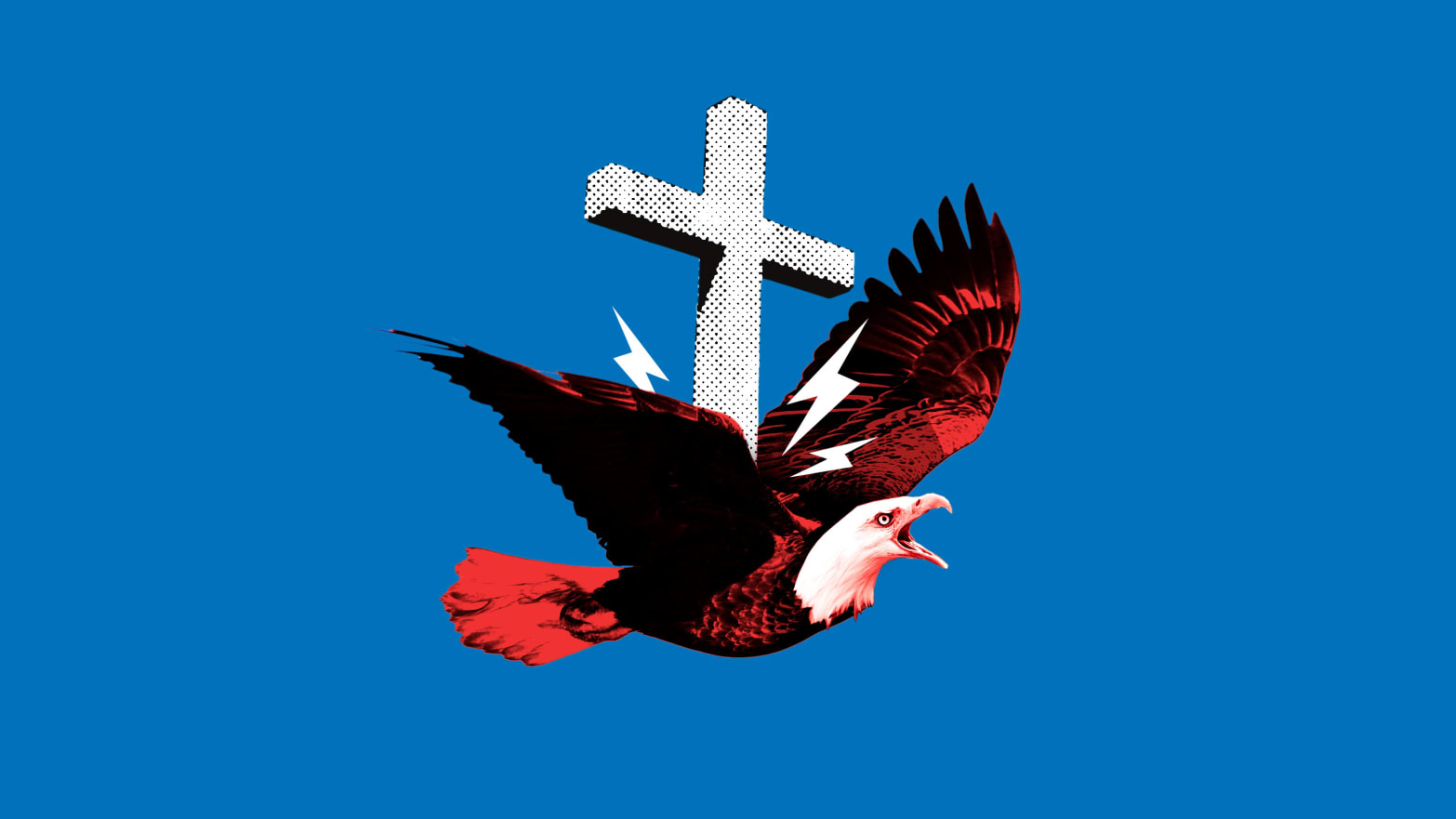
Photo Illustration by Luis G. Rendon/The Daily Beast/Getty
Washington, D.C. is home to hundreds of churches; any would have been a more fitting location for a Christian church service like last week’s National Prayer Breakfast than the U.S. Capitol. In the prestigious National Cathedral, for instance, 4,000 worshippers could have enjoyed Andrea Bocelli’s melodious tenor and the Christian speakers, sermons, and prayers.
Unfortunately, some members of Congress—oblivious or hostile to church-state separation—are determined to make this annual Christian ceremony a government-run, taxpayer-funded institution, stamped with the imprimatur of Congress and the president. Essentially, a state church.
Last week, Speaker Mike Johnson, a strident Christian nationalist, moved the historically private National Prayer Breakfast into the heart of the U.S. Capitol, Statuary Hall, a blow to the separation of church and state he has long scorned.
The rationale for the National Prayer Breakfast—that our leaders must unite in Christian prayer because “the challenges that face them cannot be solved in their own strength”—ignores a lot of history.
When the Constitutional Convention deadlocked in June 1787, for example, Ben Franklin noted that the founders rejected his proposal for a prayer as “unnecessary.” Maybe that was because the first congressional chaplain turned out to be a traitor; or because framers saw no need for “calling in foreign aid” as Alexander Hamilton, perhaps apocryphally, put it; or that there were “no funds” for a prayer, as one delegate argued.
Our founders were focused on something more important, the most revolutionary act they would take that summer: creating humanity’s first secular government. Separation of church and state is an American original, born of the Enlightenment and implemented as a bold experiment. No other nation had sought to protect the ability of citizens to think and worship freely by divorcing religion and government. For 237 years, this “Wall of Separation” has succeeded spectacularly at protecting religious freedom, fostering a pluralistic democracy, and forestalling the abuses inherent in theocracies.
Christian nationalists, however, have never stopped trying to undermine it.
The National Prayer Breakfast began in 1953, part of the “golden age” of McCarthy-era Christian nationalism that brought the National Day of Prayer, “under God” in the Pledge of Allegiance, and “In God We Trust” as the national motto.
It was more than a response to godless communists, more than the “Jesus plus nothing” motto of the shadowy nonprofit (“The Family”) behind the breakfast; it was also about right-wing politics.
I’m a Cradle Catholic. I Don’t Want Christian Nationalism.
NOT IN THIS HOUSE
Alex Thomas
Princeton historian Kevin Kruse describes it as part of a coordinated attack on the New Deal by an unholy alliance of big business and conservative clergy. Building power and access for that alliance has defined the event ever since, as its many scandals illustrate. The breakfast has been an “influence-peddling bazaar” for lobbyists and foreign agents, riddled with anti-LGBTQ hatred. Last year, “The Family” funded a trip for 2023 Prayer Breakfast Co-Chair Rep. Tim Walberg (R-MI) to urge Uganda to “stand firm” behind it’s death penalty for LGBTQ people.
In a misguided damage control effort, Congress partially took over the event in 2023 and 2024. But they’ve created a host of new problems by holding an exclusionary Christian ceremony in the sanctum sanctorum of secular democracy.
“All faiths” were supposedly welcome, but who were they kidding? Jews, Muslims, Hindus, and other non-Christians were implicitly disinvited by “gathering in the spirit of Jesus and calling on the Lord in prayer,” at a program indistinguishable from a Christian church service.
“Nones” like us—people who identify as atheists, Humanists, agnostics, or nothing in particular—were categorically excluded. One of us, Rep. Jared Huffman (D-CA), Congress’ only Humanist, raised eyebrows by attending anyway as a quiet protest.
A congressman who loves America and wants to pray for it in his own non-religious way should never feel unwelcome in Statuary Hall. The Prayer Breakfast’s exalting of Christian privilege divides America along religious lines and flouts the equality our Constitution enshrines.
Anticipating accusations of “persecution” (the ultimate projection of Christian privilege), let us be clear: every American, and every member of Congress, is free to be Christian. But those who arrogantly seek to impose Christianity as a national religion should consider Ben Franklin’s admonition: “When a Religion is good, I conceive that it will support itself; and, when it cannot support itself, and God does not take care to support, so that its Professors are obliged to call for the help of the Civil Power, it is a sign, I apprehend, of its being a bad one.”
The co-chair of this year’s breakfast, Rep. Tracey Mann (R-KS), closed the program by proclaiming Christian prayer “our heritage.” Maybe for some, but not everyone.
A more universal part of our heritage—one that respects diversity, protects religious freedom, and is enshrined in the Constitution—is separation of church and state. Congress should reaffirm that great American heritage by fully disassociating from the National Prayer Breakfast.
U.S. Rep. Jared Huffman represents California’s 2nd Congressional District and is a co-founder and co-chair of the Congressional Freethought Caucus.
Andrew L. Seidel is a constitutional attorney, VP at Americans United for Separation of Church and State, and author of The Founding Myth and American Crusade.
One of us, a non-believing member of Congress, went to the recent National Prayer Breakfast. Christian nationalists moved it to the Capitol for the first time.
Rep. Jared Huffman
Andrew L. Seidel
Updated Feb. 08, 2024 6:28PM EST / Published Feb. 08, 2024 6:09PM EST
OPINION
Photo Illustration by Luis G. Rendon/The Daily Beast/Getty
Washington, D.C. is home to hundreds of churches; any would have been a more fitting location for a Christian church service like last week’s National Prayer Breakfast than the U.S. Capitol. In the prestigious National Cathedral, for instance, 4,000 worshippers could have enjoyed Andrea Bocelli’s melodious tenor and the Christian speakers, sermons, and prayers.
Unfortunately, some members of Congress—oblivious or hostile to church-state separation—are determined to make this annual Christian ceremony a government-run, taxpayer-funded institution, stamped with the imprimatur of Congress and the president. Essentially, a state church.
Last week, Speaker Mike Johnson, a strident Christian nationalist, moved the historically private National Prayer Breakfast into the heart of the U.S. Capitol, Statuary Hall, a blow to the separation of church and state he has long scorned.
The rationale for the National Prayer Breakfast—that our leaders must unite in Christian prayer because “the challenges that face them cannot be solved in their own strength”—ignores a lot of history.
When the Constitutional Convention deadlocked in June 1787, for example, Ben Franklin noted that the founders rejected his proposal for a prayer as “unnecessary.” Maybe that was because the first congressional chaplain turned out to be a traitor; or because framers saw no need for “calling in foreign aid” as Alexander Hamilton, perhaps apocryphally, put it; or that there were “no funds” for a prayer, as one delegate argued.
Our founders were focused on something more important, the most revolutionary act they would take that summer: creating humanity’s first secular government. Separation of church and state is an American original, born of the Enlightenment and implemented as a bold experiment. No other nation had sought to protect the ability of citizens to think and worship freely by divorcing religion and government. For 237 years, this “Wall of Separation” has succeeded spectacularly at protecting religious freedom, fostering a pluralistic democracy, and forestalling the abuses inherent in theocracies.
Christian nationalists, however, have never stopped trying to undermine it.
The National Prayer Breakfast began in 1953, part of the “golden age” of McCarthy-era Christian nationalism that brought the National Day of Prayer, “under God” in the Pledge of Allegiance, and “In God We Trust” as the national motto.
It was more than a response to godless communists, more than the “Jesus plus nothing” motto of the shadowy nonprofit (“The Family”) behind the breakfast; it was also about right-wing politics.
I’m a Cradle Catholic. I Don’t Want Christian Nationalism.
NOT IN THIS HOUSE
Alex Thomas
Princeton historian Kevin Kruse describes it as part of a coordinated attack on the New Deal by an unholy alliance of big business and conservative clergy. Building power and access for that alliance has defined the event ever since, as its many scandals illustrate. The breakfast has been an “influence-peddling bazaar” for lobbyists and foreign agents, riddled with anti-LGBTQ hatred. Last year, “The Family” funded a trip for 2023 Prayer Breakfast Co-Chair Rep. Tim Walberg (R-MI) to urge Uganda to “stand firm” behind it’s death penalty for LGBTQ people.
In a misguided damage control effort, Congress partially took over the event in 2023 and 2024. But they’ve created a host of new problems by holding an exclusionary Christian ceremony in the sanctum sanctorum of secular democracy.
“All faiths” were supposedly welcome, but who were they kidding? Jews, Muslims, Hindus, and other non-Christians were implicitly disinvited by “gathering in the spirit of Jesus and calling on the Lord in prayer,” at a program indistinguishable from a Christian church service.
“Nones” like us—people who identify as atheists, Humanists, agnostics, or nothing in particular—were categorically excluded. One of us, Rep. Jared Huffman (D-CA), Congress’ only Humanist, raised eyebrows by attending anyway as a quiet protest.
A congressman who loves America and wants to pray for it in his own non-religious way should never feel unwelcome in Statuary Hall. The Prayer Breakfast’s exalting of Christian privilege divides America along religious lines and flouts the equality our Constitution enshrines.
Anticipating accusations of “persecution” (the ultimate projection of Christian privilege), let us be clear: every American, and every member of Congress, is free to be Christian. But those who arrogantly seek to impose Christianity as a national religion should consider Ben Franklin’s admonition: “When a Religion is good, I conceive that it will support itself; and, when it cannot support itself, and God does not take care to support, so that its Professors are obliged to call for the help of the Civil Power, it is a sign, I apprehend, of its being a bad one.”
The co-chair of this year’s breakfast, Rep. Tracey Mann (R-KS), closed the program by proclaiming Christian prayer “our heritage.” Maybe for some, but not everyone.
A more universal part of our heritage—one that respects diversity, protects religious freedom, and is enshrined in the Constitution—is separation of church and state. Congress should reaffirm that great American heritage by fully disassociating from the National Prayer Breakfast.
U.S. Rep. Jared Huffman represents California’s 2nd Congressional District and is a co-founder and co-chair of the Congressional Freethought Caucus.
Andrew L. Seidel is a constitutional attorney, VP at Americans United for Separation of Church and State, and author of The Founding Myth and American Crusade.
Wednesday, September 27, 2023
Sunday, September 18, 2022
Rep. Lauren Boebert said humanity is in its 'last days' and Christians should 'rise up,'.
Rep. Lauren Boebert said humanity is in its 'last days' and Christians should 'rise up,' invoking Christian nationalist imagery that's linked to violence
Sep 18, 2022, 7:06 AM
Rep. Lauren Boebert, R-Colo., addresses attendees during the Turning Point USA Student Action Summit, Saturday, July 23, 2022, in Tampa, Fla. Phelan M. Ebenhack/Associated Press
- Boebert echoed Christian nationalist talking points and invoked the end times in a speech last week.
- She said it's time for Christians to "rise up" and "influence this nation as we were called to do."
- Christian nationalism experts say such rhetoric has been linked to violence.
A recent speech by Rep. Lauren Boebert — during which she invoked the end times and said it's time for Christians to "rise up" — demonstrated how Christian nationalist ideals, including some associated with violence, have made it to the halls of Congress.
"It's time for us to position ourselves and rise up and take our place in Christ and influence this nation as we were called to do," the Colorado Republican told the crowd at a Christian conference held by the Truth and Liberty Coalition in Woodland Park, Colorado, on September 9.
"We need God back at the center of our country," she added.
Boebert heavily quoted scripture in her speech. She framed the formation of the US as divinely inspired and described the founding fathers as men of faith who were motivated by God — contentions that have been challenged by historians.
"We know that we are in the last of the last days," Boebert later said, referencing the belief held by some evangelical Christians that Jesus will return after a period of tribulation, or great suffering, and save believers. "But it's not a time to complain about it. It's not a time to get upset about it. It's a time to know that you were called to be a part of these last days. You get to have a role in ushering in the second coming of Jesus."
Boebert's comments expressing an intrinsic tie between the US and Christianity aren't new: In June she said she was "tired of this separation of church and state junk" and that "the church is supposed to direct the government." But by invoking the end times, Boebert is tapping into a side of Christian nationalism that has been associated with violence.
Although a spokesperson for Boebert told The Denver Post she does not identify as a Christian nationalist, her comments align with the tenants of Christian nationalism, an ideology and cultural framework that says Christianity should have a privileged position in American society.
"We found in our book that among Americans that embrace Christian nationalism, we see increasingly this embrace of a premillennialist interpretation of the end times, where there will be a tribulation but Christ will take away the faithful," Andrew Whitehead, a sociologist at IUPUI and co-author of "Taking America Back for God: Christian Nationalism in the United States," told Insider.
Whitehead said Boebert was taking a specific and relatively new interpretation of the end times and melding it with the idea that Christians are supposed to have an influential role in public life. He said her view wasn't necessarily about saving the nation, but about Christians countering the forces of evil while they still can and remaining faithful up until the end.
"Citing the end times really does feel like a call to action and a rallying cry in some sense," Whitehead said, adding: "A lot of that end times imagery is associated with violence and rapture and descending into chaos societally."
Experts on religion and politics told The Denver Post that Boebert's remarks could be interpreted as a call for violence, particularly in relation to the midterm elections.
"Now the apocalypse is because if we don't get our people in, it's an apocalypse," Anthea Butler, chair of the University of Pennsylvania's Department of Religious Studies, told the outlet.
Though Boebert's comments aren't new among proponents of Christian nationalism, such rhetoric has rarely, if ever, been deployed by a member of Congress.
Christian nationalism has also inspired acts of violence in the past. A report published in February by a group of faith leaders, historians, and religious scholars — including Whitehead — argued the concept was on display at the Capitol on January 6 and helped justify the insurrection. Christian nationalist ideals were also espoused by the suspects in the 2018 Pittsburgh synagogue shooting and the 2019 New Zealand mosque shootings.
"Any time that our political rhetoric moves in an area where we are raising the stakes — where it is ultimate good vs. ultimate evil," Whitehead said, "that's when political violence becomes much more likely."
Boebert's office did not respond to Insider's request for comment.
Thursday, September 15, 2022
Subscribe to:
Posts (Atom)