Origins
This Article is an excerpt from "En Route to Global Occupation" by Gary H. Kah, published by Huntington House. This important book deserves a place in your library.
After months of getting nowhere, a door finally opened. One Sunday evening in 1986 while sharing at a church in northern Indiana, I met an elderly lady who introduced herself to me at the close of the service. She inquired whether I knew anything about Freemasonry and its influence on the New Age. I told her I was aware of its involvement but that I still did not understand exactly what role the Masonic Order played in the overall scheme of things.
She went on to share that she had been researching the Masonic movement for the past twenty years and had quite a collection of materials on the Order (much of which she had obtained from widows of deceased Masons who were unaware of the significance of the Order and its literature). She would make her materials available to me if I wanted them and explained that she had been unsuccessful at getting anyone to listen to her because of her age and the lack of a fancy job title. We ended up meeting several times at her home to sort through her materials on Freemasonry. Whatever this elderly saint did not have, it seemed she knew where to get it.
In the months that followed, l received quite an education while combing through the major Masonic reference works. I found a repeated mention of such orders as the Illuminati, the Knights Templars, and the Rosicrucians, along with other cultish groups, which I had previously thought to be only myths. But I soon became convinced to the contrary, not only learning that they existed, but that Freemasonry was a modern-day continuation of Gnosticism and of the ancient mystery religions. While most sources placed the official birth of Freemasonry at 1717, Masonic references clearly indicated that the organization's history went back much further than this.
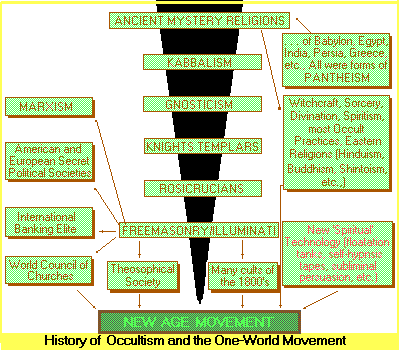
The adjacent diagram, based on my research in both Masonic and non-Masonic sources, depicts the roots of the Order along with its historical and modern-day lines of influence. (A number of other false religions and subversive movements have also had an influence on the Masonic Order.
However, those depicted are the main sects and religions to which the existence of Freemasonry and the New Age movement may be attributed. The names have changed, but the beliefs, tactics, and designs of the groups have remained essentially the same).
The history of Freemasonry, I discovered, was also the history of the secret societies, and the history of the secret societies is the history of organized occultism—particularly in the Western world. Perhaps the most complete history of organized occultism has been provided by Albert Pike in his 861 page occult classic entitled — "Morals and Dogma of the
Ancient and Accepted Scottish Rite of Freemasonry" (more commonly referred to by Masons as simply Morals and Dogma). Drawing from the sources available to him as the long-time leader of Freemasonry (1859-1891), Pike was able to trace the chronological growth and spread of the Mysteries over the face of the earth from ancient Babylon down to the present-day Masonic Order.
In reference to the esoteric doctrines of the Mysteries, Pike states:
The communication of this knowledge and other secrets, some of which are perhaps lost, constituted, under other names, what we now call Masonry, or Free, or Frank-Masonry . . . The present name of the Order, and Its titles, and the names of the Degrees now in use, were not then known . . . But, by whatever name it was known in this or the other country, Masonry existed as it now exists, the same in spirit and at heart . . . before even the first colonies emigrated into Southern India, Persia, and Egypt, from the cradle of the human race (Morals and Dogma, p.207-208).
Pike goes on to remark, "We teach the truth of none of the legends we recite. They are to us but parables and allegories, involving and enveloping Masonic instruction; and vehicles of useful and interesting information. They represent the different phases of the human mind, its efforts and struggles to comprehend nature, God, the government of the Universe, the permitted existence of sorrow and evil. To teach us wisdom, and the folly of endeavoring to explain to ourselves that which we are not capable of understanding, we reproduce the speculations of the Philosophers, the Kabalists, the Mystagogues and the Gnostics. Every one being at liberty to apply our symbols and emblems as he thinks most consistent with truth and reason and with his own faith, we give them such an interpretation only as may be accepted by all." (Ibid, p.329). Dozens of supporting statements are scattered throughout the same volume, leaving no doubt that Pike meant what he said. Other Masonic reference works provide a similar account of the Order's roots. The Freemason's Monitor, for example, explains:
"Our records inform us, that the usages and customs of Masons have ever corresponded with those of the Egyptian philosophers, to which they bear a near affinity. Unwilling to expose their mysteries to vulgar eyes, they concealed their particular tenets, and principles of polity, under hieroglyphical figures; and expressed their notions of government by signs and symbols, which they communicated to their Magi alone, who were bound by oath not to reveal them" (Thomas Smith Webb, PGM, The Freemason's Monitor Cincinnati: The Pettibone Bros., 1797, p.39).
I discovered that historical documents pertaining to the beginnings of Freemasonry and the spread of organized occultism had been preserved in a number of Masonic libraries throughout the world. In Europe, for example, a sizable collection can be found in Freemason's Hall located on Great Queen (i.e. Semiramis) Street in the heart of London. In the United States, on the other hand, a large depository of Masonic writings is located at the Grand Lodge of Iowa in Cedar Rapids. The most extensive collection by far, however, can be found at the House of the Temple in Washington, D.C.
Along with serving as the headquarters for the Mother Supreme Council of the World (the governing body of Freemasonry) and containing a vast, exquisite Masonic shrine, the House of the Temple also houses a universally renowned Masonic library. Henry C. Clausen, the former Sovereign Grand Commander of the Scottish Rite referred to this library in his book, Masons Who Helped Shape Our Nation written in 1976.
"A priceless treasure of The Supreme council is its Library. One-third of the 175,000 volumes which it contains deal with Freemasonry in all its branches, forming one of the most comprehensive collections on this subject in the entire world."
"The Archives in the House of the Temple supplement the Library. More than two-and-a-half million papers, giving details of the history of Masonry and of the Scottish Rite are carefully filed and indexed." (Henry C. Clausen, SGM, Masons Who Helped Shape Our Nation. San Diego: Neyenesch Printers, 1976, p.111).
Another prominent Masonic writer, H.L. Haywood, confirms these figures, claiming the existence of "fifty or sixty thousand Masonic books" (H.L. Haywood, Famous Masons and Masonic Presidents. Richmond, VA: Macoy Publishing and Masonic Supply Co., p.97).
If Freemasonry were nothing more than a social organization, as it publicly claims to be, then how could one account for the incredible number of books existing on the Order? What kind of social organization would possess an archive of two-and-a-half million documents along with a library of sixty thousand books containing its history? The mere existence of such a collection suggested that Freemasonry was more than a large group of citizens organized for community service.
As a result of my research, I finally came to conclude that a careful history of the occult had been maintained by the ancient priests wherever the mysteries were practiced. This information was probably initially passed along chiefly by word of mouth and possibly assisted by the use of hieroglyphics and other forms of primitive writing developed among the ancient civilizations. However, as time progressed, this knowledge of the secret rituals, beliefs and practices of the occult priesthood, was put into writing on manuscripts, providing a permanent record of these Luciferic activities.
Much of this ancient knowledge was allegedly first recorded by some of the Greek and Roman philosophers, whose philosophical societies existed as special extensions of the occult priesthood. According to Masonic sources, this information has been miraculously preserved ever since, having been passed from one generation to the next through an unbroken line of occult priests. The Masonic Order claims to be the latest in a succession of occult orders who have served as the guardians of this ancient knowledge.
Many specifics of the Order's diabolical legacy have been revealed in the works of Masonic historians such as Pike, Mackey, Haywood, M.P. Hall, and others who have provided summaries of Masonic/occult history. While some discrepancies exist among the various accounts, there is, nevertheless, a remarkable degree of uniformity and consistency considering the complexity of the subject. However, to understand the Masonic Order's complete role and where it fits in, a bit of world history is required.
A Historical Perspective
By the days of Noah the world had become completely saturated with the occult to the point where only one righteous family was left. As a result, God, who was grieved by man's sin and wickedness, judged the world by sending a flood. After the flood, however, it took only a few generations before man had once again begun to embrace the occult. This was evidenced at the building of the Tower of Babel, which is believed to have been the first ziggurat — an ancient occult worship tower with a shrine at the top. Under the umbrella of pantheism, the ancient occult mysteries began to take hold and spread. By the time of Abraham and Lot, the human state, at least in their part of the world, had once again gotten out of control. Those were the days of Sodom and Gomorrah when perversion and immorality were taken to new heights.
Although Abraham was himself not perfect, he was a man who sought to do right in the eyes of God. Because he and his family were the only righteous ones left who were willing to acknowledge Him, God would honor Abraham's faith by choosing to create a nation from his seed. God would work through this nation, Israel, to keep His truth and the way of righteousness alive in the midst of a dark, occult-ravaged world. After a few hundred years when Abraham's seed had sufficiently multiplied, there were enough Israelites to constitute a physical nation. At that time, God led His people out of Egypt by His servant Moses.
The history of Israel would be one of ups and downs. When the Israelites were obedient to God, they prospered; and none of their pantheistic neighbors could stand against them. However, when the Israelites themselves began to fall for the spiritual lies of the surrounding nations, they were oppressed by these same powers. God sent a steady stream of holy prophets to teach Israel His ways and to warn them of what would happen if they did not obey. Much like the relationship between a loving father and his child, while longing for his child (Israel) to be good and loving, there were times when that child was rebellious and needed to be disciplined before something much worse happened.
The Israelites, through Moses, had been instructed to bring regular animal offerings or sacrifices before God. These sacrifices symbolized the payment for their sins, reminding them: that sin does not come without a penalty. These offerings were also symbolic of the coming supreme sacrifice of Jesus Christ Who would pay the penalty for the sins or the entire world at the appointed time.
After the proper groundwork had been laid, God sent His Son. The Message of forgiveness and the promise of eternal Life to those who believe in Christ would be carried forward from Israel to all nations. Although this gospel (the good news) spread in all directions, It would not be equally accepted by all peoples and would meet with more resistance in some places than in others. Those missionaries, for example, who carried the message into Babylon, Persia, and India were violently rejected; and only a small number of people believed and received the truth there. Likewise today, in spite of nearly twenty centuries of missionary efforts in the Far East, with the exception of a few areas, the Message of Christ has been overwhelmingly rejected.
The hold of Satan on these countries is so complete and established that, to this day, only a small percent of the orient believes in Christ. Hinduism — the oldest surviving pantheistic religion is still being practiced by a majority of India's inhabitants.
The story would be different in the Mediterranean where the gospel was accepted by large numbers, in spite of fierce persecution against those who believed. Within a few generations there were so many Christians in this region that the high priests of the Mysteries of Greece, Rome, and Egypt began to lose their control. The teachings of Christ went head-to-head against the pantheistic beliefs and occult practices of the priests, exposing them for what they were. The more the believers were persecuted, the larger their numbers grew, until finally the occult priests were forced to go underground in order to keep their secret knowledge and traditions alive.
These occult teachings have been handed down from generation to generation ever since, kept alive in the Western world by the secret societies, which are little more than a continuation of ancient occult priesthoods. Satan's plan was to keep his priesthood and secret doctrines alive until, being sufficient in number and power, the priesthood could once again seize control over his lost territories. Gnosticism, the most effective and widely accepted form of pantheism, was more deceptive and clever than the others, developing the occult's only major counter explanation to the Message and Person of Christ. The Gnostics were the chief adversaries of the Apostle Paul and the early Church, relentlessly pursuing Christians wherever they went, long before the mystery religions even began to crumble.
According to Albert Pike, Gnosticism was an offshoot of Kabalism, an oral occult tradition, which was adhered to by a minority of the Jews. At some point, which remains uncertain, these occult teachings were reduced to writing, and the Kabalah was born. On page 626 of Morals and Dogma, Pike states, "The Kabalah is the key of all Masonry and the occult sciences; and the Gnostics were born of the Kabalists."
Kabalism was merely a unique version of the ancient mysteries specifically designed to deceive God's chosen people. Unlike the other mysteries, its teachings dealt specifically with Israel, offering occult counter-explanations to the revelations of the prophets, complete with a cleverly disguised occult interpretation of the history of Israel. Moses, for example, rather than being the righteous prophet of God who led the Israelites out of Egypt, was made out to be an occult figure whose purpose was to initiate the Israelites into the enlightened and more advanced teachings of Egypt.
If Kabalism could be viewed as the occult counter-explanation of the Old Testament, Gnosticism, existing as a further development of Kabalism and taking into account Satan's "new problem" posed by the risen Christ, would serve as the main occult counterattack against the New Testament. Thus, Kabalism and Gnosticism combined, composed a type of occult parallel to the Old and New Testaments.
Gnosticism, although originally composed of Jewish occultists, rapidly gained Gentile followers until it soon became predominantly Gentile. As the priesthoods were forced to take on new forms, Gnosticism became a magnet for these occult adepts. Branches of Gnosticism represented the first significant secret societies of the post-resurrection era with various degrees or levels of initiation and the inner circle of initiates worshiping Lucifer.
Gnosticism
A significant amount of space has been devoted to the discussion of Gnosticism in Masonic reference works. Morals and Dogma, for example, has allotted more than forty pages to Gnosticism and its connection with Freemasonry. Albert Pike, the book's author, offers the following explanation of Gnosticism:
"The Gnostics derived their leading doctrines and ideas from Plato and Philo, the Zend-avesta and the Kabalah,and the Sacred books of India and Egypt; and thus introduced into the bosom of Christianity the cosmological and theosophical speculations, which had formed the larger portion of the ancient religions of the Orient, joined to those of the Egyptian, Greek, and Jewish doctrines, which the New-Platonists had equally adopted in the Occident" (Morals and Dogma, 248).
Gnosticism flourished through various offshoots such as the Manicheans of the third century, the Euchites of the fourth century, the Paulicans of the seventh century, and the Bogomils of the ninth century (Nesta H. Webster, Secret Societies and Subversive Movements, Hawthorne, CA: Christian Book Club of America, 1924. p.32-34, 63). It is not possible within the scope of this book to identify and define each branch of Gnosticism that has existed over the centuries, but the following teaching of the Bogomils will give us an idea of what beliefs the Knights Templars embraced before passing them on to Freemasonry.
God, the Supreme Father, has two sons, the elder Satanael, the younger Jesus. To Satanael, who sat on the right hand of God, belonged the right of governing the celestial world, but filled with pride, he rebelled against his Father and fell from Heaven. Then, aided by the companions of his fall, he created the visible world, image of the celestial, having like the other its sun, moon, and stars, and last he created man and the serpent which became his minister. Later Christ came to earth in order to show men the way to Heaven, but His death was ineffectual, for even by descending into Hell He could not wrest the power from Satanael, i.e., Satan. This belief in the impotence of Christ and the necessity therefore for placating Satan, not only "the Prince of this world," but its creator, led to the further doctrine that Satan, being all-powerful, should be adored (Ibid., 63).
At the base of each form of Gnosticism existed this adoration or worship of Satan, as well as a profound hatred for Christ and His teachings. It was perversions such as these, handed down in an unbroken tradition from the earliest Gnostics, that were eventually embraced by the Knights of the Temple (Knights Templars) in the twelfth century.
Knights TemplarsThe Knights Templars were a military and religious order first established in AD 1118 in Jerusalem by nine French knights under the leadership of Hugues de Payens of Champagne and Godefroi de Saint- Omer (Ibid., 49). Their stated mission was to protect pilgrims on their way to the Holy Land during the crusades (Collier's Encyclopedia, 1985 "Knights Templars"). They also fought in various battles of the crusades and became famous for their bravery (World Book Encyclopedia, 1969 "Knights Templars"). "Baldwin II, King of Jerusalem, gave the Knights Templars quarters in his palace, built on the site of Solomon's Temple." From this, the order derived its name — Knights of the Temple.
Membership in the Knights Templars was originally limited to nobles. However, later on, the order opened its ranks to other men whom it felt could be used to further its aims. The order grew rapidly and in the year 1128 was taken under the special protection of the pope (Collier's Encyclopedia, "Knights Templars").
During the Crusades, the Knights Templars established local offices in all the Christian countries to encourage enlistment in crusading armies and to take care of funds for the pilgrims. (The pilgrims gave donations to the Order — which existed as a tax-exempt organization — in exchange for protection to and from Jerusalem). The Templars, being composed mostly of nobles, were also granted favors by many European rulers and gained possession of property throughout the continent. Through gifts of land and money, the Templars became extremely wealthy and powerful (Collier's Encyclopedia, "Knights Templars").
After the fall of Jerusalem to Saladin in 1187, the order established its headquarters in Acre. The Templars were forced to relocate once again in 1291 when Acre fell to the Muslims. This time their headquarters were moved to the island of Cyprus. However, by then, the Templars, through their enormous wealth and wide-spread organization, had become the bankers of Europe, and the order was no longer primarily a military one. It was especially influential in Spain, France, and England, where commanderies of knights, men-at-arms, and chaplains were organized, each under its own superior, subordinate to the Grand Master of the order (Ibid.).
Morals and Dogma adds, "Their watchword was, to become wealthy in order to buy the world. They became so, and in 1312, they possessed in Europe alone more than nine thousand seignories" (Morals and Dogma, 819-820). (A seignory refers to the estate or dominion of a noble or feudal lord).
The Knights Templars were probably corrupt from the beginning. But whether the order started out degenerate or became this way later, it is certain that the Templars had, during their exploits in the Middle East, become strongly influenced by both the Gnostics and the Assassins (a ruthless Arabic military order). It is a fact that several of the founders of the Knights Templars were initiates in the sect of the Assassins (Edith Starr Miller, Occult Theocracy. Hawthorne, CA; The Christian Book Club of America, 1933, p.143). The Templars, while adopting the religious beliefs of the Gnostics, received many of their organizational and political traits from the Assassins. The Templars represented the first wide-scale attempt to organize and mobilize the forces of occultism for the purpose of gaining control of the world.
Occult historian Edith Starr Miller summarizes the demise of the Templars as follows:
"Having embraced Gnosticism while in Palestine, and in touch with the sect of the Assassins, the Templar order degenerated, and some of its members, under the influence of that sect, were said to practice Phallicism or sex-worship and Satanism and to venerate "The Baphomet," the idol of the Luciferians. The crime of Sodomy was a rite of Templar initiation." (Ibid., 144). "In 1307 the Templars were charged with heresy and immorality by a former member of the order" (Collier's Encyclopedia, "Knights Templars"). As a result, Philip IV of France launched an investigation looking into the alleged misdeeds of the organization (World Book Encyclopedia, 1969, "Knights Templars"). On 15 October 1507 the king had the Templars of France arrested and brought before the Inquisitor for France by whom they were examined (Webster, Secret Societies, 51-52). The knights confessed to a variety of notorious crimes and admitted to taking blasphemous oaths against Jesus Christ upon admission into the Order.
They said, they had been shown the cross on which was the figure of Christ, and had been asked whether they believed in Him; when they answered yes, they were told in some cases that this was wrong (dixit sibi quod male credebat), because He was not God, He was a false prophet (quid falsus propheta erat, nec erat Deus). Some added that they were then shown an idol or a bearded head which they were told to worship; one added that this was of such "terrible aspect that it seemed to him to be the face of
some devil, called in French "un maufe," and that whenever he saw it he was so overcome with fear that he could hardly look at it without fear and trembling." All who confessed declared that they had been ordered to spit on the crucifix, and very many that they had received the injunction to commit obscenities and to practice unnatural vice. Some said that on their refusal to carry out these orders they had been threatened with imprisonment, even a few said they had actually been incarcerated; one declared that he had been terrorized, seized by the throat, and threatened with death (Ibid., p. 52; Michelet, Proces des Templiers II, 1841. p. 284-364).
Pope Clement V, however, refused to respond to the charges and confessions of the Templars.
Clement V, deeply resenting the King's interference with an order which existed entirely under papal jurisdiction, wrote in the strongest terms of remonstrance to Philippe le Bel urging their release, and even after their trial, neither the confessions of the Knights nor the angry expostulations of the King could persuade him to believe in their guilt (Ibid., p.53).
The pope was not only slow to respond to the confessions but actually did what he could to protect the order. Later on, however, he gave the following reasons for his actions (in his own words):
"Because it did not seem likely nor credible that men of such religion who were believed often to shed their blood and frequently expose their persons to the peril of death for Christ's name, and who showed such great and many signs of devotion both in divine offices as well as in fasts, as in other devotional observances, should be so forgetful of their salvation as to do these things, we were unwilling . . . to give ear to this kind of insinuation . . . (hujusmodi insinuacioni ac delacioni ipsorum . . . aurem noluimus inclinare)." (Ibid., p.51, Michelet, Proces des Templiers).
Due to mounting pressure from a suspicious public and because a number of the confessions before Philip IV were allegedly made under torture, the pope finally decided to mount his own investigation, consenting to receive in private audience "a certain Knight of the Order, of great nobility and held by the same Order in no slight esteem" (Ibid., 53). Upon being questioned by the pope, the Knight "testified to the abominations that took place on the reception of the Brethren, the spitting on the cross, and other things which were not lawful nor, humanly speaking, decent."
Pope Clement V then decided to examine seventy-two other French Knights at Poictiers in order to discover whether their earlier confessions before the Inquisitor for France were true. These hearings were conducted without torture, with the witnesses taking an oath promising "the full and pure truth." The Templars' Grand Master, Jacques de Molay and the French leaders of the order were likewise questioned in the presence of three Cardinals, four public notaries, and many others (Ibid.). Before these many witnesses the Templars admitted their crimes as previously confessed during the trials of King Philip IV (Ibid., 53-54). The Knights Templars, as it turned out, had been masters of deception, experts in duplicity, appearing to serve Christ on the surface while worshiping Lucifer within their inner rites.
Morals and Dogma confirms this character. "The Templars, like all other Secret Orders and Associations, had two doctrines, one concealed and reserved for the Masters . . . the other public . . . Thus they deceived the adversaries whom they sought to supplant." (Morals and Dogma, 817-818).
"The Pope, however, still refused to take action against the whole Order merely because the Master and Brethren around him had gravely sinned" (Webster, Secret Societies, 54). Instead, he decided to hold a papal commission in Paris which took place in November 1309. But by then, the word about the Templars was out and the public had become outraged. In addition to Italy and France, "Templars in England, Germany, Spain, and Portugal also stood trials, but most were acquitted" (World Book Encyclopedia, 1969, "Knights Templars").
Philip IV of France, more than any other monarch, pursued the members of the Order and sentenced many of them to death, charging them with conspiracy and Satan worship. On 12 May 1310 he had fifty-four French Templars burned alive in Paris (Miller, Occult Theocracy, p.144). In 1312, Pope Clement V was finally persuaded to abolish the Order (World Book Encyclopedia, 1969, "Knights Templars"). And on 18 March 1314, the Grand Master, Jacques de Molay, along with three of his highest ranking officers, were burned at the stake (Miller, Occult Theocracy, 144). It is this diabolical knight after whom today's Masonic Order of De Molay, reserved for young men, was named.
Following the death of De Molay, the Templars found refuge in Portugal under King Dinis II who became their protector (Ibid., 145). The Order suffered a temporary setback resulting from the confiscation of most of its property; but it remained influential, continuing to operate underground. Morals and Dogma attests to the survival of the Knights Templars stating that De Molay, prior to his execution, created four Metropolitan Lodges, at Naples for the East, at Edinburgh for the West, at Stockholm for the North, and at Paris for the South. [The initials of his name . . . found in the same order in the first three Degrees, are but one of the many internal and cogent proofs that such was the origin of modern Freemasonry . . . ] (Morals and Dogma, 820).
In a continued reference to the Templar order, Morals and Dogma adds: ". . . it lived, under other names and governed by unknown Chiefs, revealing itself only to those who, in passing through a series of Degrees, had proven themselves worthy to be entrusted with the dangerous Secret." (Ibid., 821).
The RosicruciansEvidence suggests that the surviving Knights Templars either founded or merged with an existing secret order in the early 1300s, later referred to as the Order of the Rose-Croix (the Rosicrucians). Very few details are known about its actual beginnings due to this order's ability to conceal its activities.
Morals and Dogma however, establishes a definite link between the Rosicrucians and the Templar Order. "The successors of the Ancient Adepts Rose-Croix, abandoning by degrees the austere and hierarchal Science of their Ancestors in initiation, became a Mystic Sect, uniting with many of the Templars, the dogmas of the two intermingling . . ."
By the early 1600s, more than three hundred years had passed since the Templars had been abolished. As a result, the secret order decided to test the waters to see how the public would respond to its occult philosophies. For obvious reasons, the Order could not share its real history linking it to the Templars, so it devised an allegory of its history around a mythical character by the name of Christian Rosenkreuz.
This tale was published in a document known as the "Fama Fraternitatis," which the Order circulated throughout Europe. The story elaborates how Rosenkreuz traveled to Syria and then Egypt to study the occult. After learning from all of the great masters of occult philosophy in the Middle East and Northern Africa, he returned to Europe to spread his "enlightenment" throughout that continent. But he was unfavorably received and therefore, returned home to Germany where he hoped to establish a society based on his teachings (Albert G. Mackey, An Encyclopedia of Freemasonry. New York; The Masonic History Co., 1921, p.639). This fictitious life of Christian Rosenkreuz symbolically conveyed the story of the Templars.
According to Mackey's Encyclopedia of Freemasonry, ". . . the fiction was readily accepted as a truth by most people, and the invisible society of Rosenkreuz was sought for with avidity by many who wished to unite with it" (Ibid., 640). However, the Order only wanted to test the reaction it would prompt and did not respond. (A number of societies sprang up claiming to possess the occult secrets of Rosenkreuz; but these aberrations were not the real Rosicrucian Order.)
This well calculated move by the secret Order allowed them to monitor Europe's openness to the occult without revealing the true identity of the Order or the names of its members. It also created a renewed interest in the occult throughout the Continent. But nearly another century would pass before the Order would begin to expand by publicly enlisting initiates.
Some contemporary leaders of the Masonic movement have denied any connections between their Order and the Knights Templars and Rosicrucians. However, enough evidence exists, which, if considered along with earlier statements from Morals and Dogma, clearly reveals that modern-day Freemasonry is a continuation of the preceding Orders. One outstanding example is in the names of the last three degrees of the York Rite — the Knight of the Red Cross, Knight of Malta and Knight Templar — and the eighteenth degree of the Scottish Rite — Sovereign Prince of Rose-Croix, which together with the seventeenth degree is known as the Chapter of Rose Croix.
The Birth of FreemasonryIf the Rosicrucians were to progress toward their goal of establishing a New World Order, they would eventually have to go public to enlist the support of more people to carry out their task. In the tradition of the Templars, they decided to take on the outer appearance of a benevolent organization of good works in order to continue their occult traditions within. They merged with and finally took over the stone mason guilds of Europe, retaining many of their symbols from the building trade. The stone masons became referred to as Operative Masons, as they were actually employed in the building profession; unlike the occult adepts who took over their guilds, who became known as Speculative Masons.
The builders' guilds had become a natural target for the takeover; since the Templars, centuries before, had themselves been great builders. With their enormous wealth, they constructed scores or castles and princely estates of their own pleasure and as monuments to their success and viewed themselves as great builders. They were even known to conceal themselves at times under the name of "Brethren Masons" (Morals and Dogma, p. 816).
With the construction of cathedrals on the decline, the operative guilds were shrinking in size and were in danger of going under. If they wanted to keep their traditions alive, they would have to open up their ranks to outsiders. Thus, with the two groups in need of each other, the marriage was sealed. The operative guilds, in time, became known as speculative guilds as they were flooded by esoteric occultists.
This transition from operative to Speculative Masonry took several decades to complete. The move, which began as early as the 1640's, culminated in the forming of the world's first Grand Lodge in London in l717. By way of this gradual takeover, the torch was passed to the Masonic order, with the Rosicrucians embedding themselves deep within its structure and hierarchy to become the Adepts, or the Princes of Freemasonry.
The "new" Order expanded rapidly. By the late 1700s, it had become firmly established as an organization known for its good works, and was, for the most part, viewed favorably by the public. With the groundwork successfully laid, the Adepts were once again free to pursue their age-old ambition of re-establishing the Luciferic World Order. Morals and Dogma states: "The Initiates, in fact, thought in the eighteenth century that their time had arrived, some to found a new Hierarchy, others to overturn all authority, and to press down all the Social Order under the level of Equality." (Ibid., p.821).
Toward this end, a new ultra-secret society was formed, enlisting in its ranks members from the highest degrees of the Masonic Order. This Order within an Order would come to be known as the Illuminati.
The Illuminati
The Masonic historian, Albert G. Mackey, describes the Illuminati as a "secret society, founded on May 1, 1776, by Adam Weishaupt who was professor of canon law at the University of Ingolstadt" (Mackey's Encyclopedia of Freemasonry, p.346). In his biographical sketch of Weishaupt, Mackey opens with the following words, "He is celebrated in the history of Masonry as the founder of the Order of Illuminati of Bavaria" (Ibid., 842.). Mackey later adds, "His ambition was, I think, a virtuous one; that it failed was his, and perhaps the world's misfortune" (Ibid., 843).
The Council of 13 = 13 Druids. Sir Winston Churchill was a member of the Ancient Order of Druids.
The Council of 33 = the 33o Masons.
The Council of 300 = the 300 wealthiest dynastic families.
(The Council of 13 heading up the plan for world hegemony are signified by the 13 layers of masonry portrayed on the reverse side of the Great Seal of the United States and printed on the U.S. one dollar bill by Illuminatus F.D. Roosevelt).
Any lingering doubts I had over whether the Order was Masonically inspired were removed when I discovered that H.L. Haywood, another highly esteemed Masonic historian, also included Weishaupt's biography in his book Famous Masons and Masonic Presidents. Weishaupt's esteemed summary is one of only one hundred biographical sketches appearing in the book, indicating that he had to have been a very prominent Mason (H.L. Haywood, Famous Masons and Masonic Presidents. Richmond VA: Macoy Publishing and Masonic Supply Co., 1944, p.152).
John Robison, an eighteenth century historian and a prominent Mason, was entrusted with some of the original documents and correspondence of the Illuminati. In his book, Proofs of a Conspiracy, written in 1798, he reproduced major segments of the Illuminati's original writings. Robison stated, "the express aim of the Order was to abolish Christianity, and overturn all civil government" (John Robison, Proofs of a Conspiracy. Boston: Western Islands, 1967, p.60). He went on to quote Weishaupt as stating that the plan for a New World Order can succeed "in no other way but by secret associations, which will by degrees, and in silence, possess themselves of the government of the States, and make use of those means for this purpose . . . " (Ibid., 106).
Using deception and intrigue, Weishaupt and his inner circle of adepts succeeded at gaining the support of Germany's Masonic lodges. "All these branches were controlled by the twelve leading adepts headed by Weishaupt, who at the lodge in Munich held in his hands the threads of the whole conspiracy" (Nesta Webster, World Revolution, p.20). Mackey admits to the initial success of the Illuminati, commenting:
The Order was at first very popular, and enrolled no less than two thousand names upon its registers, among whom were some of the most distinguished men of Germany. It extended rapidly into other countries, and its Lodges were to be found in France, Belgium, Holland, Denmark, Sweden, Poland, Hungary, and Italy (Mackey's Encyclopedia of Freemasonry, p.346-347).
In 1782, at the Masonic Congress of Wilhelmsbad, Weishaupt's Illuminati solidified its position among Europe's secret societies as the undisputed leader of the occult one-world movement. Around the same time, Weishaupt also succeeded at forging an alliance between Illuminized Freemasonry and the growing Rothschild banking network, thereby giving the Order the financial means to begin to carry out its plans (Webster, World Revolution, p.20 and Count Egon Caesar Corti, The Rise of the House of Rothschild. Boston: Western Islands, 1972, p.ix).
As a result of this alliance with the international financiers, the Freemasons regained the banking prominence once held by the Templars, and the Illuminati gained momentum. H.L. Haywood observes, "It took root, it grew, it flourished, it gathered into itself more men of royal and noble titles than were possessed by the Hohenzollern family; even the Jesuits joined it" (Haywood, Famous Masons and Masonic Presidents, 151-152).
Although Weishaupt's Illuminati was exposed within ten years, he had accomplished more to further "the plan" during this time than all of Freemasonry's efforts of the previous fifty years combined. One reason for his success was that he had gotten many Christian leaders to join the Order by convincing them that the Illuminati was a for the sake of Christ. Robison states, "In this scheme of Masonic Christianity, Spartacus [Weishaupt] and Philo [Baron Von Knigge] laboured seriously together. Spartacus sent him the materials, and Philo worked them up." (Robison, Proofs of a Conspiracy, p.86).
This apostate teaching, which was presented to Christian initiates, was explained by Von Knigge: "Jesus Christ established no new Religion; he would only set Religion and Reason in their ancient rights. For this purpose he would unite men in a common bond. He would fit them for this by spreading a just morality, by enlightening the understanding, and by assisting the mind to shake off all prejudices. He would teach all men, in the first place, to govern themselves. Rulers would then be needless, and equality and liberty would take place without any revolution, by the natural and gentle operation of reason and expediency. This great Teacher allows himself to explain every part of the Bible in conformity to these purposes; and he forbids all wrangling among his scholars, because every man may there find a reasonable application to his peculiar doctrines. Let this be true or false, it does not signify. This was a simple Religion and it was so far inspired; but the minds of his hearers were not fitted for receiving doctrines. I told you, said he, but you could not bear it. Many therefore were called, but few were chosen. To these elect were entrusted the most important secrets; and even among them there were degrees of information. There was a seventy, and a twelve. All this was in the natural order of things, and according to the habits of the Jews, and indeed of all antiquity. The Jewish Theosophy was a mystery; like the Eleusinian, or the Pythagorean, unfit for the vulgar, and thus the doctrines of Christianity were these they were maintained, like the Vestal Fire. They were kept up, only in hidden societies, who handed them down to posterity, and they are now possessed by the genuine Free Masons." (Ibid., 87).
"Using this cover of working for worldwide Christian unity, Weishaupt was able to gain the backing of numerous credulous leaders who thought they were working for a noble cause. In fact their every move was designed by Weishaupt to nudge the Illuminists one step closer to world domination" (Webster, World Revolution, p.13).
I can think of more than a few Christian leaders who could learn a lesson from this. Christian unity is not something that can be organized; it comes naturally among those who share a common love for Christ. The false ecumenical/interfaith unity being promoted today by the World Council of Churches — an organization that is strongly influenced by Freemasonry — is nothing new. It has been used for centuries to try to further the cause of world government. As long as Christians do NOT unite with the peoples of other religions, there can be no world government. This unwillingness of Christians to compromise their faith has been the chief obstacle for the conspirators.
Weishaupt received a special thrill out of being able to deceive Christians in this fashion. On one occasion, after having persuaded a Protestant leader to join his "unification effort," he wrote:
"You can't imagine what respect and curiosity my priest-degree has raised; and, which is wonderful, a famous Protestant divine, who is now of the Order, is persuaded that the religion contained in It is the true sense of Christianity. O MAN, MAN! TO WHAT MAYST THOU NOT BE PERSUADED. Who would imagine that I was to be the founder of a new religion." (Robison, Proofs of a Conspiracy, p.86).
Although the Illuminati's efforts officially ceased in the 1780s, unofficially its agenda continued to move forward through the network of Illuminized Masonic lodges that had already been set in place. The main catalyst for this continued drive seemed to come from the Grand Orient Lodge of France, and later on, from the Masonic leaders of Italy and the United States.
On American Soil
Already dominating the political affairs of Europe, the Masonic Order had made significant progress in the United States by the late 1700s. In fact, many of this country's political founding fathers were Masons. Most of them, like George Washington, were decent men who knew of no higher aims of the Order and who even spoke out against the activities of the Illuminati. However, with the Masonic lodges having gained acceptance in America, the Illuminati finally had in place the network through which it could recruit members and carry on its work. As a result, the first Supreme Council of Scottish Rite Freemasonry was established in Charleston, South Carolina, in 1801.
According to a Masonic publication entitled Facts Of Scottish Rite, "all other regular Supreme Councils throughout the world are descended from it" (Facts of Scottish Rite, p.4). (In 1813, the Northern Supreme Council was established as an extension of the Charleston group. The Northern Jurisdiction today consists of fifteen states and is headquartered in Boston. The Southern Jurisdiction whose headquarters have been relocated from Charleston to Washington, DC, covers the remaining thirty-five states, the District of Columbia, the U.S. territories and possessions. It is today the Mother Supreme Council of the world — Ibid.). The tremendous potential of the United States somehow had to be harnessed and brought under control if the plan for a New World Order was ever to succeed. Therefore, during the 1800s, as the U.S. emerged as a world power, the Illuminati gradually shifted its attention from Europe to the United States.
Freemasonry experienced tremendous growth during the nineteenth century, particularly during the second half of the century when Freemasonry flourished as never before. This was also a time of rapid growth for Masonically-inspired religious cults. In addition to founding the Theosophical Society, Freemasonry participated in the rise and spread of Christian Science and Unitarianism; and Masons Rutherford and Russell founded the Jehovah's Witnesses. all of these cults have served to subtly direct people away from the truth of Christ. The largest of these religious offshoots, however, would be the Mormon Church, which was founded by Joseph Smith, another high ranking Mason.
Smith was already heavily into the occult prior to becoming a Mason and had published his book of Mormon in 1830, some twelve years before joining the Order. However, on 15 March, 1842, Smith received his first degree in Freemasonry, and he was raised to the Sublime Degree of a Master Mason on the very next day. "Six weeks later, on May 2, 1842, Smith was teaching these Masonic secrets as his own "revelations" to Mormon leaders as the temple Endowment" (Chuck Sackett, What's Going On in There? Thousand Oaks, CA: Sword of the Shepherd Ministries, 1982, p.13. As taken from History of the Church {D.H.C.], Vol. 4, 550, 552). Into the fabric of Freemasonry he wove his own peculiar brand of occultism, claiming it to be "revelation" from on high. Brigham Young, the other significant early Mormon leader, was also a Mason and contributed to the rise of this occult hierarchy (W.J. McCormick, Christ, the Christian, and Freemasonry, Belfast: Great Joy Publications, 1984; p.96).
Several books have been written during the past few years by former Mormons, exposing the connection between Mormonism and Freemasonry, included among these are What's Going On in There? by Chuck Sackett; and The God Makers, by Ed Decker, co-authored with Dave Hunt, a non-Mormon. These books reveal how Mormonism's Masonic heritage is reflected in everything from its symbols to its rituals and secret doctrines.
Mormonism today has over four million members, and is, per capita the wealthiest "church" in the world. "Its influence politically and otherwise is enormous" (Ibid., p.18).
The New Super-RiteDuring this same period of time, the Masonic Order was making major inroads in American politics and economics. By the late 1800s, Freemasonry had grown so large that it had become inefficient and difficult to manage. Its many divisions, sects, and rites lacked a sense of unity and direction. Thus, in an effort to centralize the authority of Universal Freemasonry a new ultra-secret governing body was established on 20 September 1870 (Miller, Occult Theocracy, p.207-208). This represented the first major restructuring (or perestroika) of Illuminized Freemasonry. At the center of this creation was Albert Pike, who stated: "The blind Force of the people is a Force that must be economized, and also managed . . . It must be regulated by Intellect (Intellect here is a reference to the Illuminati or the highest adepts of Freemasonry), . . . When all these Forces are combined, and guided by the Intellect, and regulated by the RULE of Right, and Justice... the great revolution prepared for by the ages will begin to march. It is because Force is ill regulated that revolutions prove failures." (Morals and Dogma, p.1-2).
Pike would end up doing more than any other figure of the nineteenth century to prepare the way for this "great" revolution of which he spoke.
Pike was born in Boston in 1809. He eventually settled in Little Rock, Arkansas, where he became a Mason in 1850 (Miller, Occult Theocracy, p.210). He "lived and talked Indian, taught a backwoods school, studied law, got admitted to the bar, [and] joined the Confederate Army," where he served as Brigadier-General (Haywood, Famous Masons and Masonic Presidents, p.132; and Salem Kirban, Satan's Angels Exposed, Rossville: Grapevine Book Distributors, 1980, p.159). Following the war "he located in Washington, D.C., uniting with ex-Senator Robert Johnson in the profession of the law" (Mackey's Encyclopedia of Freemasonry, p.564).
In Famous Masons and Masonic Presidents, H.L. Haywood describes Pike as "a powerful orator of the antique type who could hold an audience for four hours at a stretch" (Haywood, Famous Masons and Masonic Presidents, p.133). Haywood continues, "He taught himself ancient languages; made a specialty of Zoroastrianism and its "Zend Avesta"; read continually but never read anything below the greatest" (Ibid.). Pike was a literary genius with the ability to read and write in sixteen ancient languages (Kirban, Satan's Angels Exposed, p. 159). Mackey says of Pike, "His standing as a Masonic author and historian, and withal as a poet, and his untiring zeal was without parallel." (Mackey's Encyclopedia of Freemasonry, p.564).
Pike was also "a great student of the Cabala and the occult" (Miller, Occult Theocracy, 208). His literary achievements in this area were numerous, including Ariel; The Sephar H. Debarim; Book of the Word; Legenda Magistralia; Ritual of the New and Reformed Palladium (4 grades out of 5), The Ritual of Elect Magus, and The Book of Apadno, which contains the prophecies concerning the reign of the anti-Christ from the Satanic point of view" (Ibid., p.220). Some of these went on to take their place among the notorious classics of Freemasonry, but no other work of Pike would gain the prominence of his 861 page book — Morals and Dogma of the Ancient and Accepted Scottish Rite of Freemasonry — written in 1871, which Haywood describes as "the Scottish Rite Bible" (Haywood, Famous Masons and Masonic Presidents, p.133).
When Albert G. Mackey became the secretary general of the Supreme Council in Charleston, he persuaded Pike to join the circle. According to Haywood, "Pike soon became so captivated by the possibilities he saw stretching before it that he set aside his other vocations and avocations, became Sovereign Grand Inspector General, and devoted himself to the Rite until his death."
Pike was placed in power in 1859 when, according to Mackey, he was elected to the position of Sovereign Grand Commander of the Southern Supreme Council (Mackey's Encyclopedia of Freemasonry, p.564). He remained the leader of Scottish Rite Freemasonry until his death in 1891. In the 1860s, Giuseppe Mazzini, the Italian revolutionary leader and the worldwide director of Illuminized Freemasonry from 1834 to 1872, established relations with Pike making him the head of the Illuminati's activities in the United States (Kirban, Satan's Angels Exposed, p.157-158 and Ralph Epperson, The Unseen Hand, Tucson: Publius Press, 1985, p.223). Finally, on 20 September 1870 the constitution creating the new super-rite was signed into effect by Pike and Mazzini (Miller, Occult Theocracy, p.215).
Occult Theocracy states: "The two founders divided their powers according to the following plan. To Pike was given dogmatic authority and the title of Sovereign Pontiff of Universal Freemasonry, while Mazzini held the executive authority with the title of Sovereign Chief of Political Action."
"Pike named the Order the New and Reformed Palladian Rite. Historian Edith Starr Miller describes it as neo-Gnosticism, "teaching that the divinity is dual and that Lucifer is the equal of Adonay (Ibid., 216-217). It is in fact Lucifer who is worshipped within this Rite of Freemasonry."
Miller goes on to state: "The Holy See of the Dogma for the whole Masonic world was set up at Charleston, the sacred city of the Palladium. Pike, the Sovereign Pontiff of Lucifer, was the president of the Supreme Dogmatic Directory, composed of ten brothers of the highest grades who formed his Supreme Grand College of Emeritus Masons. The Sovereign Executive Directory of High Masonry was established at Rome under Mazzini himself" (Ibid., p.217-218).
In a letter to Albert Pike, dated 22 January 1870 (leading up to the founding of the new rite) Mazzini wrote: "We must allow all the federations to continue just as they are, with their systems, their central authorities and their divers modes of correspondence between high grades of the same rite, organized as they are at present, but we must create a supreme rite, which will remain unknown, to which we will call those Masons of high degree whom we shall select. With regard to their brothers in masonry, these men must be pledged to the strictest secrecy. Through this supreme rite, we will govern all Freemasonry which will become the one international centre, the more powerful because its direction will be unknown." (Ibid., p.208-209).
The main centers of operation for the Supreme or Palladian Rite were located in Charleston, Rome, and Berlin (Kirban, Satan's Angels Exposed, p.159). In addition to these headquarters, Pike and Mazzini established four Grand Central Directories for the purpose of gathering information vital to political and propaganda efforts. "These were, The Grand Central Directories for North America at Washington, for South America at Montevideo, for Europe at Naples, and for Asia and Oceania at Calcutta" (Miller, Occult Theocracy, p.222). "Later on, a Sub-Directory for Africa was rounded at Port Louis on the Island of Mauritius"
According to Edith Starr Miller, "To recruit adepts, they planned to use some members of the other rites, but in the beginning they meant to rely principally on those among the initiates of Ancient and Accepted Scottish Rites who were already addicted to occultism" (Ibid., p.216). A thirty-third degree Mason, particularly, would be well received everywhere in any country, in any rite the existence of which is acknowledged. Thus it was particularly the initiates of the thirty-third degree Scottish Rites, who, owing to their extensive International ramifications, were privileged to recruit adepts for Palladism. That is why the supreme rite created its Triangles (the name given to Palladian Lodges) by degrees, but these were established on a firm base, the lowliest of its initiates being brothers long tested in ordinary masonry.
On 14 July, 1889 Albert Pike issued his instructions to the twenty-three Supreme Councils of the world, recorded by A.C. De La Rive in Za Femme et l'Enfant dans la Franc-Maconnerle Universelle (page 588). The following is a brief excerpt from his speech.
"That which we must say to the crowd is — We worship a God, but it is the God that one adores without superstition."
"To you, Sovereign Grand Inspectors General, we say this, that you may repeat it to the Brethren of the 32nd, 31st and 30th degrees — The Masonic religion should be, by all of us initiates of the high degrees, maintained in the purity of the Luciferic doctrine." (Ibid., 220).
(Note: The Grand Lodge of British Columbia and the Yukon dispute this "history". They claim Leo. Taxil honed the simple declaration, "Lucifer is God," and attributed it to Albert Pike, supposedly delivered to freemasons on Bastille Day, July 14, 1889).
Albert Pike simultaneously held the positions of Grand Master of the Central Directory of Washington, that of Grand Commander of the Supreme Council of Charleston, and that of Sovereign Pontiff of Universal Freemasonry (Ibid., 221). Speaking as the leader of Freemasonry, he revealed the true character of his Order.
(Note: The Grand Lodge of British Columbia and the Yukon claim these are spurious offices).
When Pike issued his instructions in 1889, Freemasons from the thirtieth degree up either already knew or were, for the first time, informed of the Luciferic nature of the Order. Today, however, the belief in Lucifer is not revealed until a higher level.
Pike intended the degrees leading up to the thirtieth degree to serve only as a training school to gradually condition and prepare the candidate for the ultimate acceptance of Luciferic initiation. Although perhaps not in a blatant fashion, Masonic rituals and ceremonies from the earliest stages are representative of occult rites. In Freemasonry everything has a double-meaning. Thus the candidate is practicing occultism throughout his degree work without knowing it. False interpretations are given to keep him from suspecting the institution to be anything less than noble and upright in purpose.
The success of a conspiracy depends on its ability to conceal from the masses the truth of what they are working for. The conspirators will, therefore, bring no more people into their inner circle than what is absolutely necessary for the success of their mission. With each new person initiated, the risk of detection or of leaks increases. This is one reason why those atop the hierarchy are so careful to screen out candidates along the way and reserve for themselves the right to hand pick those promoted to the thirty-third degree (and beyond).
The logic is simple — why bring a hundred thousand into the know, if only ten thousand are needed to get the job done?
Therefore, the hierarchy uses millions of innocent people as dupes to serve as a shield between the public and themselves. These people who devote countless hours to establish hospitals, to help the crippled, and to do other good works unwittingly provide a cover under which the adepts operate — a perfect public relations ploy. Who would ever suspect a good works organization to be instead one massive conspiracy to usher in an occult New World Order? It is because the idea is so outrageous that few people believe it. But the intentions of the society's leaders are unmistakably clear. The following excerpt from Morals and Dogma explains the logic and intent of the Knights Templars, of which Freemasonry is the continuation.
The tendencies and tenets of the Order were enveloped in profound mystery, and it externally professed the most perfect orthodoxy. The Chiefs alone knew the aim of the Order: the Subalterns followed them without distrust.
"To acquire influence and wealth, then to intrigue, and at need to fight, to establish the . . . Gnostic and Kabalistic dogma," were the object and means proposed to the Initiated Brethren. "The Papacy and the rival monarchies, they said to them, are sold and bought in these days, become corrupt, and tomorrow, perhaps, will destroy each other. All that will become the heritage of the Temple: the World will soon come to us for its Sovereigns and Pontiffs. We shall constitute the equilibrium of the Universe, and be rulers over the Masters of the World." (Morals and Dogma, p.817).
As a result of Pike's efforts, by the 1880s the United States was well on its way to becoming the dominant power in the drive to usher in the New World Order. The leadership role had shifted from Europe, specifically France, to the United States.
I discovered that some Masons and New Agers privately spoke of the United States as the power that will usher in the "New Atlantis." Occult tradition maintains that the world prior to the flood had become unified under a system of global government based upon ten regions. This global civilization was known as Atlantis and was the most advanced occult society ever. This is why God destroyed it.
Today we have come full cycle and are almost back to the way things were in Noah's day — the world is on the brink of taking a "quantum leap" into an occult based New World Order, which will consist of ten administrative regions. This knowledge gives new meaning to the words of Jesus spoken in Matthew. Concerning the time of the end and of His return Jesus said:
As it was in the days of Noah, so will it be at the Coming of the Son of Man (Matthew 24:57)
I now realized how literal Christ's words had been.
The Role of the Soviet Union (now Russia)
After learning about these things, there was one lingering question that I had . . . What was the role of the Soviet Union in all of this, if anything? As I looked into this matter, I soon discovered that the same forces that have gained control of America have always had control of the Soviet Union, as they were responsible for the founding of the Soviet state in the first place. What follows is a brief overview of the events leading up to the creation of communism and the birth of the Soviet Union.
In 1847 an obscure intellectual by the name of Karl Heinrich Marx joined one of the branch organizations of the Illuminati called the League of the Just (Kirban, Satan's Angels Exposed, p.157). Occult Theocracy states, "It is a fact that for a certain length of time Mazzini [the European leader of Illuminized Freemasonry] and Marx were closely associated" (Miller, Occult Theocracy, p.219). Mazzini and his International Masons would use Marx to penetrate and subvert the growing Socialist Labour movement (Ibid. p.218). So obvious was Marx's connection with Mazzini that during the early days of the Russian Revolution, the revolutionaries called themselves Spartacusts (after Adam Weishaupt's Illuminati pseudonym) before becoming known as Bolsheviks and later as Communists (Gerald Winrod, Adam Weishaupt, Clackamas, OR: Emissary Publications, 1937, p.48).
During the mid 1800s, the labor movement of France had begun to organize hoping to improve the conditions for their working class. Toward this end, they sent a deputation of French working-men to England in 1862 "to observe the utility of Trade Unions in protecting the interest of the workers." Seeking to learn from their English counterparts they intended to bring about some peaceful changes in their own country. Illuminized Freemasonry however, saw in the Working- men's Association "the very instrument they needed for carrying out their plans" (Webster, World Revolution, p.178-179).
Karl Marx, residing in London at the time, was frequently found in the clubs and cafes where the working-men gathered. Having successfully penetrated these circles, he was named to the sub-committee at the meeting in St Martin's Hall on 28 September 1864 when the Internationale was founded. The other members of the committee were Mazzini's personal secretary named Wolff; Le Lubez, a French Freemason; Cremer, the secretary of the English Masons' Union; and Weston, the Owenite.
At the very first meeting of this committee "Wolff placed before it the statutes of Mazzini's working men's associations, proposing them as the basis of the new association." Although the statutes were presented by Wolff, Marx later stated, "My propositions were all accepted by the commission." (James Guillaume, Karl Marx, pan-Germaniste, Libraraire Armand Collin, 1915, p.9, as quoted by Nester Webster, World Revolution, p.180). So close was Marx's affiliation with Mazzini that he viewed Mazzini's proposals as if they were his own. These "provisional statutes of the Internationale" were then sent from London to Paris. In the following November where they were officially ratified and the French International was founded.
E.E. Fribourg, in his book Association Internationale Des Travailleurs, published in 1871, stated that "the Internationale everywhere found support in Freemasonry" (p.31, as quoted by Webster in World Revolution, p.181). The support was particularly forthcoming from the lodges of the Grand Orient. Historian Nesta Webster, in her book World Revolution, published in 1921, expressed her indignation: "It is difficult to write of these things calmly. For to deceive the people, whose simple faith and lack of education prevents them seeing whither they are being led, is as cowardly as to guide a blind man into a ditch. Yet this is what the exploiters of the Internationale did for the working-men."
This movement, which was completely dominated by the secret societies, eventually worked its way into Russia where, with the help of existing Russian lodges, the assistance of Trotsky and Lenin, and the outside support of the international financiers, it forced itself upon the Russian people. Winston Churchill summarized these events in a statement appearing on 8 February, 1920 in London's Sunday Illustrated Herald. It is worth repeating here.
"From the days of Spartacus-Weishaupt, to those of Karl Marx, to those of Trotsky . . . this worldwide conspiracy for the overthrow of civilization and for the reconstitution of society on the basis of arrested development and envious malevolence, and impossible equality has been steadily growing. It has been the mainspring of every subversive movement during the nineteenth century; and now at last this band of extraordinary personalities from the underworld of the great cities of Europe and America have gripped the Russian people by the hair of their heads and have become the undisputed masters of that enormous empire."
Churchill must have known something about these matters as he had been a Mason himself (McCormick, Christ, the Christian, and Freemasonry, p.116).
It is only logical to conclude that if Freemasonry founded the Soviet Union, it must still be the power in charge, pulling the strings from behind the scenes. But what could have been the reasoning behind Freemasonry's creation of such a ruthless dictatorial power? The answer — If the role of the United States was to lead us into the New World Order then Russia's role, being no less important, was to apply the pressure that would make it all possible.
In order for the occult hierarchy to succeed in establishing a world government, humanity first had to become convinced of the need for such a governing body. The conditions had to be created whereby people would accept this as an alternative. If the people of the world could somehow only be convinced that nations were responsible for war and that peace could only be achieved if nationalism were eliminated, then perhaps humanity would have finally arrived at a point of accepting a One World Authority as its only alternative. In order to lead mankind to this conclusion, however, wars had to be created, sparked, and fanned into existence by acts of terrorism and military aggression. No part of the world could be left unaffected by armed conflicts and violence. But such conflicts had to be incited and the weapons supplied by someone.
Enter the Soviet Union. Nearly every major conflict in the world over the past forty years has been the result of Soviet aggression or instigation. At one point during the early 1980s nearly one in every four nations was engaged in some kind of war. Almost without exception the USSR was the main perpetrator.
This constant strife and fear that a conflict somewhere could escalate into a nuclear war, has played on peoples' minds psychologically, wearing them down. It has caused them to desire world peace more than anything else.
Now suppose that at some time in the future, a final conflict is precipitated, say in Europe or the Middle East, and the Super Powers are intentionally drawn into it. What if one of the powers was destroyed as a result, with additional destruction occurring elsewhere in the world?
Humanity would be awestruck and overwhelmed by such destruction, and would now be prepared to accept a proposed One World Government, which promises to prevent such occurring again. Effectively convinced that nations cause wars, and disillusioned by the needless loss of life resulting from such wars, the people of the world would finally be wishing to surrender their national sovereignty to a higher authority claiming the ability to protect them from one another.
There is direct evidence to suggest that the hidden powers have been planning for the eventual merger of the United States and the Soviet Union all along, but not until after a prolonged period of Cold War had accomplished their objectives. This evidence surfaced during the Reece Committee investigations into tax-exempt foundations during the 1950s. Norman Dodd, the director of research for the committee, had at one point during the investigation been invited to the headquarters of the Ford Foundation by its president. H. Rowan Gaither, who was a member of the Council on Foreign Relations.
During this visit Gaither told Dodd: "All of us here at the policymaking level have had experience, either in O.S.S. (Office of Strategic Services) or the European Economic Administration, with directives from the White House. We operate under those directives here. Would you like to know what those directives are?"
Dodd responded that he would, after which Gaither replied: "The substance of them is that we shall use our grant-making power so to alter life in the United States that we can be comfortably merged with the Soviet Union."
Dodd, who was jolted by the frankness of the remarks, asked if Gaither would be willing to repeat his statement before the Reece Committee; to which the Ford Foundation president responded: "That we would not think of doing" (James J. Drummey, "The Internationalist," The New American, 12 March, 1991. p.29-30. See Leonard C. Lewin, Report From Iron Mountain On the Possibility and Desirability of Peace; Penguin Books, 1967; Also, Taylor Caldwell, Ceremony of the Innocent, Fawcett Books, 1976).
This Article is an excerpt from "En Route to Global Occupation" by Gary H. Kah, published by Huntington House. This important book deserves a place in your library.
--------------------------------------------------------------------------------
http://www.biblebelievers.org.au/