By Mark Tooley
Published September 30, 2026 4:00pm ET
America’s previous longtime consensus for universal religious freedom is fraying. Policies that targeted traditional Christian merchants who would not cater to same-sex nuptials or shuttered Catholic adoption agencies for similar reasons foreshadowed the end of the consensus.
Those challenges came from the secular left. Now some religious conservatives are disputing America’s traditional commitment to religious freedom for all.
In recent years, small numbers of often highly educated young men have embraced Catholic integralism or Protestant confessional statism, sometimes self-identifying as Christian nationalism. The former aspires to a society that, as in medieval times, makes the Catholic Church paramount, including in matters of civil law. The latter, often romanticizing John Calvin’s Geneva or Puritan New England, wants a government specifically committed to their version of Christianity.
Both groups would restrict non-Christians and punish blasphemers and heretics in civil law. Both groups think “liberalism,” with its assumption of legal equality and freedom of speech for all, has failed. Both groups have gained outsized attention thanks to our current “postliberal” political moment.
Postliberal Catholic integralists typically think American democracy, founded on Protestant and Enlightenment principles, was flawed from the start. Postliberal Protestant Christian nationalists try to claim the founders were fine with religious establishments and legal privilege for Christians.
These arguments had seemed confined to the margins of religious conservatism. But recently, Al Mohler, president of America’s second-largest seminary, has aligned with their cause. In 2024, Mohler shared a platform at the annual National Conservatism Conference with Doug Wilson, the patriarch of Protestant confessional state Christian nationalism.
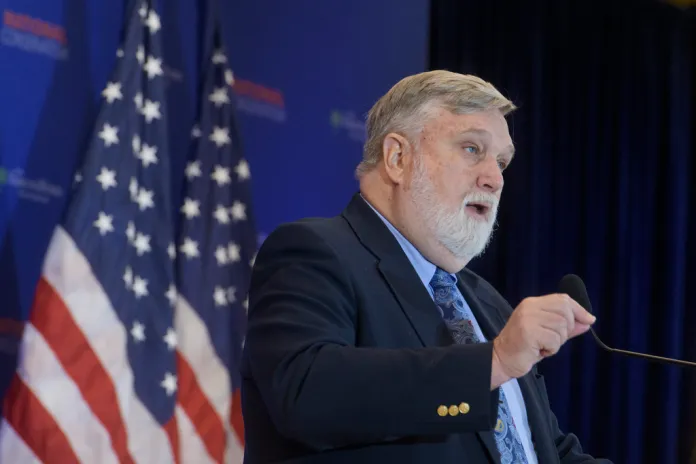
Douglas Wilson, Senior Minister of Christ Church, Moscow, Idaho, speaks at the National Conservatism Conference, Thursday, Sept. 4, 2025, in Washington. (AP Photo/Rod Lamkey, Jr.)
“I want to maximize the Christian commitments of the state,” Mohler said at the National Conservatism convo. “I call that ‘acknowledgment.’ I’m not claiming that every citizen will be a confessing Christian, but that does not mean they are not obligated to the acknowledgment of the Christian structure of this civilization.”
“I want to maximize the Christian commitments of the state,” Mohler said at the National Conservatism convo. “I call that ‘acknowledgment.’ I’m not claiming that every citizen will be a confessing Christian, but that does not mean they are not obligated to the acknowledgment of the Christian structure of this civilization.”


