Showing posts with label Roubini. Show all posts

Saturday, March 28, 2026

'Dr. Doom' Nouriel Roubini Warns Trump May Escalate Iran War: 'If HeChickens Out Right Now...'


March 28, 2026 1:43 AM


by Ananya Gairola Benzinga Staff Writer


On Friday, Nouriel Roubini, the economist who called the 2008 financial crisis, cautioned that President Donald Trump is more likely to intensify the U.S. conflict with Iran rather than seek a quick resolution.

Trump May Choose Escalation Over Ceasefire

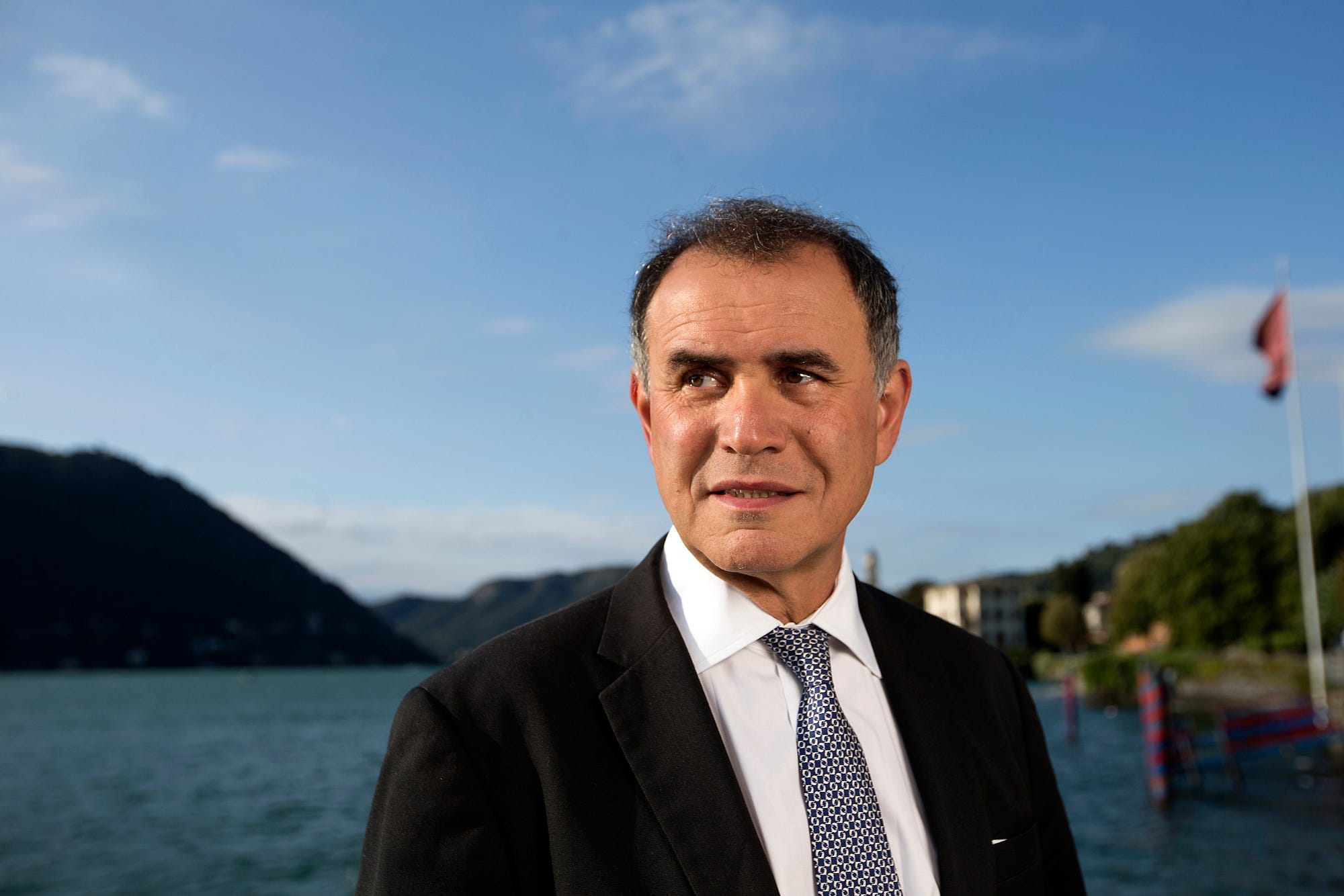
Roubini dismissed the notion that Trump is searching for an "off-ramp" to end the war, despite market optimism around a potential peace deal, he told CNBC at the Ambrosetti Forum in Cernobbio, Italy.

"If he chickens out right now, he loses credibility. He lost the war," Roubini said, adding that such a move could hurt Trump's chances in upcoming elections.

Thursday, September 22, 2022

Prepare for a ‘long and ugly’ recession, says Dr. Doom, the economist who predicted the 2008 crash


Dr. Doom is betting on a severe recession before the year is out.

BY
TRISTAN BOVE
September 21, 2022 12:56 PM EDT


Nouriel Roubini is convinced a bad recession is on the way. Udit Kulshrestha—Bloomberg/Getty Images


One of the first experts to forecast the 2008 recession is sounding the alarm bells that another big economic downturn is on the way.

With recession fears in the U.S. mounting, many economists are predicting such a downturn as early as this year. Earlier this month, Bank of America strategists wrote they expected a “mild recession” to hit sometime next year. Others, like former Treasury Secretary Larry Summers, have been more bearish with their recession forecasts, predicting that only a deep recession will be enough to fix the 40-year-high inflation hitting the country.

Now economist Nouriel Roubini—a New York University professor and the CEO of Roubini Macro Associates—whose prescience of the 2007 and 2008 housing market crash earned him the nickname Dr. Doom—seems to have chosen a side.

In an interview with Bloomberg this week, Roubini said that a recession is likely to hit the U.S. by the end of 2022 before spreading globally next year, conceivably lasting for the entirety of 2023.

“It’s not going to be a short and shallow recession; it’s going to be severe, long, and ugly,” Roubini said.
The debt problem

To fend off rising U.S. inflation, the Federal Reserve has implemented an aggressive series of interest rate hikes to put the brakes on the economy. The goal is to engineer a soft landing for the economy, where inflation returns to the Fed’s target 2% annual rate, without triggering a prolonged economic downturn or significant rise in unemployment.

But with the current economic climate, the Fed’s soft landing goal is “mission impossible” according to Roubini, who sees the rapid rise in both corporate and government debt over the past year as a damning indicator.

During the 2008 recession, Roubini argued that large amounts of consumer and corporate debt had been mismanaged and neglected by credit agencies and the federal government, contributing to the downturn. In his interview with Bloomberg, he noted that very similar threats are facing the economy today.

Roubini said that the environment created by rising interest rates does not bode well for the rising levels of global debt amassed in the wake of the pandemic. As lending rates continue to increase—as the Federal Reserve has signaled they will—it could create a growing number of so-called zombie companies, firms that formed during the pre- and early-pandemic era of easy credit, but are now stumbling along unable to turn a profit or finance their debts.

“Many zombie institutions, zombie households, corporates, banks, shadow banks, and zombie countries are going to die” as rates continue rising, Roubini said.

The “long and ugly recession” will also devastate financial markets, Roubini warned. The S&P 500—which upon last week’s higher-than-expected inflation reading had one of its worst days this year—could fall by anywhere between 30% and 40%, he said, depending on how severe the recession is.

Worst-case scenario

But despite interest rate hike after interest rate hike, Roubini said that inflation in the U.S. could persist due to rippling supply-chain shocks from the pandemic, the ongoing consequences of the Ukraine war, and China’s zero-COVID policy continuing to slow economic activity in the country.

That combination of low economic growth and unyielding inflation could lead to a global worst-case scenario of 1970s-style stagflation, Roubini warned, where prices remain high but economies stagnate anyway. Institutions including the World Bank have warned multiple times this year that a return to 1970s stagflation remains a serious concern for the global economy.

It is far from the first time Roubini has expressed his pessimistic views on the economy’s future. In 2020, Roubini warned that a new “great depression” was poised to hit the U.S. during the 2020s, citing rising debt levels. And in July, Roubini predicted that a “severe recession and a severe debt and financial crisis” was just around the corner due to the growing number of zombie companies in the economy.

Not every market watcher agrees with Roubini’s view that rising debt levels and inflation will send the economy spiraling into a deep recession. Ark Invest CEO Cathie Wood tweeted on Tuesday that hawkish economists like Roubini were set to be “blindsided” by inflation receding soon, citing “unwinding” headline inflation, the measure of total inflation within the economy.


Monday, November 12, 2018

What if Bitcoin was a Scam and Most Cryptocurrencies Were Worth Zero?


Michael K. Spencer

Blockchain Mark Consultant, tech Futurist, prolific writer. WeChat: mikekevinspencer
Oct 15


Time

What if Bitcoin was a Scam and Most Cryptocurrencies Were Worth Zero?

A lot of banking executives have said some rather remarkably ignorant things about Bitcoin and crypto-assets over the years.

Nouriel Roubini is an American economist. As a renowned Global economist he’s one of the few who predicted the 2008 financial crisis, and he’s making sure U.S. senators don’t miss his warning on cryptocurrency. His basic message believe it or not is this:
Blockchain isn’t about democracy and decentralisation — it’s about greed!

There’s no doubt hundreds of ICOs have been scams, real fraud has occured in crypto and even Jimmy Song thinks EOS is a scam and ETH is amateurish. The debates about crypto have been some of the best in tech in the 2015 to 2020 period.
What if Bitcoin Really was a Scam

“Crypto is the mother or father of all scams and bubbles,” Roubini, also a professor at New York University, told the U.S. Senate Committee on Banking, Housing and Community Affairs at a hearing.

A Harvard alumnus and now a professor at NYU Stern School of Business, Mr. Roubini has always been critical of the crypto and blockchain industry. It’s important to have economists who don’t agree with crypto, it gives the generational divide some really interesting meat on the fate of digital assets and blockchain adoption.

He may however be right, most cryptos are likely worth close to nothing. EOS could indeed be a shitcoin. It’s not outside the realm of possibility. Bitcoin’s price we have to admit is a fairly manipulated and volatile asset, whatever the movers on its price seem to be. Apparently, CNBC is one of them.

Yet in 2018 we’ve basically learned that the fate of stablecoins could actually be to protect the global economy in times of crashes and hyper-inflation. Nevermind that for now though, to congress Nouriel said: I can see a bubble when there is one — and to me, this entire space has been the mother and the father of all financial bubbles and now it’s [going to] burst.

So if you bought in to Bitcoin late, for instance when it was at its peak — you probably lost 70 percent of your value. It is a bit like gambling. Crypto in many ways has been the high-risk high-reward play that young men would be most prone to.

The self-described expert on international financial markets, asset and credit bubbles and their bust, said the first warning sign came after late last year as bitcoin neared a high of almost $20,000. Yet people seem to have stronger views on crypto than they do on politics or religion. It inspires fanatical nearly cult-like following. Is it greed, or something else?

CNBC puts crypto skeptics on their stage on a regular basis. This feeds the flames of crypto propaganda whereby manipulation of these digital assets can take place for profit. It’s not good or bad journalism, but it certainly is clickbait. With everything in America, the internet is a tool for propaganda. However, with a Bitcoin ETF, Etheruem Futures, Bakkt launching and many other factors, we could actually see another bull run for Bitcoin. Whether you agree or disagree with it, it does exist and it’s slowly legitimatizing digital assets in a way few saw coming on a macro level.

Does the world really need public blockchains, privacy and stable coins, xxxxcoins? Probably not, we would be fine without all of these things. Is Blockchain the most hyped technology most people don’t understand? Without a doubt.

CNBC goes on quoting him: “Especially folks with zero financial literacy — individuals who could not tell the difference between stocks and bonds — went into a literal manic frenzy of Bitcoin and Crypto buying,” Roubini said in prepared testimony. If we were financially literate would we be investing in Wall Street instead — basically a tool the rich user to get richer? Can most of us even afford to do so?

Crypto is a poor man’s investment, where Bitcoin has become an idol — and that crypto greed is really a symbol of our poverty. Nouriel Roubini doesn’t have to be right, blockchain like AI can strengthen and make the global economy more resilient even if true decentralization might not manifest in our lifetime. The world can laugh at crypto, but it’s not ready for real decentralization. So what’s left? Likely a lot of frauds and ponzi-schemes.


Source


Tuesday, October 10, 2017

Nouriel Roubini's "Good, Bad, & Ugly" Scenarios For The Global Economy


Oct 10, 2017 11:35 AM


Authored by Nouriel Roubini via Project Syndicate,

The International Monetary Fund, which in recent years had characterized global growth as the “new mediocre,” recently upgraded its World Economic Outlook. But is the IMF right to think that the recent growth spurt will continue over the next few years, or is a temporary cyclical upswing about to be subdued by new tail risks?


For the last few years, the global economy has been oscillating between periods of acceleration (when growth is positive and strengthening) and periods of deceleration (when growth is positive but weakening). After over a year of acceleration, is the world headed toward another slowdown, or will the recovery persist?


Finding a financial advisor who you could trust used to be difficult, but not anymore. SmartAsset's Financial Advisor Matching tool will find the best advisor for you, based on your financial profile. Learn more about how easy it is - here.


The current upswing in growth and equity markets has been going strong since the summer of 2016. Despite a brief hiccup after the Brexit vote, the acceleration endured not just Donald Trump’s election as US president, but also the heightening policy uncertainty and geopolitical chaos that he has generated. In response to this apparent resilience, the International Monetary Fund, which in recent years had characterized global growth as the “new mediocre,” recently upgraded its World Economic Outlook.


Tuesday, May 09, 2017

Roubini: "Why Are Markets Ignoring Geopolitical Risks?"


by Tyler Durden
May 9, 2017 6:55 PM


Authored by Nourial Roubini via MarketWatch.com,

With Emmanuel Macron’s defeat of the right-wing populist Marine Le Pen in the French presidential election, the European Union and the euro have dodged a bullet. But geopolitical risks are continuing to proliferate.

The populist backlash against globalization in the West will not be stilled by Macron’s victory, and could still lead to protectionism, trade wars, and sharp restrictions to migration. If the forces of disintegration take hold, the United Kingdom’s withdrawal from the EU could eventually lead to a breakup of the EU — Macron or no Macron.

At the same time, Russia has maintained its aggressive behavior in the Baltics, the Balkans, Ukraine, and Syria. The Middle East still contains multiple near-failed states, such as Iraq, Yemen, Libya, and Lebanon. And the Sunni-Shia proxy wars between Saudi Arabia and Iran show no sign of ending.

Related Video
North Korea Claims The US Plotted To Kill Kim Jong-Un, Gives No Proof


Asia, U.S. or North Korean brinkmanship could precipitate a military conflict on the Korean Peninsula. And China is continuing to engage in — and in some cases escalating — its territorial disputes with regional neighbors.


Despite these geopolitical risks, global financial markets have reached new heights. So it is worth asking if investors are underestimating the potential for one or more of these conflicts to trigger a more serious crisis, and what it would take to shock them out of their complacency if they are.

There are many explanations for why markets may be ignoring geopolitical risks.

For starters, even with much of the Middle East burning, there have been no oil-supply shocks or embargoes, and the shale-gas revolution in the United States has increased the supply of low-cost energy. During previous Middle East conflicts — such as the 1973 Yom Kippur War, Iran’s Islamic Revolution in 1979, and Iraq’s invasion of Kuwait in 1990 — oil-supply shocks caused global stagflation and sharp stock-market corrections.

A second explanation is that investors are extrapolating from previous shocks, such as the attacks of Sept. 11, 2001, when policy makers saved the day by backstopping the economy and financial markets with strong monetary and fiscal policy easing. These policies turned post-shock market corrections into buying opportunities, because the fall in asset prices was reversed in a matter of days or weeks.

Third, the countries that actually have experienced localized asset-market shocks — such as Russia and Ukraine after Russia’s annexation of Crimea and incursion into Eastern Ukraine in 2014 — are not large enough economically to affect U.S. or global financial markets.

Similarly, even as the U.K. pursues a “hard Brexit,” it still only accounts for around 2% of global GDP.

A fourth explanation is that the world has so far been spared from the tail risks associated with today’s geopolitical conflagrations. There has not yet been a direct military conflict between any major powers, nor have the EU or eurozone collapsed. President Donald Trump’s more radical, populist policies have been partly contained. And China’s economy has not yet suffered from a hard landing, which would create sociopolitical instability.

Moreover, markets have trouble pricing such black-swan events: “unknown unknowns” that are unlikely, but extremely costly. For example, the market couldn’t have predicted 9/11. And even if investors think that another major terrorist attack will come, they cannot know when.

A confrontation between the U.S. and North Korea could also turn into a black swan event, but this is a possibility that markets have happily ignored. One reason is that, notwithstanding Trump’s bluster, the U.S. has very few realistic military options: North Korea could use conventional weapons to wipe out Seoul and its surroundings, where almost half of South Korea’s population lives, were the U.S. to strike.

Investors may be assuming that even if a limited military exchange occurred, it would not escalate into a full-fledged war, and policy loosening could soften the blow on the economy and financial markets. In this scenario, as with 9/11, the initial market correction would end up being a buying opportunity.

But there are other possible scenarios, some of which could turn out to be black swans. Given the risks associated with direct military action, the U.S. is now alleged to be using cyber weapons to eliminate the North Korean nuclear threat against the U.S. mainland. This may explain why so many of North Korea’s missile tests have failed in recent months. But how will North Korea react to being militarily decapitated?

One answer is that it could launch a cyber attack of its own. North Korea’s cyber-warfare capabilities are considered to be just a notch below those of Russia and China, and the world got an early glimpse of them in 2014 when it hacked into Sony Pictures. A major North Korean cyber attack could disable or destroy parts of the U.S.’s critical infrastructure, and cause massive economic and financial damage.

That remains a risk even if the U.S. can sabotage North Korea’s entire industrial system and infrastructure.

Or, faced with disruption of its missile program and regime, North Korea could go low-tech, by sending a ship with a dirty bomb into the ports of Los Angeles or New York. An attack of this kind would most likely be very hard to monitor or stop.

So, while investors may be right to discount the risk of a conventional military conflict between the U.S. and North Korea, they also may be underestimating the threat of a true black-swan event, such as a disruptive cyberwar between the two countries or a dirty bomb attack against the U.S.

Would an escalation on the Korean Peninsula be an opportunity to “buy the dip,” or would it mark the beginning of a massive market meltdown? It is well known that markets can price the “risks” associated with a normal distribution of events that can be statistically estimated and measured.

But they have more trouble grappling with “Knightian uncertainty”: risk that cannot be calculated in probabilistic terms.


Source


Tuesday, June 28, 2016

Nouriel Roubini on Brexit at #AMNC16

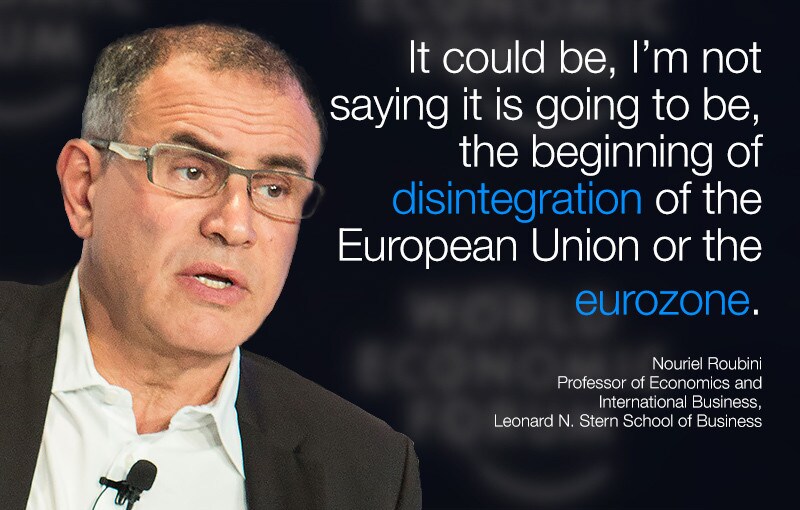
Brexit is the beginning of the breakup of EU


Monday, June 27, 2016


I don’t expect a global recession or another global financial crisis. I think the impact of Brexit is significant but not of the same size and magnitude of the one we had 2007 to 2009.

However, I would say it is a major, significant financial shock, as the reaction of the markets on Friday suggested. It creates a whole bunch of economic, financial, political and also geopolitical uncertainties.


At some point in the future, the Scots might decide to go for another referendum and it may be the break-up of the United Kingdom. Then the Catalans in Spain might say ‘me too’ and that might lead to the break-up of Spain.

Some of the Nordic members of the European Union might say ‘without the UK the European Union is mostly the Euro-zone, so what’s in it for me?


Nouriel Roubini on Brexit at #AMNC16 - 2

Tuesday, June 03, 2014

The great backlash by Nouriel Roubini*


June 02, 2014, Monday/ 15:40:30 / NEW YORK


A In the immediate aftermath of the 2008 global financial crisis, policymakers' success in preventing the Great Recession from turning into Great Depression II held in check demands for protectionist and inward-looking measures.

But now the backlash against globalization -- and the freer movement of goods, services, capital, labor, and technology that came with it -- has arrived.

This new nationalism takes different economic forms: trade barriers, asset protection, reaction against foreign direct investment, policies favoring domestic workers and firms, anti-immigration measures, state capitalism, and resource nationalism. In the political realm, populist, anti-globalization, anti-immigration, and in some cases outright racist and anti-Semitic parties are on the rise. These forces loath the alphabet soup of supra-national governance institutions -- the EU, the UN, the WTO, and the IMF, among others -- that globalization requires. Even the Internet, the epitome of globalization for the past two decades, is at risk of being balkanized as more authoritarian countries -- including China, Iran, Turkey, and Russia -- seek to restrict access to social media and crack down on free expression.

The main causes of these trends are clear. Anemic economic recovery has provided an opening for populist parties, promoting protectionist policies, to blame foreign trade and foreign workers for the prolonged malaise. Add to this the rise in income and wealth inequality in most countries, and it is no wonder that the perception of a winner-take-all economy that benefits only elites and distorts the political system has become widespread. Nowadays, both advanced economies (like the United States, where unlimited financing of elected officials by financially powerful business interests is simply legalized corruption) and emerging markets (where oligarchs often dominate the economy and the political system) seem to be run for the few. For the many, by contrast, there has been only secular stagnation, with depressed employment and stagnating wages. The resulting economic insecurity for the working and middle classes is most acute in Europe and the eurozone, where in many countries populist parties -- mainly on the far right -- outperformed mainstream forces in last weekend's European Parliament election. As in the 1930's, when the Great Depression gave rise to authoritarian governments in Italy, Germany, and Spain, a similar trend now may be underway.

If income and job growth do not pick up soon, populist parties may come closer to power at the national level in Europe, with anti-EU sentiments stalling the process of European economic and political integration. Worse, the eurozone may again be at risk: some countries (the United Kingdom) may exit the EU; others (the UK, Spain, and Belgium) eventually may break up. Even in the US, the economic insecurity of a vast white underclass that feels threatened by immigration and global trade can be seen in the rising influence of the extreme right and Tea Party factions of the Republican Party. These groups are characterized by economic nativism, anti-immigration and protectionist leanings, religious fanaticism, and geopolitical isolationism.

A variant of this dynamic can be seen in Russia and many parts of Eastern Europe and Central Asia, where the fall of the Berlin Wall did not usher in democracy, economic liberalization, and rapid output growth. Instead, nationalist and authoritarian regimes have been in power for most of the past quarter-century, pursuing state-capitalist growth models that ensure only mediocre economic performance. In this context, Russian President Vladimir Putin's destabilization of Ukraine cannot be separated from his dream of leading a “Eurasian Union” -- a thinly disguised effort to recreate the former Soviet Union. In Asia, too, nationalism is resurgent. New leaders in China, Japan, South Korea, and now India are political nationalists in regions where territorial disputes remain serious and long-held historical grievances fester. These leaders -- as well as those in Thailand, Malaysia, and Indonesia, who are moving in a similar nationalist direction -- must address major structural-reform challenges if they are to revive falling economic growth and, in the case of emerging markets, avoid a middle-income trap. Economic failure could fuel further nationalist, xenophobic tendencies -- and even trigger military conflict.

Meanwhile, the Middle East remains a region mired in backwardness. The Arab Spring -- triggered by slow growth, high youth unemployment, and widespread economic desperation -- has given way to a long winter in Egypt and Libya, where the alternatives are a return to authoritarian strongmen and political chaos. In Syria and Yemen, there is civil war; Lebanon and Iraq could face a similar fate; Iran is both unstable and dangerous to others; and Afghanistan and Pakistan look increasingly like failed states. In all of these cases, economic failure and a lack of opportunities and hope for the poor and young are fueling political and religious extremism, resentment of the West and, in some cases, outright terrorism.

In the 1930's, the failure to prevent the Great Depression empowered authoritarian regimes in Europe and Asia, eventually leading to World War II. This time, the damage caused by the Great Recession is subjecting most advanced economies to secular stagnation and creating major structural growth challenges for emerging markets. This is ideal terrain for economic and political nationalism to take root and flourish. Today's backlash against trade and globalization should be viewed in the context of what, as we know from experience, could come next.

*Nouriel Roubini is chairman of Roubini Global Economics and Professor of Economics at the Stern School of Business, New York University.


Source
.

Monday, May 12, 2014

Nouriel Roubini: We’re at the very beginning of a credit bubble


May 8, 2014, 2:37 PM ET


Nouriel Roubini whipped out the “b” word on Thursday, telling Maria Bartiromo at Fox Business Network that we’re at the beginning of a credit bubble. We’re not on the brink of a major collapse, but we might be getting there, he cautioned.


BloombergNouriel Roubini


The New York University professor and chairman of Roubini Global Economics is known as something of an economic pessimist, though he’s become slightly more optimistic recently. (Still, here are six of his risks.)

The Federal Reserve will keep its key lending rate low even after it lifts off from near zero, where it has rested for the past half decade, Roubini said. That slow process of normalization will keep the spigot of borrowing flowing, helping support the economy. But it will also lead to risky lending practices. Hence, a bubble is inflating that could eventually pop.

He’s by no means the first person to make this claim: the question of financial stability is one of the key criticisms of the Fed’s accommodative policies. Roubini didn’t criticize the central bank, so much as say that the Fed is damned-if-you-do, damned-if-you don’t.

Roubini cited the return of some of the key characters associated with the period before the last financial collapse: Lots of low quality bond sales, debt without strong protections for bondholders, and a certain kind of risky security called PIK-toggle bonds. The economist says:

“All the risky things that were happening back in ’06 and ‘07 are back again to the same level, if not more. So we are in the beginning of a credit bubble, but just the beginning.”

So file this one under “not imminent.” The risks won’t build until about a year or two down the road, he said.

If it’s not happening immediately, when will it happen? Valuations are getting pretty high, prompting junk bond guru Martin Fridson to say the asset class is in a state of “extreme overvaluation.” Credit is in such high demand right now that it’s prompting big name investors like DoubleLine Capital’s Jeffrey Gundlach to declare that the asset class is too crowded.

Citi credit strategist Matt King, who is out with an extensive report this week about the current state of the credit market, has this chart to show:


King says the eventual reversal out of credit seems “problematic”, comparing it to a rubber band that will eventually snap back. Nonetheless, like Roubini, King doesn’t see the reversal happening immediately, citing money that continues to rush into the market. For now, credit investors appear to be stuck in an uneasy equilibrium.

– Ben Eisen


Source
.

Tuesday, January 21, 2014

Roubini: Fed's Tactics Are Creating Bubbles

 
US economist Nouriel Roubini delivers a speech at the Swiss Economic Forum. (AP Photo/Keystone, Peter Schneider)


The economy isn't strong enough to stand on its own two feet, and the assistance provided by the Federal Reserve is beginning to create bubbles, says New York University economist Nouriel Roubini. He cited "frothiness" in housing, junk bonds and potentially bitcoins, according to Fortune. The situation could play out into a financial crisis in the next two to three years, he says. "The question is whether we have gotten to sustainable growth that is not based on bubbles," he said. "Not yet." [Full Story]


Sunday, June 02, 2013

Nouriel Roubini | After the gold rush


While gold prices may move higher in the next few years, they will trend lower over time as the global economy mends itself

Nouriel Roubini


First Published: Sat, Jun 01 2013. 07 38 PM IST


Photo: Bloomberg


Venice: The run-up in gold prices in recent years—from $800 per ounce in early 2009 to above $1,900 in the fall of 2011—had all the features of a bubble. And now, like all asset-price surges that are divorced from the fundamentals of supply and demand, the gold bubble is deflating.

At the peak, gold bugs—a combination of paranoid investors and others with a fear-based political agenda—were happily predicting gold prices going to $2,000, $3,000, and even to $5,000 in a matter of years. But prices have moved mostly downward since then. In April, gold was selling for close to $1,300 per ounce—and the price is still hovering below $1400, an almost 30% drop from the 2011 high.

There are many reasons why the bubble has burst, and why gold prices are likely to move much lower, toward $1,000 by 2015.

First, gold prices tend to spike when there are serious economic, financial, and geopolitical risks in the global economy. During the global financial crisis, even the safety of bank deposits and government bonds was in doubt for some investors. If you worry about financial Armageddon, it is indeed metaphorically the time to stock your bunker with guns, ammunition, canned food, and gold bars.

But, even in that dire scenario, gold might be a poor investment. Indeed, at the peak of the global financial crisis in 2008 and 2009, gold prices fell sharply a few times. In an extreme credit crunch, leveraged purchases of gold cause forced sales, because any price correction triggers margin calls. As a result, gold can be very volatile—upward and downward—at the peak of a crisis.

Second, gold performs best when there is a risk of high inflation, as its popularity as a store of value increases. But, despite very aggressive monetary policy by many central banks—successive rounds of “quantitative easing” have doubled, or even tripled, the money supply in most advanced economies—global inflation is actually low and falling further.

The reason is simple: while base money is soaring, the velocity of money has collapsed, with banks hoarding the liquidity in the form of excess reserves. Ongoing private and public debt deleveraging has kept global demand growth below that of supply.

Thus, firms have little pricing power, owing to excess capacity, while workers’ bargaining power is low, owing to high unemployment. Moreover, trade unions continue to weaken, while globalization has led to cheap production of labour-intensive goods in China and other emerging markets, depressing the wages and job prospects of unskilled workers in advanced economies.

With little wage inflation, high goods inflation is unlikely. If anything, inflation is now falling further globally as commodity prices adjust downward in response to weak global growth. And gold is following the fall in actual and expected inflation.

Third, unlike other assets, gold does not provide any income. Whereas equities have dividends, bonds have coupons, and homes provide rents, gold is solely a play on capital appreciation. Now that the global economy is recovering, other assets—equities or even revived real estate—thus provide higher returns. Indeed, US and global equities have vastly outperformed gold since the sharp rise in gold prices in early 2009.

Fourth, gold prices rose sharply when real (inflation-adjusted) interest rates became increasingly negative after successive rounds of quantitative easing. The time to buy gold is when the real returns on cash and bonds are negative and falling. But the more positive outlook about the US and the global economy implies that over time the Federal Reserve and other central banks will exit from quantitative easing and zero policy rates, which means that real rates will rise, rather than fall.

Fifth, some argued that highly indebted sovereigns would push investors into gold as government bonds became more risky. But the opposite is happening now. Many of these highly indebted governments have large stocks of gold, which they may decide to dump to reduce their debts. Indeed, a report that Cyprus might sell a small fraction—some €400 million ($520 million)—of its gold reserves triggered a 13% fall in gold prices in April. Countries like Italy, which has massive gold reserves (above $130 billion), could be similarly tempted, driving down prices further.

Sixth, some extreme political conservatives, especially in the US, hyped gold in ways that ended up being counterproductive. For this far-right fringe, gold is the only hedge against the risk posed by the government’s conspiracy to expropriate private wealth. These fanatics also believe that a return to the gold standard is inevitable as hyperinflation ensues from central banks’ “debasement” of paper money. But, given the absence of any conspiracy, falling inflation, and the inability to use gold as a currency, such arguments cannot be sustained.

A currency serves three functions, providing a means of payment, a unit of account, and a store of value. Gold may be a store of value for wealth, but it is not a means of payment; you cannot pay for your groceries with it. Nor is it a unit of account; prices of goods and services, and of financial assets, are not denominated in gold terms.

So gold remains John Maynard Keynes’s “barbarous relic”, with no intrinsic value and used mainly as a hedge against mostly irrational fear and panic. Yes, all investors should have a very modest share of gold in their portfolios as a hedge against extreme tail risks. But other real assets can provide a similar hedge, and those tail risks—while not eliminated—are certainly lower today than at the peak of the global financial crisis.
While gold prices may temporarily move higher in the next few years, they will be very volatile and will trend lower over time as the global economy mends itself. The gold rush is over.


©2013/PROJECT SYNDICATE

Nouriel Roubini is chairman of Roubini Global Economics and professor of economics at the Stern School of Business.

.

Monday, January 21, 2013

Nouriel Roubini | What’s in store in 2013


Fiscal austerity will envelop most advanced economies this year, not just the euro zone periphery and the UK

Nouriel Roubin


First Published: Mon, Jan 21 2013. 07 03 PM IST


While the ECB’s actions have reduced tail risks in the euro zone the monetary union’s fundamental problems have not been resolved. Photo: AFP


ALSO READ

World Bank cuts growth outlook but India may improve
The euro zone’s delayed reckoning
United Nations slashes forecasts for global growth
Nouriel Roubini | The euro zone’s delayed reckoning


Updated: Mon, Jan 21 2013. 07 14 PM IST

The global economy this year will exhibit some similarities with the conditions that prevailed in 2012. No surprise there: we face another year in which global growth will average about 3%, but with a multi-speed recovery—a sub-par, below-trend annual rate of 1% in the advanced economies, and close-to-trend rates of 5% in emerging markets. But there will be some important differences as well.

Painful de-leveraging—less spending and more saving to reduce debt and leverage—remains ongoing in most advanced economies, which implies slow economic growth. But fiscal austerity will envelop most advanced economies this year, rather than just the euro zone periphery and the UK. Indeed, austerity is spreading to the core of the euro zone, the US, and other advanced economies (with the exception of Japan). Given synchronized fiscal retrenchment in most advanced economies, another year of mediocre growth could give way to outright contraction in some countries.

With growth anaemic in most advanced economies, the rally in risky assets that began in the second half of 2012 has not been driven by improved fundamentals, but rather by fresh rounds of unconventional monetary policy. Most major advanced economies’ central banks—the European Central Bank (ECB), the US Federal Reserve, the Bank of England, and the Swiss National Bank—have engaged in some form of quantitative easing, and they are now likely to be joined by the Bank of Japan, which is being pushed towards more unconventional policies by Prime Minister Shinzo Abe’s new government.

Moreover, several risks lie ahead. First, America’s mini-deal on taxes has not steered it fully away from the fiscal cliff. Sooner or later, another ugly fight will take place on the debt ceiling, the delayed sequester of spending, and a congressional “continuing spending resolution” (an agreement to allow the government to continue functioning in the absence of an appropriations law). Markets may become spooked by another fiscal cliffhanger. And even the current mini-deal implies a significant amount of drag—about 1.4% of gross domestic project (GDP)—on an economy that has grown at barely a 2% rate over the last few quarters.
Second, while the ECB’s actions have reduced tail risks in the euro zone—a Greek exit and/or loss of market access for Italy and Spain—the monetary union’s fundamental problems have not been resolved. Together with political uncertainty, they will re-emerge with full force in the second half of the year.

After all, stagnation and outright recession—exacerbated by front-loaded fiscal austerity, a strong euro, and an ongoing credit crunch—remain Europe’s norm. As a result, large—and potentially unsustainable—stocks of private and public debt remain. Moreover, given ageing populations and low productivity growth, potential output is likely to be eroded in the absence of more aggressive structural reforms to boost competitiveness, leaving the private sector no reason to finance chronic current-account deficits.

Third, China has had to rely on another round of monetary, fiscal, and credit stimulus to prop up an unbalanced and unsustainable growth model based on excessive exports and fixed investment, high saving, and low consumption. By the second half of the year, the investment bust in real estate, infrastructure, and industrial capacity will accelerate. And, because the country’s new leadership—which is conservative, gradualist, and consensus-driven—is unlikely to speed up implementation of reforms needed to increase household income and reduce precautionary saving, consumption as a share of GDP will not rise fast enough to compensate. So the risk of a hard landing will rise by the end of this year.

Fourth, many emerging markets—including the BRIC countries (Brazil, Russia, India, and China), but also many others—are now experiencing decelerating growth. Their “state capitalism”—a large role for state-owned companies; an even larger role for state-owned banks; resource nationalism; import-substitution industrialization; and financial protectionism and controls on foreign direct investment—is the heart of the problem. Whether they will embrace reforms aimed at boosting the private sector’s role in economic growth remains to be seen.

Finally, serious geopolitical risks loom large. The entire greater Middle East—from the Maghreb to Afghanistan and Pakistan—is socially, economically, and politically unstable. Indeed, the Arab Spring is turning into an Arab Winter. While an outright military conflict between Israel and the US on one side and Iran on the other side remains unlikely, it is clear that negotiations and sanctions will not induce Iran’s leaders to abandon efforts to develop nuclear weapons. With Israel refusing to accept a nuclear-armed Iran, and its patience wearing thin, the drums of actual war will beat harder. The fear premium in oil markets may significantly rise and increase oil prices by 20%, leading to negative growth effects in the US, Europe, Japan, China, India and all other advanced economies and emerging markets that are net oil importers.

While the chance of a perfect storm—with all of these risks materializing in their most virulent form—is low, any one of them alone would be enough to stall the global economy and tip it into recession. And while they may not all emerge in the most extreme way, each is or will be appearing in some form. As 2013 begins, the downside risks to the global economy are gathering force. ©2013/PROJECT SYNDICATE


Nouriel Roubini is Chairman of Roubini Global Economics and Professor at the Stern School of Business, NYU.


Source
.

Tuesday, December 18, 2012

Roubini Says Fed Inflation Targeting Out the Window

.
Dec. 14 (Bloomberg) -- Nouriel Roubini, co-founder of Roubini Global Economics LLC, talks about Federal Reserve monetary policy, the outlook for the global economy and the U.S. budget negotiations. He speaks with Tom Keene, Sara Eisen and Scarlet Fu on Bloomberg Television's "Surveillance." (Source: Bloomberg)

Source
.

Tuesday, February 14, 2012

How Much Stress Can the System Take?


Uploaded by TheEconoMonitor on Feb 8, 2012

Nouriel Roubini, co-founder and chairman of Roubini Global Economics, sits down with Patrick Chovanec, associate professor at Tsinghua University's School of Economics and Management in Beijing, China for a discussion on the likelihood of a hard landing in China and consider the short and medium term implications of policy adjustments, leadership transitions, and technology advancements.
.

Monday, September 05, 2011

Roubini: Global Economy Worse Off Than in 2008

Friday, 02 Sep 2011 07:21 AM

By Forrest Jones


The world's developed economies are in worse shape than they were in 2008 due to shaky financial sectors and calls for economic austerity rather than stimulus, says New York University Professor Nouriel Roubini.

The U.S. economy, meanwhile, stands a 60 percent chance of falling back into recession, says Roubini, who accurately called the Great Recession way before it happened.

"We are in a worse situation than we were in 2008. This time around we have fiscal austerity and banks that are being cautious," Roubini says, according to CNBC.


Nouriel Roubini
(Getty Images photo)

Forward-looking economic indicators show business and consumer confidence is down across developed world and show tough times await.

"The hard economic data (which has come out recently) is all relevant to July while the soft data which has come out is for the future and that’s all moving in the wrong direction," Roubini says.

Europe, at least, may avoid a new recession, the Standard & Poor's ratings agency says

"Although most of Europe experienced a slowdown in GDP growth in the second quarter, we still anticipate that the region will escape a genuine double-dip recession," S&P says in a research note, according to the AFP newswire.

Some experts say the U.S. never really emerged from the recent recession and point out faulty economic indicators allow politicians to claim recovery that never occurred.

"It has been our contention for some time that we never really emerged from the recession of 2008," Bert Dohmen, founder of Dohmen Capital Research Institute, an economic and investment research firm, told Moneynews.

"If you correct the GDP numbers with the right number for inflation, we are right now in a serious contraction of the economy again."

Source

Thursday, August 04, 2011

Roubini: QE3 Is Coming, But Bernanke Will Be Too Late

By Chris Barth Forbes


Nouriel Roubini, the much heralded NYU economist who has gotten much attention – and the nickname Dr. Doom – for his gloomy predictions in the past few years, isn’t exactly confident in Ben Bernanke or the US economy. Over the past few days he has taken to Twitter to voice his concerns on the recent market free fall, the potential for a double dip and the ongoing crisis in Europe. Today, on the heels of currency market intervention by Japan and Switzerland, Roubini predicted that a third round of quantitative easing here in the United States, tweeting, “QE3 started in Japan & Switzerland via fx action &/or monetary easing. Fed will eventually get to QE3 but it will be too little too late.”

Japan and Switzerland have both gotten involved in currency markets over the past two days, stepping in to prevent outsized appreciation in the yen and the Swiss franc. Switzerland cut interest rates on Wednesday in an attempt to weaken the franc, while the Japanese government and the Bank of Japan collaborated on moves today in an attempt stifle similar appreciation in the yen.
Roubini has previously said that he thinks future rounds of quantitative easing are on the way. As he pointed out in another tweet today, “I argued last year we will get QE3, then QE4 & then QE5 (the Fed, as in the 1950s, targeting the 10yr Treas at 1.5% once all else fails).”

In January, when he sat down with Steve Forbes, Roubini identified states and local municipalities as potential recipients of QE3.

“Until now, we have back-stopped the states through the federal budget – transfer payments of a variety of sorts to make sure that they don't blow up. At this point, the political willingness to do more of it is limited,” Roubini explained.

“During the crisis, [the Fed] bought even toxic assets of Bear Stearns and of AIG. They could go along the lines – if there are financing pressures like the Europeans – of trying to make stop all the state governments that are in trouble. If Congress doesn't do it, there'll be some pressure on the Fed to do that. That might be a version of QE3, after QE2. QE1 was mostly agencies -- Fannie and Freddie, QE2 was treasuries mostly. QE3 could be state and local debt.”


Source
.