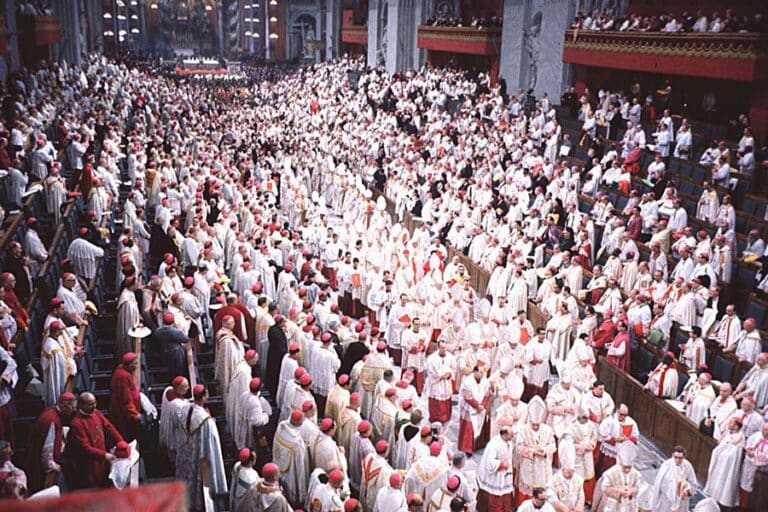
An undated photo shows prelates during the Council Hall in St. Peter's Basilica at the Vatican during the third session of the Second Vatican Council. (OSV News photo/Ernst Herb, KNA)

The Second Vatican Council, which after three years of dialogue and document drafting closed on Dec. 8, 1965, changed the face of the church, and opened it to the modern world. The council, opened under Pope John XXIII and closed under his successor, Pope Paul VI, initiated a comprehensive renewal, with major council texts released on hot-button church issues. As the church commemorates 60 years since the closing of Vatican II, here are seven key issues and documents that serve as its legacy for future generations.
December 7, 2025
By Alexander Brüggemann
By Alexander Brüggemann
The Second Vatican Council, which after three years of dialogue and document drafting closed on Dec. 8, 1965, changed the face of the church, and opened it to the modern world. The council, opened under Pope John XXIII and closed under his successor, Pope Paul VI, initiated a comprehensive renewal, with major council texts released on hot-button church issues. As the church commemorates 60 years since the closing of Vatican II, here are seven key issues and documents that serve as its legacy for future generations.
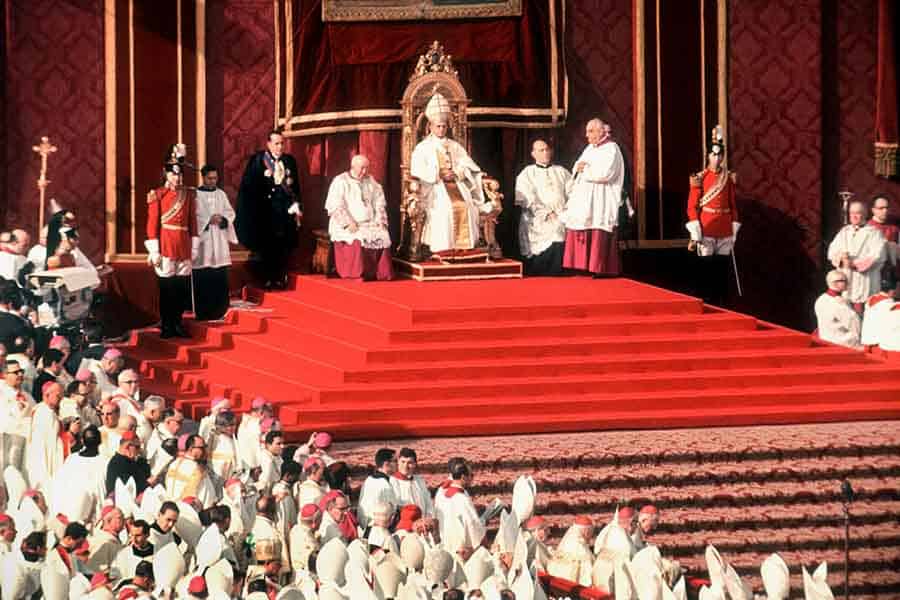
Pope Paul VI sits in the “cathedra” or bishop’s chair during the Second Vatican Council in July 1965 in St. Peter’s Square at the Vatican. (OSV News photo/Ernst Herb, KNA)
Understanding of the church: “Lumen gentium” (1964), one of the four primary constitutions of the council, sets out the new self-understanding of the Roman Catholic Church. It defines the church as a community of believers, as the “people of God” on their journey through time. In this constantly reforming church, a “common priesthood” of all believers is emphasized — something realized in different forms with clergy and laity. The constitution emphasizes the role of the college of bishops who lead the church “with Peter and under Peter,” as Cardinal Joseph Ratzinger, later Pope Benedict XVI, reminded years later. In several decrees, the council drafted guidelines for a contemporary form of Christian life and service in spiritual vocations for priests, religious and laity. The importance of the vocation of the laity is emphasized by the council fathers and the training of priests was reorganized. The church’s missionary activity was given a new theological foundation in the decree “Ad gentes.” In the decree “Christus dominus” (1965), on the episcopal pastoral office in the church, the leadership function of the bishop in his diocese was strengthened.
Understanding of the church: “Lumen gentium” (1964), one of the four primary constitutions of the council, sets out the new self-understanding of the Roman Catholic Church. It defines the church as a community of believers, as the “people of God” on their journey through time. In this constantly reforming church, a “common priesthood” of all believers is emphasized — something realized in different forms with clergy and laity. The constitution emphasizes the role of the college of bishops who lead the church “with Peter and under Peter,” as Cardinal Joseph Ratzinger, later Pope Benedict XVI, reminded years later. In several decrees, the council drafted guidelines for a contemporary form of Christian life and service in spiritual vocations for priests, religious and laity. The importance of the vocation of the laity is emphasized by the council fathers and the training of priests was reorganized. The church’s missionary activity was given a new theological foundation in the decree “Ad gentes.” In the decree “Christus dominus” (1965), on the episcopal pastoral office in the church, the leadership function of the bishop in his diocese was strengthened.


