Showing posts with label Uruguay. Show all posts

Thursday, August 27, 2026

In Latin America, Democratic Socialists Are the Toast of the Party


The success of progressive candidates in the United States is inspiring leftists abroad struggling under pressure from the Trump administration and its allies.

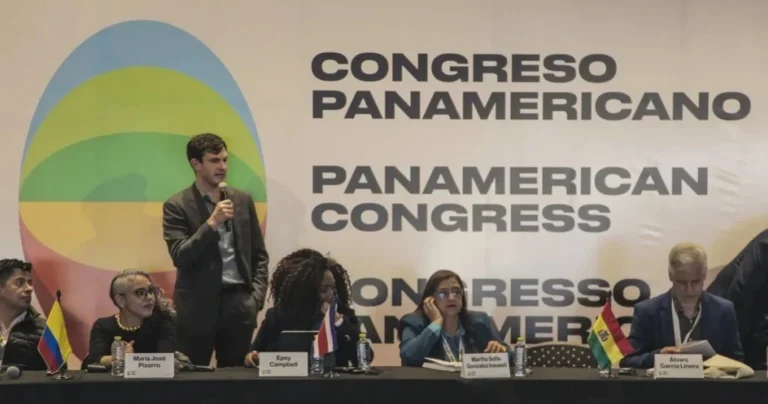
Participants at the Panamerican Congress on Saturday in Montevideo, Uruguay.Credit...

By Jack Nicas

Photographs by Anita Pouchard Serra

Reporting from Montevideo, Uruguay
Aug. 27, 2026

Leer en español

Left-wing politicians from across the Western Hemisphere gathered in Uruguay this past weekend to lick their wounds from a string of election losses and strategize on how to counter growing aggression from the Trump administration.

There were ex-presidents and expected presidential contenders, national lawmakers and campaign strategists, best-selling authors and protest leaders. But perhaps the toast of the weekend — viewed by the group as the inspiration for a path forward — were the democratic socialists from the United States, fresh off their primary victories.


Darializa Avila Chevalier is a democratic socialist and candidate for the House in New York’s 13th Congressional District.

Those candidates — Darializa Avila Chevalier and Claire Valdez of New York, Chris Rabb of Pennsylvania and Dr. Adam Hamawy of New Jersey — were all special guests at the Panamerican Congress in Montevideo, an annual meeting of leftist political leaders from across the Americas. (Dr. Hamawy identifies as progressive but not democratic socialist.)

They received a standing ovation, were asked for selfies and were repeatedly cited by fellow attendees as examples on how the left can succeed in the current political moment.


Claire Valdez, a democratic socialist assemblywoman and close ally of Mayor Zohran Mamdani of New York, is a candidate for the House in the city’s 13th Congressional District.

Their victories “give us hope that if this can be fought from within, it can also be fought from the outside,” said Gabriel Boric, the former president of Chile, who was succeeded in March by a hard-right politician aligned with President Trump.

Mr. Boric, 40, a former protest leader, said the left had been failing to make the case to the working class that it was best positioned to help them, but the democratic socialists in the United States were showing they could.

“There is a tendency in our movement to constantly talk about the right and all the evils it represents, instead of convincing and giving hope to the people,” he said in an interview. “Now that debate is happening in the United States.”

Wednesday, August 26, 2026

Congressman García Participates in the Third Panamerican Congress


Congressman García Participates in the Third Panamerican Congress

August 24, 2026
Press Release


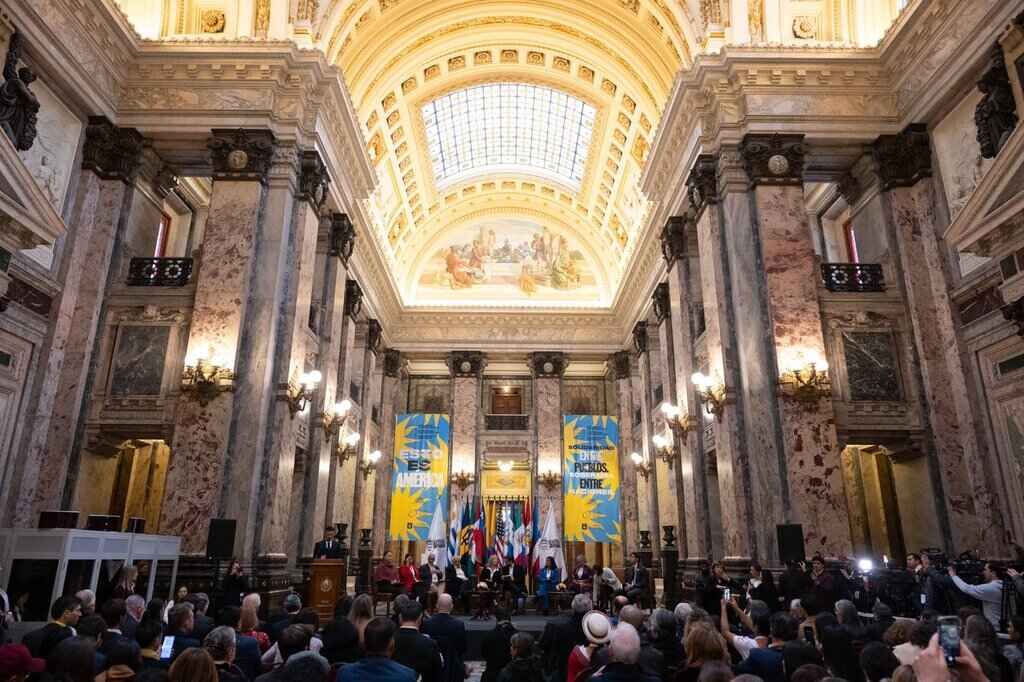
Congressman Jesús “Chuy” García (IL-04) participated in the Third Panamerican Congress that took place from Friday, Aug. 21, through Sunday, Aug. 23. The opening day began with a press conference and an opening ceremony at Uruguay’s Legislative Palace led by Uruguayan Vice President Carolina Cosse. The gatherings’ first closed-door working session started right after.

That afternoon, a public event entitled “This Is America” brought together more than 600 people to the historic Teatro Solís. Former Chilean President Gabriel Boric, former Colombian President Gustavo Petro, U.S. Sen. Bernie Sanders, Buenos Aires Governor Axel Kicillof, former Uruguayan Vice President Lucía Topolansky, former Chilean presidential candidate Jeannette Jara and former Chilean government spokesperson Camila Vallejo were among the progressive leaders from across the Americas who shared their visions for the region’s future.

On Saturday, delegations continued with additional closed-door working sessions and workshops on emerging issues, including the defense of democracy, the new global economy and cybersecurity.

The Third Panamerican Congress concluded Sunday with a closing session at the MERCOSUR Parliament, or Parlasur, in Montevideo. The parliamentary forum of democratic forces across the Americas brought together more than 150 lawmakers, former presidents, ministers and political leaders from 15 countries. Participants reviewed the outcomes of the working sessions held in Montevideo and announced Brazil as the next host country of the fourth Panamerican Congress in 2027.

The closing session began with presentations of the conclusions from four working groups focused on peace, multilateralism and security; sustainable economic development and regional integration; digital sovereignty and artificial intelligence; and well-being and care for the majority. Lawmakers agreed that the hemisphere’s challenges—from financial coercion and weaponized sanctions to concentrated technological power and the erosion of traditional welfare systems—require coordinated regional action rather than fragmented national responses.

Participants from the United States included a Congressional delegation led by U.S. Reps. Pramila Jayapal (D-WA-7), and Jesús “Chuy” García (D-IL-04).

U.S. Rep. Jesús “Chuy” García said members of the U.S. delegation share the Congress’ vision.

“Those of us who serve in the United States Congress share the vision of this Panamerican Congress,” García said. “I believe winning back the majority in Congress can open space to change U.S. policy toward the region and the Global South. We will center working-class well-being, respect for human rights and respect for the sovereignty of Latin American nations.”

Tuesday, August 25, 2026

DEMOCRACIA SIEMPRE


Building a society where people can live with dignity.

A Special Event in Honor of President José ‘Pepe’ Mujica


Democracy today faces one of its greatest tests. From Northern Europe to South Americas, from East Asia to West Africa, democratic societies are suffering the strain of rising political extremism and declining public trust.

To confront this crisis, citizens and leaders are searching for models of democratic renewal that can bridge divides, restore confidence, and redress the sources of citizen discontent.

“It is imperative to promote a common strategy to confront growing inequality, disinformation, and the challenges posed by digital technologies,” wrote the Presidents of Spain, Chile, Colombia, Brazil, and Uruguay following their July summit in Santiago.

Now, these leaders are gathering once again at a special event on the sidelines of the UN General Assembly — to grow the coalition in defense of democracy and to pay homage to the late Uruguayan President José ‘Pepe’ Mujica who was its lifelong champion.

Mujica's extraordinary journey — from political prisoner to 40th President of Uruguay — offers lessons for democratic societies everywhere. Combining authenticity, humility, and a powerful agenda of economic transformation, Mujica proved that democracy thrives not through grand rhetorical gestures but through daily acts of political inclusion, and that true service prioritizes human dignity over personal victory.

On 24 September, the Panamerican Congress, the Foro Iniciativa Mujica, and the Remarque Institute invite you to a special event in honor of President Mujica, bringing together presidents, parliamentarians, and civil society leaders to celebrate his legacy and advance the struggle to strengthen democratic societies from Montevideo to Madrid, Mexico City to Manhattan.

Sunday, August 23, 2026

Progressive leaders gathered in Uruguay denounce US interference and acknowledge their own mistakes


Saturday, August 22nd 2026 - 08:28 UTC


Participants questioned Washington's conduct in the region, citing that intervention, strikes on vessels in the Caribbean and sanctions on Cuba, and called for greater regional autonomy

The opening session of the third Pan-American Congress, held on Friday at the Legislative Palace in Montevideo, combined criticism of United States policy towards Latin America with calls for self-criticism within progressive forces. More than 150 lawmakers, former presidents, ministers and political figures from fifteen countries are taking part, according to organisers.

Former Chilean president Gabriel Boric delivered the most widely noted speech, calling for consistency between political discourse and action. He criticised what he described as a “new imperialism” driven by Donald Trump and said the major powers “today do not speak of democracy, but directly of oil at the expense of a people.” He then turned a demand on his own allies: “We do not believe that violating international law is the way to intervene illegitimately in another people, but we also have to say very clearly that Maduro had stolen the elections and that his presidency at that time was also illegitimate.” He warned that if the left fails to acknowledge such distinctions, it will struggle to persuade its own electorates.

Nicolás Maduro was captured in Caracas on January 3 during a US military operation and remains in custody in the United States. Delcy Rodríguez has since served as Venezuela's acting president.

Participants questioned Washington's conduct in the region, citing that intervention, strikes on vessels in the Caribbean and sanctions on Cuba, and called for greater regional autonomy. Former Colombian president Ernesto Samper urged a revival of Latin American integration and closer ties with the Global South, arguing the region holds strategic water, food and mineral resources but lacks the political coordination to defend its interests.

US Representative Pramila Jayapal shifted the debate to her own country, saying opposition is growing to taxes being spent on military operations abroad rather than on health services and living standards. She defended a foreign policy based on dialogue and diplomacy as the only route to “a lasting peace.”

Uruguay's vice-president, Carolina Cosse, focused on disinformation and the contest for public attention. “Indifference to truth leads inexorably to totalitarianism,” she warned. Mexican Morena official Carolina Rangel proposed combining economic growth with social rights and called for an agenda covering care policies, energy transition, productive integration and digital sovereignty.

The forum, created in Bogotá in 2024 on the initiative of then Colombian president Gustavo Petro, is organised this year around four themes: peace, security and multilateralism; sustainable development and regional integration; digital sovereignty and artificial intelligence; and wellbeing and care. Sessions continue until Sunday and will conclude at the Parlasur headquarters.


Jayapal at Panamerican Congress: Diplomacy, NOT Military Might


Friday, August 21, 2026

Montevideo hosts a progressive congress after three consecutive electoral defeats in the region


Friday, August 21st 2026 - 10:12 UTC


The meeting takes place at an adverse moment for those forces. The last three presidential elections in Latin America were won by conservative candidates. Photo: Sebastián Astorga


More than a hundred lawmakers, former presidents, ministers and political figures from fifteen countries across the Americas gather from Friday at Uruguay's Legislative Palace in Montevideo for the third Pan-American Congress, a parliamentary forum of progressive forces running until Sunday. Organisers put attendance at more than 150 participants.

The meeting takes place at an adverse moment for those forces. The last three presidential elections in Latin America were won by conservative candidates: José Antonio Kast in Chile, Keiko Fujimori in Peru and Abelardo de la Espriella in Colombia, all three sworn in this year. Uruguay and Brazil remain the main centre-left governments in South America.

“We are not arriving in a golden age, but in full recognition of those defeats,” said the congress's general coordinator, David Adler, an economist, co-founder of the Progressive International and a former adviser to US Senator Bernie Sanders. He explained that some sessions will be held behind closed doors “to talk frankly about good practices and also about experiments that have failed to reach the public.”

Under the slogan “Solidarity among peoples, sovereignty among nations,” the programme is organised around four themes: peace, security and multilateralism; sustainable development and regional integration; digital sovereignty and artificial intelligence; and wellbeing and care. Organisers also propose rebalancing relations between the north and south of the continent. “We have the International Monetary Fund and the Organization of American States, both headquartered in Washington, which shows an architecture in which the north speaks and expects the south to obey,” Adler said.

The congress was created in 2024 in Bogotá on the initiative of then Colombian president Gustavo Petro and held its second edition in Mexico City in 2025. It closes a week of events in the Uruguayan capital that included a gathering of women in politics, a closed forum of fourteen parties from eleven countries and the relaunch of the magazine Nueva Sociedad.

The Uruguayan delegation will be led by President Yamandú Orsi, who opens the forum, alongside Vice-President Carolina Cosse, former vice-president Lucía Topolansky and the secretary of the presidency, Alejandro Sánchez. International participants include former presidents Ernesto Samper of Colombia and Gabriel Boric of Chile; the governor of Buenos Aires province, Axel Kicillof; Brazilian senator Humberto Costa, of the Workers' Party; Mexican Morena official Carolina Rangel; and US representatives Pramila Jayapal and Jesús García.

Adler highlighted the choice of Uruguay as host. “We have a great deal to learn from Uruguayan society, which has a very living memory and knew how to deepen its democratic roots,” he said.


Third Progressive Pan-American Congress Opens in Montevideo


Third Progressive Pan-American Congress Opens in Montevideo


August 21, 2026 Hour: 6:52 am

The Third Pan-American Congress, bringing together leaders and parliamentarians from progressive political forces across the Americas, is set to open in Montevideo, Uruguay, on August 21 for three days of behind-closed-doors sessions debating responses to global changes imposed especially by the U.S. aggressive policy.

The inauguration is scheduled to take place at the Legislative Palace, with President Yamandú Orsi, Vice President Carolina Cosse, Buenos Aires Governor Axel Kicillof, and former Chilean Minister of Labor and former presidential candidate Jeannette Jara expected to attend.

RELATED: The U.S. Unleashes a War Against the Left Worldwide: Diaz-Canel

Former Chilean president Gabriel Boric, who arrived the previous day accompanied by several former cabinet members, is also expected at the inauguration. Boric had led the presentation of the Latin American publication Nueva Sociedad on the eve of the event.

The first edition of the conclave was held in 2024 in Bogotá, convened by then-president Gustavo Petro. The second congress took place in Mexico last year, inaugurated by President Claudia Sheinbaum, and brought together representatives from 12 countries.

The current congress is backed by the Broad Front, Uruguay’s left-wing alliance, and will gather legislators from 15 nations, including three U.S. Democratic legislators.


Author: vmmh

Source: Prensa Latina


_ _ _

P. S.

Including three U.S. Democratic legislators:

The US delegation will be led by Rep. Pramila Jayapal (D-Wash.), joined by Rep. Jesús “Chuy” García (D-Ill.), Democratic congressional candidate Dr. Adam Hamawy of New Jersey, and three members of Democratic Socialists of America also running for Congress: Claire Valdez and Darializa Avila Chevalier of New York and Chris Rabb from Pennsylvania.


Thursday, August 20, 2026

Progressives, socialists to travel to PanAmerican summit to push back on Trump’s policies in region

U.S. lawmakers and candidates will gather in Uruguay to forge cross-border links, aiming to counter the Trump administration's “Donroe Doctrine” and promote an alternative foreign policy.


By Steven Richards

Published: August 19, 2026 2:24pm

Updated: August 19, 2026 2:25pm

A group of progressive U.S. lawmakers and socialist candidates are set to attend the PanAmerican Congress in Uruguay later this month to “build a lasting coalition” of progressives to push back against the “right-wing forces” in the Western Hemisphere.

“We need to build a durable and lasting coalition of progressives that can take on the right-wing forces and answer them with the necessary call of the people,” Democrat Rep. Pramila Jayapal, a leading progressive in the House said in a statement.

Along with Jayapal, other progressive and Democratic Socialists are set to attend the conference, which will take place from Aug. 21-23.

Two Democratic Socialist candidates who won their primary elections earlier this year in New York City, Claire Valdez and Darializa Avila Chevalier, will make the journey to Montevideo, Uruguay, where it is being held. They will also be joined by Rep. Chuy Garcia, D-Ill., and New Jersey House candidate Adam Hamawy.

“We need a foreign policy built on international solidarity and cooperation — not imperialism, war and extraction,” Valdez told Politico Playbook. “The threats we face, from climate change to mass displacement to the rise of fascism, don’t stop at borders, and neither can our response.”

The PanAmerican Congress was founded in 2024 to bring “together progressive legislators from across North, Central, South America and the Caribbean” to cooperate across national boundaries and to push back against ascendant right-wing governments across Latin America.

Last week, Rep. Jayapal sent a letter to Secretary of State Marco Rubio outlining her opposition to the Trump administration’s “Donroe Doctrine,” a new spin on the historic Monroe Doctrine–a 19th century policy of the U.S. government that declared the Western Hemisphere off-limits to further European colonization.

Jayapal said that the Trump administration’s policies, which include collaborating with friendly Latin American governments to combat the drug trade, fight transnational crime, and reduce illegal immigration flows, are for partisan gain.

“Taken together, the interventions conducted under the banner of the ‘Donroe’ Doctrine appear to follow a partisan playbook: the endorsement of favored candidates, the placement of political allies, the weaponization of tariffs and sanctions, and, where those fail, the application of direct military force,” Jayapal and 10 other House colleagues wrote in the letter obtained by The Hill.

“These are tactics that destabilize our hemisphere and endanger our neighbors,” the lawmakers added.


Monday, November 08, 2010

Father General in Paraguay, Argentina, Uruguay and Chile


Father General in Paraguay, Argentina, Uruguay and Chile


(05-Nov-2010) From October 31st to November 13th Father General is in Latin America to participate in the XXI Assembly of CPAL, the Conference of Latin American Provincials. The Assembly is taking place in Asunción, Paraguay, from the 2nd to the 6th of November.


Source
.

Tuesday, August 17, 2010

Uruguay: world’s leading consumer of beef with 58.2 kilos per capita per annum


Tuesday, August 17th 2010 - 08:58 UTC

Uruguayans eat an average of 58.2 kilos of beef which makes them the world’s leading consumers per capita, per annum according to the country’s president of the National Meats Institute, INAC, Alfredo Fratti.


The traditional Uruguayan barbeque


“The tendency has been steady in the last few years and for 2010 we anticipate a consumption increase of 6% per capita”, he said which means that by the end of the year “Uruguayans will have consumed almost 60 kilos of beef per capita”.

This is “a new record” for Uruguay and makes Uruguay “the main consumer of beef in the world”.

The privilege until not so long belonged to Argentina, with almost 60 kilos per capita but in the last few years it has been decreasing and currently stands at 55 kilos per capita per annum said Fratti.

Uruguay is famous for its livestock and organic beef, which is also one of the country’s main industries. The cattle herd currently stands at just over 11 million head which means four animals per capita.

Other countries with significant beef consumption include the United States, 43 kilos per capita, per year; Australia, 39 kilos; Brazil, 36 kilos; Paraguay, 32 and New Zealand, 26 kilos. Brazil is the world’s leading exporter of beef with interests in all continents.

In Uruguay consumption has been increasing steadily from an annual average of 47.2 kilos in 2004; 47.6 kilos in 2005 and 51.2 kilos in 2006. In 2007 it dropped slightly to 51 kilos but the following year was up again to 54.7 kilos and in 2009, it reached 58.2 kilos per capita.

Fratti said that the growing consumption tendency in Uruguay can be explained because of higher income and purchasing power and because prices in the domestic market have become more stable.
.
.
.