Showing posts with label wicca. Show all posts

Sunday, December 04, 2022

Why paganism and witchcraft are making a comeback


Opinion, Analysis, Essays
CULTURE & LIFESTYLE


On a recent trip to Salem, Massachusetts, I overheard the same question: Is magic really real? For me, the answer is yes.
 

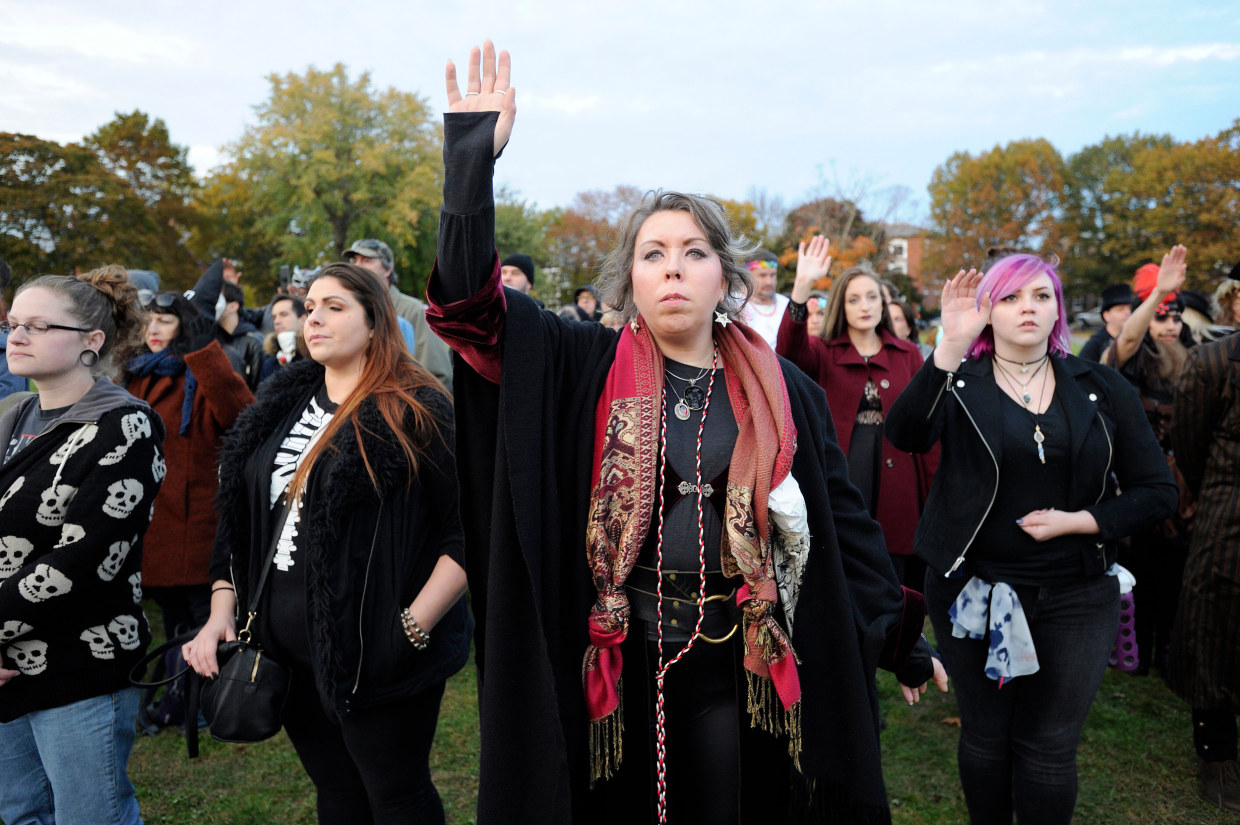
Witches take part in the Witches' Magic Circle in Salem, Mass., on Oct. 31, 2018. Joseph Prezioso / AFP via Getty Images file


Oct. 30, 2022, 7:00 AM EDT

By Antonio Pagliarulo, author of the forthcoming “The Evil Eye: The History, Mystery, and Magic of the Quiet Curse”

Two weeks ago in the run-up to Halloween, I visited Salem, Massachusetts, for the first time since the pandemic began. In renewing my annual Halloween pilgrimage, I was bowled over by what I found in the Witch City: bigger crowds, longer lines and a wider and welcome array of merchandise geared toward many different religious traditions and ethnic identities.

Amid the curious crowds in black capes and conical hats, bags overflowing with DIY spell kits and candles to enhance prosperity, I overheard the same question: Is magic really real?

Witchcraft, which includes Wicca, paganism, folk magic and other New Age traditions, is one of the fastest-growing spiritual paths in America.

For me, the answer is yes.

I am one of a million-plus Americans who — whether proudly, secretly or dabbling through the power of consumerism — practice some form of witchcraft. Witchcraft, which includes Wicca, paganism, folk magic and other New Age traditions, is one of the fastest-growing spiritual paths in America.

In 1990, Trinity College in Connecticut estimated there were 8,000 adherents of Wicca. In 2008, the U.S. Census Bureau figure was 342,000. A 2014 Pew Research Center study increased that projection several times over in assessing that 0.4% of Americans identified as pagan, Wiccan or New Age. (Most modern pagan worship, of which Wicca is one type, draws on pre-Christian traditions in revering nature.) By 2050, it said, the number of Americans practicing “other religions” — faiths outside Judaism, Christianity, Islam, Hinduism and Buddhism — would triple “due largely to switching into other religions (such as Wicca and pagan religions).

The precise number of witches in America is difficult to determine because many practitioners are solitary and, either by choice or circumstance, do not openly identify as such. But the growth is evident, especially to those who’ve made it their life’s work to study the community.

“It’s clearly increasing,” said Helen A. Berger, who spoke to me on the phone last week. Berger is one of the foremost academic experts on contemporary witchcraft and paganism in America and draws knowledge about its appeal from surveys she’s co-conducted on the pagan community.

Thursday, February 21, 2013

Court: Calif. may have to hire Wiccan chaplains


2:45p.m. EST February 20, 2013


Byron Ballard, a high priestess in the dianic tradition of Wicca, performing the ceremony of Calling the Quarters during a Sabbat service.(Photo: John Coutlakis, GPN)


STORY HIGHLIGHTS
Calif. may have as many as 2,000 Wiccan prisoners
Currently, 5 religions have full-time prison chaplains
Minister says Calif. Department of Corrections misunderstands Wicca


SAN FRANCISCO (AP) — California prisons hire full-time chaplains and spiritual leaders to serve Catholic, Muslim, Jewish, Protestant and Native American inmates.

On Tuesday, a federal appeals court gave new life to a decades-long battle by Wiccan inmates for access to their own full-time chaplain.

The 9th U.S. Circuit Court of Appeals overturned a trial judge's dismissal of a Wiccan prisoner lawsuit seeking the same rights as the five other religious practices. The appeals court said the Wiccan prisoners make a compelling argument that the California Department of Corrections and Rehabilitation may be unconstitutionally showing preference to the five religions in violation of the 1st Amendment.

The appeals court ruled that the trial court judge was wrong to dismiss the case almost immediately after it was filed without delving deeper into the evidence. For instance, the court said it could be that a Wiccan chaplain could be needed only at the Chowchilla prison rather than throughout the 33-prison statewide system of 150,000 inmates.

The appeals court also warned that the CDCR may still be able to show that the Wiccans don't have enough worshipers or critical needs for a full-time chaplain. It ordered the trial court judge to reconsider the case.

"There are certainly enough Wiccan prisoners to merit their own chaplain," said Gary Friedman, a spokesman for the American Correctional Chaplains Association. "I hope this leads to the hiring of more chaplains to represent even more minority faith groups."

The number of Wiccan inmates is in dispute. A CDCR survey reported 183 Wiccan prisoners in 2007 after recording about twice that number in 2002.

But Patrick McCollum, a leading Wiccan minister who has led the Wiccan prisoner fight for full-time chaplains for 20 years, puts the number at about 2,000 system wide. McCollum said many Wiccans prisoners were afraid to answer the CDCR survey for fear of reprisals. He also argued that a survey should be conducted by a neutral party with no ties to the CDCR.

McCollum, who volunteers as a Wiccan chaplain in California prisoners and who lost his own lawsuit against the CDCR in 2011, says he believes the CDCR opposes hiring a full-time chaplain because of a misunderstanding of the religion's beliefs.

Wicca is a pagan religion that worships nature and involves witchcraft.

"People have a lot of misconception about Wiccans," McCollum said. "It has nothing to do with Satan."

The CDCR declined comment, citing pending litigation. In court papers, its lawyers argue that its opposition is based strictly on numbers, pointing out that other minority faith groups are also without full-time chaplains. The court papers also argued that Wiccans are served by the full-time chaplains and volunteers like McCollum.

California deputy attorney general Kenneth Roost argued in the court papers that "the Constitution permits prisons to employ chaplains to accommodate inmates' religions needs, and does not require prisons to hire chaplains representative of all inmates' religions."

Still, the appeals court said that if the Wiccans claims do hold up then "the prison administration has created staff chaplain positions for five conventional faiths, but fails to employ any neutral criteria in evaluating whether a growing membership in minority religions warrants a reallocation of resources."


Source

.
.

Monday, April 30, 2012

Beltane

April 30th / May 1 - Beltane
Also known as Roodmas or May Day

Many Wiccans and Pagans celebrate Beltane. It is one of eight solar Sabbats. This holiday incorporates traditions from the Gaelic Bealtaine, such as the bonfire, but it bears more relation to the Germanic May Day festival, both in its significance (focusing on fertility) and its rituals (such as May pole dancing). Some traditions celebrate this holiday on May 1 or May day, whiles others begin their celebration the eve before or April 30th.
Beltane has long been celebrated with feasts and rituals. The name means fire of Bel; Belinos being one name for the Sun God, whose coronation feast we now celebrate. As summer begins, weather becomes warmer, and the plant world blossoms, an exuberant mood prevails. In old Celtic traditions it was a time of unabashed sexuality and promiscuity where marriages of a year and a day could be undertaken but it is rarely observed in that manner in modern times.

In the old Celtic times, young people would spend the entire night in the woods "A-Maying," and then dance around the phallic Maypole the next morning. Older married couples were allowed to remove their wedding rings (and the restrictions they imply) for this one night. May morning is a magickal time for wild water (dew, flowing streams, and springs) which is collected and used to bathe in for beauty, or to drink for health.

The Christian religion had only a poor substitute for the life-affirming Maypole -- namely, the death-affirming cross. Hence, in the Christian calendar, this was celebrated as 'Roodmas'. In Germany, it was the feast of Saint Walpurga, or 'Walpurgisnacht'. An alternative date around May 5 (Old Beltane), when the sun reaches 15 degrees Taurus, is sometimes employed by Covens. (Both 'Lady Day' and 'Ostara' are names incorrectly assigned to this holiday by some modern traditions of Wicca.)

The May pole was a focal point of the old English village rituals. Many people would rise at the first light of dawn to go outdoors and gather flowers and branches to decorate their homes. Women traditionally would braid flowers into their hair. Men and women alike would decorate their bodies. Beltane marks the return of vitality, of passion. Ancient Pagan traditions say that Beltane marks the emergence of the young God into manhood. Stirred by the energies at work in nature, he desires the Goddess. They fall in love, lie among the grasses and blossoms, and unite. The Goddess becomes pregnant of the God. To celebrate, a wedding feast, for the God and Goddess must be prepared. Let Them guide you! Breads and cereals are popular. Try oatmeal cakes or cookies sweetened with a dab of honey. Dairy foods are again appropriate...just make a lovely wedding feast and you are sure to enjoy yourself! An early morning walk through a local park or forest could be fun for everyone. Gather up some plants or flowers to display in your home. Mom and daughter could braid their hair, and weave in a few tender blossoms.

Blessed Be!


Religious Satanism·


Reactionary Religious Impulse

Satanism is part of a religious impulse struggling with Christianity to overthrow its deceptive folkloric subversion ideologies by force, using the propagandistic language of its promotion in ways that seem or become religious and spiritual props for the betterment of ourselves and those whom we like. This strips the delusion and lies away from the faithful or at least away from the projections which they promote, by displacement and blatant legitimation.
Previous engagements of this kind were waged by religious "witches" (religious "satanists" being the major followup, after about 15 years). There have been no other heresy-based incursions of this type, but successive generations launched into horror fiction/folklore for their followup (religious "vampires", and then religious "werewolves"). I am seeing signs of a more recent development whereby people style and come to understand themselves as religious "demons". Sometimes they are claiming to have done this for years. This all seems to be out of the same general movements, and academics seem to be referring to it as 'self-religion' (incorporating New Age, Thelemic, and Neopagan components).
There appear to be several "phases" of these various factions. The initial phase is a pretty blatant in its 'in your face here we are, claiming to be representatives of your worst nightmares' kind of style, sometimes doing things up theatrically and possibly fabricating a 'Charter Myth' (fabricated tale of origins), often of ancient pedigree. Many of the later generations tend to downplay the theatricality and believe these tales of ancientness and those used by Christians to scare and target their competition. They then begin to complain that they are in such a poor position as victims to the dominant Christian religion (within some Charter Myths, casting themselves as actual documented individuals, possibly exascerbated as within 'The Burning Times' promoted by Gardner and subsequent Wiccans).


Read more

.

Tuesday, March 30, 2010

Asheville Mother Grove Goddess Temple to celebrate spring equinox


ASHEVILLE — After making it through the harsh winter, people in Western North Carolina are looking forward to the warm sun of spring. Some are preparing to celebrate the season's change with an ecumenical ritual.

Saturday officially marks the first day of spring, being the day of the spring equinox.

Members of Mother Grove Goddess Temple will celebrate at 7 p.m. Saturday with A Breath of Appalachian Spring: A Ritual in Celebration of the Spring Equinox, in the parish hall of the Episcopal Cathedral of All Souls in Biltmore Village.

Saturday's event is open to all faith traditions, said Byron Ballard, wiccan priestess and a member of the temple. Mother Grove “isn't a wiccan group, though some of us are wiccans,” she said.

“Mother Grove is an outgrowth of the work of several people in the goddess/earth religions community,” Ballard said. “Its goal is to create a permanent sanctuary, where people of all faith traditions may openly and safely celebrate the divine feminine, the goddess.”

Wicca is a modern religion built on the ancient agricultural religions of Europe, she explained. “Wiccans may also refer to themselves as witches.”

Jill Boyer is a co-founder and priestess with Mother Grove. She says she looks forward to celebrating “with my celebrants and community, having time to celebrate something that is very important to me and the ritual aspects themselves.”

Boyer believes people have an ancient and human need for ritual and celebration in groups, and to acknowledge the changing of the seasons.

The celebration will consist of raising a circle, singing, “whistling up the wind” and flying prayers written on paper airplanes. Ballard will lead the ritual, explaining that it is a joyful expression of the beginning of spring and coming together as a community.

Nonperishable food items will be collected at the event for the Mother Grove Cornucopia Project food drive.

“Last year, as part of the celebration, we asked people to write a prayer or wish on a piece of paper and fold it into an airplane,” Ballard said. “We spent about five minutes flying planes around the room. Then we asked people to pick up a plane that was not theirs, take it home with them and pray for that person.”

Ballard said that “whistling up the wind” is an old English and Appalachian tradition. March is usually the windiest month, so the element of wind will be emphasized at the celebration. One person will whistle while three others honor the elements of earth, fire and water.

“It's a lovely holiday for children,” Ballard said. “The first chance to get out and see what's growing, to welcome baby chicks and lambs, to taste the first little green bits of chickweed. All pagan and wiccan holidays are family-friendly. Many Earth religionists choose to honor their spiritual traditions as a family group.”
.
.
Source: http://www.citizen-times.com/article/20100319/LIVING/303190029
.
.

TEO 3000

Monday, March 22nd, 2010

Episcopal Organization? Meet your future:

After making it through the harsh winter, people in Western North Carolina are looking forward to the warm sun of spring. Some are preparing to celebrate the season’s change with an ecumenical ritual.

You mean some kind of joint Catholic-Protestant-Orthodox thing? Nope.

Members of Mother Grove Goddess Temple will celebrate at 7 p.m. Saturday with A Breath of Appalachian Spring: A Ritual in Celebration of the Spring Equinox, in the parish hall of the Episcopal Cathedral of All Souls in Biltmore Village.

And nothing says “Welcome, spring!” quite like a fake religion performing its strange ceremonies inside the cathedral of another fake religion.

Saturday’s event is open to all faith traditions, said Byron Ballard, wiccan priestess and a member of the temple. Mother Grove “isn’t a wiccan group, though some of us are wiccans,” she said.

Noted.

“Mother Grove is an outgrowth of the work of several people in the goddess/earth religions community,” Ballard said. “Its goal is to create a permanent sanctuary, where people of all faith traditions may openly and safely celebrate the divine feminine, the goddess.”

This is badly needed what with all the witches the Christian right burns in the United States all the time. What are you looking at me like that for? You know it’s true.

Anyway, exactly how are they going to celebrate Katharine Jefferts Schori the divine feminine, the goddess? With “ancient” rituals like these.

The celebration will consist of raising a circle, singing, “whistling up the wind” and flying prayers written on paper airplanes. Ballard will lead the ritual, explaining that it is a joyful expression of the beginning of spring and coming together as a community.

If I’m not mistaken, the pagan Celts used paper airplanes to pray to their gods. But why do all this in the first place?

Jill Boyer is a co-founder and priestess with Mother Grove. She says she looks forward to celebrating “with my celebrants and community, having time to celebrate something that is very important to me and the ritual aspects themselves.”

Boyer believes people have an ancient and human need for ritual and celebration in groups, and to acknowledge the changing of the seasons.

Inventing gods. Performing weird rituals devoid of meaningful content for no particular reason other than emotion. I’d say TEO’s just about there.

.

Source: http://themcj.com/?p=10413.
.

Saturday, January 23, 2010

Wicca's Invitation


Posted by David Virtue on 2010/1/20 8:10:00


Pagan practices are meeting with an increasingly receptive audience in the Episcopal Church. Is it the consequence of an unmet need?

by Jeff Walton
January 14, 2010

The monthly meditation had a playful air about it.

"A crone is an old woman. A crone is a witch. A crone is a wise woman. Which one will you be, my friend? Which one I?"

Wrapped around a rite for "croning", the meditation embraced a history of mystical women and offered prayers to "Mothering God" and "Eternal Wisdom." But the article was not in a new age publication or Wiccan blog: it was on the pages of the September newsletter of the Episcopal Diocese of Washington.

Entitled "Crone Power", the meditation innocuously sat opposite a story about choosing a children's Bible and next to a column on St. Jerome. The newsletter quickly drew the attention of Anglican bloggers, many of whom found the placement of what appeared to be a Wiccan ritual to be jarring in an official church publication. But intentionally or not, the publication and placement of the rite were reflective of a new reality: one in which practices drawn from or inspired by pagan belief, including witchcraft, are increasingly finding acceptance within the ranks of the Episcopal Church.

"Croning rituals have been a part of modern day witchcraft since [English occultist] Gerald Gardner invented it in the 1950s," explains Catherine Sanders, author of Wicca's Charm: Understanding the Spiritual Hunger Behind the Rise of Modern Witchcraft and Pagan Spirituality. Sanders, an evangelical Christian, spent several years researching pagan practices and witnessed their incorporation into the church during the writing of her book. Sanders said that croning, the practice of honoring a woman who has gone through menopause, became more popular in the 1970s with the women's movement.

"Most of the mainline denominations had people within them experimenting with pagan rituals," Sanders said. "A lot of these people were searching for a way to affirm what they were going through in their lives."

While the croning ritual was notable for its prominence in a diocesan newsletter, such pagan-inspired practices are not new in the Episcopal Church. In 2005, Pennsylvania Episcopal priest Bill Melnyk was outed as a Druid (he belonged to the Order of Bards, Ovates, and Druids) after posting a druid ritual to an Episcopal Church Women's website. Melnyk, who had taken the name "Oakwyse," was forced to resign by his bishop.

Pagan influences in women's spirituality were also a prominent part of the "Reimagining" movement that appeared among some mainline Protestant feminists in the early 1990s. The Reimagining movement encouraged worshippers to refer to God as a feminine deity known as "Sophia," loosely based on the Greek concept of the wisdom of God. Controversy eventually subsided after denominational leaders, responding to pressure from traditionalists, distanced themselves from the Reimagining liturgies.

The diocese of Washington itself has a track record of embracing mystical rites, most recently hosting a Native American "smudging" ceremony at the National Cathedral. During an interfaith conference,Sacred Circles: a Celebration of Women's Spirituality, smoking tobacco was offered to the spirits of the four cardinal directions.

Crone Power

The author of the rite that appeared in the Washington Window was herself far from the traditional images of covens and witchcraft. An older parishioner at St. Alban's Church, Helma Lanyi arrived from the Roman Catholic Church ten years ago after taking issue with Catholicism's hierarchy and patriarchy.

Situated near the highest point in Washington, D.C., next to the prestigious school of the same name that educates many of Washington's elite, St. Alban's is more reflective of the reserved and upper-class mainstream of the Episcopal Church, rather than the fringe congregations that have previously entertained pagan ideas and practices. Its rector was recently elected to become the new bishop of the Episcopal Diocese of Georgia.

"I had become aware for a while that it's really not cool in our society to be an older woman," Lanyi said. "At one point I picked up a book on crones. That describes very much the whole pagan point of view about being an older woman."

Lanyi, a first generation immigrant from Germany, found the topic interesting. Nevertheless, it did not appeal to her as a Christian.

"I'm really not into Earth mother thinking," the St. Alban's parishioner explained. Among other concerns that she had with pagan practices, Lanyi did not like the portrayal of female power as superior to male power. But the idea of croning seemed to resonate along with a book she had read by liberal Catholic nun Joan Chittister. Lanyi saw being older as a gift, and she had grown tired of what she saw as a cultural expectation to hide one's age.

"Why is the joy of life considered to be something that it isn't part of [life] for women when they are older?" Lanyi asked. "I felt that God hasn't taken his concern away from me now that I am older. Why should that only be between me and God?"

In her words, Lanyi wanted to be "properly an old lady without being out of the picture." So she investigated croning further. Normally engaged with her work as co-chair of the Episcopal Peace Fellowship at St. Alban's, Lanyi visited Wiccan websites that her daughter had found, complete with a variety of croning rituals.

"It blended perfectly with my nonviolence training and interest," Lanyi said of some of her folk religion readings. Lanyi found in folk religion an element which "emphasized the more female elements of being non-judgmental." The St. Alban's parishioner saw those elements as being compatible with Christianity as she understood it.

"That's what Jesus came for, working together and everyone is equal," Lanyi claimed. "Jesus came not to go against all of that [folk religion], the same way he didn't go against the Jewish religion, Jesus came to affirm our nature."

But whereas Lanyi found value in folk religion, some of the Wiccan croning rituals themselves were wild and over the top.

"I couldn't see asking people to do that in my living room," the elderly German laughed. She decided that authoring her own rite was the best way to proceed.

"I pretty much made it up, that ritual doesn't exist anywhere as I know it," Lanyi explained. "I thought it was a little like baptism rituals, this idea of asking questions: what are you seeking, what do you want?"

She wrote her ritual a little bit tongue in cheek, she admitted. Then, last year, Lanyi gathered seven friends and performed the rite. They stood in a circle, one lighting a candle and placing it on a center table. They took turns reading the poem "Woman's Work," by Maya Angelou, as a sign of solidarity with all women. Then they invited the newest crone-to-be into the circle.

"What we read in these Wiccan rituals that my daughter shared with me, they used dirt or soil, and that didn't make sense, so we used a hand-woven stole," Lanyi added. She recalled the rite in her article:

She [the new crone] tells us of the phases of her life up until now. The others ask her: "What is it you are seeking for this phase of your life as a crone?"

She answers: "I seek wisdom." We say in unison: "Mothering God, grant her Crone Wisdom."

We ask: "Beside wisdom, what is it you are seeking?" She answers: "I seek judgment." We reply: "Mothering God, grant her Crone Judgment."

Finally we ask: "Besides wisdom and judgment, what is it you are seeking?" She says: "I seek Joy." We respond: "Mothering God, grant her Crone Joy."

We take turns anointing her forehead with special oil and present her with a stole, or wreath, inviting her to go forth into the world and share her Crone power.

We pray: Eternal Wisdom, source of our being and center of all our longing, In you our sister has lived to a strong age: A woman of dignity and wit, in loving insight now a blessed crone. May the phase into which she has entered bear the marks of your spirit. May she ever be borne up by the fierce and tender love of friends and by You, most intimate friend; and clothed in your light, grow in grace as she advances in years, For your love's sake.

"I wanted to indicate that this was now a passage, now a part of life," Lanyi said. "It meant a lot to us, most of us were of that age."

An Unmet Need

After years of researching Wicca, Sanders has empathy for women like Lanyi that have looked to pagan ritual.

"There definitely is a hunger," Sanders explained. The author observed that croning rituals tend to draw older women, while younger women seek rituals involving nature. Many times, the rituals grew out of desire to be recognized or acknowledged.

"Older women have a lot of wisdom, and they do have a special place in our society," Sanders said. "But the fact that our society has this view that women need to make themselves better (through things like plastic surgery), that's the result of sin and the fall."

"A lot of these women are looking to affirm something that they don't think is being met," Saunders said. Quoting author Arthur Lindsley of the C.S. Lewis Institute, Sanders surmises that sometimes "people are interested in neopaganism because of the unpaid bills of the church."
One example that Sanders cites is the church's lack of a response to miscarriage or stillbirth. While the Episcopal Church has historically offered no rite acknowledging these traumas, Wicca does.

"The problem that exists with a lot of these pagan rituals is that they don't bring the redeeming life of Jesus into them," Sanders said. "They're all about the participants, and that is where the problem lies."

For such needs to be properly addressed within the Christian Church, rites made for them have to be about what Christians believe, Sanders says. "It has to focus on Jesus and what he did for humankind."

The evangelical author notes that many of the pagan rituals do not focus on a personal God, since they presuppose a god revealed or contained only in natural forces.

"As Christians, we just go so much further than that," Sanders says. "It's perfectly fine to have a service of worship to praise Him for His creation. There can be a certain need for churches to do more of this thing, but not pagan rituals that stop short of praising God and that step outside of Christian theology."

Additionally, Sanders has concerns about feminized language that can be found in such rituals, including Lanyi's croning rite.

Lanyi said that the Washington Window editor "did come back to me to ask if I could make it more Christian." In her published meditation, Lanyi backed the feminized wording with references to Christian women in the Celtic tradition such as Hild, Ita, and Brigid. She also cited the 14th century writer Julian of Norwich, who described God as a Mother. Lanyi labels all these Christian women crones, along with Catholic school pioneer Mother Seton and Mother Theresa of Calcutta.

"In calling God Mother, the thing that is confusing for pagans or Wiccans is that we are 'part of that' but in Christianity, we are not part of God, he is wholly separate," Sanders explained. She noted that mothers give birth, a trait ascribed to the goddess in the mainline Reimagining movement. In contrast, Scripture does not describe God as possessing reproductive organs or giving birth, traits common in depictions of pagan deities.

"Obviously God is not human, he is wholly other," Sanders said. "In calling God father, that's what Jesus did. He didn't call God his mother or she, he called him he."

Sanders says that the draw toward such feminized depictions of God sometimes comes from the personal history of the practitioner.

"You have these women that are very hurt, upset because of a relationship with their father, but Christianity says God can heal you of past hurts through the redeeming love of Christ," Sanders said. During the course of her research, Sanders also found that difficult marriages or encounters with a pastor that were unsatisfactory could also leave a woman wounded and drawn to Wicca.

A Service of Remembrance

Some churches are taking notice of the need for spiritual acknowledgement of events like miscarriage. At the Falls Church, an Anglican parish in suburban Washington, D.C., the pastoral care staff worked on a liturgy of remembrance for a special All Saints' Day service. Sensing a need for women who had experienced losses through miscarriage, abortion, stillbirth, or early childhood death, the 275-year-old parish began the service in 2008.

"It wasn't about us, it was all about the redeeming work of Christ," Sanders said. "The subject of the ceremony was to remember the children and what happened to the parents there, but it was all focused on God and deeply rooted in Scripture."

"It was very much about glorifying God," the author said. "It marked the loss, but it pointed to Jesus Christ." The special All Saints' Day service proved extremely popular, with the sanctuary reaching full capacity. The pastoral care staff plans to repeat the service this year.

Rev. Nicholas Lubelfeld, an Episcopal Priest on staff at the Falls Church, explained a distinction between the church's All Saints' service and pagan rituals.

"It's one thing to try to conform our lives to God's will; it's another thing to try to shoehorn God into our goals and aspirations," Lubelfeld said. The priest said that the difference was between prayer through Jesus Christ and bringing God "into play into our plans."

"Who's agenda is it?" Lubelfeld asked. "My need is what I bring to God, but I don't try to shoehorn him into my plan -- magic has as its aim the securing of a particular end; prayer has the end of bringing our hopes and fears to God."

"It would be good for churches to consider ways to honor who God created us to be, the things we are experiencing," Sanders said. But Sanders added that if rituals do not point to Jesus, they don't have a place in the church.

"The Gospel is the best answer for those people," Sanders said. "As a result of sin, we don't honor women the way we should, and therefore they are reaching out. These are people that are in our midst that are hurting, and if it means reading up on these rituals, that will help us understand where they are coming from."

"In modern 21st century America, we think we know what we need, and that's a dangerous place to be in," Sanders said. "We need to constantly glorify him."

Since publication of her croning rite, Lanyi has received a subdued response.

"I'm aware that this may be not entirely what people are used to," Lanyi said. "Women my age have come to me and said, 'I loved your article'-- but not a lot. I'm not sure if they know what to think of it."


----Jeff Walton is Communications Manager and Anglican Staffer for the Institute on Religion & Democracy.The following article originally appeared in Forward in Christ Magazine, and is reproduced with permission.
..

.