Showing posts with label The Signs of the Times. Show all posts

Thursday, April 30, 2026

Indian Wedding Baraat Shuts Down New York!...

 
Indian Wedding Baraat Shuts Down New York! Fifth Avenue पर Desi Dance Video Viral, Public Shocked

Indian Wedding Baraat in New York: Traffic jams due to wedding processions are common in India, but when they happen on New York's Fifth Avenue, home to showrooms of the world's biggest brands, it becomes news. Recently, an Indian-origin couple made their wedding so memorable that even New York police had to stop traffic.

Wednesday, April 08, 2026

Romanism the Religion of Human Nature


There is great need that all who claim to be Bible Christians should take the Scriptures as they read. There is need of arriving at right conclusions as to what the Scriptures mean in their reference to the man of sin, who thought to change times and laws. He had no real power to change the time and the law of God, but he thought himself able to do this work; for he “opposeth and exalteth himself above all that is called God, or that is worshiped; so that he as God sitteth in the temple of God, showing himself that he is God.” He is an imitator of the first great rebel, the originator of sin. In heaven Satan thought to change the laws of God, and for this purpose he changed his character and his position in the heavenly courts, and influenced others until they united with him in the work of rebellion against God; but he did not succeed in changing the law of God. God did not alter or change his form of government to suit Satan’s ideas, but made it manifest that the foundation of his government in heaven and earth is as unchangeable as is the throne itself.

When Satan could not induce all the angels to revolt against the law of God, he made the earth the scene of his rebellion, and through the man of sin seeks to carry out his diabolical purpose. Through the Papacy, the Roman power, the man of sin, the purpose of Satan is carried out among men; the law and the time of God are set aside. In this we see that Protestantism is giving encouragement to popery; and false systems of worship, against which our fathers manfully opposed themselves, imperiling even property and life, are fostered and cherished and encouraged to extend and gain wide influence. Protestants do not search their Bibles as they should, and do not heed the warning that has been given concerning the work of the man of sin. The Roman Church claims that the pope is invested with supreme authority over all bishops and pastors, and this claim of supremacy was once denied by Protestants. They took the position that the Bible, and the Bible alone, constituted the rule of faith and doctrine, that the word of God is the only unerring guide for human souls, and that it is unnecessary and harmful to take the words of priests and prelates instead of the word of God.

To the Romanist the Bible is a forbidden book, because it plainly reveals the errors of the Roman system; and whoever searches the Bible with an enlightened understanding, cannot long be in harmony with Romanism. He who searches the Bible to understand the truth, will find no authority in the word of God for the assumption of power on the part of popes and cardinals. There is no word of God that sanctions their assumed superiority or supremacy over their people, as there is no word to sanction the claim that Lucifer made in heaven of superiority over Christ. The claim of the Papacy to superiority is made under the influence of the first great usurper, who so persistently urged his right to supremacy over the host of God. Through the Dark Ages,—that long night of ignorance and superstition,—the claim of the Papacy to superiority and supremacy was conceded by emperors and kings, although God had sanctioned no such concession, and raised up men to dispute the claim, and to break the Romish yoke from the church of God. Through his appointed agencies God summoned the church to reassert her independence, and in the strength of God she stood forth in the liberty wherewith Christ had made her free. She broke away from the papal yoke, and with the word of God in her hand, met the giant evil of Romanism, even as David met Goliath in the name of heaven, using his sling and a few pebblestones. The defier of Israel was slain before the man of faith; and while men cling to the word of the Lord, they cannot affiliate with the great system of error.

The Lord has pronounced a curse upon those who take from or add to the Scriptures. The great I AM has decided what shall constitute the rule of faith and doctrine, and he has designed that the Bible shall be a household book. The church that holds to the word of God is irreconcilably separated from Rome. Protestants were once thus apart from this great church of apostasy, but they have approached more nearly to her, and are still in the path of reconciliation to the Church of Rome. Rome never changes. Her principles have not altered in the least. She has not lessened the breach between herself and Protestants; they have done all the advancing. But what does this argue for the Protestantism of this day? It is the rejection of Bible truth which makes men approach to infidelity. It is a backsliding church that lessens the distance between itself and the Papacy.

Saturday, November 11, 2017

Women as Christian Laborers


The Signs of the Times

September 16, 1886

Women as Christian Laborers

By Mrs. E. G. White


He who died to redeem man from death, loves with a divine love; and he says to his followers: “This is my commandment that ye love one another as I have loved you.” Christ showed his love for the fallen race by his actions. The true child of God will be Christlike; and as he grows in the knowledge of the truth, and is sanctified through the truth, he will be more and more like Christ, and more desirous to save souls, the purchase of his blood.

Some can do more than others; but all can do something. Women should not feel that they are excused because of their domestic cares. They should become intelligent as to how they can work most successfully and methodically in bringing souls to Christ. If all would realize the importance of doing to the utmost of their ability in the work of God, having a deep love for souls, feeling the burden of the work upon them, hundreds would be engaged as active workers who have hitherto been dull and uninterested, accomplishing nothing, or at most but very little.


Saturday, March 14, 2015

Joseph in Egypt


THE SIGNS OF THE TIMES

February 5, 1880

The Great Controversy Between Christ and His Angels and Satan and His Angels

Chapter 16—Joseph in Egypt.

Concluded. ST February 5, 1880

By Mrs. E. G. White ST February 5, 1880

The sons of Jacob returned to their father with the joyful tidings, “Joseph is yet alive, and he is governor over all the land of Egypt.” At first the old man was overwhelmed; he could not believe what he heard, yet their words brought a faintness to his heart. But when he saw the carriages and the long line of loaded animals, and when Benjamin was at his side once more, he felt reassured, and, in the fullness of his joy, exclaimed. “It is enough; Joseph my son is yet alive. I will go and see him before I die.” The brothers then made their humiliating confession to their father, and entreated his forgiveness, for their wicked treatment of Joseph. Jacob had not suspected them of such cruelty, but he saw that God had overruled it all for good, and he forgave and blessed his erring children. 

Jacob and his sons, with their families and numerous attendants, were soon on their way to Egypt. With gladness of heart they pursued their journey, and when they came to Beersheba the aged patriarch offered grateful sacrifices, and entreated the Lord to grant them an assurance that he would go with them. In a vision of the night the divine words came to Jacob: “Fear not to go down into Egypt, for I will there make of thee a great nation. I will go down with thee into Egypt, and I will also surely bring thee up again; and Joseph shall put his hand upon thine eyes.” 

The meeting of Joseph and his father was very affective. Joseph left his chariot, and ran to meet his father on foot, and embraced him, and they wept over each other. “And Israel said unto Joseph, Now let me die since I have seen thy face, because thou art yet alive.” 

Joseph took five of his brethren to present to Pharaoh, and receive from him a grant of land for their future home. He did not wish them to be exposed to the temptations which must surround them if engaged in the king’s special service, amid the corrupting, idolatrous influences at court; therefore he counseled them, when the king should ask them of their occupation, to tell him frankly that they were shepherds. The monarch, on learning this fact, would not seek to exalt them to some honorable position for Joseph’s sake; for the occupation of a shepherd was regarded in Egypt as degrading. When taken before Pharaoh they followed the wise counsel of their God-fearing brother; and the king gave Joseph permission to settle his father and his brethren in the best part of the land of Egypt. He selected Goshen, a well-watered, fertile country, affording good pasture for their flocks. Here, also, they could worship God, undisturbed by the ceremonies attending the idolatrous service of the Egyptians. The country round about Goshen was inhabited by the Israelites, until with power and mighty signs and wonders, God brought his people out of Egypt. 

Not long after their arrival in Egypt, Joseph brought his father also to be presented to Pharaoh. The patriarch was unawed by the pomp of royalty, and the magnificence surrounding him. Amid the sublime scenes of nature he had communed with a mightier monarch; and now, in conscious superiority, he raised his hands and blessed Pharaoh. The king struck by his venerable appearance, inquired, “How old art thou?” Jacob answered, “The days of the years of my pilgrimage are an hundred and thirty years. Few and evil have the days of the years of my life been, and have not attained unto the days of the years of the life of my fathers in the days of their pilgrimage.” Jacob had seen much trouble and suffered much perplexity. The jealousy of his wives had brought a long train of evils, and the sinful course of some of his children had made the father’s life very bitter. But his last years were more peaceful. His sons had turned from their evil ways, Joseph had been restored to him, and, surrounded by every comfort which the prime minister of Egypt could bestow, and in the society of his children, he passed down gently and calmly toward the grave. 

A short time before his death, his children gathered about him to receive his blessing, and to listen to his last words of counsel. As he addressed them for the last time the Spirit of God rested upon him and he laid open before them their past lives, and also uttered prophecies which reached far into the future. Beginning with the eldest, he mentioned his sons by name, presenting before those who had followed a sinful course the light in which God regarded their deeds of violence, and that he would visit them for their sins. Reuben had taken no part in selling Joseph, but previous to that transaction he had grievously sinned. Concerning him, Jacob uttered the following prophecy: “Reuben, thou art my first-born, my might, and the beginning of my strength, the excellency of dignity and the excellency of power; unstable as water, thou shalt not excel. 

He then prophesied in regard to Simeon and Levi, who had practiced deception to the Shechemites, and then, in a most cruel, revengeful manner, destroyed them. These brothers were also the most guilty in the case of Joseph. “Simeon and Levi are brethren; instruments of cruelty are in their habitations. O my soul, come not thou into their secret; unto their assembly, mine honor, be not thou united! for in their anger they slew a man, and in their self-will they digged down a wall. Cursed be their anger, for it was fierce; and their wrath for it was cruel. I will divide them in Jacob and scatter them in Israel.” 

In regard to Judah, the fathers words of inspiration were more joyful. His prophetic eye looked hundreds of years into the future, to the birth of Christ, and he said, “The scepter shall not depart from Judah, nor a lawgiver from between his feet, until Shiloh come; and unto him shall the gathering of the people be.” 

Jacob predicted a cheerful future for most of his sons. Especially for Joseph he uttered words of eloquence of a happy character: “Joseph is a fruitful bough, even a fruitful bough by a well, whose branches run over the wall. The archers have sorely grieved him, and shot at him, and hated him; but his bow abode in strength, and the arms of his hands were made strong by the hands of the mighty God of Jacob. (From thence is the shepherd, the stone of Israel.)” “The blessings of thy father have prevailed above the blessings of my progenitors, unto the utmost bound of the everlasting hills; they shall be on the head of Joseph, and on the crown of the head of him that was separate from his brethren.” 

Jacob was an affectionate father. He had no resentful feelings toward his sorrowing children. He had forgiven them. He loved them to the last. But God, by the spirit of prophecy, elevated the mind of Jacob above his natural feelings. In his last hours, angels were all around him, and the power of God rested upon him. His paternal feelings would have led him to utter, in his dying testimony, only expressions of love and tenderness. But under the influence of inspiration he uttered truth, although painful. 

After the death of Jacob, Joseph’s brethren were filled with gloom and distress. They thought that Joseph had concealed his resentment, out of respect for their father; and now that he was dead, he would be revenged for the ill treatment he had suffered at their hands. They dared not appear before him, but sent a messenger, “Thy father did command before he died, saying, So shall ye say unto Joseph, Forgive, I pray thee now, the trespass of thy brethren, and their sin; for they did unto thee evil; and now, we pray thee, forgive the trespass of the servants of the God of thy father.” This message affected Joseph to tears, and, encouraged by this, his brethren came and fell down before him, with the words, “Behold, we be thy servants.” He met them with the comforting and assuring reply, Fear not; for am I in the place of God? But as for you, ye thought evil against me; but God meant it unto good, to bring to pass, as it is this day, to save much people alive. Now therefore fear ye not; I will nourish you, and your little ones. Joseph loved his brethren, and he could not bear the thought that they regarded him as harboring a spirit of revenge toward them.

The life of Joseph illustrates the life of Christ, Joseph’s brethren purposed to kill him, but were finally content to sell him as a slave, to prevent his becoming greater than themselves. They thought they had placed him where they would be no more troubled with his dreams, and where there would not be a possibility of their fulfillment. But the very course which they pursued, God overruled to bring about that which they designed never should take place—that he should have dominion over them.

The chief priests and elders were jealous of Christ, fearing that he would draw the attention of the people away from themselves. They knew that he was doing greater works than they ever had done, or ever could perform; and they knew that if he was suffered to continue his teachings, he would become higher in authority than they, and might become king of the Jews. They agreed together to prevent this by privately taking him, and hiring witnesses to testify falsely against him, that they might condemn him and put him to death. They would not accept him as their king, but cried out, Crucify him! crucify him! But by murdering the Son of God, they were bringing about the very thing they sought to prevent. Joseph, by being sold by his brethren into Egypt, became a saviour to his father’s family. Yet this fact did not lesson the guilt of his brethren. The crucifixion of Christ by his enemies made him the Redeemer of mankind, the Saviour of the fallen race, and ruler over the whole world. But the crime of his enemies was just as heinous as though God’s providential hand had not controlled events for his own glory and the good of man. 

Joseph walked with God. And when he was imprisoned, and suffered because of his innocence, he meekly bore it without murmuring. His self-control, his patience in adversity, and his unwavering fidelity, are left on record for the benefit of all who should afterward live on the earth. When Joseph’s brethren acknowledged their sin before him, he freely forgave them, and showed by his acts of benevolence and love that he harbored no resentful feelings for their former cruel conduct toward him. 

The life of Jesus, the Saviour of the world, was a pattern of benevolence, goodness, and holiness. Yet he was despised and insulted, mocked and derided, for no other reason than because his righteous life was a constant rebuke to sin. His enemies would not be satisfied until he was given into their hands, that they might put him to a shameful death. He died for the guilty race; and, while suffering the most cruel torture, meekly forgave his murderers. He rose from the dead, ascended up to his Father, and received all power and authority, and returned to the earth again to impart it to his disciples. He gave gifts unto men. And all who have ever come to him repentant, confessing their sins, he has received into his favor, and freely pardoned. And if they remain true to him, he will exalt them to his throne, and make them his heirs to the inheritance which he has purchased with his own blood. 


The Signs of The Times, February 5, 1880

.
.

Sunday, March 08, 2015

Retribution For Sin


February 12, 1880


The Lord gave Jeremiah a message of reproof to bear to his people, charging them with the continual rejection of God’s counsel; saying, “I have spoken unto you, rising early and speaking; but ye hearkened not unto me. I have sent also unto you all my servants the prophets, rising up early and sending them, saying, Return ye now every man from his evil way, and amend your doings, and go not after other gods to serve them, and ye shall dwell in the land which I have given to you and to your fathers.” 

God plead with them not to provoke him to anger with the work of their hands and hearts; “but they hearkened not.” Jeremiah then predicted the captivity of the Jews, as their punishment for not heeding the word of the Lord. The Chaldeans were to be used as the instrument by which God would chastise his disobedient people. Their punishment was to be in proportion to their intelligence, and the warnings they had despised. God had long delayed his judgments because of his unwillingness to humiliate his chosen people; but now he would visit his displeasure upon them, as a last effort to check them in their evil course.

In these days he has instituted no new plan to preserve the purity of his people. He entreats the erring ones who profess his name, to repent and turn from their evil ways, in the same manner that he did of old. He predicts the dangers before them, by the mouth of his chosen servants now as then. He sounds his note of warning, and reproves sin just as faithfully as in the days of Jeremiah. But the Israel of our time have the same temptations to scorn reproof and hate counsel, as did ancient Israel. They too often turn a deaf ear to the words that God has given his servants for the benefit of those who profess the truth. Though the Lord in mercy withholds for a time the retribution of their sin, as in the days of Jeremiah, he will not always stay his hand, but will visit iniquity with righteous judgment.

The Lord commanded Jeremiah to stand in the court of the Lord’s house, and speak unto all the people of Judah who came there to worship, those things which he would give him to speak, diminishing not a word; that they might hearken and turn from their evil ways. Then God would repent of the punishment which he had purposed to do unto them because of their wickedness. The unwillingness of the Lord to chastise his erring people is here vividly shown. He stays his judgments, he pleads with them to return to their allegiance.

He brought them out of bondage that they might faithfully serve himself, the only true and living God; but they had wandered into idolatry, they had slighted the warnings given them by his prophets; yet he defers his chastisement to give them one more opportunity to repent and avert the retribution for their sin. Through his chosen prophet, he now sends them a clear and positive warning, and lays before them the only course by which they can escape the punishment which they deserve. This is a full repentance of their sin, and a turning from the evil of their ways.

The Lord commanded Jeremiah to say to the people: “Thus saith the Lord: If ye will not hearken to me, to walk in my law, which I have set before you, to hearken to the words of my servants the prophets, whom I sent unto you, both rising up early and sending them, but ye have not hearkened; then will I make this house like Shiloh, and will make this city a curse to all the nations of the earth.” They understood this reference to Shiloh, and the time when the Philistines overcame Israel and the ark of God was taken. 

The sin of Eli was in passing lightly over the iniquity of his sons, who were occupying sacred offices. The neglect of the father to reprove and restrain his sons, brought upon Israel a fearful calamity. The sons of Eli were slain, Eli himself lost his life, the ark of God was taken from Israel, and thirty thousand of their people were slain. All this was because sin was lightly regarded, and allowed to remain in their midst. What a lesson is this to men holding responsible positions in the church of God! It adjures them to faithfully remove the wrongs that dishonor the cause of truth.

Israel thought, in the days of Samuel, that the presence of the ark containing the commandments of God, would gain them the victory over the Philistines, whether or not they repented of their wicked works. Just so the Jews, in Jeremiah’s time, believed that the divinely appointed services of the temple being strictly observed, would preserve them from the just punishment of their evil course.

The same danger exists today among that people who profess to be the repository of God’s law. They are too apt to flatter themselves that the regard in which they hold the commandments should preserve them from the power of divine justice. They refuse to be reproved of evil, and blame God’s servants with being too zealous in putting sin out of the camp. A sin-hating God calls upon those who profess to keep his law to depart from all iniquity. Neglect to repent and obey his word will bring as serious consequences upon Gods people today, as did the same sin upon ancient Israel. There is a limit beyond which he will no longer delay his judgments. The correction of God through his chosen instruments cannot be disregarded with impunity. The desolation of Jerusalem stands as a solemn warning before the eyes of modern Israel. 

When the priests and the people heard the message that Jeremiah delivered to them in the name of the Lord, they were very angry, and declared that he should die. They were boisterous in their denunciations of him, crying, “Why hast thou prophesied in the name of the Lord, saying. This house shall be like Shiloh, and this city shall be desolate without an inhabitant? And all the people were gathered against Jeremiah in the house of the Lord.” Thus was the message of God despised, and the servant with whom he entrusted it threatened with death. The priests, the unfaithful prophets, and all the people turned in wrath upon him who would not speak to them smooth things and prophesy deceit.

The unfaltering servants of God have usually suffered the bitterest persecution from false teachers of religion. But the true prophets will ever prefer reproach and even death rather than unfaithfulness to God. The Infinite eye is upon the instruments of divine reproof, and they bear a heavy responsibility. But God regards the injury done to them through misrepresentation, falsehood or abuse, the same as though it were done unto himself, and will punish accordingly.

The princes of Judah had heard concerning the words of Jeremiah, and came up from the king’s house, and sat in the entry of the Lord’s house. “Then spake the priests and the prophets unto the princes and to all the people, saying, This man is worthy to die; for he hath prophesied against this city, as ye have heard with your ears.” But Jeremiah stood boldly before the princes and the people declaring, “The Lord sent me to prophesy against this house and against this city all the words which ye have heard. Therefore now amend your ways and your doings, and obey the voice of the Lord your God; and the Lord will repent him of the evil that he hath pronounced against you. As for me, behold, I am in your hand; do with me as seemeth good and meet unto you. But know ye for certain, that if ye put me to death, ye shall surely bring innocent blood upon yourselves, and upon this city, and upon the inhabitants thereof; for of a truth the Lord hath sent me unto you to speak all these words in your ears.” 

Had the prophet been intimidated by the threats of those in high authority, and the clamoring of the rabble, his message would have been without effect, and he would have lost his life. But the courage with which he discharged his painful duty commanded the respect of the people, and turned the princes of Israel in his favor. Thus God raised up defenders for his servant. They reasoned with the priests and false prophets, showing them how unwise would be the extreme measures which they advocated.

The influence of these powerful persons produced a reaction in the minds of the people. Then the elders united in protesting against the decision of the priests regarding the fate of Jeremiah. They cited the case of Micah, who prophesied judgments upon Jerusalem, saying, “Zion shall be plowed like a field, and Jerusalem shall become heaps, and the mountains of the house as the high places of a forest.” They put to them the question: “Did Hezekiah king of Judah and all Judah put him at all to death? did he not fear the Lord, and beseech the Lord, and the Lord repented him of the evil which he had pronounced against them? Thus might we procure great evil against our souls.”

So, through the pleading of Ahikam and others, the prophet Jeremiah’s life was spared; although many of the priests and false prophets would have been pleased had he been put to death on the plea of sedition; for they could not endure the truths that he uttered exposing their wickedness.

But Israel remained unrepented and the Lord saw that they must be punished for their sin, so he instructed Jeremiah to make yokes and bonds and place them upon his neck, and send them to the king of Edom, the king of Moab, of the Ammonites, of Tyrus and Zidon, commanding the messengers to say that God had given all these lands to Nebuchadnezzar, the king of Babylon. That all these nations should serve him and his descendants for a certain time, till God should deliver them. They were to declare that if those nations refused to serve the king of Babylon they should be punished with the famine, with the sword, and pestilence, till they should be consumed. “Therefore,” said the Lord, “Hearken not ye to your prophets, nor to your diviners, nor to your dreamers, nor to your enchanters, nor to your sorcerers, which speak unto you, saying, Ye shall not serve the king of Babylon; for they prophesy a lie unto you to remove you far from your land; and that I should drive you out, and ye should perish. But the nations that bring their neck under the yoke of the king of Babylon, and serve him, those will I let remain still in their own land, saith the Lord; and they shall till it, and dwell therein.” 

Jeremiah declared that they were to wear the yoke of servitude for seventy years, and the captives that were already in the hands of the king of Babylon, and the vessels of the Lord’s house which had been taken, were also to remain in Babylon till that time had elapsed. But at the end of the seventy years God would deliver them from their captivity, and would punish their oppressors, and bring into subjection the proud king of Babylon. 

Ambassadors had come from the various nations named to consult with the king of Judah as to the matter of engaging in battle with the king of Babylon. But the prophet of God, bearing the symbols of subjection, delivered the message of the Lord to these nations, commanding them to bear it to their several kings. This was the lightest punishment that a merciful God could inflict upon so rebellious a people; but if they warred against this decree of servitude, they were to feel the full vigor of his chastisement. They were faithfully warned not to listen to their false teachers who prophesied lies.

The amazement of the assembled council of nations knew no bounds when Jeremiah, carrying the yoke of subjection about his neck, made known to them the will of God. But Hananiah, one of the false prophets against whom God had warned his people through Jeremiah, lifted up his voice in opposition to the prophecy declared. Wishing to gain the favor of the king, and his court, he affirmed that God had given him words of encouragement for the Jews. Said he: “Within two full years will I bring again into this place all the vessels of the Lord’s house, that Nebuchadnezzar, king of Babylon, took away from this place, and carried them to Babylon. And I will bring again to this place Jeconiah, the son of Jehoiakim king of Judah, with all the captives of Judah, that went into Babylon, saith the Lord; for I will break the yoke of the king of Babylon.”

Jeremiah, in the presence of all the priests and the people, said that it was the earnest wish of his heart that God would so favor his people that the vessels of the Lord’s house might be returned and the captives brought back from Babylon. But this could only be done on condition that the people repented and turned from their evil way to the obedience of God’s law. Jeremiah loved his country and ardently wished that the desolation predicted might be averted by the humiliation of the people; but he knew the wish was vain. He hoped the punishment of Israel would be as light as possible; therefore he earnestly entreated them to submit to the king of Babylon for the time that the Lord specified.

He entreated them to hear the words that he spoke. He cited them to the prophecies of Hosea, Habakkuk, Zephaniah, and others whose messages of reproof and warning had been similar to his own. He referred them to events which had transpired in their history in fulfillment of the prophecies of retribution for unrepented sins. Sometimes, as in this case, men had arisen in opposition to the message of God, and predicted peace and prosperity, to quiet the fears of the people, and gain the favor of those in high places. But in every past instance the judgment of God had been visited upon Israel, as the true prophets had indicated. Said he, “The prophet which prophesieth of peace, when the word of the prophet shall come to pass, then shall the prophet be known that the Lord hath truly sent him.” If Israel chose to run the risk, future developments would effectually decide which was the false prophet. 

But Hananiah, incensed at this, took the yoke from Jeremiah’s neck and broke it. “And Hananiah spake in the presence of all the people, saying, Thus saith the Lord: Even so will I break the yoke of Nebuchadnezzar king of Babylon from the necks of all nations within the space of two full years. And the prophet Jeremiah went his way.”

He had done his work, he had warned the people of their danger, he had pointed out the only course by which they could regain the favor of God. But they had mocked his words; men in responsible positions had denounced him, and tried to arouse the people to put him to death. Yet his only crime was in faithfully delivering the message of God to an unbelieving people. 

God pities the blindness and perversity of man; he sends light to their darkened understanding in reproof and threatenings which are designed to make the most exalted feel their ignorance and deplore their errors. He would cause the self-complacent to feel dissatisfied with their attainments and seek greater blessings by closer connection with Heaven. 

God’s plan is not to send messengers who will please and flatter sinners, he delivers no messages of peace to lull the unsanctified into carnal security. But he lays heavy burdens upon the conscience of the wrong-doer, and pierces his soul with sharp arrows of conviction. The ministering angels present to him the fearful judgments of God to deepen the sense of his great need and prompt the agonizing cry “what shall I do to be saved?” The very hand that humbles to the dust, rebukes sin, and puts pride and ambition to shame, lifts up the penitent, stricken one, and inquires with deepest sympathy, “What wilt thou that I shalt do unto thee? 

When man has sinned against a holy and merciful God, there is no course for him to pursue so noble, as to sincerely repent and confess his errors in tears and bitterness of soul. This God requires of him and will accept of nothing less than a broken heart and a contrite spirit.

Mrs. E. G. White 

Signs of The Times, February 12, 1880, Art. B
.
.

Saturday, February 21, 2015

Joseph in Egypt


Joseph in Egypt
Continued.

By E. G. White

The Signs of the Times, January 15, 1888.

Read here
http://text.egwwritings.org/publication.phppub?type=Periodical&bookCode=ST&lang=en&QUERY=and%2Bangels&resultId=9913&year=1880&month=January&day=15
.

Sunday, January 04, 2015

Signs of the Times, December 18, 1879


THE SIGNS OF THE TIMES

December 18, 1879

The Great Controversy Between Christ and His Angels and Satan and his Angels

Chapter 15—Jacob and Joseph

By Mrs. E. G. White ST December 18, 1879

Of the twelve sons of Jacob, the one for whom he had special love was Joseph; for he was the son of his beloved wife Rachel, and one of the children of his old age. He was a son of remarkable beauty. His oldest sons had arrived at manhood, and had developed unhappy traits of character. There was continual strife among the eleven; they were neither just nor benevolent toward each other. The envy and jealousy which were cherished by the several mothers making the family relation very unhappy, were instilled by word and example into the minds and hearts of the children, who grew up revengeful, jealous, and uncontrollable. They would not endure provocation, for they had too long cherished hatred and revenge. These evils will ever be found to be the result of polygamy. Each of the mothers is envious and jealous lest her own children shall not receive due attention from the father; and again they experience bitterness and discontent whenever they are made to feel that another is preferred before them. Children who grow up together surrounded by such elements are most likely to indulge in resentment for every supposed slight, and revenge for any imaginary wrongs. There is that in polygamy which dries up human affection, and tempts to the loosening of ties which should be held sacred. ST December 18, 1879, par. 1

Jacob’s life was made very bitter by the conduct of his sons. Joseph had another spirit; he was cheerful and happy, and possessed great love for his father whose heart was bound up in his child. This preference for Joseph was unwisely manifested, and called out the revengeful disposition of his other sons. When Joseph saw the wicked course pursued by his brethren he remonstrated with them; but they hated him for his entreaties, and for daring to reprove them who were so much older than he, and accused him of being a spy upon their actions. As Joseph saw that his words and entreaties only excited wrath against himself, he laid the plans and evil purposes of his brethren before his father, which gave him knowledge of many things he otherwise would not have known. The fathers of children among the Hebrews were made responsible in a great degree for the sins of their children, when they were left without the exercise of authority and restraint. When the father’s solicitude was expressed to his sons in a voice tremulous with grief, and he implored them to have respect for his gray hairs and not make his name a reproach, and to be despised because of their course, the sons felt sorry and ashamed before their father, because their wickedness was known, but felt envious and jealous of Joseph because he had informed his father of their course of sin. Jacob flattered himself that his sons repented of their wickedness, and he trusted they would reform. ST December 18, 1879, par. 2

Jacob unwisely gave expression to his love for Joseph in making him a present of a coat of beautiful colors. This only increased the hatred of his brothers against him; for they thought Joseph had stolen their father’s affections from them, and they considered themselves ill treated and deprived of their father’s confidence and love. They did not see that their own wicked course was a continual shame and disgrace to his gray hairs, and that his affections centered upon Joseph because of his purity and true excellence of character. ST December 18, 1879, par. 3

The Lord gave Joseph a dream which he related; Jacob would have been alarmed had he suspected the hatred and malicious feelings this dream aroused in the hearts of his sons against his beloved child. Joseph dreamed that while they were all engaged binding sheaves of grain, his sheaf arose and stood upright, and the sheaves of all the rest stood round about and bowed before his sheaf. No sooner was his dream related than they all understood its significance. His brothers exclaimed with indignation, “Shalt thou indeed have dominion over us?” Their hatred toward him burned deeper in their hearts than before. Soon the Lord gave Joseph another dream of the same import, but more strikingly significant. This dream he also related to his father and his brethren. He said, “Behold I have dreamed a dream more, and, behold, the sun and the moon and the eleven stars made obeisance to me.” The interpretation of this dream was quite as quickly discerned as was that of the first. “And his father rebuked him, and said unto him, what is this dream that thou hast dreamed? Shall I and thy mother and thy brethren indeed come to bow down ourselves to thee to the earth? And his brethren envied him; but his father observed the saying.” ST December 18, 1879, par. 4

Like a youthful prophet Joseph stood before them in the simplicity of virtuous innocence, his beautiful countenance lighted up with the spirit of inspiration. His brethren could but admire his purity and goodness; but they did not choose to leave their wicked course and become virtuous and noble like him. The spirit that actuated Cain was fastening upon them. Like him they hated their brother because he was innocent and righteous and beloved of his father, while they were wicked and a source of grief to their father as Cain was to his father. ST December 18, 1879, par. 5

Joseph’s father had confidence that the Lord was revealing the future to his son; but his words of apparent severity did not satisfy his elder sons, for the voice of tremulous affection betrayed his true feelings. He called to mind the promise of God to Abraham, to Isaac, and to himself. His heart had been grieved and disappointed in his older sons, but as he saw the qualities of mind possessed by Joseph, his hopes centered in him. He hoped that God would wonderfully bless him, the eldest son of his beloved Rachel. The favor with which Jacob regarded Joseph could not be concealed, and the gorgeous colored coat which he had given him was a clear evidence to his sons of his partiality. This they thought gave them sufficient reason for harboring jealousy, hatred, and revenge in their hearts. ST December 18, 1879, par. 6

These brothers were obliged to move from place to place in order to secure better pasturage for their flocks, and sometimes they did not see their father for months. At one time Jacob directed them to go to Shechem, a place which he had purchased. After they had been gone some time, and he had received no word from them he feared that evil might have befallen them, knowing that they were near where their cruelty had been practiced upon the Shechemites. So he sent Joseph to Shechem to find his brethren, and bring him word of their condition. Had Jacob known the true feelings of his sons toward Joseph, he would not have trusted him alone with them; but they had concealed their wicked purposes from him. ST December 18, 1879, par. 7

When Joseph arrived at the place where his father supposed his brethren were, he did not find them. As he was traveling from field to field in search of them, a stranger learned his errand and told him they had gone to Dothan. He had already traveled fifty miles, and, a distance of fifteen more lay before him. This was a long journey for the youth; but he performed it cheerfully, desiring to relieve the anxiety of his beloved father, and longing to see his brethren who were enshrined in his affections. But he was illy repaid for his love and obedience. ST December 18, 1879, par. 8

At length he saw his brethren in the distance and hastened to greet them. They also saw him coming, his gay colored coat making him easily recognized; but as they beheld it, their feelings of envy, jealousy, and hatred, were aroused. They did not consider the long journey he had made on foot to meet them; they did not think of his weariness and hunger, and that as their brother he had claims upon their hospitality, their tender consideration and brotherly love. The sight of that coat which signalized him in the distance filled them with a Satanic frenzy. “And when they saw him afar off, even before he came near unto them, they conspired against him to slay him. And they said one to another, Behold, this dreamer cometh.” ST December 18, 1879, par. 9

There seemed to be a common feeling of deadly hatred in their hearts. They had engaged in carnage and destruction until their feelings had become calloused. The indulgence of one known sin deadens the conscience so that it is more easily overcome with the next temptation. Thus step by step the course of sin and transgression is pursued until there is a harvest of crime through the indulgence of the first sin. These men regardless of the consequences, had passed on from stage, to stage hardening their hearts in the indulgence of sin until they had to all intents and purposes the spirit of Cain. They were enraged that Joseph had heretofore informed against them, and they looked upon him as a spy. ST December 18, 1879, par. 10

They had ere this decided that if a favorable opportunity offered they would slay him; the proposition was made, “Come now, therefore, and let us slay him, and cast him into some pit, and we will say, some evil beast hath devoured him; and we shall see what will become of his dreams.” ST December 18, 1879, par. 11

This terrible purpose would have been carried out had not Reuben shrunk from participating in the murder of his brother. He plead for Joseph, showing with clear arguments what guilt would ever rest upon them, and, that the curse of God would come upon them for such a crime. He proposed to have him cast alive into a pit, and left there to perish, meaning to take him out privately and return him to his father. He left their company, fearing that his feelings would betray his design. ST December 18, 1879, par. 12

Joseph came on, glad and joyful that the object of his long search was accomplished. But, instead of a pleasant greeting, he met only scorn, abuse, and fierceness of looks which terrified him. He was immediately seized, and the coat which had created so much hatred, was stripped from him with the most taunting remarks. He had never before received such treatment and he expected his brethren would immediately kill him. His mind runs back to his home, his father, and the blessing he had received as he parted from him, and then he anticipated the sorrow he would feel at his death and the guilt of his murderers. He entreated them to spare his life, but all to no avail; he was helpless in the hands of infuriated men whose hearts were insensible to pity, and whose ears were deaf to the cry of anguish. But the eye of God was upon him, and Joseph’s cries of distress reached his throne. His brethren thrust him into a dark pit and then sat down to enjoy their customary meal. But while they were eating, they saw a company of Ishmaelites approaching, and Judah, who was beginning to regret what had been done, suggested that here was an opportunity to sell their brother and obtain money, which would be better than leaving him to perish in the pit; for said he, is he not our own flesh? Then, too, Judah thought that he could be disposed of by being removed entirely from them. All agreed to the proposition of Judah; Joseph was drawn up out of the pit, and heartlessly sold as a slave. ST December 18, 1879, par. 13

(To be Continued.) ST December 18, 1879
.
.

Tuesday, October 28, 2014

Romanism the Religion of Human Nature

Pope Leo XIII

*

The Signs of the Times-1894

8. Article Title: Romanism the Religion of Human Nature

There is great need that all who claim to be Bible Christians should take the Scriptures as they read. There is need of arriving at right conclusions as to what the Scriptures mean in their reference to the man of sin, who thought to change times and laws. He had no real power to change the time and the law of God, but he thought himself able to do this work; for he "opposeth and exalteth himself above all that is called God, or that is worshiped; so that he as God sitteth in the temple of God, showing himself that he is God." He is an imitator of the first great rebel, the originator of sin. In heaven Satan thought to change the laws of God, and for this purpose he changed his character and his position in the heavenly courts, and influenced others until they united with him in the work of rebellion against God; but he did not succeed in changing the law of God. God did not alter or change his form of government to suit Satan's ideas, but made it manifest that the foundation of his government in heaven and earth is as unchangeable as is the throne itself.

When Satan could not induce all the angels to revolt against the law of God, he made the earth the scene of his rebellion, and through the man of sin seeks to carry out his diabolical purpose. Through the Papacy, the Roman power, the man of sin, the purpose of Satan is carried out among men; the law and the time of God are set aside. In this we see that Protestantism is giving encouragement to popery; and false systems of worship, against which our fathers manfully opposed themselves, imperiling even property and life, are fostered and cherished and encouraged to extend and gain wide influence. Protestants do not search their Bibles as they should, and do not heed the warning that has been given concerning the work of the man of sin. The Roman Church claims that the pope is invested with supreme authority over all bishops and pastors, and this claim of supremacy was once denied by Protestants. They took the position that the Bible, and the Bible alone, constituted the rule of faith and doctrine, that the word of God is the only unerring guide for human souls, and that it is unnecessary and harmful to take the words of priests and prelates instead of the word of God.

To the Romanist the Bible is a forbidden book, because it plainly reveals the errors of the Roman system; and whoever searches the Bible with an enlightened understanding, cannot long be in harmony with Romanism. He who searches the Bible to understand the truth, will find no authority in the word of God for the assumption of power on the part of popes and cardinals. There is no word of God that sanctions their assumed superiority or supremacy over their people, as there is no word to sanction the claim that Lucifer made in heaven of superiority over Christ. The claim of the Papacy to superiority is made under the influence of the first great usurper, who so persistently urged his right to supremacy over the host of God. Through the Dark Ages,--that long night of ignorance and superstition,--the claim of the Papacy to superiority and supremacy was conceded by emperors and kings, although God had sanctioned no such concession, and raised up men to dispute the claim, and to break the Romish yoke from the church of God. Through his appointed agencies God summoned the church to reassert her independence, and in the strength of God she stood forth in the liberty wherewith Christ had made her free. She broke away from the papal yoke, and with the word of God in her hand,met the giant evil of Romanism, even as David met Goliath in the name of heaven, using his sling and a few pebblestones. The defier of Israel was slain before the man of faith; and while men cling to the word of the Lord, they cannot affiliate with the great system of error.

The Lord has pronounced a curse upon those who take from or add to the Scriptures. The great I AM has decided what shall constitute the rule of faith and doctrine, and he has designed that the Bible shall be a household book. The church that holds to the word of God is irreconcilably separated from Rome. Protestants were once thus apart from this great church of apostasy, but they have approached more nearly to her, and are still in the path of reconciliation to the Church of Rome. Rome never changes. Her principles have not altered in the least. She has not lessened the breach between herself and Protestants; they have done all the advancing. But what does this argue for the Protestantism of this day? It is the rejection of Bible truth which makes men approach to infidelity. It is a backsliding church that lessens the distance between itself and the Papacy.

It is souls like Luther, Cranmer, Ridley, Hooper, and the thousands of noble men who were martyrs for the truth's sake, who are the true Protestants. They stood as faithful sentinels of truth, declaring that Protestantism is incapable of union with Romanism, but must be as far separated from the principles of the Papacy as is the east from the west. Such advocates of truth could no more harmonize with "the man of sin" than could Christ and his apostles. In earlier ages the righteous felt that it was impossible to affiliate with Rome, and, though their antagonism to this system of error was maintained at risk of property and life, yet they had courage to maintain their separation, and manfully struggled for the truth. Bible truth was dearer to them than wealth, honor, or even life itself. They could not endure to see the truth buried under a mass of superstition and lying sophistry. They took the word of God in their hands, and raised the standard of truth before the people, boldly declaring that which God had revealed unto them through diligent searching of the Bible. They died the cruelest of deaths for their fidelity to God, but by their blood they purchased for us liberties and privileges that many who claim to be Protestants are easily yielding up to the power of evil. But shall we yield up these dearly bought privileges? Shall we offer insult to the God of heaven, and, after he has freed us from the Romish yoke, again place ourselves in bondage to this antichristian power? Shall we prove our degeneracy by signing away our religious liberty, our right to worship God according to the dictates of our own conscience?

The voice of Luther, that echoed in mountains and valleys, that shook Europe as with an earthquake, summoned forth an army of noble apostles of Jesus, and the truth they advocated could not be silenced by fagots, by tortures, by dungeons, by death; and still the voices of the noble army of martyrs are telling us that the Roman power is the predicted apostasy of the last days, the mystery of iniquity which Paul saw beginning to work even in his day. Roman Catholicism is rapidly gaining ground. Popery is on the increase, and those who have turned their ears away from hearing the truth are listening to her delusive fables. Papal chapels, papal colleges, nunneries, and monasteries are on the increase, and the Protestant world seems to be asleep. Protestants are losing the mark of distinction that distinguished them from the world, and they are lessening the distance between themselves and the Roman power. They have turned away their ears from hearing the truth; they have been unwilling to accept light which God shed upon their pathway, and are therefore going into darkness. They speak with contempt of the idea that there will be a revival of the past cruel persecution on the part of Romanists and those who affiliate with them. They do not recognize the fact that the word of God fully predicts such a revival, and will not concede that the people of God in the last days shall suffer persecution, although the Bible says, "The dragon was wroth with the woman, and went to make war with the remnant of her seed, which keep the commandments of God, and have the testimony of Jesus Christ."
Popery is the religion of human nature, and the mass of humanity love a doctrine that permits them to commit sin, and yet frees them from its consequences. People must have some form of religion, and this religion, formed by human device, and yet claiming divine authority, suits the carnal mind. Men who think themselves wise and intelligent turn away in pride from the standard of righteousness, the ten commandments, and do not think it is in harmony with their dignity to inquire into the ways of God. Therefore they go into false ways, into forbidden paths, become self-sufficient, self inflated, after the pattern of the pope, not after the pattern of Jesus Christ. They must have the form of religion that has the least requirement of spirituality and self-denial, and as unsanctified human wisdom will not lead them to loathe popery, they are naturally drawn toward its provisions and doctrines. They do not want to walk in the ways of the Lord. They are altogether too much enlightened to seek God prayerfully and humbly, with an intelligent knowledge of his word. Not caring to know the ways of the Lord, their minds are all open to delusions, all ready to accept and believe a lie. They are willing to have the most unreasonable, most inconsistent falsehoods palmed off upon them as truth.

Satan's masterpiece of deception is popery; and while it has been demonstrated that a day of great intellectual darkness was favorable to Romanism, it will also be demonstrated that a day of great intellectual light is also favorable to its power; for the minds of men are concentrated on their own superiority, and do not like to retain God in their knowledge. Rome claims infallibility, and Protestants are following in the same line. They do not desire to search for truth and go on from light to a greater light. They wall themselves in with prejudice, and seem willing to be deceived and to deceive others.

But though the attitude of the churches is discouraging, yet there is no need of being disheartened; for God has a people who will preserve their fidelity to his truth, who will make the Bible, and the Bible alone, their rule of faith and doctrine, who will elevate the standard, and hold aloft the banner on which is inscribed, "The commandments of God and the faith of Jesus." They will value a pure gospel, and make the Bible the foundation of their faith and doctrine.

For such a time as this, when men are casting aside the law of the Lord of hosts, the prayer of David is applicable,--"It is time for thee, Lord, to work; for they have made void thy law." We are coming to a time when almost universal scorn will be heaped upon the law of God, and God's commandment-keeping people will be severely tried; but will they lose their respect for the law of Jehovah because others do not see and realize its binding claims? Let God's commandment-keeping people, like David, reverence God's law in proportion as men cast it aside and heap upon it disrespect and contempt.

.

Sunday, August 10, 2014

The Doom Of Sodom -


A Warning For The Last Days


SODOM was situated in a beautiful and fertile plain, and reveled in an abundance of everything that nature and art could bestow. The inhabitants of Sodom seemed to be strangers to want and to work. A poor man was not permitted to become an inhabitant of the city. He was driven out by abuse, or if not driven out, was the victim of an iniquitous plan that compassed his ruin. The people of this wicked city took no thought for the future life. Idleness and wealth and love of excitement carried them into every excess of pleasure and indulgence. The sensual, animal nature was cultivated, and as, like the world before the flood, the imagination of their hearts was evil, and evil continually, they set their minds to work to find out new, unnatural ways whereby they might gratify their abominable, corrupt passions.

Inspiration gives a testimony concerning the corrupt condition of the world before the flood. The Bible says: "As the days of Noah were, so shall also the coming of the Son of Man be. For as in the days that were before the flood they were eating and drinking, marrying and giving in marriage, until the day that Noah entered into the ark, and knew not until the flood came, and took them all away; so shall also the coming of the Son of Man be." Before the flood they employed all their powers for the gratification of base passions, and cast contempt upon the law of God, and as it was in the days of the flood, so it was in the time of Sodom. They would not admit for a moment that their devotion to sensual pleasure brought upon them guilt and danger. They knew not that the cloud of divine wrath, which their sin had for years been loading, was about to break forth in vengeance upon them.

Before the time of Sodom's overthrow, two angels visited Abraham and were courteously entertained. As they were passing on their way to Sodom, Abraham accompanied them, and they revealed to the patriarch the errand for which they had come,--to destroy Sodom. They told Abraham that because of the grievous wickedness of the inhabitants, the city was to be destroyed. Abraham knew that Lot was in this place, and although he had been taught of God, he could not believe that the inhabitants of Sodom were so utterly corrupt. He began to plead that the righteous should not perish with the wicked, that if a certain number of the godly were there, the city might be spared. Pleading for the city, he decreased the number of righteous that would be likely to be found in the city, until he reached the number of ten. But although God would have spared the city if ten righteous persons could have been found there, that number could not be made up to redeem the city.

As the evening draws on, the men of Sodom see the two messengers approaching, but as they have concealed their heavenly character, they appear as common men coming in from the country to visit Sodom. If the veil could be removed from our eyes we should often see in the form of men, the powerful messengers of mercy or of wrath among us. They warn, they caution, they reprove, they protect from a thousand dangers, and yet we know not that the angel's blessing has come to us.

As the angels draw nigh unto Sodom, only one man manifests an interest in the strangers. Lot welcomed them in, invited them to his house. He was ignorant in regard to the character of these men, and knew not the terrible errand upon which they had come; but the courtesy which he manifested was in harmony with his character, and he was saved from the general ruin. Had he appeared indifferent to these strangers, he would not have secured to himself such help as only the angels can give. Many a house has been closed to strangers who were God's messengers of hope, and blessing, and peace. In neglecting the commonest duties of life, withholding kindness and courtesy and hospitality, we miss the richest blessings heaven has to bestow.

When the men of Sodom saw that Lot opened his doors to these strangers, that he did not treat them with derision and contempt, they were stirred with passion. As Lot in Eastern fashion bows in deference, and invites them to share his home, they taunt and jeer. Lot was a man of great wealth, but in showing respect to these travelers he did not meet the mind of these ease-loving Sodomites. They crowded about the house of Lot, and as the crowd increased, vile speeches were made which revealed the state of corruption that existed among the people, and the worst suggestions were received and acted upon. The crowd became more clamorous in their cries to have Lot bring forth the strangers to them; for they had become so base through the indulgence of evil passions, that every good thought had been uprooted, and reason was so clouded that they would even do violence to the angels of heaven.

The angels had come to see if there were any in the city who were not corrupted, and could be persuaded to flee from the impending doom that threatened Sodom. That night the evil doers added the last drop to their cup of iniquity, and the wrath of God could no longer be delayed. The night of the destruction of Sodom the inhabitants of the city were doing that which they had been doing through all their past life. They were no more base and dissolute and corrupt than on other nights when strangers had entered their city; but there is a point beyond which there is no reprieve, and that night the inhabitants of Sodom passed the mystic boundary that decided their destiny. Lot expostulated with them at his door, and refused to permit them to do violence to the strangers who were in his house. But the evil doers had no idea of being restrained from accomplishing their purpose, but thought to beat Lot to the ground, and get access to the strangers. Before this was done, the angels drew Lot into the house, and smote the men with blindness, so that they wearied themselves to find the door.

The angels then told Lot what was their errand, and made known to him that God would bring destruction upon the wicked city. Lot believed the word of the angels, but his family was reluctant to receive their message, for they had so long lived in sight and sound of wickedness that their senses were blunted to the grievous character of sin. Lot had afflicted his soul for the debasing sins that the Sodomites were continually committing, and yet even he had not thought their sin was of the debasing character it was, nor deemed that it was so firmly seated as to yield to no remedy. He begs permission of the angels to go forth and warn his daughters and sons-in-law who live in the city. He made his way through the rabble, who were prevented from injuring him by the power of the angels, and gave his message to his children. With grief and terror he begs them to leave the doomed city, and flee with him ere its destruction shall be accomplished, but they look upon him as upon one who is mad, coming to them with such a message at the midnight hour. They laugh at his fears, and think some horrible nightmare has crazed his brain. They will not trouble themselves about the matter, but treat it as a joke, and these who will not receive the message, sleep on, heedless of the last warning of their lives.

Anxious and disappointed, Lot returns to his home through the rabble, and finds the angels still waiting, urging that Lot and his family leave the city before the sun is fully risen. As they go out they see no visible token of God's displeasure. Everything seems to say peace and safety. The sun is illuminating the eastern hills with golden beams, and everything in nature seems to say peace. But the words of the angels ring in the ears of Lot, saying, "The Lord will destroy this city." Unbelief did not prevent the destruction of Sodom. Trifling and gayety did not secure its inhabitants against the doom that overtook the wicked city. They flattered themselves that long days of indulgence in sin were yet to be theirs, but in such an hour as they thought not of, ruin encompassed them.

How hard it was for Lot to leave Sodom! Part of his family had to be left behind, and all the wealth he had accumulated had to be sacrificed. He must go out from Sodom a poor man. The labor of years has to be counted in vain. He does not feel the terrible necessity for God's judgment to fall upon the wicked city, and he still lingers. The angels urge his immediate departure; but Lot, stupefied with sorrow for the loss of his children and property, still hesitates. The angels lay hold of his hands, and the hands of his wife and children, and with merciful violence hasten them out of the city. When they reach the city limits, a word of command is given with startling vehemence: "Escape for thy life; look not behind thee, neither stay thou in all the plain; escape to the mountain, lest ye be consumed." A few moments' delay now, a few moments of hesitancy, a few moments' disregard of the warning, will cost the fugitives their lives. They are not even to turn their eyes back to see if their beautiful home has survived the general ruin, or the storm will burst upon them. God has delayed his retributive judgment only that they may escape. What care, what tenderness, to these four who flee from the doomed city!

Lot is confused, terrified, and distracted. He begs to be allowed to rest at a little settlement on this side the mountains. Unbelief sprang up in his heart, and he said: "Oh, not so, my Lord; behold now, thy servant hath found grace in thy sight, and thou hast magnified thy mercy, which thou hast showed unto me in saving my life; and I cannot escape to the mountain, lest some evil take me, and I die; behold now, this city is near to flee unto, and it is a little one; oh, let me escape thither (is it not a little one?) and my soul shall live. And he said unto him, See, I have accepted thee concerning this thing also, that I will not overthrow this city, for the which thou hast spoken. Haste thee, escape thither; for I cannot do anything till thou be come thither. Therefore the name of the city was called Zoar."

But why should Lot not have trusted the mercy of the angels in directing him to escape to the mountains, since he ascribed to them the saving of his life? Lot's stay in Sodom had not tended to increase his faith in God, nor had his intercourse with those who knew not God tended to convert them from the error of their way. He had pleaded that the angels permit him to take up his abode in the city of Zoar, saying, "Is it not a little one? and my soul shall live," as though the God who had directed his escape from Sodom did not understand how to preserve the life he had saved. But what mercy and condescension are manifested by the God of heaven! His request is heard, and his plea granted; yet how much better would it have been to heed the angel's voice, and go to the mountains, as far as possible from the wicked city. The angel bids him to hasten, because the fiery storm would be widespread and terrible.

One of the four fugitives ventures to cast a lingering look behind, to see the coming storm, and the number is less by one; for she stands as a memento of God's wrath, turned into a pillar of salt. Had Lot earnestly and firmly fled to the mountains, as the angels had directed, without pleading for a new plan, his wife would not have transgressed the commandment of the angels, and would have been at his side.

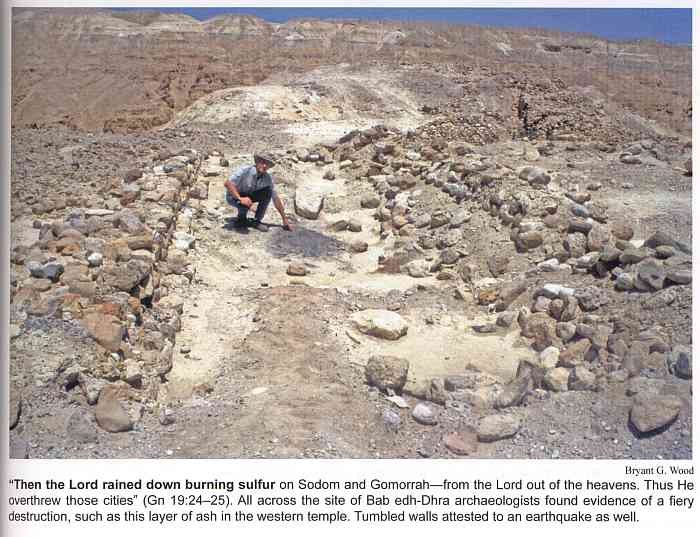
When the first beams of the morning dawn, the inhabitants of Sodom are not aware of the departure of Lot and the angels. They were determined to abuse the strangers, but as they come to the house of Lot, it is found vacant, and the hour of doom comes upon them. And the Lord rains fire and brimstone upon the city, and the beautiful plain that looked like Paradise when the angels passed over it, now looks like a parched and blackened desert. The smoke of the burning goes up like the smoke of a great furnace, and the whole heaven is illuminated with the flames of the great conflagration. Sodom has become a place of desolation and ruin.

The sin of the people rose up to heaven, and because of the iniquity of the people, the Lord poured out the vials of his wrath. The fearful doom of Sodom stands forth as a warning for all time, and especially for those who live in the last days. The destruction of Sodom was a symbol of the destruction that will come upon the finally impenitent, when tempests of fire come from above, and fountains of flame break forth from the crust of the earth. The fate of this ancient city should be a warning to all who live for self, and who corrupt their ways before God. The sin of Sodom is the sin of many cities now in existence, that have not been destroyed as was Sodom. Ezekiel says, "Behold, this was the iniquity of thy sister Sodom, pride, fullness of bread, and abundance of idleness was in her and in her daughters, neither did she strengthen the hand of the poor and needy. And they were haughty, and committed abomination before me; therefore I took them away as I saw good."

The warning that was given to Lot comes down to us who live in this degenerate age,--"Escape for thy life." The voice of the tempter is crying peace and safety. The evil one would have you feel that you have nothing to fear, and bids you eat, drink, and be merry. Which voice will you heed, the voice of heaven, or the voice that lures you to destruction? The Redeemer of the world, the compassionate Friend of man, discloses to our eyes the fact that there is a sin greater than the sin of Sodom. It is that of sinning against greater light. To those who have heard and have not heeded the gospel invitation to repent and have faith in Christ, the sin is greater than was the sin of Sodom. To those who have professed the name of Jesus, who have professed to know God, and to keep his commandments, and yet who have misrepresented Christ in their daily life and character, who have been warned and entreated, and still dishonor their Redeemer by their unconsecrated lives, the sin is greater than that of Sodom.

Jesus said: Woe unto thee, Chorazin! woe unto thee, Bethsaida! for if the mighty works, which were done in you, had been done in" Tyre and Sidon, they would have repented long ago in sackcloth and ashes. But I say unto you, It shall be more tolerable for Tyre and Sidon at the day of judgment, than for you. And thou, Capernaum, which art exalted unto heaven, shall be brought down to hell; for if the mighty works, which have been done in thee, had been done in Sodom, it would have remained unto this day. But I say unto you, That it shall be more tolerable for the land of Sodom in the day of judgment, than for thee." The warning of Christ sounds down along the lines to our day. He would arouse the people for whom he gave his life, and attract their attention to himself, the source of all wisdom, righteousness, strength, and hope, and peace. He would have his people let their light shine forth to the world in good works. The sins of Sodom are repeated in our day, and the earth is destroyed and corrupted under the inhabitants thereof; but the worst feature of the iniquity of this day is a form of godliness without the power thereof. Those who profess to have great light are found among the careless and indifferent, and the cause of Christ is wounded in the house of its professed friends. Let those who would be saved, arouse from their lethargy, and give the trumpet a certain sound; for the end of all things is at hand. 


The Signs of the Times October 9 & 16, 1893
.

Saturday, October 12, 2013

The Doom of Sodom a Warning for the Last Days


October 16, 1893

By Mrs. E. G. White

How hard it was for Lot to leave Sodom! Part of his family had to be left behind, and all the wealth he had accumulated had to be sacrificed. He must go out from Sodom a poor man. The labor of years has to be counted in vain. He does not feel the terrible necessity for God’s judgment to fall upon the wicked city, and he still lingers. The angels urge his immediate departure; but Lot, stupefied with sorrow for the loss of his children and property, still hesitates. The angels lay hold of his hands, and the hands of his wife and children, and with merciful violence hasten them out of the city. When they reach the city limits, a word of command is given with startling vehemence: “Escape for thy life; look not behind thee, neither stay thou in all the plain; escape to the mountain, lest ye be consumed.” A few moments’ delay now, a few moments of hesitancy, a few moments’ disregard of the warning, will cost the fugitives their lives. They are not even to turn their eyes back to see if their beautiful home has survived the general ruin, or the storm will burst upon them. God has delayed his retributive judgment only that they may escape. What care, what tenderness, to these four who flee from the doomed city!

Lot is confused, terrified, and distracted. He begs to be allowed to rest at a little settlement on this side the mountains. Unbelief sprang up in his heart, and he said: “Oh, not so, my Lord; behold now, thy servant hath found grace in thy sight, and thou hast magnified thy mercy, which thou hast showed unto me in saving my life; and I cannot escape to the mountain, lest some evil take me, and I die; behold now, this city is near to flee unto, and it is a little one; oh, let me escape thither (is it not a little one?) and my soul shall live. And he said unto him, See, I have accepted thee concerning this thing also, that I will not overthrow this city, for the which thou hast spoken. Haste thee, escape thither; for I cannot do anything till thou be come thither. Therefore the name of the city was called Zoar.”

But why should Lot not have trusted the mercy of the angels in directing him to escape to the mountains, since he ascribed to them the saving of his life? Lot’s stay in Sodom had not tended to increase his faith in God, nor had his intercourse with those who knew not God tended to convert them from the error of their way. He had pleaded that the angels permit him to take up his abode in the city of Zoar, saying, “Is it not a little one? and my soul shall live,” as though the God who had directed his escape from Sodom did not understand how to preserve the life he had saved. But what mercy and condescension are manifested by the God of heaven! His request is heard, and his plea granted; yet how much better would it have been to heed the angel’s voice, and go to the mountains, as far as possible from the wicked city. The angel bids him to hasten, because the fiery storm would be widespread and terrible.

One of the four fugitives ventures to cast a lingering look behind, to see the coming storm, and the number is less by one; for she stands as a memento of God’s wrath, turned into a pillar of salt. Had Lot earnestly and firmly fled to the mountains, as the angels had directed, without pleading for a new plan, his wife would not have transgressed the commandment of the angels, and would have been at his side.

When the first beams of the morning dawn, the inhabitants of Sodom are not aware of the departure of Lot and the angels. They were determined to abuse the strangers, but as they come to the house of Lot, it is found vacant, and the hour of doom comes upon them. And the Lord rains fire and brimstone upon the city, and the beautiful plain that looked like Paradise when the angels passed over it, now looks like a parched and blackened desert. The smoke of the burning goes up like the smoke of a great furnace, and the whole heaven is illuminated with the flames of the great conflagration. Sodom has become a place of desolation and ruin.

The sin of the people rose up to heaven, and because of the iniquity of the people, the Lord poured out the vials of his wrath. The fearful doom of Sodom stands forth as a warning for all time, and especially for those who live in the last days. The destruction of Sodom was a symbol of the destruction that will come upon the finally impenitent, when tempests of fire come from above, and fountains of flame break forth from the crust of the earth. The fate of this ancient city should be a warning to all who live for self, and who corrupt their ways before God. The sin of Sodom is the sin of many cities now in existence, that have not been destroyed as was Sodom. Ezekiel says, “Behold, this was the iniquity of thy sister Sodom, pride, fullness of bread, and abundance of idleness was in her and in her daughters, neither did she strengthen the hand of the poor and needy. And they were haughty, and committed abomination before me; therefore I took them away as I saw good.”

The warning that was given to Lot comes down to us who live in this degenerate age,—“Escape for thy life.” The voice of the tempter is crying peace and safety. The evil one would have you feel that you have nothing to fear, and bids you eat, drink, and be merry. Which voice will you heed, the voice of heaven, or the voice that lures you to destruction? The Redeemer of the world, the compassionate Friend of man, discloses to our eyes the fact that there is a sin greater than the sin of Sodom. It is that of sinning against greater light. To those who have heard and have not heeded the gospel invitation to repent and have faith in Christ, the sin is greater than was the sin of Sodom. To those who have professed the name of Jesus, who have professed to know God, and to keep his commandments, and yet who have misrepresented Christ in their daily life and character, who have been warned and entreated, and still dishonor their Redeemer by their unconsecrated lives, the sin is greater than that of Sodom.

Jesus said: “Woe unto thee, Chorazin! woe unto thee, Bethsaida! for if the mighty works, which were done in you, had been done in Tyre and Sidon, they would have repented long ago in sackcloth and ashes. But I say unto you, It shall be more tolerable for Tyre and Sidon at the day of judgment, than for you. And thou, Capernaum, which art exalted unto heaven, shall be brought down to hell; for if the mighty works, which have been done in thee, had been done in Sodom, it would have remained unto this day. But I say unto you, That it shall be more tolerable for the land of Sodom in the day of judgment, than for thee.”

The warning of Christ sounds down along the lines to our day. He would arouse the people for whom he gave his life, and attract their attention to himself, the source of all wisdom, righteousness, strength, and hope, and peace. He would have his people let their light shine forth to the world in good works. The sins of Sodom are repeated in our day, and the earth is destroyed and corrupted under the inhabitants thereof; but the worst feature of the iniquity of this day is a form of godliness without the power thereof. Those who profess to have great light are found among the careless and indifferent, and the cause of Christ is wounded in the house of its professed friends. Let those who would be saved, arouse from their lethargy, and give the trumpet a certain sound; for the end of all things is at hand.
 
 
The Signs of the Times, October 16, 1893
.
.

Friday, August 09, 2013

Romanism the Religion of Human Nature


 "It is a backsliding church that lessens the distance between itself and the papacy."
Signs of the Times, Feb.19,1894.


There is great need that all who claim to be Bible Christians should take the Scriptures as they read. There is need of arriving at right conclusions as to what the Scriptures mean in their reference to the man of sin, who thought to change times and laws. He had no real power to change the time and the law of God, but he thought himself able to do this work; for he "opposeth and exalteth himself above all that is called God, or that is worshiped; so that he as God sitteth in the temple of God, showing himself that he is God." He is an imitator of the first great rebel, the originator of sin. In heaven Satan thought to change the laws of God, and for this purpose he changed his character and his position in the heavenly courts, and influenced others until they united with him in the work of rebellion against God; but he did not succeed in changing the law of God. God did not alter or change his form of government to suit Satan's ideas, but made it manifest that the foundation of his government in heaven and earth is as unchangeable as is the throne itself.

When Satan could not induce all the angels to revolt against the law of God, he made the earth the scene of his rebellion, and through the man of sin seeks to carry out his diabolical purpose. Through the Papacy, the Roman power, the man of sin, the purpose of Satan is carried out among men; the law and the time of God are set aside. In this we see that Protestantism is giving encouragement to popery; and false systems of worship, against which our fathers manfully opposed themselves, imperiling even property and life, are fostered and cherished and encouraged to extend and gain wide influence. Protestants do not search their Bibles as they should, and do not heed the warning that has been given concerning the work of the man of sin. The Roman Church claims that the pope is invested with supreme authority over all bishops and pastors, and this claim of supremacy was once denied by Protestants. They took the position that the Bible, and the Bible alone, constituted the rule of faith and doctrine, that the word of God is the only unerring guide for human souls, and that it is unnecessary and harmful to take the words of priests and prelates instead of the word of God.

To the Romanist the Bible is a forbidden book, because it plainly reveals the errors of the Roman system; and whoever searches the Bible with an enlightened understanding, cannot long be in harmony with Romanism. He who searches the Bible to understand the truth, will find no authority in the word of God for the assumption of power on the part of popes and cardinals. There is no word of God that sanctions their assumed superiority or supremacy over their people, as there is no word to sanction the claim that Lucifer made in heaven of superiority over Christ. The claim of the Papacy to superiority is made under the influence of the first great usurper, who so persistently urged his right to supremacy over the host of God. Through the Dark Ages,--that long night of ignorance and superstition,--the claim of the Papacy to superiority and supremacy was conceded by emperors and kings, although God had sanctioned no such concession, and raised up men to dispute the claim, and to break the Romish yoke from the church of God. Through his appointed agencies God summoned the church to reassert her independence, and in the strength of God she stood forth in the liberty wherewith Christ had made her free. She broke away from the papal yoke, and with the word of God in her hand, met the giant evil of Romanism, even as David met Goliath in the name of heaven, using his sling and a few pebblestones. The defier of Israel was slain before the man of faith; and while men cling to the word of the Lord, they cannot affiliate with the great system of error.

The Lord has pronounced a curse upon those who take from or add to the Scriptures. The great I AM has decided what shall constitute the rule of faith and doctrine, and he has designed that the Bible shall be a household book. The church that holds to the word of God is irreconcilably separated from Rome. Protestants were once thus apart from this great church of apostasy, but they have approached more nearly to her, and are still in the path of reconciliation to the Church of Rome. Rome never changes. Her principles have not altered in the least. She has not lessened the breach between herself and Protestants; they have done all the advancing. But what does this argue for the Protestantism of this day? It is the rejection of Bible truth which makes men approach to infidelity. It is a backsliding church that lessens the distance between itself and the Papacy.

It is souls like Luther, Cranmer, Ridley, Hooper, and the thousands of noble men who were martyrs for the truth's sake, who are the true Protestants. They stood as faithful sentinels of truth, declaring that Protestantism is incapable of union with Romanism, but must be as far separated from the principles of the Papacy as is the east from the west. Such advocates of truth could no more harmonize with "the man of sin" than could Christ and his apostles. In earlier ages the righteous felt that it was impossible to affiliate with Rome, and, though their antagonism to this system of error was maintained at risk of property and life, yet they had courage to maintain their separation, and manfully struggled for the truth. Bible truth was dearer to them than wealth, honor, or even life itself. They could not endure to see the truth buried under a mass of superstition and lying sophistry. They took the word of God in their hands, and raised the standard of truth before the people, boldly declaring that which God had revealed unto them through diligent searching of the Bible. They died the cruelest of deaths for their fidelity to God, but by their blood they purchased for us liberties and privileges that many who claim to be Protestants are easily yielding up to the power of evil. But shall we yield up these dearly bought privileges? Shall we offer insult to the God of heaven, and, after he has freed us from the Romish yoke, again place ourselves in bondage to this antichristian power? Shall we prove our degeneracy by signing away our religious liberty, our right to worship God according to the dictates of our own conscience?

The voice of Luther, that echoed in mountains and valleys, that shook Europe as with an earthquake, summoned forth an army of noble apostles of Jesus, and the truth they advocated could not be silenced by fagots, by tortures, by dungeons, by death; and still the voices of the noble army of martyrs are telling us that the Roman power is the predicted apostasy of the last days, the mystery of iniquity which Paul saw beginning to work even in his day. Roman Catholicism is rapidly gaining ground. Popery is on the increase, and those who have turned their ears away from hearing the truth are listening to her delusive fables. Papal chapels, papal colleges, nunneries, and monasteries are on the increase, and the Protestant world seems to be asleep. Protestants are losing the mark of distinction that distinguished them from the world, and they are lessening the distance between themselves and the Roman power. They have turned away their ears from hearing the truth; they have been unwilling to accept light which God shed upon their pathway, and are therefore going into darkness. They speak with contempt of the idea that there will be a revival of the past cruel persecution on the part of Romanists and those who affiliate with them. They do not recognize the fact that the word of God fully predicts such a revival, and will not concede that the people of God in the last days shall suffer persecution, although the Bible says, "The dragon was wroth with the woman, and went to make war with the remnant of her seed, which keep the commandments of God, and have the testimony of Jesus Christ."

Popery is the religion of human nature, and the mass of humanity love a doctrine that permits them to commit sin, and yet frees them from its consequences. People must have some form of religion, and this religion, formed by human device, and yet claiming divine authority, suits the carnal mind. Men who think themselves wise and intelligent turn away in pride from the standard of righteousness, the ten commandments, and do not think it is in harmony with their dignity to inquire into the ways of God. Therefore they go into false ways, into forbidden paths, become self-sufficient, self inflated, after the pattern of the pope, not after the pattern of Jesus Christ. They must have the form of religion that has the least requirement of spirituality and self-denial, and as unsanctified human wisdom will not lead them to loathe popery, they are naturally drawn toward its provisions and doctrines. They do not want to walk in the ways of the Lord. They are altogether too much enlightened to seek God prayerfully and humbly, with an intelligent knowledge of his word. Not caring to know the ways of the Lord, their minds are all open to delusions, all ready to accept and believe a lie. They are willing to have the most unreasonable, most inconsistent falsehoods palmed off upon them as truth.

Satan's masterpiece of deception is popery; and while it has been demonstrated that a day of great intellectual darkness was favorable to Romanism, it will also be demonstrated that a day of great intellectual light is also favorable to its power; for the minds of men are concentrated on their own superiority, and do not like to retain God in their knowledge. Rome claims infallibility, and Protestants are following in the same line. They do not desire to search for truth and go on from light to a greater light. They wall themselves in with prejudice, and seem willing to be deceived and to deceive others.

But though the attitude of the churches is discouraging, yet there is no need of being disheartened; for God has a people who will preserve their fidelity to his truth, who will make the Bible, and the Bible alone, their rule of faith and doctrine, who will elevate the standard, and hold aloft the banner on which is inscribed, "The commandments of God and the faith of Jesus." They will value a pure gospel, and make the Bible the foundation of their faith and doctrine.

For such a time as this, when men are casting aside the law of the Lord of hosts, the prayer of David is applicable,--"It is time for thee, Lord, to work; for they have made void thy law." We are coming to a time when almost universal scorn will be heaped upon the law of God, and God's commandment-keeping people will be severely tried; but will they lose their respect for the law of Jehovah because others do not see and realize its binding claims? Let God's commandment-keeping people, like David, reverence God's law in proportion as men cast it aside and heap upon it disrespect and contempt.


The Signs of the Times-1894
8. Article Title: Romanism the Religion of Human Nature
.
.