Showing posts with label social doctrine. Show all posts

Sunday, May 31, 2026

Pope Leo warning on AI is just Catholic Church socialism | Fort Worth Star-Telegram

 Pope Leo warning on AI is just Catholic Church socialism | Fort Worth Star-Telegram

Pope Leo’s warning on AI is just more Catholic Church socialism | Opinion 


By our readers May 31, 2026 5:07 AM 


The dignity of labor is overrated. We can all get a hobby. Getty Images 

Catholic socialism 

Ayn Rand, an advocate for rationality and capitalism, referred to the pope as the “highest authority of the opposite side.” She saw mysticism as more dangerous than communism. In his recent encyclical, Pope Leo demonstrates this. He essentially calls for the economy to be kept inefficient so everyone can have a job to stay active and feel useful. 

Won’t people see through the ruse of unnecessary make-work whose only purpose is to reassure the workers? It’s been said we could cure unemployment by requiring that excavation be done only with teaspoons, but that’s no way to run an economy. 

I have misgivings about artificial intelligence, but the pope’s warnings about “forced inactivity” and “anthropological regression” (whatever that is) are not among them. The dignity of labor is overrated. We can all get a hobby. The Catholic Church is a socialist institution. 

- George Michael Sherry, Fort Worth

Source


Monday, May 25, 2026

Vance ‘looking forward to reading’ Pope Leo’s AI encyclical


by Kate Scanlon - OSV News May 20, 2026


U.S. Vice President JD Vance speaks during a press briefing at the White House in Washington, D.C., U.S., May 19, 2026. (OSV News photo/Kevin Lamarque, Reuters)


WASHINGTON (OSV News) — Vice President JD Vance said May 19 during a press briefing at the White House that he is “looking forward to reading” Pope Leo XIV’s upcoming first encyclical, “Magnifica Humanitas,” addressing artificial intelligence.

“I think when the pope issues an encyclical on artificial intelligence, it’s going to have some influence,” Vance said in response to a question on the topic, adding, “I, of course, don’t know how much influence. I don’t know exactly what it’s going to say, but I think when the leader of the world’s largest Christian denomination speaks on an issue like that, it’s certainly going to have some influence.”

The title of the encyclical is Latin for “Magnificent Humanity,” and it will address artificial intelligence and human dignity, the Vatican has announced. It will be published May 25.

Vance said he is sure the encyclical will “contain a lot of insights, some of which I’ll probably agree with, some of which I may not, but I think that it’s going to be a very, very important document.”

In response to a related question on whether the government should create a new mandatory review process for new AI models, Vance argued that President Donald Trump “wants us to be pro-innovation” on AI.

“He wants us to win the AI race against all other countries in the world,” Vance said. “He recognizes that AI is going to be an important tool, not just for our economy, but for our military, and so he wants to ensure that we are winning that particular race. We also want to make sure that we’re protecting people, we’re protecting people’s data, we’re protecting people’s privacy.”

But Vance also acknowledged the technology “does have some downsides.”

“We’re trying to balance that safety against innovation, and we think that we’ve got the right balance here in the Trump administration, but something we’re going to have to keep on working on, because that’s just the nature of these technologies, is they certainly change,” he said.

Pope Leo has consistently expressed interest in the issue of artificial intelligence and the dignity of work since the first days of his pontificate, telling the College of Cardinals shortly after his election in May 2025 that he took his papal name partly in honor of Pope Leo XIII, whose landmark encyclical “Rerum Novarum” has shaped the Church’s social teaching for more than a century.


Friday, May 22, 2026

‘Colossal profits’: Christian leaders lambast fossil fuel giants as they demand EU windfall tax


Copyright European Union, 2025, licensed under CC BY 4.0


By Ruth Wright
Published on 21/05/2026 - 6:30 GMT+2

“Europe holds a historic duty and opportunity to lead the transition to a new era away from fossil fuels”, say faith groups from across the EU.

A coalition of Christian organisations has issued an urgent appeal to EU institutions: phase out fossil fuels and tax those who profit from them.

120 organisations from 20 EU countries have signed the first ever appeal of its kind.

“Europe has a unique opportunity and the moral responsibility to accelerate the phase out of fossil fuels and shift to clean energy, including through a permanent tax on the colossal profits of fossil fuel companies”, the document says. It was recently revealed by the Guardian newspaper that the world’s top 100 oil and gas companies made more than $30 million (€25.8m) every hour in profit in the first month of the US-Israeli war in Iran.

The appeal calls on the EU to “remain steadfast in its founding values of human dignity and the common good by accelerating a just energy transition.”

Signatory organisations include European and national faith-based institutions, including episcopal bodies, religious orders, social and environmental NGOs, international development charities, and Christian movements and communities. Organisations include Laudato Si’ Movement, Caritas Europa and the Central Committee of German Catholics.

What the Vatican Just Released on Gay Catholics — and Where Pope Leo Stands

Letters from Leo 


An explainer on Study Group 9’s final report, the two testimonies that surprised everyone, and the synodal process Pope Leo XIV is letting run.

Christopher Hale
May 20, 2026


On May 5, three days before the first anniversary of Pope Leo XIV’s election, the Vatican released a document with a title built to put readers to sleep: “Theological Criteria and Synodal Methodologies for Shared Discernment of Emerging Doctrinal, Pastoral, and Ethical Issues.”

Within forty-eight hours, James Martin had called it historic, Cardinal Gerhard Müller had branded it heretical, and Father Gerald Murray, speaking on EWTN, used the word horrific.

The reason is buried in two appendices.

Here is what Study Group 9 is, and what its report actually does.

The body and the assignment

Study Group 9 is one of ten committees Pope Francis spun out of the Synod on Synodality in early 2024.

Each was handed a question the synod assembly could not finish in the room. Group 9 drew the hardest topic — what the Vatican initially labeled “controversial doctrinal, pastoral, and ethical issues.” Same-sex relations sat at the top of the list. The role of women, divorce and remarriage, and questions of conscience were also on the docket.

The group’s chair is Cardinal Carlos Gustavo Castillo Mattasoglio, the Peruvian archbishop of Lima. Robert Prevost — the missionary who spent nearly four decades in Peru before becoming Pope Leo XIV — knows him well.

The committee’s first symbolic act came before publication. It renamed its own assignment. “Controversial issues” became “emerging issues.” Group 9 wrote that the change was meant to register a “paradigm shift” away from a Church that hands down rulings and toward a Church that learns by listening.

Tuesday, May 19, 2026

Pope Leo XIV’s first encyclical Magnifica humanitas to be published May 25


Pope Leo XIV

Pope Leo XIV’s first encyclical, Magnifica humanitas, on safeguarding the human person in the time of artificial intelligence, will be released on May 25. A presentation event with the Pope and various speakers is scheduled for the same day at the Vatican.

Vatican News

Pope Leo XIV’s first Encyclical Letter Magnifica humanitas, on safeguarding the human person in the time of artificial intelligence, will be released on May 25, 2026.

It bears the Pope’s signature dated May 15th, 135th anniversary of the publication of Pope Leo XIII’s encyclical Rerum novarum.

Magnifica humanitas will be presented on the day of its release at 11:30 a.m. at the Vatican’s Synod Hall.

The Pope will be present, along with several speakers: Cardinal Víctor Manuel Fernández, Prefect of the Dicastery for the Doctrine of the Faith; Cardinal Michael Czerny, S.J., Prefect of the Dicastery for Promoting Integral Human Development; Professor Anna Rowlands, a theologian and professor at Durham University (United Kingdom); Christopher Olah, co-founder of Anthropic (USA) and head of research on the interpretability of artificial intelligence; and Professor Leocadie Lushombo, I.T., professor of political theology and Catholic social thought at the Jesuit School of Theology / Santa Clara University in California (USA).

Cardinal Secretary of State Pietro Parolin will offer closing remarks, followed by an address and blessing by Pope Leo XIV.


Friday, May 01, 2026

What is May Day? For the most part, the opposite of capitalism


May Day demonstrators march through downtown Los Angeles last year. Thousands of people took to the streets across the nation that May 1 in rallies calling for immigration reform, workers' rights and police accountability.Ringo H.W. Chiu/AP


Updated May 1, 2024
9:15 AM ET


May Day, celebrated by workers across the globe as International Labor Day, falls on May 1.

But you'd be forgiven if that's news to you. While the day traces its origins to an American laborers' fight for a shorter work day, the U.S. does not officially recognize International Labor Day.

Like other countries that mark Labor Days on different dates, the U.S. and Canada celebrate their Labor Day in September.

U.S. resistance to celebrate International Labor Day — also called International Workers' Day — in May stems from a resistance to emboldening worldwide working-class unity, historians say.

"The ruling class did not want to have a very active labor force connected internationally," said Peter Linebaugh, author of The Incomplete, True, Authentic, and Wonderful History of May Day. "The principle of national patriotism was used against the principle of working-class unity or trade union unity."

That hasn't stopped American workers from commemorating the day, which in recent years has ranged from marching for labor rights to reading literature about Marxism.

"The meaning of that day keeps changing," Linebaugh said.

Before we consider how May Day has evolved in the U.S., let's dive into how it all began.

Saturday, April 04, 2026

Hegseth Says U.S. Troops Are Fighting for Jesus. The Pope Disagrees.

In sharp contrast to the Trump administration’s calls for Christian prayers for the war effort, Pope Leo XIV says military domination is “entirely foreign to the way of Jesus Christ.”


Pope Leo, during the Holy Thursday Mass in Rome, said the Christian mission had often been “distorted by a desire for domination.”Credit...Vincenzo Livieri/Reuters


By Motoko Rich

Reporting from Rome
April 3, 2026


Pete Hegseth, the U.S. defense secretary, has asked the American people to pray “every day, on bended knee” for a military victory in the Middle East “in the name of Jesus Christ.”

Pope Leo XIV, the first U.S.-born pontiff, has a starkly different take on what should be done in Jesus’s name.

In a homily during a Mass on Thursday morning before Easter, the pope said that the Christian mission has often been “distorted by a desire for domination, entirely foreign to the way of Jesus Christ.”

Since the United States and Israel began bombing Iran in late February, the pope has consistently called for an end to the violence and a return to dialogue to resolve the conflict. But without naming Mr. Hegseth, he has also pointed out the ways in which Christianity has been marshaled for purposes that the pope says do not align with Catholic teaching.

Thursday, March 05, 2026

Regularisation of migrants in Spain: ‘Every person is an end in themselves'


A man walks the beach in Las Palmas, Spain, a week after arriving from Gambia (AFP or licensors)
World

Regularisation of migrants in Spain: ‘Every person is an end in themselves'

Amaya Valcárcel, International Advocacy Advisor at Jesuit Refugee Service, speaks to Vatican News about the Spanish government’s recent decision to grant legal residency to hundreds of thousands of undocumented immigrants.


By Joseph Tulloch

Last month, the Spanish cabinet approved a decree granting legal residency to hundreds of thousands of undocumented migrants.

At a time when deportation and detention dominate discussions on migration elsewhere, it was a striking choice.

In Spain, irregular migrants had lived “for years in the shadows,” said Amaya Valcárcel, International Advocacy Advisor at Jesuit Refugee Service. For the estimated 500,000 to one million affected, regularisation means “recognition of their civil existence” and “a step toward legal security.”

Speaking to Vatican News via email, Valcárcel, who is Spanish, emphasised that irregular migrants carry out “indispensable” work in Spain, in sectors such as agriculture, hospitality, construction and domestic work. However, without access to formal job contracts or safety nets, they live “under constant risk”.

Wednesday, October 01, 2025

Pope Leo XIV calls for more regulations to address climate change


Pope Leo XIV calls for more regulations to address climate change


By Callie Patteson

October 1, 2025 11:57 am

Pope Leo XIV called on governments worldwide to increase regulations aimed at mitigating climate change, continuing the teachings of the late Pope Francis.

The Chicago-born pope made the remarks at the Raising Hope conference just south of Rome. The conference is intended to mark the 10th anniversary of Francis's landmark encyclical on the environment.

Published in 2015, Laudato Si called on the Catholic Church to put the environment at the center of its social teachings. Francis wrote that the Earth was starting to look like "an immense pile of filth," adding that the church holds a moral obligation to support efforts aimed at combating climate change.

Leo praised his predecessor's words and his impact on Wednesday, saying the encyclical has greatly inspired the church in the years since it was published.

However, Leo warned that the challenges Francis wrote about are more relevant today, not only in a religious and spiritual nature, but also in a political one.

Leo pointed to an apostolic exhortation released by Francis in 2023, which illustrated how divisive the matter of climate change has become and criticized those who have "chosen to deride the increasingly evident signs of climate change."

Francis insisted that caring for the environment is intrinsically linked with the Catholic faith, later putting pressure on individuals to more strongly advocate mitigating actions.

"Pope Francis emphasized that the most effective solutions would not come from individual efforts alone, but above all from major political decisions on the national and international levels," Leo said.

"Everyone in society, through nongovernmental organizations and advocacy groups, must put pressure on governments to develop and implement more rigorous regulations, procedures, and controls," he continued. "Citizens need to take an active role in political decision-making at national, regional, and local levels. Only then will it be possible to mitigate the damage done to the environment."

Only five months into his tenure as pope, Leo has made it clear that tackling climate change and lowering the risks of global warming for poor and vulnerable individuals will be a priority during his papacy.

In July, Leo held a special mass urging Catholics to engage in efforts aimed at combating the effects of climate change, noting that the planet is experiencing an "ecological crisis."

Leo has also prioritized environmentally friendly changes in the Vatican, including using solar power to make Vatican City the first carbon-neutral state. Additionally, he launched a new ecological center and farm dedicated to sustainability.

The American pope's emphasis on addressing climate change is a break from the current political focus of the U.S. government. President Donald Trump has rolled back numerous climate-related policies and again pulled the United States from the 2016 Paris Climate Agreement.

In recent weeks, the Trump administration has escalated pressure on the European Union to do the same, targeting methane and other climate change-related regulations that fossil fuel companies say will hurt their ability to increase exports abroad.

While Energy Secretary Chris Wright, for example, has said climate change is a real phenomenon and a global challenge, the administration has insisted it is not an essential threat and is less important to address than getting ahead in the artificial intelligence race.


Thursday, September 11, 2025

A promise is a promise


A promise is a promise

Congressman and physician Raul Ruiz MPP 2001 made a pledge to serve.


By Theo Emery
Photograph by Mark Ostow

THE SUN WAS HIGH and the suit was hot. Raul Ruiz mopped his brow with a handkerchief as he walked the sunbaked sidewalks of Coachella, California, his hometown. He had a briefcase in his hand with a stack of carefully typed contracts inside.

In the scorching summer of 1990, the teenager in the itchy blue suit went from business to business with a proposition: Donate toward his college education, and he would return to the community as a physician. He made the pledge in writing, and he stapled the donor’s card to each signed contract.

These were long odds for the son of farmworkers in a poor and dusty community down the highway from the groomed golf courses of Palm Springs. Yet Ruiz made good on that promise. Not only did he return to Coachella to practice emergency medicine, but he came back with three graduate degrees from Harvard, including a master’s in public policy from the Kennedy School.

Today the 41-year-old physician represents the 36th District of California in Congress after pulling off one of the campaign upsets of 2012. In a race that even close friends doubted he could win, he dislodged Mary Bono Mack from the seat she’d held since 1998.

Friday, August 29, 2025

Pope Leo XIV urges Catholic politicians to follow the Gospel in public life


Pope Leo XIV addresses a delegation of political representatives and civic leaders from the Diocese of Créteil, France, on Aug. 28, 2025, at the Vatican. | Credit: Vatican Media


By Nicolás de Cárdenas

ACI Prensa Staff, Aug 28, 2025 / 12:30 pm

Pope Leo XIV on Thursday encouraged Catholic politicians to live coherently as Christians and follow the Gospel, even when performing their public duties in a secular polity.

During an Aug. 28 meeting with a delegation of political representatives and civic leaders from the Diocese of Créteil, France, accompanied by Bishop Dominique Blanchet, the Holy Father stated that “a more just, more human, more fraternal world” can only be “a world more imbued with the Gospel.”

Thus, he added, “in the face of the various deviations present in our Western societies, we can do nothing better, as Christians, than to turn to Christ and ask for his help in carrying out our responsibilities.”

For this reason, the pope highlighted the importance of political and social leaders being committed to acting in coherence with their faith, because “beyond mere personal enrichment, it carries great importance and usefulness for the men and women they serve.”

In this regard, he underlined that such determination “is all the more praiseworthy considering that, in France, due to a sometimes-misunderstood secularism, it is not easy for an elected representative to act and decide consistently with their faith.”

Monday, February 03, 2025

As mass deportations ramp up, Catholic clergy and religious rally for immigrants


January 29, 2025


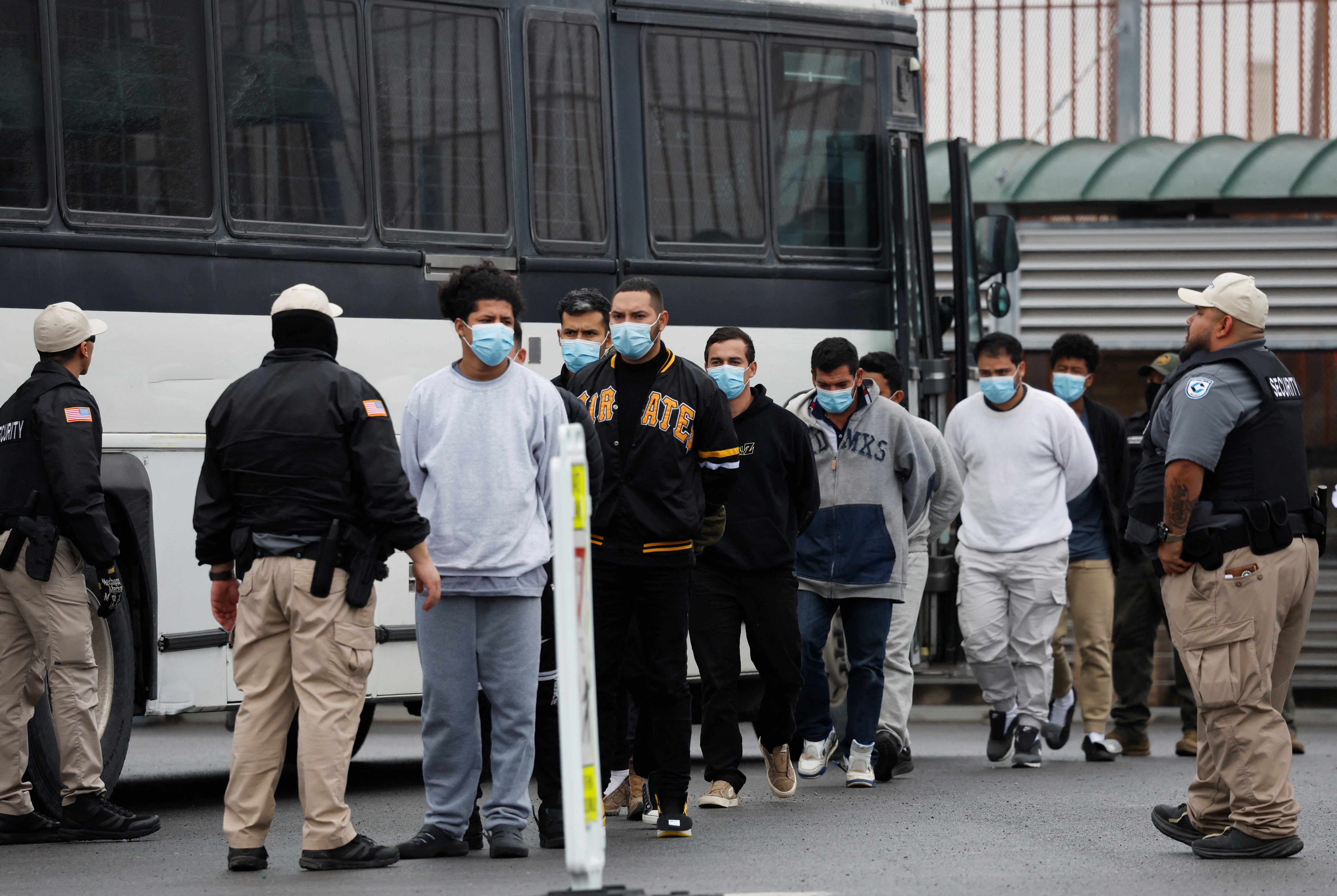
Migrants are escorted Jan. 27, 2025, across the Hidalgo International Bridge in McAllen, Texas, at the U.S.-Mexico border as they are deported under Title 8, a law that allows for immediate deportation after individuals cross into the U.S. without authorization. (OSV News photo/Daniel Becerril, Reuters)


PHILADELPHIA (OSV News) -- Clergy and religious continue to speak out against the Trump administration’s orders to carry out mass deportation operations and allow for immigration arrests in houses of worship, schools and other locations formerly designated as “sensitive.”

“I think we’re beginning to witness the fear and great concern for people who are vulnerable among us -- wonderful, wonderful people who are making our country great,” Sister Eileen Marnien, president of the Sisters of St. Joseph of Philadelphia, told OSV News.

Sister Eileen joined fellow women religious, clergy and immigrant advocates at a Jan. 25 interfaith rally in the heart of Philadelphia, urging Mayor Cherelle Parker’s administration to uphold Philadelphia’s commitment to remaining a “sanctuary city” -- a designation for municipalities that limit their cooperation with U.S. Immigration and Customs Enforcement, or ICE.

Currently, hundreds of U.S. cities, along with some dozen states, have adopted sanctuary policies. In contrast, a number of states -- including Alabama, Georgia, Florida, Iowa, Tennessee, Texas and West Virginia -- have enacted laws forbidding such policies.

At the Philadelphia rally, participants shrouded the city’s iconic LOVE sculpture, created by artist Robert Indiana, to symbolize how “love gets covered up” by hardline immigration policies.

“We feel it’s our responsibility as members of the Catholic faith, and as Sisters of St. Joseph … to stand with those who live on the margins,” said Sister Eileen.

Joining her at the rally were fellow congregation members and staff from the order’s Welcome Center, which since 2003 has provided literacy, citizenship classes and, with the approval of the U.S. Department of Justice, immigration legal services. So far, the center has helped 358 immigrants to become naturalized U.S. citizens.