Showing posts with label Lehman Bros.. Show all posts

Tuesday, October 20, 2009

Andrew Sorkin's 'Inside Story' On Financial Collapse


Georgetown Global Forum
In 2007, the World Economic Forum named Andrew Ross Sorkin a Young Global Leader.


Andrew Sorkin's 'Inside Story' On Financial Collapse


Financial journalist Andrew Ross Sorkin discusses his investigation into what really happened one year ago during the financial collapse and bailout. ...
(October 20, 2009)
http://www.npr.org/templates/story/story.php?storyId=113938903

Currently on NPR's "Fresh Air" ...


........................................................ The Story:

Andrew Sorkin's 'Inside Story' On Financial Collapse
October 20, 2009

Audio for this story from Fresh Air from WHYY will be available at approx. 3:00 p.m. ET
Transcript

October 20, 2009
Financial journalist Andrew Ross Sorkin talks with Fresh Air host Terry Gross about his investigation into what really happened one year ago, during the financial collapse and bailout. It's an epic tale that's he's documented in a new book: Too Big To Fail: The Inside Story of How Wall Street and Washington Fought to Save the Financial System — and Themselves.

Sorkin is the award-winning chief mergers and acquisitions reporter for The New York Times, where he also writes a column and serves as assistant editor of business and finance news. He founded and edits DealBook, the Times' multimedia financial journal.

Source: http://www.npr.org/templates/story/story.php?storyId=113938903

Tuesday, September 08, 2009

A year after financial crisis, a new world order emerges


AP – FILE - In this Sept. 25, 2008 file photo, a Wall St. street sign is shown in front of the American flag …


By Kevin G. Hall, McClatchy Newspapers Kevin G. Hall, Mcclatchy Newspapers – Tue Sep 8, 3:41 pm ET


WASHINGTON — One year after the near collapse of the global financial system, this much is clear: The financial world as we knew it is over, and something new is rising from its ashes.

Historians will look to September 2008 as a watershed for the U.S. economy.

On Sept. 7 , the government seized mortgage titans Fannie Mae and Freddie Mac . Eight days later, investment bank Lehman Brothers filed for bankruptcy, sparking a global financial panic that threatened to topple blue-chip financial institutions around the world. In the several months that followed, governments from Washington to Beijing responded with unprecedented intervention into financial markets and across their economies, seeking to stop the wreckage and stem the damage.

One year later, the easy-money system that financed the boom era from the 1980s until a year ago is smashed. Once-ravenous U.S. consumers are saving money and paying down debt. Banks are building reserves and hoarding cash. And governments are fashioning a new global financial order.

Congress and the Obama administration have lost faith in self-regulated markets. Together, they're writing the most sweeping new regulations over finance since the Great Depression. And in this ever-more-connected global economy, Washington is working with its partners through the G-20 group of nations to develop worldwide rules to govern finance.

"Our objective is to design an economic framework where we're going to have a more balanced pattern of growth globally, less reliant on a buildup of unsustainable borrowing . . . and not just here, but around the world," said Treasury Secretary Timothy Geithner .

The first faint signs that the U.S. economy may be clawing its way back from the worst recession since the Great Depression are only now starting to appear, a year after the panic began. Similar indications are sprouting in Europe , China and Japan .

Still, economists concur that a quarter-century of economic growth fueled by cheap credit is over. Many analysts also think that an extended period of slow job growth and suppressed wage growth will keep consumers — and the businesses that sell to them — in the dumps for years.

"Those things are likely to be subpar for a long period of time," said Martin Regalia, the chief economist for the U.S. Chamber of Commerce . "I think it means that we probably see potential rates of growth that are in the 2-2.5 (percent) range, or maybe . . . 1.8-1.9 (percent)." A growth rate of 3 percent to 3.5 percent is considered average.

The unemployment rate rose to 9.7 percent in August and is expected to peak above 10 percent in the months ahead. It's already there in at least 15 states. Regalia thinks that it could be five years before the U.S. economy generates enough jobs to overcome those lost and to employ the new workers entering the labor force.

All this is likely to keep consumers on the sidelines.

"I think this financial panic and Great Recession is an inflection point for the financial system and the economy," said Mark Zandi , the chief economist for forecaster Moody's Economy.com. "It means much less risk-taking, at least for a number of years to come — a decade or two. That will be evident in less credit and more costly credit. If you are a household or a business, it will cost you more, and it will be more difficult to get that credit."

The numbers bear him out. The Fed's most recent release of credit data showed that consumer credit decreased at an annual rate of 5.2 percent from April to June, after falling by a 3.6 percent annual rate from January to March. Revolving lines of credit, which include credit cards, fell by an annualized 8.9 percent in the first quarter, followed by an 8.2 percent drop in the second quarter.

That's a sea change. For much of the past two decades, strong U.S. growth has come largely through expanding credit. The global economy fed off this trend.

China became a manufacturing hub by selling attractively priced exports to U.S. consumers who were living beyond their means. China's Asian neighbors sent it components for final assembly; Africa and Latin America sold China their raw materials. All fed off U.S. consumers' bottomless appetite for more, bought on credit.

"That's over. Consumers can do their part — spend at a rate consistent with their income growth, but not much beyond that," Zandi said.

If U.S. consumers no longer drive the global economy, then consumers in big emerging economies such as China and Brazil will have to take up some of the slack. Trade among nations will take on greater importance.

In the emerging "new normal," U.S. companies will have to be more competitive. They must sell into big developing markets; yet as the recent Cash for Clunkers effort underscored, the competitive hurdles are high: Foreign-owned automakers, led by Toyota , reaped the most benefit from the U.S. tax breaks for new car purchases, not GM and Chrysler .

Need a loan? Tough luck: Many U.S. banks are in no condition to lend. Around 416 banks are now on a "problem list" and at risk of insolvency. Regulators already have shuttered 81 banks and thrifts this year.

The Federal Deposit Insurance Corp. reported on Aug. 27 that rising loan losses are depleting bank capital. The ratio of bank reserves to bad loans was 63.5 percent from April to June, the lowest it's been since the savings-and-loan crisis in 1991.

For all that, the U.S. economy does seem to be rising off its sickbed. The latest manufacturing data for August point to a return to growth, and home sales are rising. Indeed, there are many encouraging signs emerging in the global economy.

It's all growth from a low starting point, however, and many economists think that there'll be a lower baseline for U.S. and global growth if the new financial order means less risk-taking by lenders and less indebtedness by companies and consumers.

That seems evident now in the U.S. personal savings rate. It fell steadily from 9.59 percent in the 1970s to 2.68 percent in the easy-money era from 2000 to 2008; from 2005 to 2007, it averaged 1.83 percent.

Today, that trend is in reverse. From April to June, Americans' personal savings rate was 5 percent, and it could go higher if the unemployment rate keeps rising. Almost 15 million Americans are unemployed — and countless others are underemployed or uncertain about their job security, so they're spending less and saving more.

A few years ago, banks fell all over themselves to offer cheap home equity loans and lines of consumer credit. No more. Even billions in government bailout dollars to spur lending haven't changed that.

"The strategy that was stated at the beginning of the year — which is that you would sustain the banking system in order that it would resume lending — hasn't worked, and it isn't going to work," said James K. Galbraith , an economist at the University of Texas at Austin .

Over the course of 2008, the nation's five largest banks reduced their consumer loans by 79 percent, real estate loans by 66 percent and commercial loans by 19 percent, according to FDIC data. A wide range of credit measures, including recent FDIC data, show that lending remains depressed.

Why? The foundation of U.S. credit expansion for the past 20 years is in ruin. Since the 1980s, banks haven't kept loans on their balance sheets; instead, they sold them into a secondary market, where they were pooled for sale to investors as securities. The process, called securitization, fueled a rapid expansion of credit to consumers and businesses. By passing their loans on to investors, banks were freed to lend more.

Today, securitization is all but dead. Investors have little appetite for risky securities. Few buyers want a security based on pools of mortgages, car loans, student loans and the like.

"The basis of revival of the system along the line of what previously existed doesn't exist. The foundation that was supposed to be there for the revival (of the economy) . . . got washed away," Galbraith said.

Unless and until securitization rebounds, it will be hard for banks to resume robust lending because they're stuck with loans on their books.

"We've just been scared," said Robert C. Pozen , the chairman of Boston -based MFS Investment Management . He thinks that the freeze in securitization reflects a lack of trust in Wall Street and its products and remains a huge obstacle to the resumption of lending that's vital to an economic recovery.

Enter the Federal Reserve. It now props up the secondary market for pooled loans that are vital to the functioning of the U.S. financial system. The Fed is lending money to investors who're willing to buy the safest pools of loans, called asset-backed securities.

Through Sept. 3 , the Fed had funded purchases of $817.6 billion in mortgage-backed securities. These securities were pooled mostly by mortgage finance giants Fannie Mae , Freddie Mac and Ginnie Mae . In recent months, the Fed also has moved aggressively to lend for purchase of pools of other consumer-based loans.

Today, there's little private-sector demand for new loan-based securities; government is virtually the only game in town. That's why on Aug. 17 , the Fed announced that it would extend its program to finance the purchase of pools of loans until mid-2010. That suggests there's still a long way to go before a functioning securitization market — the backbone of consumer lending — returns to a semblance of normalcy.


Source: http://news.yahoo.com/s/mcclatchy/20090908/pl_mcclatchy/3307834

.

Monday, September 07, 2009

Remembering The 2008 Financial Nightmare

Remembering The 2008 Financial Nightmare

by Marilyn Geewax
September 6, 2009

Listen to the Story
Weekend Edition Sunday
[4 min 31 sec]
Add to Playlist
Download
Transcript


Richard Drew/AP

Timeline: A Year Of Financial Crisis


September 6, 2009


Politics and weather dominated headlines during the first week of September 2008. Sarah Palin made her national debut at the Republican National Convention, and Hurricane Gustav soaked much of the South.

But within days, the news had taken a drastic turn, as a series of stunning events paralyzed America's financial system and profoundly rattled the global economy. Stocks tumbled, and the credit markets short-circuited. Pale, frightened regulators, bankers and politicians tried haltingly to explain how they might avert an economic catastrophe.

The crisis had been long in the making. Home foreclosures had been rising at an unnerving rate for more than a year. Congressional efforts to contain the foreclosure mess had failed. By early September, investment banks were racking up huge losses tied to bad bets on mortgages. The whole housing sector was crumbling.

Read The Series Overview Read The Series Overview
Financial Crisis: One Year And Counting

Then the financial crisis hit with brute force. On Sept. 7, the federal government took over mortgage giants Fannie Mae and Freddie Mac. Separately, the board of Washington Mutual, the nation's largest savings and loan, fired its CEO because of massive mortgage losses.

On Sept. 14, a Sunday, an apparent free fall began. Bank of America announced that it would buy the collapsing Merrill Lynch to save it. But there was no saving Lehman Brothers that day. The once-mighty global financial-services firm, founded in 1850, was crushed by its massive debts and the unwillingness of the government to guarantee its survival.

Trying to bring calm before markets opened the next day, the Federal Reserve enigmatically announced extraordinary measures it was taking, "including enhancements to its existing liquidity facilities." Whatever the words, the meaning was clear: Financial markets were freezing up.

The rest of the month played out with one nightmarish development following another. The Fed slashed interest rates and threw an $85 billion rescue plan at insurance giant AIG. Federal regulators seized the failed Washington Mutual and immediately sold it to JPMorgan Chase for $1.9 billion. The Securities and Exchange Commission banned short-selling of financial-sector stocks; Congress geared up for speedy passage of a $700 billion bank bailout that became known as the Troubled Asset Relief Program.

On and on went the scramble, and down and down went confidence. Commercial paper markets froze up. That spooked businesses that needed short-term loans to buy equipment and make payroll. So the Fed intervened there, too, to keep those markets going. Goldman Sachs and Morgan Stanley morphed into bank holding companies, putting an end to the glory days of investment banks. By month's end, the U.S. economy was plunging and plunging. And no one could tell how far it would fall.

In the coming days, NPR will revisit those nerve-racking days of just a year ago. We'll look at measures taken, the human toll and whether enough has been done to avert the next crisis.


Source: http://www.npr.org/templates/story/story.php?storyId=112573372

.

Sunday, February 01, 2009

Hands Out For The Bailout


HANDS OUT FOR THE BAILOUT


By Derry Brownfield
February 1, 2009

NewsWithViews.com

Everybody wants in on the act. The banks, the auto industry, even foreign banks think Uncle Sam’s money must grow on a tree somewhere on federal lands here in the U.S. It’s like writing a letter to Santa Claus and waiting for stockings to be filled. $700 billion to the “Troubled Asset Relief Program,” $200 billion to “Fannie Mae and Freddie Mac,” $29 billion to “Bear Stearns,” $123 billion for “AIG,” $300 billion for the “Federal Housing Administration Rescue Bill,” $87 billion for “JP Morgan Chase” for financing bad trades made by Lehman Brothers, the Big Three Auto Manufacturers have their hands out, and what about those poor bankers around the world?

We should give or loan the Central Banks of Canada, England, Japan, Denmark, Europe, Norway, Australia, Sweden, Switzerland, Brazil, Mexico, South Korea and Singapore a total of about $750 billion dollars. As I have stated many times, I was one of those unfortunate farmers back in the l980’s that couldn’t pay 20% interest on our farm loans. Farmers who had borrowed more money than their total assets were worth were foreclosed upon and the COMMITTEE FOR ECONOMIC DEVELOPMENT (CED) said: “this is a good thing.” The CED wrote a Statement on National Agricultural Policy in 1956, saying there were too many farmers and the inefficient ones should be eliminated. The policy statement said: “The movement of people from farms is important to the industrial sectors of the economy as well as to agriculture.” No bailout policy for financially strapped farmers was even considered.

Based on that philosophy, there are already too many banks and these inefficient banks should be allowed to fail, but this isn’t going to happen. Our government through the actions of the Federal Reserve will keep printing fiat dollars, and using the money to bail out failing banks, corporations, or even home owners, until the entire nation fails, due to our “debt money system.”

Unlike our Federal Government, if I personally had the money to bail out a failing corporation or any business that has allowed its executives to do stupid things and make stupid mistakes, I would call a meeting of the shareholders and let them know that if they want this bail-out they must fire those who have allowed the company to get into the financial mess. Oliver Cromwell was an English political leader, who in the 1600’s once told a group: “You have sat here too long for any good you have been doing. Depart, I say, and let us have done with you. In the name of God, go!” They should “GO” without their last month’s salary and get NO benefits for leaving. But, that isn’t the way it works in this modern global society run by socialist politicians. AIG was in the process of receiving $123 billion in handouts and decided to use some of the money to have a BIG party. Public pressure was so great that when it was time to hold another junket the entire staff went incognito. According to reporters for abc15.com (KNXV) “while the company was pleading the federal government for another $40 billion dollars in loans, AIG top executives held a secret gathering at a luxury resort in Phoenix. Reporters photographed the AIG executives on hidden cameras at the Pointe Hilton Squaw Peak Resort, despite apparent efforts by the company to disguise its involvement. AIG made significant efforts to disguise the conference, making sure there were no AIG logos or signs anywhere on the property.”

Even as Chrysler cuts thousands of jobs and seeks federal aid to survive, the company still plans to pay about $30 million in retention bonuses to keep about 40 top executives. The Detroit Free Press reported that at least six Chrysler executives are due to receive bonuses of more than $1 million each to stay through August 2009. The bonus plan includes $1.89 million for manufacturing chief Frank Ewasyshyn, $1.8 million for product development chief Frank Klegon and $l.63 million for Steven Landry, executive vice-president of North American sales. Would tar and feathers be in order, or would handcuffs and jail cells be more appropriate?

You and I as US citizens and taxpayers are not even supposed to know how this money is being used. November 10th, Bloomberg News reported; “The Federal Reserve is refusing to identify the recipients of almost $2 trillion of emergency loans from American taxpayers or the troubled assets the central bank is accepting as collateral. Fed Chairman Ben S. Bernanke and Treasury Secretary Henry Paulson said in September they would comply with congressional demands for transparency in a $700 billion bailout of the banking system. Two months later, as the Fed lends far more than that in separate rescue programs that didn’t require approval by Congress, Americans have no idea where their money is going or what securities the banks are pledging in return.”

The fox is in the chicken coop, and our Federal Reserve bankers put him there. The man who was in charge of “risk” at Bear Stearns has been hired by the Federal Reserve Bank of New York to “SUPERVISE THE FINANCIAL SAFETY AND SOUNDNESS OF U.S. BANKS.” Michael Alix is now Vice President in the bank supervision group of the New York FED. He spent 12 years working at Bear Stearns, ten of which he was head of “worldwide risk management.” He was named “chief risk officer” in 2006 and held the job when the government helped rescue the bank. This can be compared to a college football coach that never had a winning season, becoming head coach for the Green Bay Packers!

In a NewsWithViews article dated, November 9, Roger Fredinburg summed up my sentiments when he wrote: “The only bailout in the news should be stories of our politicians and their felonious friends being bailed out of jail and smuggled out of the country. As a matter of fact, I think we might consider banishing them and sending them to live on a cold frozen continent more fitting with their cruel, frigid and selfish hearts. I suggest an outdoor nudist colony in Greenland.”

© 2009 Derry Brownfield - All Rights Reserved

Friday, October 10, 2008

The Sucking Sound of Ad Dollars Disappearing


Jesse Lefkowitz


Newspapers and magazines have already been hit, and hard. Even network TV and luxury advertisers may not escape this recession


It has been a lousy few years for much of the media, and 2008 has offered no respite. But to quote the hideous '70s band Bachman Turner Overdrive, b-b-b-baby, you just ain't see n-n-nothing yet.
Because on top of the wrenching change affecting essentially every non- online media, here comes a very scary-looking economic downturn.
Think of the recession, says Barclays (BCS) analyst Anthony DiClemente, "as a vine growing up a wall. Except instead of a healthy vine, like at Wrigley [Field], it's like—'feed me, Seymour'—from The Little Shop of Horrors."
Forgive the surfeit of pop-culture jokes. I'm only trying to inject levity into an extremely grim picture. According to ad tracker TNS Media Intelligence, which provided all such figures for this column, automotive and financial services were the No. 1 and No. 3 U.S. ad categories last year. We all know what happened to the latter in recent months. In 2007, Merrill Lynch (MER), Lehman Brothers (LEH), Bear Stearns (BSC), and Washington Mutual (WM) spent $213.1 million on advertising. Even if those companies' new owners spend something to reassure old customers, you're likely looking at a nine-figure sum sucked out of the ad marketplace by those guys alone. And when major carmakers report sales drops of 30%, boffo ad buys do not follow. Ford Motor's (F) ad spending was down over 31% for the first half of this year. Car sales' slide has accelerated since. In case you're wondering, the No. 2 ad category was retail, which is now under severe pressure as consumers spend less.
The consequences of all this contraction are readily apparent when you talk to key media executives. Magazines sell ads long before they appear, and advertisers already are making noises about cutting back in the first half of 2009, says one senior executive in that industry. "Everyone says they are going to keep advertising in a downturn," says another executive, who has run major sales organizations in different media. "But not everyone actually does it. That's just the reality of having to report earnings and profits." And while the wealthiest consumer may remain relatively untouched, those who have recently traded up to high-end products may slam the brakes on such consumption, raising chances that luxury advertisers will be affected, too. Food looks more likely to stay stable. One mordant TV executive puts it this way: "The auto industry is out. And Campbell's Soup (CPB) is in."
How the dollars flow—or rather don't flow—in any downturn can shape events in ways obscured until much later. As strange as it sounds today, the tech bust that started in 2000 meant that total dollars spent on online display advertising declined 21% between 2001 and 2002. And as strange as it sounds today, many established media organizations used that decline as a rationale for deemphasizing the Web in favor of their traditional businesses—and underinvestment allowed all manner of Web-only startups to outflank them in the one medium that's still growing. While online display ads will still be up in '09, says BMO Capital Markets analyst Leland Westerfield, that growth rate will likely slow. Look for search advertising to hold up, so Google should be hurt the least.
Elsewhere, Barclay's DiClemente suggests, the slowdown's effects will move up a media ladder of sorts, starting with newspapers, magazines, radio, local TV, and then hitting broadcast and—possibly—cable TV. There's a "high probability," he says, that the "advertising malaise spreads to network TV"—the one long-running medium that's held steadiest as others have fallen off.
DiClemente is forecasting a 5.5% pullback in ad spending next year, with only Web and cable TV posting ad upticks. It may be hard to conjure a scenario worse than today's, given what radio, local TV, and newspapers are currently experiencing. This has been a year in which many unthinkable things have happened—newspaper executives, for instance, mulling which days of the week they won't publish. But the coming downturn means that what once was unthinkable ... well, you better start thinking it.


Fine is BusinessWeek's MediaCentric columnist and Fine On Media blogger .


Monday, September 22, 2008

The Rage of the Previously Rich

Lehman trader copes with the sudden onset of income shrinkage.


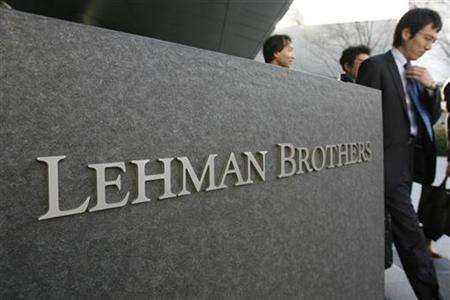
(Photo: Joshua Lott/Reuters/Landov; Person in photograph not the subject of the story)

The ’97 Barbaresco was not supposed to be opened for this. Stashed under a desk on the third floor of Lehman Brothers’ Seventh Avenue headquarters, the bottle awaited an appropriate victory. Like food, wine pairs well with vast sums of money.

But on Friday, September 12, as Lehman’s stock flatlined at $3.65 per share, the Trader knew it was time to uncork the Santo Stefano. He was in his late thirties, at the prime of his earning potential, a standout in one of Lehman’s profitable trading divisions. When the stock price had fallen below $20 a share in July, the Trader knew things were bad but took solace in the prospect of one more bonus cycle. Things are bad; things will be bad for a while. We’ll hunker down and survive, he had thought then.

But the fact that the Trader’s desk met its targets in August meant nothing at Lehman, where cascading losses from a few epic bets on commercial real estate triggered a firmwide meltdown. As one recently laid-off Lehman staffer said, in characteristic Wall Street vernacular, “These axxxs on another floor completely dropped our pants.”

Around 5:30 p.m. on Friday, as the reality sank in, the Trader assembled his staff. With the weekend looming, this would likely be the last time they would gather at Lehman as a team. The eight colleagues, friends really, stood around glowing Bloomberg terminals as the $700 Barbaresco was poured into paper cups. A crowd formed. Champagne was brought out. What they didn’t know was that upstairs, Lehman lawyers and bankers were negotiating with counterparts at Barclays, Bank of America, and the Fed, piecing together a deal. After a few minutes, the Trader was called over to open the books for the counterparties. He brushed his teeth, scrubbing the scent of wine from his breath. Leaving work at nine that evening, the Trader knew that Lehman Brothers, as he’d known it, was at an end. The culture would change, inevitably. But at that moment, he couldn’t conceive of the firm’s actually going bankrupt.

The Trader had come to Lehman only a year ago, after being recruited from a rival firm. He’d studied physics as a grad student, then come to Wall Street as the tech bubble and the aggressive gentrification of the Giuliani years remade Manhattan into a banker’s playground, a place where a $2 million salary could seem like the norm.

Like many on Wall Street, the Trader’s career was moving along briskly. By 2006, he had settled into a new $2 million house in Connecticut with a pool, and kept a pied-à-terre in Manhattan. With two young children, he had private-school tuition to cover. He had recently completed a home renovation, and now there was talk of a new porch with a built-in stainless-steel barbecue. The Trader estimated that he was two years from making enough money to retire and never have to work again.

But by Saturday, September 13, Lehman Brothers teetered on the precipice of bankruptcy after Barclays and Bank of America walked away from a deal. The Trader was certain of little, except that he was a lot poorer. The unvested stock from his previous year’s bonus, once worth $3 million, was now reduced to a scant $6,000. And on Wall Street, self-worth and net worth can amount to the same thing. “The hardest thing in my mind is to have your compensation cut,” a veteran Wall Street executive says. “It’s almost like you’re a bad person.”

At a dinner party in Darien that evening, the conversation was a mix of denial and panic. An executive from UBS lamented what the Lehman meltdown would mean for Wall Street. “This is going to be a disaster,” the executive said. The executive’s wife nervously tried to steer the topic toward lighter subjects. She kept talking about summer vacation. And then she turned to the Trader and asked, “What do you do?”

The collapse of the world’s most powerful wealth-creating engine required everyone to take stock of their financials. One Lehman executive in Rye Brook, fretting about paying off a Hamptons summer house and a ski chalet in Vermont, panicked on Monday morning and laid off her nanny, who had been with the Westchester family for nine years. “The nanny called me crying,” says Marla Sanders, who runs Advance Nannies and staffs Lehman homes. “One of the children she had brought home from the hospital.” Sanders knows more cuts for her clients are on the way. “They’re going to have to sell homes. The question is, will the homes sell? They’re cutting some of the children’s activities out, dance class, acting class. Are they going to have flowers delivered every day to their homes? I don’t think so!”

Source: http://nymag.com/news/businessfinance/50523/

P.S. xxx censored for vulgarity.

Wednesday, September 17, 2008

AP Top News at 5:39 p.m. EDT

Trader Christopher Crotty rubs his eyes as he works on the floor of the New York Stock Exchange, Wednesday Sept. 17, 2008. Wall Street stumbled again Wednesday, with anxieties about the financial system still running high even after the government bailed out the insurer American International Group Inc. (AP Photo/Richard Drew)


AP Top News at 5:39 p.m. EDT
2 hours ago

NEW YORK (AP) — Wall Street plunged again in a crisis of confidence Wednesday as anxieties about the financial system still ran high after the government's bailout of insurer American International Group Inc. The Dow Jones industrial average dropped about 450 points, and investors seeking the safety of hard assets and government debt sent gold, oil and short-term Treasurys soaring. The market was more unnerved than comforted by news that the Federal Reserve is giving a two-year, $85 billion loan to AIG in exchange for a nearly 80 percent stake in the company, which lost billions in the risky business of insuring against bond defaults. Wall Street had feared that the conglomerate, which has its tentacles in various financial services industries around the world, would follow the investment bank Lehman Brothers Holdings Inc. into bankruptcy. The ramifications of the world's largest insurer going under likely would have far surpassed the demise of Lehman.

Source: http://ap.google.com/article/ALeqM5g8-DEMtAE9q4i4ySQ0eV_qZefmRQD938NJQ01

Sunday, September 14, 2008

Weekend talks seek buyer for Lehman

With files from Reuters

WASHINGTON -- Two more large U.S. financial institutions, Lehman Brothers Holdings Inc. and Washington Mutual Inc., are scrambling to find buyers this weekend and avoid collapse as the worst U.S. banking crisis since the Depression continues unabated.

The government's dramatic seizure this week of mortgage giants Fannie Mae and Freddie Mac was designed to stabilize financial markets.

Instead, the rescue has merely shifted focus to the next weakest links in the chain of beleaguered financial service companies, putting renewed pressure on a U.S. government that appears reluctant to sink any more taxpayer money into the industry.

"Anyone hoping the Treasury's takeover of Fannie Mae and Freddie Mac would somehow mark the bottom of the credit crunch is likely sorely disappointed," said John Silvia, chief economist at Wachovia Corp. "There are still formidable financial challenges ahead for the economy."

Treasury Secretary Henry Paulson has reportedly told key industry players that he isn't prepared to bankroll any more deals, including a takeover of Lehman, one of the biggest players in the mortgage bond market.

Bank of America Corp., the largest U.S. bank by market value, was considering a joint bid for Lehman along with private equity investor J.C. Flowers and sovereign wealth fund China Investment Co., according to published reports. Lehman has declined to comment.

Senator Richard Shelby, the top Republican on the Senate banking committee, told CNBC that the Treasury and the U.S. Federal Reserve Board were trying to work a deal that involved no U.S. government money. But he said he couldn't guarantee it wouldn't be needed at some point to prevent Lehman from collapsing.

"I'm hoping that some big firm will want them more than the Fed wants them," Mr. Shelby said.

The investment bank is struggling to find a solution to the worst crisis of its 158-year history. Lehman, the No. 4 U.S. broker, wrote down its assets by $5.6-billion (U.S.) in the third quarter, triggering a second successive quarterly loss of $3.9-billion.

Lehman has so far failed to attract investors to shore up its capital position, weakened this year by its outsized exposure to commercial real estate and residential mortgage assets hard hit by the continuing credit crunch.

Meanwhile, JPMorgan Chase & Co., which swallowed Bear Stearns earlier this year with the help of a $29-billion loan from the Fed, is in "advanced talks" to acquire Seattle-based Washington Mutual, the country's largest savings-and-loan company, Reuters reported, citing a source close to the discussions.

Lehman shares fell to a 14-year low yesterday, shedding 13.5 per cent of their value. Washington Mutual tumbled by 3.5 per cent. Investor fear has also spread to other institutions, including leading brokerage Merrill Lynch & Co. Inc. and American International Group Inc., a major insurer.

"The Fed, and now Treasury, have essentially installed a take-a-number machine on their front door steps, and the lineup is getting longer by the week," Bank of Nova Scotia economist Derek Holt said in a research report.

Mr. Holt pointed out that growing credit spreads suggest the crisis isn't nearly over.

A long list of companies, from banks to auto makers, is now making the case to Washington that they too are too big to fail.

U.S. auto makers, for example, have hired lobbyists to push for $25-billion in federal loan guarantees to help them modernize and build more fuel-efficient cars.

We are witnessing the "socialization of American capitalism," and there's more coming, Mr. Holt predicted.

"The state's role in the U.S. economy was already among the greatest in the industrialized world, and it is now on the verge of running a far bigger swath ... which may further distort long-run incentives and moral hazard," he said.

Merrill Lynch economist David Rosenberg warned that it will take "some time" for the credit crunch to work its way through the supply chain.

"It started between banks, migrated into mortgages and is now working its way through to the rest of consumer credit," he said.

LEHMAN (LEH)

Close: $3.65, down 57¢

WASHINGTON MUTUAL (WM)

Close: $2.73, down 10¢

***

CREDIT CRUNCH

SAVING LEHMAN BROTHERS

Year of the bear

for banks

Lehman Bros -94.42

Washington Mutual -79.9

Merrill Lynch -68.2

Wachovia -62.5

Legg Mason -44.8

Citigroup -38.9

Percentage losses in share value in 2008

$1.21-trillion

The market cap the S&P 500 financials index has shed since its Oct. 5, 2007 high of 483.87, or about 42 per cent.

$125-billion

Amount the failure of about 700 savings and loans cost U.S. taxpayers in the late 1980s and early 1990s.

Last weekend it was Henry Paulson, the U.S. Treasury secretary leading a monumental bailout of mortgage lenders Fannie Mae and Freddie Mac. The move was greeted with a wave of relief, but within days two other lenders were brought to their knees as Washington Mutual and Lehman Brothers, the storied 158-year-old investment bank, saw their shares collapse.

This weekend, the Treasury will be joined by Federal Reserve officials and top bankers from Wall Street and around the world, including China to work up a plan to save the banks. In the rescue of Bear Stearns, the federal government agreed to absorb as much as $29-billion (U.S.) in potential losses. With Fannie-Freddie, it's been estimated it could have to inject up to $100-billion. But on Friday, the message coming from sources at Treasury was that officials were pushing for a deal, possibly with multiple suitors, that would not involve government money. A key concern is that another rescue would trigger even more bailouts.

Source: http://www.theglobeandmail.com/servlet/story/LAC.20080913.RLEHMAN13/TPStory/Business

Thursday, September 11, 2008

U.S. Government Helping to Arrange Sale of Lehman Brothers


Washington Post Staff Writers
Thursday, September 11, 2008; 7:18 PM


The Federal Reserve and Treasury are actively helping Lehman Brothers put itself up for sale, and officials are hoping a deal will be in place this weekend before Asian markets open on Monday, according to sources familiar with the matter.


The government is looking for an agreement that would not involve public money. A scenario that is emerging includes multiple suitors acquiring different pieces of the venerable investment bank, which has suffered staggering losses from its bets on real estate and mortgages.


Regulators have been in touch with Lehman on almost an hourly basis in recent days. And high-ranking officials including New York Federal Reserve President Timothy F. Geithner, Treasury Secretary Henry M. Paulson Jr. and Federal Reserve Chairman Ben S. Bernanke have been discussing a broad range of possibilities for Lehman, trying to determine what risks each outcome would pose to the financial system, the sources said on condition of anonymity because the details had not yet been finalized.


Securities and Exchange Commission Chairman Christopher Cox and Lehman chief executive Richard S. Fuld have also been speaking several times daily.


The effort comes just a few days after the Treasury and other federal regulators announced they were taking control of mortgage financiers Fannie Mae and Freddie Mac, in what was one of the largest government interventions in the private markets in history.


Lehman Brothers, which had been anxious to show it could weather the credit crisis that contributed to the firm's $3.9 billion third-quarter loss, said Wednesday that it would sell a majority stake in its investment-management division, slash its dividend and spin off about $30 billion of real estate assets.


The announcement did little to calm investors' concerns that Lehman, the smallest of the four major Wall Street investment banks, might suffer the same fate as former rival Bear Stearns, which was acquired by J.P. Morgan Chase in a deal regulators brokered in March after a bank run that shook the securities industry.


Lehman's share price fell nearly 40 percent to $4.22 at the end of trading today, continuing a precipitous fall from more than $60 a share as of February.


Goldman Sachs Group reduced its rating on the company, with one analyst saying that the restructuring "fell short of what was necessary," the Bloomberg news service reported, while Moody's Investor Services argued that the firm faced a cut in its credit rating unless it quickly enters a "strategic arrangement" with a stronger partner.


During a conference call with Lehman executives yesterday, analysts pressed for assurances that the $5.6 billion of write-downs that the firm disclosed for the quarter ended Aug. 31 -- primarily for declines in the value of assets tied to residential mortgages -- sufficiently reflected the severity of the troubles in the real estate market. The concern demonstrated the skepticism that remains even after last weekend's federal bailout of government-sponsored enterprises Fannie Mae and Freddie Mac, which play a vital role in supporting the mortgage and housing markets.


"There's still an element of doubt in terms of confidence of the financial players, and that's not going to go away just with the bailing out of Bear Stearns and the bailing out of the GSEs," said Michael Kastner, managing director of fixed income at Sterling Stamos Capital Management in New York. "What we're going to need to see is at least one quarter where the financial institutions don't show write-downs and do show profits and an ability to grow their business."


Staff writer Howard Schneider contributed to this report.


Source: http://www.washingtonpost.com/wp-dyn/content/article/2008/09/11/AR2008091102580.html?referrer=email