Showing posts with label opium. Show all posts

Sunday, May 24, 2026

Europe's drug mafia (1/2) - How drugs made the Netherlands rich | DW Documentary


Europe's drug mafia (1/2) - How drugs made the Netherlands rich | DW Documentary

DW Documentary

DW is a German public broadcast service. Wikipedia 

May 21, 2026  

For centuries, Dutch prosperity has been based on global trade. But this has always had a dark side. Drugs, like opium and cocaine, are traded too. | 


The first part of this documentary shows how the Netherlands became the European hub for narcotics.

As early as the 17th century, Dutch colonialism laid the foundation for a lucrative drug trade. Opium from Indonesia financed the rise of the trading empire. This was followed by the cultivation of coca plants on Java - which formed the basis for Amsterdam's early cocaine production. Even when international bans officially ended the trade during World War I, the system survived, underground. In the interwar period, an illegal market emerged and continues to have an impact today.

After the Second World War, drug trafficking initially seemed to be a thing of the past. But the 1960s brought radical change: with the rise of counterculture, demand grew for hashish from Morocco and heroin from the Indian subcontinent. The Netherlands responded with a unique strategy - the separation of so-called hard and soft drugs. Coffee shops were aimed at regulating consumption. But criminal structures became entrenched. Figures such as Klaas Bruinsma, the "Dutch Al Capone,” became powerful drug lords.

In the 1990s, the country became the epicenter of synthetic drugs: ecstasy pills flooded Europe, and the profits flowed into real estate and the real economy. When the old underworld generation disappeared, young criminals from working-class neighborhoods took over. Their focus was on cocaine, the ‘new’ profitable drug. The documentary shows how colonial trade routes gave rise to a modern network that continues to shape Europe's drug market to this day.


Wednesday, April 30, 2014

An Afghan Village Of Drug Addicts, From Ages 10 To 60


by Renee Montagne
April 30, 2014 3:31 AM ET


Listen to the Story
Morning Edition

8 min 44 sec


David P. Gilkey/NPR


David P. Gilkey/NPR


David P. Gilkey/NPR


David P. Gilkey/NPR


David P. Gilkey/NPR


Herat is one of the most graceful cities in Afghanistan. Its traditions go back to the Persian empire, with its exquisite blue and green glass, and its thriving poetry scene.

Now Herat is struggling with a darker side: drug addiction at a higher rate than almost anywhere else in the country.

In a dusty ravine on the outskirts of the city, Ahmad, a scruffy 20-year-old, is striking a match to inhale heroin.

It's a simple act he repeats throughout his day — heating a dark slab of heroin paste smeared on a bit of foil so he can smoke it.

Ahmad is one of hundreds of addicts who have turned a dumping ground for building material into a village. A drug village.

They used chunks of cement and tarps to honeycomb the ravine with what look like stone igloos.

Ahmad's mother, Zahra, leans against some rocks in front of their place. Her flat, gold eyes peer at us from beneath a plaid veil as she tells her story

"I used to weave carpets and also worked as a maid," she says. "Then my husband got cancer and died."

Zahra's life spiraled downward, hitting bottom when her sister-in-law returned from Iran and offered her heroin.

Now, Zahra says, "I can't do anything except beg on the street."

We pull back a red cloth to find another woman, Zahra's sister, blinking up into the light. In the center of this tiny space is a cooking area — not for food, but for heroin.

There's also a small figure moaning and moving restlessly under a filthy blue burka.

"That's my daughter," says Zahra.

She's 10, and she's hooked on heroin too.

How did such a young girl become addicted?

"When we had my sister-in-law living with us, she was addicted," says Zahra. "I would go out to other homes to do housekeeping. And my little girl Laila used to cry a lot. So my sister-in-law gave the child opium to calm her down — that's when she became an addict."

Zahra says her daughter has already gone through rehab at a clinic in the city.
But back in this drug village, the 10-year-old became addicted once again.

Few Resources To Combat Drugs

In a white-tiled office, Dr. Ezmaray Hassin runs several clinics in Herat, and he says one of them serves children as young as 4. There are an estimated 70,000 drug users here now, he says.

"There's no doubt that Afghanistan is one of the largest producers of poppy, but historically they have never been drug users," Dr. Hassin says. But more than three decades of war, which has displaced millions of Afghans, has created all sorts of upheavals, he says.

"A lot of people travel to the neighboring countries, and they got to know about narcotics and they become addicted," he adds. "And the one country that's closest to Herat is Iran."


Saleh (from left), 25, Mohammed Ibrahim, 31, and Nisar Ahmed, 23, sit in a drug rehabilitation center on the outskirts of Herat. Opium grown in Afghanistan has long been smuggled through Herat on its way to Iran and to the West. Now Herat has many drug addicts of its own. David P. Gilkey/NPR

Iran has long had one of the highest rates of drug addiction in the world. Heroin is widely used in Iran, but recently there has been a dramatic rise in the use of crystal meth.

Sitting on a bed in this clinic in Herat is Saleh, 25, who tells a story we hear again and again, from migrants and refugees who've returned from Iran with addictions.

A few years ago, he crossed the border into Iran to look for work.

"I was in Iran and I was digging wells," he begins. "Then my legs would really, really hurt, really bad. Basically it started with opium first to treat my legs — to kill the pain. And then over time I went to heroin. Then the problem became that every time I did not use heroin my legs even would hurt more. So I had to use."

Relatively speaking, Saleh is among the lucky ones. There are just 250 beds devoted to drug treatment in all of Herat.

The city's top counternarcotics officer is Faquil Gul Amini, whose office in the center of Herat is protected by trucks with mounted machine guns.

Amini's resources are limited, and the challenge is growing with the arrival of a drug he'd never seen before a couple of years ago: crystal meth, which is known in Persian as shisheh, or glass.

Amini says he has just raided meth labs in Herat and arrested a Breaking Bad kind of guy from Iran. But he has no illusions about the magnitude of the battle he faces.

"I'm afraid to say when it comes to the list of priorities for the government to deal with, the issue of drug addicts, I'm afraid to say, it's below zero," he said.

Which is why this village outside the city is full of addicts. On a hot day you can see a constant flow of men walking up and down on a path crunchy with broken glass.

They are going nowhere.


A self-proclaimed poet and scholar, Haji Ismatullah blows smoke out after taking a hit of crystal meth. He says he turned to drugs after his wife and kids were killed in a car accident. David P. Gilkey/NPR

Those who are on crystal meth are easy to spot. One we encounter has the air of a 60-something hipster. A trim gray beard. A black leather jacket. A tattoo on his hand spelling love.

His name is Haji Ismatullah, and the young men clustered around him call out, "He's a writer."

As evidence, he opens a notebook filled with elegant Persian script in red and black.

"I say poetry for the people here," he says. "For the pain of the people."

Ismatullah says he began using crystal meth after his wife and three children were killed in a car accident.

"My heart was hurting a lot after the accident when I lost my family," he says. "Some people told me if you take meth it makes you forget things. And there's a lot in Herat, so I took it."

For the first few months, it did help, he says. But, he adds with a cackle, "After that, it does not help me because it's not a good friend."

Still, Ismatullah would like some meth right now.

As we walk with him to his place, a young woman who carries herself like a dancer comes toward us. The men see her and laugh. She has lost her mind, she's crazy, they say.

She does in fact call herself by the name of a famous Iranian singer and seems to think she's on stage. Decked out in a magenta cape, turquoise beads and a turban, she tosses her head dramatically and with a kind of wild beauty.

Then she spins away, just as we reach the dwelling of Ismatullah, which resembles a stone igloo.


A man walks past a fresh grave in the Kamar Kulagh slum outside of Herat. David P. Gilkey/NPR


He goes inside the tiny place and smokes crystal meth in a glass pipe.

Afterward, he's ready to wander again, so we walk to the top of a hill to a makeshift cemetery. He takes us to a fresh grave marked by a small mound of rocks. There lies his friend Baluchi, who died two days before.

It's a moment that brings to mind a question we put earlier to a man named Mohammed, who has been residing in this drug village for six months. I asked him how he sees his future. "Look at my life, this life," he said. "The end for us is death. That's what we're waiting for."


Source
.

Sunday, October 13, 2013

signs of times


Friday, May 10, 2013


Jan 10 2013 | Bruce Telfer |


Quotes of the Times: “And this is good old Boston. The home of bean and cod. Where the Lowells talk only to Cabots, And the Cabots talk only to God.” The Boston Toast’ by John Collins Bossidy“When we sold the Heathen nations rum and opium in roll, And the Missionaries went along to save their souls”. ‘The Old Clipper Days’  by Julian S. Cutler.
 
“A New England ancestry than which one more distinguished could hardly be named.”  Rev. E.S. Lines (bishop of diocese of Newark, and president of the Newark Historical Society), referring to the ancestry of William Huntingdon Russell.
In the attempt to take over and destroy America, the Jesuits have, for a long time, had powerful allies within America.  In order to understand who these allies are and why they would work together with the Jesuits, we need to go back to the establishment of the American colonies, which were originally part of the British Empire.
When Princess Diana gave birth to two sons, for the British royal family, it was said partially in jest, that she had done her duty and produced “an heir and a spare.”  All aristocratic families were/are obsessed with the necessity of creating a male heir to carry on the family name and preserving the family fortune.  [Do you remember Henry VIII and his six wives – all for the sake of producing that vital male heir].  Since infant mortality was high in former times, as many ‘spares’ as possible were also welcome in case of the death of the first-born.
However, it was always a problem to know what to do with all the ‘spares’ – the usual custom was for the younger sons to become officers in the army or navy or alternatively to join the church as priests.  However, as the British Empire expanded several other attractive alternatives became possible.  For example, there was a growing demand for colonial administrators - but the greatest opportunities were in the area of trade and commerce.  The ‘spares’ were provided with capital and sent off into the world to seek their fortunes (and the fortunes of their families) - the most popular destinations were India and America.  Great fortunes were made by these people, and the creation of great family dynasties were nurtured and preserved by the accumulation of wealth. 
[Red Coats Vs Americans at Stoney Creek 1812]
When the American colonies revolted against the Empire, the loyalty of the ‘spares’ and their descendants, were firmly on the side of the Empire - when the Empire lost the struggle, it is assumed that most of these people all fled to Canada - but many also remained.  One of the areas that became a bastion for these pro-British Americans, was that part of New England that constitutes the states of Connecticut and Massachusetts in general, and in particular the city of Boston.  Even today Boston is well-known for its dynastical families such as the Lowells and the Cabots (and many more).  Locally, they are known as the ‘Boston Brahmins’ (after the highest class in the Hindu caste system – they even have their own distinctive accent).  Nationally, they are known as the ‘Eastern Establishment’ and the ‘Untitled Aristocracy.’  Internationally, they are known as the ruling class in America.  What is not known (or rather what has been forgotten), is that these people have never been republicans (i.e. they have never been supporters of the American constitution or the American political system).  Their first loyalty is not to the Republic of the United States of America.  Their first loyalty is to their own families (including their aristocratic connections in England).  And their instincts are aristocratic, not democratic – they despise everything to do with democratic forms of government.  Like all those who are aristocratically inclined they believe they are ‘born to rule.’  These people make natural allies for the Jesuits – they share the same philosophical outlook, they share the same goals, and they share the same hatred for the Republic of the United States of America.  [Their treasonous inclinations were on evidence during the war of 1812 (against Britain) when the ‘Essex Junto’ (named after a county in Massachusetts) advocated the succession of New England from the Union, in favour of Britain.  The ‘Essex Junto’ was made up of the ‘untitled New England aristocracy’ – they were never prosecuted for their treason].
If we examine just one of these ‘untitled New England’ families, we will be able to understand the profound influence these pro-British (and anti-American) families have had, and continue to have, over the entire spectrum of American society.  The family we will choose to study is the Russell family.  The family with, “a New England ancestry than which one more distinguished could hardly be named.”
The Russells were originally ‘de Roussel’ from Normandy, in France.  They won their aristocratic spurs when they crossed the English Channel with William the Conquer in 1066.  After the Norman Conquest, Hugue (Hugh) de Roussel was appointed Marshall of England, (the office of Marshall was to manage the horses and to protect the Monarch).  This is the beginning of the Russell aristocratic line – and if their New England ancestry was distinguished, their close connection to the English crown was even more distinguished.
In order to come down to modern times, we must jump several centuries to 1842, when we find Samuel Russell in possession of what Wikipedia calls “the largest and most important American trading house in China…” called Russell and Company.  Samuel Russell was a drug smuggler.  He made his fortune by trading goods in Turkey for opium, and then trading the opium into China for the much sort after China tea, silk and porcelain.  Samuel would have made even more money if he could have bought his opium in India and then went to China.  But unfortunately for Samuel (and all the other American traders and drug smugglers) India was a part of the British Empire and the British had a monopoly on Indian opium and they were the main players, in the opium for Chinese tea, silk and porcelain trade.
[European factories at Canton]
It is worth digressing here to examine the China trade in more detail.  The wealth of the British Empire rested on its ability to transport the trade of the world in British ships – legislation was passed in Britain and around the Empire to insure a near monopoly on international trade.  [The wealth of the present American Empire is dependent on the same arrangement – the only difference being that international trade is ‘carried’ by the American dollar].
The British system had several key hubs.  The first hub was the cotton producing southern states of America.  Cotton was a key ingredient in the industrial revolution.  The cotton was shipped to England, where it was made into textiles.  The textiles were shipped all over the world, but especially to India, which had a huge population and was hence a huge market. [Before India became a part of the British Empire it had a vibrant textile industry of its own, but the British destroyed it by imposing high taxes and tariffs on the industry.  The British then encouraged the production of opium in India for smuggling/trading into China].
The reason the British (and Americans) became drug dealers is because there was a huge demand (worldwide) for Chinese products, but the Chinese (having a long tradition of insularity and disdain for foreigners), did not want anything to do with the ‘barbarian’ Europeans, and they were not interested in importing British or American industrial or manufactured goods.  The Chinese were willing to trade for gold and silver (and sometimes the Americans were willing to use gold and silver), but the British were not willing to pay for Chinese products with gold and silver and they forced the Chinese to take opium.
[Chinese Opium Den]
When the Chinese became aware of the nefarious effects of opium addiction they made the opium trade illegal.  The British responded by using their navy to bombard the coastal Chinese cities until the Chinese relented.  The Chinese tried a second time to ban opium and to free themselves from the dominance of the drug dealers, but again the British responded by destroying Chinese cities.  Historically, these opium fueled confrontations between China and Britain are called ‘The Opium Wars’ (The First Opium War 1839-1842 – the Second 1856-1860).  The British Empire was, in large part, being funded by drug dealing.  At this point in history, opium was the single most traded commodity in international trade – it occupied the position then, what oil occupies now – just as we have oil wars now – they had opium wars then.
This imposed imperial ‘trading’ arrangement which was so lucrative, naturally attracted competitors.  The most successful competitors were American ships sailing out of the cities of Boston and Salem, in the state of Massachusetts.  [These port cities have had a long history of trading with China and it is known locally as ‘The Old China Trade’].  
The first American trading ship arrived in China in 1784 (one year after American independence).  Samuel Russell arrived in Canton, China in 1819.  Initially, he started trading on behalf of another company called Edward Carrington & Company and again according to Wikipedia Samuel traded in “various goods and products including opium, an extremely profitable activity despite being outlawed-yet protected by foreign forces.”  Samuel Russell was a drug dealer – but so was everyone else – and the armies and navies of various European nations (but especially Britain) were there to ensure the trade in opium continued uninterrupted.
[The Nemisis destroying chinese war junks during the Second Battle of Chuenpee, 7 January 1841 ]
But Samuel did not do it all on his own, there were other ‘Boston Brahmins’ in China as well (including the Cabots and the Lowells).  John Perkins Cushing was in China even before Samuel Russell, arriving there in 1803.  John Cushing’s mother was a Perkins (another Boston Brahmin family), and John Cushing went to China to manage the Perkins Company (which was already established there).  This company (Perkins and Company) later merged with the Samuel Russell run company, of Russell and Company, making Russell and Company the dominant American Company in China.  [Thus we see that the Boston Brahmins are very much inter-related both through business links and family ties – and because of these intimate links, all of their fabulously fabled fortunes originated with the opium drug trade]. 
Drug smuggling Samuel Russell had a cousin called William Huntington Russell.  William was an academic.  He spent two years studying in Germany (1831,32), attending various German universities (the home of the Jesuit inspired Illuminati).  Upon his return to America in 1832, he immediately founded the secret society of ‘The Order of Skull and Bones’ at Yale University.  [Yale has been intimately entwined with the Russell Family - Noadiah Russell being one of the founding trustees of the university].   [The name of the University comes from one of its greatest benefactors, Elihu Yale.  Elihu worked for the East Indian Company rising to the position of Governor of Madras.  His fortune, some of which he gave to Yale University, came from the opium drug trade].  [The legal entity that administers Skull and Bones and owns the society’s assets is called The Russell Trust Association].  [Harvard University, being that other elite school for ‘the untitled aristocracy’, was also endowed with money from the opium drug trade].
[Skull & Bones Secret Society]
The influence of Skull and Bones over American affairs can be demonstrated by pointing out what was foisted on the American people during the 2004 Presidential Elections – both candidates were from ‘the untitled New England aristocracy’ and both of them were members of Skull and Bones.  [George W. Bush wrote in his autobiography: “In my senior year I joined Skull and Bones, a secret society; so secret, I can’t say anything more.”  When both John Kerry and George Bush were asked by a TV show host what it meant for the American people, that both presidential candidates were members of Skull and Bones Kerry replied: “Not much because it’s a secret”].  Meet the Press, August 31, 2003.
It surely is a ‘Sign of the Times’ that presidential candidates (and other political candidates) can stand for elections in a republican/democratic society (where everything is supposed to be transparent and open), and yet they openly confess membership in a secret shadowy world, that the voting public is not allowed to know anything about.  It should be obvious that membership in such an exclusive and elitist secret society such as Skull and Bones does not fall under the category of “not much” – when it comes to consequences for the American people and the world at large.  Republican and democratic principles are meant to be about legitimate choice – in the 2004 election there was no genuine choice – if you voted for tweedledum or tweedledee – you ended up with the same thing – Skull and Bones.
To be continued…
God bless, Bruce Telfer.
For further information go to:  http://www.minormusings.com/Index.html
Extra Note:  The Russell penchant (and expertise) for creating secret societies is evident in the creation of the Jehovah’s Witnesses.  Charles Taze Russell founded the Jehovah’s Witnesses and the Watchtower (the proprietary organisation than owns and administers the JW sect) in 1881.  From the beginning of the movement there has been much speculation about the origins of the JWs and especially whether C. T. Russell was a freemason or not.  The fact that C.T. Russell was buried in the Rosemont United Cemetery (just outside Pittsburgh), with a pyramid adjacent his headstone, and on the pyramid Masonic symbols – perhaps this should be enough evidence to conclude, that he was involved with occult secret societies.   [The Watchtower publications often feature occult symbolism – the purpose of which is to alert the ‘adepts’ or the ‘initiates’ (those high ranking secret society members) of the true nature of the organisation].
Extra Note:  It would be naïve to believe that the ‘powers that be’ should abandon something as lucrative as the drug trade.  After all, it is not only lucrative from a purely monetary point of view – but it can also be used as a form of warfare by another means, as is demonstrated by what happened to China.  [The whole social fabric of China was weakened by the opium drug trade – and deliberately so, because it enabled the ‘powers that be’ to control China].  That the ‘powers that be’ have not relinquished control over the drug trade is evident with what has recently happened with ‘The Hong Kong and Shanghai Banking Corporation (HSBC) - the largest of all the European Banks.
First some more history:  the British involvement in India was originally in the hands of a private company called the ‘East India Company’ – this company was in India purely for profit.  It was this company that was behind the opium drug trade into China (it as this company that was so powerful that they could call upon the British Imperial war machine to back their plans and goals – such as the two Opium Wars against China).  It was during the first Opium War that Britain annexed the island of Hong Kong and used it as a trading post into China (still its role today).  The Hong Kong and Shanghai Banking Corporation (HSBC) was established in 1865 to facilitate trade between China and England – which was of course largely trade in opium.  Did the HSBC ever cease to be involved in the drug trade – NO!  [The same tactics (the use of drugs) that were used to destabilize China are now being used to destabilise America.  The only difference is that the drug of choice is no longer opium, but its more powerful derivative heroin, along with cocaine and its derivatives.  (Other countries are also severely hurt in the process, such as Colombia and Mexico – but they are just ‘collateral damage’ – the real target is America)]. 
The HSBC has recently been found guilty of ‘laundering’ the profits of the illegal drug industry.  After an extensive investigation by the American Government, the bank has been fined $1.2 billion - but nobody is going to jail.  The latest development is that the bank and the government have done a deal.  The deal is called a ‘deferred prosecution agreement’ (DPA).  What this ‘agreement’ means is that not one of the guilty executives at the bank will be prosecuted – no one will be held accountable.   The New York Times informs us, that state and federal officials “decided against indicting HSBC in a money-laundering case over concerns that criminal charges could jeopardize one of the world’s largest banks and ultimately destabilize the global financial system.”  NYT Dec. 10, 2012.  Which means that, the ‘too big to fail banks’ are also ‘too big to prosecute.’ 
But wait, the executives did get one punishment – they are going to have their bonuses delayed! – not denied – just delayed].  [The shareholders will be paying the fine – but they probably won’t mind, after all the bank’s profits for the previous year were $22 billion].  However, other commentators are not so generous with their assessment of the ‘slap on the hand’ as The New York Times.   Matt Taibbi, financial journalist at Rolling Stone wrote a representative piece expressing the outrage many feel (please excuse the colourful language, some of it is deleted):
“Wow. So the executives who spent a decade laundering billions of dollars will have to partially defer their bonuses during the five-year deferred prosecution agreement?  Are you ******* kidding me? That’s the punishment? The government’s negotiators couldn’t hold firm on forcing HSBC officials to completely wait to receive their ill-gotten bonuses?  They had to settle on making them ‘partially’ wait?  Every honest prosecutor in America has to be puking his guts out at such bargaining tactics.  What was the Justice Department’s opening offer–asking executives to restrict their Caribbean vacation time to nine weeks a year?... What’s the appropriate penalty for a bank in HSBC’s position?  Exactly how much money should one extract from a firm that has been shamelessly profiting from business with criminals for years and years?  Remember, we’re talking about a company that has admitted to a smorgasbord of serious banking crimes.  If you’re the prosecutor, you’ve got this bank by the *****.  So how much money should you take?  How about all of it?  How about every last dollar the bank has made since it started its illegal activity?  How about you dive into every bank account of every single executive involved in this mess and take every last bonus dollar they’ve ever earned?  Then take their houses, their cars, the paintings they bought at Sotheby’s auctions, the clothes in their closets, the loose change in the jars on their kitchen counters, every last freaking thing. Take it all and don’t think twice.  And then throw them in jail.”  Rolling Stone, Dec. 13, 2012.
 
Source
.
 

Thursday, May 31, 2012

Afghanistan: our modern opium war

Washington justified this occupation by the 'war on terror'. But it makes more sense as another theatre of the failed 'war on drugs'


Pratap Chatterjee
guardian.co.uk, Sunday 1 April 2012 11.19 EDT

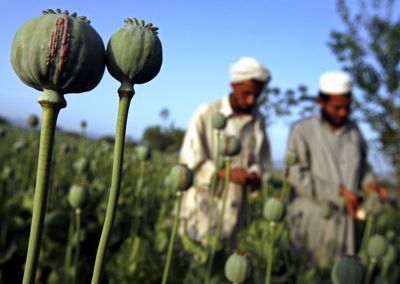
Afghan farmer with opium crop
An Afghan farmer tends his poppy crop. Photograph: Shah Marai/AFP/Getty Images


Parween, the opium farmer in Badakhsan province, who supported her ageing husband. Haji Barat, the opium merchant in the provincial capital of Fayzabad, who built a health clinic with 50 beds with his profits. Images one does not expect from war-torn Afghanistan, a country that makes headlines now only when Qur'ans are burned or another massacre takes place.

The stories of Opium Nation, a new book about Afghanistan by Fariba Nawa, an Afghan American who was born in Herat but grew up in northern California after her family fled the Soviets, offer a rare and contradictory glimpse into the drug trade that is the economic life blood of Afghanistan. This is the actual narrative that the media and politicians should be grappling with.

The author takes the reader on a seven-year journey through many provinces, in her search for the story behind Darya, a 12-year-old opium bride, who was sold by her father to pay off a debt. As Nawa nears her goal of following the young girl-turned-woman whom she meets in the opening pages, she starts to understand the complexities of the drug trade.

She discovers, for example, that not all those involved in this transnational business are simply victims or villains. Some of the farmers and traders are small-town heroes whose tales are seldom heard because they don't fit the picture we want to hear.

Nawa also discovers that the same is true of the country of her birth. She writes:

"The western media propagates an image of a romantic Afghanistan, one that cannot be conquered or tamed. Its people are unruly natives unwelcoming to modern society. Others believe that it's the white man's burden to save it from ignorance and tribalism."

When she started this odyssey in 2000, during the time of the Taliban, Nawa says that she, too, believed these myths and believed that it was her mission to save Darya. At the end, having traveled to opium bazaars and rehabilitation clinics, visited the beautiful homes of warlords and attended the Blackwater-run police training sessions to destroy the trade, she discovers that the good solutions are much harder to come by than one might hope. She concludes:

"Darya is no longer a mystery or a victim I must liberate. The Afghan women who live there are not the weak, voiceless victims they are so often made out to be in the western media."

Instead of trying to just save the victims and punish the villains of the drug trade in Afghanistan, she argues that the west needs to understand that it has taken Afghanistan 30 years to build a strong opium trade and it is unlikely to take less time to dismantle what has become the cornerstone of the national economy. "There are no short cuts, quick fixes, or shock-and-awe solutions," says Nawa. It is a lesson that would be well noted by those in power in Washington, if they are contemplating embarking on the even more ambitious project of introducing "democracy" to the struggling masses in Central Asia.

Bringing peace and prosperity to war-torn Afghanistan was a first and major mission of Barack Obama's foreign policy. Today, with the fresh new images of burnt Qur'ans and the innocent victims of the alleged rampage by a US soldier, the question of the endgame of this conflict has been pushed back to the front pages of the daily newspapers yet again. "When Qur'an Burnings Incite Riots and a Mass Murder Doesn't" was the headline of a New York Times article, puzzling over the eternal mystery of the unruly native.

Every day on TV network news, we hear the grave voices of experts on the "war on terror" speaking to us from Washington. Sometimes, it is Peter Bergen at the New America Foundation, who met Osama bin Laden; on other occasions, it is Lisa Curtis at the Heritage Foundation, who worked at the CIA.

Time and again, the media tell us that Washington is consulting books galore on how to "solve" Afghanistan. "The struggle to set the future course of the Afghan war is becoming a battle of two books – both suddenly popular among White House," declared the Wall Street Journal in 2009. Which would it be? Lessons in Disaster or A Better War, both of which are chronicles of Vietnam. Yet, with more than half the income of Afghanistan derived from the opium trade, it would a mistake to imagine that the war in Afghanistan has anything in common with fighting the Viet Cong or even Communism.

Opium Nation reminds us that Afghanistan is not just a war, but a country of many ordinary yet unique people, kind and cruel, rich and poor. Not least of all, Nawa points out the obvious, inescapable fact: the solution to the opium trade – and the war – lies not in bullets or military strategy, but in addressing the root cause, which is the demand for the drug in the west.


Saturday, April 24, 2010

Modern Day Pilgrims and Puritans


It's my opinion that a situation exists today in America simiilar to the conditions in colonial New England. Back then, there were Pilgrim settlers and Puritan settlers on the coast of present day Massachusetts. These two groups differed fundamentally in that the Pilgrims (also called Separatists) separated themselves from the Church of England to worship The Almighty God as they were led by the Holy Spirit through prayer and study of the Holy Bible; On the other hand the Puritans remained within the Corporate Body of the Church of England, and attempted to 'reform' that denomination from within its structure. The Pilgrims saw the futility in undertaking such a task, and readily 'extracted' their participation from an apostate church. During the same period the Puritans (who quickly followed the Pilgrims sojourn) enthusiastically defended the Anglican Church's sovereignty, even in the newly 'acquired' colonial territories. The Puritans saw themselves as the defenders of the Faith. While the Pilgrims sought to dedicate their efforts to worship their Creator in spirit and in truth without involving themselves in clerical matters.
.
My comparison does not refer to the doctrines the two groups espoused, or how they relate to modern Christian beliefs, But rather to their approach to livng a 'religious' lifestyle and their relationship to the 'world' .

There are two similar forces in christian churches today. There is a group similar to the Pilgrims of yesteryear who refuse to participate in an Ecumenical Corporate Structure that is genetically a clone, and also a member of the New Age organizations NCC and WCC; A Corporate Body that may own a copyright (Registered Trademark) of (on) its name.

The modern day Pilgrims separate themselves from these generic churches which are indistinguishable one from the other, since they believe the time has arrived for a millennium of peace and security. Had they read their Bibles prayerfully they would have discerned that it's time for the second coming of Jesuschrist to bring judgement to a rebellious and sinful world. To bring judgement and destruction to the evil doers; Not peace and security! Also, to save and remove His faithful servants from this corrupt environment.
.
The Puritans of today are busy planting churches on every corner, and organizing volunteer programs to help Haiti, to help the elderly, and to feed the needy. Yet, their sermons are devoid of any redeeming truths. This social gospel is not Biblical. They lie about there awaiting mankind decades of hope and prosperity; When the signs clearly point towards a time of unprecedented destruction and chaos. Had they read their Bibles, instead of People Magazine, they would have known that Jesus is at the threshold. The Puritan's counterpart now are as lost and confused as their namesakes were 400 years ago; Since the purpose of the Lord for a Church and a faithful people are not to defend corporations, societies, real estate property, or fallible men; But, rather to be the salt of the earth. To represent the Almighty God, to love, and to worship only Him with all your might. To prepare a people for the great day of the Lord. Never has it been the purpose of God to have a group of politicians using His name to further their sinful goals, and goad others to do likewise (conform).
The Puritans and the Pilgrims are alive today.


Which group are you in?
Are you in the group that wants to "fix" the church, the USA, the world?

Or, are you instead in the group that is reforming themselves and preparing others for the soon triumphant return of the Lord?


The Pilgrims and the Puritans are back!
Arsenio..

Saturday, November 14, 2009

The geopolitics behind the phoney US war in Afghanistan

by F. William Engdahl*

One of the most remarkable aspects of the Obama Presidential agenda is how little anyone has questioned in the media or elsewhere why at all the United States Pentagon is committed to a military occupation of Afghanistan. There are two basic reasons, neither one of which can be admitted openly to the public at large.

--------------------------------------------------------------------------------


21 October 2009

From
Frankfurt (Germany)


Behind all the deceptive official debate over how many troops are needed to “win” the war in Afghanistan, whether another 30,000 is sufficient, or whether at least 200,000 are needed, the real purpose of US military presence in that pivotal Central Asian country is obscured.

Even during the 2008 Presidential campaign candidate Obama argued that Afghanistan not Iraq was where the US must wage war. His reason? Because he claimed, that was where the Al Qaeda organization was holed up and that was the “real” threat to US national security. The reasons behind US involvement in Afghanistan is quite another one.

The US military is in Afghanistan for two reasons. First to restore and control the world’s largest supply of opium for the world heroin markets and to use the drugs as a geopolitical weapon against opponents, especially Russia. That control of the Afghan drug market is essential for the liquidity of the bankrupt and corrupt Wall Street financial mafia.

Geopolitics of Afghan Opium

According even to an official UN report, opium production in Afghanistan has risen dramatically since the downfall of the Taliban in 2001. UNODC data shows more opium poppy cultivation in each of the past four growing seasons (2004-2007), than in any one year during Taliban rule. More land is now used for opium in Afghanistan, than for coca cultivation in Latin America. In 2007, 93% of the opiates on the world market originated in Afghanistan. This is no accident.

It has been documented that Washington hand-picked the controversial Hamid Karzai, a Pashtun warlord from the Popalzai tribe, long in the CIA’s service, brought him back from exile in the USA, created a Hollywood mythology around his “courageous leadership of his people.” According to Afghan sources, Karzai is the Opium “Godfather” of Afghanistan today. There is apparently no accident that he was and is today still Washington’s preferred man in Kabul. Yet even with massive vote buying and fraud and intimidation, Karzai’s days could be ending as President.

The second reason the US military remains in Afghanistan long after the world has forgotten even who the mysterious Osama bin Laden and his alleged Al Qaeda terrorist organization is or even if they exist, is as a pretext to build a permanent US military strike force with a series of permanent US airbases across Afghanistan. The aim of those bases is not to eradicate any Al Qaeda cells that may have survived in the caves of Tora Bora, or to eradicate a mythical “Taliban” which at this point according to eyewitness reports is made up overwhelmingly of local ordinary Afghanis fighting to rid their land once more of occupier armies as they did in the 11980’s against the Russians.

The aim of the US bases in Afghanistan is to target and be able to strike at the two nations which today represent the only combined threat in the world today to an American global imperium, to America’s Full Spectrum Dominance as the Pentagon terms it.

The lost ‘Mandate of Heaven’

The problem for the US power elites around Wall Street and in Washington is the fact that they are now in the deepest financial crisis in their history. That crisis is clear to the entire world and the world is acting on a basis of self-survival. The US elites have lost what in Chinese imperial history is known as the Mandate of Heaven. That mandate is given a ruler or ruling elite provided they rule their people justly and fairly. When they rule tyrannically and as despots, oppressing and abusing their people, they lose that Mandate of Heaven.

If the powerful private wealthy elites that have controlled essential US financial and foreign policy for most of the past century or more ever had a “mandate of Heaven” they clearly have lost it. The domestic developments towards creation of an abusive police state with deprivation of Constitutional rights to its citizens, the arbitrary exercise of power by non elected officials such as Treasury Secretaries Henry Paulson and now Tim Geithner, stealing trillion dollar sums from taxpayers without their consent in order to bailout the bankrupt biggest Wall Street banks, banks deemed “Too Big To Fail,” this all demonstrates to the world they have lost the mandate

In this situation, the US power elites are increasingly desperate to maintain their control of a global parasitical empire, called deceptively by their media machine, “globalization.” To hold that dominance it is essential that they be able to break up any emerging cooperation in the economic, energy or military realm between the two major powers of Eurasia that conceivably could pose a challenge to future US sole Superpower control—China in combination with Russia.

Each Eurasian power brings to the table essential contributions. China has the world’s most robust economy, a huge young and dynamic workforce, an educated middle class. Russia, whose economy has not recovered from the destructive end of the Soviet era and of the primitive looting during the Yeltsin era, still holds essential assets for the combination. Russia’s nuclear strike force and its military pose the only threat in the world today to US military dominance, even if it is largely a residue of the Cold War. The Russian military elites never gave up that potential.

As well Russia holds the world’s largest treasure of natural gas and vast reserves of oil urgently needed by China. The two powers are increasingly converging via a new organization they created in 2001 known as the Shanghai Cooperation Organization (SCO). That includes as well as China and Russia, the largest Central Asia states Kazakhstan, Kyrgyzstan, Tajikistan, and Uzbekistan.

The purpose of the alleged US war against both Taliban and Al Qaeda is in reality to place its military strike force directly in the middle of the geographical space of this emerging SCO in Central Asia. Iran is a diversion. The main goal or target is Russia and China.

Officially, of course, Washington claims it has built its military presence inside Afghanistan since 2002 in order to protect a “fragile” Afghan democracy. It’s a curious argument given the reality of US military presence there.

In December 2004, during a visit to Kabul, US Defense Secretary Donald Rumsfeld finalized plans to build nine new bases in Afghanistan in the provinces of Helmand, Herat, Nimrouz, Balkh, Khost and Paktia. The nine are in addition to the three major US military bases already installed in the wake of its occupation of Afghanistan in winter of 2001-2002, ostensibly to isolate and eliminate the terror threat of Osama bin Laden.

The Pentagon built its first three bases at Bagram Air Field north of Kabul, the US’ main military logistics center; Kandahar Air Field, in southern Afghanistan; and Shindand Air Field in the western province of Herat. Shindand, the largest US base in Afghanistan, was constructed a mere 100 kilometers from the border of Iran, and within striking distance of Russia as well as China.

Afghanistan has historically been the heartland for the British-Russia Great Game, the struggle for control of Central Asia during the 19th and early 20th Centuries. British strategy then was to prevent Russia at all costs from controlling Afghanistan and thereby threatening Britain’s imperial crown jewel, India.

Afghanistan is similarly regarded by Pentagon planners as highly strategic. It is a platform from which US military power could directly threaten Russia and China, as well as Iran and other oil-rich Middle East lands. Little has changed geopolitically over more than a century of wars.

Afghanistan is in an extremely vital location, straddling South Asia, Central Asia, and the Middle East. Afghanistan also lies along a proposed oil pipeline route from the Caspian Sea oil fields to the Indian Ocean, where the US oil company, Unocal, along with Enron and Cheney’s Halliburton, had been in negotiations for exclusive pipeline rights to bring natural gas from Turkmenistan across Afghanistan and Pakistan to Enron’s huge natural gas power plant at Dabhol near Mumbai. Karzai, before becoming puppet US president, had been a Unocal lobbyist.

Al Qaeda doesn’t exist as a threat

The truth of all this deception around the real purpose in Afghanistan becomes clear on a closer look at the alleged “Al Qaeda” threat in Afghanistan. According to author Erik Margolis, prior to the September 11, 2001 attacks, US intelligence was giving aid and support both to the Taliban and to Al Qaeda. Margolis claims that “The CIA was planning to use Osama bin Laden’s Al Qaeda to stir up Muslim Uighurs against Chinese rule, and Taliban against Russia’s Central Asian allies.” [1] The US clearly found other means of stirring up Muslim Uighurs against Beijing last July via its support for the World Uighur Congress. But the Al Qaeda “threat” remains the lynchpin of Obama US justification for his Afghan war buildup.

Now, however, the National Security Adviser to President Obama, former Marine Gen. James Jones has made a statement, conveniently buried by the friendly US media, about the estimated size of the present Al Qaeda danger in Afghanistan. Jones told Congress, “The al-Qaeda presence is very diminished. The maximum estimate is less than 100 operating in the country, no bases, no ability to launch attacks on either us or our allies.”

That means that Al-Qaeda, for all practical purposes, does not exist in Afghanistan. Oops…

Even in neighboring Pakistan, the remnants of Al-Qaeda are scarcely to be found. The Wall Street Journal reports, “Hunted by US drones, beset by money problems and finding it tougher to lure young Arabs to the bleak mountains of Pakistan, al Qaeda is seeing its role shrink there and in Afghanistan, according to intelligence reports and Pakistan and U.S. officials. For Arab youths who are al Qaeda’s primary recruits, ‘it’s not romantic to be cold and hungry and hiding,’ said a senior U.S. official in South Asia.”

If we follow the statement to its logical consequence we must conclude then that the reason German soldiers are dying along with other NATO youth in the mountains of Afghanistan has nothing to do with “winning a war against terrorism.” Conveniently most media chooses to forget the fact that Al Qaeda to the extent it ever existed, was a creation in the 1980’s of the CIA, who recruited and trained radical muslims from across the Islamic world to wage war against Russian troops in Afghanistan as part of a strategy developed by Reagan’s CIA head Bill Casey and others to create a “new Vietnam” for the Soviet Union which would lead to a humiliating defeat for the Red Army and the ultimate collapse of the Soviet Union.

Now US NSC head Jones admits there is essentially no Al Qaeda anymore in Afghanistan. Perhaps it is time for a more honest debate from our political leaders about the true purpose of sending more young to die protecting the opium harvests of Afghanistan.


.
[1] Washington is Playing a Deeper Game with China, by F. William Engdahl, Voltaire Network; 13 July 2009.
.
.