Showing posts with label Alinsky. Show all posts
Showing posts with label Alinsky. Show all posts
Tuesday, January 20, 2026
Saturday, July 21, 2018
The Unholy Alliance Between George Soros and Pope Francis

Special Report
The Unholy Alliance Between George Soros and Pope Francis
May 3, 2017, 9:34 am
An excerpt from George Neumayr’s new book, “The Political Pope.”
The election of a liberal Jesuit to the papacy thrilled Democrats in the United States, whose unholy alliance with the Catholic left goes back many decades. Barack Obama, one of the pope’s most prominent supporters, has long been a beneficiary of that alliance. The faculty at Jesuit Georgetown University in Washington, D.C., ranked as one of the top donors to his campaign.
In a grim irony, Obama, whose presidency substantially eroded religious freedom in America, rose to power not in spite of the Catholic Church but because of it. The archdiocese of Chicago helped bankroll his radicalism in the 1980s. As he recounts in his memoirs, he began his work as a community organizer in the rectory rooms of Holy Rosary parish on Chicago’s South Side. The Alinskyite organization for which he worked — the Developing Communities Project — received tens of thousands of dollars from the Catholic Campaign for Human Development.
Obama was close to the late Chicago Cardinal Joseph Bernardin. A proponent of the “Seamless Garment” movement within the Catholic Church in the 1980s, a movement that downplayed abortion and emphasized political liberalism, Bernardin was drawn to the socialism and relativism of the liberal elite. He was so “gay-friendly” that he requested that the “Windy City Gay Chorus” perform at his funeral. He embodied Obama’s conception of a “good” bishop and one can see in his admixture of left-wing politics and relativistic nonjudgmental theology a foreshadowing of the rise of Pope Francis.
Cardinal Bernardin put pressure on his priests to work with Obama and even paid for Obama’s plane fare out to a 1980 training session in Los Angeles organized by Saul Alinsky’s Industrial Areas Foundation. The conference was held at a Catholic college in Southern California, Mount St. Mary’s, which has long been associated with Alinsky’s group.
This alliance between the Catholic left and the Democratic left explains the honorary degree Obama received from Notre Dame in 2009, even as he plotted to persecute the Church under Obamacare’s contraceptive and abortifacient mandate. Notre Dame’s former president, Fr. Theodore Hesburgh, who supported honoring Obama, had been close to Monsignor John Egan, the socialist who started the Catholic Campaign for Human Development and sat on Saul Alinsky’s Industrial Areas Foundation board.
The unholy alliance also explains how the Democratic Party, despite its support for abortion and gay marriage, won a majority of the Catholic vote in Obama’s two presidential elections. At the 2012 Democratic convention in Charlotte, nuns such as Sister Simone Campbell shared the stage with abortion activists from Planned Parenthood. A liberal dean of a Catholic university, Sister Marguerite Kloos, even got caught in an act of voter fraud that year, forging the signature of a deceased nun on a ballot. As Thomas Pauken writes in The Thirty Years War, “the radicalization of elements of the Catholic clergy turned out to be one of Saul Alinsky’s most significant accomplishments.”
The election of Pope Francis was seen by Alinskyite activists as a dream come true. “I think that Pope Francis is quite an inspiring figure,” Al Gore said at UC Berkeley in early 2015. The former vice president turned radical environmental activist called Pope Francis a “phenomenon” and laughed at his liberalism: “Is the pope Catholic?” Gore said that he is so “inspiring to me” that “I could become a Catholic.”
Leftists frequently turn up at the Vatican, often invited by one of Pope Francis’s closest advisers, the socialist Honduran Cardinal Oscar Rodriguez Maradiaga. Before the pope’s visit to the U.S., a group of left-wing activists and officials from unions and organizations such as the SEIU and PICO (an Alinskyite group founded by the liberal Jesuit Father John Baumann) descended on the Vatican to confer with curial officials about the trip. Around the same time, over 90 members of the U.S. Congress sent Pope Francis a letter, urging him to focus upon politically liberal themes. The leader of this group was Rosa DeLauro, a Catholic who supports abortion rights.
In 2016, it was revealed through disclosures by WikiLeaks that the billionaire socialist George Soros bankrolled much of this lobbying. He spent hundreds of thousands of dollars in an attempt to shape the pope’s visit to the U.S. According to the leaked documents, Soros’s Open Society Foundation sought to create a “critical mass” of American bishops and lay Catholics supportive of the pope’s priorities. The documents made special mention of Maradiaga, a champion of PICO, as a useful ally for ensuring that the pope’s speeches in the U.S. pushed socialism
Wednesday, May 03, 2017
The Unholy Alliance Between George Soros and Pope Francis
Special Report
George Neumayr
May 3, 2017, 9:34 am
An excerpt from George Neumayr’s new book, “The Political Pope.”
The election of a liberal Jesuit to the papacy thrilled Democrats in the United States, whose unholy alliance with the Catholic left goes back many decades. Barack Obama, one of the pope’s most prominent supporters, has long been a beneficiary of that alliance. The faculty at Jesuit Georgetown University in Washington, D.C., ranked as one of the top donors to his campaign.
In a grim irony, Obama, whose presidency substantially eroded religious freedom in America, rose to power not in spite of the Catholic Church but because of it. The archdiocese of Chicago helped bankroll his radicalism in the 1980s. As he recounts in his memoirs, he began his work as a community organizer in the rectory rooms of Holy Rosary parish on Chicago’s South Side. The Alinskyite organization for which he worked — the Developing Communities Project — received tens of thousands of dollars from the Catholic Campaign for Human Development.
Obama was close to the late Chicago Cardinal Joseph Bernardin. A proponent of the “Seamless Garment” movement within the Catholic Church in the 1980s, a movement that downplayed abortion and emphasized political liberalism, Bernardin was drawn to the socialism and relativism of the liberal elite. He was so “gay-friendly” that he requested that the “Windy City Gay Chorus” perform at his funeral. He embodied Obama’s conception of a “good” bishop and one can see in his admixture of left-wing politics and relativistic nonjudgmental theology a foreshadowing of the rise of Pope Francis.
Cardinal Bernardin put pressure on his priests to work with Obama and even paid for Obama’s plane fare out to a 1980 training session in Los Angeles organized by Saul Alinsky’s Industrial Areas Foundation. The conference was held at a Catholic college in Southern California, Mount St. Mary’s, which has long been associated with Alinsky’s group.
Friday, July 17, 2015
A return to Catholic Action

By Father Bruce Nieli|
ARTICLE SOCIAL JUSTICE
Published:
Tuesday, June 30, 2015
On Thursday night, November 20, 2014, President Barack Obama announced his executive action limiting deportations of undocumented immigrants to the most criminal cases, thereby providing freedom and hope to some 5 million people. In doing so he not only launched a process of compassion to many persons seeking a better life for themselves and their families, he also dramatically challenged Congress to pass a law encompassing broader immigration reform. Such focused confrontation from a base of power to call forth social responsibility from political leadership is something that Obama learned as a community organizer in Chicago. It was the fruit of a once powerful movement known as Catholic Action.
Chicago has been a fount of community organizing since the Great Depression, when the Catholic Church united with organized labor in the Back of the Yards neighborhood on the city’s south side. With the strong support of Cardinal George Mundelein and his auxiliary bishop, Bernard James Sheil, the Back of the Yards Council provided a voice for the immigrant communities of that impoverished neighborhood. They collaborated with community organizer and activist Saul Alinsky, whose friendship with Catholic philosopher Jacques Maritain and collaboration with Catholic Church leaders would enrich subsequent community organizing efforts. (Even Archbishop Giovanni Montini, the future Blessed Pope Paul VI, would confer with Alinsky on community organizing in Italy.)
This example of grassroots social justice, of collective listening to the cry of the poor, would have the principles of Catholic Action as its philosophical and theological base. The future U. S. president was a student and practitioner of this philosophy and theology. It is no accident that Obama’s first office was located in a Catholic church.
I pray for a return to Catholic Action. My own first contact with Catholic Action came in 1972, during my seminary internship year at our Paulist mother house, St. Paul the Apostle Church on Manhattan’s West Side. I was part of the parish team hosting a rally in our spacious church basement for Cesar Chavez and his United Farm Workers. Chavez was quick to point out that among the 2,000 participants there that day was a “saint,” Dorothy Day.
Both Chavez and Day had been heroes of mine throughout my formation in the culturally formative 1960s. So when one of the UFW members addressed our parish Cursillo group the next morning and mentioned that both he and Chavez were cursillistas, I was motivated to experience the movement myself, even though I’d been a bit hesitant up to that point.
I would later meet the Cursillo founder, Eduardo Bonnin. As a young man in Spain in the 1940s, Bonnin, I learned, belonged to something called “Catholic Action.” He and a group of other young men, disturbed by the absence of young adults in church participation, made a pilgrimage to the shrine of St. James of Compostela along the famous Camino de Santiago. After a profound conversion experience, they came up with the Cursillo method of transforming society through small communities of committed Christians.
The term “Catholic Action” described both a movement and a mentality. As a movement, Catholic Action had its beginnings in the latter part of the 19th century, when people proactively took measures to counteract the anti-clericalism running rampant, especially throughout Europe. As the church entered the 20th century, Catholic Action became more of an organized movement in which laypeople, collaborating with members of the hierarchy, worked to bring Christ and the social teachings of the Catholic Church into the greater society. Joseph Leo Cardijn, a Belgian priest and later cardinal, was the godfather of the movement. In 1919 Cardijn founded the Young Trade Unionists, which later became the Young Christian Workers—the quintessential model for Catholic Action.
Peter Maurin, who cofounded the Catholic Worker movement with Dorothy Day, penned an essay in 1933 titled “Blowing the Dynamite,” which captures the philosophy of Catholic Action. Cardijn referred to Maurin’s thought as “the purest spirit of the Gospel.” Maurin wrote:
Writing about the Catholic Church, a radical writer says: “Rome will have to do more than to play a waiting game; she will have to use some of the dynamite inherent in her message.” To blow the dynamite of a message is the only way to make the message dynamic. If the Catholic Church is not today the dominant social dynamic force, it is because Catholic scholars have taken the dynamite of the church, have wrapped it up in nice phraseology, placed it in an hermetic container and sat on the lid. It is about time to blow the lid off so the Catholic Church may again become the dominant social dynamic force.
It would be this “blowing the dynamite” approach to proactive Catholicism that would characterize the highly diverse groups coming under the umbrella of Catholic Action. These would include, in addition to the Young Christian Workers, the Young Christian Students; the aforementioned Cursillo movement, itself giving birth to numerous parish and youth encounters; RENEW International; the Legion of Mary; Sodalities; the Christian Family Movement; the various community organizing groups like COPS (Communities Organized for Public Service) in San Antonio, whose founder, Ernesto Cortes, would later train the young Barack Obama in Chicago; and Friendship House in Harlem (an early influence on Thomas Merton).
Cardijn also designed what would become the predominate methodology of Catholic Action, summarized by the three titles see (observe), judge, and act. This approach would make its way into Pope John XXIII’s 1961 encyclical on Christianity and social progress, Mater et Magistra. “There are three stages which should normally be followed in the reduction of social principles into practice,” he wrote. “First, one reviews the concrete situation; secondly, one forms a judgment on it in the light of these same principles; thirdly, one decides what in the circumstances can and should be done to implement these principles. These are the three stages that are usually expressed in the three terms: observe, judge, act.”
To put it another way, we see the reality around us—with all of its problems and challenges—with the eyes of Christ. We discern a response to these problems and challenges with the mind of Christ, using scripture and the teachings of the church. And we implement our responses in action as the body of Christ.
In addition to being a movement, Catholic Action is also a mentality. The move to bring Catholic social teaching into the public square motivated Catholics like Msgr. John A. Ryan of the Catholic University of America, whom many have called the prophet of the New Deal, and Paulist priest John J. Burke, founder of the National Catholic Welfare Conference, the precursor to the United States Conference of Catholic Bishops. In fact, the current Catholic Campaign for Human Development began with the guiding principles of Catholic Action.
Even Hollywood has felt the influence of the Catholic Action mentality. Movies of the 1930s, ’40s, and ’50s, including Boys Town, The Keys of the Kingdom, Going My Way, and On the Waterfront, highlighted the role of the socially conscious Catholic priest.
For a contemporary example of a priest directly formed by Catholic Action, take the prophetic and spirit-filled Msgr. Thomas Kleissler, whose influence permeates current Catholicism. In his recent autobiography, Beyond My Wildest Dreams: From Local Ministry to Worldwide Mission (RENEW International), Kleissler describes a boyhood experience that took place at the school library one rainy day. He recalls picking up a pamphlet about Father Cardijn and the Young Christian Workers, where he learned the approach of “observe, judge, act.”
That approach, along with a lifelong passion for justice and service to the poor, would dominate Kleissler’s work as a priest, from leadership in the Christian Family Movement to active participation in the civil rights movement. It also led him to found (with Msgr. Tom Ivory) RENEW International, a process that perhaps more than any other would build up the church out of base communities of parishioners committed to ongoing personal conversion to Jesus and connecting faith to everyday life.
To put it mildly, Catholic Action helped to place the foundation for lay involvement in church life that was so prominent in the Second Vatican Council, but there has been a subsequent lull. Now is the time for a revival and renewal. Hopefully the new evangelization of St. John Paul II, Pope Benedict XVI, and Pope Francis can spark such a revival and renewal. Certainly the caring witness of Pope Francis, and his magnificent apostolic exhortation The Joy of the Gospel, provide reasons for hope.
America today is desperately in search of a way to embrace the motto e pluribus unum, “one out of many.” It is precisely Catholic Action, both as a movement and a mentality, that offers the best opportunities to unite the polarized pro-life and pro-poor camps.
Recently I participated in a unified effort in Texas coordinated by Catholic Charities of the Diocese of Brownsville. The purpose was to serve immigrant children and families coming across the U. S.-Mexico border from Central America in a desperate flight from poverty and threats of ruthless gangs and drug traffickers. There at the Rio Grande, at Sacred Heart Church in McAllen, Texas, were volunteers from all walks of life and ideologies. We came from the faith communities, the medical profession, various levels of government, the legal profession, the local food bank, and even the bus station.
We were there working together to meet the basic humanitarian needs of God’s precious children. There, in a border town filled with a cross section of the human race, I rejoiced to see a return to Catholic Action.
This essay appeared in the July 2015 issue of U.S. Catholic (Vol. 80, No. 7, pages 36–38).
Image: Joseph Leo Cardijn, Cesar Chavez, and Dorothy Day, all public domain.
Father Bruce Nieli, C.S.P., is a Paulist evangelist and missionary based in Austin, Texas. He is a former director for evangelization of the United States Conference of Catholic Bishops.
Father Bruce Nieli, C.S.P., is a Paulist evangelist and missionary based in Austin, Texas. He is a former director for evangelization of the United States Conference of Catholic Bishops.
.
Tuesday, January 06, 2015
Rules from Saul Alinsky’s Rules for Radicals

- RULE 1: Power is not only what you have, but what the enemy thinks you have. If your organization is small, hide your numbers in the dark and raise a din that will make everyone think you have many more people than you do.
- RULE 2: Never go outside the experience of your people… the result is confusion, fear, and retreat… [and] the collapse of communication.
- RULE 3: Whenever possible, go outside the expertise of the enemy. Here you want to cause confusion, fear, and retreat.
- RULE 4: Make the enemy live up to their own book of rules. You can kill them with this, for they can no more obey their own rules than the Christian church can live up to Christianity
- RULE 5: Ridicule is man’s most potent weapon. It’s hard to counter attack ridicule, and it infuriates the opposition, which then reacts to your advantage.
- RULE 6: A good tactic is one that your people enjoy. If your people aren’t having a ball doing it, there is something very wrong with the tactic.
- RULE 7: A tactic that drags on too long becomes a drag. Commitment may become ritualistic as people turn to other issues
- RULE 8: Keep the pressure on, with different tactics and actions, and utilize all events of the period for your purpose*.
- RULE 9: The threat is usually more terrifying than the thing itself.
- RULE 10: The major premise for tactics is the development of operations that will maintain a constant pressure upon the opposition. It is this unceasing pressure that results in the reactions from the opposition that are essential for the success of the campaign.
- RULE 11: If you push a negative hard and deep enough it will break through into its counterside. This is based on the principle that every positive has its negative*.
- RULE 12: The price of a successful attack is a constructive alternative. Avoid being trapped by an opponent or an interviewer who says, “Okay, what would you do?”
- RULE 13. Pick the target, freeze it, personalize it, and polarize it. Don’t try to attack abstract corporations or bureaucracies. Identify a responsible individual. Ignore attempts to shift or spread the blame. The real action is in the enemy’s reaction. The enemy properly goaded and guided in his reaction will be your major strength.
Source
.
.
Friday, October 19, 2012
Gamaliel and the Barack Obama Connection
Barack Obama and the Gamaliel Foundation (Community Action utilizing Faith…..and Saul Alinsky Training)
First this:
From the Gamaliel Foundation:
Gamaliel and the Barack Obama Connection
by Gregory A. Galluzzo
President elect Barack Obama has throughout his political career made repeated references to his time as a community organizer on the South Side of Chicago. It is important that we all understand the connection between Barack and Gamaliel. In l980 Mary Gonzales and I created the United Neighborhood Organization of Chicago.
In l982 we decided that we needed some expertise from someone who had done faith based community organizing. A person who had worked as such an organizer in Illinois and in Pennsylvania approached me about joining our organizing team. His name was Jerry Kellman. Jerry helped Mary and myself become better organizers. While he was working for us, he connected with a group called the Calumet Community Religious Conference (CCRC) operating on the South Side in the South Suburbs of Chicago, and in Indiana. CCRC had been formed in response to the massive shut down of major industry and the resulting job loss and all of the concomitant social tragedies.
Jerry and I reached an understanding that we would support his work in the South Suburbs so that he could become director of his own project. It was Jerry Kellman who put an ad in the New York Times about an organizing position in the Chicago area. Barack responded; Jerry interviewed him and offered him a position. Barack accepted. Almost at this very time, Jerry propositioned an old friend of his to return to Chicago from Texas and work with him in this new organizing venture. His friend was Mike Kruglik. Mike and Jerry were the first mentors of Barack in organizing.
CCRC, which spanned communities in Northwest Indiana, the South Suburbs and parts of the City of Chicago proved to be unwieldy. Jerry and I decided to split it into three parts. Barack would work to found a new independent project in the South side of Chicago, Mike Kruglik would be the director of the South Suburban Action Conference and Jerry Kellman would develop organizing in Northwest Indiana. At that point Jerry asked me to become Barack’s consultant.
And at this time we were just creating the Gamaliel Foundation. I met with Barack on a regular basis as he incorporated the Developing Communities Project, as he moved the organization into action and as he developed the leadership structure for the organization. He would write beautiful and brilliant weekly reports about his work and the people he was engaging.
When Barack decided to go to Harvard Law School, he approached John McKnight, a professor at Northwestern and a Gamaliel Board member for a letter of recommendation. When Barack was leaving he made sure that Gamaliel was the formal consultant to the organization that he had created and to the staff that he had hired.
Barack has acknowledged publicly that he had been the director of a Gamaliel affiliate. He has supported Gamaliel throughout the years by conducting training both at the National Leadership Training events and at the African American Leadership Commission. He has also attended our public meetings.
We are honored and blessed by the connection between Barack and Gamaliel.
Then ADD THIS:
From Discover the Networks:
Network of grassroots organizations working to bring about social change
Models its tactics after those of the radical Sixties activist Saul Alinsky
The stated mission of the Gamaliel Foundation (GF) is “to be a powerful network of grassroots, interfaith, interracial, multi-issue organizations working together to create a more just and more democratic society.” Predicated on the notion that America is a land rife with injustice, GF agitates for social change by supporting the efforts of a network of organizations (the Gamaliel Network) whose goal is to allow for individuals to “effectively participate” in the political, environmental, social and economic arenas. GF offers, for its network affiliates, programs to teach techniques and methodologies for bringing about social change; ongoing consultations; and organizer recruitment campaigns.
The Gamaliel Foundation derives its name from the biblical figure who, according to the New Testament, chastised the Jewish Sanhedrin (rabbinical court) for wanting to give the death penalty to Jesus’s apostles. Says GF, “We work in the hope and the confidence that this work is of God.” GF was established in 1968 to support the Contract Buyers League, an African American organization fighting to protect homeowners on Chicago’s West Side who had been discriminated against by banks and lending institutions.
The Gamaliel Network receives much of its funding from the leftist group Catholic Campaign for Human Development (CCHD). Yet according to the Roman Catholic Faithful website, GF’s “goals and philosophies are at fundamental odds with Church teaching.” GF endorses “scriptural relativism“and “encourage[s] a wide range of scriptural interpretations.”
The Gamaliel Foundation models itself after the activism of the 1960s radical Saul Alinsky, who authored the books Reveille for Radicals (1946), The Professional Radical (1970), and Rules for Radicals (1971). Alinsky’s prescription for effective organizing consisted of the following elements: (a) Develop a “trade union in the social factory” to serve as a vehicle by which people in the neighborhood can bargain, strike, and struggle to advance their agendas; (b) create a power-oriented community organization willing to use militant, confrontational tactics; and (c) promote a democratic organization where organizers do not themselves lead, but rather develop local leaders so as to create the veneer of self-determination and grassroots democracy.
GF likens its own mission to that of the biblical apostle Paul. “In Corinthians,” explains GF, “Paul states, ‘I am Paul, a disciple of Gamaliel.’ Saul Alinsky made all of his organizers read the letters of Paul because he regarded his namesake to be one of the greatest organizers of all time.”
The Gamaliel Foundation takes a strong stand against current homeland security measures and immigration restrictions. In September of 2003, for example, Ana Garcia-Ashley, GF’s Director of Civil Rights for Immigrants, described the Patriot Actas an “attack on immigrants.” Moreover, GF seeks to persuade the U.S. government to “legalize and provide rights to tax-paying [illegal] immigrants in this country.” ”We support any immigration legislation,” adds GF, “that secures the civil rights of all immigrants; leads to the legalization of undocumented persons; provides for full labor protection and labor rights of immigrants; ends the inhumane detention and warehousing of asylum seekers; ends deportation for minor offenses; encourages family unity; provides security of our borders; includes humane border enforcement policies; [and] protects the civil liberties of all people.”
The Gamaliel Foundation is a sponsoring organization of theImmigrant Workers Freedom Ride Coalition, which seeks to secure ever-expanding rights and civil liberties protections for illegal immigrants, and policy reforms that diminish or eliminate restrictions on immigration.
At its 2003 National Leadership Assembly in Milwaukee, GF assembled a large number of leftist religious leaders to launch a voter drive against the incumbent Bush administration. At the event, featured speaker Rev. Tommie Pierson of Metropolitan Congregations United stated that he looked forward to the sound “of furniture being moved out of the White House.” Also attending the event were Democratic Senator Russ Feingold and Democratic Presidential candidate and Progressive Caucusmember Dennis Kucinich.
Gregory Galluzzo, a former Jesuit priest, is the Executive Director of the Gamaliel Foundation. In 1980 Galluzzo co-founded, along with his wife Mary Gonzalez, a Chicago Latino activist organization called the United Neighborhood Organization (UNO). Today, Ms. Gonzalez is the Gamaliel Foundation’s Director of Western Territory. UNO, also modeled after Alinsky’s methods, is known for using aggressive organizing and confrontational tactics to push for change.
The President of the Board of the Gamaliel Foundation is Ann Smith, who in 1985 became the first black female to win a statewide election in Illinois when she was voted onto the Board of Trustees of the University of Illinois.
The Gamaliel Foundation receives grants from theBauman Family Foundation, the Public Welfare Foundation, the Carnegie Corporation of New York, theW.K. Kellogg Foundation, the Ford Foundation, George Soros‘s Open Society Institute, and others.
..
Tuesday, December 06, 2011
Obama Condemns Income Inequality
BULLY PULPIT Mandel Ngan / AFP / Getty Images
Mandel Ngan / AFP / Getty ImagesPresident Obama channeled some 99 percent populism in a big speech on economic inequality, saying that it is at the worst level since the Great Depression and that it’s a “make or break moment for the middle class." Invoking Theodore Roosevelt, Obama said that a free market is not “a free license to take whatever you want from whoever you can.” Switching to campaign mode, he contrasted his stance with the Republicans, whom he compared to the Gilded Age elites that opposed Roosevelt and “thought massive inequality and exploitation was just the price of progress.” Obama also threatened to veto any attempt by congressional Republicans to weaken the new consumer-protection panel.
Thursday, December 01, 2011
Rules for Radicals

In 1971, Saul Alinsky wrote an entertaining classic on grassroots organizing titled Rules for Radicals. Those who prefer cooperative tactics describe the book as out-of-date. Nevertheless, it provides some of the best advice on confrontational tactics. Alinsky begins this way:
What follows is for those who want to change the world from what it is to what they believe it should be. The Prince was written by Machiavelli for the Haves on how to hold power. Rules for Radicals is written for the Have-Nots on how to take it away.His “rules” derive from many successful campaigns where he helped poor people fighting power and privilege
For Alinsky, organizing is the process of highlighting what is wrong and convincing people they can actually do something about it. The two are linked. If people feel they don’t have the power to change a bad situation, they stop thinking about it.
According to Alinsky, the organizer — especially a paid organizer from outside — must first overcome suspicion and establish credibility. Next the organizer must begin the task of agitating: rubbing resentments, fanning hostilities, and searching out controversy. This is necessary to get people to participate. An organizer has to attack apathy and disturb the prevailing patterns of complacent community life where people have simply come to accept a bad situation. Alinsky would say, “The first step in community organization is community disorganization.”
Through a process combining hope and resentment, the organizer tries to create a “mass army” that brings in as many recruits as possible from local organizations, churches, services groups, labor unions, corner gangs, and individuals.
Alinsky provides a collection of rules to guide the process. But he emphasizes these rules must be translated into real-life tactics that are fluid and responsive to the situation at hand.
Rule 1: Power is not only what you have, but what an opponent thinks you have. If your organization is small, hide your numbers in the dark and raise a din that will make everyone think you have many more people than you do.
Rule 2: Never go outside the experience of your people.
The result is confusion, fear, and retreat.
Rule 3: Whenever possible, go outside the experience of an opponent. Here you want to cause confusion, fear, and retreat.
Rule 4: Make opponents live up to their own book of rules. “You can kill them with this, for they can no more obey their own rules than the Christian church can live up to Christianity.”
Rule 5: Ridicule is man’s most potent weapon. It’s hard to counterattack ridicule, and it infuriates the opposition, which then reacts to your advantage.
Rule 6: A good tactic is one your people enjoy. “If your people aren’t having a ball doing it, there is something very wrong with the tactic.”
Rule 7: A tactic that drags on for too long becomes a drag. Commitment may become ritualistic as people turn to other issues.
Rule 8: Keep the pressure on. Use different tactics and actions and use all events of the period for your purpose. “The major premise for tactics is the development of operations that will maintain a constant pressure upon the opposition. It is this that will cause the opposition to react to your advantage.”
Rule 9: The threat is more terrifying than the thing itself. When Alinsky leaked word that large numbers of poor people were going to tie up the washrooms of O’Hare Airport, Chicago city authorities quickly agreed to act on a longstanding commitment to a ghetto organization. They imagined the mayhem as thousands of passengers poured off airplanes to discover every washroom occupied. Then they imagined the international embarrassment and the damage to the city’s reputation.
Rule 10: The price of a successful attack is a constructive alternative. Avoid being trapped by an opponent or an interviewer who says, “Okay, what would you do?”
Rule 11: Pick the target, freeze it, personalize it, polarize it. Don’t try to attack abstract corporations or bureaucracies. Identify a responsible individual. Ignore attempts to shift or spread the blame.
According to Alinsky, the main job of the organizer is to bait an opponent into reacting. “The enemy properly goaded and guided in his reaction will be your major strength.”
Saturday, November 21, 2009
Vatican Backs Obama’s Global Agenda

Photo (Courtesy)http://www.usasurvival.org/images/pope_obama2.png
AIM Report By Cliff Kincaid November 18, 2009
In fact, the bishops believe that “health care is a basic human right,” which is the premise of the Obama plan and it is driving the campaign to have the federal government take over the health care sector.
Some pro-life Catholics reacted with shock to the news that the Vatican warmly greeted the awarding of the Nobel Peace Prize to President Obama, who is pro-abortion. They don't seem to understand that the Vatican and Obama agree on most major international issues. This is the untold story-how Obama and the Vatican accept major ingredients of what has been called a New World Order.
Another untold story is how, despite a disagreement over abortion, the U.S. Catholic Bishops and the Obama Administration agree on major aspects of so-called health care reform.
These topics are mostly taboo in the liberal and conservative media. Liberal and conservative Catholics alike would prefer not to discuss how the Catholic Church, here and abroad, functions like a liberal/left-wing political lobby.
But the facts should not be much of a surprise. A majority of Catholics voted for Obama, despite the fact that his pro-abortion record was well known, and when he was honored at Notre Dame, the premier Catholic University in the U.S., only about one-third of U.S. Catholic Bishops publicly objected.
The Nobel Committee's award to Obama has been viewed by many, on the left and right, as a surprise. But it makes perfect sense. The committee noted that Obama "has as President created a new climate in international politics. Multilateral diplomacy has regained a central position, with emphasis on the role that the United Nations and other international institutions can play." All of this is true. Obama has built up the power of global institutions at the expense of the United States.
While the Vatican statement congratulating Obama was also seen by some as a surprise, it too makes sense. The Vatican expressed the hope that "this most important recognition will ultimately encourage such a difficult but fundamental commitment for the future of humanity, so that it might bring the expected results."
The "expected results" are evident when one considers that Pope Benedict, the leader of 1.2 billion Catholics, had endorsed a "World Political Authority," a form of world government, in his recent encyclical "Caritas in Veritate." This world political authority, in the Vatican view, is supposed to "manage the economy," bring about "timely disarmament," and ensure "food, security and peace."
On domestic matters, it is frequently reported that the Roman Catholic Bishops in the U.S. oppose the Obama health care plan. In fact, the bishops believe that "health care is a basic human right," which is the premise of the Obama plan and it is driving the campaign to have the federal government take over the health care sector.
The Bishops disagree with Obama on tax-funding of abortion, but on other matters-such as health care for immigrants and the poor-the Bishops are to the left of the plans introduced by Congressional Democrats.
The Bishops, who have a staff of 350 people, also agree with the Obama Administration and Congressional Democrats on what is euphemistically called "immigration reform." On October 8, Catholic Cardinal Theodore McCarrick told the Senate that a new bill should help bring illegal aliens "out of the shadows" and give them permanent residency and citizenship. Such a bill figures to be one of the next major Obama initiatives.
On the matter of a cap-and-trade energy bill, which would raise energy prices supposedly to combat global warming, the Catholic Bishops believe that the U.S. should adopt "mitigation and adaptation" approaches that mean "shifting behavior now to adjust to the near-term impacts of climate change." The Bishops explain that "Mitigation means cutting back on the emissions of harmful global warming pollutants and taking action to prevent further harm to the atmosphere."
Again, this is the Obama Administration position.
The Bishops have launched a "Climate Change Justice and Health Initiative" that promotes "legislative action," including "the transfer of such technologies and technical assistance that may be appropriate and helpful to developing countries in meeting the challenges of global climate change." This, too, is accepted and being promoted by the Obama Administration.
Decision On Afghanistan
On the controversial matter of what to do in Afghanistan, left-wing pressure has been applied on the Obama Administration by Pax Christi, a Catholic group which insists that the U.S. military presence has "fueled the spiral of violence and further destabilized the region." It says that the solution lies in "reducing the U.S. military footprint" and favors ending the use of air strikes and drones on terrorist targets. Its "solution" is more diplomacy and foreign aid.
On an equally serious matter, Iran's pursuit of nuclear weapons, Dave Robinson, executive director of PaxChristi USA, recently signed a letter endorsing "the administration's intent to engage Iran diplomatically..." Robinson favors more talking with Iran, not more sanctions and certainly not military action against the fanatical regime.
What's interesting is that you find the same Catholic personnel working on domestic and foreign policy issues.
For example, the executive committee on the Pax Christi national council includes figures such as Donna Toliver Grimes, a "Poverty Education and Outreach Manager" for the bishops who also serve on the staff of the Catholic Campaign for Human Development (CCHD). This is the entity funded by an annual collection authorized by the U.S. Catholic Bishops which is advertised as a charity to "break the vicious cycle of poverty" but which has poured millions of dollars into ACORN and related organizations over the years.
In an October 2 memorandum, Bishop Roger P. Morin acknowledged that the CCHD had also been funding several groups promoting public policy positions in violation of Catholic moral teaching. These were groups promoting homosexual rights and abortion. Morin claimed that the funding had been cut off.
However, Bellarmine Veritas Ministry, which uncovered the scandal, says that Morin's response is unsatisfactory and "factually deficient in several areas."
Obama's Catholic Connection
Obama's community organizing days in Chicago began in an organization funded by the Catholic Church. In a Politico.com story about Barack Obama's friendly meeting with the Pope, reporter Josh Gerstein featured information that made it clear that the President's Catholic connection goes back to his days as a community organizer and that Obama's associates understand and appreciate this fact.
Deputy National Security Adviser Denis McDonough was quoted as saying that Obama's work as an organizer on the South Side of Chicago "was funded partly" by the "Catholic Church campaign for human development..."-the CCHD.
McDonough, a former Senior Fellow at the George Soros-funded Center for American Progress (CAP), was the moderator of a May 10, 2006, CAP event on "How Catholic Progressives View the Role of Faith in Governance."
Conservative Catholics concerned about this problem have documented that millions of dollars of Catholic money over the last four decades have gone into Saul Alinsky-style networks which pursue their own brand of socialist direct action. CCHD itself acknowledges funding ACORN projects with grants totaling more than $7.3 million during the last 10 years.
Filling in more of the details of the story that Deputy National Security Adviser Denis McDonough referred to, conservative Catholic writer and activist Stephanie Block has documented that Obama was lead organizer in Chicago for the Alinskyian Developing Communities Project. It received a $40,000 Catholic Campaign for Human Development grant in 1985 and another $33,000 grant in 1986.
While he was in Chicago, Obama was trained by top Alinskyian organizers. One was the ex-Jesuit, Greg Galuzzo, lead organizer for Gamaliel. The Developing Com-munities Project operated under the Gamaliel Foundation, a network of Alinskyian organizations that also received CCHD grants.
Gamaliel calls Obama a former Gamaliel organizer and boasts of connections to top White House officials such as Obama friend Valerie Jarrett.
The Developing Communities Project, which hired Obama as lead organizer, was an offshoot of the Calumet Community Religious Conference of Alinsky-trained Jerry Kellman. The network of community organizations Alinsky founded, known as the Industrial Areas Foundation, also received CCHD grants.
The grants are being used, however, not just to seize power, but to change the minds of traditional Catholics. Indeed, this is a necessary prerequisite for taking power.
Alinskyian training sessions in the religious context are designed not to develop or cultivate a personal relationship with Christ and promote traditional values and cultural institutions but to engage in Marxist political activity and radical change. Stephanie Block puts it this way: "Their worldview is marred by visions of class struggle and perpetual revolution. They are systematically trained to renounce moral truth in favor of consensus-based 'values.'"
What has happened over the years, some of these experts say, is that Catholics trained in Alinskyian thought have become confused about moral issues and problems. They think, for example, that opposition to the death penalty is on the same moral plane as opposition to abortion, even though Catholic moral teaching has never precluded capital punishment. They believe that fighting "global warming" is as important as saving the lives of unborn children or preventing the killing of the elderly. They are trained to fight for abortion and homosexual "rights" in violation of traditional Catholic Church teaching.
The BigGovernment.com videos of questionable ACORN activities have outraged taxpayers and members of Congress. Many Catholics will be angered by the revelations-if Fox News dares to publicize the evidence-of how their money has been funneled to ACORN and similar organizations by the official Catholic hierarchy.
The evidence of Catholic collaboration with Marxist and "progressive" networks is substantial. A documentary, "The Democratic Promise: Saul Alinsky and His Legacy," notes that "Alinsky envisioned an 'organization of organizations,' comprised of all sectors of the community-youth committees, small businesses, labor unions, and, most influential of all, the Catholic Church." A website devoted to the documentary cites the Catholic Campaign for Human Development as one of several organizations "actively practicing Alinsky's techniques."
The Citizen's Handbook to radical organizing notes that "Much of IAF [Industrial Areas Foundation] organizing occurs through Christian churches particularly the Catholic church."
Obama "worked in several Catholic parishes, supported by the Catholic Campaign for Human Development, helping to address severe joblessness and housing needs in economically disadvantaged neighborhoods of Chicago," noted the group calling itself Catholic Democrats. Another group, Catholics for Obama, says that "President Barack Obama reflects core values of Catholic Social Teaching, which informs how we live our faith in the world."
The president of Catholic Democrats, Patrick Whelan, serves on the board of Catholics for Obama and as co-director of Pax Christi in Massachusetts.
In the newsletter of Pax Christi Massachusetts, Whelan writes about flying to Chicago in May of this year, "where I attended a reunion of Catholic Priests and community activists who hired a young Barack Obama in 1985."
Whelan says that Obama, in his book, Dreams from My Father, "created a character named Marty Kaufmann, based on two real-life community organizers who attended this gathering on May 16, 2009."
Whelan also writes about Obama's meeting with the Pope. "Overall," he says, "it was clear that the common ground between the US Government and the Holy See-on poverty, the environment, international armed conflict and peace in the Middle East-far outweighed their differences."
PROGRESSIVES SUPPORT GLOBAL TAXES
While policymakers debate a few million dollars for ACORN and a few hundred billion dollars more for health care reform, those committed to one-world government are moving ahead with plans for a global tax that could extract trillions of dollars out of Americans' already depleted IRAs and stock holdings.
One can't exclude the possibility of such a tax being slipped into a health care or cap-and-trade bill that the Congress or the public could not have time to read before passage.
Bob Davis of the Wall Street Journal deserves a journalism prize for taking the time to read the recent communiqué issued by the G-20 countries meeting in Pittsburgh. He found they had assigned the International Monetary Fund (IMF) the job of studying how to implement a global tax on America and the rest of the world.
"The IMF assignment from the G-20 has been widely overlooked," Davis noted. His article ran under the headline, "IMF Mulls Global Bank Tax."
The "Leader's Statement" endorsed by President Obama and released at the event declares on page 10 that "We task the IMF to prepare a report for our next meeting with regard to the range of options countries have adopted or are considering as to how the financial sector could make a fair and substantial contribution toward paying for any burdens associated with government interventions to repair the banking system."
The term "fair and substantial contribution" is code for a global tax. Other misleading terms for global taxes include "innovative sources of finance" and "Solidarity Levies."
While the global tax would affect the savings of ordinary Americans and be passed on to consumers, it is being packaged by the international left and its progressive allies in the U.S. as an assault on Wall Street and the big banks.
One proposal, popular at the United Nations for decades and long-advocated by Fidel Castro, is the Tobin Tax, named after Yale University economist James Tobin. Such a tax, which could affect stocks, mutual funds, and pensions, could generate hundreds of billions of dollars a year. Indeed, Steven Solomon, a former staff reporter at Forbes, says in his book, The Confidence Game, that such a proposal "might net some $13 trillion a year..." because it is based on taking a percentage of money from the trillions of dollars exchanged daily in global financial markets.
Such transactions are commonplace on behalf of Americans who have stock in mutual funds or companies that invest or operate overseas.
Meanwhile, President Obama used his recent speech to the United Nations to declare, "We have fully embraced the Millennium Development Goals." He left unsaid what this means. It has been calculated that this will cost the U.S. $845 billion to meet U.N. demands for a certain percentage of Gross National Product to go for official foreign aid to the rest of the world. Compliance with the Millennium Development Goals (MDGs) was incorporated into the Global Poverty Act that Obama had introduced as a U.S. senator but which never passed.
A global tax of the kind envisioned in the G-20 document could help provide the revenue to fulfill Obama's promise to comply with the MDGs.
One of the leading cheerleaders for the global tax is economist Joseph Stiglitz, an Obama supporter and former Clinton official who has been working with the Socialist International Commission on Global Financial Issues. He played a key behind-the-scenes role in the June United Nations Conference on the World Financial and Economic Crisis. He was selected as a U.N. adviser by the then-president of the U.N. General Assembly, Communist Catholic Priest Miguel D'Escoto.
Over at the Huffington Post, a voice of the Obama-supporting left, Kyle G. Brown advised that such a tax is doable and that "a modest fee on every stock, every bond-in short, every financial transaction" could generate $100 billion a year at a rate of just 0.5 percent. He explains, "That would defray health care costs, and help struggling states restore social services that have been axed over the past two years."
Brown is not a policy maker but rather a self-described writer and broadcast journalist at the BBC and CBC.
The progressives know that such a rate could be ratcheted up quickly, bringing in hundreds of billions or trillions of dollars.
The AFL-CIO, the giant labor federation backing Obama, has already endorsed the Tobin Tax, as has Robert Kuttner, a leading liberal thinker who serves as co-editor of The American Prospect and a senior fellow at Demos. This is a pro-Democratic Party think tank that still includes ousted Obama green jobs czar Van Jones on its board.
As reported by The Hill newspaper, Rep. Peter DeFazio (D-Ore.), chairman of the Highways and Transit Transportation Subcommittee, has "seized on the idea as a way to help pay for a new massive surface transportation reauthorization bill, estimated to cost $450 billion over six years," but wants to tax oil-based derivatives rather than stock transactions. DeFazio had previously introduced a House resolution to pass a Tobin Tax.
What is driving the global taxation agenda is a Marxist view that the U.S. is exploiting the people and natural resources of the world.
In his 2001 speech to the U.N. World Conference on Racism, Castro advocated the Tobin Tax specifically in order to generate U.S. financial reparations to the rest of the world. He declared that "the tax suggested by Nobel Prize Laureate James Tobin" should be imposed in order to generate "one trillion US dollars annually to save and develop the world."
The only thing that has changed is that the U.S. now has a President who agrees with Castro, and he and his progressive backers believe that they can obtain a slice of the revenue for their socialist projects here as well.
--------------------------------------------------------------------------------
Source:http://www.aim.org/aim-report/vatican-backs-obamas-global-agenda/


Tuesday, July 07, 2009
Rules for Radicals
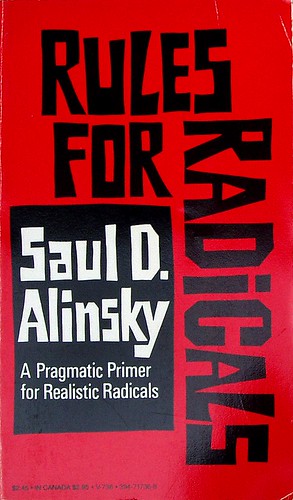
Rules for Radicals
In 1971, Saul Alinsky wrote an entertaining classic on grassroots organizing titled Rules for Radicals. Those who prefer cooperative tactics describe the book as out-of-date. Nevertheless, it provides some of the best advice on confrontational tactics. Alinsky begins this way:
What follows is for those who want to change the world from what it is to what they believe it should be. The Prince was written by Machiavelli for the Haves on how to hold power. Rules for Radicals is written for the Have-Nots on how to take it away.
His “rules” derive from many successful campaigns where he helped poor people fighting power and privilege
For Alinsky, organizing is the process of highlighting what is wrong and convincing people they can actually do something about it. The two are linked. If people feel they don’t have the power to change a bad situation, they stop thinking about it.
According to Alinsky, the organizer — especially a paid organizer from outside — must first overcome suspicion and establish credibility. Next the organizer must begin the task of agitating: rubbing resentments, fanning hostilities, and searching out controversy. This is necessary to get people to participate. An organizer has to attack apathy and disturb the prevailing patterns of complacent community life where people have simply come to accept a bad situation. Alinsky would say, “The first step in community organization is community disorganization.”
Through a process combining hope and resentment, the organizer tries to create a “mass army” that brings in as many recruits as possible from local organizations, churches, services groups, labor unions, corner gangs, and individuals.
Alinsky provides a collection of rules to guide the process. But he emphasizes these rules must be translated into real-life tactics that are fluid and responsive to the situation at hand.
Rule 1: Power is not only what you have, but what an opponent thinks you have. If your organization is small, hide your numbers in the dark and raise a din that will make everyone think you have many more people than you do.
Rule 2: Never go outside the experience of your people.
The result is confusion, fear, and retreat.
Rule 3: Whenever possible, go outside the experience of an opponent. Here you want to cause confusion, fear, and retreat.
Rule 4: Make opponents live up to their own book of rules. “You can kill them with this, for they can no more obey their own rules than the Christian church can live up to Christianity.”
Rule 5: Ridicule is man’s most potent weapon. It’s hard to counterattack ridicule, and it infuriates the opposition, which then reacts to your advantage.
Rule 6: A good tactic is one your people enjoy. “If your people aren’t having a ball doing it, there is something very wrong with the tactic.”
Rule 7: A tactic that drags on for too long becomes a drag. Commitment may become ritualistic as people turn to other issues.
Rule 8: Keep the pressure on. Use different tactics and actions and use all events of the period for your purpose. “The major premise for tactics is the development of operations that will maintain a constant pressure upon the opposition. It is this that will cause the opposition to react to your advantage.”
Rule 9: The threat is more terrifying than the thing itself. When Alinsky leaked word that large numbers of poor people were going to tie up the washrooms of O’Hare Airport, Chicago city authorities quickly agreed to act on a longstanding commitment to a ghetto organization. They imagined the mayhem as thousands of passengers poured off airplanes to discover every washroom occupied. Then they imagined the international embarrassment and the damage to the city’s reputation.
Rule 10: The price of a successful attack is a constructive alternative. Avoid being trapped by an opponent or an interviewer who says, “Okay, what would you do?”
Rule 11: Pick the target, freeze it, personalize it, polarize it. Don’t try to attack abstract corporations or bureaucracies. Identify a responsible individual. Ignore attempts to shift or spread the blame.
According to Alinsky, the main job of the organizer is to bait an opponent into reacting. “The enemy properly goaded and guided in his reaction will be your major strength.”
Source: http://www.vcn.bc.ca/citizens-handbook/rules.html
In 1971, Saul Alinsky wrote an entertaining classic on grassroots organizing titled Rules for Radicals. Those who prefer cooperative tactics describe the book as out-of-date. Nevertheless, it provides some of the best advice on confrontational tactics. Alinsky begins this way:
What follows is for those who want to change the world from what it is to what they believe it should be. The Prince was written by Machiavelli for the Haves on how to hold power. Rules for Radicals is written for the Have-Nots on how to take it away.
His “rules” derive from many successful campaigns where he helped poor people fighting power and privilege
For Alinsky, organizing is the process of highlighting what is wrong and convincing people they can actually do something about it. The two are linked. If people feel they don’t have the power to change a bad situation, they stop thinking about it.
According to Alinsky, the organizer — especially a paid organizer from outside — must first overcome suspicion and establish credibility. Next the organizer must begin the task of agitating: rubbing resentments, fanning hostilities, and searching out controversy. This is necessary to get people to participate. An organizer has to attack apathy and disturb the prevailing patterns of complacent community life where people have simply come to accept a bad situation. Alinsky would say, “The first step in community organization is community disorganization.”
Through a process combining hope and resentment, the organizer tries to create a “mass army” that brings in as many recruits as possible from local organizations, churches, services groups, labor unions, corner gangs, and individuals.
Alinsky provides a collection of rules to guide the process. But he emphasizes these rules must be translated into real-life tactics that are fluid and responsive to the situation at hand.
Rule 1: Power is not only what you have, but what an opponent thinks you have. If your organization is small, hide your numbers in the dark and raise a din that will make everyone think you have many more people than you do.
Rule 2: Never go outside the experience of your people.
The result is confusion, fear, and retreat.
Rule 3: Whenever possible, go outside the experience of an opponent. Here you want to cause confusion, fear, and retreat.
Rule 4: Make opponents live up to their own book of rules. “You can kill them with this, for they can no more obey their own rules than the Christian church can live up to Christianity.”
Rule 5: Ridicule is man’s most potent weapon. It’s hard to counterattack ridicule, and it infuriates the opposition, which then reacts to your advantage.
Rule 6: A good tactic is one your people enjoy. “If your people aren’t having a ball doing it, there is something very wrong with the tactic.”
Rule 7: A tactic that drags on for too long becomes a drag. Commitment may become ritualistic as people turn to other issues.
Rule 8: Keep the pressure on. Use different tactics and actions and use all events of the period for your purpose. “The major premise for tactics is the development of operations that will maintain a constant pressure upon the opposition. It is this that will cause the opposition to react to your advantage.”
Rule 9: The threat is more terrifying than the thing itself. When Alinsky leaked word that large numbers of poor people were going to tie up the washrooms of O’Hare Airport, Chicago city authorities quickly agreed to act on a longstanding commitment to a ghetto organization. They imagined the mayhem as thousands of passengers poured off airplanes to discover every washroom occupied. Then they imagined the international embarrassment and the damage to the city’s reputation.
Rule 10: The price of a successful attack is a constructive alternative. Avoid being trapped by an opponent or an interviewer who says, “Okay, what would you do?”
Rule 11: Pick the target, freeze it, personalize it, polarize it. Don’t try to attack abstract corporations or bureaucracies. Identify a responsible individual. Ignore attempts to shift or spread the blame.
According to Alinsky, the main job of the organizer is to bait an opponent into reacting. “The enemy properly goaded and guided in his reaction will be your major strength.”
Source: http://www.vcn.bc.ca/citizens-handbook/rules.html
Monday, May 18, 2009
Senator Stealth

How to advance radical causes when no one's looking
By Stanley Kurtz
Posted: Tuesday, September 2, 2008
By Stanley Kurtz
Posted: Tuesday, September 2, 2008
ARTICLE
National Review Vol. LX, No. 16
Publication Date: September 1, 2008
After hearing about Barack Obama's ties to the Rev. Jeremiah Wright, Bill Ayers, Bernardine Dohrn, Fr. Michael Pfleger, and the militant activists of ACORN (the Association of Community Organizations for Reform Now), it should be clear to everyone that his extremist roots run deep. But the presumptive Democratic presidential nominee has yet another connection with the world of far-Left radicalism. Obama has long been linked -- through foundation grants, shared political activism, collaboration on legislation and tactics, and mutual praise and support -- with the Chicago-based Gamaliel Foundation, one of the least known yet most influential national umbrella groups for church-based "community organizers."
The same separatist, anti-American theology of liberation that was so boldly and bitterly proclaimed by Obama's pastor is shared, if more quietly, by Obama's Gamaliel colleagues. The operative word here is "quietly." Gamaliel specializes in ideological stealth, and Obama, a master student of Gamaliel strategy, shows disturbing signs of being a sub rosa radical himself. Obama's legislative tactics, as well as his persistent professions of non-ideological pragmatism, appear to be inspired by his radical mentors' most sophisticated tactics. Not only has Obama studied, taught, and apparently absorbed stealth techniques from radical groups like Gamaliel and ACORN, but in his position as a board member of Chicago's supposedly nonpartisan Woods Fund, he quietly funneled money to his radical allies -- at the very moment he most needed their support to boost his political career. It's high time for these shadowy, perhaps improper, ties to receive a dose of sunlight.
The connections are numerous. Gregory Galluzzo, Gamaliel's co-founder and executive director, served as a trainer and mentor during Obama's mid-1980s organizing days in Chicago. The Developing Communities Project, which first hired Obama, is part of the Gamaliel network. Obama became a consultant and eventually a trainer of community organizers for Gamaliel. (He also served as a trainer for ACORN.) And he has kept up his ties with Gamaliel during his time in the U.S. Senate.
The Gamaliel connection appears to supply a solution to the riddle of Obama's mysterious political persona. On one hand, he likes to highlight his days as a community organizer -- a profession with proudly radical roots in the teachings of Chicago's Saul Alinsky, author of the highly influential text Rules for Radicals. Obama even goes so far as to make the community-organizer image a metaphor for his distinctive conception of elective office. On the other hand, Obama presents himself as a post-ideological, consensus-minded politician who favors pragmatic, common-sense solutions to the issues of the day. How can Obama be radical and post-radical at the same time? Perhaps by deploying Gamaliel techniques. Gamaliel organizers have discovered a way to fuse their Left-extremist political beliefs with a smooth, non-ideological surface of down-to-earth pragmatism: the substance of Jeremiah Wright with the appearance of Norman Vincent Peale. Could this be Obama's secret?
FROM REVELATION TO REVOLUTION
Before outlining Gamaliel's techniques of political stealth, we need to identify the views that they are camouflaging. These can be found in Dennis Jacobsen's book Doing Justice: Congregations and Community Organizing. Jacobsen is the pastor of Incarnation Lutheran Church in Milwaukee and director of the Gamaliel National Clergy Caucus. Jacobsen's book, which is part of the first-year reading list for new Gamaliel organizers, lays out the underlying theology of Gamaliel's activities. While Jacobsen's book was published in 2001, it is based on presentations Jacobsen has been making at Gamaliel's clergy-training center since 1992 and clearly has Galluzzo's endorsement. So while we cannot be sure that Obama has read or taught Doing Justice, the book certainly embodies a political perspective to which Obama's more than 20 years of friendship with Galluzzo, and his stint as a Gamaliel instructor, would surely have exposed him.
In Jacobsen's conception, America is a sinful and fallen nation whose pervasive classism, racism, and militarism authentic Christians must constantly resist. Drawing on the Book of Revelation, Jacobsen exhorts, "Fallen, fallen is Babylon the great! . . . Come out of her, my people, so that you do not take part in her sins." The United States, Jacobsen maintains, employs nationalism, propaganda, racism, bogus "civil religion," and class enmity to bolster its entrenched and oppressive corporate system. Authentic Christians forced to live in such a nation can "come out of Babylon," says Jacobsen, only by entering into "a perpetual state of internal exile."
Of course, many believers do feel at home in the United States, but according to Jacobsen, these inauthentic and misguided Christians have been lulled into the false belief that the United States is somehow different from other countries -- that it stands as a genuine defender of freedom and democracy. According to Jacobsen, the desire of most Americans to create a safe, secure life for themselves and their families constitutes an unacceptable emotional distancing from the sufferings of the urban poor. Jacobsen says that whenever he feels himself seduced by the American dream of personal security -- this "unconscionable removal from the lives of those who suffer" -- he rejects its pull as the deplorable "encroachment of America on my soul." To "feel at home in the United States," maintains Jacobsen, is not only to fall victim to a scarcely disguised form of political despotism; it is to betray Christianity itself.
Although Jacobsen acknowledges that the sufferings of the poor in America do not quite rise to the level of the Nazi Holocaust, he nonetheless finds a similarity: "The accommodation and silence of the church amidst Nazi atrocities are paralleled by the accommodation and silence of the church in this country amidst a calculated war against the poor." He recounts being present at the Pentagon "to fast and vigil with a group of religious resisters against the madness of nuclear build-up and militarism generated in that place" and is horrified when he sees that many in the American military actually think of themselves as Christians. For Jacobsen, this means that the church has "aligned itself with oppressive forces and crucified its Lord anew."
Jacobsen has a low opinion of the food pantries, homeless shelters, and walk-a-thons that make up so much religious charitable activity in the United States. All that charity, says Jacobsen, tends to suppress the truth that the system itself is designed to benefit the prosperous and keep the poor down. He complains: "The Christians who are so generous with food baskets at Thanksgiving or with presents for the poor at Christmas often vote into office politicians whose policies ignore or crush those living in poverty." "Most churches do not operate on the basis of healthy agitation," he says, but instead "on the basis of manipulation, authoritarianism, or guilt-tripping."
The solution, says Jacobsen, is community organizing: "Metropolitan organizing offers a chance to end the warfare against the poor and to heal the divisions of class and race that separate this sick society." "Militant mass action . . . fueled by righteous anger," he maintains, offers authentic community, and therefore "the possibility of fulfillment in a vacuous society." He continues: "If the pain and human degradation all around us doesn't stir up within us sufficient anger to want to shake the foundations of this society, then it's probably best for us to go back to playing church."
Other than the sense of community that is generated by militant struggle, what does Jacobsen offer as the cure for America's ills? He is short on detail here, but there are tantalizing hints. Jacobsen invokes the communal property and absence of private ownership that prevailed among early Christians as a possible model. Despite his initial skepticism regarding such selflessness, says Jacobsen, he has seen this sort of "radical sharing of limited resources" on a trip to a poor African church in Tanzania. Unfortunately, says Jacobsen, "the church in the United States lacks community. The American church by and large is privatistic, insular, and individualistic. It reflects American culture."
These, then, are the beliefs at the spiritual heart of the Gamaliel Foundation's community-organizing efforts. They show clear echoes of Jeremiah Wright's and James Cone's black-liberation theology, and it's evident that Obama has an affinity for organizations that embody this point of view. But a question arises. Gamaliel's goal is to build church-based coalitions capable of wielding power on behalf of the poor. These congregation-based organizations are supposed to counterbalance and undercut America's oppressive power structures. Yet if most American Christians are deluded servants of a sinful and oppressive system, how can they be molded into a majority coalition for change? Given the privatistic, insular, and individualistic character of American culture, theological frankness might backfire and drive away potential allies, exactly as happened with Reverend Wright. Thus arises the need for stealth.
FAKE RIGHT, GO LEFT
It might have been all but impossible to penetrate the strategic thinking of Obama's cohorts if not for the fortuitous 2008 publication of Organizing Urban America: Secular and Faith-based Progressive Movements, by Rutgers political scientist Heidi Swarts. This is the first book-length study of the organizing tactics and political ideologies of Gamaliel and ACORN, the two groups to which Obama's community-organizing ties are closest. Swarts's study focuses on Gamaliel and ACORN in St. Louis, but given the degree of national coordination by both groups, the carry-over of her findings to Chicago is bound to be substantial. Because Swarts is highly sympathetic to the community-organizing groups she studies, she was granted an unusual degree of access to strategic discussions during her period of fieldwork.
Swarts calls groups like ACORN and (especially) Gamaliel "invisible actors," hidden from public view because they often prefer to downplay their efforts, because they work locally, and because scholars and journalists pay greater attention to movements with national profiles (like the Sierra Club or the Christian Coalition). Congregation-based community organizations like Gamaliel, by contrast, are often invisible even at the local level. A newspaper might report on a demonstration led by a local minister or priest, for example, without noticing that the clergyman in question is part of the Gamaliel network. "Though often hidden from view," says Swarts, "leaders have intentionally and strategically organized these movements that appear to well up and erupt from below."
Although Gamaliel and ACORN have significantly different tactics and styles, Swarts notes that their political goals and ideologies are broadly similar. Both groups press the state for economic redistribution. The tactics of Gamaliel and ACORN have been shaped in a "post-Alinsky" era of welfare reform and conservative resurgence, posing a severe challenge to those who wish to expand the welfare state. The answer these activists have hit upon, says Swarts, is to work incrementally in urban areas, while deliberately downplaying the far-Left ideology that stands behind their carefully targeted campaigns.
While ACORN's membership is fairly homogeneous, consisting chiefly of inner-city blacks and Hispanics, congregation-based community organizations like the Gamaliel Foundation tend to have more racially, culturally, and politically mixed constituencies. The need to overcome these divisions and gather a broad coalition behind its hard-Left agenda has pushed Gamaliel to develop what Swarts calls an "innovative cultural strategy." Because of the suspicions that blue-collar members might harbor toward its elite, liberal leaders, Gamaliel's main "ideological tactic," says Swarts, is to present its organizers as the opposite of radical, elite, or ideological. As Swarts explains, they deliberately refrain from using leftist jargon like "racism," "sexism," "classism," "homophobia," "oppression," or "multiple oppressions" in front of ordinary members -- even though, amongst themselves, Gamaliel's organizers toss around this sort of lingo with abandon, just as Jacobsen does in his book.
Swarts supplies a chart listing "common working-class perceptions of liberal social movements" on one side, while displaying on the other side Gamaliel organizers' tricky tactics for getting around them. To avoid seeming like radicals or "hippies left over from the sixties," Gamaliel organizers are careful to wear conventional clothing and conduct themselves with dignity, even formality. Since liberal social movements tend to come off as naïve and idealistic, Gamaliel organizers make a point of presenting their ideas as practical, pragmatic, and down-to-earth. When no one else is listening, Gamaliel organizers may rail at "racism," "sexism," and "oppressive corporate systems," but when speaking to their blue-collar followers, they describe their plans as "common sense solutions for working families."
Although the Gamaliel agenda is deeply collectivist and redistributionist, organizers are schooled to frame their program in traditional American, individualist terms. As Swarts puts it:
What makes [Gamaliel's] ideology liberal rather than conservative is that it advocates not private or voluntary solutions but collective public programs. They seek action from the state: social welfare programs, redistribution, or regulation. . . . But publicly [Gamaliel and other congregation-based groups] usually emphasize individual responsibility on the part of authorities.
What Gamaliel really wants, in other words, is for the public as a whole to fork over funds to the government, but they're careful to frame this demand as a call for "personal responsibility" by particular government officials.
The relative homogeneity of ACORN's membership allows it to display its radicalism more openly. According to Swarts, ACORN members think of themselves as "oppositional outlaws" and "militants unafraid to confront the powers that be." Yet even ACORN has a deeper, hidden ideological dimension. "Long-term ACORN organizers . . . tend to see the organization as a solitary vanguard of principled leftists," says Swarts, while ordinary members rarely think in these overtly ideological terms; for them, it's more about attacking specific problems. In general, ACORN avoids programmatic statements. During a 1980 effort to purge conservatives from its ranks, however, the organization did release a detailed political platform -- which Swarts calls "a veritable laundry list of progressive positions."
Although ACORN's radicalism is somewhat more frank than Gamaliel's, ACORN has an "innovative cultural strategy" of its own. ACORN's radicalism is incremental; it's happy to work toward ambitious long-term goals through a series of baby steps. For example, although ACORN has fought for "living wage" laws in several American cities, these affect only the small fraction of the workforce employed directly by city governments. The real purpose of ACORN's urban living-wage campaigns, says Swarts, is not economic but political. ACORN's long-term goal is an across-the-board minimum-wage increase at the state and federal levels. The public debate spurred by local campaigns is meant to prepare the political ground for ACORN's more ambitious political goals, and to build up membership in the meantime.
WITH A LITTLE HELP FROM MY FRIENDS
Throughout his career, Obama has drawn on all of these strategies. In Illinois's Republican-controlled state senate, Obama specialized in incremental legislation, often drawn up in collaboration with groups like Gamaliel and ACORN. His tiny, targeted expansions of government-financed health care, for example, were designed to build political momentum for universal health care. And his claim to be a "common-sense pragmatist," rather than a leftist ideologue, comes straight out of the Gamaliel playbook.
New evidence now ties Obama still more closely to both organizations. Not only was Obama a trainer for Gamaliel and ACORN, he appears to have used his influence to secure a major increase in funding for both groups -- arguably stretching the bounds of propriety in the process.
In 2005, the year after Obama was elected to the U.S. Senate, the Washington, D.C.–based Center for Community Change released a report titled "Promising Practices in Revenue Generation for Community Organizing." One of the report's authors was Jean Rudd, Obama's friend and the president of the Woods Fund during Obama's years on that foundation's board. Buried deep within the report lies the story of Obama's role in expanding the Woods Fund's financial support for groups like Gamaliel and ACORN.
Since the start of his organizing career, Obama was recognized by the Woods Fund as "a great analyst and interpreter of organizing," according to the 2005 report. Initially an adviser, Obama became a Woods Fund board member, and finally board chairman, serving as a key advocate of increased funding for organizing during that period. In 1995, the Woods Fund commissioned a special evaluation of its funding for community organizing -- a report that eventually recommended a major expansion of financial support. Obama chaired a committee of organizers that advised the Woods Fund on this important shift.
The committee's report, "Evaluation of the Fund's Community Organizing Grant Program," is based on interviews with all the big names in Obama's personal organizer network. Greg Galluzzo and other Gamaliel Foundation officials were consulted, as were several ACORN organizers, including Madeline Talbott, Obama's key ACORN contact. Talbott, an expert on ACORN's tactics of confrontation and disruption, is quoted more often than any other organizer in the report, sometimes with additional comments from Obama himself. The report holds up Gamaliel and ACORN as models for other groups and supports Talbott's call for "‘a massive infusion of resources' to make organizing a truly mass-based movement."
Support from the Woods Fund had importance for these groups that went way beyond the money itself. Since community organizers often use confrontation, intimidation, and "civil disobedience" in the service of their political goals, even liberal foundations sometimes find it difficult to fund them without risking public criticism. As the report puts it: "Some funders . . . are averse to confrontational tactics, and are loathe [sic] to support organizing for that reason. They essentially equate organizing with the embarrassment of their business and government associates." The Woods Fund is both highly respected and one of the few foundations to consistently support community organizing, so its money acts as a kind of Good Housekeeping Seal of Approval, providing political cover for other foundations interested in funding the hard Left. Obama apparently sought to capitalize on this effect, not only by expanding the Woods Fund's involvement in organizing, but by distributing the Woods report to a national network of potential funders.
Formally, the Woods Fund claims to be "non-ideological." According to the report: "This stance has enabled the Trustees to make grants to organizations that use confrontational tactics against the business and government 'establishments,' without undue risk of being criticized for partisanship." Yet ACORN received substantial funding from Woods, apparently aided by Obama's internal advocacy, and we now know that ACORN members have played key roles as volunteer ground troops in Obama's various political campaigns. That would seem to raise the specter of partisanship.
A 2004 article in Social Policy by Chicago ACORN leader Toni Foulkes, titled "Case Study: Chicago -- The Barack Obama Campaign," explains that, given Obama's long and close relationship to ACORN, "it was natural for many of us to be active volunteers" in Obama's campaigns. Perhaps ACORN volunteers observed the technical legalities and helped Obama merely in their capacity as private citizens. Even so, it seems at least possible that Obama used his position at a supposedly nonpartisan foundation to direct money to an allegedly nonpartisan group, in pursuit of what were in fact nakedly partisan ends.
Given Obama's political aspirations, it's notable that the focus of his Woods Fund report is its call for "improving the tie between organizing and policy making" and shifting organizing's focus from local battles to "citywide or statewide coalitions." The report boldly criticizes Saul Alinsky himself for being excessively focused on local issues, complaining that "he did not seek to fundamentally upset the distribution of power in the wider society."
The ultimate goal of all these efforts -- fundamental disruption of America's power structure, and economic redistribution along race, poverty, and gender lines -- is entirely compatible with the program outlined by Dennis Jacobsen in Doing Justice. Obama could hardly have been unfamiliar with the general drift of Gamaliel ideology, especially given his reputation as an analyst of community organizing and his supervision of a comprehensive review of the field.
Even after becoming a U.S. senator, Obama has maintained his ties to the Gamaliel Foundation. According to an October 2007 report for the University of California by Todd Swanstrom and Brian Banks, "it is almost unheard of for a U.S. Senator to attend a public meeting of a community organization, but Senator Obama attended a Gamaliel affiliate public meeting in Chicago." Given this ongoing contact, given the radicalism of Gamaliel's core ideology, given Obama's close association with Gamaliel's co-founder, Gregory Galluzzo, given Obama's role as a Gamaliel consultant and trainer, and given Obama's outsized role in channeling allegedly "nonpartisan" funding to Gamaliel affiliates (and to his political ground troops at ACORN), some questions are in order. Obama needs to detail the nature of his ties to both Gamaliel and ACORN, and should discuss the extent of his knowledge of Gamaliel's guiding ideology. Ultimately, we need to know if Obama is the post-ideological pragmatist he sometimes claims to be, or in fact a stealth radical.
-- Mr. Kurtz is a senior fellow at the Ethics and Public Policy Center
Publication Date: September 1, 2008
After hearing about Barack Obama's ties to the Rev. Jeremiah Wright, Bill Ayers, Bernardine Dohrn, Fr. Michael Pfleger, and the militant activists of ACORN (the Association of Community Organizations for Reform Now), it should be clear to everyone that his extremist roots run deep. But the presumptive Democratic presidential nominee has yet another connection with the world of far-Left radicalism. Obama has long been linked -- through foundation grants, shared political activism, collaboration on legislation and tactics, and mutual praise and support -- with the Chicago-based Gamaliel Foundation, one of the least known yet most influential national umbrella groups for church-based "community organizers."
The same separatist, anti-American theology of liberation that was so boldly and bitterly proclaimed by Obama's pastor is shared, if more quietly, by Obama's Gamaliel colleagues. The operative word here is "quietly." Gamaliel specializes in ideological stealth, and Obama, a master student of Gamaliel strategy, shows disturbing signs of being a sub rosa radical himself. Obama's legislative tactics, as well as his persistent professions of non-ideological pragmatism, appear to be inspired by his radical mentors' most sophisticated tactics. Not only has Obama studied, taught, and apparently absorbed stealth techniques from radical groups like Gamaliel and ACORN, but in his position as a board member of Chicago's supposedly nonpartisan Woods Fund, he quietly funneled money to his radical allies -- at the very moment he most needed their support to boost his political career. It's high time for these shadowy, perhaps improper, ties to receive a dose of sunlight.
The connections are numerous. Gregory Galluzzo, Gamaliel's co-founder and executive director, served as a trainer and mentor during Obama's mid-1980s organizing days in Chicago. The Developing Communities Project, which first hired Obama, is part of the Gamaliel network. Obama became a consultant and eventually a trainer of community organizers for Gamaliel. (He also served as a trainer for ACORN.) And he has kept up his ties with Gamaliel during his time in the U.S. Senate.
The Gamaliel connection appears to supply a solution to the riddle of Obama's mysterious political persona. On one hand, he likes to highlight his days as a community organizer -- a profession with proudly radical roots in the teachings of Chicago's Saul Alinsky, author of the highly influential text Rules for Radicals. Obama even goes so far as to make the community-organizer image a metaphor for his distinctive conception of elective office. On the other hand, Obama presents himself as a post-ideological, consensus-minded politician who favors pragmatic, common-sense solutions to the issues of the day. How can Obama be radical and post-radical at the same time? Perhaps by deploying Gamaliel techniques. Gamaliel organizers have discovered a way to fuse their Left-extremist political beliefs with a smooth, non-ideological surface of down-to-earth pragmatism: the substance of Jeremiah Wright with the appearance of Norman Vincent Peale. Could this be Obama's secret?
FROM REVELATION TO REVOLUTION
Before outlining Gamaliel's techniques of political stealth, we need to identify the views that they are camouflaging. These can be found in Dennis Jacobsen's book Doing Justice: Congregations and Community Organizing. Jacobsen is the pastor of Incarnation Lutheran Church in Milwaukee and director of the Gamaliel National Clergy Caucus. Jacobsen's book, which is part of the first-year reading list for new Gamaliel organizers, lays out the underlying theology of Gamaliel's activities. While Jacobsen's book was published in 2001, it is based on presentations Jacobsen has been making at Gamaliel's clergy-training center since 1992 and clearly has Galluzzo's endorsement. So while we cannot be sure that Obama has read or taught Doing Justice, the book certainly embodies a political perspective to which Obama's more than 20 years of friendship with Galluzzo, and his stint as a Gamaliel instructor, would surely have exposed him.
In Jacobsen's conception, America is a sinful and fallen nation whose pervasive classism, racism, and militarism authentic Christians must constantly resist. Drawing on the Book of Revelation, Jacobsen exhorts, "Fallen, fallen is Babylon the great! . . . Come out of her, my people, so that you do not take part in her sins." The United States, Jacobsen maintains, employs nationalism, propaganda, racism, bogus "civil religion," and class enmity to bolster its entrenched and oppressive corporate system. Authentic Christians forced to live in such a nation can "come out of Babylon," says Jacobsen, only by entering into "a perpetual state of internal exile."
Of course, many believers do feel at home in the United States, but according to Jacobsen, these inauthentic and misguided Christians have been lulled into the false belief that the United States is somehow different from other countries -- that it stands as a genuine defender of freedom and democracy. According to Jacobsen, the desire of most Americans to create a safe, secure life for themselves and their families constitutes an unacceptable emotional distancing from the sufferings of the urban poor. Jacobsen says that whenever he feels himself seduced by the American dream of personal security -- this "unconscionable removal from the lives of those who suffer" -- he rejects its pull as the deplorable "encroachment of America on my soul." To "feel at home in the United States," maintains Jacobsen, is not only to fall victim to a scarcely disguised form of political despotism; it is to betray Christianity itself.
Although Jacobsen acknowledges that the sufferings of the poor in America do not quite rise to the level of the Nazi Holocaust, he nonetheless finds a similarity: "The accommodation and silence of the church amidst Nazi atrocities are paralleled by the accommodation and silence of the church in this country amidst a calculated war against the poor." He recounts being present at the Pentagon "to fast and vigil with a group of religious resisters against the madness of nuclear build-up and militarism generated in that place" and is horrified when he sees that many in the American military actually think of themselves as Christians. For Jacobsen, this means that the church has "aligned itself with oppressive forces and crucified its Lord anew."
Jacobsen has a low opinion of the food pantries, homeless shelters, and walk-a-thons that make up so much religious charitable activity in the United States. All that charity, says Jacobsen, tends to suppress the truth that the system itself is designed to benefit the prosperous and keep the poor down. He complains: "The Christians who are so generous with food baskets at Thanksgiving or with presents for the poor at Christmas often vote into office politicians whose policies ignore or crush those living in poverty." "Most churches do not operate on the basis of healthy agitation," he says, but instead "on the basis of manipulation, authoritarianism, or guilt-tripping."
The solution, says Jacobsen, is community organizing: "Metropolitan organizing offers a chance to end the warfare against the poor and to heal the divisions of class and race that separate this sick society." "Militant mass action . . . fueled by righteous anger," he maintains, offers authentic community, and therefore "the possibility of fulfillment in a vacuous society." He continues: "If the pain and human degradation all around us doesn't stir up within us sufficient anger to want to shake the foundations of this society, then it's probably best for us to go back to playing church."
Other than the sense of community that is generated by militant struggle, what does Jacobsen offer as the cure for America's ills? He is short on detail here, but there are tantalizing hints. Jacobsen invokes the communal property and absence of private ownership that prevailed among early Christians as a possible model. Despite his initial skepticism regarding such selflessness, says Jacobsen, he has seen this sort of "radical sharing of limited resources" on a trip to a poor African church in Tanzania. Unfortunately, says Jacobsen, "the church in the United States lacks community. The American church by and large is privatistic, insular, and individualistic. It reflects American culture."
These, then, are the beliefs at the spiritual heart of the Gamaliel Foundation's community-organizing efforts. They show clear echoes of Jeremiah Wright's and James Cone's black-liberation theology, and it's evident that Obama has an affinity for organizations that embody this point of view. But a question arises. Gamaliel's goal is to build church-based coalitions capable of wielding power on behalf of the poor. These congregation-based organizations are supposed to counterbalance and undercut America's oppressive power structures. Yet if most American Christians are deluded servants of a sinful and oppressive system, how can they be molded into a majority coalition for change? Given the privatistic, insular, and individualistic character of American culture, theological frankness might backfire and drive away potential allies, exactly as happened with Reverend Wright. Thus arises the need for stealth.
FAKE RIGHT, GO LEFT
It might have been all but impossible to penetrate the strategic thinking of Obama's cohorts if not for the fortuitous 2008 publication of Organizing Urban America: Secular and Faith-based Progressive Movements, by Rutgers political scientist Heidi Swarts. This is the first book-length study of the organizing tactics and political ideologies of Gamaliel and ACORN, the two groups to which Obama's community-organizing ties are closest. Swarts's study focuses on Gamaliel and ACORN in St. Louis, but given the degree of national coordination by both groups, the carry-over of her findings to Chicago is bound to be substantial. Because Swarts is highly sympathetic to the community-organizing groups she studies, she was granted an unusual degree of access to strategic discussions during her period of fieldwork.
Swarts calls groups like ACORN and (especially) Gamaliel "invisible actors," hidden from public view because they often prefer to downplay their efforts, because they work locally, and because scholars and journalists pay greater attention to movements with national profiles (like the Sierra Club or the Christian Coalition). Congregation-based community organizations like Gamaliel, by contrast, are often invisible even at the local level. A newspaper might report on a demonstration led by a local minister or priest, for example, without noticing that the clergyman in question is part of the Gamaliel network. "Though often hidden from view," says Swarts, "leaders have intentionally and strategically organized these movements that appear to well up and erupt from below."
Although Gamaliel and ACORN have significantly different tactics and styles, Swarts notes that their political goals and ideologies are broadly similar. Both groups press the state for economic redistribution. The tactics of Gamaliel and ACORN have been shaped in a "post-Alinsky" era of welfare reform and conservative resurgence, posing a severe challenge to those who wish to expand the welfare state. The answer these activists have hit upon, says Swarts, is to work incrementally in urban areas, while deliberately downplaying the far-Left ideology that stands behind their carefully targeted campaigns.
While ACORN's membership is fairly homogeneous, consisting chiefly of inner-city blacks and Hispanics, congregation-based community organizations like the Gamaliel Foundation tend to have more racially, culturally, and politically mixed constituencies. The need to overcome these divisions and gather a broad coalition behind its hard-Left agenda has pushed Gamaliel to develop what Swarts calls an "innovative cultural strategy." Because of the suspicions that blue-collar members might harbor toward its elite, liberal leaders, Gamaliel's main "ideological tactic," says Swarts, is to present its organizers as the opposite of radical, elite, or ideological. As Swarts explains, they deliberately refrain from using leftist jargon like "racism," "sexism," "classism," "homophobia," "oppression," or "multiple oppressions" in front of ordinary members -- even though, amongst themselves, Gamaliel's organizers toss around this sort of lingo with abandon, just as Jacobsen does in his book.
Swarts supplies a chart listing "common working-class perceptions of liberal social movements" on one side, while displaying on the other side Gamaliel organizers' tricky tactics for getting around them. To avoid seeming like radicals or "hippies left over from the sixties," Gamaliel organizers are careful to wear conventional clothing and conduct themselves with dignity, even formality. Since liberal social movements tend to come off as naïve and idealistic, Gamaliel organizers make a point of presenting their ideas as practical, pragmatic, and down-to-earth. When no one else is listening, Gamaliel organizers may rail at "racism," "sexism," and "oppressive corporate systems," but when speaking to their blue-collar followers, they describe their plans as "common sense solutions for working families."
Although the Gamaliel agenda is deeply collectivist and redistributionist, organizers are schooled to frame their program in traditional American, individualist terms. As Swarts puts it:
What makes [Gamaliel's] ideology liberal rather than conservative is that it advocates not private or voluntary solutions but collective public programs. They seek action from the state: social welfare programs, redistribution, or regulation. . . . But publicly [Gamaliel and other congregation-based groups] usually emphasize individual responsibility on the part of authorities.
What Gamaliel really wants, in other words, is for the public as a whole to fork over funds to the government, but they're careful to frame this demand as a call for "personal responsibility" by particular government officials.
The relative homogeneity of ACORN's membership allows it to display its radicalism more openly. According to Swarts, ACORN members think of themselves as "oppositional outlaws" and "militants unafraid to confront the powers that be." Yet even ACORN has a deeper, hidden ideological dimension. "Long-term ACORN organizers . . . tend to see the organization as a solitary vanguard of principled leftists," says Swarts, while ordinary members rarely think in these overtly ideological terms; for them, it's more about attacking specific problems. In general, ACORN avoids programmatic statements. During a 1980 effort to purge conservatives from its ranks, however, the organization did release a detailed political platform -- which Swarts calls "a veritable laundry list of progressive positions."
Although ACORN's radicalism is somewhat more frank than Gamaliel's, ACORN has an "innovative cultural strategy" of its own. ACORN's radicalism is incremental; it's happy to work toward ambitious long-term goals through a series of baby steps. For example, although ACORN has fought for "living wage" laws in several American cities, these affect only the small fraction of the workforce employed directly by city governments. The real purpose of ACORN's urban living-wage campaigns, says Swarts, is not economic but political. ACORN's long-term goal is an across-the-board minimum-wage increase at the state and federal levels. The public debate spurred by local campaigns is meant to prepare the political ground for ACORN's more ambitious political goals, and to build up membership in the meantime.
WITH A LITTLE HELP FROM MY FRIENDS
Throughout his career, Obama has drawn on all of these strategies. In Illinois's Republican-controlled state senate, Obama specialized in incremental legislation, often drawn up in collaboration with groups like Gamaliel and ACORN. His tiny, targeted expansions of government-financed health care, for example, were designed to build political momentum for universal health care. And his claim to be a "common-sense pragmatist," rather than a leftist ideologue, comes straight out of the Gamaliel playbook.
New evidence now ties Obama still more closely to both organizations. Not only was Obama a trainer for Gamaliel and ACORN, he appears to have used his influence to secure a major increase in funding for both groups -- arguably stretching the bounds of propriety in the process.
In 2005, the year after Obama was elected to the U.S. Senate, the Washington, D.C.–based Center for Community Change released a report titled "Promising Practices in Revenue Generation for Community Organizing." One of the report's authors was Jean Rudd, Obama's friend and the president of the Woods Fund during Obama's years on that foundation's board. Buried deep within the report lies the story of Obama's role in expanding the Woods Fund's financial support for groups like Gamaliel and ACORN.
Since the start of his organizing career, Obama was recognized by the Woods Fund as "a great analyst and interpreter of organizing," according to the 2005 report. Initially an adviser, Obama became a Woods Fund board member, and finally board chairman, serving as a key advocate of increased funding for organizing during that period. In 1995, the Woods Fund commissioned a special evaluation of its funding for community organizing -- a report that eventually recommended a major expansion of financial support. Obama chaired a committee of organizers that advised the Woods Fund on this important shift.
The committee's report, "Evaluation of the Fund's Community Organizing Grant Program," is based on interviews with all the big names in Obama's personal organizer network. Greg Galluzzo and other Gamaliel Foundation officials were consulted, as were several ACORN organizers, including Madeline Talbott, Obama's key ACORN contact. Talbott, an expert on ACORN's tactics of confrontation and disruption, is quoted more often than any other organizer in the report, sometimes with additional comments from Obama himself. The report holds up Gamaliel and ACORN as models for other groups and supports Talbott's call for "‘a massive infusion of resources' to make organizing a truly mass-based movement."
Support from the Woods Fund had importance for these groups that went way beyond the money itself. Since community organizers often use confrontation, intimidation, and "civil disobedience" in the service of their political goals, even liberal foundations sometimes find it difficult to fund them without risking public criticism. As the report puts it: "Some funders . . . are averse to confrontational tactics, and are loathe [sic] to support organizing for that reason. They essentially equate organizing with the embarrassment of their business and government associates." The Woods Fund is both highly respected and one of the few foundations to consistently support community organizing, so its money acts as a kind of Good Housekeeping Seal of Approval, providing political cover for other foundations interested in funding the hard Left. Obama apparently sought to capitalize on this effect, not only by expanding the Woods Fund's involvement in organizing, but by distributing the Woods report to a national network of potential funders.
Formally, the Woods Fund claims to be "non-ideological." According to the report: "This stance has enabled the Trustees to make grants to organizations that use confrontational tactics against the business and government 'establishments,' without undue risk of being criticized for partisanship." Yet ACORN received substantial funding from Woods, apparently aided by Obama's internal advocacy, and we now know that ACORN members have played key roles as volunteer ground troops in Obama's various political campaigns. That would seem to raise the specter of partisanship.
A 2004 article in Social Policy by Chicago ACORN leader Toni Foulkes, titled "Case Study: Chicago -- The Barack Obama Campaign," explains that, given Obama's long and close relationship to ACORN, "it was natural for many of us to be active volunteers" in Obama's campaigns. Perhaps ACORN volunteers observed the technical legalities and helped Obama merely in their capacity as private citizens. Even so, it seems at least possible that Obama used his position at a supposedly nonpartisan foundation to direct money to an allegedly nonpartisan group, in pursuit of what were in fact nakedly partisan ends.
Given Obama's political aspirations, it's notable that the focus of his Woods Fund report is its call for "improving the tie between organizing and policy making" and shifting organizing's focus from local battles to "citywide or statewide coalitions." The report boldly criticizes Saul Alinsky himself for being excessively focused on local issues, complaining that "he did not seek to fundamentally upset the distribution of power in the wider society."
The ultimate goal of all these efforts -- fundamental disruption of America's power structure, and economic redistribution along race, poverty, and gender lines -- is entirely compatible with the program outlined by Dennis Jacobsen in Doing Justice. Obama could hardly have been unfamiliar with the general drift of Gamaliel ideology, especially given his reputation as an analyst of community organizing and his supervision of a comprehensive review of the field.
Even after becoming a U.S. senator, Obama has maintained his ties to the Gamaliel Foundation. According to an October 2007 report for the University of California by Todd Swanstrom and Brian Banks, "it is almost unheard of for a U.S. Senator to attend a public meeting of a community organization, but Senator Obama attended a Gamaliel affiliate public meeting in Chicago." Given this ongoing contact, given the radicalism of Gamaliel's core ideology, given Obama's close association with Gamaliel's co-founder, Gregory Galluzzo, given Obama's role as a Gamaliel consultant and trainer, and given Obama's outsized role in channeling allegedly "nonpartisan" funding to Gamaliel affiliates (and to his political ground troops at ACORN), some questions are in order. Obama needs to detail the nature of his ties to both Gamaliel and ACORN, and should discuss the extent of his knowledge of Gamaliel's guiding ideology. Ultimately, we need to know if Obama is the post-ideological pragmatist he sometimes claims to be, or in fact a stealth radical.
-- Mr. Kurtz is a senior fellow at the Ethics and Public Policy Center
Subscribe to:
Posts (Atom)