Showing posts with label Roman Catholics. Show all posts
Showing posts with label Roman Catholics. Show all posts
Tuesday, August 25, 2026


Saturday, August 22, 2026
Sunday, August 16, 2026
Monday, June 15, 2026
Friday, June 12, 2026
Former Louisiana priest sentenced to life in prison after conviction on three counts of sexual abuse
Former Louisiana priest sentenced to life in prison after conviction on three counts of sexual abuse
WWLTV
Jun 2, 2026
A former New Orleans-area priest will spend the rest of his life in a Texas prison. A jury handed down the sentence for Anthony Odiong after his conviction last week
Thursday, June 11, 2026
A religion of externals is attractive to the unrenewed heart.
 Many Protestants suppose that the Catholic religion is unattractive and that its worship is a dull, meaningless round of ceremony. Here they mistake. While Romanism is based upon deception, it is not a coarse and clumsy imposture. The religious service of the Roman Church is a most impressive ceremonial. Its gorgeous display and solemn rites fascinate the senses of the people and silence the voice of reason and of conscience. The eye is charmed. Magnificent churches, imposing processions, golden altars, jeweled shrines, choice paintings, and exquisite sculpture appeal to the love of beauty. The ear also is captivated. The music is unsurpassed. The rich notes of the deep-toned organ, blending with the melody of many voices as it swells through the lofty domes and pillared aisles of her grand cathedrals, cannot fail to impress the mind with awe and reverence.
 This outward splendor, pomp, and ceremony, that only mocks the longings of the sin-sick soul, is an evidence of inward corruption. The religion of Christ needs not such attractions to recommend it. In the light shining from the cross, true Christianity appears so pure and lovely that no external decorations can enhance its true worth. It is the beauty of holiness, a meek and quiet spirit, which is of value with God.
Brilliancy of style is not necessarily an index of pure, elevated thought. High conceptions of art, delicate refinement of taste, often exist in minds that are earthly and sensual. They are often employed by Satan to lead men to forget the necessities of the soul, to lose sight of the future, immortal life, to turn away from their infinite Helper, and to live for this world alone.
A religion of externals is attractive to the unrenewed heart. The pomp and ceremony of the Catholic worship has a seductive, bewitching power, by which many are deceived; and they come to look upon the Roman Church as the very gate of heaven. None but those who have planted their feet firmly upon the foundation of truth, and whose hearts are renewed by the Spirit of God, are proof against her influence. Thousands who have not an experimental knowledge of Christ will be led to accept the forms of godliness without the power. Such a religion is just what the multitudes desire.
The Great Controversy, pp. 566,567.
The Spiritual Journey of J.D. Vance | Communion
Book Haven
Jun 7, 2026 #Communion #JDVance #CommunionBook
In this video, we explore Communion: Finding My Way Back to Faith by J. D. Vance, a deeply personal memoir that traces his journey from doubt and secularism back to Christian faith through his conversion to Catholicism. Discover the book's central themes of faith, family, purpose, tradition, spirituality, and personal transformation.
If you enjoyed Hillbilly Elegy, this book offers a compelling look at the spiritual side of Vance's life, revealing how faith shaped his worldview, values, and understanding of community and responsibility.
In this video, you'll learn:
✅ A complete summary of Communion: Finding My Way Back to Faith
✅ Key themes and lessons from the book
✅ J.D. Vance's spiritual journey and Catholic conversion
✅ Insights on faith, family, and personal growth
✅ Who should read this memoir
Whether you're interested in Christian books, Catholic memoirs, spiritual journeys, personal development, or contemporary nonfiction, this summary will help you understand the book's most important ideas.
Thursday, May 28, 2026

Wednesday, May 06, 2026
Tuesday, May 05, 2026
Friday, April 03, 2026
Tuesday, March 31, 2026
An Ecumenism of the Trenches
Christians are called to unity, but not at the expense of truth. In a divided age, what does faithful unity actually require?
03/25/26
John Stonestreet and Timothy D Padgett

John Stonestreet

Timothy D Padgett
Download/Print PDF
According to an article in Religion Unplugged, Roman Catholic officials are considering the Augsburg Confession as a basis for Christian unity. For those not up on their Church history, this was written in 1530 by Philip Melanchthon as a joint statement for Protestant leaders in Germany. The confession was rejected by the Emperor Charles V and the Vatican hierarchy, but it remains the fundamental doctrinal statement for Lutherans around the world and serves as a template for other Protestant confessions in the last five centuries.
The Vatican praising Augsburg is kind of like Pepsi telling customers to go try a Coke. A Jesuit scholar quoted in the article even said this,
03/25/26
John Stonestreet and Timothy D Padgett
John Stonestreet
Timothy D Padgett
Download/Print PDF
According to an article in Religion Unplugged, Roman Catholic officials are considering the Augsburg Confession as a basis for Christian unity. For those not up on their Church history, this was written in 1530 by Philip Melanchthon as a joint statement for Protestant leaders in Germany. The confession was rejected by the Emperor Charles V and the Vatican hierarchy, but it remains the fundamental doctrinal statement for Lutherans around the world and serves as a template for other Protestant confessions in the last five centuries.
The Vatican praising Augsburg is kind of like Pepsi telling customers to go try a Coke. A Jesuit scholar quoted in the article even said this,
“Acknowledging the Reformation’s contributions and recognizing the Augsburg Confession as a paradigm for Christian unity would further the cause of mission and a unified Christian witness to a broken world that needs to hear the Gospel.”Whether this move by the Vatican becomes more than just compliments, ecumenism has a complicated history. While most Christians recognize the need for greater unity, the devil is in the details. Bridge-building should never devolve into moral compromise or a denial of the Gospel.
Sunday, March 29, 2026
Consecration of the United States for the 250th Anniversary of the Country

Mar 27, 2026
Full Benediction and Consecration of the United States for it's 250th anniversary at the 3rd annual Catholic Prayer For America Gala on Thursday March 19, 2026, feast of St. Joseph. Celebrating 250 years of the United States! Watch the full event: https://www.youtube.com/live/Qa79PD7TreM
Friday, March 20, 2026
Wednesday, March 11, 2026
What US adults think about Pope Leo XIV, according to a new AP-NORC poll
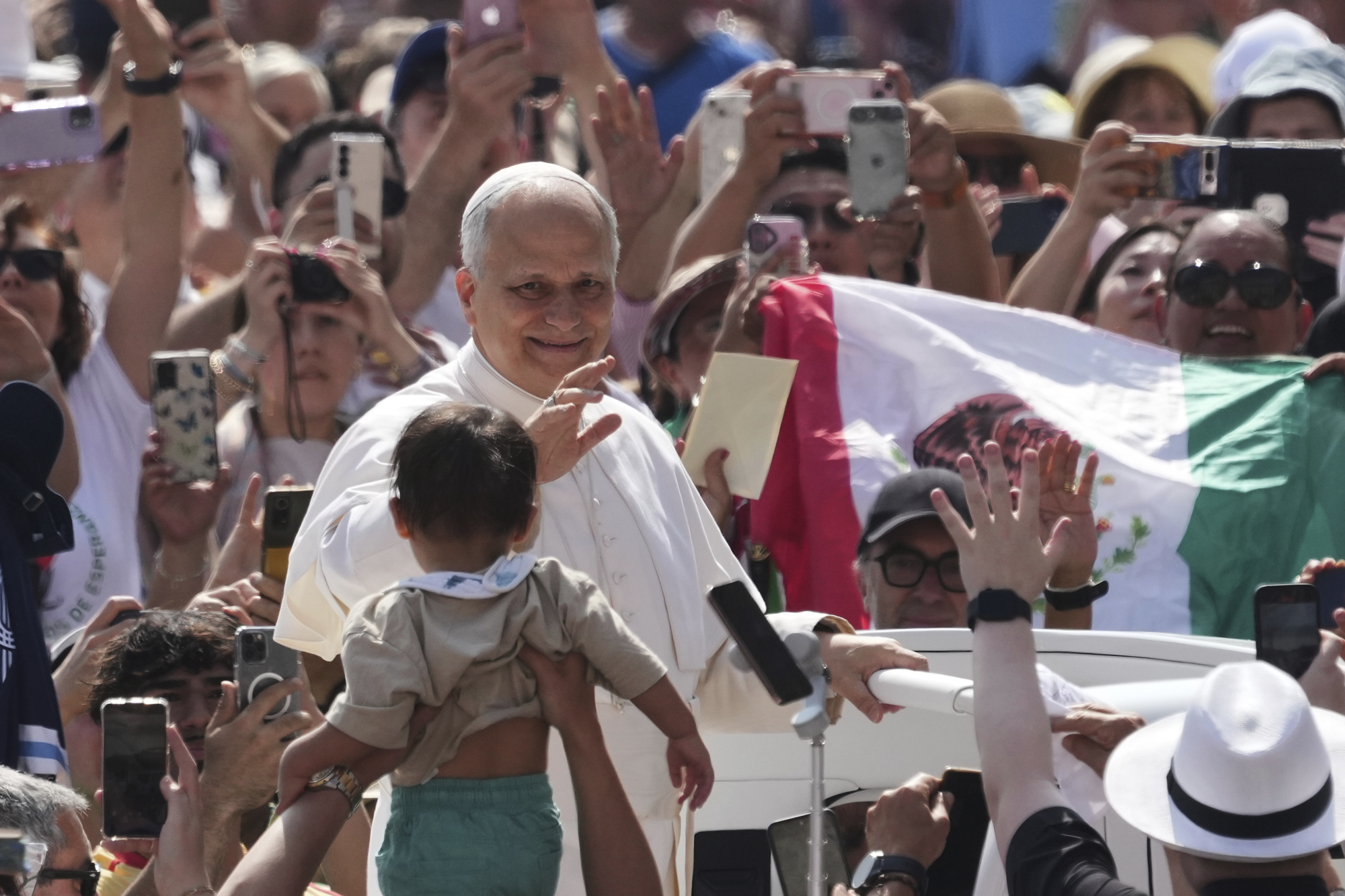
Pope Leo XIV waves as he arrives for his weekly general audience in St. Peter's Square at The Vatican, Wednesday, June 11, 2025. (AP Photo/Andrew Medichini)
Luis Andres Henao
AMELIA THOMSON-DEVEAUX
The Associated Press
Washington, D.C. — June 17, 2025
Just over a month after Pope Leo XIV became the first U.S.-born pontiff in the history of the Catholic Church, a new poll shows that American Catholics are feeling excited about their new religious leader.
About two-thirds of American Catholics have a "very" or "somewhat" favorable view of Pope Leo, according to the new survey from The Associated Press-NORC Center for Public Affairs Research, while about 3 in 10 don't know enough to have an opinion. Very few Catholics — less than 1 in 10 — view him unfavorably.
Among Americans overall, plenty of people are still making up their minds about Pope Leo. But among those who do have an opinion, feelings about the first U.S.-born pope are overwhelmingly positive. The survey found that 44% of U.S. adults have a "somewhat" or "very" favorable view of Pope Leo XIV. A similar percentage say they don't know enough to have an opinion, and only about 1 in 10 see him unfavorably.
As he promises to work for unity in a polarized church, Americans with very different views about the future of the church are feeling optimistic about his pontificate. Terry Barber, a 50-year-old Catholic from Sacramento, California, hopes Leo will seek a "more progressive and modern church" that is more accepting of all.
"I'm optimistic. Certainly, the first pope from the United States is significant," said Barber, who identifies as a Democrat. "Since he worked under the previous pope, I'm sure he has similar ideas, but certainly some that are original, of his own. I'm looking forward to seeing what, if any changes, come about under his leadership."
Thursday, February 12, 2026
Catholic commissioner removed from White House Religious Liberty Commission

Religious Liberty Commission Hearing on Feb. 9. Department of Justice video screengrab / YouTube
Elise Winland on February 11, 2026
Carrie Prejean Boller, a Catholic commissioner on the White House Religious Liberty Commission, was removed from the panel Feb. 11 after arguing during a hearing that her Catholic faith does not require support for political Zionism and that criticism of Israel’s actions in Gaza should not automatically be labeled antisemitic.
Republican Texas Lt. Gov. Dan Patrick, who chairs the commission, announced the decision in a post on X.
“No member of the Commission has the right to hijack a hearing for their own personal and political agenda on any issue,” Patrick wrote. “This is clearly, without question, what happened Monday in our hearing on antisemitism in America. This was my decision.”
During the Feb. 9 hearing, which focused on debates and riots on American college campuses and the role of government officials in protecting religious freedom, Prejean Boller cited multiple Catholic scholars, Scripture passages, and Jewish leaders to support her position and pressed witnesses on whether they believed her opposition to Zionism, grounded in religious conviction, made her “antisemitic.”
Saturday, February 07, 2026
Friday, January 23, 2026
Pope Leo XIV’s thanks to the volunteers of the Order of Malta, at the heart of the Jubilee of Hope

Photo-credit: © Vatican Media
14/01/2026
Pope Leo XIV received in the Paul VI Hall the representatives of the institutions and organizations that contributed to the realization of the Jubilee of Hope. Among them were nearly 1,000 volunteers of the Sovereign Order of Malta, led by Grand Hospitaller Josef D. Blotz and engaged throughout the Holy Year in the medical posts of the four Major Basilicas.
With dedication and professionalism, they assisted millions of pilgrims who came to Rome from all over the world.
During the audience, the Pontiff wished to thank them for their service: “How much good there is in the world. You are the proof of how much good there is in the world!” This recognition gives value to a year of silent and generous work, carried out by the Order of Malta thanks to the contribution of more than 2,200 volunteers from about 30 countries. Each week, more than 35 volunteers were on duty, organized into eight teams made up of a doctor, a nurse or paramedic, and assistants, supported by the 90 regular volunteers of the St Peter’s Square First Aid Post. Thanks to their commitment, around 3,000 interventions were carried out, and the assistance offered to pilgrims ranged from basic medical care to the management of the most complex emergencies.
Source
Sunday, December 28, 2025
Catholics in Maryland
Draft posted: 2019-02-09
On the ground from the beginning
Colonial Maryland, like its Chesapeake neighbor Virginia, was marked by slavery, but also by its distinction as a Catholic haven in British North America. George Calvert, Lord Baltimore, had been raised a Catholic, but he converted to the Church of England to pursue a life of service to King James. But, Calvert's conversion was half-hearted and he eventually reverted to Catholicism, and in the 1620s, he took up his long-held dream of helping to colonize North America with his fellow-Catholics in mind. He began by investing in an emerging Catholic colony in Newfoundland, but finding it inhospitable he set his sights on the Chesapeake. After visiting Virginia in 1629, Calvert pressed on to secure the necessary permissions from the Crown and the Privy Council to draw up a charter for Maryland. In 1631 the Privy Council embarked on the work of drawing up a charter that would grant Calvert absolute rule over the land between the Delaware Bay and the Potomac River. While charter was in preparation George Calvert died (1632), but his twenty-six year-old son, Cecil, took up his work. The younger Lord Baltimore was assisted in by Andrew White, SJ, who had been an advisor to George Calvert in planning and publicizing the venture since 1628.1
Andrew White's relationship with the Calverts assured that the English Jesuits would play a major role in the establishment of Catholic life in Maryland. In 1633, White set sail from England as one of the province's original Adventurers, leading British who were responsible for guiding expeditions of people with fewer means to populate the colony. White undertook his voyage on the Ark and Dove, bringing 26 men with him to support his mission to Christianize the territory. White's group was joined by other wealthy Adventurers and their accompanying Settlers, who were most often Protestant indentured servants. In March 1634, the vessels landed on an island in the lower Potomac, and from that spot, the Maryland Catholic community and the Society of Jesus grew up together in Lord Baltimore's North American colony.2
White's role in publicizing and recruiting colonists for the voyage ensured that he and the English Jesuits shared the interests of the wealthy Adventures who were responsible for creating the colonial community from the beginning. Despite their missionary aims for their interaction with the local native communities, the Jesuits found themselves aligned with the Catholic planter class who settled the area, rather than the burgeoning population of Protestant indentured servants who came to do the work of building the colony.
Thus, in the late 1630s, just as every other wealthy Adventurer did, the Jesuits undertook the process of claiming their land from Lord Baltimore. This early crew, Andrew White, John Altham (aka Gravenor), Thomas Copley, and Ferdinand Pulton, filed their claims as individuals rather than as an order because English, and hence Maryland, did not recognize the right of a religious order of corporate body to own property. Given that Lord Baltimore resisted the Jesuits' efforts to hold their land in common, eventually, they transferred the land rights to a layperson, Cuthbert Fenwick, to hold in trust for the order. In doing so they set into motion the process that resulted in the establishment of the first two Jesuit plantations in Southern Maryland: St. Inigoe's Manor and St. Thomas's Manor.3
Subscribe to:
Posts (Atom)