Showing posts with label reuters. Show all posts

Monday, October 19, 2026

World Food Programme Cuts Aid to 500,000 Palestinians in Gaza, Citing Funding Shortages


By Reuters
|
Oct. 19, 2026, at 3:21 a.m.


World Food Programme Cuts Aid to 500,000 Palestinians in Gaza, Citing Funding Shortages


REUTERS

Palestinian children wait to receive food from a soup kitchen funded by the World Food Programme (WFP), in Deir Al-Balah, in the central Gaza Strip October 18, 2026. REUTERS/Mahmoud Issa


CAIRO/GAZA, Oct 19 (Reuters) - The UN World Food Programme ⁠has ⁠said funding shortages are ⁠forcing major cuts to its aid programme in Gaza, leaving ​about 500,000 people without monthly food support in a territory where two-thirds of the population ‌struggle to get enough to eat.

The ‌WFP said it was reducing the number of recipients of its monthly assistance ⁠to 1.1 ⁠million people from 1.6 million.

In addition, food rations have been halved, ​cash assistance has been cut for 75,000 families, and the number of daily hot meals for those unable to cook has fallen to 150,000 from 250,000, with some families in ​hard-to-reach areas now receiving a hot meal only every other day.
c
The WFP said ⁠about ⁠1.4 million people, or two-thirds ⁠of Gaza's ​population, face crisis levels of food insecurity or worse, including roughly 200,000 people in ​emergency conditions.

Last year's US-brokered ⁠Gaza ceasefire calls for the eventual reconstruction of the territory. But little progress has been made towards implementing a deal to end the conflict that includes terms for Hamas to disarm and Israel to withdraw its troops.

"It's a year into the agreement ⁠of this ceasefire. Well, life is still brutal here. There is no ⁠proper shelter.. There is no basic services. There is no safety, no security," acting Executive Director of the World Food Program WFP Carl Skau told Reuters in Gaza.

"These cuts are happening just as we are facing the fourth winter. You know, I've been through the winters here, absolutely brutal," he added.

The WFP said it urgently needs $450 million over the next six months to maintain critical operations in Gaza and the Israeli-occupied West Bank.

"We tell ⁠the world now is this is not the time to look away. This is the time to step up to sustain this support, to protect the progress that has been made, but also to push for early ​recovery," said Skau.

(Reporting by Nidal Al-Mughrabi in Cairo and Mahmoud Issa ​in Gaza;Editing by David Goodman, William Maclean)


Copyright 2026 Thomson Reuters.


Global Security Forum in Doha, Qatar

 LIVE: Global Security Forum in Doha, Qatar

Reuters

Qatar holds the annual Global Security Forum in Doha, where Qatar's PM, Sheikh Mohammed bin Abdulrahman Al Thani, is expected to give the opening speech

Thursday, October 15, 2026

The Vatican's 'unusual' transparency about Pope Leo's cancer

The Vatican's 'unusual' transparency about Pope Leo's cancer

Reuters  

Oct 14, 2026  

'Communication about Pope Leo's health has shown a kind of level of unusual transparency for the Vatican,' says Joshua McElwee, as the pontiff recovers from a surgery that removed a cancerous lung nodule and one lobe of his lower right lung.

Tuesday, September 22, 2026

Xi is going to be in America, but not at the UN: Why China’s president chose Trump over the General Assembly


Edited By Jatin Verma
Published: Sep 22, 2026, 14:53 IST | Updated: Sep 22, 2026, 14:53 IST


Xi Jinping and Donald Trump Photograph: (AFP)

Story highlights

Xi Jinping is skipping the UN podium to meet Donald Trump in Washington, putting China-US ties, trade, AI and Taiwan at the centre of his US visit
Chinese President Xi Jinping will be in the United States this week, but he will not be taking the podium at the United Nations General Assembly in New York. Instead, Xi is heading to Washington for a state visit and a closely watched meeting with US President Donald Trump. The UN General Debate opens in New York on September 22, bringing together more than 130 world leaders at a moment marked by wars, economic tensions, artificial intelligence risks and questions over the future of the multilateral system. Yet Xi's three-day US visit begins on September 23, with his most important engagement taking place at the White House on September 24.

The decision means Xi will be hundreds of kilometres away from the UN podium while Trump addresses the General Assembly in New York. But Beijing has not presented Xi's absence as a rejection of the UN. China has officially said Xi is travelling to Washington at Trump's invitation from September 23 to 25, where the two leaders will discuss China-US relations as well as international issues involving peace and development.

Washington takes centre stage

For Beijing, the immediate diplomatic priority appears to be direct engagement with Washington. The White House has planned a high-profile reception for Xi. Trump is scheduled to personally greet the Chinese president at Joint Base Andrews on September 23, followed by a state arrival ceremony at the White House on September 24. The visit comes more than a decade after Xi's previous White House visit.

That symbolism matters. Rather than participating in the crowded diplomatic environment of UNGA, Xi will have direct access to Trump in a bilateral setting where trade, technology, Taiwan and wider geopolitical issues can be discussed without the constraints of a multilateral forum. The meeting also comes after years of friction between the world's two largest economies, including tariff disputes, technology restrictions and tensions over Taiwan.

Trade, AI and Taiwan on the table

The Trump-Xi meeting is expected to cover several of the most sensitive areas of the relationship. Trade remains a central issue, with both sides having an interest in preventing another escalation in tariffs and economic restrictions. Artificial intelligence and technology controls are also increasingly important areas of competition, particularly over advanced chips and access to critical technologies. Taiwan is another major fault line. US arms sales to Taiwan and Washington's broader security relationship with Taipei remain highly sensitive issues for Beijing.

Not a Chinese withdrawal from the UN

It would be misleading, however, to interpret Xi's absence as China walking away from the United Nations. China continues to participate in the UN system, and Chinese officials remain involved in the General Assembly and other diplomatic discussions. Xi's choice is better understood in the context of his unusually significant Washington agenda this week.

Why the timing matters

Xi's decision comes at a moment when Washington and Beijing are attempting to manage competition without allowing it to spiral into a broader confrontation. The two leaders have already met earlier this year, and the September visit is being presented by Beijing as another important high-level engagement. The White House, meanwhile, is giving Xi a formal state welcome, underscoring the importance Washington attaches to the meeting.

For Xi, the Washington meetings offer an opportunity for sustained, direct discussions with the US president on issues that affect China's economic and strategic interests. For Trump, hosting Xi during UNGA week puts the US-China relationship at the centre of an already crowded diplomatic calendar.


P.S.

Global leaders head to UN, Xi Jinping will go to White House

Kremlin says UN Security Council should add new permanent members, keep veto power that Erdogan urged scrapping


By ReutersSeptember 22, 20266:38 AM EDT


The United Nations emblem can be seen at the entrance to the general assembly hall as the United Nations prepares for world leaders to convene for the 81st United Nations General Assembly in New York City, US, September 21, 2026. REUTERS/David 'Dee' Delgado 


MOSCOW, Sept 22 (Reuters) - Russia believes the UN Security Council should expand its number ​of permanent members beyond the ‌current five, and that the existing veto system should remain, the Kremlin said ​on Tuesday.

Kremlin spokesman Dmitry Peskov ​was responding to a question ⁠from reporters about Turkish President Tayyip ​Erdogan's call to abolish both ​permanent membership and the veto.

Erdogan has long criticised the council, saying its veto-carrying permanent ​members - Britain, China, France, Russia ​and the US - are not reflective of the ‌international ⁠community and are unable to take swift decisions.

Peskov said Russia wanted the council to be reformed, and the permanent ​membership ​expanded.
"At the ⁠same time, we believe that the institution of ​permanent members of the Security ​Council, ⁠as well as the right of veto, are very important elements of ⁠the ​entire structure of ​the United Nations," he said.


Reporting by Dmitry Antonov Writing ​by Alessandra Prentice Editing by Mark Trevelyan


Saturday, June 13, 2026

Donald Trump’s Evangelical Base May Be Cracking


PUBLISHED

JUN 12, 2026 AT 11:09 AM EDT


By Andrew Stanton
Weekend Staff Writer

President Donald Trump’s approval rating with evangelical voters, a critical voting bloc for the Republican Party, is slipping, according to a new poll.

The poll suggests support for Trump among his evangelical base is cracking ahead of the 2026 midterms, when Democrats hope to win control of the House of Representatives and the Senate. White evangelical or born-again Christians were essential to his 2024 election, as he won the group with 82 percent support, according to CNN exit polling. A fracture in that base could be a major red flag for Republicans’ prospects in this year’s elections.

Trump Evangelical Support Slips: What To Know

Trump’s approval rating among evangelical voters fell to 52 percent in the latest Reuters/Ipsos poll, which surveyed 4,531 adults nationwide from June 3-8, with a margin of error of plus or minus 2 percentage points. That marks a downward trajectory from August 2025, when his approval rating among evangelical Americans was 61 percent, according to the poll.

Across all Americans, Trump’s approval rating was 35 percent. His approval has tumbled amid economic concerns around the cost of living and higher gas prices following the Iran war, which began at the end of February and has not polled well among Americans.

Fifty-four percent of evangelical respondents said they do not believe Trump’s use of the military in Iran is “in line with their understanding of Christianity,” compared to 41 percent who said it was.

Wednesday, August 08, 2018

New Mexico child abuse suspects accused of training children for shootings


August 8, 2018 / 6:17 AM / Updated 2 hours ago


Andrew Hay


TAOS, N.M. (Reuters) - Two men charged in the abuse of 11 youths found malnourished at a ramshackle compound in New Mexico were training the children with firearms to commit school shootings, prosecutors said in court documents filed in the case on Wednesday. 


Conditions at a compound in rural New Mexico where 11 children were taken into protective custody for their own health and safety after a raid by authorities, are shown in this photo near Amalia, New Mexico, U.S., provided August 6, 2018. Taos County Sheriff's Office/Handout via REUTERS 


One of the suspects, identified as Huraj Wahhaj, is the father of a young boy whose disappearance from his home near Atlanta months ago prompted the investigation that led authorities to raid the compound, located north of Taos, New Mexico, last week.

Remains believed to be that of the boy, who was 3 years old when his mother reported him missing, were found at the property on Monday but have not yet been positively identified, authorities said.

Wahhaj, a second man accused of harboring him as a fugitive, Lucas Morton, and three women presumed to be the mothers of the 11 children, who were taken into protective custody from the compound, were each charged with 11 counts of felony child abuse.

The five defendants made their initial court appearance before a local magistrate on Wednesday. They were due to be arraigned later in the day.

Taos County Sheriff Jerry Hogrefe told reporters on Tuesday that investigators found a shooting range built at one end of the squalid compound, located on the outskirts of the community of Amalia in northern New Mexico, near the Colorado border.

Wahhaj, 39, whose first name is alternately presented in some court documents as Siraj and is the person described as being “in control” of the compound, was heavily armed when taken into custody, the sheriff said.

A foster parent of one of the 11 children told authorities that Wahhaj “had trained the child in the use of an assault rifle in preparation for future school shootings,” prosecutors alleged in an expedited motion for pretrial detention.

The document further stated that Wahhaj was “under investigation for the death” of a 12th child at the compound, as well as for “training of children with weapons in furtherance of a conspiracy to commit school shootings.”

The court filing also states he “transported children across state lines for the purpose of children receiving advanced weapons training to commit future acts of violence.”

Similar allegations were leveled in a motion prosecutors filed seeking expedited pretrial detention of Morton.

The court documents said that most of the defendants appeared to be from Georgia, New York or elsewhere from the U.S. East Coast.

No mention was made of ideology or motive in initial court filings. The sheriff in comments over the weekend referred to the suspects as “extremists of Muslim belief,” but he declined to elaborate on that characterization when asked about it by reporters at a news conference on Tuesday.

According to CNN, Wahhaj is himself the son of a prominent Muslim cleric in New York.


The FBI is also taking part in the investigation, the sheriff said. So far, no federal charges are known to have been brought in the case.


Reporting by Andrew Hay in Taos, N.M.; additional reporting and writing by Steve Gorman in Los Angeles, editing by Larry King and Jonathan Oatis


Saturday, June 30, 2018

'Weed Apocalypse' dawns for California pot dealers on Sunday


By Rollo Ross, Reuters • June 29, 2018


FILE PHOTO: Customers queue for recreational marijuana outside the MedMen store in West Hollywood, California U.S. January 2, 2018. REUTERS/Lucy Nicholson/File PhotoMore


By Rollo Ross

LOS ANGELES (Reuters) - Six months after California made recreational marijuana use legal, the so-called "Weed Apocalypse" arrives this weekend, as tight state regulations going into effect on Sunday have dispensaries scrambling to unload non-compliant product.

But while the deadline is giving pot shop owners headaches, it is creating an opportunity for consumers. They are already anticipating deep discounts on their favorite marijuana products on what has been dubbed "Green Saturday" - for the color of cannabis - and for black market dealers.

"There's going to be a lot of massive sales, a lot of retails fire-selling a lot of products," said Nick Danias, manager of The Pottery cannabis dispensary in mid-city Los Angeles.

"It's about getting rid of a lot of older product that doesn't meet city and state requirements and getting through that old inventory and moving on to the next steps after July 1," he said.

The state Bureau of Cannabis Control regulations require shops to sell only marijuana that has been tested for pesticides, potency and microbiological contaminants.

The government-approved pot will be marked with a harvest and "best use by" date and sealed in child-resistant packaging. The rules were designed to take effect on July 1, six months after legalization approved by voters in November formally took effect on Jan. 1.

Business owners say they have struggled to meet the deadline because of a lack of approved testing facilities in California, which has created a bottleneck in the supply of compliant marijuana that could drive customers to the black market.

The Bureau of Cannabis Control lists 31 labs for testing on its website but says only 19 are operational.

"We issued our emergency regulations back in November, and at that time, we were pretty clear about the fact that there would be a six-month transition period for retailers to use up their existing supply," said Alex Traverso, a spokesman for the bureau. "We felt that was a sufficient amount of time to deplete stock on hand and adapt to California’s new rules."


Sunday, April 29, 2018

‘Caravan’ Migrants Weigh Risks of US vs. Life in Mexico


April 29, 2018 3:06 AM


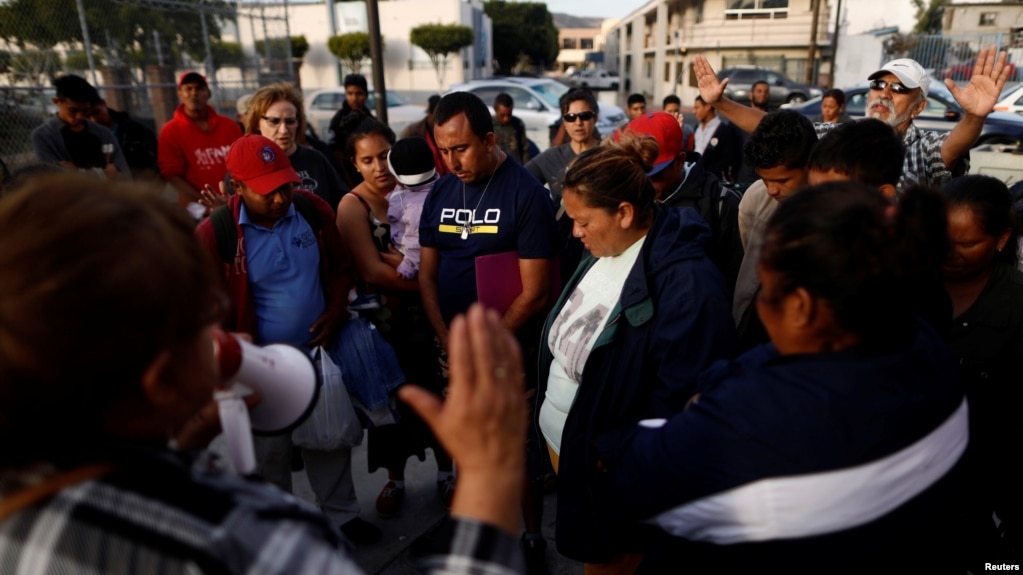
Members of a migrant caravan from Central America pray in preparation for an asylum request in the U.S., in Tijuana, Baja California state, Mexico, April 28, 2018.


TIJUANA, MEXICO —

Hondurans, Guatemalans and Salvadorans who drew the wrath of President Donald Trump in a monthlong caravan to the U.S. border will make hard decisions Sunday: Risk being deported all the way home by trying to cross in the U.S., or to build a life in Mexico.

After angry tweets from Trump, U.S. border authorities said some people associated with the caravan had been caught trying to slip through the fence, and encouraged the rest to hand themselves in to authorities.

“We are a very welcoming country but just like your own house, we expect everyone to enter through our front door, and answer questions honestly,” San Diego Chief Patrol Agent Rodney S. Scott said in a statement.


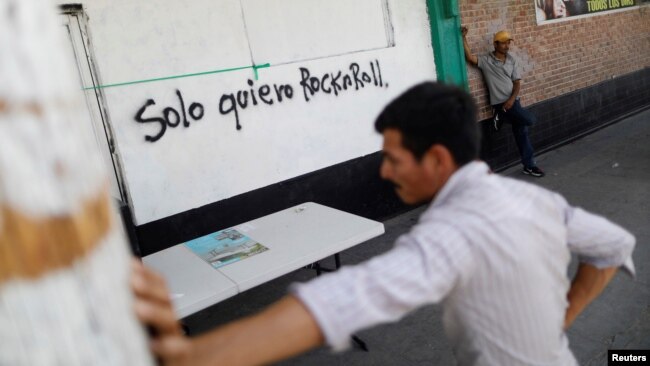
Central American migrants, moving in a caravan through Mexico and traveling to request asylum in U.S, arrive in Mexicali, Baja California state, Mexico, April 25, 2018. The words read, "I just want Rock and Roll."


​Sober advice, mood

Most of the group of about 400 travelers who arrived in border city of Tijuana on buses over the past couple of days said they intended to legally seek asylum in San Diego on Sunday, but lawyers advising the group gave them stark advice: Not everyone will be successful.

After the grueling journey, a somber mood took hold as the reality sank in that many of them would be separated from their families. Lovers and parents with slightly older sons and daughters could be forced to split up.

At venues around the city, U.S. immigration lawyers working pro bono Saturday listened to harrowing tales of life in the immigrants’ home countries.

Death threats from local gangs, the murder of family members, retaliatory rape, and political persecution back home prompted them to flee, the migrants and lawyers say.


Honduran family Nolvia Luja, left, Willian Bonilla, and their son Wilmer Bonilla, who attended the annual Migrants Stations of the Cross caravan for migrants' rights, rest at a shelter in Tlaquepaque, Jalisco state, Mexico, April 18, 2018.


Many of the immigrants who spoke at length with Reuters at various points during their trip through Mexico had been short on knowledge of their legal rights, but at least 24 recounted detailed stories of facing death threats.

As poor migrants from Central America on a perilous route through Mexico, they feared they could be robbed, raped, arrested and assaulted, so traveling by caravan offered their only protection, they said.

The lawyers advised which cases had higher chances of passing the “credible fear” test required to enter the long and often difficult U.S. asylum process, said immigrant rights organization Al Otro Lado, Spanish for On the Other Side.

“A lot will depend on how well they can articulate their case,” said one of the pro bono lawyers, who preferred to remain anonymous.

Some advised to stay in Mexico

The rest were advised to stay put in Mexico, which would remove the risk that U.S. authorities fly them the more than 2,000 miles (3,600 km) back home.

“We’ll wait and see,” said Bryan Garcia, from Honduras, seated beside 4-year-old Nicole, who was eating a strawberry biscuit as they waited for her mother to come out of a meeting with a lawyer.

Nicole and her mother are from El Salvador. They befriended Garcia along the caravan’s journey and the adults had fallen for each other.

But Garcia would not be asking for asylum. He would stay in Tijuana, having already been deported once from the U.S.

“We’ll just have to try to stay connected,” he said as Nicole paused from eating her biscuit and blinked up at him.

Pressure on Mexico

Trump has been pressuring Mexico to stop the migrants before they reached the border, linking the future of the North American Free Trade Agreement (NAFTA) to Mexican efforts to stem the flow of Central Americans.

The friction has coincided with high intensity efforts by U.S., Canadian and Mexican teams to renegotiate NAFTA on Trump’s bidding, with officials saying a deal could be just a few weeks away after months of talks.

Mexico deports tens of thousands of Central Americans every year back across its southern border with Guatemala.