Showing posts with label volunteers. Show all posts

Sunday, June 07, 2026

Magnificent humanity and shared responsibility at Delaney Hall


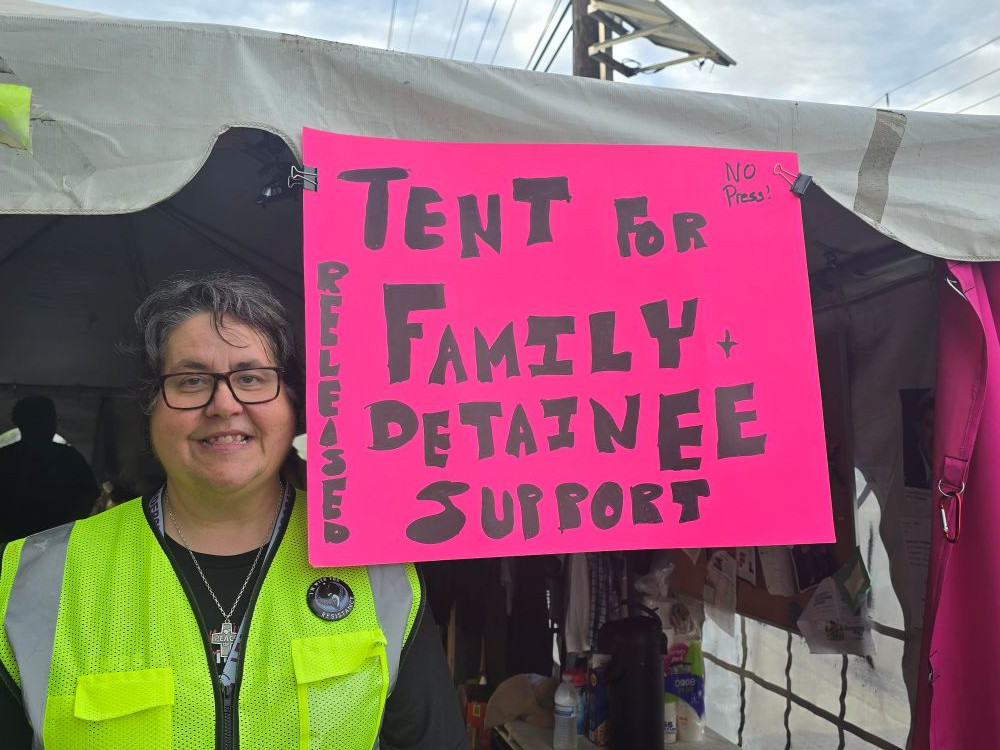
Sr. Susan Rose Francois of the Sisters of St. Joseph of Peace poses next to the sign outside the family and detainee support tent in front of Delaney Hall in Newark, New Jersey. (Courtesy of Eyes on ICE NJ/Joseph O'Leary)


by Susan Rose Francois

NCR Contributor

View Author Profile

June 1, 2026

For more than a year, a network of community leaders has provided public witness, solidarity and mutual aid in support of detained immigrant neighbors and their families at Delaney Hall in Newark, New Jersey.

Delaney Hall opened in May 2025 and is operated by the private prison corporation GEO Group under a 15-year $1 billion government contract. It is the largest detention center on the East Coast. Five miles from my convent, it has been on my radar for over a year but has just recently entered the national consciousness due to a courageous hunger and labor strike by those held captive behind its walls.

The Eyes on ICE NJ coalition includes a diverse collection of organizations: Catholics like the Sisters of St. Joseph of Peace and Pax Christi New Jersey, other faith groups, peace organizations, earnest people from local community and political organizations and immigration advocates. Then there are just ordinary folks who are looking for a way to make a real difference in the face of the cruelty that is happening in our name. We are committed to a common mission to oppose Delaney Hall and the unjust operations of ICE through nonviolence, mutual aid, radical hospitality and interfaith cooperation until the facility ceases operations. We are here for the long haul, and we center the concerns of our immigrant neighbors who are detained and the real needs of their families left behind. For the past year, volunteers have been present every visiting day to staff the "Radical Hospitality" tent or to peacefully stand vigil outside the facility on non-visiting days.

I have come to consider my fellow volunteers as my friends and could not help but think of them as I read these words from Pope Leo XIV in Magnifica Humanitas:
[B]uilding a world in which everyone can flourish requires shared responsibility and courage. No one can singlehandedly bear the weight of the challenges the world is facing, just as no one is so weak that they cannot play their part, for "power is made perfect in weakness" (2 Cor 12:9). … We should not be intimidated by tensions or differences because they can become creative forces when guided by shared responsibility.

I'll be honest: We don't always at first agree on details, but we agree on our values and that is what matters. We agree that the cruelty happening in our name is unacceptable. We believe that our friends in detention and their families come first. This isn't easy on the best of days, and it has become even more difficult with the recent attention and activity outside Delaney Hall this past week. The increased focus was sparked by a family-led press conference the Friday before Memorial Day weekend, highlighting the inhumane conditions their loved ones are facing. More than 300 people held at Delaney Hall then went on a hunger and labor strike to raise awareness and concern for the most vulnerable among them.

Saturday, February 10, 2018

A question of time- volunteering, social and civic engagement in a connected society


Breakfast meeting-Thursday 22 February


Volunteering, social and civic engagement are a fundament of democratic societies and the social cohesion of a society. It, however, also depends on common free time and this seems to be increasingly limited. At the same time, social media allows for new forms of participation not requiring synchronised rest time, such as Hashtag activism. Yet, can these new forms compensate for the “traditional” ways of commitment? Is digitalisation undermining or facilitating civic engagement? And if there is a lack of civic engagement, what can the EU do to help countering this development?

To address these issues, the EP Interest Group on work-life balance will hold on Thursday 22 February 2018 a breakfast meeting on “A question of time –volunteering, social and civic engagement in a connected society”.


We would like to discuss the necessity of re-synchronising our private and working life in a digitalised society and reflect on possible ways. How will these developments affect volunteering and civic engagement and what does this mean for social cohesion? Could new forms of social media compensate - at least partially - the lack of common free time?


Thursday 22 February 2018


08h00-09h30 at the EU Parliament


Event hosted by MEP Thomas Mann & MEP Evelyn Regner

Discussion:

Prof. Dr. Paul-Stefan Roß, Cooperative State University Stuttgart, Faculty of Social Science

Gabriella Civico, Director of the European Volunteer Center

Chris Van Droogenbroeck, Belgium Trade Union LBC-NVK, Commerce Sector

The meeting will be held in English. We are looking forward to a lively discussion!

Download the invitation

Please register by Wednesday 15 February 2018 :

REGISTER HERE


Friday, January 25, 2013

A Great Weekend for National Service


By Wendy Spencer

This weekend was a major moment for national service, and I want to share some of the many highlights that inspired me.

As the federal agency that leads the Martin Luther King Jr. Day of Service, we worked closely with the Presidential Inaugural Committee to make the President’s National Day of Service and MLK Day into a Weekend of Service.

The result: Americans in all 50 states came together to make a difference. They delivered meals, refurbished homes and schools, collected food and clothing, signed up mentors, promoted nonviolence, supported veterans and military families, and much more.


On Saturday, I had the honor of serving alongside President Obama, Mrs. Obama, their daughters, and members of City Year, an AmeriCorps program, at the Burrville Elementary School in Washington, DC. It was remarkable to see the President and First Lady’s passion and commitment to service up close.

It was also great to see so many Administration officials and elected leaders at all levels of government engaged in and promoting service over this weekend.

Another example comes from a service project for our military families. Vice President Biden, Dr. Jill Biden, and members of their family joined thousands of volunteers, including Senior Corps and CNCS employees, at the D.C. Armory. They spoke with AmeriCorps NCCC members who helped organize the project.

It was a remarkable experience, and we must give a special thanks to our partners Target and Points of Light, as well as Operation Gratitude. Thousands of volunteers prepared care packages and sent messages of support to our troops, military families, and first responders.

Watch this short video and check out our photo gallery that capture the energy from this event and others.

As we reflect on the Weekend of Service, we want to build on this momentum. Let's remember the sense of accomplishment and collaboration that we felt, and bring more Americans into service.

Whether you're an individual who wants to serve your community, or an organization that wants to recruit volunteers, please visit Serve.gov. This site is our year-round resource where you can find a service project near you or register your group's event.

You can also share your service experience with us on facebook.com/serve and on Twitter via@servedotgov.

I'm fired up, and I hope that you are too. Join me in making service an even bigger part of your life.


Posted on 1/24/2013


.

Tuesday, October 11, 2011

FAFCE Conference on the contribution of “invisible work” to the creation of wealth


17 October in Brussels: FAFCE Conference on the contribution of “invisible work” to the creation of wealth


In the framework of the European Year of Volunteering and with regard to the recommendations of the Stiglitz report, the findings of the recent OECD report Cooking, Caring and Volunteering: Unpaid Work Around the World, and the EESC Opinions SOC/243, SOC/366 et SOC/399, theFAFCE organises a conference under the sponsorship of Group III of the European Economic and Social Committee on the contribution of « invisible work » to the creation of wealth – an added value to the social cohesion.

According to the OECD report mentioned above “household production constitutes an important aspect of economic activity and ignoring it may lead to incorrect inferences about levels and changes in well-being”.Volunteering, intergenerational solidarity, and mutual help and assistance are all favoured by family associations. In addition, the production of households is one of these kinds of “invisible work”, that contributes directly to social cohesion. Here, the OECD directly addresses the question of the inclusion of this invisible work in the evaluation of wealth of the society and the wellbeing of populations This question leads to others at the heart of an interrogation on social cohesion: are there any reasons to consider gratuitousness in economical terms? Is social cohesion measurable in economical terms? If so, which indicators should be integrated in the usual and existing measures of wellbeing and sustainable development in order to account for the richness of the factors that favour social cohesion? Should these indicators be stimulated and if so, how?

Registration before 10th October: www.fafce.org


Sunday, August 08, 2010

Volunteer builders construct two Mid-State churches


Posted: Jun 16, 2010 5:48 PM EDT


Unity Project on Facebook


MCMINNVILLE,Tenn. – More than 450 volunteers from five different states will finish construction on two churches in Warren County, as part of a mission called "A Unity Project".

Hundreds of volunteers are giving their time and money to help build the churches in McMinnville in only three weeks.

Pastor DeWayne Howard of Bridges of Hope Fellowship told News 2 Wednesday that he's watching a miracle go up before his eyes.

"We're a 3 1/2 year old congregation, no money in the bank. God said build it. We stepped out, and here it is," Howard told News 2 as members of churches from Macon, Georgia worked inside and out.

The sanctuary and classrooms of the church he pastors will be finished this week with only painting and some other details left to go.

Howard says his church is saving hundreds of thousands of dollars, including $200,000 in labor costs alone.

"It's a $650,000 building. We're building it for $175,000," Howard said.

Baptist church groups from Alabama, Georgia, Tennessee, South Carolina and North Carolina have worked on the building, plus they have helped get a sanctuary for McMinnville Seventh Day Adventist Church off the ground.

"They have the money to buy the materials, but they don't have workers. We said, let's let our Baptist volunteers build their Seventh Day Adventist Building," said Pastor Howard, adding, "Yes, it is very unusual."

Harley Roth is pastor of the McMinnville Seventh Day Adventist Church, being built just a few miles down the road.

Roth said, "Our church has been wanting to build for decades, but there's never been an opportunity financially, or in coming together."

The volunteers started on the Adventist church last Thursday, and within less than a week, walls and a roof were in place.

Pastor Roth said, "It's surprising, because they're giving of themselves. What amazes me is that these people pay for the privilege. I understand it's about $300. They pay just for coming."

The groups even brought their own food and cooks, and some took vacation time from work to be there.

Don Hensley, who is retired, is volunteering with the Georgia group.

He explained his motivation for travelling to another state to help build a church for strangers.

Hensley said, "We're Christians, we love Christ, and we're trying to help somebody else have the opportunity to serve God."

According to a press release, "A Unity Project" aims to encourage both congregations to set aside any differences and to focus on the things that unite them.

"We want to stretch hands across denominational lines and reach other people," said Howard.

Many of the building supplies, concrete, and other items were donated by a number of different businesses from Murfreesboro and Nashville.

Both church buildings will be finished by Friday. ..


.

Sunday, December 20, 2009

Lesbians cruise the seas with a cause

NEWS
Published 12/10/2009
by Heather Cassell
heather@whimsymedia.com


Sweet co-founders Jennifer Rainin, left, and Shannon Wentworth stand by a wall at the Karl Heusner Memorial Hospital pediatric ward in Belize City, Belize. Volunteers from the ship helped paint the ward. Photo: Whimsy Media/Help Yourself Tech Services

More than a thousand lesbians braved tropical storm Ida and sailed through rough waters to have fun in the sun and to lend a helping hand in the Caribbean last month on Sweet's maiden adventure on the high seas.

"This is a dream that has come true," gushed Jen Rainin, 42, an out lesbian and co-founder of Sweet. "It's going to keep coming true for a very long time."

"I've never been so naturally high," added out lesbian Shannon Wentworth, Sweet CEO and co-founder.

Sweet evolved out of a desire to combine the two lesbians' love of travel, building community, and working on social and environmental issues that they care about, the women said. More than two years later Wentworth's vision set sail out of New Orleans on November 6 and made stops in Costa Maya, Mexico; Belize City, Belize; Roatan, Honduras; and Cozumel, Mexico before returning to New Orleans eight days later.

What sets Sweet apart is that passengers can opt to participate in volunteer activities at the various ports of call, and spend part of the trip giving back to local communities. On this maiden voyage, 310 passengers took part in volunteer projects, out of 1,200 who were on the cruise.

The voyage was also noteworthy as actress Meredith Baxter was a passenger and last week she came out as lesbian in several publications and an appearance on the Today show. Her presence on the cruise was not publicized at the time, Sweet officials said, out of respect for passengers' privacy.

The future of travel

It wasn't an easy voyage. Wentworth, 37, navigated Sweet through rough waters both at sea and onshore, earning the praise of queer travel pioneers. The company hopes to emerge as another big player in lesbian travel.

"This is not the future of lesbian travel, this is the future of all travel led by lesbians," said Charlie Rounds, president of RSVP Vacations.

He applauded Sweet's creators for making passengers ambassadors of the LGBT community and America and in the process, revolutionizing the future of the travel industry.

"No one is going to say I was a genius on choosing when to start this company," Wentworth told shewired.com in June about beginning a start-up, luxury, lesbian, eco-friendly, "voluntourism" company during a struggling economy, especially with a reigning queen of lesbian cruises, Olivia, already an established brand.

Judy Dlugacz, founder and co-owner of Olivia, recognized the challenge Sweet faced with the downturn of the economy.

"They came in a very tough time of the economy, that's tough for them," Dlugacz said earlier this year.

For their part, Sweet's founders said they are not in competition.

"I'm really glad that the comparison can die down now that people see the different product. We are not trying to do Olivia's business," said Wentworth. "There is no bad blood with Sweet and Olivia."

"My greatest hope is that other businesses take this idea. What's good for the environment is good for people and what's good for people is good for the environment. All of that is good for the world and good for business," Wentworth added.

The recession got Rainin and Wentworth's creative juices flowing. Wentworth developed programs to attract younger travelers, made the ship accessible and welcoming to a variety of guests, including those with disabilities and those in recovery. The women also tried to help ease travelers' stress over tightened wallets.

But mostly, they proved that businesses can be wise and sensitive to their customers' and their own bottom lines as well as the environment.

"I believe this is the largest carbon-free cruise ever," said Wentworth, quoting estimates from Carbonfund.org that calculated the cost at $20 per guest on the cruise and airlines and $1.50 per guest at the hotels to offset carbons released into the atmosphere. Carbonfund.org, a carbon reduction and offset organization supports high-quality verified renewable energy, energy efficiency and reforestation projects, according to the organization's Web site.


Sweet passengers party around the pool on board the ship. Photo: Whimsy Media/Help Yourself Tech Services

Sweet ambassadors

Sweet also tapped into a new market of travelers. Not attracted to "packaged travel," Wentworth reached a comfortable compromise attracting politically conscious consumers looking to have fun and do good.

"What we wanted were people who wanted to make a difference in the world and to have fun at the same time," said Wentworth.

Women representing 10 countries from around the globe conquered sea sickness from Ida, reptiles and bugs of all sorts, swamps and trash laden beaches, homophobia and sexism, and swarms of excited screaming children whose lives were brightened by cartoon painted walls and piles of books, school supplies, and toys brought to them by Sweet passengers.

"I absolutely loved it. Honestly, it took Sweet to get me on a cruise," said Denise Johnson, 46, a lesbian IT specialist from Chicago. "The beauty of this cruise was the opportunity to give back and that's exactly what got me on my first cruise."

Johnson volunteered in three of the four ports putting together computers, painting classrooms, and cleaning beaches, she said.

Darcie Takeuchi, 32, from San Francisco, who volunteered with Johnson on the shores of Mexico and in Belize at an elementary school, agreed. She wasn't exactly a "cruise girl," but she was attracted and inspired by an eco-friendly and social justice vacation, she said.

"Just because that is where my heart is," said Takeuchi, a social worker temporarily turned nanny. "My passion is to be doing outreach and volunteer with communities and families, especially children and families."

Takeuchi only wished she had been able to volunteer at each port like Johnson, but it was a vacation. Takeuchi took time out to relax with her girlfriend, Lauren Patton, 26, an emergency communications dispatcher for the California Highway Patrol. The two women had fun riding scooters around Cozumel, lying out in the sun by the pool, and meeting like-minded women.

Volunteering didn't impact Johnson's free time either.

"I had the rest of my half of the day to have fun, come back [to the ship] and relax or wash paint off," she said.

Wentworth foresees Sweet's voluntourists driving future projects, she said.

"What we really want is for our guests to tell us what they want to do, what they can do," said Wentworth. "[Sweet's guests] want us to push the envelope more." Wentworth isn't just planting seeds hoping that they grow. She plans to keep passengers in the know about the impact they make with the projects.

The ship barley left a port before local governments and communities reported the impact of the projects and invited Sweet back, Wentworth said.

"We have every intention to invest in these communities every few years so we can build on this stuff, we can really see our work grow, and we can see the dialogue grow about gay and lesbian issues in these ports," said Wentworth, who chose the port cities based on the cruise route that makes it easy to return in the future.


Killing homophobia, sexism with kindness

In the future Wentworth plans on working with LGBT, women's, and HIV/AIDS organizations as well as staying longer in the ports, she said.

"We can make the biggest impact ... in the Caribbean [on] the lives of gay people," said Wentworth, pointing out that unlike in Mexico and the United States where homosexuality is legal, the biggest impact could be in Belize and Honduras where homosexuality is illegal.

Sweet's passengers were a curiosity for Belizean press that announced the ship's pending arrival and crowded around Karl Heusner Memorial Hospital early in the morning only to be turned away by Dr. Francis G. Longsworth, the hospital's CEO. Kim Simplis Barrow, first lady of Belize, managed the Belizean press by handpicking reporters to cover the lesbian volunteers painting the pediatric ward with American cartoon characters chosen by the kids.

Simplis Barrow is also founder of Lifeline Foundation, an organization that works to improve Belizean children's lives. The foundation partnered with Sweet and another organization, Magic Brushes.

Sweet managed to avoid attracting press attention at the James Garbutt Seventh Day Adventist Primary School, where parents threatened to pull their kids out of class for the day and shut down the project if it was made public, Wentworth said. That day, most of the school's 265 elementary students screamed with excitement as they ran from newly painted classrooms to the library and admired tattoo-adorned lesbian and gay volunteers.

"We showed these kids there are different ways to be female," said Wentworth.

Culture clash

Some passengers weren't aware of the anti-gay laws in the countries where the ship docked, however, and ran into some problems.

Chawntea Palmore, 34, a bisexual African American woman from Oakland, felt that Belize was "a little dangerous" and wished that Sweet personnel had been "more forthcoming with all of the information that they have about the port cities."

Sweet did have information on its Web site about things to do in Roatan and Belize, but not the type of information that Palmore and her friends would have appreciated.

"They were very kind in Honduras," said Palmore, who enjoyed herself in Roatan and was "glad" she wasn't aware of the anti-gay laws, yet she insisted, "They took a choice away from me."

"Belize, it was a very different story," she said.

Her group ended up returning to the ship after an incident with some men who became upset when one of her friends told them she had a wife. A police officer informed the women of the anti-gay law and that they could be jailed simply for "holding hands" in public, Palmore said.

Other than that experience, Palmore said she had a great time during the rest of the cruise.

Saddened by some guests' unfavorable response to Belize, Wentworth told the B.A.R. that she doesn't plan to give up.

"Belize is a community that I really, really want to invest in. They took a really big risk because it's not a good place to be a homosexual in Belize," said Wentworth, who was happy for media coverage that caused the city to have a "dialogue about same-sex couples." She hopes residents' contact with the volunteers and passengers will change the conversation about queer people and women, she said.

Roatan, Honduras is a different story. Roatan is an island off of Honduras' mainland, which is the site of human rights violations against queer activists, as reported by the International Gay and Lesbian Human Rights Commission, Human Rights Watch, and other organizations, as well as recent political turmoil. The island, however, remains a different world. A popular port for ships, including gay cruises, residents of the resort island hold a somewhat more global perspective, especially regarding LGBT people.

Roataneans simply "don't care what you do," said Shela O. Brooks, a native and owner of Floweras Bay Roatan.

"We would never put our guests in danger," said Wentworth, aware of the political situations in Belize and Honduras. But she didn't want to get into politics.

"I want to have fun, save the world," said Wentworth.

RSVP's Rounds pointed out the impact Sweet passengers had wasn't only upon the communities in the port cities, but the estimated 1,000 crew members on the ship who largely came from developing countries.

"For one week by being polite, by being respectful, and being fabulous ... that's an impact that is immeasurable," said Rounds.

Many crew members said they were happy with the job.

"We all wanted the 'I am Sweet' T-shirts," said Didia Charles, a crewmember from St. Lucia, who said some staff received the shirts and that the guests were so low maintenance that the crew was also allowed some time off.

For more information about Sweet, visit http://discoversweet.com/.
.
.
Thursday, March 19, 2009

House Passes Volunteerism Bill Critics Call Pricey, Forced Service

March 17: First lady Michelle Obama greets members of AmeriCorps Youthbuild USA during her visit to a "green" home building project on the National Mall in Washington. (Reuters)


House Passes Volunteerism Bill Critics Call Pricey, Forced Service

The legislation will expand the1993 AmeriCorps program to match the renewed interest in national service since President Obama's election, which backers say is crucial in tough economic times.

By Kelley Beaucar Vlahos
FOXNews.com
Wednesday, March 18, 2009


WASHINGTON -- The House of Representatives passed a measure Wednesday that supporters are calling the most sweeping reform of nationally-backed volunteer programs since AmeriCorps. But some opponents are strongly criticizing the legislation, calling it expensive indoctrination and forced advocacy.

The Generations Invigorating Volunteerism and Education Act, known as the GIVE Act -- sponsored by Reps. Carolyn McCarthy, D-N.Y, and George Miller, D-Calif. -- was approved by a 321-105 vote and now goes to the Senate.

The legislation, slated to cost $6 billion over five years, would create 175,000 "new service opportunities" under AmeriCorps, bringing the number of participants in the national volunteer program to 250,000. It would also create additional "corps" to expand the reach of volunteerism into new sectors, including a Clean Energy Corps, Education Corps, Healthy Futures Corps and Veterans Service Corps, and it expands the National Civilian Community Corps to focus on additional areas like disaster relief and energy conservation.

It is the first time the AmeriCorps program, which was created by President Clinton in 1993, will be reauthorized, and supporters say it will have additional funding to match the renewed interest in national service since President Obama's election and the acute need for volunteerism and charity in tough economic times.

"National and community service can help make Americans a part of the solution to get our country through this economic crisis. I hope the House and Senate will join us in moving as quickly as possible to help President Obama sign this critical bill into law," Miller, chairman of the education committee, said after the bill was passed.

But the bill's opponents -- and there are only a few in Congress -- say it could cram ideology down the throats of young "volunteers," many of whom could be forced into service since the bill creates a "Congressional Commission on Civic Service."

The bipartisan commission will be tasked with exploring a number of topics, including "whether a workable, fair and reasonable mandatory service requirement for all able young people could be developed and how such a requirement could be implemented in a manner that would strengthen the social fabric of the nation."

"We contribute our time and money under no government coercion on a scale the rest of the world doesn't emulate and probably can't imagine," said Luke Sheahan, contributing editor for the Family Security Foundation. "The idea that government should order its people to perform acts of charity is contrary to the idea of charity and it removes the responsibility for charity from the people to the government, destroying private initiative."

House committee staff insist the GIVE Act will not change the voluntary nature of service.

"Its ridiculous to suggest that our bill includes any effort to make service a mandatory requirement. All of the opportunities our bill provides to Americans are voluntary. Americans are proud of their service and volunteering and their interest in it is only growing, especially in the face of this crisis. Our legislation recognizes that more Americans than ever want to serve and give back and provides them with more opportunities to be able to do so," Miller spokeswoman Rachel Racusen said in an e-mail to FOXNews.com.

Others say they are concerned that the increased funding will be used to promote one ideology over another.

"It's allowing taxpayer funding of the left-wing organizations," said Larry Hart, director of government relations for the American Conservative Union.

"I think this is a problem that is rife throughout the federal government. When you dramatically expand the program, then you dramatically expand the ability for these left-wing advocacy organizations to get more funding. I don't see a lot of attention being paid to that, even from those who are critical. That's where the focus should be. Republicans tend to say its not that they oppose the program, they just want to spend less money. It's the program that's bad."

South Carolina Rep. Joe Wilson was one of three Republicans to oppose the legislation in committee. Wilson questioned the utility of the cash-strapped federal government making such huge investments in what he says should be community-inspired projects and programs.

"Volunteerism is part of the American spirit of generosity, and we all stand in support of those who will share their time," said Wilson, who was voted against the bill with Minnesota Rep. John Kline and California Rep. Tom McClintock.

"However, while our economy and our government is in financial trouble, it is not the best use of taxpayer dollars to spend the level of money on new and existing programs included in this bill."

Aides to Miller say they are awaiting estimates from the Congressional Budget Office on how much the GIVE Act would ultimately cost. In addition to all of the funding that goes to organizations in the forms of grants and administrative costs, AmeriCorps volunteers typically receive stipends and college scholarships when they complete one of the several available programs.

For example, a participant in the National Civilian Community Corps, which is a 10-month residential commitment, now receives $4,000 in living expenses and a $4,475 in money toward school. That conceivably would increase under the new legislation.

But regardless of the budget estimate, the financial benefits outweigh the cost, Racusen said.

"The millions of Americans who volunteered in 2007 generated benefits worth $158 billion," Racusen said. "A cost-benefit analysis of AmeriCorps, for example, shows that every dollar invested in the programs yields almost $4 in direct, measurable benefits. Investing in service helps low-income students achieve in school, prepares future workers for green jobs, provides assistance to veterans returning from war, and rebuilds homes and communities after disasters."

Many of the provisions in the GIVE Act can be found in Obama's 2010 fiscal year budget blueprint issued in February. The administration proposes $1.3 billion for the Corporation for National and Community Service, which administers AmeriCorps. CNCS received an estimated $260 million in fiscal 2009.

But some critics on the right suggest that the president's push for national service goes too far, and the recent congressional steps toward expanding the federal role in volunteerism and "civilian service" smacks of a larger agenda. They point to a campaign speech the president made last July in which he suggested national security could be entrusted to a civilian force.

"We cannot continue to rely on our military in order to achieve the national security objectives we've set. We've got to have a civilian national security force that is just as powerful, just as strong, just as well funded," Obama, who worked as a community organizer in Chicago early in his career, said during a Colorado Springs rally.

At the time, Obama was discussing expanding the USA Freedom Corps -- created by President George W. Bush in 2002 -- Peace Corps and AmeriCorps, as well as beefing up the cadre of foreign service officers abroad and programs in which veterans help veterans back home.

"This will empower more Americans to craft their own service agenda and make their own change from the bottom up," Obama said in the speech.

"Senator Obama aims to tap into the already active volunteerism of millions of Americans and recruit them to become cogs in a gigantic government machine grinding out his social re-engineering agenda," Lee Cary of the conservative American Thinker wrote at the time about Obama's remarks.

"(His words) were about turning America into one, giant, community organizer's sandbox at enormous cost to taxpayers," Cary wrote.

Supporters say critics are a minority who prefer to agitate than assist.

"Resistance to expanded public service programs can be expected from the ideologically sclerotic, those who occupy the negative ground between government as the problem and government as our enemy," former Democratic Colorado Sen. Gary Hart wrote in a recent op-ed on the Huffington Post Web site.

The Senate is mulling over a similar piece of legislation, the "Serve America Act," sponsored by Sens. Orrin Hatch, R-Utah, and Ted Kennedy, D-Mass. It was given a special endorsement by the president in his address before Congress on Feb. 24.


,