Showing posts with label António Guterres. Show all posts
Showing posts with label António Guterres. Show all posts
Wednesday, January 14, 2026


Friday, November 21, 2025
Wednesday, June 11, 2025
Sunday, June 01, 2025
Friday, October 25, 2024
Saturday, October 19, 2024
Monday, September 23, 2024
'We are here to bring multilateralism back from the brink' - UN chief
P.S.
More Agenda 2030 Multilateralism
Wednesday, January 17, 2024
António Guterres (UN Secretary-General) at WEF 2024 in Davos
Summary
Special address by UN Secretary-General António Guterres to the World Economic Forum Annual Meeting in Davos, Switzerland
Description
The World Economic Forum's Annual Meeting takes place in Davos from 15-19 January 2024. It will welcome over 100 governments from around the world, all major international organizations, the Forum's 1000 Partner companies, as well as civil society leaders, experts, youth, social entrepreneurs and the media. Under the theme "Rebuilding Trust", it will seek to provide the crucial space to step back and focus on the fundamental principles driving trust, including transparency, consistency and accountability.
Video: World Economic Forum (via European Broadcasting Union)
Saturday, September 16, 2023
Saturday, April 22, 2023
Thursday, April 06, 2023
Guterres calls for world ‘united in peace’ as Ramadan, Easter, Passover coincide
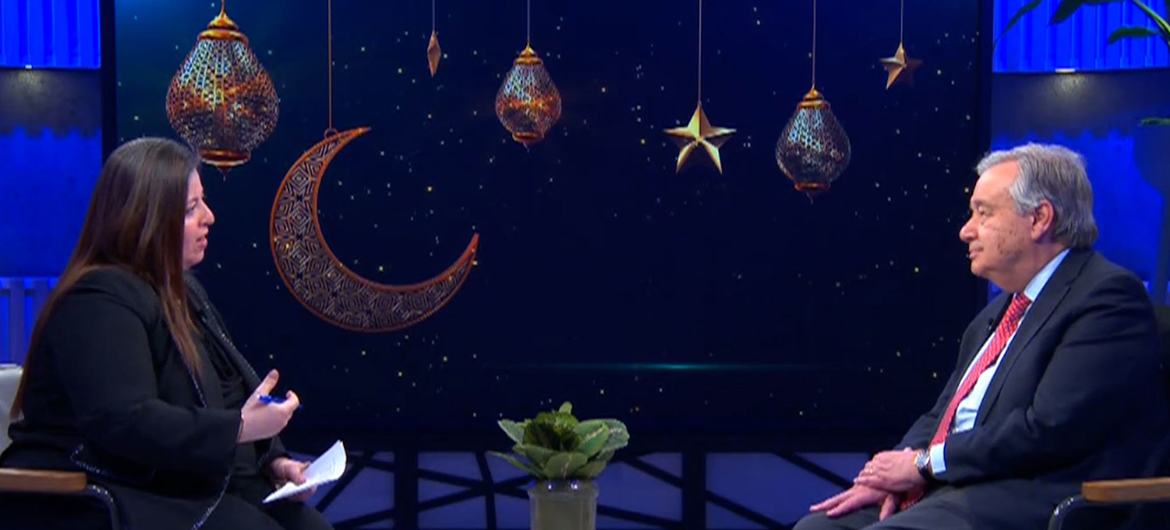
UN video
Reem Abaza of UN News speaks with Secretary-General António Guterres about his annual Ramadan solidarity visits.
5 April 2023
Reem Abaza of UN News speaks with Secretary-General António Guterres about his annual Ramadan solidarity visits.
5 April 2023
Migrants and Refugees
The UN chief has called for people of faith worldwide to “join their voices in a common prayer for peace”, as the holy festivals of Ramadan, Easter and Passover coincide this week.
Secretary-General António Guterres issued his plea for peace acknowledging that it is “dramatically lacking” in many parts of the world, during an interview with UN News’s Arabic service, ahead of what has now become an annual visit for him, to a Muslim country beset by challenges, during the holy month of Ramadan.
“I think this is the moment for us to be all united for peace. Peace is the most precious thing that we can have in the world”, Mr. Guterres said.
The UN chief has called for people of faith worldwide to “join their voices in a common prayer for peace”, as the holy festivals of Ramadan, Easter and Passover coincide this week.
Secretary-General António Guterres issued his plea for peace acknowledging that it is “dramatically lacking” in many parts of the world, during an interview with UN News’s Arabic service, ahead of what has now become an annual visit for him, to a Muslim country beset by challenges, during the holy month of Ramadan.
“I think this is the moment for us to be all united for peace. Peace is the most precious thing that we can have in the world”, Mr. Guterres said.
Precious peace
“So, this is the moment to come together and for those that believe in God (in) different ways, with different expressions, to join their voices in a common prayer for peace.”
The UN chief began his tradition of paying a solidarity visit during Ramadan, while he was High Commissioner for Refugees, running the refugee agency UNHCR – a job he held for ten years, before taking up the UN’s top job in 2017.
“The majority of the refugees were Muslim, and the majority of the communities hosting refugees with enormous generosity and solidarity, were Muslim”, he told UN News’s Reem Abaza, noting that the 1951 Refugee Convention on protection of refugees, is fully in line with the spiritual values of the Holy Quran.
Fasting in solidarity
He said his annual visit to refugee camps or settlements as UNHCR chief, where he fasted in solidarity, also provided an opportunity to highlight the generosity being shown by host communities.
“When I became Secretary-General, I thought that this tradition should be maintained - now, not focused on refugee communities, but focused on the Muslim communities that are suffering”, he said.
Islam’s true face
Asked what insight joining Muslims fasting during Ramadan has given him down the years, the UN chief said it showed to him, “the true face of Islam.”
“The sense of peace, the sense of solidarity, the sense of generosity that I witnessed in the communities hosting refugees, and also the resilience, the courage of the refugees themselves was extremely inspiring. And it remains a very important inspiration of everything I do today, as Secretary-General of the United Nations.”
Prayer for Peace
Next week, to mark what is a special time on the spiritual calendar for the Abrahamic faiths - Islam, Christianity and Judaism - representatives from the world's major religions, as well as the non-religious, will gather on Friday at UN Headquarters in New York, to pray for peace.
The idea behind the 15 minute moment of contemplation, is to deliver a critical message about peace at a time of so much conflict and suffering worldwide.
Members of the UN family, including staff, delegates and the press corps, are welcome to attend.
The moment of prayer for individuals of diverse faiths and beliefs, is due to begin at the Knotted Gun sculpture, at 1230pm local time.
Tuesday, February 21, 2023
Wednesday, December 28, 2022
Monday, November 07, 2022
Saturday, June 06, 2020
Saturday, October 19, 2019
Climate emergency: City mayors are 'world's first responders', says UN chief
World Bank/Franz Mahr
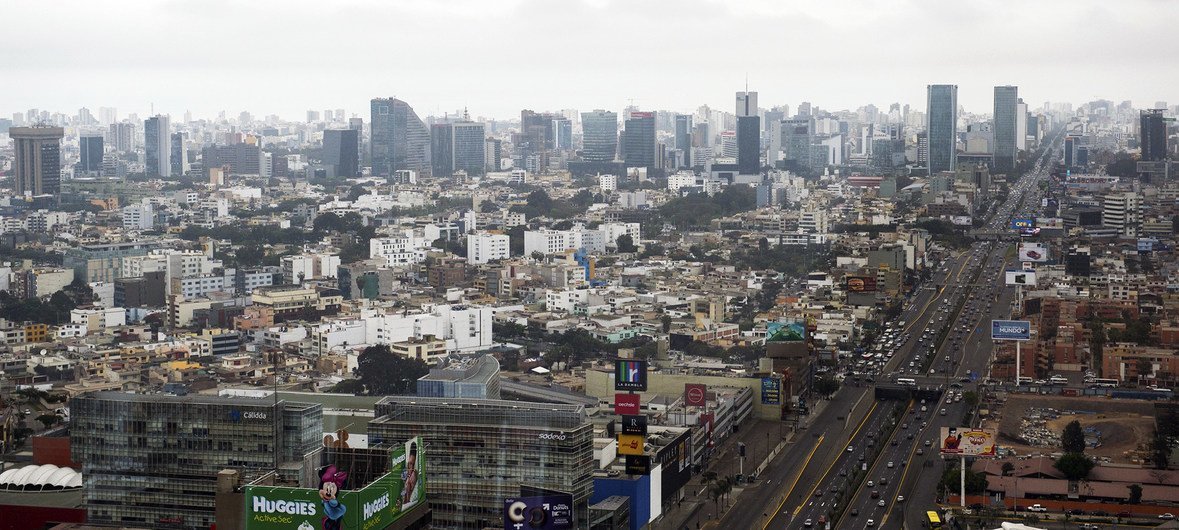
Lima, the capital of Peru, a South American megacity. (file)
11 October 2019
Climate Change
City bosses are “the world’s first responders to the climate emergency” UN chief António Guterres declared on Friday, at an international mayors’ summit in Copenhagen.
In his opening remarks to the C40 World Mayors Summit – a forum for member cities to present innovative actions to slow global warming – the Secretary-General noted that cities, which contain more than half the world’s population, and have an “enormous climate footprint”, are “on the frontlines of sustainable and inclusive development”.
Urban citizens, he continued, look to mayors to make cities havens for diversity, social cohesion and job creation.
Reminding delegates of the existential threat to humanity posed by the climate emergency, and the need to dramatically boost climate action at all levels, Mr. Guterres said that, at the UN Climate Action Summit in September, some 70 countries, and around 100 cities, announced plans to enhance their national plans to cut harmful emissions by 2020.
Lima, the capital of Peru, a South American megacity. (file)
11 October 2019
Climate Change
City bosses are “the world’s first responders to the climate emergency” UN chief António Guterres declared on Friday, at an international mayors’ summit in Copenhagen.
In his opening remarks to the C40 World Mayors Summit – a forum for member cities to present innovative actions to slow global warming – the Secretary-General noted that cities, which contain more than half the world’s population, and have an “enormous climate footprint”, are “on the frontlines of sustainable and inclusive development”.
Urban citizens, he continued, look to mayors to make cities havens for diversity, social cohesion and job creation.
Reminding delegates of the existential threat to humanity posed by the climate emergency, and the need to dramatically boost climate action at all levels, Mr. Guterres said that, at the UN Climate Action Summit in September, some 70 countries, and around 100 cities, announced plans to enhance their national plans to cut harmful emissions by 2020.
Saturday, March 23, 2019
Sunday, January 13, 2019
UN Secretary-General António Guterres - 2019 New Year's Video Message

United Nations - Video message by United Nations Secretary-General António Guterres on the occasion of the 2019 New Year.
Dear fellow citizens of the world,
I wish you a happy, peaceful and prosperous new year.
Last New Year, I issued a red alert, and the dangers I mentioned still persist. These are anxious times for many, and our world is undergoing a stress test.
Climate change is running faster than we are.
Geo-political divisions are deepening, making conflicts more difficult to resolve.
And record numbers of people are moving in search of safety and protection.
Inequality is growing. And people are questioning a world in which a handful of people hold the same wealth as half of humanity.
Intolerance is on the rise.
Trust is on the decline.
But there are also reasons for hope.
The talks on Yemen have created a chance for peace.
The agreement signed in Riyadh in September between Ethiopia and Eritrea has eased long-running tensions and brought improved prospects to an entire region.
And the agreement between the parties to the conflict in South Sudan has revitalized chances for peace, bringing more progress in the past four months than in the previous four years.
The United Nations was able to bring countries together in Katowice to approve the Work Programme for the implementation of the Paris Agreement on climate change.
Now we need to increase ambition to beat this existential threat.
It’s time to seize our last best chance.
It’s time to stop uncontrolled and spiraling climate change.
In recent weeks, the United Nations also oversaw landmark global agreements on migration and refugees, that will help to save lives and overcome damaging myths.
And everywhere, people are mobilizing behind the Sustainable Development Goals – our global blueprint for peace, justice and prosperity on a healthy planet.
When international cooperation works, the world wins.
In 2019, the United Nations will continue to bring people together to build bridges and create space for solutions.
We will keep up the pressure.
And we will never give up.
As we begin this New Year, let’s resolve to confront threats, defend human dignity and build a better future -- together.
I wish you and your families a peaceful and healthy New Year.
Monday, April 02, 2018
Thursday, March 22, 2018
World cannot take water for granted, say UN officials at launch of global decade for action
UNICEF/Parelkar
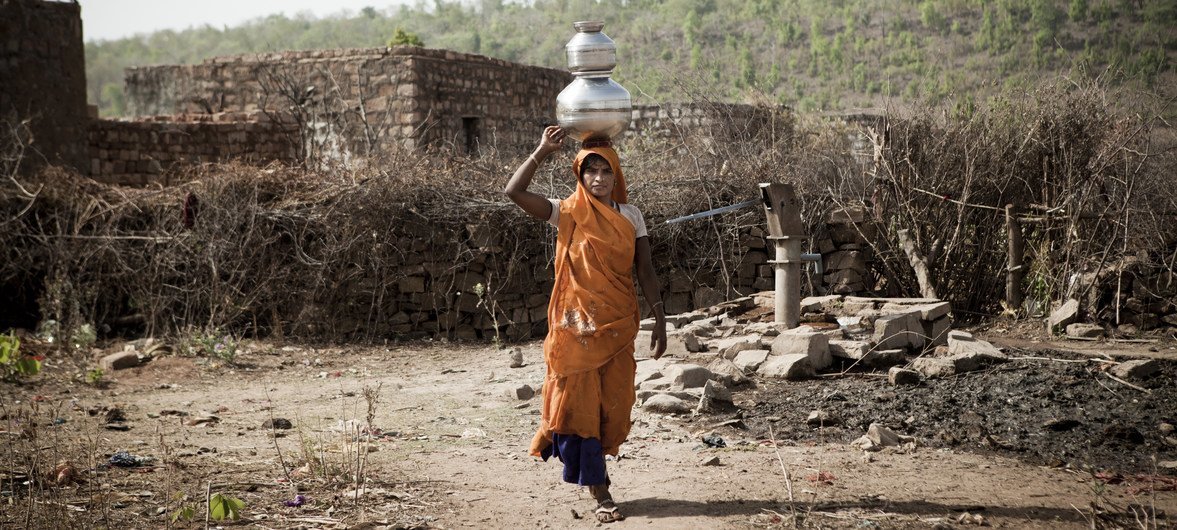
A woman in rural India carries containers of water to her home. Women in developing countries have to spend a lot of time fetching water due to lack of infrastructure. The decade for action on water aims to address this and other problems.
22 March 2018
SDGs
The United Nations on Thursday launched a 10-year water action plan that seeks to forge new partnerships, improve cooperation and strengthen capacity to implement the 2030 Agenda for Sustainable Development.
Most directly linked to Sustainable Development Goal 6, safe water and adequate sanitation are indispensable for healthy ecosystems, reducing poverty, and achieving inclusive growth, social well-being and sustainable livelihoods – the targets for many of the 17 Goals.
However, growing demands, poor management and climate change have increased water stresses and scarcity of water is a major problem in many parts of the world.
Furthermore, more than two billion people worldwide lack access to safe water and over 4.5 billion to adequate sanitation services, warned UN Secretary-General António Guterres.
“By 2050 at least one in four people will live in a country where the lack of fresh water will be chronic or recurrent,” he said, speaking at the launch of the International Decade for Action: Water for Sustainable Development, 2018-2028.
“Quite simply, water is a matter of life and death. Our bodies, […] our cities, our industries and our agriculture all depend on it.”
Stressing that water cannot be taken for granted, the UN chief said that while solutions and technologies to improve water management exist, these are often not accessible to all. In many cases, end up perpetrating inequity within and among countries.
“As with most development challenges, women and girls suffer disproportionately. For example, women and girls in low-income countries spend some 40 billion hours a year collecting water,” he stressed.
Addressing these and other challenges needs a comprehensive approach to water supply, sanitation, water management and disaster risk reduction, said the UN chief, highlighting that aligning existing water and sanitation programmes and projects with the 2030 Agenda will also be vital.
Also crucial is the political will for strengthened cooperation and partnerships, he added.
Subscribe to:
Posts (Atom)