38 min 12 sec
Showing posts with label MARTYRDOM. Show all posts
Showing posts with label MARTYRDOM. Show all posts
Wednesday, June 24, 2026
Tuesday, May 26, 2026
ELLEN G. WHITE: THE GREAT CONTROVERSY
ELLEN G. WHITE: THE GREAT CONTROVERSY AUDIO BOOK
American Christian Ministries
Premiered Apr 15, 2025
🎧 The Great Controversy – Now in Audiobook Format 🎧
Step into the sweeping drama of history’s greatest conflict — the battle between good and evil, truth and deception, Christ and Satan. In The Great Controversy, author Ellen G. White takes you on a powerful journey through the rise and fall of empires, the Reformation, the early church, and the final events of Earth’s history — all through the lens of Bible prophecy.
This audiobook version brings the pages to life, allowing you to absorb deep spiritual insights while on the go — during your commute, daily walk, or quiet reflection time.
🌍 Explore:
The fall of Jerusalem
The rise of the papacy
The Protestant Reformation
America’s prophetic role
The final warning to the world
Christ’s soon return
📖 "It is the purpose of Satan to cause men to forget God, that he may secure them as his own..."
– The Great Controversy
Listen, learn, and be inspired to stand for truth in the last days.
Monday, April 13, 2026
Cuban president says ‘if we need to die, we’ll die’ to prevent U.S. invasion: Full interview
6667 y y jjjjjjjjjjjxjjjjjjjjjjjxcnnnnnnnnnnnnjnko I oķ
Wednesday, April 01, 2026
Martyrdom: The secret shield protecting Iran from collapse
Iran’s strength lies in belief—martyrdom turns suffering into power, making war strengthen resolve instead of breaking the system from within
Written By : Girish Linganna
Updated: Mar 30, 2026 12:21 IST

Highlights
Created by News24 AI • Verified by the editorial team
Understanding Iran's Resilience Amidst Conflict
Understanding Iran's Resilience Amidst Conflict
- Iran's identity is deeply rooted in Shia Islam, specifically the 1,400-year-old story of Imam Hussein's sacrifice at Karbala in 680 AD.
- Shia belief teaches that suffering and dying for what is right is not defeat but a victory, a concept the Iranian government has used since 1979.
- External attacks, such as missile strikes and leader killings, can inadvertently strengthen the Islamic Republic's narrative by validating its claims of oppression.
Impact of External Pressure
- Demands for 'unconditional surrender' from the US, like those made by Donald Trump, are perceived by Iran as attempts to humiliate and erase them, turning even doubtful Iranians into defenders.
This is the part that most news channels never explain to us.
Saturday, February 21, 2026
Monday, March 10, 2025
Friday, March 17, 2017
Monday, June 29, 2015
Justice Sotomayor compares the death penalty drug to 'being burned at the stake'
DEATH PENALTY
11:24 a.m. ET

11:24 a.m. ET
Allison Shelley/Getty Images
In a dissent from Monday's Supreme Court ruling that upheld the use of a death penalty drug, Justice Sonia Sotomayor likened the drug to methods of medieval torture, including the burning of heretics at the stake and the slow torturing of people to death. The lethal injection drug that Sotomayor railed against has been used in previous botched executions, including the 2014 execution of Oklahoma death-row inmate Clayton Lockett, which took 43 minutes and saw him writhing in pain. Sotomayor argued that the drug violates the Eighth Amendment's prohibition against "cruel and unusual punishment."
"Under the court's new rule, it would not matter whether the state intended to use midazolam, or instead to have petitioners drawn and quartered, slowly tortured to death, or actually burned at the stake," Sotomayor wrote in her dissent. Becca Stanek
In a dissent from Monday's Supreme Court ruling that upheld the use of a death penalty drug, Justice Sonia Sotomayor likened the drug to methods of medieval torture, including the burning of heretics at the stake and the slow torturing of people to death. The lethal injection drug that Sotomayor railed against has been used in previous botched executions, including the 2014 execution of Oklahoma death-row inmate Clayton Lockett, which took 43 minutes and saw him writhing in pain. Sotomayor argued that the drug violates the Eighth Amendment's prohibition against "cruel and unusual punishment."
"Under the court's new rule, it would not matter whether the state intended to use midazolam, or instead to have petitioners drawn and quartered, slowly tortured to death, or actually burned at the stake," Sotomayor wrote in her dissent. Becca Stanek
.
Saturday, June 20, 2015
The Whore of Babylon- Revelation 17

ProclaimHisWord
Uploaded on Mar 2, 2010
Revelation 17
1.Then one of the seven angels who had the seven bowls came and talked with me, saying to me, "Come, I will show you the judgment of the great harlot who sits on many waters,
2.with whom the kings of the earth committed fornication, and the inhabitants of the earth were made drunk with the wine of her fornication."
3.So he carried me away in the Spirit into the wilderness. And I saw a woman sitting on a scarlet beast which was full of names of blasphemy, having seven heads and ten horns.
4.The woman was arrayed in purple and scarlet, and adorned with gold and precious stones and pearls, having in her hand a golden cup full of abominations and the filthiness of her fornication.
5.And on her forehead a name was written: MYSTERY, BABYLON THE GREAT, THE MOTHER OF HARLOTS AND OF THE ABOMINATIONS OF THE EARTH.
6.I saw the woman, drunk with the blood of the saints and with the blood of the martyrs of Jesus. And when I saw her, I marveled with great amazement.
7.But the angel said to me, "Why did you marvel? I will tell you the mystery of the woman and of the beast that carries her, which has the seven heads and the ten horns.
8.The beast that you saw was, and is not, and will ascend out of the bottomless pit and go to perdition. And those who dwell on the earth will marvel, whose names are not written in the Book of Life from the foundation of the world, when they see the beast that was, and is not, and yet is.
9.Here is the mind which has wisdom: The seven heads are seven mountains on which the woman sits.
10.There are also seven kings. Five have fallen, one is, and the other has not yet come. And when he comes, he must continue a short time.
11.And the beast that was, and is not, is himself also the eighth, and is of the seven, and is going to perdition.
12.The ten horns which you saw are ten kings who have received no kingdom as yet, but they receive authority for one hour as kings with the beast.
13.These are of one mind, and they will give their power and authority to the beast.
14.These will make war with the Lamb, and the Lamb will overcome them, for He is Lord of lords and King of kings; and those who are with Him are called, chosen, and faithful."
15.Then he said to me, "The waters which you saw, where the harlot sits, are peoples, multitudes, nations, and tongues.
16.And the ten horns which you saw on the beast, these will hate the harlot, make her desolate and naked, eat her flesh and burn her with fire.
17.For God has put it into their hearts to fulfill His purpose, to be of one mind, and to give their kingdom to the beast, until the words of God are fulfilled.
18.And the woman whom you saw is that great city which reigns over the kings of the earth."
.
.
Saturday, May 09, 2015
Papal envoy to be present at commemoration of death of Jan Hus

Catholic World News - May 04, 2015
Pope Francis has appointed Cardinal Miloslav Vlk, the retired archbishop of Prague, as his special envoy for the commemoration of the 600th anniversary of the death of Jan Hus.
The Bohemian priest was burned at the stake for heresy, and in 1999 Pope St . John Paul II expressed regret for his death.
“On the eve of the Great Jubilee, I feel obliged to express deep regret for the cruel death inflicted on Jan Hus and the resulting wound, a source of conflict and division which was thus opened in the minds and hearts of the Bohemian people,” he said.
The commemoration will take place in Prague on July 5 and 6.
.
Saturday, February 01, 2014
The Inquisition: A Model For Modern Interrogators

An illustration shows heretics being tortured and nailed to wooden posts during the first Inquisition.
The individuals who participated in the first Inquisition 800 years ago kept detailed records of their activities. Vast archival collections at the Vatican, in France and in Spain contain accounts of torture victims' cries, descriptions of funeral pyres and even meticulous financial records about the price of torture equipment.
"[There are] expense accounts [for things] like how much did the rope cost to tie the hands of the person you burnt at the stake," says writer Cullen Murphy. "The people who were doing interrogations were meticulous."
Murphy's book God's Jury: The Inquisition and the Making of the Modern World comes out in paperback next week. It traces the history of the Inquisitions — there were several — and draws parallels between some of the interrogation techniques used in previous centuries with the ones used today.
"A few years ago, the intelligence agencies had some transcripts released ... of interrogations that were done at Guantanamo, and the interrogations done by the Inquisition were surprisingly similar and just as detailed," he tells Fresh Air's Terry Gross. "[They were] virtually verbatim."
Eight-hundred years ago, the first Inquisition was initially designed to deal with an upsurge in heretical activity from the Cathars in France. The Cathars' unconventional interpretation of religious doctrine worried Pope Gregory and other Vatican leaders.

The Inquisition and the Making of the Modern World
Paperback, 310 pages
The Use Of Torture
Clerics were given authority to use torture in a document issued by the pope in 1252. They were also given advice manuals with instructions for interrogating suspected heretics. Murphy says he was astonished by the similarities between the Inquisitor advice manual and modern-day guides for intelligence agencies and police departments.
"You see that everything that is being suggested now had already been anticipated," he says. "For instance, you want to spook the person you're interrogating. [The Inquisitors] have a whole bunch of tricks they lay out. The person to be interrogated comes into the room and the inquisitor [advice manual advises]: 'Be sitting there. Have a huge stack of documents in front of you. And as the person is answering questions, flip through the documents as if you have more information than this person could dream of. And every so often, shake your head as if you can't believe what they're saying.' It's almost word for word, you find the same thing in modern handbooks."
When Inquisitors needed a confession, they could elevate their interrogations to include torture.
"The basic line here was, 'Has this person confessed or not?' " says Cullen. "The answer is, 'If they confess, it's true. So torture comes into the picture when you need a confession."
But the Inquisitors were aware that confessions given under torture could be problematic, says Murphy.
"If a person confessed to something under torture, the Inquisitors were not prepared to accept that confession as evidence," he says. "They said, 'Now you have to give it some time. Let a day go by. Bring the person someplace else. Then ask them again. And if they still confess, then we'll accept that confession.' But it's not as if the person who made the confession has forgotten the fact that they were just tortured and couldn't be tortured again. [The Inquisitors] were mindful of the flaws of torture, but they went ahead and did it anyway."

Cullen Murphy is the editor-at-large for Vanity Fair and previously served as managing editor at The Atlantic Monthly.
A century later, during the Spanish Inquisition, interrogators began using more elaborate forms of torture, such as the rack, the pulley and waterboarding. They also began parading their victims through the streets in elaborate displays of punishment.
"You would invite the diplomatic core to come and watch. The nobility would be there," he says. "People would be lined up in the streets to watch everyone going by. If people who were condemned had in fact already died, their bodies would be dug up and they'd be brought by on carts."
The dead bodies were burned on public funeral pyres. The living were publicly tried, and then tortured for several hours. Some were burned at the stake. Others were forced to become galley slaves or returned to prison for more bouts of torture.
"Technically during the Inquisition, there were guidelines in place that said ... you were supposed to torture a person only once," says Murphy. "But if you wanted to torture a person a second time or a third time, there was a way in which you could simply define the second, third or fourth time as simply a continuance of the first time."
Interview Highlights
"The idea that the pope would authorize the use of something as heinous as torture by priests or people working for priests is a pretty astonishing development. Ultimately, the justification that it invokes is the same one anyone uses when they're using torture for reasons that are not sadistic and that is, in essence: 'The moral cause that we're engaged in is too important to settle for half-measures.' ... When you read accounts of torture, you get the unmistakable impression that the people doing the torture or conducting the torture — somewhere inside them, they think they are saving souls."
On the number of people killed in the first Inquisition
"There were thousands of people who were killed. ... I think the rough ratio [was] for every person burned at the stake, maybe 50 others who were sentenced to something. But then if you factor in the families of those people and the people called as witnesses, you have a great deal of penetration into society. Everybody was aware that this was going on. It's not hard to see why the Inquisition weighs so heavily on the psychology of people at the time."
On the state-run Spanish Inquisition
"The reason for it was that Jews who had converted to Christianity were reverting to Judaism. That was the charge. And the degree to which it was or wasn't true is one of those things historians debate to this day. These charges were leveled at a time when anti-Semitism in Spain was on the increase. There had been terrible pogroms beginning in the 14th century, forced conversions, continual rounding up of Jews into ghettos. The situation was terrible even before the Inquisition began, and once the Inquisition began, it became worse."
"The pope had control over the Medieval Inquisition and over the Inquisition that came later, but the pope had no control over the Spanish Inquisition. As a result, you had the government — the monarchs — presented with this extraordinary tool that they could use for a variety of purposes. ... The Spanish government did not have the welfare of victims in mind. What it did have was the uses it could put prisoners to. And one of the things the monarchy needed was galley slaves [to row ships]. It's probably the worst punishment that can ever be meted out. Your life expectancy was not more than a couple years."

On waterboarding
"Many people in the Bush administration were insisting [it] was not torture at all. The Inquisition was actually very clear on the matter. It obviously was torture. That's why they were using it."
On the printing press and the third Inquisition
"For a long time, the church had had an effective monopoly on the intellectual life in Europe. Publishing was something that involved copying manuscripts. ... Suddenly, there's a new technology on the block. And the church sees this as a threat. So the church sees a combined attack — from the printing press and the Protestant Reformation — [and that] is really the thing that instigates the third Inquisition. ... This is the Inquisition that puts Galileo on trial. ... It's the Inquisition that starts the index of forbidden books."
Source.
.
.
Tuesday, February 26, 2013
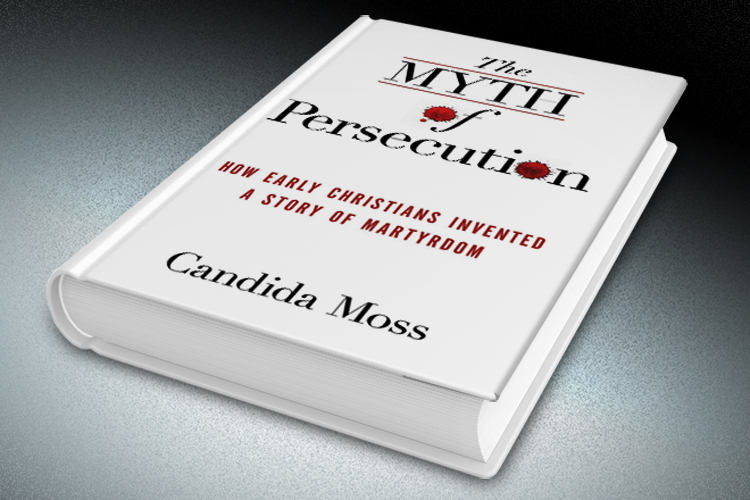
“The Myth of Persecution”: Early Christians weren’t persecuted
SUNDAY, FEB 24, 2013 04:00 PM EST
The Romans did not target, hunt or massacre Jesus' followers, says a historian of the early church

Laura Miller is a senior writer for Salon. She is the author of "The Magician's Book: A Skeptic's Adventures in Narnia" and has a Web site, magiciansbook.com.
Source
.
The Romans did not target, hunt or massacre Jesus' followers, says a historian of the early church
BY LAURA MILLER

In the immediate aftermath of the Columbine High School massacre, a modern myth was born. A story went around that one of the two killers asked one of the victims, Cassie Bernall, if she believed in God. Bernall reportedly said “Yes” just before he shot her. Bernall’s mother wrote a memoir, titled “She Said Yes: The Unlikely Martyrdom of Cassie Bernall,” a tribute to her daughter’s courageous Christian faith. Then, just as the book was being published, a student who was hiding near Bernall told journalist Dave Cullen that the exchange never happened.
Although Candida Moss’ new book, “The Myth of Persecution: How Early Christians Invented a Story of Martyrdom,” is about the three centuries following the death of Jesus, she makes a point of citing this modern-day parallel. What Bernall truly said and did in the moments before her death absolutely matters, Moss asserts, if we are going to hold her up as a “martyr.” Yet misconceptions and misrepresentations can creep in so soon. The public can get the story wrong even in this highly mediated and thoroughly reported age — and do so despite the presence among us of living eyewitnesses. So what, then, to make of the third-hand, heavily revised, agenda-laden and anachronistic accounts of Christianity’s original martyrs?
Moss, professor of New Testament and early Christianity at the University of Notre Dame, challenges some of the most hallowed legends of the religion when she questions what she calls “the Sunday school narrative of a church of martyrs, of Christians huddled in catacombs out of fear, meeting in secret to avoid arrest and mercilessly thrown to lions merely for their religious beliefs.” None of that, she maintains, is true. In the 300 years between the death of Jesus and the conversion of the Emperor Constantine, there were maybe 10 or 12 scattered years during which Christians were singled out for supression by Rome’s imperial authorities, and even then the enforcement of such initiatives was haphazard — lackadaisical in many regions, although harsh in others. “Christians were never,” Moss writes, “the victims of sustained, targeted persecution.”
Much of the middle section of “The Myth of Persecution” is taken up with a close reading of the six “so-called authentic accounts” of the church’s first martyrs. They include Polycarp, a bishop in Smyrna during the second century who was burned at the stake, and Saint Perpetua, a well-born young mother executed in the arena at Carthage with her slave, Felicity, at the beginning of the third century. Moss carefully points out the inconsistencies between these tales and what we know about Roman society, the digs at heresies that didn’t even exist when the martyrs were killed and the references to martyrdom traditions that had yet to be established. There’s surely some kernel of truth to these stories, she explains, as well as to the first substantive history of the church written in 311 by a Palestinian named Eusebius. It’s just that it’s impossible to sort the truth from the colorful inventions, the ax-grinding and the attempts to reinforce the orthodoxies of a later age.
Moss also examines surviving Roman records. She notes that during the only concerted anti-Christian Roman campaign, under the emperor Diocletian between 303 and 306, Christians were expelled from public offices. Their churches, such as the one in Nicomedia, across the street from the imperial palace, were destroyed. Yet, as Moss points out, if the Christians were holding high offices in the first place and had built their church “in the emperor’s own front yard,” they could hardly have been in hiding away in catacombs before Diocletian issued his edicts against them.
This is not to deny that some Christians were executed in horrible ways under conditions we’d consider grotesquely unjust. But it’s important, Moss explains, to distinguish between “persecution” and “prosecution.” The Romans had no desire to support a prison population, so capital punishment was common for many seemingly minor offenses; you could be sentenced to be beaten to death for writing a slanderous song. Moss distinguishes between those cases in which Christians were prosecuted simply for being Christians and those in which they were condemned for engaging in what the Romans considered subversive or treasonous activity. Given the “everyday ideals and social structures” the Romans regarded as essential to the empire, such transgressions might include publicly denying the divine status of the emperor, rejecting military service or refusing to accept the authority of a court. In one of her most fascinating chapters, Moss tries to explain how baffling and annoying the Romans (for whom “pacifism didn’t exist as a concept”) found the Christians — when the Romans thought about them at all.
Christians wound up in Roman courts for any number of reasons, but when they got there, they were prone to announcing, as a believer named Liberian once did, “that he cannot be respectful to the emperor, that he can be respectful only to Christ.” Moss compares this to “modern defendants who say that they will not recognize the authority of the court or of the government, but recognize only the authority of God. For modern Americans, as for ancient Romans, this sounds either sinister or vaguely insane.” It didn’t help that early Christians developed a passion for martyrdom. Suffering demonstrated both the piety of the martyr and the authenticity of the religion itself, and besides, it earned you an immediate, first-class seat in heaven. (Ordinary Christians had to wait for Judgment Day.) There were reports of fanatics deliberately seeking out the opportunity to die for their faith, including a mob that turned up at the door of a Roman official in Asia Minor, demanding to be martyred, only to be turned away when he couldn’t be bothered to oblige them.
Moss cannot be called a natural or fluent writer, but she is thorough, strives for clarity and is genuinely fired up in her concern for the influence of the myth of martyrdom on Western societies. “The idea of the persecuted church is almost entirely the invention of the 4th century and later,” she writes. This was, significantly, a period during which the church had become “politically secure,” thanks to Constantine. Yet, instead of providing a truthful account of Christianity’s early years, the scholars and clerics of the fourth century cranked out tales of horrific, systemic violence. These stories were subtly (and not so subtly) used as propaganda against heretical ideas or sects. They also made appealingly gruesome entertainment for believers who were, personally, fairly safe; Moss likens this to contemporary suburbanites reveling in a horror film.
Today, polemicists continue to use the deeply ingrained belief in a persecuted — and therefore morally righteous — church as a political club to demonize their opponents. Moss sees a direct link between the valorization of martyrs and preposterous right-wing rhetoric about the “war on Christianity.” It’s a tactic that makes compromise impossible. “You cannot collaborate with someone who is persecuting you,” Moss astutely points out. “You have to defend yourself.”
Where she is less shrewd is in her belief that by exposing the “false history of persecution,” we can somehow purge this paranoid approach to political differences. One of the most enlightening aspects of “The Myth of Persecution” is Moss’ ability to find contemporary analogies that make the ancient world more intelligible to the average reader, such as the Cassie Bernall story. But that story has an additional lesson to offer, about the true believer’s imperviousness to unpalatable facts. Bernall’s family and church are unmoved by the schoolmates who were present at the shooting and who have debunked the “She said yes” legend. “You can say it didn’t happen that way,” the Bernalls’ pastor told one reporter, “but the church won’t accept it. To the church, Cassie will always say yes, period.”
In the immediate aftermath of the Columbine High School massacre, a modern myth was born. A story went around that one of the two killers asked one of the victims, Cassie Bernall, if she believed in God. Bernall reportedly said “Yes” just before he shot her. Bernall’s mother wrote a memoir, titled “She Said Yes: The Unlikely Martyrdom of Cassie Bernall,” a tribute to her daughter’s courageous Christian faith. Then, just as the book was being published, a student who was hiding near Bernall told journalist Dave Cullen that the exchange never happened.
Although Candida Moss’ new book, “The Myth of Persecution: How Early Christians Invented a Story of Martyrdom,” is about the three centuries following the death of Jesus, she makes a point of citing this modern-day parallel. What Bernall truly said and did in the moments before her death absolutely matters, Moss asserts, if we are going to hold her up as a “martyr.” Yet misconceptions and misrepresentations can creep in so soon. The public can get the story wrong even in this highly mediated and thoroughly reported age — and do so despite the presence among us of living eyewitnesses. So what, then, to make of the third-hand, heavily revised, agenda-laden and anachronistic accounts of Christianity’s original martyrs?
Moss, professor of New Testament and early Christianity at the University of Notre Dame, challenges some of the most hallowed legends of the religion when she questions what she calls “the Sunday school narrative of a church of martyrs, of Christians huddled in catacombs out of fear, meeting in secret to avoid arrest and mercilessly thrown to lions merely for their religious beliefs.” None of that, she maintains, is true. In the 300 years between the death of Jesus and the conversion of the Emperor Constantine, there were maybe 10 or 12 scattered years during which Christians were singled out for supression by Rome’s imperial authorities, and even then the enforcement of such initiatives was haphazard — lackadaisical in many regions, although harsh in others. “Christians were never,” Moss writes, “the victims of sustained, targeted persecution.”
Much of the middle section of “The Myth of Persecution” is taken up with a close reading of the six “so-called authentic accounts” of the church’s first martyrs. They include Polycarp, a bishop in Smyrna during the second century who was burned at the stake, and Saint Perpetua, a well-born young mother executed in the arena at Carthage with her slave, Felicity, at the beginning of the third century. Moss carefully points out the inconsistencies between these tales and what we know about Roman society, the digs at heresies that didn’t even exist when the martyrs were killed and the references to martyrdom traditions that had yet to be established. There’s surely some kernel of truth to these stories, she explains, as well as to the first substantive history of the church written in 311 by a Palestinian named Eusebius. It’s just that it’s impossible to sort the truth from the colorful inventions, the ax-grinding and the attempts to reinforce the orthodoxies of a later age.
Moss also examines surviving Roman records. She notes that during the only concerted anti-Christian Roman campaign, under the emperor Diocletian between 303 and 306, Christians were expelled from public offices. Their churches, such as the one in Nicomedia, across the street from the imperial palace, were destroyed. Yet, as Moss points out, if the Christians were holding high offices in the first place and had built their church “in the emperor’s own front yard,” they could hardly have been in hiding away in catacombs before Diocletian issued his edicts against them.
This is not to deny that some Christians were executed in horrible ways under conditions we’d consider grotesquely unjust. But it’s important, Moss explains, to distinguish between “persecution” and “prosecution.” The Romans had no desire to support a prison population, so capital punishment was common for many seemingly minor offenses; you could be sentenced to be beaten to death for writing a slanderous song. Moss distinguishes between those cases in which Christians were prosecuted simply for being Christians and those in which they were condemned for engaging in what the Romans considered subversive or treasonous activity. Given the “everyday ideals and social structures” the Romans regarded as essential to the empire, such transgressions might include publicly denying the divine status of the emperor, rejecting military service or refusing to accept the authority of a court. In one of her most fascinating chapters, Moss tries to explain how baffling and annoying the Romans (for whom “pacifism didn’t exist as a concept”) found the Christians — when the Romans thought about them at all.
Christians wound up in Roman courts for any number of reasons, but when they got there, they were prone to announcing, as a believer named Liberian once did, “that he cannot be respectful to the emperor, that he can be respectful only to Christ.” Moss compares this to “modern defendants who say that they will not recognize the authority of the court or of the government, but recognize only the authority of God. For modern Americans, as for ancient Romans, this sounds either sinister or vaguely insane.” It didn’t help that early Christians developed a passion for martyrdom. Suffering demonstrated both the piety of the martyr and the authenticity of the religion itself, and besides, it earned you an immediate, first-class seat in heaven. (Ordinary Christians had to wait for Judgment Day.) There were reports of fanatics deliberately seeking out the opportunity to die for their faith, including a mob that turned up at the door of a Roman official in Asia Minor, demanding to be martyred, only to be turned away when he couldn’t be bothered to oblige them.
Moss cannot be called a natural or fluent writer, but she is thorough, strives for clarity and is genuinely fired up in her concern for the influence of the myth of martyrdom on Western societies. “The idea of the persecuted church is almost entirely the invention of the 4th century and later,” she writes. This was, significantly, a period during which the church had become “politically secure,” thanks to Constantine. Yet, instead of providing a truthful account of Christianity’s early years, the scholars and clerics of the fourth century cranked out tales of horrific, systemic violence. These stories were subtly (and not so subtly) used as propaganda against heretical ideas or sects. They also made appealingly gruesome entertainment for believers who were, personally, fairly safe; Moss likens this to contemporary suburbanites reveling in a horror film.
Today, polemicists continue to use the deeply ingrained belief in a persecuted — and therefore morally righteous — church as a political club to demonize their opponents. Moss sees a direct link between the valorization of martyrs and preposterous right-wing rhetoric about the “war on Christianity.” It’s a tactic that makes compromise impossible. “You cannot collaborate with someone who is persecuting you,” Moss astutely points out. “You have to defend yourself.”
Where she is less shrewd is in her belief that by exposing the “false history of persecution,” we can somehow purge this paranoid approach to political differences. One of the most enlightening aspects of “The Myth of Persecution” is Moss’ ability to find contemporary analogies that make the ancient world more intelligible to the average reader, such as the Cassie Bernall story. But that story has an additional lesson to offer, about the true believer’s imperviousness to unpalatable facts. Bernall’s family and church are unmoved by the schoolmates who were present at the shooting and who have debunked the “She said yes” legend. “You can say it didn’t happen that way,” the Bernalls’ pastor told one reporter, “but the church won’t accept it. To the church, Cassie will always say yes, period.”
Laura Miller is a senior writer for Salon. She is the author of "The Magician's Book: A Skeptic's Adventures in Narnia" and has a Web site, magiciansbook.com.
Source
.
Saturday, January 05, 2013

Saturday, December 31, 2011
They loved not their lives unto the death

Revelation 12:10-12
King James Version (KJV)
10And I heard a loud voice saying in heaven, Now is come salvation, and strength, and the kingdom of our God, and the power of his Christ: for the accuser of our brethren is cast down, which accused them before our God day and night.
11And they overcame him by the blood of the Lamb, and by the word of their testimony; and they loved not their lives unto the death.
12Therefore rejoice, ye heavens, and ye that dwell in them. Woe to the inhabiters of the earth and of the sea! for the devil is come down unto you, having great wrath, because he knoweth that he hath but a short time.
Saturday, April 03, 2010
THE POPES OF ROME
 Pope Pius XII [1939-1958]
"Watch out for false prophets. They come to you in sheep's clothing, but inwardly they are ferocious wolves. By their fruit you will recognise them…" Matthew 7:15-16
CORRUPTION
STEPHEN VII (896-897AD)
"He dug up a Corsican predecessor, Pope Formosus (891-896), when he had been dead for over nine months…. He dressed the stinking corpse in full pontificals, placed him on the throne in the Lateran and proceeded to interrogate him personally….After being found guilty, the corpse was condemned as an anti-pope, stripped and minus the two fingers with which he had given his fake apostolic blessing, was thrown into the Tiber…." (Vicars of Christ - the Dark Side of the Papacy by Peter de Rosa).
SERGIUS III (904-911)
Standing in his way to the throne had been Leo V, who reigned for one month before he was imprisoned by an usurper, Cardinal Christopher. Sergius had both killed. Then he exhumed his predecessor and had him beheaded, three fingers chopped off and thrown into the Tiber.
JOHN XII (955 - 963)
He invented sins, it was said, that had not been known since the beginning of the world - including sleeping with his mother. John XII ran a harem in the Lateran Palace, he gambled with the offerings of pilgrims and he even toasted the devil at the high altar during the mass.
BENEDICT V (964)
Described by a church historian as "the most iniquitous of all the monsters of ungodliness."
BENEDICT IX (1032-44, 1045, 1047-8)
Elected pope at age eleven, he was twice driven from his position due to his participation in plunder, immorality, oppression and murder. Church historians described him as "That wretch, from the beginning of his pontificate to the end of his life, feasted on immorality," and "a demon from hell in the disguise of a priest has occupied the chair of Peter."
SIXTUS IV (1471 - 1484)
This is the pope who built the Sistine Chapel in which all popes are now elected. Sixtus IV had several illegitimate sons, licensed the brothels of Rome and received a large amount of revenue for the papacy from these houses of iniquity, introduced the novel idea of selling indulgences for the dead to raise more revenue, and sanctioned the Inquisition in Castile (Spain) by issuing a bull in 1478 (in just one year - 1482 - in one city of Andalusia, 2000 "heretics" were burned as a result).
ALEXANDER VI (1492 - 1503)
He was a murderer by age 12, he had 10 known illegitimate children, he was infamous for his drunken and immoral parties, he was known to have cardinals who had purchased their positions to be poisoned so that he could sell their positions again and increase his turnover. He spent a fortune in bribes to secure his own election as pope and he caused the Reformer Savonarola to be burned at the stake.
CRUELTY
The Romans papacy has been characterised by extreme cruelty in its persecution of those it deemed as heretics. In particular the Waldensians, Lollards and Albigensians were slaughtered by the forces of Rome.
In 1208 Pope Innocent III declared: "Death to the heretics!" Great privileges and rewards were promised to those who would annihilate the "heretics" and to every man who killed one of them, the assurance was given that he would attain the highest place in Heaven!
The first target of this crusade against the Albigensians was the town of Begiers. All it's inhabitants were killed and all the buildings burned. The monk leading this slaughter, Arnold, reported back to Innocent III "Today, Your Holiness, twenty thousand citizens were put to the sword, regardless of age or sex."
In Bram the papal soldiers cut off the noses and gouged out the eyes of the Albigensian "heretics".
In Minerve, 140 Albigensians were burned alive.
In Lavaure 400 "heretics" were burned at the stake.
In response, Innocent III praised the papal soldiers who had destroyed the heretics.
The successor of Innocent III, Pope Gregory IX established the Inquisition in 1232. For over 600 years, spanning the reigns of over 80 popes, the Inquisition tortured and killed tens of thousands of Protestants including the Waldensians, Hussites, Lollards and Huguenots.
CONTRADICTION
Pope Gregory VII (1073-85) declared that "The Pope cannot make a mistake".
The First Vatican Council (1869-70) under Pope Pius IX raised the Dogma of Papal infallibility to become the official teaching of Roman Catholicism adding the usual anathema upon all who dared to disagree:
"But if anyone ….presume to contradict this assertion, let him be accused."
Yet between 1378 to 1408 there were first two popes and then three! Gregory XII reigned from Rome, Benedict XIII from Avignon and John XXIII from Pisa.
John XXIII was described in Vicars of Christ: "He was noted as a former pirate, pope-poisoner, mass-murderer, mass-fornicator…, adulterer on a scale unknown outside fables, simoniac par excellence, blackmailer, pimp, master of dirty tricks."
Yet John XXIII accused his rival pope Benedict XIII of being "a Fake" and Gregory XII he nicknamed "Mistake"!
Pope Pius IX, who at the First Vatican Council (1869 - 1870) caused the dogma of Papal Infallibility to become the official teaching of Roman Catholicism, also issued an edict permitting "excommunication, confiscation, banishment, imprisonment for life, as well as secret execution in heinous cases."
At the First Vatican Council, Bishop Strossmayer (himself a papist) gave a speech arguing against papal infallibility. He pointed out: "Gregory I calls anyone anti-Christ who takes the name of Universal Bishop; and contrawise Boniface III made Emperor Phocas confer that title upon him. Paschal II and Eugenius III authorised duelling; Julius II and Pins IV forbad it. Hadrian II declared civil magistrates to be valid; Pius VII condemned them. Sixtus V published an edition of the Bible and recommended it to be read; Pius VII condemned the reading of the Bible."
It could also be noted that while one (supposedly infallible) pope, Eugene IV (1431 - 1447), condemned Joan of Arc as a heretic to be burned alive, another pope, Benedict XV, in 1920, declared her to be a saint and her burning a mistake.
Yet the Dogma of Papal Infallibility declares that when a pope speaks ex cathedra his words are "as infallible as if it had been uttered by Christ Himself!"
In plain contradiction to this "papal infallibility" is the Bible. The apostle Peter (from whom all popes claim their succession) never suggested that he was infallible. Indeed in his first general epistle Peter described himself simply as "an elder" and he exhorted his "fellow elders" not to act as "lords over those entrusted to you" (1 Peter 5:1-3).
Paul records in Galatians 2:11 "But when Peter had come to Antioch I withstood him to his face, because he was to be blamed…" Plainly Paul did not see Peter as infallible. Also Peter was married (Mark 1:30; 1 Corinthians 9:5). Indeed a requirement of a church leader is that he is married and bring up his children in the faith (1 Timothy 3:4-5).
The Lord Jesus taught: "You know that the rulers of the gentiles lord it over them, and those who are great exercise authority over them. Yet it shall not be so among you; but whoever desires to be first among you, let him be your slave - just as the Son of Man did not come to be served but to serve…" Matthew 20:25-28
Jesus taught that no one is good - except God alone (Mark 10:18) and we are to call no-one on earth Father - God alone is our spiritual Father. How then can any pope be called "his Holiness" or "Holy Father"! The term Holy Father is only used once in the Bible and it is clearly addressed to God the Father in Christ's prayer (John 17:11).
It is no wonder that when Archbishop Thomas Cranmer was about to be burned at the stake, on 21 March 1556, he declared: "As for the pope, I refuse him as Christ's enemy, and Anti-Christ, with all his false doctrines."
In the words of Martin Luther: "Unless I am convinced by Scripture or clear reasoning that I am in error - for popes and councils have often erred and contradicted themselves - I cannot recant for I am subject to the Scriptures I have quoted. My conscience is captive to the Word of God. It is unsafe and dangerous to do anything against one's conscience. Here I stand. I cannot do otherwise. So help me God. Amen."
Sources: Vicars of Christ - the Dark Side of the Papacy by Peter de Rosa, Corgi
Books, London, 1989
Roman Catholicism by Loraine Boetner, Banner of Truth, London, 1966
The Pope by Ian Brown, Londonderry, 1991
See related articles:
CORRUPTION
STEPHEN VII (896-897AD)
"He dug up a Corsican predecessor, Pope Formosus (891-896), when he had been dead for over nine months…. He dressed the stinking corpse in full pontificals, placed him on the throne in the Lateran and proceeded to interrogate him personally….After being found guilty, the corpse was condemned as an anti-pope, stripped and minus the two fingers with which he had given his fake apostolic blessing, was thrown into the Tiber…." (Vicars of Christ - the Dark Side of the Papacy by Peter de Rosa).
SERGIUS III (904-911)
Standing in his way to the throne had been Leo V, who reigned for one month before he was imprisoned by an usurper, Cardinal Christopher. Sergius had both killed. Then he exhumed his predecessor and had him beheaded, three fingers chopped off and thrown into the Tiber.
JOHN XII (955 - 963)
He invented sins, it was said, that had not been known since the beginning of the world - including sleeping with his mother. John XII ran a harem in the Lateran Palace, he gambled with the offerings of pilgrims and he even toasted the devil at the high altar during the mass.
BENEDICT V (964)
Described by a church historian as "the most iniquitous of all the monsters of ungodliness."
BENEDICT IX (1032-44, 1045, 1047-8)
Elected pope at age eleven, he was twice driven from his position due to his participation in plunder, immorality, oppression and murder. Church historians described him as "That wretch, from the beginning of his pontificate to the end of his life, feasted on immorality," and "a demon from hell in the disguise of a priest has occupied the chair of Peter."
SIXTUS IV (1471 - 1484)
This is the pope who built the Sistine Chapel in which all popes are now elected. Sixtus IV had several illegitimate sons, licensed the brothels of Rome and received a large amount of revenue for the papacy from these houses of iniquity, introduced the novel idea of selling indulgences for the dead to raise more revenue, and sanctioned the Inquisition in Castile (Spain) by issuing a bull in 1478 (in just one year - 1482 - in one city of Andalusia, 2000 "heretics" were burned as a result).
ALEXANDER VI (1492 - 1503)
He was a murderer by age 12, he had 10 known illegitimate children, he was infamous for his drunken and immoral parties, he was known to have cardinals who had purchased their positions to be poisoned so that he could sell their positions again and increase his turnover. He spent a fortune in bribes to secure his own election as pope and he caused the Reformer Savonarola to be burned at the stake.
CRUELTY
The Romans papacy has been characterised by extreme cruelty in its persecution of those it deemed as heretics. In particular the Waldensians, Lollards and Albigensians were slaughtered by the forces of Rome.
In 1208 Pope Innocent III declared: "Death to the heretics!" Great privileges and rewards were promised to those who would annihilate the "heretics" and to every man who killed one of them, the assurance was given that he would attain the highest place in Heaven!
The first target of this crusade against the Albigensians was the town of Begiers. All it's inhabitants were killed and all the buildings burned. The monk leading this slaughter, Arnold, reported back to Innocent III "Today, Your Holiness, twenty thousand citizens were put to the sword, regardless of age or sex."
In Bram the papal soldiers cut off the noses and gouged out the eyes of the Albigensian "heretics".
In Minerve, 140 Albigensians were burned alive.
In Lavaure 400 "heretics" were burned at the stake.
In response, Innocent III praised the papal soldiers who had destroyed the heretics.
The successor of Innocent III, Pope Gregory IX established the Inquisition in 1232. For over 600 years, spanning the reigns of over 80 popes, the Inquisition tortured and killed tens of thousands of Protestants including the Waldensians, Hussites, Lollards and Huguenots.
CONTRADICTION
Pope Gregory VII (1073-85) declared that "The Pope cannot make a mistake".
The First Vatican Council (1869-70) under Pope Pius IX raised the Dogma of Papal infallibility to become the official teaching of Roman Catholicism adding the usual anathema upon all who dared to disagree:
"But if anyone ….presume to contradict this assertion, let him be accused."
Yet between 1378 to 1408 there were first two popes and then three! Gregory XII reigned from Rome, Benedict XIII from Avignon and John XXIII from Pisa.
John XXIII was described in Vicars of Christ: "He was noted as a former pirate, pope-poisoner, mass-murderer, mass-fornicator…, adulterer on a scale unknown outside fables, simoniac par excellence, blackmailer, pimp, master of dirty tricks."
Yet John XXIII accused his rival pope Benedict XIII of being "a Fake" and Gregory XII he nicknamed "Mistake"!
Pope Pius IX, who at the First Vatican Council (1869 - 1870) caused the dogma of Papal Infallibility to become the official teaching of Roman Catholicism, also issued an edict permitting "excommunication, confiscation, banishment, imprisonment for life, as well as secret execution in heinous cases."
At the First Vatican Council, Bishop Strossmayer (himself a papist) gave a speech arguing against papal infallibility. He pointed out: "Gregory I calls anyone anti-Christ who takes the name of Universal Bishop; and contrawise Boniface III made Emperor Phocas confer that title upon him. Paschal II and Eugenius III authorised duelling; Julius II and Pins IV forbad it. Hadrian II declared civil magistrates to be valid; Pius VII condemned them. Sixtus V published an edition of the Bible and recommended it to be read; Pius VII condemned the reading of the Bible."
It could also be noted that while one (supposedly infallible) pope, Eugene IV (1431 - 1447), condemned Joan of Arc as a heretic to be burned alive, another pope, Benedict XV, in 1920, declared her to be a saint and her burning a mistake.
Yet the Dogma of Papal Infallibility declares that when a pope speaks ex cathedra his words are "as infallible as if it had been uttered by Christ Himself!"
In plain contradiction to this "papal infallibility" is the Bible. The apostle Peter (from whom all popes claim their succession) never suggested that he was infallible. Indeed in his first general epistle Peter described himself simply as "an elder" and he exhorted his "fellow elders" not to act as "lords over those entrusted to you" (1 Peter 5:1-3).
Paul records in Galatians 2:11 "But when Peter had come to Antioch I withstood him to his face, because he was to be blamed…" Plainly Paul did not see Peter as infallible. Also Peter was married (Mark 1:30; 1 Corinthians 9:5). Indeed a requirement of a church leader is that he is married and bring up his children in the faith (1 Timothy 3:4-5).
The Lord Jesus taught: "You know that the rulers of the gentiles lord it over them, and those who are great exercise authority over them. Yet it shall not be so among you; but whoever desires to be first among you, let him be your slave - just as the Son of Man did not come to be served but to serve…" Matthew 20:25-28
Jesus taught that no one is good - except God alone (Mark 10:18) and we are to call no-one on earth Father - God alone is our spiritual Father. How then can any pope be called "his Holiness" or "Holy Father"! The term Holy Father is only used once in the Bible and it is clearly addressed to God the Father in Christ's prayer (John 17:11).
It is no wonder that when Archbishop Thomas Cranmer was about to be burned at the stake, on 21 March 1556, he declared: "As for the pope, I refuse him as Christ's enemy, and Anti-Christ, with all his false doctrines."
In the words of Martin Luther: "Unless I am convinced by Scripture or clear reasoning that I am in error - for popes and councils have often erred and contradicted themselves - I cannot recant for I am subject to the Scriptures I have quoted. My conscience is captive to the Word of God. It is unsafe and dangerous to do anything against one's conscience. Here I stand. I cannot do otherwise. So help me God. Amen."
Sources: Vicars of Christ - the Dark Side of the Papacy by Peter de Rosa, Corgi
Books, London, 1989
Roman Catholicism by Loraine Boetner, Banner of Truth, London, 1966
The Pope by Ian Brown, Londonderry, 1991
See related articles:
How the Reformation Changed the Church
Frontline Fellowship
P O Box 74, Newlands, 7725, Cape Town, South Africa
Tel.: +27 21 689-4480 Fax: +27 21 685-5884
E-Mail: admin@frontline.org.za
Frontline Fellowship
P O Box 74, Newlands, 7725, Cape Town, South Africa
Tel.: +27 21 689-4480 Fax: +27 21 685-5884
E-Mail: admin@frontline.org.za
.
Note: Highlights added for emphasis.
..
Tuesday, March 09, 2010
A Lamp in the Dark: The Untold History of the Bible
New Documentary Release: A Lamp in the Dark: The Untold History of the Bible
Contact: Meg A. Pinto, Producer, 818-309-3856, meg@adullamfilms.com
NASHVILLE, Nov. 20 /Christian Newswire/ -- A new documentary titled, "A Lamp in the Dark: The Untold History of the Bible" has just been released by Adullam Films. This riveting three hour presentation tracks the history of the Bible from the first century to the present time.
Enter into a world of saints and martyrs battling against spies, assassins and wolves in sheep's clothing. Through the Middle Ages, the Inquisition forbade the translation of the Bible threatening imprisonment and death to any who disobeyed. Learn the stories of valiant men who battled the principalities of the Dark Age to communicate the Holy Scriptures to a lost and dying world.
Bible translators by faith subdued whole kingdoms through the Protestant Reformation. But in response, Rome would launch a Counter Reformation to oppose them. By learning from the past, can we recognize this conflict in our world today? And if so, how does it affect the Bible?
ABOUT THE PRODUCTION
"Lamp" was filmed on locations in England and Belgium, and features original interviews with leading Bible scholars, including chief curators from the British Library in London, Erasmus House in Belgium, and the Tyndale Museum in Vilvoorde. This fast paced documentary is filled with rich visual graphics and dramatic re-enactments of key historic events.
ABOUT THE DIRECTOR
Christian J. Pinto is the founder of the Adullam Films Christian film ministry. His past documentaries have won "Best Documentary" awards at New York and Los Angeles film festivals, along with 4 Telly Awards for excellence in film and video production.
FILM REVIEW by Dr. Mike Bennett
"A Lamp in The Dark" should bring tears to the eyes of every Christian who treasures their Bible -- printed by the blood and sacrifices of our brave Christian forefathers, as evidenced in this moving production... Pinto's work is a certain cure for Christian apathy and idleness, when the battle for truth is made so clear in this work. People will never look at the Bible the same way again and will now take notice of the battle over God's Word that now rages around us." - J. Michael Bennett, PH.D, host, "Future Quake" Radio Show, WENO, AM 760, Nashville, TN
For more information online go to www.adullamfilms.com
.
.
Source: http://www.christiannewswire.com/news/8899012235.html
.
Friday, February 19, 2010
Street Preachers Killed In United States
NEWS ALERT: Street Preachers Killed In United States
Saturday, February 6, 2010 (8:55 am)
By BosNewsLife News Center

Saturday, February 6, 2010 (8:55 am)
By BosNewsLife News Center

WASHINGTON, USA (BosNewsLife)-- A religious liberty group warned Saturday, February 6, that "Anti-Christian hostility is getting increasingly deadly" in the United States after two street preachers were shot and killed by a teenager who apparently opposed their message.
"The increasing demonization of Christians in our culture makes some feel its open season on Christians," said Gary Cass of the Christian Anti-Defamation Commission.
Tite Sufra, 24, (pictured above) and Stephen Ocean (pictured below), 23, were shot to death late Saturday, January 30, in Boynton Beach in the U.S. State of Florida, where they evangelized, after meeting 18-year-old Jeriah Woody, local police said.
"They witnessed to Woody for fifteen minutes, when he got a phone call and told the preachers he 'had to go'," added the Commission, which closely monitored the case.
CHRISTIANS EXECUTED
"As they walked away, Woody suddenly started walking back toward them. Sufra walked up to greet him and was killed with a shot gun blast at point blank range. When Ocean ran, he was shot in the back. After he fell, Woody shot him in the head execution style."

"The increasing demonization of Christians in our culture makes some feel its open season on Christians," said Gary Cass of the Christian Anti-Defamation Commission.
Tite Sufra, 24, (pictured above) and Stephen Ocean (pictured below), 23, were shot to death late Saturday, January 30, in Boynton Beach in the U.S. State of Florida, where they evangelized, after meeting 18-year-old Jeriah Woody, local police said.
"They witnessed to Woody for fifteen minutes, when he got a phone call and told the preachers he 'had to go'," added the Commission, which closely monitored the case.
CHRISTIANS EXECUTED
"As they walked away, Woody suddenly started walking back toward them. Sufra walked up to greet him and was killed with a shot gun blast at point blank range. When Ocean ran, he was shot in the back. After he fell, Woody shot him in the head execution style."

Woody was detained Wednesday, February 3, and is charged with two counts of first-degree murder. Bail was reportedly denied to him.
Cass complained about a lack of interest in national media. "As of today, there are no national news organizations reporting this vicious murder of two innocent Christian men. Why?"
Cass said, "I'll ask this: If two Muslims, or two feminists or two homosexuals were murdered, wouldn't the media be all over it? These were two fine young black Christian men shot by another black man for their Christian faith, yet the media does not seem to care."
"OMINOUS SIGN"
He described the case as "an ominous sign" of times "that Christians are being shot on the streets and in our churches."
Last year, Jim Pullion was killed while holding pro-life signs in front of his granddaughter's Owasso Michigan high school. Reverend Fred Winters was murdered while preaching in his pulpit in Maryville, Illinois.
"Increasingly we see Christian ministers threatened and churches terrorized and vandalized for their stand on marriage. Now when Christians gather for worship they must have armed security."
He said, "Anti-Christian defamation and bigotry has helped to create this violent climate and it must stop."
Cass complained about a lack of interest in national media. "As of today, there are no national news organizations reporting this vicious murder of two innocent Christian men. Why?"
Cass said, "I'll ask this: If two Muslims, or two feminists or two homosexuals were murdered, wouldn't the media be all over it? These were two fine young black Christian men shot by another black man for their Christian faith, yet the media does not seem to care."
"OMINOUS SIGN"
He described the case as "an ominous sign" of times "that Christians are being shot on the streets and in our churches."
Last year, Jim Pullion was killed while holding pro-life signs in front of his granddaughter's Owasso Michigan high school. Reverend Fred Winters was murdered while preaching in his pulpit in Maryville, Illinois.
"Increasingly we see Christian ministers threatened and churches terrorized and vandalized for their stand on marriage. Now when Christians gather for worship they must have armed security."
He said, "Anti-Christian defamation and bigotry has helped to create this violent climate and it must stop."
.
.
.
Saturday, September 26, 2009
No Martyrs After Probation Closes

He shall call upon me, and I will answer him: I will be with him in trouble; I will deliver him, and honour him. Ps. 91:15.
The people of God will not be free from suffering; but while persecuted and distressed, while they endure privation and suffer for want of food they will not be left to perish. . . .
Yet to human sight it will appear that the people of God must soon seal their testimony with their blood as did the martyrs before them. They themselves begin to fear that the Lord has left them to fall by the hand of their enemies. It is a time of fearful agony. Day and night they cry unto God for deliverance. . . .
The eye of God, looking down the ages, was fixed upon the crisis which His people are to meet, when earthly powers shall be arrayed against them. Like the captive exile, they will be in fear of death by starvation or by violence. But the Holy One who divided the Red Sea before Israel, will manifest His mighty power and turn their captivity. "They shall be mine, saith the Lord of hosts, in that day when I make up my jewels; and I will spare them, as a man spareth his own son that serveth him." Malachi 3:17. If the blood of Christ's faithful witnesses were shed at this time, it would not, like the blood of the martyrs, be as seed sown to yield a harvest for God. Their fidelity would not be a testimony to convince others of the truth; for the obdurate heart has beaten back the waves of mercy until they return no more. If the righteous were now left to fall a prey to their enemies, it would be a triumph for the prince of darkness. Says the psalmist: "In the time of trouble he shall hide me in his pavilion: in the secret of his tabernacle shall he hide me." Psalm 27:5. Christ has spoken: "Come, my people, enter thou into thy chambers, and shut thy doors about thee: hide thyself as it were for a little moment, until the indignation be overpast. For, behold, the Lord cometh out of his place to punish the inhabitants of the earth for their iniquity." Isaiah 26:20, 21. Glorious will be the deliverance of those who have patiently waited for His coming and whose names are written in the book of life.
The people of God will not be free from suffering; but while persecuted and distressed, while they endure privation and suffer for want of food they will not be left to perish. . . .
Yet to human sight it will appear that the people of God must soon seal their testimony with their blood as did the martyrs before them. They themselves begin to fear that the Lord has left them to fall by the hand of their enemies. It is a time of fearful agony. Day and night they cry unto God for deliverance. . . .
The eye of God, looking down the ages, was fixed upon the crisis which His people are to meet, when earthly powers shall be arrayed against them. Like the captive exile, they will be in fear of death by starvation or by violence. But the Holy One who divided the Red Sea before Israel, will manifest His mighty power and turn their captivity. "They shall be mine, saith the Lord of hosts, in that day when I make up my jewels; and I will spare them, as a man spareth his own son that serveth him." Malachi 3:17. If the blood of Christ's faithful witnesses were shed at this time, it would not, like the blood of the martyrs, be as seed sown to yield a harvest for God. Their fidelity would not be a testimony to convince others of the truth; for the obdurate heart has beaten back the waves of mercy until they return no more. If the righteous were now left to fall a prey to their enemies, it would be a triumph for the prince of darkness. Says the psalmist: "In the time of trouble he shall hide me in his pavilion: in the secret of his tabernacle shall he hide me." Psalm 27:5. Christ has spoken: "Come, my people, enter thou into thy chambers, and shut thy doors about thee: hide thyself as it were for a little moment, until the indignation be overpast. For, behold, the Lord cometh out of his place to punish the inhabitants of the earth for their iniquity." Isaiah 26:20, 21. Glorious will be the deliverance of those who have patiently waited for His coming and whose names are written in the book of life.
Marantha, E.G. White, pp.277.
.


Friday, August 21, 2009
Catholic Inquisition and The Torture Tools
http://www.youtube.com/watch?v=Rx8PdvOELvYhttp://
BereanBeacon
Most people have some knowledge of the holocaust. The 6 years of torture and atrocities that the Jews suffered under Hitler and the Nazis during the Second World War. While in no way downplaying the terrible events of the holocaust, such a massacre does not compare to the severity to the torture and murder that took place under Papal authority during the 605 years of the Inquisition. From the beginning of the Papacy, until the present time, it is estimated by credible historians that more than 50,000,000, men and women have been slaughtered for the crime of heresy charged against them by Papal Rome. This Video contains actual photographs of some of the instruments of torture that were used. Since we consider this Video on the Inquisition one of the more important message that we have given, please make it known to others, and if possible post the link on your own website.
Richard's Play List: http://www.youtube.com/view_play_list...
http://www.bereanbeacon.org
intro@bereanbeacon.org
Rome's Desire for World Domination by Tom Friess - http://www.youtube.com/watch?v=4_eu7u...
Live broadcasting with instant message 24/7, free downloads, Ipod, and dial up - http://www.warneveryonestudios.com
Questions for Catholics are:
What was the first message preached by Peter that resulted in the conversion of 3000 orthodox Jews in Acts 2 and another 5000 in Acts 4?
If the Eucharist teaching was introduced in Acts why weren't the Apostles charged by the rulers for breaking an OT law and what were they charged with?
(Leviticus 7:27 Whatsoever soul it be that eateth any manner of blood, even that soul shall be cut off from his people.
Leviticus 17:10,11 And whatsoever man there be of the house of Israel, or of the strangers that sojourn among you, that eateth any manner of blood; I will even set my face against that soul that eateth blood, and will cut him off from among his people. For the life of the flesh is in the blood: and I have given it to you upon the altar to make an atonement for your souls: for it is the blood that maketh an atonement for the soul.
Leviticus 17:14 For it is the life of all flesh; the blood of it is for the life thereof: therefore I said unto the children of Israel, Ye shall eat the blood of no manner of flesh: for the life of all flesh is the blood thereof: whosoever eateth it shall be cut off.) What were the apostles arrested for?
Since many left Jesus in John 6:66 because of John 6:54, why wasn't there a similar occurrance in Acts 2 and Acts 4 and the rest of the book of Acts?
These were instructions given to the converted Gentiles. Why wasn't the Euchariest doctrine included in them?
Acts 15:20,29 But that we write unto them [converted Gentiles], that they abstain from pollutions of idols, and from fornication, and from things strangled, and from blood. That ye abstain from meats offered to idols, and from blood, and from things strangled, and from fornication: from which if ye keep yourselves, ye shall do well. Fare ye well.
Quotes by Evolutionary Scientists Against Evolution - http://www.warneveryone.com/evolution...
Live broadcasting with instant message 24/7, free downloads, Ipod, and dial up - http://www.warneveryonestudios.com
KJV1611 Bible - http://www.youtube.com/results?search...
The Czech Republic Legacy - http://www.youtube.com/watch?v=bBWC3K...
605 années d'Inquisition - avec sous-titres en français - http://www.youtube.com/watch?v=tFniD2...
.
.
.
BereanBeacon
Most people have some knowledge of the holocaust. The 6 years of torture and atrocities that the Jews suffered under Hitler and the Nazis during the Second World War. While in no way downplaying the terrible events of the holocaust, such a massacre does not compare to the severity to the torture and murder that took place under Papal authority during the 605 years of the Inquisition. From the beginning of the Papacy, until the present time, it is estimated by credible historians that more than 50,000,000, men and women have been slaughtered for the crime of heresy charged against them by Papal Rome. This Video contains actual photographs of some of the instruments of torture that were used. Since we consider this Video on the Inquisition one of the more important message that we have given, please make it known to others, and if possible post the link on your own website.
Richard's Play List: http://www.youtube.com/view_play_list...
http://www.bereanbeacon.org
intro@bereanbeacon.org
Rome's Desire for World Domination by Tom Friess - http://www.youtube.com/watch?v=4_eu7u...
Live broadcasting with instant message 24/7, free downloads, Ipod, and dial up - http://www.warneveryonestudios.com
Questions for Catholics are:
What was the first message preached by Peter that resulted in the conversion of 3000 orthodox Jews in Acts 2 and another 5000 in Acts 4?
If the Eucharist teaching was introduced in Acts why weren't the Apostles charged by the rulers for breaking an OT law and what were they charged with?
(Leviticus 7:27 Whatsoever soul it be that eateth any manner of blood, even that soul shall be cut off from his people.
Leviticus 17:10,11 And whatsoever man there be of the house of Israel, or of the strangers that sojourn among you, that eateth any manner of blood; I will even set my face against that soul that eateth blood, and will cut him off from among his people. For the life of the flesh is in the blood: and I have given it to you upon the altar to make an atonement for your souls: for it is the blood that maketh an atonement for the soul.
Leviticus 17:14 For it is the life of all flesh; the blood of it is for the life thereof: therefore I said unto the children of Israel, Ye shall eat the blood of no manner of flesh: for the life of all flesh is the blood thereof: whosoever eateth it shall be cut off.) What were the apostles arrested for?
Since many left Jesus in John 6:66 because of John 6:54, why wasn't there a similar occurrance in Acts 2 and Acts 4 and the rest of the book of Acts?
These were instructions given to the converted Gentiles. Why wasn't the Euchariest doctrine included in them?
Acts 15:20,29 But that we write unto them [converted Gentiles], that they abstain from pollutions of idols, and from fornication, and from things strangled, and from blood. That ye abstain from meats offered to idols, and from blood, and from things strangled, and from fornication: from which if ye keep yourselves, ye shall do well. Fare ye well.
Quotes by Evolutionary Scientists Against Evolution - http://www.warneveryone.com/evolution...
Live broadcasting with instant message 24/7, free downloads, Ipod, and dial up - http://www.warneveryonestudios.com
KJV1611 Bible - http://www.youtube.com/results?search...
The Czech Republic Legacy - http://www.youtube.com/watch?v=bBWC3K...
605 années d'Inquisition - avec sous-titres en français - http://www.youtube.com/watch?v=tFniD2...
.
.
.
Wednesday, August 19, 2009
Who Burned the Witches?

by Sandra Miesel
8/08/09
Since the Enlightenment, rationalists have liked to cite witch burning as a prime example of medieval ignorance and religious (usually Catholic) bigotry run amok. (Leftists today still denounce it as a cynical plot by the strong against the weak.) Writing history that way was simple: Historians catalogued horrors, disparaged religion (or at least someone else's religion), and celebrated the triumph of science and liberal government. The history of witchcraft seemed a settled issue in 1969 when Hugh Trevor-Roper published his classic essay, "The European Witch-Craze of the Sixteenth and Seventeenth Centuries."
But a clamor of new voices has since reopened the controversy. Members of the growing neopagan revival -- 200,000 strong in America today -- claim witches burned during the great witch-hunt as their martyred forebears. In 2000, a consortium of pagan leaders demanded a special apology from Pope John Paul II on the Jubilee Day of Pardon. They mourned a "pagan Holocaust" of nine million secret nature-worshippers exterminated by Christians 500 years ago under the Inquisition.
Sixty years ago, one of the neopagan movement's founders, Gerald Gardner, coined the term "the Burning Times" to describe this time of persecution. Although Gardner's historical expertise has since been questioned, neopagan proponents Margot Adler and Starhawk (nee Miriam Simos) are still preaching Gardner's teachings because, they say, "invented history is satisfying myth."
Nine million women burned is a figure conveniently larger than the Jewish Shoah, yet it was actually invented out of whole cloth by American feminist Matilda Joslyn Gage in 1893. Radical feminists have made much of this mass "gynecide," as antipornography activist Andrea Dworkin has called it. The feminists see witches as the natural enemy of patriarchy, rallying around them as Old Leftists did around the leaders of the Spanish Republic. For them, as for pagans, playing the politics of victimization strengthens solidarity.
Meanwhile, those of a Green stripe, a group that overlaps with the pagans and radical feminists, charge that suppressing witchcraft deprived medieval people of alternative medicine and estranged them from ancient Earth wisdom. In their 1973 book, Witches, Midwives, and Nurses: A History of Women Healers, feminist and environmentalist writers Barbara Ehrenreich and Deirdre English argued that witches were actually midwives targeted by their rivals, male physicians. Ecofeminist Carolyn Merchant has blamed patriarchal science for "the death of Nature" in her book of that title.
Although the general public has yet to notice, recent academic research has largely demolished both the old Enlightenment certainties and the new neopagan theories. Archival studies conducted in different regions of Europe over the last few decades have more accurately measured who killed how many of whom under what circumstances. Using the tools of anthropology and psychology, historians have reconstructed the social context in which the witch-hunts happened. They have a clearer picture now of how witchcraft theories developed and on what intellectual basis.
A Multitude Of Myths
For example, historians have now realized that witch-hunting was not primarily a medieval phenomenon. It peaked in the 17th century, during the rationalist age of Descartes, Newton, and St. Vincent de Paul. Persecuting suspected witches was not an elite plot against the poor; not was practicing witchcraft a mode of peasant resistance. Catholics and Protestants hunted witches with comparable vigor. Church and state alike tried and executed them. It took more than pure Reason to end the witch craze.
Nor were witches secret pagans serving an ancient Triple Goddess and Horned God, as the neopagans claim. In fact, no witch was ever executed for worshipping a pagan deity. Matilda Gage's estimate of nine million women burned is more than 200 times the best current estimate of 30,000 to 50,000 killed during the 400 years from 1400 to 1800 -- a large number but no Holocaust. And it wasn't all a burning time. Witches were hanged, strangled, and beheaded as well. Witch-hunting was not woman-hunting: At least 20 percent of all suspected witches were male. Midwives were not especially targeted; nor were witches liquidated as obstacles to professionalized medicine and mechanistic science.
This revised set of facts should not entirely comfort Catholics, however. Catholics have been misled -- at times deliberately misled -- about the Church's role in the witch-hunts by apologists eager to present the Church as innocent of witches' blood so as to refute the Enlightenment theory that witch-burning was almost entirely a Catholic phenomenon. Catholics should know that the thinking that set the great witch-hunt in motion was developed by Catholic clerics before the Reformation.
But the great witch-hunt was nonetheless remarkably slow in coming. Many cultures around the world believed for millennia -- and still believe -- in witches. In typical folklore, past and present, witches are night-flying evildoers who inflict harm on others by supernatural means, such as curses, the evil eye, and magic substances. Witchcraft is usually thought of as an innate power, unlike sorcery, whose magical spells must be learned. What Christianity uniquely added to those traditional beliefs was Satan. God's enemies were said to join Satan's band of demons through a pact and worship him at monstrous bacchanals called "sabbats," where they parodied the liturgy.
The Church inherited Roman and Germanic laws regarding maleficent magic, laws that treated witchcraft as a crime. But to St. Augustine, concrete witchcraft consisted of idolatry and illusion rather than harm to others. Following Augustine, an anonymous ninth-century text, Canon Episcopi, became part of the Church's canon law, declaring that belief in the reality of night-flying witches was heresy because there was no such thing as an actual witch. Although the idolatry and heresy associated with witchcraft resided only in the will, not in actual deeds, they were nevertheless sinful, Augustine wrote. Punishment was in order -- but not burning.
The High Middle Ages of the twelfth and 13th centuries saw the bloody suppression of heretics, notably the Cathars in Provence. Measures against Jews, magicians, and sexual deviants also grew harsher. These groups were associated with a stereotyped set of blasphemies, orgies, and outrages, including infanticide and cannibalism. Starting in 1232, the papal Inquisition dispatched roving specialists to detect and punish heretics outside existing legal systems.
Then, the idea that witchcraft was a reality rather than a heretical illusion suddenly made a comeback. The inquisitors who had cut their teeth on heretics were devouring accused witches as well by the end of the Middle Ages. This was not simply a matter of shifting scapegoats to suit market demand. In a society that feared supernatural menaces working through human conspiracies, the sinister folk figure of the esoterically schooled magician apparently fused with that of the petty village wise-woman or cunning man to create the new phenomenon of the diabolical witch.
After the first wisps of this change in the late 14th century, the flames burst forth around 1425 in the Savoy region, in what is now southeast France, and in the canton of Valais in Switzerland, near the borders of France and Italy. About 500 more witch trials followed before the Reformation began in 1517.
The Witch-Hunter's Baedeker
Meanwhile, witch-hunters' manuals multiplied, most notably the infamous Malleus Maleficarum (Hammer of Witches), published in 1486. Its authors, Jacob Sprenger and Heinrich Kraemer, were experienced Dominican inquisitors who had burned 48 witches in one diocese alone and had obtained a papal bull approving their mission. Reversing the old principle of the Canon Episcopi, Sprenger and Kraemer proclaimed that not believing in the reality of witches was heresy. Witches regularly did physical as well as spiritual harm to others, they wrote, and allegiance to the devil defined witchcraft. Sprenger and Kraemer exhorted secular authorities to fight witches by any means necessary.
Malleus Maleficarum (notice the feminine possessive of "witches") was a vicious misogynist tract. It depicted women as the sexual playmates of Satan, declaring: "All witchcraft comes from carnal lust, which is in women insatiable." Ironically, Sprenger also had a deep devotion to Mary. He helped to shape the modern rosary and founded the first rosary confraternity.
Malleus Maleficarum did not cover its ground completely, failing to discuss the actual pact that witches made with the devil, the sabbat, familiars (imps in animal form who aided witches), and night-flying. But those elements did not always appear in witchcraft cases. By itself, the Malleus started no new witch-panics, but it was freely used by later witchcraft writers, Protestant and Catholic alike. The Spanish inquisitors were nearly alone in scoffing at its lack of sophistication.
The demonologists who absorbed the Malleus were highly cultured men, such as the Protestant Jean Bodin, "the Aristotle of the 16th century," and his contemporary, the Jesuit classicist Martin del Rio. Those theoreticians pounded home the principle of the crimen exceptum: Because witchcraft was so vile an offense, accused witches had no legal rights. "Not one witch in a million would be accused or punished," Bodin boasted, "if the procedure were governed by ordinary rules." Anyone who defended accused witches or denied their crimes deserved the same punishment as witches, Bodin wrote.
Socially elite persecutors, demonologists, and judges relentlessly hunted witches with the zeal of modern revolutionaries pursuing a political utopia. No cost was too great, because witch-hunting served the greater good of Christendom, in their view. They believed that witchcraft inverted society's key values, disturbed godly order, challenged the divine right of kings -- the ancient doctrine that rulers derive their right to rule from God -- and diminished the majesty of God. It was thought that witch-hunting saved souls and averted the wrath of God by purging society of evil as the End Times loomed.
Commoners, by contrast, simply wanted relief from the evildoers of folklore who, they believed, were harming them, their children, their cattle, and their crops. It was grassroots complaints that started most witch-hunts. If authorities were too slow to act, peasants were capable of lynching suspected neighbors.
Although maleficium -- physical harm -- loomed much larger than diabolism in common people's accusations against suspected witches, their folk beliefs cross-fertilized the learned ones of Bodin and others in complex ways. Through sermons, gossip, trial accounts, and luridly illustrated "witch-books" (especially popular in Germany), everyone learned what witches did and how to detect them.
Witches Everywhere
The 30,000 to 50,000 casualties of the European witch-hunts were not distributed uniformally through time or space, even within particular jurisdictions. Three-quarters of Europe saw not a single trial. Witch persecution spread outward from its first center in alpine Italy in the early 15th century, guttering out in Poland, where witchcraft laws were finally repealed in 1788. The center had generally stopped trying witches before the peripheries even started.
The Spanish Road stretching from Italy to the Netherlands was also a "witch-road." The Catholic-ruled Spanish Netherlands (today's Belgium) saw far worse persecutions than the Protestant-ruled United Provinces of the Netherlands, which had stopped burning convicted witches by 1600. There were early panics in the German cities of Brandenburg and Mecklenburg, as well as in Lorraine, France, and parts of Switzerland and Scotland. The Rhineland and Southwest Germany suffered severe outbreaks, with German ecclesiastical territories hit hardest. Three-quarters of all witchcraft trials took place in the Catholic-ruled territories of the Holy Roman Empire. But Catholic Portugal, Castile and Spanish-ruled Italy, and the Orthodox lands of Eastern Europe saw virtually none. The panic in Salem, Massachusetts, was as bad as anything in England, but there seem to have been no executions in the Latin colonies of the New World.
The regional tolls demonstrated the patchwork pattern of witch-hunting. The town of Baden, Germany, for example, burned 200 witches from 1627 to 1630, more than all the convicted witches who perished in Sweden. The tiny town of Ellwangen, Germany, burned 393 witches from 1611 to 1618, more than Spain and Portugal combined ever executed. The Catholic prince-bishop of Wurzburg, Germany, burned 600 witches from 1628 to 1631, more witches than ever died in Protestant Sweden, Norway, Finland, and Iceland combined. The Swiss canton of Vaud executed about 1,800 witches from 1611 to 1660, compared with Scotland's toll of between 1,300 and 1,500 and England's toll of 500. The claim of some Catholic apologists that Elizabeth I executed 800 witches a year is gross slander. In Southwest Germany alone, 3,229 people were executed for witchcraft between 1562 and 1684 -- more than were executed for any reason by the Spanish, Portuguese, and Roman Inquisitions between 1500 and 1800. (All three of these Inquisitions burned fewer than a dozen witches in total.)
The most-dreaded lay witch-hunter was Nicholas Remy, attorney general of Lorraine, who boasted of sending 900 persons to the stake in a single decade (1581-1591). But the all-time grand champion exterminator of witches was Ferdinand von Wittelsbach, Catholic prince-archbishop of Cologne, Germany, who burned 2,000 members of his flock during the 1630s.
Let no one argue that witch-hunting was a predominantly Protestant activity. Both Catholic and Protestant lands saw light and heavy hunts. Demonologists and critics alike came from both religious camps.
Regional Influences
Local factors, not religious loyalties, determined the severity of witch persecutions. Roman law on the continent was harsher than English common law. Prosecuting maleficium alone, as England and Scandinavia did, yielded fewer victims than prosecuting diabolism (Scotland and Germany) or white magic (Lorraine and France). Unlimited torture in Germany induced more confessions than the limited torture in the Franche-Comte region in France. English third-degree methods such as sleep-deprivation were also effective ways of raising the number of convictions.
Ignoring denunciations procured through torture preserved Denmark from Germany's dreadful chain-reaction panics in which accused witches would in turn finger other witches. "Spectral evidence" from accusers' dreams was a significant prosecution device in Salem. Finding a witch's mark insensitive to pricking "or a witch's teat," on which familiars allegedly fed, secured convictions in Scotland and England; uncertainty about the credibility of witch's marks won acquittals in Geneva. Child witnesses -- often-malicious liars -- proved deadly in Sweden, the Basque country in Spain, Germany, and England (the hysteria resembled that surrounding the sex-abuse charges brought against U.S. day-care centers during the 1980s).
Professional witch-finders had dire impact. The best known of these freelance accusers was England's Matthew Hopkins, who doomed up to 200 people from 1645 through 1647. But special inquisitors or investigative committees were also lethal. Local judges were usually harsher than professional jurists from outside the community. Reviews of convictions by central authorities spared accused witches in Denmark, France, Sweden, and Austria. An informal appeal from ministers outside Salem halted the panic there.
Witch-hunting was typically part of broader campaigns to repress unruly behavior and impose religious orthodoxies. The hunt played out in a world of shrinking opportunities for ordinary folk. Early modern village economies were often zero-sum games, where the death of a cow could ruin a family. Peasants were locked into face-to-face contact with their neighbor-enemies. Feuds could last for generations.
The poorest and most common targets of the witch-hunts, social subordinates and even children sometimes turned the tables by accusing their wealthy superiors of witchcraft.
Women were more prominent than men at witchcraft trials, both as accused and as accusers. Not only did Sprenger's image of women as the more lustful and malicious sex generate suspicions; the fact that women had a lower social status than men made them easier to accuse. In most regions, about 80 percent of the alleged witches killed were female. Women were then as likely to be accused witches as men were to be saints or violent criminals. That was because women typically fought with curses instead of steel. Although the stereotype did not always fit, the British witch was usually seen as irascible, aggressive, unneighborly, and often repulsive -- hardly the gentle healer of neopagan fantasy. Her colorful curses could blight everything down to "the little pig that lieth in the sty." She magnified her powers to frighten others and extort favors. If she could not be loved, she meant to be feared.
Alternatively, the witches of Lorraine were said to be "fine and crafty, careful not to quarrel with people or threaten them." Effusive compliments were signs of suspected witchcraft in Lorraine, and suppressed anger could be ominous. Being innocent of the impossible crimes associated with witchcraft did not necessarily mean that witch-hunt victims were "nice." Some were prostitutes, beggars, or petty criminals. Austria's Zauberjaeckl trials (1675-1690) punished as witches people who were actually dangerous felons. The Magic Jacket Society prosecuted in those trials was a Baroque version of the Hell's Angels, recruiting waifs whom it controlled through black magic, sodomy, and conjurations with mice. The prince-archbishop of Salzburg, Austria, graciously forbade executing members of the society who were under the age of twelve. But 200 others were put to death.
Panic And Torture
Witch-hunting could be endemic or epidemic. Its dynamics varied. Small panics (fewer than 20 victims) tended to occur in villages worried about maleficium. Their victims were often poor, obnoxious persons whose removal the rest of the community applauded.
If small panics fed on long-smoldering fears about neighbors, large ones exploded without warning, killing people of all classes and conditions and rupturing social bonds. The worst examples of this were in Germany, where unlimited use of torture (in defiance of imperial law) produced an ever-expanding wave of denunciations. To object was to court death.
Large witch-panics started with the usual obscure suspects and worked up the social scale to prosperous citizens, reputable matrons, high-ranking clerics, town officials, and even judges. The longer a panic lasted, the higher was the proportion of male and wealthy victims.
According to the Dutch Jesuit Cornelius van Loos, confiscations from suspected witches in large panics could "coin gold and silver from human blood," Youngsters were legally old enough to burn as soon as they could distinguish "gold from an apple." Children as young as nine were burned in Wurzburg, including the bishop's nephew, and boys ages three and four were imprisoned as Satan's catamites.
Some of the German trials were marred by collusion, bribes, and rape. Unspeakable tortures were routine -- 17 different kinds were authorized by "the Saxon lawgiver," Benedikt Carpzov, during the 17th century. Confessing "without torture" in Germany meant without torture that drew blood. Nearly all who underwent this broke, even the blameless.
Yet witches sometimes did turn themselves in and confess spontaneously, the equivalent of today's "suicide by police." The same melancholy, frustration, and despair that they claimed had driven them into the devil's arms brought them willingly to the stake. They had apparently come to believe the wish-fulfillment fantasies of pleasure and revenge enacted in the theaters of their minds. Nevertheless, they still hoped to save their souls through pain.
A few brave men spoke up for justice. In 1563, Johann Weyer, a Protestant court physician, drew attention to the cruelty of the trials and the mental incompetence of many of the accused. English country gentleman Reginald Scot mocked witchcraft as popish nonsense in 1584. In 1631, the Jesuit Friedrich von Spec, confessor to witches burned at Mainz, proclaimed them innocent victims. Van Loos, witness to the horrors of witchcraft trials at Trier, had his manuscript confiscated in 1592 before it could be published and was himself imprisoned and banished.
Ironically, a Spanish inquisitor named Alonso Salazar y Frias mounted the most dramatic challenge to witch-hunting. In 1609, a panic among French Basques in the western Pyrenees on the Bay of Biscay spilled over into the Navarra region in Spain, where six accused witches went to the stake. But Salazar, who had been a judge in that trial, became skeptical as the panic widened to engulf 1,800 suspects, 1,500 of them children. Basque witches' confessions included such incredible details as familiars in the form of costumed toads that child-witches herded with little crooks during sabbats.
Salazar cross-checked testimony, had supposed magic substances tested, and applied logic to conclude that the alleged witches were simply an artifact of witch-hunting. "There were neither witches nor bewitched until they were talked and written about," he reported in 1610. With stubborn practice, Salazar wrested a decision from his superiors that freed the accused in 1614. The Spanish Inquisition never executed another witch; nor did it permit secular authorities to do so after an outbreak in Catalonia that saw more than 300 witches hanged between 1616 and 1619. What could have erupted into Europe's worst witch-panic was extinguished by one man.
Cooling Ashes
Slowly, the critics were vindicated, and ashes cooled all across Europe during the 18th century. This was no simple triumph of Enlightenment wisdom. Witch beliefs persisted -- as they do today -- but witches no longer faced stakes, gallows, or swords. The great witch-panics had left a kind of psychic weariness in their wake. Realizing that innocents had been cruelly sent to their deaths, people no longer trusted their courts' judgments. As Montaigne had written 200 years earlier, "It is putting a very high price on one's conjectures to have a man roasted alive because of them."
After a 20th century unmatched for bloodshed, the world today is in no position to disparage early modern Europe. Witch-hunts have much in common with our own political purges, imagined conspiracies, and rumors of ritualized child abuse. Our capacity to project enormities on the enemy Other is as strong as ever.
The truth about witch-hunting is worth knowing for its own sake. But the issue has added significance for Catholics because it has provided ammunition for rationalists, pagans, and radical feminists to attack the Church. It is helpful to know that the number of victims has been grossly exaggerated, and that the reasons for the persecutions had as much to do with social factors as with religious ones.
But although Catholics have been fed comforting errors by overeager apologists about the Church's part in persecuting witches, we must face our own tragic past. Fellow Catholics, to whom we are forever bound in the communion of saints, did sin grievously against people accused of witchcraft. If our historical memory can be truly purified, then the smoke from the Burning Times can finally disperse.
--------------------------------------------------------------------------------
Sandra Miesel is a writer and medievalist. This article originally appeared in the October 2001 issue of Crisis Magazine.
Source: http://insidecatholic.com/Joomla/index.php?option=com_content&task=view&id=6627&Itemid=48
8/08/09
Since the Enlightenment, rationalists have liked to cite witch burning as a prime example of medieval ignorance and religious (usually Catholic) bigotry run amok. (Leftists today still denounce it as a cynical plot by the strong against the weak.) Writing history that way was simple: Historians catalogued horrors, disparaged religion (or at least someone else's religion), and celebrated the triumph of science and liberal government. The history of witchcraft seemed a settled issue in 1969 when Hugh Trevor-Roper published his classic essay, "The European Witch-Craze of the Sixteenth and Seventeenth Centuries."
But a clamor of new voices has since reopened the controversy. Members of the growing neopagan revival -- 200,000 strong in America today -- claim witches burned during the great witch-hunt as their martyred forebears. In 2000, a consortium of pagan leaders demanded a special apology from Pope John Paul II on the Jubilee Day of Pardon. They mourned a "pagan Holocaust" of nine million secret nature-worshippers exterminated by Christians 500 years ago under the Inquisition.
Sixty years ago, one of the neopagan movement's founders, Gerald Gardner, coined the term "the Burning Times" to describe this time of persecution. Although Gardner's historical expertise has since been questioned, neopagan proponents Margot Adler and Starhawk (nee Miriam Simos) are still preaching Gardner's teachings because, they say, "invented history is satisfying myth."
Nine million women burned is a figure conveniently larger than the Jewish Shoah, yet it was actually invented out of whole cloth by American feminist Matilda Joslyn Gage in 1893. Radical feminists have made much of this mass "gynecide," as antipornography activist Andrea Dworkin has called it. The feminists see witches as the natural enemy of patriarchy, rallying around them as Old Leftists did around the leaders of the Spanish Republic. For them, as for pagans, playing the politics of victimization strengthens solidarity.
Meanwhile, those of a Green stripe, a group that overlaps with the pagans and radical feminists, charge that suppressing witchcraft deprived medieval people of alternative medicine and estranged them from ancient Earth wisdom. In their 1973 book, Witches, Midwives, and Nurses: A History of Women Healers, feminist and environmentalist writers Barbara Ehrenreich and Deirdre English argued that witches were actually midwives targeted by their rivals, male physicians. Ecofeminist Carolyn Merchant has blamed patriarchal science for "the death of Nature" in her book of that title.
Although the general public has yet to notice, recent academic research has largely demolished both the old Enlightenment certainties and the new neopagan theories. Archival studies conducted in different regions of Europe over the last few decades have more accurately measured who killed how many of whom under what circumstances. Using the tools of anthropology and psychology, historians have reconstructed the social context in which the witch-hunts happened. They have a clearer picture now of how witchcraft theories developed and on what intellectual basis.
A Multitude Of Myths
For example, historians have now realized that witch-hunting was not primarily a medieval phenomenon. It peaked in the 17th century, during the rationalist age of Descartes, Newton, and St. Vincent de Paul. Persecuting suspected witches was not an elite plot against the poor; not was practicing witchcraft a mode of peasant resistance. Catholics and Protestants hunted witches with comparable vigor. Church and state alike tried and executed them. It took more than pure Reason to end the witch craze.
Nor were witches secret pagans serving an ancient Triple Goddess and Horned God, as the neopagans claim. In fact, no witch was ever executed for worshipping a pagan deity. Matilda Gage's estimate of nine million women burned is more than 200 times the best current estimate of 30,000 to 50,000 killed during the 400 years from 1400 to 1800 -- a large number but no Holocaust. And it wasn't all a burning time. Witches were hanged, strangled, and beheaded as well. Witch-hunting was not woman-hunting: At least 20 percent of all suspected witches were male. Midwives were not especially targeted; nor were witches liquidated as obstacles to professionalized medicine and mechanistic science.
This revised set of facts should not entirely comfort Catholics, however. Catholics have been misled -- at times deliberately misled -- about the Church's role in the witch-hunts by apologists eager to present the Church as innocent of witches' blood so as to refute the Enlightenment theory that witch-burning was almost entirely a Catholic phenomenon. Catholics should know that the thinking that set the great witch-hunt in motion was developed by Catholic clerics before the Reformation.
But the great witch-hunt was nonetheless remarkably slow in coming. Many cultures around the world believed for millennia -- and still believe -- in witches. In typical folklore, past and present, witches are night-flying evildoers who inflict harm on others by supernatural means, such as curses, the evil eye, and magic substances. Witchcraft is usually thought of as an innate power, unlike sorcery, whose magical spells must be learned. What Christianity uniquely added to those traditional beliefs was Satan. God's enemies were said to join Satan's band of demons through a pact and worship him at monstrous bacchanals called "sabbats," where they parodied the liturgy.
The Church inherited Roman and Germanic laws regarding maleficent magic, laws that treated witchcraft as a crime. But to St. Augustine, concrete witchcraft consisted of idolatry and illusion rather than harm to others. Following Augustine, an anonymous ninth-century text, Canon Episcopi, became part of the Church's canon law, declaring that belief in the reality of night-flying witches was heresy because there was no such thing as an actual witch. Although the idolatry and heresy associated with witchcraft resided only in the will, not in actual deeds, they were nevertheless sinful, Augustine wrote. Punishment was in order -- but not burning.
The High Middle Ages of the twelfth and 13th centuries saw the bloody suppression of heretics, notably the Cathars in Provence. Measures against Jews, magicians, and sexual deviants also grew harsher. These groups were associated with a stereotyped set of blasphemies, orgies, and outrages, including infanticide and cannibalism. Starting in 1232, the papal Inquisition dispatched roving specialists to detect and punish heretics outside existing legal systems.
Then, the idea that witchcraft was a reality rather than a heretical illusion suddenly made a comeback. The inquisitors who had cut their teeth on heretics were devouring accused witches as well by the end of the Middle Ages. This was not simply a matter of shifting scapegoats to suit market demand. In a society that feared supernatural menaces working through human conspiracies, the sinister folk figure of the esoterically schooled magician apparently fused with that of the petty village wise-woman or cunning man to create the new phenomenon of the diabolical witch.
After the first wisps of this change in the late 14th century, the flames burst forth around 1425 in the Savoy region, in what is now southeast France, and in the canton of Valais in Switzerland, near the borders of France and Italy. About 500 more witch trials followed before the Reformation began in 1517.
The Witch-Hunter's Baedeker
Meanwhile, witch-hunters' manuals multiplied, most notably the infamous Malleus Maleficarum (Hammer of Witches), published in 1486. Its authors, Jacob Sprenger and Heinrich Kraemer, were experienced Dominican inquisitors who had burned 48 witches in one diocese alone and had obtained a papal bull approving their mission. Reversing the old principle of the Canon Episcopi, Sprenger and Kraemer proclaimed that not believing in the reality of witches was heresy. Witches regularly did physical as well as spiritual harm to others, they wrote, and allegiance to the devil defined witchcraft. Sprenger and Kraemer exhorted secular authorities to fight witches by any means necessary.
Malleus Maleficarum (notice the feminine possessive of "witches") was a vicious misogynist tract. It depicted women as the sexual playmates of Satan, declaring: "All witchcraft comes from carnal lust, which is in women insatiable." Ironically, Sprenger also had a deep devotion to Mary. He helped to shape the modern rosary and founded the first rosary confraternity.
Malleus Maleficarum did not cover its ground completely, failing to discuss the actual pact that witches made with the devil, the sabbat, familiars (imps in animal form who aided witches), and night-flying. But those elements did not always appear in witchcraft cases. By itself, the Malleus started no new witch-panics, but it was freely used by later witchcraft writers, Protestant and Catholic alike. The Spanish inquisitors were nearly alone in scoffing at its lack of sophistication.
The demonologists who absorbed the Malleus were highly cultured men, such as the Protestant Jean Bodin, "the Aristotle of the 16th century," and his contemporary, the Jesuit classicist Martin del Rio. Those theoreticians pounded home the principle of the crimen exceptum: Because witchcraft was so vile an offense, accused witches had no legal rights. "Not one witch in a million would be accused or punished," Bodin boasted, "if the procedure were governed by ordinary rules." Anyone who defended accused witches or denied their crimes deserved the same punishment as witches, Bodin wrote.
Socially elite persecutors, demonologists, and judges relentlessly hunted witches with the zeal of modern revolutionaries pursuing a political utopia. No cost was too great, because witch-hunting served the greater good of Christendom, in their view. They believed that witchcraft inverted society's key values, disturbed godly order, challenged the divine right of kings -- the ancient doctrine that rulers derive their right to rule from God -- and diminished the majesty of God. It was thought that witch-hunting saved souls and averted the wrath of God by purging society of evil as the End Times loomed.
Commoners, by contrast, simply wanted relief from the evildoers of folklore who, they believed, were harming them, their children, their cattle, and their crops. It was grassroots complaints that started most witch-hunts. If authorities were too slow to act, peasants were capable of lynching suspected neighbors.
Although maleficium -- physical harm -- loomed much larger than diabolism in common people's accusations against suspected witches, their folk beliefs cross-fertilized the learned ones of Bodin and others in complex ways. Through sermons, gossip, trial accounts, and luridly illustrated "witch-books" (especially popular in Germany), everyone learned what witches did and how to detect them.
Witches Everywhere
The 30,000 to 50,000 casualties of the European witch-hunts were not distributed uniformally through time or space, even within particular jurisdictions. Three-quarters of Europe saw not a single trial. Witch persecution spread outward from its first center in alpine Italy in the early 15th century, guttering out in Poland, where witchcraft laws were finally repealed in 1788. The center had generally stopped trying witches before the peripheries even started.
The Spanish Road stretching from Italy to the Netherlands was also a "witch-road." The Catholic-ruled Spanish Netherlands (today's Belgium) saw far worse persecutions than the Protestant-ruled United Provinces of the Netherlands, which had stopped burning convicted witches by 1600. There were early panics in the German cities of Brandenburg and Mecklenburg, as well as in Lorraine, France, and parts of Switzerland and Scotland. The Rhineland and Southwest Germany suffered severe outbreaks, with German ecclesiastical territories hit hardest. Three-quarters of all witchcraft trials took place in the Catholic-ruled territories of the Holy Roman Empire. But Catholic Portugal, Castile and Spanish-ruled Italy, and the Orthodox lands of Eastern Europe saw virtually none. The panic in Salem, Massachusetts, was as bad as anything in England, but there seem to have been no executions in the Latin colonies of the New World.
The regional tolls demonstrated the patchwork pattern of witch-hunting. The town of Baden, Germany, for example, burned 200 witches from 1627 to 1630, more than all the convicted witches who perished in Sweden. The tiny town of Ellwangen, Germany, burned 393 witches from 1611 to 1618, more than Spain and Portugal combined ever executed. The Catholic prince-bishop of Wurzburg, Germany, burned 600 witches from 1628 to 1631, more witches than ever died in Protestant Sweden, Norway, Finland, and Iceland combined. The Swiss canton of Vaud executed about 1,800 witches from 1611 to 1660, compared with Scotland's toll of between 1,300 and 1,500 and England's toll of 500. The claim of some Catholic apologists that Elizabeth I executed 800 witches a year is gross slander. In Southwest Germany alone, 3,229 people were executed for witchcraft between 1562 and 1684 -- more than were executed for any reason by the Spanish, Portuguese, and Roman Inquisitions between 1500 and 1800. (All three of these Inquisitions burned fewer than a dozen witches in total.)
The most-dreaded lay witch-hunter was Nicholas Remy, attorney general of Lorraine, who boasted of sending 900 persons to the stake in a single decade (1581-1591). But the all-time grand champion exterminator of witches was Ferdinand von Wittelsbach, Catholic prince-archbishop of Cologne, Germany, who burned 2,000 members of his flock during the 1630s.
Let no one argue that witch-hunting was a predominantly Protestant activity. Both Catholic and Protestant lands saw light and heavy hunts. Demonologists and critics alike came from both religious camps.
Regional Influences
Local factors, not religious loyalties, determined the severity of witch persecutions. Roman law on the continent was harsher than English common law. Prosecuting maleficium alone, as England and Scandinavia did, yielded fewer victims than prosecuting diabolism (Scotland and Germany) or white magic (Lorraine and France). Unlimited torture in Germany induced more confessions than the limited torture in the Franche-Comte region in France. English third-degree methods such as sleep-deprivation were also effective ways of raising the number of convictions.
Ignoring denunciations procured through torture preserved Denmark from Germany's dreadful chain-reaction panics in which accused witches would in turn finger other witches. "Spectral evidence" from accusers' dreams was a significant prosecution device in Salem. Finding a witch's mark insensitive to pricking "or a witch's teat," on which familiars allegedly fed, secured convictions in Scotland and England; uncertainty about the credibility of witch's marks won acquittals in Geneva. Child witnesses -- often-malicious liars -- proved deadly in Sweden, the Basque country in Spain, Germany, and England (the hysteria resembled that surrounding the sex-abuse charges brought against U.S. day-care centers during the 1980s).
Professional witch-finders had dire impact. The best known of these freelance accusers was England's Matthew Hopkins, who doomed up to 200 people from 1645 through 1647. But special inquisitors or investigative committees were also lethal. Local judges were usually harsher than professional jurists from outside the community. Reviews of convictions by central authorities spared accused witches in Denmark, France, Sweden, and Austria. An informal appeal from ministers outside Salem halted the panic there.
Witch-hunting was typically part of broader campaigns to repress unruly behavior and impose religious orthodoxies. The hunt played out in a world of shrinking opportunities for ordinary folk. Early modern village economies were often zero-sum games, where the death of a cow could ruin a family. Peasants were locked into face-to-face contact with their neighbor-enemies. Feuds could last for generations.
The poorest and most common targets of the witch-hunts, social subordinates and even children sometimes turned the tables by accusing their wealthy superiors of witchcraft.
Women were more prominent than men at witchcraft trials, both as accused and as accusers. Not only did Sprenger's image of women as the more lustful and malicious sex generate suspicions; the fact that women had a lower social status than men made them easier to accuse. In most regions, about 80 percent of the alleged witches killed were female. Women were then as likely to be accused witches as men were to be saints or violent criminals. That was because women typically fought with curses instead of steel. Although the stereotype did not always fit, the British witch was usually seen as irascible, aggressive, unneighborly, and often repulsive -- hardly the gentle healer of neopagan fantasy. Her colorful curses could blight everything down to "the little pig that lieth in the sty." She magnified her powers to frighten others and extort favors. If she could not be loved, she meant to be feared.
Alternatively, the witches of Lorraine were said to be "fine and crafty, careful not to quarrel with people or threaten them." Effusive compliments were signs of suspected witchcraft in Lorraine, and suppressed anger could be ominous. Being innocent of the impossible crimes associated with witchcraft did not necessarily mean that witch-hunt victims were "nice." Some were prostitutes, beggars, or petty criminals. Austria's Zauberjaeckl trials (1675-1690) punished as witches people who were actually dangerous felons. The Magic Jacket Society prosecuted in those trials was a Baroque version of the Hell's Angels, recruiting waifs whom it controlled through black magic, sodomy, and conjurations with mice. The prince-archbishop of Salzburg, Austria, graciously forbade executing members of the society who were under the age of twelve. But 200 others were put to death.
Panic And Torture
Witch-hunting could be endemic or epidemic. Its dynamics varied. Small panics (fewer than 20 victims) tended to occur in villages worried about maleficium. Their victims were often poor, obnoxious persons whose removal the rest of the community applauded.
If small panics fed on long-smoldering fears about neighbors, large ones exploded without warning, killing people of all classes and conditions and rupturing social bonds. The worst examples of this were in Germany, where unlimited use of torture (in defiance of imperial law) produced an ever-expanding wave of denunciations. To object was to court death.
Large witch-panics started with the usual obscure suspects and worked up the social scale to prosperous citizens, reputable matrons, high-ranking clerics, town officials, and even judges. The longer a panic lasted, the higher was the proportion of male and wealthy victims.
According to the Dutch Jesuit Cornelius van Loos, confiscations from suspected witches in large panics could "coin gold and silver from human blood," Youngsters were legally old enough to burn as soon as they could distinguish "gold from an apple." Children as young as nine were burned in Wurzburg, including the bishop's nephew, and boys ages three and four were imprisoned as Satan's catamites.
Some of the German trials were marred by collusion, bribes, and rape. Unspeakable tortures were routine -- 17 different kinds were authorized by "the Saxon lawgiver," Benedikt Carpzov, during the 17th century. Confessing "without torture" in Germany meant without torture that drew blood. Nearly all who underwent this broke, even the blameless.
Yet witches sometimes did turn themselves in and confess spontaneously, the equivalent of today's "suicide by police." The same melancholy, frustration, and despair that they claimed had driven them into the devil's arms brought them willingly to the stake. They had apparently come to believe the wish-fulfillment fantasies of pleasure and revenge enacted in the theaters of their minds. Nevertheless, they still hoped to save their souls through pain.
A few brave men spoke up for justice. In 1563, Johann Weyer, a Protestant court physician, drew attention to the cruelty of the trials and the mental incompetence of many of the accused. English country gentleman Reginald Scot mocked witchcraft as popish nonsense in 1584. In 1631, the Jesuit Friedrich von Spec, confessor to witches burned at Mainz, proclaimed them innocent victims. Van Loos, witness to the horrors of witchcraft trials at Trier, had his manuscript confiscated in 1592 before it could be published and was himself imprisoned and banished.
Ironically, a Spanish inquisitor named Alonso Salazar y Frias mounted the most dramatic challenge to witch-hunting. In 1609, a panic among French Basques in the western Pyrenees on the Bay of Biscay spilled over into the Navarra region in Spain, where six accused witches went to the stake. But Salazar, who had been a judge in that trial, became skeptical as the panic widened to engulf 1,800 suspects, 1,500 of them children. Basque witches' confessions included such incredible details as familiars in the form of costumed toads that child-witches herded with little crooks during sabbats.
Salazar cross-checked testimony, had supposed magic substances tested, and applied logic to conclude that the alleged witches were simply an artifact of witch-hunting. "There were neither witches nor bewitched until they were talked and written about," he reported in 1610. With stubborn practice, Salazar wrested a decision from his superiors that freed the accused in 1614. The Spanish Inquisition never executed another witch; nor did it permit secular authorities to do so after an outbreak in Catalonia that saw more than 300 witches hanged between 1616 and 1619. What could have erupted into Europe's worst witch-panic was extinguished by one man.
Cooling Ashes
Slowly, the critics were vindicated, and ashes cooled all across Europe during the 18th century. This was no simple triumph of Enlightenment wisdom. Witch beliefs persisted -- as they do today -- but witches no longer faced stakes, gallows, or swords. The great witch-panics had left a kind of psychic weariness in their wake. Realizing that innocents had been cruelly sent to their deaths, people no longer trusted their courts' judgments. As Montaigne had written 200 years earlier, "It is putting a very high price on one's conjectures to have a man roasted alive because of them."
After a 20th century unmatched for bloodshed, the world today is in no position to disparage early modern Europe. Witch-hunts have much in common with our own political purges, imagined conspiracies, and rumors of ritualized child abuse. Our capacity to project enormities on the enemy Other is as strong as ever.
The truth about witch-hunting is worth knowing for its own sake. But the issue has added significance for Catholics because it has provided ammunition for rationalists, pagans, and radical feminists to attack the Church. It is helpful to know that the number of victims has been grossly exaggerated, and that the reasons for the persecutions had as much to do with social factors as with religious ones.
But although Catholics have been fed comforting errors by overeager apologists about the Church's part in persecuting witches, we must face our own tragic past. Fellow Catholics, to whom we are forever bound in the communion of saints, did sin grievously against people accused of witchcraft. If our historical memory can be truly purified, then the smoke from the Burning Times can finally disperse.
--------------------------------------------------------------------------------
Sandra Miesel is a writer and medievalist. This article originally appeared in the October 2001 issue of Crisis Magazine.
Source: http://insidecatholic.com/Joomla/index.php?option=com_content&task=view&id=6627&Itemid=48
.
Subscribe to:
Posts (Atom)