Showing posts with label 95 Theses. Show all posts
Showing posts with label 95 Theses. Show all posts
Friday, April 13, 2018


Tuesday, October 31, 2017
Catholic and Protestant leaders unite to mark start of Reformation
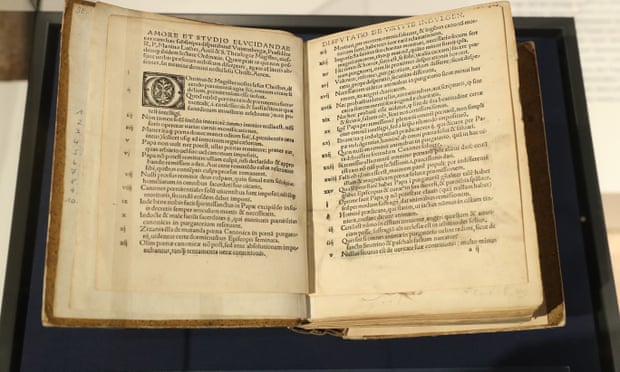
An edition of The 95 Theses printed in Basel in 1517. The academic disputation on indulgences lit the fuse of the Reformation. Photograph: Sean Gallup/Getty Images
Christianity
Catholic and Protestant leaders unite to mark start of Reformation
Archbishop of Canterbury to use service to present joint declaration described as ‘sign of healing after 500 years of division’
Harriet Sherwood Religion correspondent
@harrietsherwood
Tuesday 31 October 2017 02.00 EDT
Last modified on Tuesday 31 October 2017 02.02 EDT
Catholic and Protestant leaders will stress their mutual bonds 500 years after the start of the Reformation, a movement which tore apart western Christianity and sparked a string of bloody religious wars in Europe lasting more than a century.
A service in Westminster Abbey on Tuesday will mark the anniversary of the date in 1517 on which the German theologian Martin Luther submitted The 95 Theses to the archbishop of Mainz as well as nailing a copy to the door of a church in Wittenburg, lighting the fuse of the Reformation.
The Guardian view on the Reformation: justification through faith
Editorial: Luther’s defiance of papal authority shaped Europe and the world in ways he could never have foreseen
The archbishop of Canterbury, Justin Welby, will present a text by the Anglican communion affirming a joint declaration by the Roman Catholic church and global Protestant bodies described as “a sign of healing after 500 years of division”.
Last week, Pope Francis said Catholics and Protestants were now enjoying a relationship of “true fraternity” based on mutual understanding, trust and cooperation.
He told Derek Browning, moderator of the Church of Scotland, who was visiting the Vatican as part of the Reformation commemorations, that the two traditions were “no longer … adversaries, after long centuries of estrangement and conflict”
The pontiff added: “For so long we regarded one another from afar, all too humanly, harbouring suspicion, dwelling on differences and errors, and with hearts intent on recrimination for past wrongs.”
The 95 Theses, written in Latin, was a backlash against increasing corruption in the Catholic church and, in particular, the highly profitable sale of “indulgences”. These promised a fast-track to heaven and were sold to fund the building of St Peter’s Basilica in Rome.
Luther argued that salvation could not be bought or brokered by the church, but was a matter between an individual and God.
His challenge to the authority and elitism of the Catholic church was translated into German and other European languages. Thanks to revolutionary new printing presses, his message spread rapidly and was taken up by others, including the French theologian John Calvin.
Rome condemned Luther as a heretic and launched the Counter-Reformation, but by the end of the 16th century most of northern Europe was Protestant.
In England, Henry VIII, desperate to dissolve his marriage to Catherine of Aragon in pursuit of a male heir, launched his own, less clear-cut, separation from the Catholic church which involved the destruction of much of the country’s religious heritage.
In 1999, the Catholic and Lutheran churches agreed a “joint declaration on the doctrine of justification” that resolved many of the theological issues at the heart of the schism. This document has now been welcomed and affirmed by the Anglican communion.
A spokesperson for the Catholic church in England and Wales said: “The desire for reconciliation is such that mistakes can be recognised, injuries can be forgiven and wounds healed.
“We give thanks to the joy of the gospel we share as Christians, express repentance for the sadness of our divisions and renew our commitment to common witness and service to the world.”
But despite the warm words of reconciliation issued by leaders, there are issues blocking the prospect of a reunification of the two traditions, not least that of female priests.
Meanwhile, pockets of sectarianism remain in parts of northern Europe, including Northern Ireland and Scotland.
Last year, a document released by an evangelical Protestant group, Reformanda Initiative, drew a distinction between individual Catholics and the “unchecked dogmatic claims and complex political and diplomatic structure … [of the] the institutional Catholic church”.
It concluded: “The issues that gave birth to the Reformation 500 years ago are still very much alive in the 21st century for the whole church.”
Christianity
Catholic and Protestant leaders unite to mark start of Reformation
Archbishop of Canterbury to use service to present joint declaration described as ‘sign of healing after 500 years of division’
Harriet Sherwood Religion correspondent
@harrietsherwood
Tuesday 31 October 2017 02.00 EDT
Last modified on Tuesday 31 October 2017 02.02 EDT
Catholic and Protestant leaders will stress their mutual bonds 500 years after the start of the Reformation, a movement which tore apart western Christianity and sparked a string of bloody religious wars in Europe lasting more than a century.
A service in Westminster Abbey on Tuesday will mark the anniversary of the date in 1517 on which the German theologian Martin Luther submitted The 95 Theses to the archbishop of Mainz as well as nailing a copy to the door of a church in Wittenburg, lighting the fuse of the Reformation.
The Guardian view on the Reformation: justification through faith
Editorial: Luther’s defiance of papal authority shaped Europe and the world in ways he could never have foreseen
The archbishop of Canterbury, Justin Welby, will present a text by the Anglican communion affirming a joint declaration by the Roman Catholic church and global Protestant bodies described as “a sign of healing after 500 years of division”.
Last week, Pope Francis said Catholics and Protestants were now enjoying a relationship of “true fraternity” based on mutual understanding, trust and cooperation.
He told Derek Browning, moderator of the Church of Scotland, who was visiting the Vatican as part of the Reformation commemorations, that the two traditions were “no longer … adversaries, after long centuries of estrangement and conflict”
The pontiff added: “For so long we regarded one another from afar, all too humanly, harbouring suspicion, dwelling on differences and errors, and with hearts intent on recrimination for past wrongs.”
The 95 Theses, written in Latin, was a backlash against increasing corruption in the Catholic church and, in particular, the highly profitable sale of “indulgences”. These promised a fast-track to heaven and were sold to fund the building of St Peter’s Basilica in Rome.
Luther argued that salvation could not be bought or brokered by the church, but was a matter between an individual and God.
His challenge to the authority and elitism of the Catholic church was translated into German and other European languages. Thanks to revolutionary new printing presses, his message spread rapidly and was taken up by others, including the French theologian John Calvin.
Rome condemned Luther as a heretic and launched the Counter-Reformation, but by the end of the 16th century most of northern Europe was Protestant.
In England, Henry VIII, desperate to dissolve his marriage to Catherine of Aragon in pursuit of a male heir, launched his own, less clear-cut, separation from the Catholic church which involved the destruction of much of the country’s religious heritage.
In 1999, the Catholic and Lutheran churches agreed a “joint declaration on the doctrine of justification” that resolved many of the theological issues at the heart of the schism. This document has now been welcomed and affirmed by the Anglican communion.
A spokesperson for the Catholic church in England and Wales said: “The desire for reconciliation is such that mistakes can be recognised, injuries can be forgiven and wounds healed.
“We give thanks to the joy of the gospel we share as Christians, express repentance for the sadness of our divisions and renew our commitment to common witness and service to the world.”
But despite the warm words of reconciliation issued by leaders, there are issues blocking the prospect of a reunification of the two traditions, not least that of female priests.
Meanwhile, pockets of sectarianism remain in parts of northern Europe, including Northern Ireland and Scotland.
Last year, a document released by an evangelical Protestant group, Reformanda Initiative, drew a distinction between individual Catholics and the “unchecked dogmatic claims and complex political and diplomatic structure … [of the] the institutional Catholic church”.
It concluded: “The issues that gave birth to the Reformation 500 years ago are still very much alive in the 21st century for the whole church.”
Saturday, October 28, 2017
Reformation's impacts still felt locally after 500 years
Janet Heim 50 min ago

Gathered at Trinity Lutheran Church in Hagerstown are, left to right, Rev. Greg Shook, Rev. Marilyn Hembrock, and Rev. Kevin Munroe.
Joe Crocetta/Staff Photographer
It’s been just shy of 500 years since Martin Luther posted his 95 Theses on the door of All Saints’ Church, more commonly known as Castle Church, in Wittenberg, Germany, on Oct. 31, 1517.
“It moved Western society out of the Dark Ages,” said The Rev. G. Stanley Steele of St. Mark’s Lutheran Church in Hagerstown. “It had a huge political, huge cultural impact.”
Indeed, the impact has resounded locally, where some experts argue it’s impossible to separate the Reform movement from the history of Washington County.
“The Reformation, it’s one reason why Hagerstown is here,” said the Rev. Kevin Munroe of Zion Reformed United Church of Christ in Hagerstown. “You can’t really separate the history of the migration that took place because of the Reformation with why Hagerstown was founded.
Munroe said that a large number of people immigrated to the United States as a result of religious persecution in Europe.
“And as you go forward in Hagerstown,” he said, “the leadership of the town came out of the churches.”
Churches around the world and in Washington County have been celebrating the anniversary in a variety of ways. Besides individual churches marking the anniversary, an ecumenical committee of local church members and pastors has been working behind the scenes to plan ways to commemorate the milestone.
The result is a Reformation 500 Hymn Festival featuring Dr. Wayne L. Wold Sunday at Trinity Lutheran Church in Hagerstown at 4 p.m.
The anniversary of the Reformation is celebrated on Reformation Sunday, the Sunday closest to Oct. 31.
It’s a long and complicated history and this story only begins to tell some of it.
Who was Martin Luther and what is the Reformation?
Martin Luther is one of the most influential and controversial figures of the Protestant Reformation movement.
The Reformation, a time of questioning and rebirth, took place during the 14th, 15th and 16th centuries during the Renaissance, according to research done by Kent Shaffer of Zion Reformed United Church of Christ in Hagerstown.
Subscribe to:
Posts (Atom)