Showing posts with label Bloomberg. Show all posts
Showing posts with label Bloomberg. Show all posts
Wednesday, May 21, 2025


Tuesday, March 04, 2025
Wednesday, August 21, 2024
Monday, January 15, 2024
What Is Disease X? How Scientists Are Preparing for the Next Pandemic

Cell nuclei being infected by SARS-CoV-
2.Photographer: Jane Barlow/PA Images
By Jason Gale
January 15, 2024 at 5:51 AM EST
It sounds like something Elon Musk might have cooked up: “Disease X.” In fact, the term was coined years ago as a way of getting scientists to work on medical countermeasures for unknown infectious threats — novel coronaviruses like the one that causes Covid-19, for example — instead of just known ones, like the Ebola virus. The idea was to encourage the development of platform technologies, including vaccines, drug therapies and diagnostic tests, that could be rapidly adapted and deployed in response to an array of future outbreaks with epidemic or pandemic potential.
1. What is ‘Disease X?’
It’s the somewhat mysterious name for an illness caused by a currently unknown, yet serious microbial threat. The World Health Organization added Disease X in 2017 to a short list of pathogens deemed a top priority for research, alongside known killers like Severe Acute Respiratory Syndrome (SARS) and Ebola. The issue made it onto the agenda of the World Economic Forum in Davos, Switzerland, with WHO Director General Tedros Adhanom Ghebreyesus joining other health officials to discuss it.
Covid-19, caused by a novel coronavirus, was an example of a Disease X when it touched off the pandemic at the end of 2019. The vast reservoir of viruses circulating in wildlife are seen as a likely source of more such diseases. That’s because of their potential to spill over and infect other species, including humans, giving rise to an infection against which people will have no immunity.
2. What’s the point of studying Disease X?
As the WHO puts it, it’s to “enable early cross-cutting R&D preparedness that is also relevant” for an unknown disease. The humanitarian crisis sparked by the 2014–2016 Ebola epidemic in West Africa was a wake up call. Despite decades of research, there were no products ready to deploy in time to save more than 11,000 lives. In response, the WHO created an R&D Blueprint to accelerate development of a range of tools for “priority diseases.”
The current list includes:
- Covid-19,
- Crimean-Congo hemorrhagic fever,
- Ebola virus disease and Marburg virus disease,
- Lassa fever,
- Middle East respiratory syndrome (MERS) and SARS,
- Nipah and henipaviral diseases,
- Rift Valley fever,
- Zika,
- Disease X
3. How’s the research for the next pandemic going?
It took just 326 days from the release of the genetic sequence of the SARS-CoV-2 virus to the authorization of the first Covid vaccine, thanks in part to the work done since 2017 in preparation for Disease X. Now groups like the Coalition for Epidemic Preparedness Innovations, or CEPI, are supporting rapid response vaccine platforms that could develop new immunizations within 100 days of a virus with pandemic potential emerging under a $3.5 billion plan. Other efforts underway include:
- Updating the International Health Regulations and developing a new global agreement to protect the world from future emergencies.
- A new fund, approved by the World Bank, for pandemic prevention, preparedness and response.
- A WHO Hub for Pandemic and Epidemic Intelligence in Berlin that aims to speed access to key data, and develop analytic tools and predictive models to assess potential threats.
- The Global Virome Project that aims to discover zoonotic viral threats and stop future pandemics.
- A $5 billion US government initiative to develop next-generation vaccines and treatments for Covid-19, called Project NextGen.
- $262.5 million in funding for a US national network for detecting and responding more efficiently to public health emergencies.
- Establishment of global center for pandemic therapeutics.
Still, numerous challenges threaten to undermine these efforts, including depleted and weakened health systems, a growing anti-science movement that has increased vaccine hesitancy, and the potential for governments to eventually deprioritize funding for outbreak detection and preparedness as perceived risks dissipate.
The Reference Shelf
- QuickTakes on Covid’s aftermath, pandemic risks and the threat to humans from bird flu.
- The WHO homepage for Blueprint R&D.
- Nobel Peace Prize laureate Ellen Johnson Sirleaf urges “transformational change” to prepare for next pandemic.
- The International Pandemic Preparedness Secretariat’s 100 Days Mission 2022 report.
- The University of Oxford asks if we’re ethically prepared for Disease X.
Bloomberg Opinion’s Lisa Jarvis talks Covid lessons with former White House adviser Anthony Fauci.
— With assistance from Marthe Fourcade
— With assistance from Marthe Fourcade
Friday, December 23, 2022
Tuesday, September 27, 2022
Monday, November 12, 2018
China missing out by sending few senior officials to Bloomberg New Economy Forum in Singapore
Beijing mainly stayed away from event it was originally scheduled to host, leaving some frustrated that its voice went unheard
PUBLISHED : Sunday, 11 November, 2018, 3:58pm
UPDATED : Monday, 12 November, 2018, 6:58am
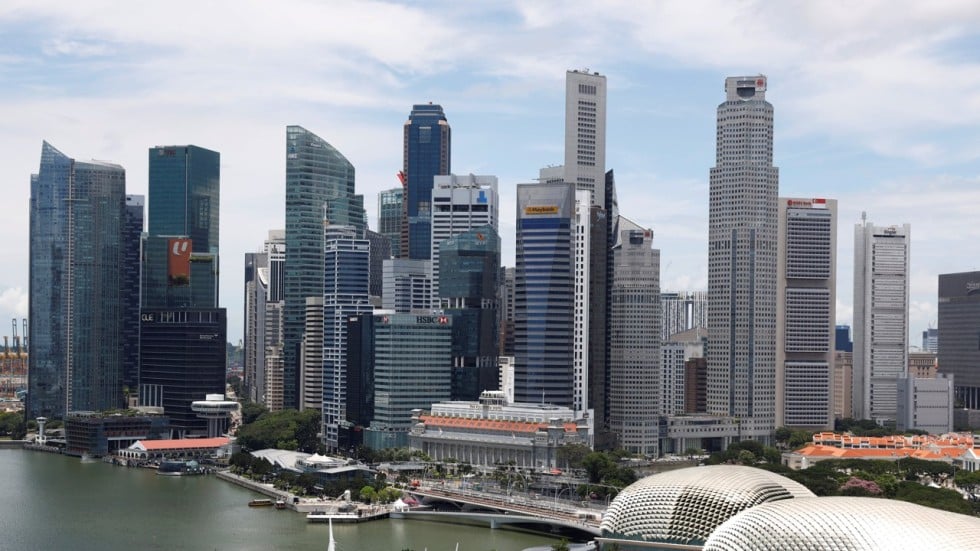
Singapore stepped in to host the Bloomberg New Economy Forum after it was moved from China. Photo: Reuters

tammy.tam@scmp.com
Those were the words of Michael Bloomberg, founder of the global finance media network of the same name and former mayor of New York, as he opened the high-level “New Economy Forum” last week.
The two-day event was moved to the city state from Beijing to avoid clashing with the opening of the inaugural China International Import Expo.
As if to quell speculation that China was not really keen on the forum amid its escalating trade war with the US, Vice-President Wang Qishan, a trusted aide of President Xi Jinping, flew to Singapore to deliver a keynote speech.
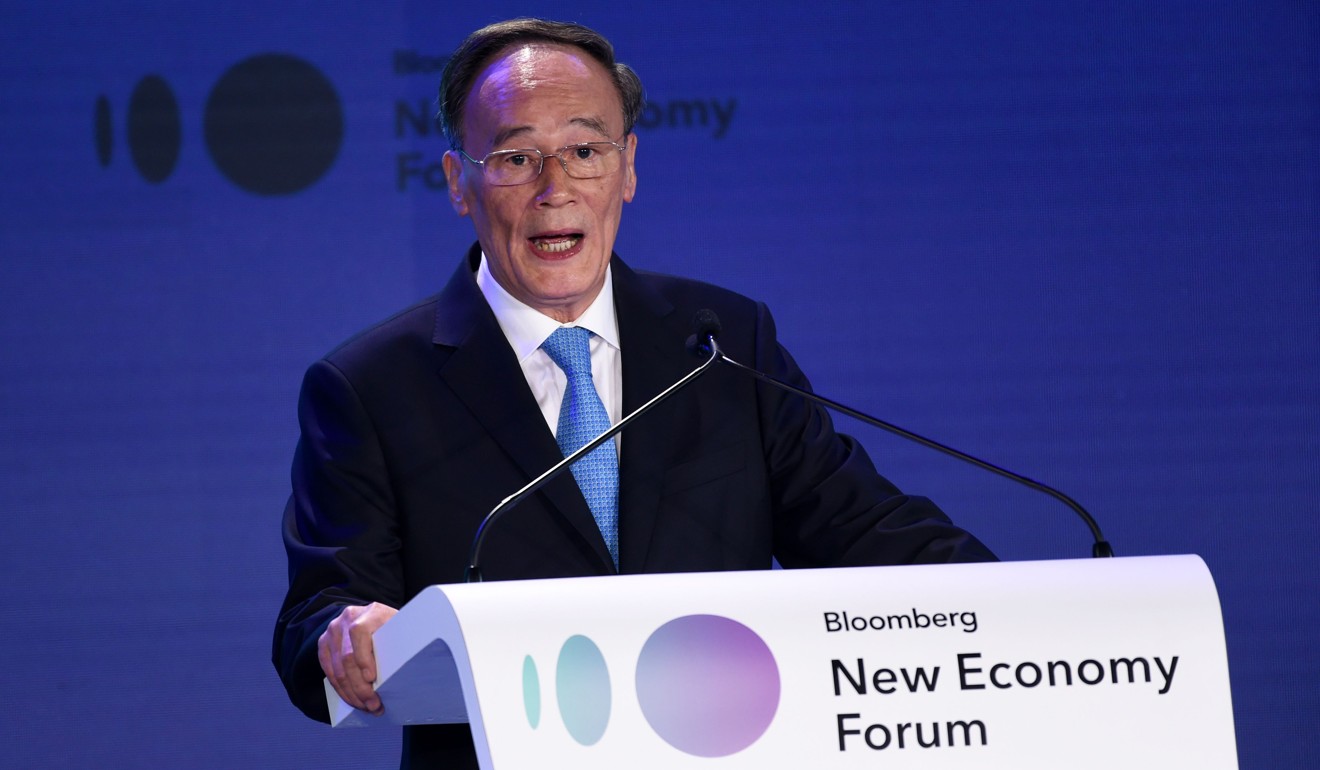
Chinese Vice-President Wang Qishan speaking at the Bloomberg New Economy Forum in Singapore on November 6. Photo: AFP
He also met many old friends, including Bloomberg and former US secretary of state Henry Kissinger. Wang ended his whirlwind tour with a meeting with Singapore Prime Minister Lee Hsien Loong.
So would Bloomberg have given the same compliment to Beijing had the venue not been changed? Very likely, yes, but nice words make people happy. A Singapore business friend of mine proudly accepted the praise, declaring: “Where else in Asia can you pull it off in just about six weeks other than Singapore – or Hong Kong?”
It was kind of him to include Hong Kong. For some reason, many people in the two cities are obsessed with constant comparisons, politically, economically and socially.
We do not know whether Hong Kong was ever considered as a venue for the forum, but Singapore proved it was the right choice by ensuring a well-organised event.
In addition to Kissinger, the long VIP list included former US treasury secretary Hank Paulson; IMF chief Christine Lagarde; former US Federal Reserve chair Janet Yellen; former chief economic adviser to US President Donald Trump, Gary Cohn; former Australian prime minister Kevin Rudd; Malaysian prime minister-in-waiting Anwar Ibrahim; ministers from other Asian countries and Hong Kong’s first chief executive Tung Chee-hwa.
Tuesday, February 06, 2018
Robots in Finance Bring New Risks to Stability, Regulators Warn
Robots in Finance Bring New Risks to Stability, Regulators Warn
By
Silla Brush
@sabrushMore stories by Silla Brush
November 1, 2017 11:00 AM EDT
Financial Stability Board issues paper on AI, machine learning
Firms are rapidly adopting artificial intelligence, FSB says

Robots Are Coming for Jobs on Wall Street
Banks and hedge funds that rely on artificial intelligence threaten to inject risks into the financial system that could exacerbate a future crisis, according to global regulators.
The financial industry’s rush to adopt AI raises the potential that firms will become overly dependent on technologies that herd them toward the same view of risks and could “amplify financial shocks,” according to a study published on Wednesday by the Financial Stability Board, a panel of regulators that includes the U.S. Federal Reserve and European Central Bank.
“AI and machine learning applications show substantial promise if their specific risks are properly managed,” the FSB said in a report that called for additional monitoring and testing of robotic technologies designed to lessen human involvement. “Taken as a group, universal banks’ vulnerability to systemic shocks may grow if they increasingly depend on similar algorithms or data streams.”
The FSB, headed by Bank of England Governor Mark Carney, said that many of the technologies are being designed and tested in a period of low volatility in financial markets, and, as a result, “may not suggest optimal actions in a significant economic downturn or in a financial crisis.”
Artificial intelligence is a branch of computer science that aims to imbue machines with aspects of reasoning. The term now includes machine learning, which is the ability for computers to learn by ingesting data, and natural language processing -- the ability to read or produce text.
Read More: How to Survive Wall Street’s Robot Revolution
The world’s biggest banks and hedge funds are embracing the tools, driven by the availability of major new sources of data that can be analyzed quickly with computer power and at the same time a desire to cut costs and employment levels. Management consultant Opimas LLC estimated in March that AI would result in a cut of 230,000 workers at financial firms worldwide by 2025, with the hardest hit being 90,000 people in asset management.
Firms are using AI and machine learning to assess the credit quality of borrowers, price insurance contracts, automate interactions with clients and estimate the risk of trading positions, the FSB said. Hedge funds relying purely on AI and machine learning technologies are growing rapidly and have about $10 billion in assets under management, the FSB said, citing an estimate from a unnamed financial firm.
Silla Brush
@sabrushMore stories by Silla Brush
November 1, 2017 11:00 AM EDT
Financial Stability Board issues paper on AI, machine learning
Firms are rapidly adopting artificial intelligence, FSB says
Robots Are Coming for Jobs on Wall Street
Banks and hedge funds that rely on artificial intelligence threaten to inject risks into the financial system that could exacerbate a future crisis, according to global regulators.
The financial industry’s rush to adopt AI raises the potential that firms will become overly dependent on technologies that herd them toward the same view of risks and could “amplify financial shocks,” according to a study published on Wednesday by the Financial Stability Board, a panel of regulators that includes the U.S. Federal Reserve and European Central Bank.
“AI and machine learning applications show substantial promise if their specific risks are properly managed,” the FSB said in a report that called for additional monitoring and testing of robotic technologies designed to lessen human involvement. “Taken as a group, universal banks’ vulnerability to systemic shocks may grow if they increasingly depend on similar algorithms or data streams.”
The FSB, headed by Bank of England Governor Mark Carney, said that many of the technologies are being designed and tested in a period of low volatility in financial markets, and, as a result, “may not suggest optimal actions in a significant economic downturn or in a financial crisis.”
Artificial intelligence is a branch of computer science that aims to imbue machines with aspects of reasoning. The term now includes machine learning, which is the ability for computers to learn by ingesting data, and natural language processing -- the ability to read or produce text.
Read More: How to Survive Wall Street’s Robot Revolution
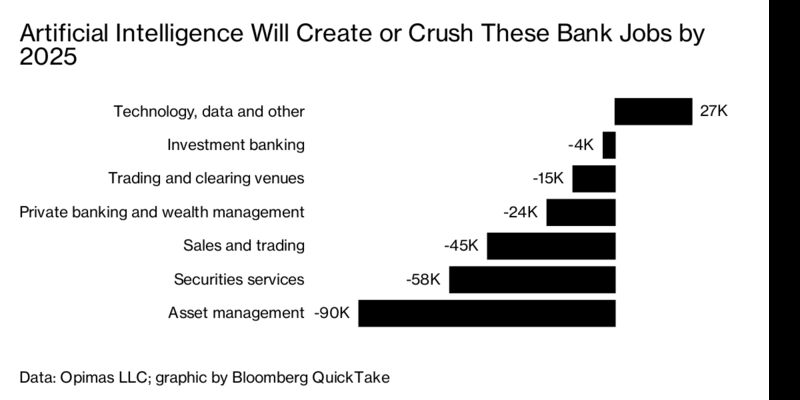
The world’s biggest banks and hedge funds are embracing the tools, driven by the availability of major new sources of data that can be analyzed quickly with computer power and at the same time a desire to cut costs and employment levels. Management consultant Opimas LLC estimated in March that AI would result in a cut of 230,000 workers at financial firms worldwide by 2025, with the hardest hit being 90,000 people in asset management.
Firms are using AI and machine learning to assess the credit quality of borrowers, price insurance contracts, automate interactions with clients and estimate the risk of trading positions, the FSB said. Hedge funds relying purely on AI and machine learning technologies are growing rapidly and have about $10 billion in assets under management, the FSB said, citing an estimate from a unnamed financial firm.
The FSB said technology’s potential to cut costs and drive new profits is even creating an “arms race” among firms to demonstrate their use of AI.
In the process, firms may be relying on a small number of third-party technological developers and services. If those were to fail, the effect would ripple across the wider financial system and contribute to major disruptions at large financial firms at the same time.
“These risks may become more important in the future if AI and machine learning are used for ‘mission-critical’ applications of financial institutions,” the FSB said. “Moreover, advanced optimization techniques and predictable patterns in the behavior of automated trading strategies could be used by insiders or by cyber-criminals to manipulate market prices.”
— With assistance by Edward Robinson
In the process, firms may be relying on a small number of third-party technological developers and services. If those were to fail, the effect would ripple across the wider financial system and contribute to major disruptions at large financial firms at the same time.
“These risks may become more important in the future if AI and machine learning are used for ‘mission-critical’ applications of financial institutions,” the FSB said. “Moreover, advanced optimization techniques and predictable patterns in the behavior of automated trading strategies could be used by insiders or by cyber-criminals to manipulate market prices.”
— With assistance by Edward Robinson
Tuesday, November 15, 2016
Church Plan Litigation Hits Seventh-Day Adventist Hospital
From Pension & Benefits Daily
Pension & Benefits Daily™ covers all major legislative, regulatory, legal, and industry developments in the area of employee benefits every business day, focusing on actions by Congress,...
By Jacklyn Wille
Oct. 31 — A Florida-based Seventh-Day Adventist hospital system is the latest large health-care company to be accused of underfunding its pension plans by millions of dollars based on a faulty reliance on ERISA’s “church plan” exemption ( Sheedy v. Adventist Health Sys. Sunbelt Healthcare Corp. , M.D. Fla., No. 6:16-cv-01893-GAP-GJK, complaint filed 10/28/16 ).
The lawsuit, filed Oct. 28 in a Florida federal court, claims that Adventist Health System’s pension plans are underfunded by a combined $134 million. Like more than three dozen recent suits against Catholic and other religiously affiliated hospitals, this lawsuit attributes the underfunding to Adventist’s improper reliance on a religious exemption from the Employee Retirement Income Security Act, which allows “church plans” freedom to avoid the statute’s strict funding and disclosure requirements.
The U.S. Supreme Court is expected to announce in the coming weeks whether it will wade into this ongoing controversy, in which plaintiffs claim that more than 300,000 hospital workers face a pension shortfall of about $4 billion. The litigation effort has scored victories in the U.S. Courts of Appeals for the Third, Seventh and Ninth circuits and has netted several multimillion-dollar settlements, including a $352 million deal by Washington-based Providence Health & Services announced earlier this month.
The 12-count lawsuit against Adventist Health differs from many of its predecessors because it targets several pension plans, including a multiemployer plan covering several Adventist-affiliated entities and a group of frozen plans in which participants are no longer accruing benefits.
The case is also noteworthy for being the first to target a hospital system with ties to the Seventh-Day Adventist Church. The vast majority of the nearly 40 church plan lawsuits have targeted Catholic health-care providers.
Finally, this is the first church plan case to be filed in a Florida federal court and only the second to be filed in any court within the Eleventh Circuit. The other lawsuit, filed against Baptist Health System in the Northern District of Alabama, led to an $11 million settlement that the parties said was on top of $89 million in voluntary pension contributions by Baptist.
The employees suing Adventist are represented by Sheppard White Kachergus & DeMaggio P.A. and Gainey McKenna & Egleston, the latter of which recently filed a similar suit against Cincinnati-based Mercy Health. That case was recently consolidated with two other proposed class actions against the hospital, and the firm in August agreed to allow plaintiffs’ firms Cohen Milstein Sellers & Toll and Keller Rohrback to take over as class counsel.
Adventist didn’t immediately respond to Bloomberg BNA’s request for comments.
To contact the reporter on this story: Jacklyn Wille in Washington atjwille@bna.com
To contact the editor responsible for this story: Jo-el J. Meyer at jmeyer@bna.com
The case is also noteworthy for being the first to target a hospital system with ties to the Seventh-Day Adventist Church. The vast majority of the nearly 40 church plan lawsuits have targeted Catholic health-care providers.
Finally, this is the first church plan case to be filed in a Florida federal court and only the second to be filed in any court within the Eleventh Circuit. The other lawsuit, filed against Baptist Health System in the Northern District of Alabama, led to an $11 million settlement that the parties said was on top of $89 million in voluntary pension contributions by Baptist.
The employees suing Adventist are represented by Sheppard White Kachergus & DeMaggio P.A. and Gainey McKenna & Egleston, the latter of which recently filed a similar suit against Cincinnati-based Mercy Health. That case was recently consolidated with two other proposed class actions against the hospital, and the firm in August agreed to allow plaintiffs’ firms Cohen Milstein Sellers & Toll and Keller Rohrback to take over as class counsel.
Adventist didn’t immediately respond to Bloomberg BNA’s request for comments.
To contact the reporter on this story: Jacklyn Wille in Washington atjwille@bna.com
To contact the editor responsible for this story: Jo-el J. Meyer at jmeyer@bna.com
More Information
Text of the complaint is at http://www.bloomberglaw.com/public/document/Sheedy_v_Adventist_Health_System_Sunbelt_Healthcare_Corporation_e/1.
Copyright © 2016 The Bureau of National Affairs, Inc. All Rights Reserved.
Source
Text of the complaint is at http://www.bloomberglaw.com/public/document/Sheedy_v_Adventist_Health_System_Sunbelt_Healthcare_Corporation_e/1.
Copyright © 2016 The Bureau of National Affairs, Inc. All Rights Reserved.
Source
Monday, June 20, 2016
Why America’s men aren’t working

The Washington Post
Ylan Q. Mui

The national unemployment rate has fallen by more than half since the nation emerged from the worst economic crisis since the Great Depression. It peaked at 10 percent in 2010 and stood at just 4.7 percent last month.
That’s mostly good news: Private employers have added more than 14 million jobs. About 2 million people have been out of a job for six months or longer, far too many but only about a quarter of the number of long-term unemployed people seven years ago. By almost every measure, the labor market has made incredible progress.
But there’s one statistic that has been vexing economists. The size of the nation’s workforce -- known as the labor force participation rate -- continues to fall. Since the start of the downturn, the percentage of that population that has a job or is looking for one has dropped more than 3 percentage points, to 62.6 percent, a level not seen since the 1970s.
The problem is particularly pronounced among men between the ages of 25 and 54, traditionally considered the prime working years. Their participation rate has been declining for decades, but the drop-off accelerated during the recession. The high mark was 98 percent in 1954, and it now stands at 88 percent. A new analysis from the White House’s Council of Economic Advisers, slated for release Monday, found that the United States now has the third-lowest participation rate for “prime-age men” among the world’s developed countries.
In other words, Greece, Slovenia and Turkey have a larger share of men in their workforces than the United States does. The United States beats only Italy and Israel.

The CEA’s analysis looks at several common theories behind why so many American men have dropped out of the job market. Legions of women have joined the workforce since the 1950s, when about one-third of them had a job or were looking for one. Women’s participation rate topped 50 percent in the late 1970s and peaked at about 60 percent in the early 2000s. Perhaps fewer men are working because their wives are bringing home the bacon instead.
But the share of women in the workforce also has decreased significantly since the recession. And the CEA found that less than a quarter of prime-age men have a working spouse -- and that number has actually declined over the past 50 years.
Economists have posited that Social Security Disability Insurance could be incentivizing men to enroll in government assistance rather than look for work. The number of disability insurance recipients has risen by 2 percent since the late 1960s, not enough to account for the much greater drop in the male workforce. The CEA estimates that the increase in disability insurance explains only about half a percentage point of the decline in the male participation rate.
Instead, the CEA concludes that the problem is one of education and the erosion of demand for low-skilled workers. More than 90 percent of college-educated men are in the workforce, compared with 83 percent of those with a high school diploma or less. It’s a theme seen time and again in our increasingly globalized and high-tech economy: Blue-collar jobs that were once the cornerstone of the middle class get outsourced or replaced by automation.

There’s a ripple effect, too. When a manufacturing plant shuts down, for example, the laid-off employees may wind up in lower-skilled jobs, displacing those workers and potentially forcing them out of the labor market.
The lower the wage, the more likely workers are to pass up the job altogether. The CEA looked at state-level data and found that among the bottom 10 percent of wage earners, a $1,000 increase in annual income boosted the participation rate by 0.16 percent for prime-age men.
“ When the returns to work for those at the bottom of the wage distribution are particularly low, more prime-age men choose not to participate in the labor force,” the report states.
The report also explores one more unorthodox explanation: the high number of men who have been incarcerated. The CEA notes that the U.S. prison population has grown significantly since 1990 and is far above that of any other developed country.
People in prison are not counted as part of the population for the purposes of labor market statistics. At first blush, that would actually boost the participation rate: A smaller population means the share in the workforce is larger. But in reality, there are immense and well-documented barriers to the job market for workers once they leave prison. And the gloomy prospects of the formerly incarcerated outweigh the statistical benefit of having a large prison population.

Of course, the CEA argues that White House proposals -- from familiar positions such as raising the minimum wage and expanding the earned-income tax credit to wonkier ones such as reforming community colleges and flexibility in claiming unemployment benefits -- can help more men return to the workforce.
But the bigger question is whether there is really a way to reverse the tide, or if the best hope is to merely mitigate the pain. For 60 years, economists have debated the answer. And still, the share of men in the workforce continues to shrink.
Tuesday, August 20, 2013
Dear NSA and NYPD: If you watch us, we’re going to watch you.
Police the Police
By William Saletan
Posted Tuesday, Aug. 20, 2013, at 10:32 AM

Left: National Security Agency Director Gen. Keith Alexander at a symposium in Baltimore on June 27, 2013. Right: New York Police Department Commissioner Ray Kelly at a news conference on Aug. 12, 2013, in New York.
Photo illustration by Slate. Photos by Reuters.
Here’s a simple rule for any government agency that monitors or polices Americans: If you get to watch us, we get to watch you.
It’s a basic lesson of history and human nature: People are much more likely to behave badly when nobody’s watching. That’s why police patrol neighborhoods. It’s the rationale for New York City’s “stop, question, and frisk” policy. It’s also what led to the National Security Agency’s current surveillance programs. The Sept. 11 plotters used communications channels we weren’t monitoring adequately. Now the NSA is watching those channels.
NSA analysts and New York City cops are nothing like the thugs and terrorists they police. But they’re still people. They behave better when they’re monitored. And because they work for the government, with all its power, their misbehavior can become dangerous. The watchers must be watched.
The debates that have erupted in recent days—first over a federal court ruling that struck down parts of the stop-and-frisk policy, then over the Washington Post’s revelation of legal infractions by the NSA—are complex. There’s a good case to be made for allowing police to stop, question, and frisk people based a lower standard of suspicion than is needed for an arrest. There’s also a good case to be made for applying looser rules to the NSA’s collection of communications records than to its searches of those records. But one principle should be easy to accept: Both the NSA and the NYPD should be closely scrutinized by independent overseers who can make them suffer for exceeding their authority.
That’s what federal Judge Shira Scheindlin prescribed a week ago, when she found the NYPD’s stop-and-frisk methods unconstitutional. “The City’s highest officials have turned a blind eye to the evidence that officers are conducting stops in a racially discriminatory manner,” the judge concluded. To rein in this practice, she ordered “a trial program requiring the use of body-worn cameras in one precinct per borough, a community-based joint remedial process to be conducted by a court-appointed facilitator, and the appointment of an independent monitor to ensure that the NYPD’s conduct of stops and frisks is carried out in accordance with the Constitution.”
Mayor Michael Bloomberg and Police Commissioner Ray Kelly protested the oversight. “We have to give the members of our Police Department the tools they need to do their jobs without being micro-managed and second-guessed every day by a judge or a monitor,” said Bloomberg, borrowing the arguments of Dick Cheney. Putting tiny cameras on officers, as thousands of other police departments have done, “would be a nightmare,” Bloomberg asserted, since critics would just claim that the officers “deliberately chose an angle” or failed to capture the whole scene. On Sunday, Kelly went on three national talk shows to bash the judge’s decision. “The body camera issue opens up certainly more questions than answers,” he told Bob Schieffer. “When do you have the cameras on? When do you turn them off? Do you have it on during a domestic dispute? Do you have it on when somebody comes to give you confidential information?”
The NSA, like the NYPD, claims to be thoroughly supervised. An NSA spokeswoman says the agency reports all its mistakes “internally and to federal overseers.” But documents published by the Post show that the agency filters what it reports. The chief judge of the Foreign Intelligence Surveillance Court, when asked by the Post why the NSA used a new data collection method “for many months” before the FISC ruled it unconstitutional, explained that the court “is forced to rely upon the accuracy of the information that is provided” by the NSA. Dianne Feinstein, the Democratic chairwoman of the Senate Intelligence Committee, admits that the committee gets “some” information about compliance issues from the court and the NSA itself but “should do more to independently verify that NSA’s operations are appropriate, and its reports of compliance incidents are accurate.”
The public gets even less disclosure. More than two months ago, the Associated Press filed a Freedom of Information Act request to see the NSA’s vaunted “minimization procedures” for protecting Americans from inadvertent surveillance. The AP is still waiting for the documents. A few days ago, in a conference call with reporters, the NSA’s compliance director admitted the agency had experienced "a couple" of willful legal violations in the past decade but gave no details and declined to specify the number. Then, on Sunday, we saw this exchange between Rep. Peter King, R-N.Y., and Fox News anchor John Roberts:
Roberts: You said that everything was self-reported by the NSA. The documents that were leaked at the end of last week clearly show that many of these violations were not appropriately reported, at least not to the Foreign Intelligence Surveillance Court, whose members also complain that they do not have the power to initiate investigations into noncompliance …
King: I'm on the Intelligence Committee. I am satisfied that we are told what the NSA is doing. …
Roberts: Did you know, Congressman King, all of what was reported at the end of the week?
King: It was all available. And there's nothing there that bothers me. Quite frankly, that shows that the system works.
In other words, the guy who’s supposed to supervise the NSA is satisfied that he’s being told enough, even though he didn’t know the full extent and nature of the compliance problems, which were apparently edited into reassuring summaries for the committee. That sounds a lot like the NYPD, which insists that court-ordered monitoring of its stop-and-frisk practices is unnecessary because its cops are already scrutinized by internal affairs, integrity-control officers, inspections units, quality-assurance personnel, and the Civilian Complaint Review Board.
Defenders of the NSA, like defenders of the NYPD, plead that their errors are largely inadvertent or well-intentioned. That’s a fair and important point. But their claims of adequate oversight are self-refuting. When you respond to evidence of infractions by telling us that everything you’re doing is OK and that you already have internal control mechanisms, that doesn’t show us the extent to which those mechanisms are working. It shows the extent to which they’re failing. It tells us you need better independent oversight.
Spare us the Cheney scare tactics. Appointing a civil liberties advocate to argue before the FISC won’t cripple national security. Nor will full reporting of compliance incidents to the FISC and the intelligence committees. Body cameras on cops won’t ruin policing, either. They’ve helped other police departments, vindicating accused officers and reducing misconduct complaints. When agents of the government are closely watched, compliance is verified, noncompliance is reduced, and citizens become more confident that our rights are being respected. Everybody wins.
Source
Fuente
.
Monday, August 19, 2013
Bloomberg Proposes Fingerprinting at Public Housing
Bloomberg Proposes Fingerprinting at Public Housing — Democratic Mayoral Hopefuls Pounce

Richard French
Published on Aug 16, 2013
Richard French and the RFL panel discuss New York City Mayor Michael Bloomberg's proposal to install fingerprint keypads in public housing.
.
Thursday, August 08, 2013
Obama Snubs, Russia Laughs, Putin Wins

Vladimir Putin was this close to caring that Barack Obama decided not to meet with him. Photographer: Jochen Eckel/Bloomberg
By Leonid Bershidsky Aug 7, 2013 12:53 PM ET
In the U.S., President Barack Obama's decision to cancel a summit with Russian President Vladimir Putin for harboring fugitive Edward Snowden is seen as an important diplomatic demarche.
From the Russian perspective, it's a bit of a joke.
One freshly minted Russian witticism, picked up by the news site Gazeta.ru, portrayed the U.S. president as a jilted suitor: "Obama won't see Putin because Putin is already seeing Snowden."
The White House issued a statement saying Obama "looked forward to" the September G-20 summit in St. Petersburg, but that he had decided against a one-on-one meeting with Putin "given our lack of progress on issues such as missile defense and arms control, trade and commercial relations, global security issues, and human rights and civil society in the last 12 months." As regards the man wanted in the U.S. for leaking information on government surveillance, the White House said: "Russia’s disappointing decision to grant Edward Snowden temporary asylum was also a factor that we considered in assessing the current state of our bilateral relationship."
The fact that Obama stopped short of skipping the entire G-20 meeting was seen in the Putin camp as a sign of weakness. The dominant theory is that the U.S. president did not really want to make hostile moves against Russia, but domestic interests forced him to make a show of chastising Putin.
"Obama is under powerful pressure from the cold war lobby," political analyst Sergei Markov told the news agency Interfax.
"This is clearly a political defeat for Obama," pro-Putin newspaper editor Vitaly Tretyakov wrote on the social network Vkontakte. In an eerie echo of the White House statement, Tretyakov added: "Russia, strictly speaking, does not care. What could we expect from Obama's visit? A second reset? But the first one failed. A second detente? Who even remembers the first one?"
Putin's liberal opponents, for their part, could not sympathize with Obama's move. They saw better reasons than Snowden's asylum to chastise Putin.
"It's sad that Obama did not refuse to meet with Putin because of human rights violations in Russia but rather because of rights violations in the U.S.," blogger Oleg Kozyrev wrote on Twitter.
The two leaders did not have much to discuss, anyway.
Russia and the United States do not see eye to eye on most issues, from gay rights to the civil war in Syria. The differences have been starkly evident for at least a year, since Putin returned to the Kremlin after a four-year hiatus. Now a man wanted in the U.S. for espionage has found an apartment in Moscow, is looking for a job and sending out invitations to family in the U.S. If a meeting would not have changed anything, neither does its cancellation.
"Obama canceled his meeting with Putin," Russia's most popular anti-Putin politician Alexei Navalny, who is now running for mayor of Moscow, wrote on Twitter. "As for me, I held my meeting with the residents of Zyablikovo neighborhood as planned."
(Leonid Bershidsky, an editor and novelist, is a Bloomberg View contributor. Follow him on Twitter.)
In the U.S., President Barack Obama's decision to cancel a summit with Russian President Vladimir Putin for harboring fugitive Edward Snowden is seen as an important diplomatic demarche.
From the Russian perspective, it's a bit of a joke.
One freshly minted Russian witticism, picked up by the news site Gazeta.ru, portrayed the U.S. president as a jilted suitor: "Obama won't see Putin because Putin is already seeing Snowden."
The White House issued a statement saying Obama "looked forward to" the September G-20 summit in St. Petersburg, but that he had decided against a one-on-one meeting with Putin "given our lack of progress on issues such as missile defense and arms control, trade and commercial relations, global security issues, and human rights and civil society in the last 12 months." As regards the man wanted in the U.S. for leaking information on government surveillance, the White House said: "Russia’s disappointing decision to grant Edward Snowden temporary asylum was also a factor that we considered in assessing the current state of our bilateral relationship."
The fact that Obama stopped short of skipping the entire G-20 meeting was seen in the Putin camp as a sign of weakness. The dominant theory is that the U.S. president did not really want to make hostile moves against Russia, but domestic interests forced him to make a show of chastising Putin.
"Obama is under powerful pressure from the cold war lobby," political analyst Sergei Markov told the news agency Interfax.
"This is clearly a political defeat for Obama," pro-Putin newspaper editor Vitaly Tretyakov wrote on the social network Vkontakte. In an eerie echo of the White House statement, Tretyakov added: "Russia, strictly speaking, does not care. What could we expect from Obama's visit? A second reset? But the first one failed. A second detente? Who even remembers the first one?"
Putin's liberal opponents, for their part, could not sympathize with Obama's move. They saw better reasons than Snowden's asylum to chastise Putin.
"It's sad that Obama did not refuse to meet with Putin because of human rights violations in Russia but rather because of rights violations in the U.S.," blogger Oleg Kozyrev wrote on Twitter.
The two leaders did not have much to discuss, anyway.
Russia and the United States do not see eye to eye on most issues, from gay rights to the civil war in Syria. The differences have been starkly evident for at least a year, since Putin returned to the Kremlin after a four-year hiatus. Now a man wanted in the U.S. for espionage has found an apartment in Moscow, is looking for a job and sending out invitations to family in the U.S. If a meeting would not have changed anything, neither does its cancellation.
"Obama canceled his meeting with Putin," Russia's most popular anti-Putin politician Alexei Navalny, who is now running for mayor of Moscow, wrote on Twitter. "As for me, I held my meeting with the residents of Zyablikovo neighborhood as planned."
(Leonid Bershidsky, an editor and novelist, is a Bloomberg View contributor. Follow him on Twitter.)
.
Friday, May 10, 2013
New York City considers allowing non-citizens to vote
By Jessica Chasmar
The Washington Times
Thursday, May 9, 2013

** FILE ** New York Mayor Michael R. Bloomberg. (Associated Press) more >
STORY TOPICS
Daniel Dromm
Michael Bloomberg
New York City could soon become the first major city to allow non-citizens to vote in its municipal elections, as city council hearings on the proposal begin today.
According to Talking Points Memo, the proposal appears to have a veto-proof majority in the Council — enough to overcome opposition by Mayor Michael Bloomberg.
“It’s going to be huge and just imagine the implications that are involved here,” Councilman Daniel Dromm, one of the co-sponsors of “Voting By Non-Citizen Residents,” told TPM Wednesday.
The proposal would allow immigrants lawfully residing in the city for six months or longer to vote provided they meet all the other current requirements for voter registration in New York State, TPM reports. The bill specifies that they are not permitted to vote in state or federal elections.
“This is extremely important, because it’s based on the founding principle of this country and that was, ‘No Taxation Without Representation.’ All of the people who would be included in this and would be allowed to vote are paying taxes, they’ve contributed to society,” Mr. Dromm added.
Mayor Michael Bloomberg opposes the legislation, but TPM points out that it may not be enough. It currently has the support of 34 of the Council’s 51 members, exactly the amount needed to override a veto.
“I’m optimistic both with the committee and on the floor and I would hope that we could pass this by the end of the year,” Mr. Dromm said.
Read more: http://www.washingtontimes.com/news/2013/may/9/new-york-city-considers-allowing-non-citizens-vote/#ixzz2SrexBUgp
.
Thursday, April 25, 2013
Bloomberg’s Constitution

Editorial of The New York Sun | April 23, 2013
“The people who are worried about privacy have a legitimate worry. But we live in a complex world where you’re going to have to have a level of security greater than you did back in the olden days, if you will. And our laws and our interpretation of the Constitution, I think, have to change.” That is the latest from Mayor Bloomberg in the wake of the Boston Marathon bombing. He is quoted in Politicker.com by the New York Observer’s Jill Colvin, in a dispatch that gives, en passant, a glimpse of the mayor’s inchoate view of the American parchment.
On the one hand, His Honor warns that we live in a “very dangerous world” in which “there are people who want to take away our freedoms.” So, he says, “we’re going to have more cameras and that kind of stuff.” He goes on to call that “good in some sense” but “different from what we are used to.” On the other hand, Ms. Colvin quotes him as pointing to the gun debate and noting that the courts have allowed for what she paraphrases the mayor as calling increasingly stringent regulations in response to ever-more powerful weapons.
Well, we suppose that’s one way of looking at what the Supreme Court has said. Another way of looking at is that the Supreme Court has said that while some regulation of guns may be permitted, the government is prohibited from going too far. The Court, in District of Columbia v. Heller, has noted that some think that the Second Amendment is “outmoded in a society where our standing army is the pride of our Nation, where well-trained police forces provide personal security, and where gun violence is a serious problem.”
The Court called that “perhaps debatable.” But, the Court continued, “what it is not debatable is that it is not the role of this Court to pronounce the Second Amendment extinct.” Yet extinct is precisely what the Second Amendment has become in Mayor Bloomberg’s New York, where, we have quipped, Mother Teresa couldn’t get a permit to carry even a small-caliber pistol. Nor could even the most law-abiding and well-trained citizen. So what are New Yorkers, or anyone else, to make of the blithe assurances from the mayor in respect of the Constitution.
On the one hand, he is quoted by Ms. Colvin as suggesting we’re going to “have to live” with what he calls “reasonable levels of security.” The word “reasonable” echoes the Fourth Amendment, which vouchsafes the of Americans to be secure in their persons, houses, papers, and effects, against “unreasonable” searches and seizures. At the moment, the Bloomberg administration is in federal court fighting for the right to stop and frisk New Yorkers whom police officers suspect might be up to no good. Seems reasonable to us.
On the other hand, the mayor is being quoted by Ms. Colvin as pointing to the use of magnetometers to catch weapons in city schools. In other words, he is for searching pupils and adult visitors whether or not they are suspected of being up to no good. That, too, may turn out to be reasonable. “It really says something bad about us that we have to do it,” Politicer.com quotes the mayor as saying. “But our obligation first and foremost is to keep our kids safe in the schools; first and foremost, to keep you safe if you go to a sporting event.:
It seems that the obligation the mayor puts “first and foremost” is “to keep you safe if you walk down the streets or go into our parks.” From there it’s but hop-skip-and-a-jump to keeping you safe when you order a soda pop along with the French fries you’re going to wash down with it. This week the mayor has changed his mind and decided it also involves prohibiting persons under the age of 21 from purchasing a pack of cigarettes — not even smoking them, simply purchasing them, even if for, say, a parent.
This is the context in which New Yorkers roll their eyes when the mayor is quoted, as he is by Ms. Colvin, as saying: “What we can’t do is let the protection get in the way of us enjoying our freedoms.” Here is His Honor’s chutzpah: “You still want to let people practice their religion, no matter what that religion is.” He neglects to mention, say, that he’s in court trying to protect his power to regulate the way religious Jews conduct the ritual of circumcision. At the end of the day the mayor’s lectures on our national parchment suggest a public figure who views the Constitution as a convenience of the Nanny State.
.
Tuesday, April 02, 2013
Gun Control Debate 2013: 5 Updates Including Free Guns, New Fines And More
By Charlie Creitz, Apr 02, 2013 01:53 PM EDT

Advertisements indirectly funded by Mayor Michael Bloomberg, I-New York City, are reportedly not being received well in the swing states his gun control PAC is targeting.
The gun control debate continues in earnest following a number of major events including the aftermath of the shooting at a school in Newtown, Conn., and the pretrial activities for accused Colorado theater shooter James Holmes. Astronaut Mark Kelly, husband of gun violence victim Rep. Gabrielle Giffords, D-Ariz., appeared on "Fox News Sunday with Chris Wallace" on Easter to share his much-publicized opinions on the issue.
As the Latin Times previously reported, Kelly has come under fire for allegedly purchasing a semiautomatic rifle from a Tucson, Ariz. gun store for the intended purpose to turn it over to police. Kelly reportedly said it showed how easy it is for anyone to obtain a weapon in the United States.
"20 first graders ... were murdered in their classrooms," Kelly told Chris Wallace. " ... and it is important to take action."
Wallace then noted that despite the high demand supposed by Kelly for increased regulations on guns, that some high profile Republicans in Congress including Sen. Rand Paul of Kentucky and Marco Rubio of Florida said that they would filibuster any attempt to impose further restrictions. Paul is no stranger to the process, as he recently held up confirmation of newly-minted CIA Director John Brennan.
Mark Kelly then told Wallace that residents in Paul's and Rubio's home states would likely support further background checks at the least, something that would allegedly fall under threat of a filibuster.
Recently, moderate Republican Sen. Lindsey Graham of South Carolina said that he would againoppose filibusters by members of his party on gun control legislation. He and Sen. John McCain, R-Ariz., criticized bipartisan filibuster of Brennan's nomination, choosing instead to dine with President Barack Obama. Graham said he wants an "open process" approach to gun control reform, saying that he would join his more conservative colleagues in voting against background checks and other stricter gun control policy.
In Texas, Sen. Ted Cruz, a freshman Republican, has echoed conservative sentiments toward infringing upon the Second Amendment rights of Americans. Now, a Houston-based charitable organization is offering free guns to citizens in high crime areas like some parts of the Gulf Coast city as well as in Dallas. The Armed Citizen Project is aiming to protect those in violent areas from gun violence, echoing the sentiment that guns don't kill people, people kill people. Participants would have to complete a "safety training course" to be eligible for donated protection.
Reports have also surfaced that pro-gun control advertisements funded indirectly by anti-soda Mayor Michael Bloomberg, I-New York City, are not resonating with those in target areas where the ads are playing. In fact, Bloomberg's televised gun control pleas seem to have backfired. The gun control ads were allegedly meant to warn swing state lawmakers up for election next term that despite the interests of the NRA, it is important that gun control measures go through for the safety of their constituents. Many of the senators' states that are targeted are home to a large population of hunters who oppose gun control measures. Sen. Mark Begich, D-Alaska, Kay Hagan, D-N.C., and Mark Warner, D-Va., represent states where owning rifles and the like is the way of life for many who shoot for sport. Sen. Mark Pryor, D-Ark., recently called out Bloomberg's attempt to sway his vote saying "I don't take gun advice from the mayor of New York City, I listen to Arkansans."
In line with Bloomberg's pleas for stricter gun control laws, the United Nations passed the Arms Trade Treaty, or ATT. It establishes international requirements for member nations to regulate the export of tanks and military-type aircraft, as well as requires the government to determine whether weapons would be used in acts of crime or terrorism. Despite attempts in Congress led by Oklahoma Republican Sen. Jim Inhofe to appeal to the Obama administration to oppose the measure if it came to a vote, the United States delegation voted with 153 other nations to pass the ATT. Three countries voted against it and 23 abstained. Iran, North Korea and Syria reportedly voted against the gun control measures.
Most recently, the Daily Caller reported Tuesday morning that liberal Democrats lead by New York City Congresswoman Carolyn Maloney introduced legislation to treat gun ownership like vehicle ownership: require gun owners to purchase liability insurance in order to purchase weapons. Seen by many as another roadblock to exercising Second Amendment rights, the NRA's Chris Cox called the proposed gun control bill "ridiculous on its face," no doubt after reading the clause imposing a $10,000 fine on insurance evaders.
Source
.
Thursday, January 17, 2013
Corporate Profits Soar as Executives Attack Obama Policy
By David J. Lynch - Jan 17, 2013 12:00 AM ET
Tom Donohue, the president of the U.S. Chamber of Commerce, last week said higher taxes and a “flood of new regulations” will damage an already subpar economy. “In many ways, we’re going backwards,” he said.
Such complaints, echoed by corporate executives throughout President Barack Obama’s first term, obscure one fact: American business has never had it so good.

U.S. President Barack Obama. Leigh Vogel/WireImage
U.S. corporations’ after-tax profits have grown by 171 percent under Obama, more than under any president since World War II, and are now at their highest level relative to the size of the economy since the government began keeping records in 1947, according to data compiled by Bloomberg.
Profits are more than twice as high as their peak during President Ronald Reagan’s administration and more than 50 percent greater than during the late-1990s Internet boom, measured by the size of the economy.
Business leaders cite low labor costs in an era of high unemployment, the Federal Reserve’s easy-money policies, and their own management savvy for the profit boom. Prosperity has come in spite of the president, not because of him, they say.
“I don’t think he deserves any credit,” John Engler, president of the Business Roundtable, a Washington-based association of chief executive officers, said in an interview.
Economists disagree. In a February 2012 survey, 80 percent of senior economics professors said unemployment was lower at the end of 2010 than it would have been without Obama’s stimulus spending. A July 2010 study by Alan Blinder, former Federal Reserve vice chairman, and Mark Zandi of Moody’s Analytics, said the stimulus, bank rescues and Fed policy “probably averted what could have been called Great Depression 2.0.”
Profits are more than twice as high as their peak during President Ronald Reagan’s administration and more than 50 percent greater than during the late-1990s Internet boom, measured by the size of the economy.
Business leaders cite low labor costs in an era of high unemployment, the Federal Reserve’s easy-money policies, and their own management savvy for the profit boom. Prosperity has come in spite of the president, not because of him, they say.
“I don’t think he deserves any credit,” John Engler, president of the Business Roundtable, a Washington-based association of chief executive officers, said in an interview.
Economists disagree. In a February 2012 survey, 80 percent of senior economics professors said unemployment was lower at the end of 2010 than it would have been without Obama’s stimulus spending. A July 2010 study by Alan Blinder, former Federal Reserve vice chairman, and Mark Zandi of Moody’s Analytics, said the stimulus, bank rescues and Fed policy “probably averted what could have been called Great Depression 2.0.”
Political Confrontations
Extending the climb in corporate profits this year is expected to grow more challenging as labor costs rise with increased hiring. CEOs say they also face uncertainty over new health-care rules and taxes. Washington’s repetitive political confrontations threaten to further lengthen their odds.
For four years, American business has seen the Democratic president as a tax-and-spend advocate of big government who was intent on imposing red tape. Some criticized him for a lack of experience in business.
In the presidential campaign, business groups spent millions of dollars on Republican candidates in a bid to unseat Obama. Former General Electric Co. CEO Jack Welch even accused the White House of manipulating unemployment data for political advantage.
‘Clumsy Instrument’
Still, executives dislike the prospect of economic volatility even more than they dislike the president. So they’ve become reluctant White House allies in the current battle over raising the nation’s $16.4 trillion borrowing limit, which the government could hit as early as next month.
“We don’t want to reach the point where our government, in some fashion, is unable to make interest payments or is unable to pay our vendors,” said Engler, a former Republican governor of Michigan. He called the debt limit “a clumsy instrument” to force spending discipline.
Donohue told Bloomberg Television on Jan. 10 that defaulting on the U.S. debt would be a “mistake” and that lawmakers should refrain from using the borrowing limit to push for cutbacks in programs.
Bond investors, who would suffer most directly if the government defaulted on its debt, aren’t worried. The yield on the 10-year note, a benchmark for everything from mortgages to corporate borrowing costs, is lower now than on Aug. 5, 2011, when Standard & Poor’s downgraded the U.S. during the last debt ceiling showdown. The yield on 10-year Treasuries was 1.82 percent as of 5 p.m. in New York yesterday.
Denting Confidence
Business leaders say a prolonged political showdown could dent consumer confidence or unsettle equity investors. In 2011, the Standard & Poor’s 500 Index (SPX) fell almost 17 percent in the 11 trading sessions following the breakdown of debt-reduction talks between the White House and congressional Republicans. The Conference Board’s consumer confidence readingdropped to its lowest level in more than two years.
Washington dysfunction threatens to scuttle a period of high profitability and rising share prices. Across the economy, corporations in their third-quarter earnings reports posted stellar profits.Caterpillar Inc. (CAT)’s earnings-per-share rose more than 32 percent from the same period the previous year while Yahoo Inc.’s grew 67 percent.
The S&P 500 index has risen more than 80 percent since Obama was sworn in on Jan. 20, 2009, as of yesterday. That’s the biggest gain under any president since at least World War II.
Slowing Growth
The debt-limit fight comes as the economy likely is growing at an annual rate of just 1.5 percent in the first quarter, although it will expand 2 percent during the year, according to the median forecast of 91 economists surveyed by Bloomberg. At a Jan. 14 news conference, the president called default a “self- inflicted wound” that could trigger a new recession and called on Republicans “to pay America’s bills on time.”
“Investors around the world will ask if the United States of America is in fact a safe bet,” Obama said. “Markets could go haywire, interest rates would spike for anybody who borrows money.”
Many companies, including small businesses, say the White House itself is casting a cloud on the economy.
They complain about excessive regulation and a tax-first, cut-spending-later approach to deficit reduction. The administration has completed only one-third of the 447 regulations mandated by the Dodd-Frank financial regulation act, Donohue said in a Jan. 10 speech in Washington.
‘Extraordinary Confusion’
Provisions of Obama’s health-care law, which is intended to expand insurance coverage to tens of millions of Americans, are creating “extraordinary confusion” for businesses, he said.
A monthly index of business sentiment maintained by the National Federation of Independent Business, was at 88 in December, a low level that, prior to the financial crisis, wasn’t seen since the 1980 recession.
William Dunkelberg, NFIB’s chief economist, said the group’s members anticipate a “pretty lousy first half of 2013.”
Corporations are holding more than $1.7 trillion in liquid assets, reflecting uncertainty over future policies. They’re investing in capital projects only 80 percent of their available internal funds, according to data compiled by Bloomberg. Though that figure is up about one-third from late-2009, that ratio has been below 80 percent only once since the end of 1958.
“We’re in the curious position where businesses are net savers,” said Paul Ashworth, chief U.S. economist at Capital Economics Ltd. “This net saving is a problem. It’s because businesses are too cautious.”
Amy Brundage, a White House spokeswoman, didn’t return an e-mail asking for comment.
Spending More
Since the end of 2009, corporations have been gradually putting more money to work. Liquid assets as a percentage of total corporate assets, which peaked at 6.3 percent in the fourth quarter of 2009, fell to 5.5 percent of assets by the third quarter of last year, the latest Federal Reserve data available.
That’s still above the 5.2 percent average over the past 20 years, though below the 5.9 percent Bush administration high in 2005’s fourth quarter.
Companies survived the “searing experience” of the financial crisis by becoming more efficient, Engler said. More than four years of the Federal Reserve’s near-zero interest rates also opened the door for companies to pay off high-cost borrowings. Last year, U.S. corporations issued more than $1.5 trillion in debt, up from $1.2 trillion the year before.
Labor Costs
In recent years, high unemployment kept labor costs in check while output surpassed pre-crisis levels. Employee compensation rose 7 percent from the end of 2008 through the third quarter of last year. That was less than half the increase registered in either of President George W. Bush’s terms. Workers’ compensation is claiming a 54 percent share of the economy, down from 59 percent as recently as 2001 and the lowest mark since March 1955.
Through 2011, profits rose in tandem with the jobless rate. Over the past year, as the unemployment rate fell, earnings continued to climb, a trend that may be losing steam.
“It’s a maturing earnings cycle, which is going to be decelerating in 2013,” says Stephen Wood, chief markets strategist for Russell Investments with $159 billion in assets under management.
To contact the reporter on this story: David J. Lynch in Washington at dlynch27@bloomberg.net
To contact the editor responsible for this story: Cesca Antonelli at fantonelli@bloomberg.net
.
Tuesday, December 18, 2012
Roubini Says Fed Inflation Targeting Out the Window
.
Dec. 14 (Bloomberg) -- Nouriel Roubini, co-founder of Roubini Global Economics LLC, talks about Federal Reserve monetary policy, the outlook for the global economy and the U.S. budget negotiations. He speaks with Tom Keene, Sara Eisen and Scarlet Fu on Bloomberg Television's "Surveillance." (Source: Bloomberg)
Source
.
Dec. 14 (Bloomberg) -- Nouriel Roubini, co-founder of Roubini Global Economics LLC, talks about Federal Reserve monetary policy, the outlook for the global economy and the U.S. budget negotiations. He speaks with Tom Keene, Sara Eisen and Scarlet Fu on Bloomberg Television's "Surveillance." (Source: Bloomberg)
Source
.
Sunday, October 28, 2012
BLOOMBERG ORDERS PARTIAL NYC EVACUATION AHEAD OF HURRICANE SANDY, 6- TO 11- FOOT STORM SURGE PREDICTED
Posted on October 28, 2012 at 12:44pm
by  Madeleine Morgenstern

A man hurries to prepare a restaurant from the high winds of approaching Hurricane Sandy on Oct. 28, 2012 in Ocean City, N.J. New Jersey is expected to be hit hard by approaching storm sometime on Monday, bringing heavy winds and floodwaters. (Getty Images)
New York City Mayor Michael Bloomberg on Sunday ordered mandatory evacuations of parts of lower Manhattan and other low-lying areas in the city as the Northeast braced for Hurricane Sandy.
Bloomberg also announced the city’s 1.1 million-student public school system would be closed Monday. New York Gov. Andrew Cuomo had already ordered all bus, subway and commuter train service be halted at 7 p.m. Sunday.
“If you don’t evacuate, you are not only endangering your life, you are also endangering the lives of the first responders who are going in to rescue you,” Bloomberg said during a news conference Sunday morning. “This is a serious and dangerous storm.”
Rainfall was expected to start late Sunday or early Monday in New York as Sandy headed north from the Caribbean, where it left more than five dozen people dead. It was expected to turn left toward the mid-Atlantic coast and come ashore late Monday or early Tuesday, most likely in New Jersey, and collide with a wintry storm coming from the west and a cold front from the Arctic to create a rare hybrid storm.

A woman grabs the few remaining water bottles from the shelves at the Waldbaums grocery store as Hurricane Sandy approaches on Oct. 28, 2012 in Long Beach, New York. (Getty Images)
Bloomberg said forecasters had revised their initial predictions upward and were expecting a six- to 11-foot storm surge to affect low-lying areas of New York City. The worst of the storm was expected to come Monday night.
“I don’t want anybody to go to bed tonight thinking they can spend some time worrying” tomorrow, Bloomberg said. “We’ve got to take some preparations today and we anticipate the surge will hit a lot of low-lying areas and the possibility of flooding will continue to Tuesday afternoon.”
The National Weather Service said Sunday morning that Sandy was expected to bring “life-threatening” storm surge flooding to the mid-Atlantic coast, including along the Long Island Sound and New York Harbor. Sandy was expected to have near-hurricane-force winds of 75 mph when it made landfall.

Construction workers carry boards of wood to cover air vents that could cause the New York City subway system to flood in preparation for Hurricane Sandy on Oct. 28, 2012 in New York. (Getty Images)
This post will be updated.
The Associated Press contributed to this report.
Madeleine MorgensternA man hurries to prepare a restaurant from the high winds of approaching Hurricane Sandy on Oct. 28, 2012 in Ocean City, N.J. New Jersey is expected to be hit hard by approaching storm sometime on Monday, bringing heavy winds and floodwaters. (Getty Images)
New York City Mayor Michael Bloomberg on Sunday ordered mandatory evacuations of parts of lower Manhattan and other low-lying areas in the city as the Northeast braced for Hurricane Sandy.
Bloomberg also announced the city’s 1.1 million-student public school system would be closed Monday. New York Gov. Andrew Cuomo had already ordered all bus, subway and commuter train service be halted at 7 p.m. Sunday.
“If you don’t evacuate, you are not only endangering your life, you are also endangering the lives of the first responders who are going in to rescue you,” Bloomberg said during a news conference Sunday morning. “This is a serious and dangerous storm.”
Rainfall was expected to start late Sunday or early Monday in New York as Sandy headed north from the Caribbean, where it left more than five dozen people dead. It was expected to turn left toward the mid-Atlantic coast and come ashore late Monday or early Tuesday, most likely in New Jersey, and collide with a wintry storm coming from the west and a cold front from the Arctic to create a rare hybrid storm.
A woman grabs the few remaining water bottles from the shelves at the Waldbaums grocery store as Hurricane Sandy approaches on Oct. 28, 2012 in Long Beach, New York. (Getty Images)
Bloomberg said forecasters had revised their initial predictions upward and were expecting a six- to 11-foot storm surge to affect low-lying areas of New York City. The worst of the storm was expected to come Monday night.
“I don’t want anybody to go to bed tonight thinking they can spend some time worrying” tomorrow, Bloomberg said. “We’ve got to take some preparations today and we anticipate the surge will hit a lot of low-lying areas and the possibility of flooding will continue to Tuesday afternoon.”
The National Weather Service said Sunday morning that Sandy was expected to bring “life-threatening” storm surge flooding to the mid-Atlantic coast, including along the Long Island Sound and New York Harbor. Sandy was expected to have near-hurricane-force winds of 75 mph when it made landfall.
Construction workers carry boards of wood to cover air vents that could cause the New York City subway system to flood in preparation for Hurricane Sandy on Oct. 28, 2012 in New York. (Getty Images)
This post will be updated.
The Associated Press contributed to this report.
.
Thursday, November 17, 2011
Wall Street clashes start Occupy's day of action
November 17, 2011 7:30 AM
Source
(CBS/AP) 


Updated at 9:42 a.m. ET
NEW YORK - Police arrested protesters who sat on the ground and blocked traffic into New York's financial district on Thursday, part of a day of mass gatherings in response to efforts to break up Occupy Wall Street camps nationwide.
Police in riot helmets hauled several protesters to their feet and handcuffed them one block from Wall Street.
"All day, all week, shut down Wall Street!" the crowd chanted.
The march comes after anti-Wall Street activists in San Francisco Wednesday swarmed into a Bank of America branch and tried to set up camp in the lobby. About 100 demonstrators rushed into the bank, chanting "money for schools and education, not for banks and corporations."
In New York, after several arrests, most of the protesters retreated down the street. A line of riot police followed them.
"You do not have a parade permit! You are blocking the street!" a police officer told protesters through a bullhorn.
The congestion brought taxis and delivery trucks to a halt.
Special Section: Occupy Wall Street Protests
Occupy Berkeley camp raided, torn down
Democrats see minefield in Occupy protests
The protest had been planned before the city and park owners cracked down on the encampment in Zuccotti Park, but took on added importance to the protesters after tents, tarps and sleeping bags were cleared out early Tuesday and the granite plaza across the street from the World Trade Center site was cleaned for the first time since the group arrived more than two months ago.
"This is a critical moment for the movement given what happened the other night," said Paul Knick, 44, a software engineer from Montclair, N.J. "It seems like there's a concerted effort to stop the movement and I'm here to make sure that doesn't happen."
The confrontations in New York followed early-morning arrests in Dallas, where police evicted dozens of protesters from their campsite near City Hall citing public safety and hygiene issues. They arrested 18 protesters who refused to leave.
Transit officials were preparing to deal with a crush of people as part of the protest billed as a national day of action. The group announced it would rally near the New York Stock Exchange, then fan out across Manhattan and head to subways, before gathering downtown and marching over the Brooklyn bridge.
Passer-by Gene Williams, a 57-year-old bond trader, joked that he was "one of the bad guys" but that he empathized with the demonstrators.
"They have a point in a lot of ways," he said. "The fact of the matter is, there is a schism between the rich and the poor and it's getting wider."
Similar protests were planned around the county.
New York City officials said they had not spoken to demonstrators but were aware of the plans.
"The protesters are calling for a massive event aimed at disrupting major parts of the city," Deputy Mayor Howard Wolfson said. "We will be prepared for that."
At Wednesday's San Francisco protest, police in riot gear responded and began cuffing the activists one-by-one as other demonstrators surrounded the building, blocking entrances and exits.
After protesters had dispersed, police said 95 activists were arrested, taken to jail, cited and released.
No injuries were reported in the protest, one of several in the area focusing on school funding.
Source
Subscribe to:
Posts (Atom)