Tuesday, January 21, 2025
Wednesday, January 01, 2025
Sugar Bowl Postponed After Deadly New Year’s Attack in New Orleans

What We Know
Photos
The Suspect
Vehicle Ramming Attacks
How the F.B.I. Defines Terrorism
Current time in:
New Orleans Jan. 1, 1:46 p.m.
LiveUpdated
Jan. 1, 2025, 2:46 p.m. ETJust now
Live Updates: Sugar Bowl Postponed After Deadly New Year’s Attack in New Orleans
Officials said they did not believe the suspect who rammed into New Year’s revelers, killing at least 10 and injuring about 35 more, was “solely responsible” for the attack and were hunting for possible connections to terrorist organizations.
Police officials said at least 10 people were killed and more than 30 were injured after a man drove a pickup truck into crowds on Bourbon Street in New Orleans in the early hours of New Year’s Day.
Thursday, February 14, 2019
Pope Francis’ climatologist visits New Orleans
Updated 14 hrs ago; Posted 14 hrs ago

Pope Francis greets The Rev. Eduardo Scarel, a Carmelite priest known as the pope's climatologist.
By Sara Sneath
The Rev. Eduardo Scarel is best known for his role in advising Pope Francis on climate change. As such, he’s been dubbed the Pope’s climatologist. A Carmelite priest and atmospheric scientist, Scarel was in New Orleans earlier this week speaking with high school students and to an audience at the Notre Dame Seminary Tuesday evening.
Why does the Pope need a climatologist? “Because the care for environment, for nature requires to see the state of the planet,” Scarel said. “And the tools of science provide the best way to see.”
Scarel helped advise Pope Francis on the Pope’s 2015 encyclical about climate change. An encyclical is a letter to Catholic leadership clarifying the church’s stance on an issue. The 2015 encyclical argued that humans have a moral imperative to address climate change.
Saturday, November 03, 2018
New Orleans Archdiocese: 57 clergy have credible claims of sexual abuse of minors
'I believe it is the right thing to do … in the pursuit of justice,' Archbishop Gregory Aymond says
►LIST: 57 members of the clergy who face credible claims of sexual abuse of minors
NEW ORLEANS - The Archdiocese of New Orleans on Friday identified 57 priests and deacons it said have faced credible claims of sexual abuse of minors in recent decades.
The clergy were identified in a list Archbishop Gregory Aymond released as the church sex abuse scandal recently made news across the country and in New Orleans.
In a letter he released Friday morning, Aymond said he received calls both urging him to release the list and to keep it private. “I believe it is the right thing to do in order to foster the healing of victims, in a spirit of transparency, and in the pursuit of justice,” the letter reads.
The list is 10 pages long and included recent allegations as well as one as far back as 1917.
It included four categories:
-The names of Archdiocese of New Orleans clergy who are alive and have been accused of sexually abusing a minor which led to their removal from ministry. In each case, the cleric remains out of ministry.
-The names of Archdiocese of New Orleans clergy who are deceased and who admitted or have been publicly accused of sexually abusing a minor.
-The names of religious order priests who were serving in the Archdiocese of New Orleans at the time of the allegation and the archdiocese was notified of the allegation. The investigation and final disposition of the allegation was the responsibility of the religious order.
-Religious order priests taken out of ministry by the Archbishop of New Orleans in 2002, even though the abuse was not alleged to have occurred in the Archdiocese of New Orleans.
Thursday, April 05, 2018
Navy chaplain fired after being caught on film having sex at New Orleans bar
| April 04, 2018 05:30 PM

(Image via Marine Corps)
A Navy chaplain was fired from his post last month after being caught on video having sex with a woman at a New Orleans pub, according to a report Wednesday.
A Marine spokesman, Lt. Col. Ted Wong, told USA Today that Capt. Loften Thornton was fired on March 20 due to a "lost of trust and confidence."
Two defense officials confirmed to the outlet that authorities were evaluating a video which showed Thornton engaging in sex with a woman at the Crown & Anchor Pub, which is reportedly only a five minute drive from the Marine Reserve where he served in New Orleans.
Thornton had been a chaplain since 1986 and previously served on the destroyer Cole, according to the Navy Times.
The Navy supplies chaplains to the the Marine Corps and they “are embedded within commands operating at sea and ashore to ensure 24/7 availability,” the Navy’s strategic plan for religious ministry reads.
Implicit in the professional Naval chaplaincy role is also "the expectation that chaplains will be faithful representatives of their religious organizations."
Thursday, May 08, 2014
Bishops to hear reports on marriage, family, sex abuse at June meeting
Nation
By Carol Zimmermann

Miami Archbishop Thomas G. Wenski, center left, and other members of the U.S. Conference of Catholic Bishops attend their annual fall meeting in 2013 in Baltimore. The bishops will meet June 11-13 in New Orleans for their spring general assembly. (CNS photo/Nancy Wiechec)
Posted: 5/7/2014 WASHINGTON (CNS) -- The U.S. bishops, meeting in New Orleans June 11-13, will discuss today's economy and its impact on marriages and evangelization. They will also review their efforts in preventing sexual abuse of children, strengthening marriage, helping typhoon victims and preparing for upcoming church-sponsored events on family life.
The bishops will hear presentations on "Marriage and the Economy" and "the New Evangelization and Poverty" on the second day of their gathering before they close for executive sessions.
The first day will be filled with reports on upcoming events, including presentations on the Oct. 5-19 extraordinary Synod of Bishops on the family and the World Meeting of Families, set for Sept. 22-27, 2015, in Philadelphia.
The synod at the Vatican this October will bring together presidents of bishops' conferences, the heads of Eastern Catholic churches and the heads of Vatican offices to discuss "pastoral challenges to the family in the context of evangelization."
Pope Francis has said the synod will take up the subject of church teaching and practice on marriage, including the eligibility of divorced and civilly married Catholics to receive Communion.
In preparation for the synod, the Vatican issued a survey for Catholic families and a handful of U.S. bishops have released some of the results of their responses submitted to the Vatican at the end of January.
The bishops will hear a presentation by Philadelphia Archbishop Charles J. Chaput and Archbishop Vincenzo Paglia, president of the Pontifical Council for the Family, on the World Meeting of Families taking place in Philadelphia next September.
Organizers say the meeting will be open to families and people of different faiths, including no faith at all, and is meant to engage the wider society in dialogue and to strengthen families.
The bishops will also hear a report from Catholic Relief Services regarding relief efforts in the Philippines in the wake of last November's Typhoon Haiyan. U.S. dioceses raised $24.5 million for these relief efforts. The amount collected includes $6.4 million specifically designated for humanitarian aid and $18.1 million to be equally divided between humanitarian aid and long-term church reconstruction and other programs.
Other items on the agenda for the meeting include:
-- An update and vote on a proposal by a working group on the bishops' statement linking church teachings to political responsibility.
-- The annual progress report of the bishops' efforts to protect children and young people from sexual abuse, presented by Francesco Cesareo, chairman of the National Review Board.
-- Debate and vote on the renewal of the bishops' Ad Hoc Committee for Religious Liberty, formed in 2011, for an additional three-year term.
-- An update on the work of the USCCB subcommittees on the Catechism and the Promotion and Defense of Marriage.
-- Debate and vote on the request for renewal of the "recognitio," or Vatican approval, for the national directory for the formation, ministry and life of permanent deacons.
The bishops will also be consulted on proceeding with the cause for canonization of Father Paul Wattson, founder of the Franciscan Friars and Sisters of the Atonement at Graymoor in Garrison, N.Y.
The priest, who was born in 1863 and died in 1940, initiated the Week of Prayer for Christian Unity in 1908. Initially an Episcopal priest, he was ordained a Catholic priest in 1910.
He founded St. Christopher's Inn, a refuge for homeless men; The Lamp, a monthly magazine devoted to Christian unity and the missions; a radio program; and an organization to distribute donations. He also co-founded the Catholic Near East Welfare Association.
- - -
Editors: Coverage of the meeting is open to credentialed media. Sessions open to the media will be Wednesday, June 11 and Thursday, June 12. Reporters seeking to cover the meeting need to download a credential application form at www.usccb.org/about/media-relations/upload/application-news-media-credentials.pdf and submit it by June 1.
Source
.
Monday, November 04, 2013
REVIEW: 'Five Days at Memorial,' by Sheri Fink
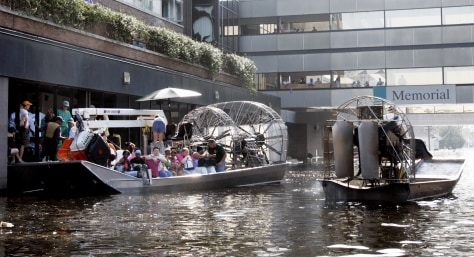
Article by: CURT SCHLEIER , Special to the Star Tribune
Updated: October 19, 2013 - 2:00 PM
A gripping, detailed examination of a New Orleans hospital in the aftermath of Katrina.
If “Five Days at Memorial” were a novel, critical reaction undoubtedly would be overwhelmingly negative: It is too far-fetched.
Sadly, it isn’t fiction. An expanded and updated version of a 2009 magazine article that won author Sheri Fink a Pulitzer Prize, the book describes in remarkable detail Hurricane Katrina’s impact on Memorial Medical Center, a New Orleans mainstay, “the place you went to ride out each hurricane.”
At the center of the narrative is the decision by certain staff members to euthanize patients who could not be evacuated. Murder, or heroism? Fink’s balanced account lets you decide.
Much has already been written about New Orleans at the time: the inadequate preparation by local authorities, followed by the almost criminally inept response by FEMA. The storm hit Monday, Aug. 29, 2005. Early the following morning, city power failed. At the hospital, auxiliary generators kicked in, but with limited power. There was no air conditioning.
About 2 a.m. on Wednesday, Aug. 31, the last of the hospital’s generators failed, stopping life-support machines. The stench of urine, overflowing diapers and feces-soiled garments suffused the swampy air, Fink writes.
Chaos in the hospital was overshadowed by chaos on the outside. Gunshots were heard and rumors spread that looters were about to invade the facility and raid the pharmacy.
Usually, disasters are contained. Even in New York on Sept. 11, 2001, emergency personnel and equipment were able to get to the scene. They worked long hours, but they were relieved; they had time to eat, shower and sleep.
Katrina was different, a natural disaster unprecedented in the United States. While a number of Memorial medical staffers left — some to accompany patients, others just to get out of there — many stayed the full five days before being forced to evacuate with a few patients left behind.
One doctor told Fink that he “knew [euthanasia] was technically a crime, but his alternative was to stay in this hostile, unnatural environment until they died on their own. Or leave them to die by themselves, perhaps eaten by animals.”
The second half of the book deals with events following the disaster. A doctor and two nurses were arrested and charged with four cases of second-degree murder. A grand jury refused to indict.
With global climate change increasing the likelihood of these large-scale natural disasters, the question becomes: Have we learned anything? And the answer is: yes and no.
Fink visited Memorial before Hurricane Isaac last August and found the hospital’s patients safely evacuated — but also found the hospital’s electrical switching equipment still located in the basement, the part of the building that is the first to flood.
Meanwhile, the Institute of Medicine, an advisory board of the National Academies, said: “Neither the law nor ethics support the intentional hastening of death, even in a crisis.”
Fink, who is a medical doctor and journalist, has written an important book that will make your blood boil no matter which side of the issue you support.
Curt Schleier is a book critic and EMT and a 40-year member of his volunteer ambulance corps.
Source
.
Sunday, May 12, 2013
Mother's Day Parade Shooting: At Least 12 Shot During New Orleans Festivities
New Orleans Mother's Day Parade Shooting, 12 Shot at Secondline by 2 Types of Weapon

Published on May 12, 2013
More massive killing this year now in New Orleans!
Pray for New Orleans for this tragedy.
5/12/13 - NEW ORLEANS (AP) - New Orleans police say that a dozen people have been shot during a Mother's Day second-line parade. Police Superintendent Ronal Serpas told reporters at least 12 people were shot during the parade in the city's 7th Ward. Police say the incident happened about 2 p.m. Sunday at the intersection of Frenchmen and Villere streets.
The Times-Picayune reports there were about 200 people at the event when gunfire erupted.
Serpas told reporters the victims include a 10-year-old who sustained a minor wound. WDSU-TV reports at least four people were in surgery and others had been taken to four area hospitals.
Nobody has been arrested. It's unclear what sparked the gunfire.
Police are said to be looking for three people in connection with the attack
Saturday, August 13, 2011
Jesuit to Serve New Orleans on Civil Service Commission

This appointment continues Fr. Wildes’ long-time record of service for the city. Following Hurricane Katrina, he played a key role in establishing the city’s Ethics Review Board and in setting up an independent Office of the Inspector General. Wildes currently sits on the Public Belt Railroad Commission.
“While I believe public service is always important, the challenges for post-Katrina New Orleans make public service even more vital today,” said Wildes. “New Orleans citizens are demanding, and rightly so, to live within a city government that functions transparently, efficiently and justly. I am honored to be able to assist in this effort.”
New Orleans Mayor Mitch Landrieu was supportive of Wildes’ nomination, explaining that reforming the civil service system is critical to improving the quality of service for the residents of New Orleans.
“Fr. Wildes has a distinguished record of service in the faith-based and academic communities and has taken on numerous positive reforms locally post-Katrina. I appreciate his willingness to help improve city government,” said Landrieu.
For more on Wildes’ new appointment, visit the Loyola University New Orleans website.
Source
.
Sunday, January 09, 2011
State, New Orleans activate emergency weather plans
Updated: Sunday, January 09, 2011, 4:45 PM
By Dennis Persica, The Times-Picayune

Associated Press archive
Gov. Bobby Jindal
Gov. Bobby Jindal declared a state of emergency Saturday night in advance of wintry weather headed into the state, and the city of New Orleans implemented its freeze plan to help homeless people find shelter.
Jindal's declaration helps the state better facilitate its response to parish reqests for assistance.
While the weather is expected to impact north and central Louisiana more seriously than the southern portion of the state, high winds forced the closure of the Causeway bridge across Lake Ponchartrain by about 3 p.m. Sunday.
New Orleans, meanwhile, implemented its freeze plan as of about 4:30 p.m. Friday.
The Governor's Office of Homeland Security and Emergency Preparedness's Crisis Action Team is monitoring for rain, sleet, snow and other possible hazardous conditions that could impact parts of Louisiana over the next couple of days. GOHSEP also remains in contact with the National Weather Service and parish officials in the event state resources are requested. GOHSEP personnel are located in each region to assist affected parishes.
Louisiana State Police has extra troopers on standby to monitor hazardous road conditions, the Department of Transportation and Development remains on standby to assist with the de-icing of roads and the Louisiana National Guard is also on standby and prepared to assist if needed, the governor's office said in a press release.
GOHSEP Director Mark Cooper urged residents to pay attention to local weather forecasts, especially advisories to stay off icy roads.
Under the New Orleans freeze plan, people needing shelter will be accepted at the following locations under the following conditions:
•The Salvation Army, 4500 South Claiborne Ave. - Is accepting males and females.
•The New Orleans Mission, 1130 Oretha C. Haley Blvd. - Will accept males and females starting at 7 p.m.
•The Ozanam Inn, 843 Camp St. - Will accept males only starting at 7 p.m.
•The Covenant House, 611 N. Rampart St. - Will accept males and females between the ages 16-21, their dependent children, and any female with dependent minor children starting at 7 p.m.
All shelters will be opened free of charge to persons seeking shelter during this period of inclement weather.
Source
.
Friday, September 03, 2010
Gay guide released for New Orleans

Gay guide released for New Orleans
Associated Press Reporting
There's now an official gay and lesbian destination guide for New Orleans. The Navigaytour will launch just in time for the 39th Annual Southern Decadence Festival, which welcomes on average 100,000 attendees for events over the Labor Day weekend.
The 32-page guide highlights events, attractions, restaurants, bars, clubs, accommodations and neighborhoods.
This year, the Navigaytour guide features the first-ever Gay History Trail Map for New Orleans.
Its website says Navigaytour guides are only produced in conjunction with official tourist bureaus and Chambers of Commerce. The first was created in 2004 for Philadelphia; the group also has guides to Los Angeles, Pittsburgh, Chicago and San Diego.
Source: http://www.wwl.com/Gay-guide-released-for-New-Orleans/8068017
Monday, August 30, 2010
TRANSCRIPT OF OBSERVANCE SPEECH AT XAVIER

 Xavier University of Louisiana - President of The United States Barack Obama Visits for the 5th Anniversary of Hurricane Katrina.
Creditline: Photo by Irving Johnson III
8/29/2010
ijohnson@xula.edu
.
.
OBAMA: Hello, everybody. It is good to be back. It is good to be back.
AUDIENCE MEMBER: It's good to have you back!
OBAMA: I'm glad. And due to popular demand, I decided to bring the first lady down here.
We have just an extraordinary number of dedicated public servants who are here. If you will be patient with me, I want to make sure that all of them are acknowledged.
First of all, you've got the governor of the great state of Louisiana - Bobby Jindal is here. We have the outstanding mayor of New Orleans, Mitch Landrieu. We have the better-looking and younger senator from Louisiana, Mary Landrieu. I believe that Senator David Vitter is here. David - right here. We have - hold on a second now - we've got Congressman Joe Cao is here. Congressman Charlie Melancon is here. Congressman Steve Scalise is here.
Secretary of Housing and Urban Development, who has been working tirelessly down here in Louisiana, Shaun Donovan. We've got our EPA Administrator Lisa Jackson here — homegirl. Administrator of FEMA Craig Fugate is here. The person who's heading up our community service efforts all across the country — Patrick Corvington is here. Louisiana's own Regina Benjamin, the surgeon general — a Xavier grad, I might add. We are very proud to have all of these terrific public servants here.
It is wonderful to be back in New Orleans, and it is a great honor ...
OBAMA: It is a great honor to be back at Xavier University. And I - it's just inspiring to spend time with people who've demonstrated what it means to persevere in the face of tragedy; to rebuild in the face of ruin.
I'm grateful to Jade for her introduction, and congratulate you on being crowned Miss Xavier. I hope everybody heard during the introduction she was a junior at Ben Franklin High School five years ago when the storm came. And after Katrina, Ben Franklin High was terribly damaged by wind and water. Millions of dollars were needed to rebuild the school. Many feared it would take years to reopen - if it could be reopened at all.
But something remarkable happened. Parents, teachers, students, volunteers, they all got to work making repairs. And donations came in from across New Orleans and around the world. And soon, those silent and darkened corridors, they were bright and they were filled with the sounds of young men and women, including Jade, who were going back to class. And then Jade committed to Xavier, a university that likewise refused to succumb to despair. So Jade, like so many students here at this university, embody hope. That sense of hope in difficult times, that's what I came to talk about today.
It's been five years since Katrina ravaged the Gulf Coast. There's no need to dwell on what you experienced and what the world witnessed. We all remember it keenly: water pouring through broken levees; mothers holding their children above the waterline; people stranded on rooftops begging for help; bodies lying in the streets of a great American city. It was a natural disaster but also a manmade catastrophe — a shameful breakdown in government that left countless men, and women, and children abandoned and alone.
And shortly after the storm, I came down to Houston to spend time with some of the folks who had taken shelter there. And I'll never forget what one woman told me. She said, "We had nothing before the hurricane. And now we've got less than nothing."
In the years that followed, New Orleans could have remained a symbol of destruction and decay; of a storm that came and the inadequate response that followed. It was not hard to imagine a day when we'd tell our children that a once vibrant and wonderful city had been laid low by indifference and neglect. But that's not what happened. It's not what happened at Ben Franklin. It's not what happened here at Xavier. It's not what happened across New Orleans and across the Gulf Coast. Instead this city has become a symbol of resilience and of community and of the fundamental responsibility that we have to one another.
And we see that here at Xavier. Less than a month after the storm struck, amidst debris and flood-damaged buildings, President Francis promised that this university would reopen in a matter of months. Some said he was crazy. Some said it couldn't happen. But they didn't count on what happens when one force of nature meets another. And by January — four months later — class was in session. Less than a year after the storm, I had the privilege of delivering a commencement address to the largest graduating class in Xavier's history. That is a symbol of what New Orleans is all about.
We see New Orleans in the efforts of Joycelyn Heintz, who's here today. Katrina left her house 14 feet underwater. But after volunteers helped her rebuild, she joined AmeriCorps to serve the community herself — part of a wave of AmeriCorps members who've been critical to the rebirth of this city and the rebuilding of this region. So today, she manages a local center for mental health and wellness.
We see the symbol that this city has become in the St. Bernard Project, whose founder Liz McCartney is with us. This endeavor has drawn volunteers from across the country to rebuild hundreds of homes throughout St. Bernard Parish and the Lower Ninth Ward.
I've seen the sense of purpose people felt after the storm when I visited Musicians' Village in the Ninth Ward back in 2006. Volunteers were not only constructing houses; they were coming together to preserve the culture of music and art that’s part of the soul of this city — and the soul of this country. And today, more than 70 homes are complete, and construction is underway on the Ellis Marsalis Center for Music.
We see the dedication to the community in the efforts of Xavier grad Dr. Regina Benjamin, who mortgaged her home, maxed out her credit cards so she could reopen her Bayou la Batre clinic to care for victims of the storm — and who is now our nation's Surgeon General.
And we see resilience and hope exemplified by students at Carver High School, who have helped to raise more than a million dollars to build a new community track and football field — their "Field of Dreams" — for the 9th Ward.
So because of all of you — all the advocates, all the organizers who are here today, folks standing behind me who've worked so hard, who never gave up hope — you are all leading the way toward a better future for this city with innovative approaches to fight poverty and improve health care, reduce crime, and create opportunities for young people. Because of you, New Orleans is coming back.
And I just came from Parkway Bakery and Tavern. Five years ago, the storm nearly destroyed that neighborhood institution. I saw the pictures. Now they're open, business is booming, and that's some good eats. I had the shrimp po-boy and some of the gumbo. But I skipped the bread pudding because I thought I might fall asleep while I was speaking. But I've got it saved for later.
Five years ago, many questioned whether people could ever return to this city. Today, New Orleans is one of the fastest growing cities in America, with a big new surge in small businesses. Five years ago, the Saints had to play every game on the road because of the damage to the Superdome. Two weeks ago, we welcomed the Saints to the White House as Super Bowl champions. There was also food associated with that. We marked the occasion with a 30-foot po-boy made with shrimp and oysters from the Gulf. And you'll be pleased to know there were no leftovers.
Now, I don't have to tell you that there are still too many vacant and overgrown lots. There are still too many students attending classes in trailers. There are still too many people unable to find work. And there are still too many New Orleanians, folks who haven't been able to come home. So while an incredible amount of progress has been made, on this fifth anniversary, I wanted to come here and tell the people of this city directly: My administration is going to stand with you — and fight alongside you — until the job is done. Until New Orleans is all the way back, all the way.
When I took office, I directed my Cabinet to redouble our efforts, to put an end to the turf wars between agencies, to cut the red tape and cut the bureaucracy. I wanted to make sure that the federal government was a partner — not an obstacle — to recovery here in the Gulf Coast. And members of my Cabinet — including EPA administrator Lisa Jackson, who grew up in Pontchartrain Park — they have come down here dozens of times. Shaun Donovan has come down here dozens of times. This is not just to make appearances. It's not just to get photo ops. They came down here to listen and to learn and make real the changes that were necessary so that government was actually working for you.
So for example, efforts to rebuild schools and hospitals, to repair damaged roads and bridges, to get people back to their homes — they were tied up for years in a tangle of disagreements and byzantine rules. So when I took office, working with your outstanding delegation, particularly Senator Mary Landrieu, we put in place a new way of resolving disputes. We put in place a new way of resolving disputes so that funds set aside for rebuilding efforts actually went toward rebuilding efforts. And as a result, more than 170 projects are getting underway — work on firehouses, and police stations, and roads, and sewer systems, and health clinics, and libraries, and universities.
We're tackling the corruption and inefficiency that has long plagued the New Orleans Housing Authority. We're helping homeowners rebuild and making it easier for renters to find affordable options. And we're helping people to move out of temporary homes. You know, when I took office, more than three years after the storm, tens of thousands of families were still stuck in disaster housing — many still living in small trailers that had been provided by FEMA. We were spending huge sums of money on temporary shelters when we knew it would be better for families, and less costly for taxpayers, to help people get into affordable, stable, and more permanent housing. So we've helped make it possible for people to find those homes, and we've dramatically reduced the number of families in emergency housing.
On the health care front, as a candidate for President, I pledged to make sure we were helping New Orleans recruit doctors and nurses, and rebuild medical facilities — including a new veterans hospital. Well, we have resolved a long-standing dispute — one that had tied up hundreds of millions of dollars — to fund the replacement for Charity Hospital. And in June, Veterans Secretary Ric Shinseki came to New Orleans for the groundbreaking of that new VA hospital.
In education, we've made strides as well. As you know, schools in New Orleans were falling behind long before Katrina. But in the years since the storm, a lot of public schools opened themselves up to innovation and to reform. And as a result, we're actually seeing rising achievement, and New Orleans is becoming a model of innovation for the nation. This is yet another sign that you're not just rebuilding — you're rebuilding stronger than before. Just this Friday, my administration announced a final agreement on $1.8 billion dollars for Orleans Parish schools. This is money that had been locked up for years, but now it's freed up so folks here can determine best how to restore the school system.
And in a city that's known too much violence, that's seen too many young people lost to drugs and criminal activity, we've got a Justice Department that's committed to working with New Orleans to fight the scourge of violent crime, and to weed out corruption in the police force, and to ensure the criminal justice system works for everyone in this city. And I want everybody to hear — to know and to hear me thank Mitch Landrieu, your new mayor, for his commitment to that partnership.
Now, even as we continue our recovery efforts, we're also focusing on preparing for future threats so that there is never another disaster like Katrina. The largest civil works project in American history is underway to build a fortified levee system. And as I — just as I pledged as a candidate, we're going to finish this system by next year so that this city is protected against a 100-year storm. We should not be playing Russian roulette every hurricane season. And we're also working to restore protective wetlands and natural barriers that were not only damaged by Katrina — were not just damaged by Katrina but had been rapidly disappearing for decades.
In Washington, we are restoring competence and accountability. I am proud that my FEMA Director, Craig Fugate, has 25 years of experience in disaster management in Florida. He came from Florida, a state that has known its share of hurricanes. We've put together a group led by Secretary Donovan and Secretary Napolitano to look at disaster recovery across the country. We're improving coordination on the ground, and modernizing emergency communications, helping families plan for a crisis. And we're putting in place reforms so that never again in America is somebody left behind in a disaster because they're living with a disability or because they're elderly or because they're infirm. That will not happen again.
Finally, even as you've been buffeted by Katrina and Rita, even as you've been impacted by the broader recession that has devastated communities across the country, in recent months the Gulf Coast has seen new hardship as a result of the BP Deepwater Horizon oil spill. And just as we've sought to ensure that we are doing what it takes to recover from Katrina, my administration has worked hard to match our efforts on the spill to what you need on the ground. And we've been in close consultation with your governor, your mayors, your parish presidents, your local government officials.
And from the start, I promised you two things. One is that we would see to it that the leak was stopped. And it has been. The second promise I made was that we would stick with our efforts, and stay on BP, until the damage to the Gulf and to the lives of the people in this region was reversed. And this, too, is a promise that we will keep. We are not going to forget. We're going to stay on it until this area is fully recovered.
That's why we rapidly launched the largest response to an environmental disaster in American history — 47,000 people on the ground, 5,700 vessels on the water — to contain and clean up the oil. When BP was not moving fast enough on claims, we told BP to set aside $20 billion in a fund — managed by an independent third party — to help all those whose lives have been turned upside down by the spill.
And we will continue to rely on sound science, carefully monitoring waters and coastlines as well as the health of the people along the Gulf, to deal with any long-term effects of the oil spill. We are going to stand with you until the oil is cleaned up, until the environment is restored, until polluters are held accountable, until communities are made whole, and until this region is all the way back on its feet.
So that's how we're helping this city, and this state, and this region to recover from the worst natural disaster in our nation's history. We're cutting through the red tape that has impeded rebuilding efforts for years. We're making government work better and smarter, in coordination with one of the most expansive nonprofit efforts in American history. We're helping state and local leaders to address serious problems that had been neglected for decades — problems that existed before the storm came, and have continued after the waters receded — from the levee system to the justice system, from the health care system to the education system.
And together, we are helping to make New Orleans a place that stands for what we can do in America — not just for what we can't do. Ultimately, that must be the legacy of Katrina: not one of neglect, but of action; not one of indifference, but of empathy; not of abandonment, but of a community working together to meet shared challenges.
The truth is, there are some wounds that have not yet healed. And there are some losses that can't be repaid. And for many who lived through those harrowing days five years ago, there's searing memories that time may not erase. But even amid so much tragedy, we saw stirrings of a brighter day. Five years ago we saw men and women risking their own safety to save strangers. We saw nurses staying behind to care for the sick and the injured. We saw families coming home to clean up and rebuild — not just their own homes, but their neighbors' homes, as well. And we saw music and Mardi Gras and the vibrancy, the fun of this town undiminished. And we've seen many return to their beloved city with a newfound sense of appreciation and obligation to this community.
And when I came here four years ago, one thing I found striking was all the greenery that had begun to come back. And I was reminded of a passage from the book of Job: "There is hope for a tree if it be cut down that it will sprout again, and that its tender branch will not cease." The work ahead will not be easy, and there will be setbacks. There will be challenges along the way. But thanks to you, thanks to the great people of this great city, New Orleans is blossoming again.
Thank you, everybody. God bless you. And God bless the United States of America.
.
Source: http://www.xula.edu/mediarelations/obama_katrinavisit_script.php
.
P.S.
...
All the honored guests that President Obama acknowledged in his first paragraph are all Roman Catholics. Go figure! What a lovely convenient arrangement?
BTW: Have you ever wondered why Louisiana is the only state in the union that divides its territory politically into Parishes, instead of Counties like the rest of the country?
All Catholics:
Louisiana Governor Bobby Jindal
mayor of New Orleans Mitch Landrieu
senator from Louisiana, Mary Landrieu
Senator (LA) David Vitter
Congressman Charlie Melancon
Congressman Steve Scalise
Congressman (LA) Joe Cao [Joseph] - as in Ordo ab Cao):
Cao almost became a Roman Catholic priest. He graduated from Jersey Village High School in Houston. He then earned a bachelor's degree in physics at Baylor University in Waco, Texas. He was a Jesuit seminarian for six years, but abandoned it, realizing it was not his vocation.[15] He earned his master's degree in philosophy from Fordham University and, in 2000, his J.D. from Loyola University School of Law in New Orleans. While in law school, he also taught undergraduate courses in philosophy at Loyola.[16] http://en.wikipedia.org/wiki/Joseph_Cao
.

Wednesday, June 23, 2010
Vatican, U.S. bishops enlarge dialogue with Catholic Church media

From left is Archbishop Richard Smith of Edmonton, Alberta; Archbishop Gregory Aymond of New Orleans; Bishop Ronald P. Herzog of Alexandria, La; and Bishop Thomas G. Doran of Rockford, Ill.
June 9th, 2010
By Rick DelVecchio
“To walk with man, without condemning, without judging...offering what we have in our heart that is Jesus, because we perceive that only in this encounter with Jesus man can find his happiness.”
That is the service that Catholic media can perform for the world today, Archbishop Claudio Maria Celli, the Vatican’s top communications man, told Catholic media professionals.
Catholic media are important in the mission of the Church to evangelize but play a dual role, Archbishop Celli said in a question-and-answer session with a small group of journalists June 3 during the 2010 Catholic Media Convention in New Orleans.
They serve not only to teach but also to be in dialogue with the world, he said.
Such dialogue is more important today than ever, with the Church confronting not only a critical secular press but also the explosion of social media and the resulting disruption of old patterns of sharing knowledge, said Archbishop Celli, who is president of the Pontifical Council for Social Communications in Rome.
Archbishop Celli told a parable about a musician whose guitar was stolen but who responded that “you can’t steal the music in my heart.”
“Here is communication for us: what is the music that you have in your heart and how do you communicate with others?” Archbishop Celli asked. “This is why the Church and its media cannot talk only to the Catholic community, because I think the Church has in its heart a music that can be understood by the mankind of today.
“I think we have something inside the Church that can really respond to the suffering of humanity today,” he said, “and we have to give it. This is communication for me.”
Archbishop Celli confessed that he is in the process of learning how this mission should be adapted for the digital age, where new technologies are bringing about a new culture. He said the Church must press forward with its prophetic role in the development of society, but cautioned that there is great variety in Church needs and means between the U.S. and Africa, for example, and between print and digital forms.
Archbishop Celli noted that a friend, a priest in Madrid, recently told him that more people visit the priest’s website than attend Mass. Yet, in Latin America most Church organizations do not have websites, he said.
He also noted that the balance between the catechetical, the devotional and dialogue in Church communication varies from place to place according to culture and resources.
Archbishop Celli is inviting each episcopal body to send three Church communicators – two from the print side, one from the Internet – to an international conference in Rome in October.
“I think we need to see what is the meaning of the Catholic press today,” he said, adding that the Vatican is looking for points of reference and does not want to impose solutions. “Inside the Church, we must discover what is the meaning of the Internet.”
Archbishop Celli said he is also dwelling on the question of how will meditation, how will prayer, survive in the digital age?
“The new generations are afraid to live in a moment of silence,” he said.
He noted that many directors of seminaries are switching off wireless service for their seminarians – “not only forbidding them to use social networks but teaching them how to use them.”
During the convention in New Orleans, U.S. bishops opened a dialogue with Catholic media professionals about their respective roles. A panel of four bishops candidly addressed press questions about the relationship between bishops and the staffs of Church media organizations. A common theme that emerged was that although bishops and communicators must be partners in evangelization, they have separate roles to play.
The session, the first of its kind, was on the last day of the 2010 Catholic Media Convention, sponsored by the Catholic Press Association and the Catholic Academy for Communication Arts Professionals. Helen Osman, secretary for communications at the bishops’ conference, opened the dialogue.
Those participating in the panel were Archbishop Richard Smith of Edmonton, Alberta; Archbishop Gregory Aymond of New Orleans; Bishop Ronald Herzog of Alexandria, La., and Bishop Thomas Doran of Rockford, Ill.
“There needs to be a distinction between reporting the news, which in some ways can be easier than handing on Church teaching,” Archbishop Aymond said. “In terms of handing on Church teaching, the media has a powerful responsibility to help us in terms of not telling people what to do but in helping them inform their conscience.”
The separate role of bishops and Church media is an important matter but not the crucial one, Archbishop Smith said. “In the context of evangelization, it becomes the question of how do we best collaborate with one another,” he said.
Archbishop Aymond said the U.S. bishops realize they could be better communicators and must do so by responding more quickly to reports in the secular media, and responding with one voice.
“Those are two challenges that we are aware of and that we must face if we can be credible,” he said
But the Church must resist forces that would divide it, Bishop Doran said.
“The problem is that we can’t break up the Church into factions,” he said, “much as some would have us do. We have a constant exhortation in the New Testament, one heart and one mind, and we have to strive for that.”
Auxiliary Bishop Gabino Zavala of Los Angeles gave a talk on the elements of a faithful Catholic media. Catholic media must stand apart from the secular media with their tendency to attack, he said.
“I also do not think that we should go to the other extreme and simply say that faithful Catholic media organizations are those who engage in apologetics to defend bishops at all costs,” he said. “That is too simplistic and does not respect the intelligence of Catholics in North America. They deserve a Catholic media that takes a more nuanced perspective.”
From June 11, 2010 issue of Catholic San Francisco.
Tuesday, February 23, 2010
Schedule for Mountain Media Ministries Spring Seminar trip

In December of 2007 we presented Country Living Seminars at four SDA churches in California (Hillcrest, Placerville, Hollister, and Fontana).Then in February and March of 2008 we took another trip where we presented these seminars at three SDA churches (Sacramento Central, Templeton Hills, and Placerville again). Then in the spring of 2008 we visited the Huntington and Point Pleasant SDA churches in WV; Manhattan SDA Church (NYC); Rainsville SDA Church in AL; Greater Atlanta SDA Church in GA; Talge Hall Chapel, Southern Adventist University; and South Orlando SDA Chruch in FL; as well as other locations that were arranged in North Carolina and Michigan.In August of 2008 we presented these seminars at the Pasadena SDA Church, the Lake Tahoe Campmeeting, and the Mountain View Japanese SDA Church (all in California).
Then the fall/winter of 2008, we presented seminars at the Sulphur SDA Church (OK), Evansville West Side SDA Church (IN), Nashville First SDA Church (TN), Portsmouth SDA Church (OH), Mt. Pisgah SDA Church (Kennesaw, GA), Piedmont SDA Church (AL), Cedar Ridge SDA Church (Georgetown, TN), McDonald Road SDA Church (Collegedale, TN),Palmetto SDA Church (FL), West Columbia SDA Church (SC), Pisgah SDA Church (Bryan's Road, MD), Ebenezer SDA Church (Brooklyn, NY), and the Johnston SDA Church (RI).
In the spring of 2009, we presented Country Living Seminars at Mt. Shasta SDA Church (CA), Magalia SDA Church (CA), Thunderbird SDA Church (Scottsdale, AZ), Casa Grande SDA Church (AZ), Glendale SDA Church (AZ), S. Orlando SDA Church (FL) again, Dalton SDA Church (GA), Floral Crest SDA Church (AL), Wheaton SDA Church (MD), CPC SDA Church (Alexandria, VA), Woodbury SDA Church (NJ), & Liberty SDA Church (Baltimore, MD).
During the fall of 2009, we presented Country Living Seminars at Roseburg SDA Church (OR), Sacramento Central SDA Church (again), Leoni Meadows Camp (N. CA), Prescott SDA Church (AZ), Arbuckle View SDA Church (OK), Willow Springs, MO, Middletown SDA Church (NY), Seabrook SDA Church (MD), Fort Walton Beach SDA Church (FL), Pompano Beach SDA Church (FL), Raleigh SDA Church (Memphis, TN), McDonald Road SDA Church (Collegedale, TN - again), and Wimbish Road SDA Church (Macon, GA).
SPRING 2010 TRIP - We are scheduling our upcoming trip for the spring of 2010. Please contact us ASAP If you or your church/group are interested in having us conduct seminars in your area.
March 13 & 14 - Brooklyn, NY - Brooklyn SDA Church
March 20 & 21 - Roxbury, MA (Boston area) - Salem Hispanic SDA Church
March 27 & 28 - Olney, MD (DC area) - Olney SDA Church
April 10 & 11 - Huntsville, AL - Oakwood University Campus
April 12 - Marrero, LA (New Orleans area) - Marrero SDA Church
April 17 - Fontana, CA (L.A. area) - Fontana SDA Church
April 20 - Palm Desert, CA - Palm Desert Oasis SDA Church
April 24 & 25 - Santa Cruz, CA - Santa Cruz SDA Church
April 26-29 - Leoni Meadows Camp, CA - Country Living/Gardening Seminars & Workshops
May 1 & 2 - San Francisco, CA - San Francisco Japanese SDA Church
June 12 & 13 - Gladstone, OR (Portland area) - Gladstone Park SDA Church
.
Thursday, January 07, 2010
Disney movie has Loyola music connections
By
Published: Wednesday, December 16, 2009
Updated: Wednesday, December 16, 2009

(AP Photo/Disney, file)
In this film publicity image released by Disney, Princess Tiana, voiced by Anika Noni Rose, right, is shown with frog Prince Naveen, voiced by Bruno Campos, in a scene from the animated film, "The Princess and the Frog." The film was nominated for a Golden Globe Award for best animated feature film, Tuesday, Dec. 15, 2009. The Golden Globe awards will be held Jan. 17 in Beverly Hills, Calif.
NEW ORLEANS (AP) — The latest release from Walt Disney Animation studios — the Princess and the Frog — isn't just set in New Orleans. It also features music by a choir organized by a staffer from Loyola University in New Orleans.
The Pinnacle Gospel Choir, organized by Loyola staffer Lyle E. Henderson, provides background vocals for a song in the film.
Loyola notes in a news release that the film also features Grammy Award-winning jazz trumpeter Terence Blanchard, artistic director of the Thelonious Monk Institute of Jazz Performance at Loyola.
The Princess and the Frog opened in theaters on Dec. 11.
.
Source:http://www.loyolamaroon.com/ap-wire/disney-movie-has-loyola-music-connections-1.2125282
.


Friday, November 06, 2009
Investigators Raid ACORN New Orleans Office
POSTED: 1:27 pm CST November 6, 2009
UPDATED: 1:37 pm CST November 6, 2009

NEW ORLEANS -- Investigators with the Louisiana Attorney General's Office raided the New Orleans ACORN office Friday in connection with embezzlement and tax fraud allegations.
Assistant Attorney General David Caldwell said the office got a tip that some employee computers may be missing. Investigators executed a search warrant and hauled off laptops and hard drives to make copies of information stored on the computers.
Caldwell said the machines would be returned at a later date.
ACORN officials had no comment Friday afternoon.
Source: http://www.wdsu.com/news/21542857/detail.html#
.