Showing posts with label M. Shedlock. Show all posts

Monday, December 31, 2012

Poison Pill and Gold Debate


Sunday, December 30, 2012 10:15 PM


In Ho Hum - Fiscal Cliff Deal Stalls - Republicans Offer More and More Concessions; Poison Pill Nonsense I stated ...

"The real poison pill is allowing Social Security and Medicare costs to escalate unabated. Does anyone in either party want to admit the truth? ... the best hope still remains that all compromises fail."

The above thought prompted Uncle Frank to respond in a comment "Mish relishes chaos and financial ruin for this country so his gold holdings shoot-up in value. Everyone has an ulterior motive you know."

Ulterior Motives?

Since I get accused of this sort of thing quite frequently, please let me point out a few things:


Gold has been sinking, as it should, if Congress is fiscally prudent.
Government Should be Prudent
Government Won't Be Prudent
Should Congress be fiscally prudent (and the fiscal cliff is not close to being fiscally prudent), I would change my stance on gold in one second flat.

Nonetheless, should Congress fail to address the Fiscal Cliff, I would expect the exact opposite of what Uncle Frank suggests.

In short, regardless of my personal beliefs regarding gold (that one would be prudent to buy and hold gold), I actually advocate government and Fed policies that are contrary to my recommendations.

My reasons are easily explained:


Neither the Fed nor the government gives a darn about what is fiscally prudent.
Both the Fed and Congress are highly likely to debase currency, causing gold to rise, even if I think that is bad economic and fiscal policy, which of course I do.
Thus the accusations of Uncle Frank, and countless others before him are 100% baseless. Should Congress actually do what I expect, I think it would not be good for gold.

I recommend governmental actions on the basis of policy merit alone, not based on my stock market positioning. I find it very sad that few others do the same.

Mike "Mish" Shedlock
http://globaleconomicanalysis.blogspot.com


.

Friday, October 07, 2011

Payrolls +103,000 Jobs , 444,000 Part-Time on Household Survey

Friday, October 07, 2011 10:25 AM


Jobs Report at a Glance


Here is an overview of September Jobs Report, today's release.

  • US Payrolls +103,000
  • 45,000 Striking Workers Return
  • Net effect is +58,000 jobs
  • US Unemployment Rate Flat at 9.1%
  • Participation Rate +.2 to 64.2%
  • Actual number of Employed (by Household Survey) rose by 398,000
  • Unemployment rose by 25,000
  • Those not in the labor force dropped by 224,000
  • Civilian population rose by 200,000,
  • Civilian Labor Force rose by 423,000
  • Average Weekly Workweek rose .1 hours to 34.3 hours
  • Average Private Hourly Earnings rose 3 Cents 10 $19.52
  • Government employment decreased by 34,000

Recall that the unemployment rate varies in accordance with the Household Survey not the reported headline jobs number, and not in accordance with the weekly claims data.

For a change, the labor force actually rose today. This is a welcome sign. However, were it not for people dropping out of the labor force for the past two years, the unemployment rate would be well over 11%.

September 2011 Jobs Report

Please consider the Bureau of Labor Statistics (BLS) September 2011 Employment Report.

Nonfarm payroll employment edged up by 103,000 in September, and the unemployment rate held at 9.1 percent, the U.S. Bureau of Labor Statistics reported today. The increase in employment partially reflected the return to payrolls of about 45,000 telecommunications workers who had been on strike in August. In September, job gains occurred in professional and business services, health care, and construction. Government employment continued to trend down.

Unemployment Rate - Seasonally Adjusted


Nonfarm Employment - Payroll Survey - Annual Look - Seasonally Adjusted


Notice that employment is lower than it was 10 years ago.

Nonfarm Employment - Payroll Survey - Monthly Look - Seasonally Adjusted


click on chart for sharper image

Between January 2008 and February 2010, the U.S. economy lost 8.8 million jobs.

In the last year of the weakest recovery on record, 2+ years old, the economy averaged about 116,000 jobs a month.

Since April, the economy has averaged 72,000 jobs a month, a downright pathetic number.

Statistically, 127,000 jobs a month is enough to keep the unemployment rate flat.

Nonfarm Employment - Payroll Survey Details - Seasonally Adjusted


Average Weekly Hours


Index of Aggregate Weekly Hours


Average Hourly Earnings vs. CPI


"Success" of QE2

Over the past 12 months, average hourly earnings have increased by 1.9 percent. The consumer price index for all urban consumers (CPI-U) was up 3.8 percent over the year ending in August.

Not only are wages rising slower than the CPI, there is also a concern as to how those wage gains are distributed.

BLS Birth-Death Model Black Box

The BLS Birth/Death Model is an estimation by the BLS as to how many jobs the economy created that were not picked up in the payroll survey.

The BLS has moved to quarterly rather than annual adjustments to smooth out the numbers.

For more details please see Introduction of Quarterly Birth/Death Model Updates in the Establishment Survey

In recent years Birth/Death methodology has been so screwed up and there have been so many revisions that it has been painful to watch.

The Birth-Death numbers are not seasonally adjusted while the reported headline number is. In the black box the BLS combines the two coming out with a total.

The Birth Death number influences the overall totals, but the math is not as simple as it appears. Moreover, the effect is nowhere near as big as it might logically appear at first glance.

Do not add or subtract the Birth-Death numbers from the reported headline totals. It does not work that way.

Birth/Death assumptions are supposedly made according to estimates of where the BLS thinks we are in the economic cycle. Theory is one thing. Practice is clearly another as noted by numerous recent revisions.

Birth Death Model Adjustments For 2011


BLS Back in Outer-Space

Do NOT subtract the Birth-Death number from the reported headline number. That is statistically invalid.

I am nearly in shock over the negative BLS adjustment this month. The two revision months historically have been January and July. We have not see a negative number other than January or July for as long as I can remember.

Household Data


click on chart for sharper image

In the last year, the civilian population rose by 1,749,000. Yet the labor force dropped by 107,000. Those not in the labor force rose by 1,856,000.

Were it not for people dropping out of the labor force, the unemployment rate would be well over 11%.

Table A-8 Part Time Status


click on chart for sharper image

A year ago there were 8.6 million people who wanted a full-time job but could only find part-time work. In the last month, the number of people working part-time for economic reasons jumped by 444,000.

Part-time jobs are volatile but this is a huge jump.

Table A-15

Table A-15 is where one can find a better approximation of what the unemployment rate really is.


click on chart for sharper image

Distorted Statistics

Given the total distortions of reality with respect to not counting people who allegedly dropped out of the work force, it is hard to discuss the numbers.

The official unemployment rate is 9.1%. However, if you start counting all the people that want a job but gave up, all the people with part-time jobs that want a full-time job, all the people who dropped off the unemployment rolls because their unemployment benefits ran out, etc., you get a closer picture of what the unemployment rate is. That number is in the last row labeled U-6.

While the "official" unemployment rate is an unacceptable 9.1%, U-6 is much higher at 16.5%. The jump in U-6 this month is from part-time workers.

Things are much worse than the reported numbers would have you believe. Moreover, the unemployment rate is barely better than it was a year ago. It would actually be worse than a year ago were it not for people dropping out of the labor force.

Mike "Mish" Shedlock
http://globaleconomicanalysis.blogspot.com


Thursday, June 17, 2010

Spain to Use $30 Billion "Fund for Orderly Bank Restructuring"


Thursday, June 17, 2010


Spain to Use $30 Billion "Fund for Orderly Bank Restructuring"; Spain's Borrowing Costs Rise; Is an EU or IMF Bailout of Spain in the Works?


Inquiring minds are wondering if an EU or IMF orchestrated bailout of Spain is in the works. Spain denies it, but rumors of secret talks are running rampant.

Please consider Spanish debt wilts amid €250bn rescue plan confusion


European debt markets remain under high stress on persistent reports that Spain is in secret talks with EU officials and the International Monetary Fund for a support package of up to €250bn (£208bn), the largest rescue in history.

The spreads on 10-year Spanish bonds jumped to a post-EMU high of 224 basis points above German Bunds as traders brace for a crucial auction by Madrid on Thursday. The relentless rise in bond yields replicates the pattern seen in Greece at the onset of crisis. Spain must raise €25bn of debt in a cluster of auctions in July.

"We're in a dangerous and stressful situation," said Gary Jenkins, a credit expert at Evolution Securities. "Spain is a big enough borrower to wipe out the EU's rescue fund."

Elena Salgado, Spain's finance minister, reacted angrily to a report in the Spanish daily El Economista claiming that the support plans are well advanced.

"It has been denied by the Spanish government, by the European Commission, and by the IMF. How much more can we deny it?" she said.

The story refuses to die, however. Three German newspapers have run similar stories over recent days, citing German sources. The markets are convinced that some form of contingency planning is underway.

"In our view there is absolutely no doubt that a backstop facility for Spain will be put in place should stress in the system remain," said Silvio Peruzzo, an economist at RBS,
Concern Over Spanish Bank Stress Tests

Bloomberg reports Yen Gains, Euro Weakens on Concern Europe Crisis to Slow Growth

The euro weakened against most major currencies after Spain’s central bank said yesterday it planned to publish the results of stress tests carried out on lenders to counter speculation it needs international aid. Last month the EU announced a 750 billion-euro ($920 billion) rescue mechanism to stem contagion from Greece as the risk premiums on Spanish and Portuguese bonds surged.

World Bank President Robert Zoellick said yesterday there are “challenges” ahead in Europe even if the rescue packages put together by authorities have “bought time.”

EU leaders will meet in Brussels to discuss the region’s economies and the so-called stability and growth pact. The Bank of Spain plans to make the findings of its stress tests public to provide markets with full knowledge of the state of the country’s banking system, Miguel Angel Fernandez Ordonez, the central bank governor, said yesterday in a speech.

“Investors continue to express concerns over Spain, especially whether the government can commit enough funds to ring-fence the banking sector,” Brian Kim, a currency strategist at UBS AG in Stamford, Connecticut, wrote in a research note yesterday. The euro is likely to weaken to $1.15 in three months, he said.
RBS Sticks With IMF Bailout Idea After Spain's Denial

RBS Analysts Say Spain Rescue Credit Line From IMF Still Likely.
Some form of credit support for Spain from the European Commission and International Monetary Fund is still likely, even after a report of such a plan was denied yesterday, Royal Bank of Scotland analysts said.

Such a plan may become necessary as the government faces around 25 billion euros in bond redemptions in the next month, and those may not be easily refinanced given how bond yields have risen, they wrote. RBS said Spain could receive an IMF Flexible Credit Line similar to those received by Poland, Mexico and Colombia.
Spain Borrowing Costs Rise at Auction of 10-Year Debt

Tick, Tock. Bloomberg reports Spain Borrowing Costs Rise at Auction of 10-Year Debt
Spain paid an average yield of 4.864 percent at an auction of 10-year debt, compared with a rate of 4.045 percent at an auction on May 20, the Bank of Spain said today.
That is a rather hefty increase in rates. Spain will be in trouble if that continues for several months.

Spain to Use $30 Billion "Fund for Orderly Bank Restructuring"

Inquiring minds are reading Spain may use 30 billion euros for bank restructuring

Spain may use as much as 30 billion euros of its Fund for Orderly Bank Restructuring (FROB) to cover the financing needs of its banks, the Economy Minister Elena Salgado said on Thursday. The FROB, created to help the banking sector, can issue up to 99 billion euros to aid credit institutions.

"(The fund) will be more than sufficient for all of banks' needs," Salgado said during a television interview.

"It's going to be much less than (90 billion euros). These figures have to come from the Bank of Spain, but I would estimate, with total certainty, that it will be less than one third."
$30 billion may buy some time for a while.

However, odds are very good that Spain will need a bailout from the EU, IMF, or both. Then what?

Eventually Greece and Spain are likely to default and Italy is waiting in the wings.

Good luck with that.

Mike "Mish" Shedlock


.

Sunday, December 06, 2009

Fractional Reserve Lending Constitutes Fraud


Monday, October 05, 2009

Fractional Reserve Lending Constitutes Fraud


I was asked to reply to Karl Denninger's Rebuttal To Mish On Fractional Reserve Lending.

Here goes: Denninger does not phrase my arguments correctly on points 2-5, however he thinks they are immaterial so the points are somewhat moot. The crux of the matter is not whether assets are backed by collateral as Denninger suggests, but rather whether the same money has been lent out multiple times.

Let's follow through with a real life example.

Fannie Mae makes a loan of $1,000,000. Let's be more than reasonably fair and assume Fannie Mae issued bonds for the entire amount, not borrowing a single cent into existence. So far there is no fraud.

$1,000,000 goes to the home builder. That home builder deposits $1,000,000 into a Bank of America checking account. Ignoring sweeps that would allow Bank of America to loan out every cent, let's assume BofA keeps 10% in reserves and lends out $900,000 to a new furniture store on the corner strip mall.

The furniture store owner buys $900,000 of furniture from a wholesaler. The wholesaler deposits $900,000 into a Citigroup checking account. Again, ignoring the likelihood Citigroup sweeps the whole amount into a savings account thereby able to lend out the entire amount (savings accounts have no reserve requirements), let's assume that Citigroup keeps 10% in reserves and lends out $810,000 to a High Roller who takes out a home equity loan on his house that is supposedly worth $3,000,000.

High Roller buys a yacht from a boating manufacturer for $810,000. The yacht manufacturer deposits $810,000 in a checking account at Wells Fargo. Following the same pattern, Wells Fargo keeps 10% in reserves and lends out $729,000 to a plumbing supply company, because home sales are going gangbusters and the plumbing supplier needs more supplies.

I think you can see where this is headed.

On the original $1,000,000 this is what FRL allows to be lent out.

$900,000
$810,000
$729,000
$656,000
$590,000
$531,000
$478,000
$430,000
$387,000
....

See where this is going?
I am going to arbitrarily stop the chain right there, but the total so far is $5,511,000 out of $1,000,000 was lent out.

Karl claims this is not fraudulent because "it's all backed by assets".

Well for starters the value of those assets backing the loans is questionable. Clearly it does not take much of a decline in asset prices to cause some major writeoffs. But let's get to the crux of the matter with a simple example.

Imagine I had gold depository with $1,000,000 in gold and lent out receipts for $10,000,000 in gold for people to buy things. Think that is not fraud whether or not those receipts were backed by pledges (assets) to pay back the gold?

Of course it's fraud, and so is lending out $5,511,000 when only $1,000,000 really exists. By lending out more money or gold than exists, asset prices reach unsustainably high levels before they crash. Sound familiar?

This is where the Libertarian argument "it's OK if two people agree" falls flat. It is not OK because it cheapens the dollar, thereby robbing everyone saving dollars via theft of inflation (making those dollars worth less over time).

Greenspan compounded this already massive problem in 1994 by allowing banks to "sweep" checking accounts (unknown to customers) into savings accounts. This made the problem worse because savings accounts have no reserve requirements at all.

Is it any wonder credit exploded?

For more on the case against Fractional Reserve Lending please see

Fractional Reserve Banking by Murray Rothbard.
Case Against The Fed by Murray


Please click on the second link above and read it.

On page 46 of the book Case Against The Fed Rothbard says "By the very nature of fractional Reserve Lending, banks cannot honor all its contracts".

Is that not fraud?

Search that book for the word "fractional" and you will find more arguments worthy of consideration.

Fractional Reserve Lending constitutes fraud. The case is irrefutable.

Mike "Mish" Shedlock
http://globaleconomicanalysis.blogspot.com


Source: http://globaleconomicanalysis.blogspot.com/2009/10/fractional-reserve-lending-constitutes.html


.

Monday, November 09, 2009

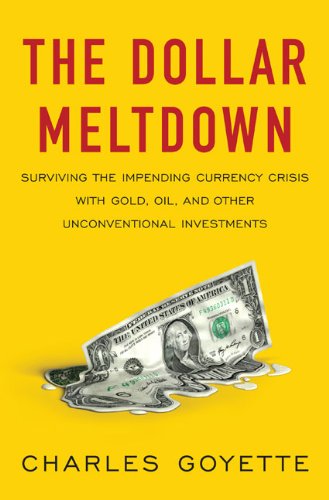
The Dollar Meltdown


I had the pleasure of reading a final finished copy of The Dollar Meltdown by Charles Goyette this past week.
.
Congressman Ron Paul offers an opinion on the front cover to which I certainly concur: "Goyette does a great job explaining why America faces a looming financial crisis and outlines commonsense strategies for individuals to protect themselves and their families. This book truly is a must read."
.
Before publication, I read a preliminary copy which explains this quote on the back jacket "The Dollar Meltdown is the definitive guide to where we are, how we got here, and what the best investment opportunities are looking ahead, regardless of one's personal views on the raging inflation/deflation debate" - Mike "Mish" Shedlock
.
Others on the back jacket endorsing the book include Jim Rogers, Lew Rockwell, and Peter Schiff.
.
Step by step Goyette outlines Where we are, How we got here, and What to do. The book is a nice blend of facts, humor, and practicality. It is easy reading and very difficult to put down.
Each chapter begins with a few thought provoking quotes on which Charles expounds. Here is the kickoff to Chapter 7, How It Comes Down.
.
"Don’t ask me where we’re going to find the money. I’m going to get it where Paulson found it”. - Charles Rangel, House Ways and Means Committee Chairman
.
Today was Presidents’ Day. Congress commemorated George Washington’s throwing a dollar across the Potomac by throwing $780 billion down a rat hole. - Jay Leno, The Tonight Show
.
Chapter 8, Toppling the Dollar, Your New World Order Is Waiting! begins with the following quotes for discussion.
.
"We have in many ways humiliated ourselves as a nation with some of the problems that have taken place here." - Henry Paulson, U.S. Treasury Secretary
.
"I think there is a question mark over the durability of any power that relies as heavily as the United States on importing capital and borrowing from abroad." - Niall Ferguson
.
I started to write more excerpts but the problem was I ended up with pages from every chapter.
.
Doug French writing for LewRockwell.Com had this to say:
"Charles Goyette provides a roadmap for survival with his newly released book, The Dollar Meltdown: Surviving The Impending Currency Crisis With Gold, Oil, And Other Unconventional Investments. The former Phoenix radio talk-show host has learned from some of the brightest minds in economics and investing. It's the rare book that engagingly teaches sound economic theory, provides the history of how we got in this mess and then provides solid investment advice that considers the precarious times we live in. As ambitious as this sounds Goyette's fast-paced book gets it all done."
.
At first glance it may seem that Goyette's opinion and mine on the US dollar are dramatically different. However, I would like to point out that he gives no timeline for the collapse, only that a collapse will eventually occur if the US stays on this economic path. That is an idea I hope everyone agrees with.
.
Monday Night, 10 p.m. PST. Charles will be on Coast to Coast AM George Noory to discuss his book and the coming currency crisis. The program will be broadcast live in every major city in the country.
.
Please click here for a list of Coast To Coast Affiliate Stations.
.
George Noory is a fabulous talk show host as is Charles Goyette himself. This is one interview you will not want to miss.
.

Mike "Mish" Shedlock