Wednesday, March 18, 2026
Saturday, November 08, 2025
A small Jesuit school in Denver has quietly become a pipeline for powerful Republicans surrounding Trump
By Dave Smith
October 3, 2025 at 6:03 AM EDT
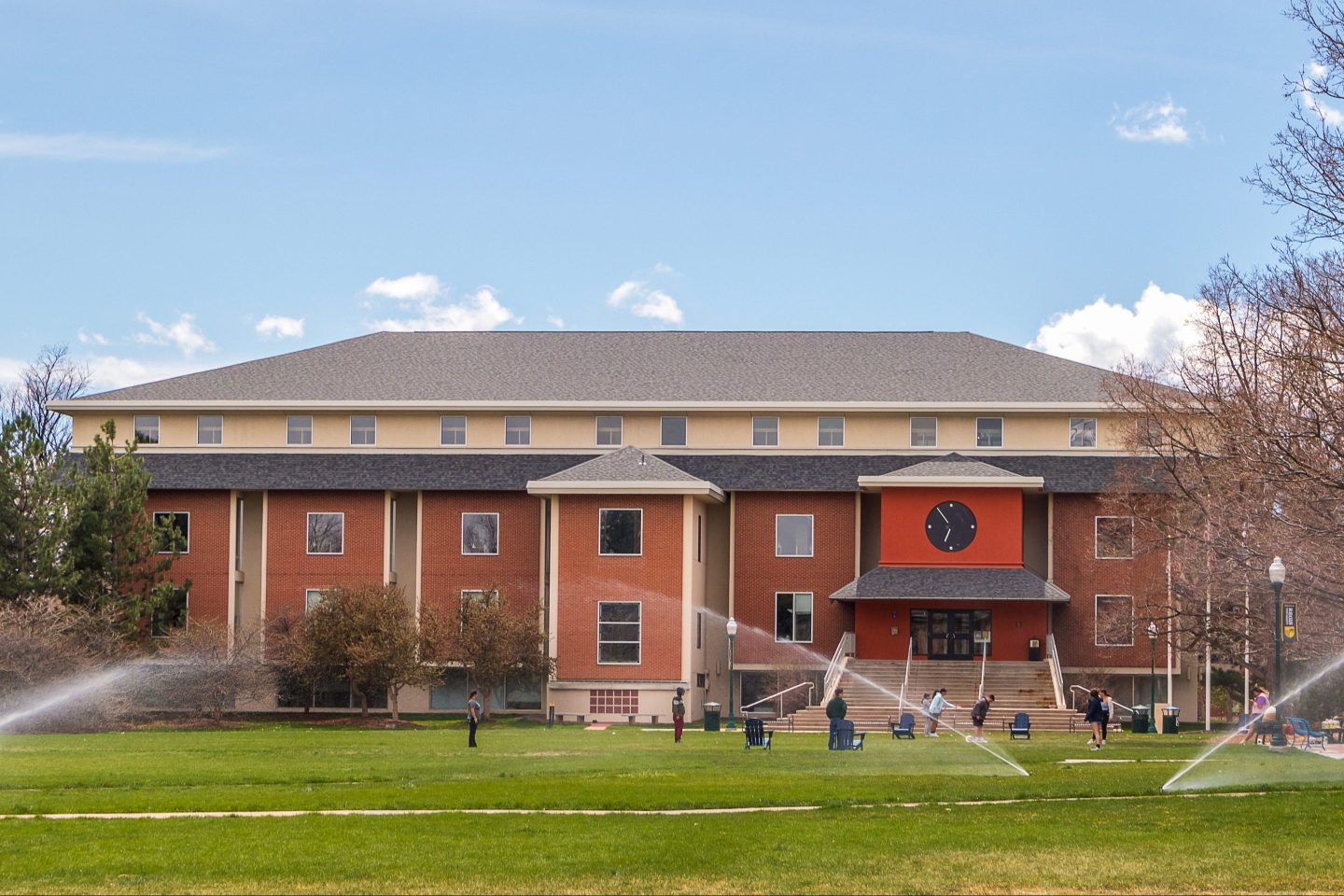
A Catholic university nestled in the Rocky Mountains has quietly produced a surprising number of figures who now occupy influential positions within President Donald Trump’s political sphere and the broader conservative movement.
Regis University, a 148-year-old Jesuit institution in Denver, has become an unexpected common denominator among conservative leaders who have shaped American politics for decades.
The connection includes two women in Trump’s orbit currently making headlines: Erika Kirk, the new CEO of Turning Point USA following her husband Charlie Kirk’s assassination, and Lindsey Halligan, Trump’s nominee for U.S. attorney for the Eastern District of Virginia; both earned degrees from Regis.
But their alma mater has produced a much broader network of conservative power brokers who have shaped American politics for generations.
Regis University, which serves about 2,700 students, was able to confirm to Fortune that Erika Kirk was a student there from fall 2007 through the end of fall 2009, and Lindsey Halligan did graduate from the school in 2011, but offered no further comment.
Wednesday, July 17, 2019
Thursday, November 14, 2013
How The Sharing Economy Is Changing The Places We Work
by Elise Hu
November 14, 2013 3:08 AM
4 min 30 sec

Co-workers at Denver's Galvanize, a tech hub in Colorado's capital. Elise Hu/NPR
This week, we've been reporting on — a term that describes the couch-surfing, car-sharing and community-garden-growing world where so many people are using their existing talents, space or tools. You'll find the stories on this blog and , and we would love to hear your questions about the topic. Just , leave a comment or .
The sharing economy is powering a rise of new entrepreneurs who need a different kind of office space. Co-working spaces that foster certain communities, , in Denver, cater to that changing culture of work. When you walk into it — the first thing you'll see is a well-stocked bar. The second is a coffee shop.

A morning meeting at Galvanize's office bar. Elise Hu/NPR
"Cause coffee fires entrepreneurship, if you will," says Chris Onan, one of the three co-founders of Galvanize.
The 30,000-square-foot space is converted from an old bank note building, and a year after opening it's home to more than 140 tech companies that range from having one person work here occasionally, to teams of 30 that rent semi-permanent suite spaces.
The front, where you find the cafe, is open to the public. The nerve center of the space is an atrium of open workspace, which costs a few hundred dollars a month for membership. The outer rim of the bullpen is lined with glass-enclosed studios where midstage startups rent space next to one another but don't get tied to long-term leases.
"I'm not gonna rent a space for five years. Who knows where I'm gonna be in five years?" says , who heads GoSpotCheck, one of the companies who snagged a glass suite.
As the sharing (or peer) economy became big, more people shunned traditional offices and started their own enterprises, and those enterprises needed space and resources. That's what happened with Holloway.

The main atrium of Galvanize allows freelancers to work or come and go as they please, for a monthly membership fee. Elise Hu/NPR
"We were just a couple of us in a garage beforehand," she says. "We had graduated from my basement to a garage; we were in that garage for about a year. And then we were growing as a team, we were finding the right product market fit, and we needed a better environment to work."
This kind of work environment is now cropping up in cities around the world. Galvanize is not exclusively a co-working space, but a hub for tech-specific companies, since the vision was to create a community for entrepreneurs in the same field. It's also a school for designers and developers. It's the brainchild of Jim Deters.
"I do think the rise of facilities like this [arose] to support these solo-prenuers that don't just want to work in a coffee shop or hotel lobby, or get tired of sitting at home by themselves in their jammies," Deters says. "They want to come and work in inspiring environments to make connections and be part of a community to share ideas and transfer ideas."

Galvanize co-founder Chris Onan holds a cup of Galvanize's signature coffee. Elise Hu/NPR
It was the ideas for technology platforms that make so much of the peer economy possible. So it's fitting that the people founding technology companies led the way to this newer kind of work style.
"I like to talk about the importance of building the connective tissue or the relationships between people in these sort of share-a-beer moment, or share-a-coffee moment, because that's what makes us human, right?" Deters says. "We like to break bread together, we like to socialize together, and work and life are not different for this generation. Work is not just work for these people. It is their life."
"These people" — millennials — are the sons and daughters of baby boomers and now number at least 75 million. By many counts, they outnumber boomers. Denise Cheng, a peer economy researcher with the MIT Center for Civic Media, points out a key reason millennials went full bore into the sharing economy: out of necessity.
"They actually don't have a lot of the same opportunities because right around the time they were born was when a lot of corporate structures started to change, and those benefits started to go away," Cheng says. "I think that one really big thing about the millennial generation is that we are going to have so many different careers over a lifetime. And that fluidity also translates into what our work structure looks like."
That fluidity is working out well — not just for Galvanize's young tech founders — but for employees of existing and established businesses that work out of the space, which include the car service Uber, file-sharing company Box and online audio company Pandora. Pandora's small sales team rents desks overlooking Galvanize's floor of freelancers.
"It was just two of us; we wanted to be part of something greater, with more a vibe to it," says Pandora's Robin May.

The lobby entrance to Galvanize is a bar and a coffee shop. Elise Hu/NPR
The vibe is what the future of work feels like for lots of young entrepreneurs. A place without walls, all kinds of freedom and fueled by coffee and beer.
Source
.
Wednesday, January 02, 2013
Denver Murals International Airport Colorado

Uploaded on Dec 3, 2010
Video and still picture footage of the Airport of Airports when it comes to conspiracy theory's.
Murals, a secret base underneath the place. Hidden messages within pictures and more.
We investigated to see what we could come out with...
Thursday, February 19, 2009
DIA Murals

DIA Murals
1993 - 1995
In Peace and Harmony With Nature
Commissioned by and on permanent exhibit at Denver International Airport
This is one of two sets of murals (four total)
Two smaller at 12 ft. x 15 ft. w
Two larger at and 12 ft. x 28 ft. w.
Smaller mural – The Present State of the Environment
Humanity, represented by multi-racial children, is shocked and saddened at finding our natural world in a trampled and abused state. Surrounding the youthful group are endangered or extinct wildlife species. The bewildered children view the Snow Leopard, said to be the most beautiful of the large cats, laid out lifeless before them displaying its exquisite fur and colors. To the left, a young girl gazes at a Great Auk in a display case, a vanished species made extinct in 1844. On the right front, a young boy touches a display case containing the last of the Passenger Pigeons, a species existing in immense numbers throughout the Eastern U.S., and finally extinguished in 1914. Shown also are a harpooned Gray Whale, a Kemp’s Ridley sea turtle enmeshed in a fishing net, and a wall mounted buffalo head. Fluttering over the central scene, is an agitated Quetzal bird, with parts of a display case ominously surrounding it, as if foretelling its extinction.
Behind these central images, a fire rages, consuming a rainforest, while in the foreground we see endangered plant life, such as the Holy Ghost Orchid, from Panama, the Flower of the Gods, South Africa and others. In the immediate foreground are three concrete coffins, each containing a young girl clutching cultural articles. These three girls symbolize our own humanity as victims of our self destruction, notably through war, slavery, genocide, exploitation and violence of all kind.
Larger mural – A Hopeful Future in which Humanity Rehabilitates the Environment
On this mural, I depict humanity, represented by children of the world arrayed in national or folkloric costumes. They move from both ends towards the center, and are shown smiling optimistically as they strive to rehabilitate our natural environment. On the background to this jubilant procession, are depicted various temperate zones of our planet beginning, on the extreme left with the ocean, temperate forests, frigid, tropical rainforest, and desert.
These “zones” are pictorially described with relevant geographical features, as well as wildlife indigenous to those regions. For example, the Quetzal bird signifies tropical rain or cloud forests, while the Snow Leopard is representative of frigid mountainous environments. Moreover, these different zones are shown as robust and healthy, as are the various wildlife species depicted. This portrayal is confluent with the ideal of a rehabilitated natural environment resplendent in all its beauty.
The elated children, in the colorful and lively costumes of thirty-two nations, move happily to where a special and unique flowering plant is about to be placed in the soil. This flower, its radiating leaves reflecting all the colors of the rainbow, reveal within its folds the configuration of a small white dove (reminiscent of the Holy Ghost Orchid). With this image, I sought to symbolize a new appreciation of our environment as a spiritual as well as a physical entity, a precious and delicate domain entrusted to our care.
Source: http://leotanguma.com/dia.htm


Denver Airport


"What in God's name is that all about? Man, that's sick! - Doug McGivens of Glen Burnie, MD. while looking at the mural
"Ah, terrific...I don't need this right now. What a horrible thing to have up for people to have to look at!" - Karen D. from Broomfield, CO after her 8-year old daughter got upset at seeing the mural
"The damn sneaks" - Me, when I saw they painted over and changed some of the murals
The initial cost of this New Beast was to be 1.7 billion dollars (with a "B") but by the time they were done playing games, having problems, getting bailed out and got extra government money (and money from private corporations on top of that), it cost about $4.8 billion - obscenely over budget. I have yet to meet a local who wanted the thing built, or didn't have a frothing, rabid story about the whole mess. Words used to describe the DIA were "buried in technical problems", "poor project management", "overwhelming complexity" and "America's most inconvenient airport". It was built in a high wind area (Stapleton hadn't been) that causes it to be shut down or flights delayed often. The extensive automated baggage system so was messed up, such a circus of errors that it was worse than unusable - it was an industry joke. But it had to be built, and built there. Some say the reason that this was built and there was no stopping it, no cost spared to do so and why it was so SO overbudget and took so many years is because it's really an underground military base and a civilian detainment camp.
Even though the area is basically flat (with a stunning view of mountains all around, since it's in a valley), the expense and time was taken to extensively lower some areas and raise others. They moved 110 million cubic yards of earth around. This is about 1/3rd of the amount of earth they moved when they dug out the Panama Canal.
The airport has a fiber optic communications core made of 5,300 miles of cable. That's longer than the Nile River. That's from New York City to Buenos Aires, Argentina. The airport also has 11,365 miles of copper cable communications network.
The fueling system can pump 1,000 gallons of jet fuel per minute through a 28-mile network of pipes. There are six fuel hold tanks that each hold 2.73 million gallons of jet fuel. This is somewhere in the "no one will ever ever need this much" range.
Granite was imported from all over the world - Asia, Africa, Europe, North and South America - and used in making the main terminal floor. This is a ridiculous expense, especially when you're already over budget. They say, "The floor pattern echoes the roof design and subtly reinforces passenger flows". Ah...subliminal messages to move your ass. It might look pretty but would any of us know Chilean granite from Chinese granite? Or care? You can dye rock if it's colors you're after. Cheaper rocks. (I wonder what the "stones have power" people say about this...)
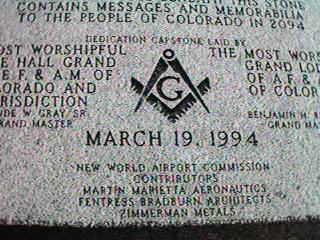
The huge, main terminal is Jeppesen Terminal, named after Elfrey Jeppesen, who was the first person to create maps specifically for aviation (the company is still in business today). This area is known as the "Great Hall"; it's said this is what the Masons name their meeting place.It is 900 feet by 210 feet big. This is over 1.5 million square feet of space. All told, there is over 6 million square feet of public space at DIA. The airport brags that they have room to build another terminal and two more concourses and could serve 100 million passengers a year. The airport flew 36 million in 2001.
The only way to get to the other two concourses/terminals from the Great Hall, or vice versa, is via the airport's train system.
There are more than 19 miles (30 km) of conveyor belt track, luggage transport cars and road in their own underground tunnels that move baggage and goods. They're so huge you can drive trucks through them, and some remain unused.
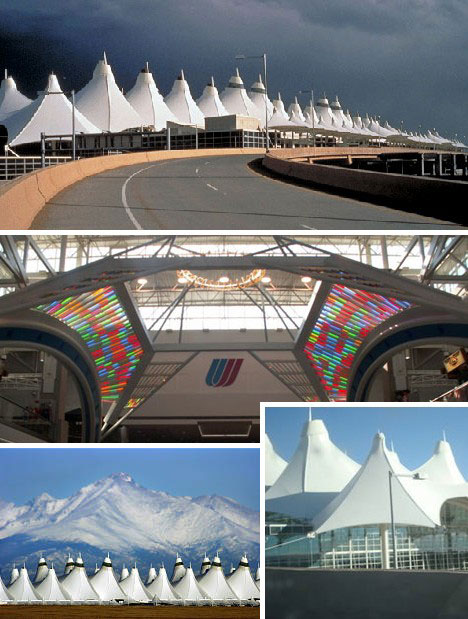
The entire roof of DIA is made of 15 acres of Teflon-coated, woven fiber glass. The same material is on the inside as a layer, also. The place looks like a bizarre (but kind of cool) scene out of "Dune", comprised of huge, spiked tent-like structures. The material reflects 90% of the sunlight and doesn't conduct heat. So you can't see into the place with radar or see heat signatures. I added helpfully.
Perhaps the DIA does push the "limit of complexity" but that's only because the politicians and government designed it to be such a complex monster. It's not as if some engineering problem was posed and met like the Chunnel, the Petrova Towers in Malaysia, the Burj Al Arab hotel in Dubai or a hydroelectric dam. Why would the military give a hoot about the baggage problems the airport had? If you believe what you are told in the papers, most of the problem was because the people who built the system weren't the ones that were awarded the contract to run the thing. Hardly any "engineering" snafu. Or did their billion dollar underground base not work out as good as they had hoped?