Showing posts with label Central America. Show all posts

Sunday, August 24, 2025

Fuerzas Comando 2025


News | Aug. 18, 2025
Fuerzas Comando 2025

By Maj. Trevor Wild,
ILOPANGO, El Salvador –

Sixteen special operations teams from across Central and South America and the Caribbean will gather in Ilopango, El Salvador, Aug. 18–29, for Fuerzas Comando 2025, the 19th iteration of the premier special operations skills competition and senior leadership seminar.

Established in 2004, Fuerzas Comando is a 10-day event designed to test participants’ skills through a friendly competition among special operations forces. The event promotes interoperability and military-to-military relationships through cordial contests, enhances training knowledge, and strengthens regional cooperation.

Concurrently, a senior leadership seminar will convene, uniting top multinational special operations leaders to address transnational threats impacting defense and stability across the region.

Participating nations include Argentina, Belize, Chile, Colombia, Costa Rica, Dominican Republic, Ecuador, El Salvador, Guatemala, Honduras, Jamaica, Mexico, Panama, Paraguay, Peru, and the United States.

Fuerzas Comando 2025 is sponsored by U.S. Southern Command and executed by Special Operations Command South in partnership with the Fuerza Armada de El Salvador.

The competition will feature a series of evaluated events:
Day 1: Weapons zero (non-graded)
Day 2: Physical training event (100 points) and opening ceremony
Day 3: Assaulter stages 1 and 2 / Sniper stage 1 (300 points)
Day 4: Assaulter stages 3 and 4 / Sniper stages 2 and 3 (300 points)
Day 5: Assaulter stage 5 / Sniper stages 4 and 5 (400 points)
Day 6: Assaulter stages 6 and 7 / Sniper stage 7 (400 points)
Day 7: Assaulter and sniper stage 8 / Combined assault (300 points)
Day 8: Ruck event (200 points)
Day 9: Obstacle course (200 points)
Day 10: Water event (200 points)
Day 11: No evaluation
Day 12: Closing ceremony

For updates and standings, follow @SOCSOUTH and @FUERZARMADASV on Instagram, Facebook, and X.

“Juntos somos Fuerzas Comando.”


Sunday, April 29, 2018

‘Caravan’ Migrants Weigh Risks of US vs. Life in Mexico


April 29, 2018 3:06 AM


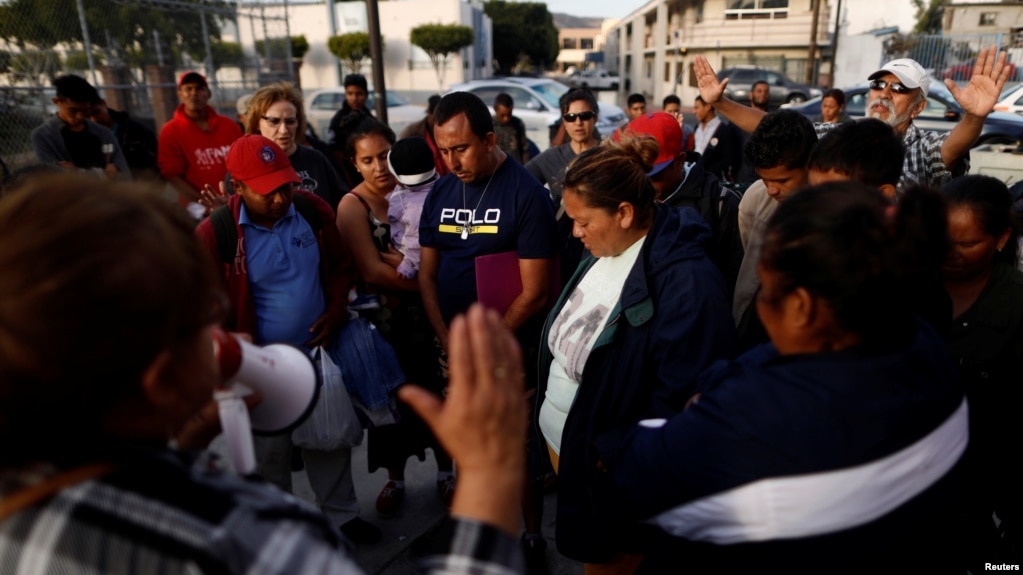
Members of a migrant caravan from Central America pray in preparation for an asylum request in the U.S., in Tijuana, Baja California state, Mexico, April 28, 2018.


TIJUANA, MEXICO —

Hondurans, Guatemalans and Salvadorans who drew the wrath of President Donald Trump in a monthlong caravan to the U.S. border will make hard decisions Sunday: Risk being deported all the way home by trying to cross in the U.S., or to build a life in Mexico.

After angry tweets from Trump, U.S. border authorities said some people associated with the caravan had been caught trying to slip through the fence, and encouraged the rest to hand themselves in to authorities.

“We are a very welcoming country but just like your own house, we expect everyone to enter through our front door, and answer questions honestly,” San Diego Chief Patrol Agent Rodney S. Scott said in a statement.


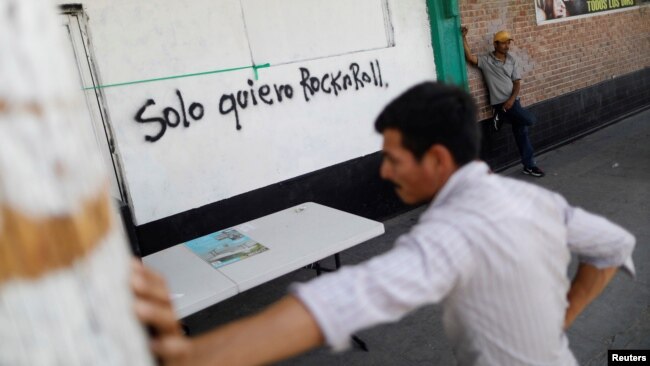
Central American migrants, moving in a caravan through Mexico and traveling to request asylum in U.S, arrive in Mexicali, Baja California state, Mexico, April 25, 2018. The words read, "I just want Rock and Roll."


​Sober advice, mood

Most of the group of about 400 travelers who arrived in border city of Tijuana on buses over the past couple of days said they intended to legally seek asylum in San Diego on Sunday, but lawyers advising the group gave them stark advice: Not everyone will be successful.

After the grueling journey, a somber mood took hold as the reality sank in that many of them would be separated from their families. Lovers and parents with slightly older sons and daughters could be forced to split up.

At venues around the city, U.S. immigration lawyers working pro bono Saturday listened to harrowing tales of life in the immigrants’ home countries.

Death threats from local gangs, the murder of family members, retaliatory rape, and political persecution back home prompted them to flee, the migrants and lawyers say.


Honduran family Nolvia Luja, left, Willian Bonilla, and their son Wilmer Bonilla, who attended the annual Migrants Stations of the Cross caravan for migrants' rights, rest at a shelter in Tlaquepaque, Jalisco state, Mexico, April 18, 2018.


Many of the immigrants who spoke at length with Reuters at various points during their trip through Mexico had been short on knowledge of their legal rights, but at least 24 recounted detailed stories of facing death threats.

As poor migrants from Central America on a perilous route through Mexico, they feared they could be robbed, raped, arrested and assaulted, so traveling by caravan offered their only protection, they said.

The lawyers advised which cases had higher chances of passing the “credible fear” test required to enter the long and often difficult U.S. asylum process, said immigrant rights organization Al Otro Lado, Spanish for On the Other Side.

“A lot will depend on how well they can articulate their case,” said one of the pro bono lawyers, who preferred to remain anonymous.

Some advised to stay in Mexico

The rest were advised to stay put in Mexico, which would remove the risk that U.S. authorities fly them the more than 2,000 miles (3,600 km) back home.

“We’ll wait and see,” said Bryan Garcia, from Honduras, seated beside 4-year-old Nicole, who was eating a strawberry biscuit as they waited for her mother to come out of a meeting with a lawyer.

Nicole and her mother are from El Salvador. They befriended Garcia along the caravan’s journey and the adults had fallen for each other.

But Garcia would not be asking for asylum. He would stay in Tijuana, having already been deported once from the U.S.

“We’ll just have to try to stay connected,” he said as Nicole paused from eating her biscuit and blinked up at him.

Pressure on Mexico

Trump has been pressuring Mexico to stop the migrants before they reached the border, linking the future of the North American Free Trade Agreement (NAFTA) to Mexican efforts to stem the flow of Central Americans.

The friction has coincided with high intensity efforts by U.S., Canadian and Mexican teams to renegotiate NAFTA on Trump’s bidding, with officials saying a deal could be just a few weeks away after months of talks.

Mexico deports tens of thousands of Central Americans every year back across its southern border with Guatemala.


Sunday, April 01, 2018

Why U.S.-bound ‘caravans’ of Central American migrants are getting Trump’s attention


by Alex Horton April 1 at 6:16 PM

Trump: 'Mexico has got to help us at the border'


President Trump said Mexico needed to help secure the U.S. border after tweeting there would be "no more DACA deal" and threatening to "stop" NAFTA on April 1. (Elyse Samuels/The Washington Post)

In a three-tweet salvo Sunday morning, Trump decried recent struggles with congressional Democrats to reach a deal that would legalize the status of millions of “dreamers” — undocumented immigrants who were brought to this country as children.

“Border Patrol Agents are not allowed to properly do their job at the Border because of ridiculous liberal (Democrat) laws like Catch & Release,” Trump said in his first tweet. “Getting more dangerous. ‘Caravans’ coming. Republicans must go to Nuclear Option to pass tough laws NOW. NO MORE DACA DEAL!”

DACA refers to the Obama-era Deferred Action for Childhood Arrivals program, which Trump ended in the fall. The program had allowed dreamers to live in the country without fear of deportation.

Trump, a self-proclaimed “Fox & Friends” fan, appears to have fired off the tweets in response to a segment on the program in the morning (at least the National Border Patrol Council sees a connection, it claimed in a post afterward).


Wednesday, January 17, 2018

International Court Pushes Gay Marriage on 20 Latin American Nations


Michelle Riestra / January 17, 2018


The autonomous Inter-American Court of Human Rights has faced growing resistance from Latin American countries in recent months. (Photo: iStock Photos)


Commentary By


Michelle Riestra


Michelle Riestra serves as legal counsel for ADF International in Washington, D.C., where she engages in legal advocacy at the Organization of American States.


The Inter-American Court of Human Rights called last week for the recognition of same-sex marriage and of proclaimed “gender identity” as a protected category for nondiscrimination under the American Convention on Human Rights.

Although the decision is not binding, 20 countries throughout the Americas have accepted the jurisdiction of the court, and will now be pressured to implement its decision.

The 20 countries are Argentina, Barbados, Bolivia, Brazil, Chile, Colombia, Costa Rica, the Dominican Republic, Ecuador, El Salvador, Guatemala, Haiti, Honduras, Mexico, Nicaragua, Panama, Paraguay, Peru, Suriname, and Uruguay.

Same-sex marriage is already legal in some of those countries, including Argentina, Brazil, Colombia, and Uruguay, and others recognize civil unions, but still others do not recognize either and will be expected to change their laws.

Americans need an alternative to the mainstream media. But this can't be done alone. Find out more >>

The case originated from Costa Rica, which requested an advisory opinion from the court on whether its domestic law violated international law, as it does not facilitate name changes based on gender identity, nor recognize patrimonial rights of same-sex partnerships.

Advisory opinions are not even binding on the country that asked the question, let alone the other 19 nations that have accepted the court’s jurisdiction. However, the court ignored this legal reality and called upon the countries to issue temporary decrees recognizing same-sex marriage until new legislation can be enacted by those countries.

The court has no authority to order such a thing, and the decision goes against the clear wording of the American Convention on Human Rights, as well as several national constitutions. However, the court’s decision is just the latest example of judicial activism, which stretches back more than a decade.

The court is tasked with interpreting the American Convention on Human Rights and operates within the broader Organization of American States framework.

Faced with stubbornly conservative member nations that are slow to follow the legal and cultural liberalism flowing out of Canada, the U.S., and much of Western Europe, the court has taken it upon itself to force its own liberal agenda on a reluctant region.


Wednesday, January 10, 2018

Strong quake in Caribbean Sea shakes Honduras, Mexico and Belize, no tsunami


By Gustavo Palencia,
Reuters•January 10, 2018


Magnitude 7.6 quake hits in Caribbean north of Honduras
WGBA - Green Bay Scripps


By Gustavo Palencia

TEGUCIGALPA (Reuters) - An earthquake of magnitude 7.6 that struck near remote islands belonging to Honduras on Tuesday was felt across northern Central America but there were no immediate reports of casualties or major damage.


Related SearchesEarthquake MagnitudeCaribbean SeaEarthquake UsgsEarthquake Scale

The quake rattled windows in the Honduran capital of Tegucigalpa roughly 323 miles (519 km) to the east and was felt at least as far north as the Mexican state of Quintana Roo, but no damage was immediately reported.

Rodrigo Anaya Rodriguez was in a hammock inside his house near the popular tourist site of Bacalar Lake near Mexico's Caribbean coast when he felt three tremors.

"It felt like a bulldozer was driving past," he said. "It didn't last long but was very violent."

He ran to his balcony and saw electricity posts and cables swaying.

In Honduras, firefighters said some residents in southern neighborhoods fled their homes after feeling the shaking.

The country operates a small naval base on Great Swan Island, about 27 miles (44 km) west of the quake's epicenter, but it was not immediately clear how the tremors affected the station.

"We have reports that it was felt in the majority of the country, but we don't have reports of damage," said Lizandro Rosales, director of Honduras' contingencies commission.

The U.S. Geological Survey said the quake, initially reported as a magnitude 7.8, was centered 125 miles (202 km)northeast of Barra Patuca in Honduras and 191 miles (307 km)southwest of George Town in the Cayman Islands.

The quake was very shallow, at only 6.2 miles (10 km), which would have amplified its effect.

The Pacific Tsunami Warning Center initially warned that tsunami waves up to 1 meter (3 feet) above tide level could hit parts of Honduras, Belize and Puerto Rico along with the U.S. and British Virgin Islands.

About two hours after the quake, the center said the threat had passed, withdrawing all tsunami advisories connected with the quake.

The tremors were felt in Belize's capital, Belize City, but there were no immediate reports of damage.

Belize's minister in charge of emergency management, Edmond Castro, spoke on local radio to urge people living in low lying coastal areas and islands to stay alert for potentially dangerous waves.

(Additional reporting by Sandra Maler in Washington; Daina Beth Solomon, Adriana Barrera and Frank Jack Daniel in Mexico City; Jose Sanchez in Belize City; Editing by Lisa Shumaker and Simon Cameron-Moore)


Monday, September 12, 2016

Tim Kaine's radical roots


September 09, 2016, 04:35 pm


By Ken Blackwell, contributor


Greg Nash

According to the media, Tim Kaine took a life transforming "mission" trip to Latin America in 1980. Conveniently left out of these stories, are the radical reality of the Cold War in Latin America and Tim Kaine's Soviet sympathizing mentors. In fact, whatever Kaine's intentions, he more likely met Karl Marx than Jesus Christ while there.

Connect the dots with a little history, and an alarming picture emerges of Kaine's adventures with radicals and revolutionaries in 1980s Latin America.

Reports indicate that in Honduras, “Mr. Kaine embraced an interpretation of the gospel, known as liberation theology...”This wasn't mainstream “Catholic thought” at the time. It was a radical, Marxist-based ideology at odds with the Church, the pope, and the United States, but supportive of (and supported by) the Soviet Union.

To counter Vatican opposition to this theology, now published documents from the Soviet and East German archives show “active measures” were undertaken to undermine the Vatican and the pope — key barriers to a Soviet influence in Latin America.

The documents are detailed in books by former Associated Press Berlin bureau chief, John Koehler and the Mitrokhin Archive data published by Cambridge University Professor Christopher Andrew.

Tim Kaine's political formation wasn't pro-American or pro-Catholic, it was pro-Soviet.


Wednesday, July 27, 2016

Obama Opens Doors to More Central American Refugees


July 26, 20165:55 PM ET


RICHARD GONZALES


The Obama administration announced today that it is expanding a program that helps Central American refugees, including minors, to reunite with their families in the United States. The effort is designed to discourage people from leaving their homeland and flooding the southern U.S. border, say administration officials.

The program has three components.

First, it broadens the categories of people eligible to enter the U.S. to include siblings over the age of 21, parents of qualified children, and other "caregivers" when they accompany an unmarried minor child.

Second, with the assistance of a United Nations agency, the U.S. will screen applicants in their country of origin when they apply for refugee status.

Third, the government of Costa Rica has agreed to temporarily host up 200 migrants who are in the greatest need of protection. Administration officials called this a "Protective Transfer Arrangement."

At its core, the new effort signals an acknowledgement by the Obama administration that its program to stem the tide of families and children leaving Central America hasn't worked. The administration currently allows Central American minors to apply to join a parent who has legal status in the U.S.

"Our current efforts to date have been insufficient to address the number of people who may have legitimate refugee claims," said Amy Pope, White House Deputy Homeland Security Adviser.

"There are insufficient pathways for those people to present their claims for adjudication," said Pope, adding that the changes announced today will help insure "a safe and orderly processing" of asylum claims.

But administration officials said they don't know how many people could be eligible for refugee status under the expanded program. Thus far, they said, approximately 9,500 minors have applied to leave Guatemala, El Salvador, and Honduras. According to Alejandro Mayorkas, Deputy Secretary of Homeland Security, 2,880 minors have been approved to reunite with their families in the U.S. and more than 600 already have arrived.

The number of Central American minors crossing the border surged in 2014, eased off in much of 2015, but resumed thereafter. According to the AP, since October 2015, more than 43,000 unaccompanied children have been caught crossing the border.


Thursday, October 22, 2015

Mexican priest offers shelter for Central American migrants on a perilous path


Mexican priest offers shelter for Central American migrants on a perilous path


PBS NewsHour

Published on Oct 22, 2015


Immigrants aren't coming from Mexico as much as through that country in recent years. Special correspondent Fred de Sam Lazaro visits a migrant shelter in Northern Mexico, where people from Honduras, Guatemala and El Salvador take respite near the end of their long, dangerous journey in hopes of illegally crossing into the U.S.

....

Tuesday, September 08, 2015

Catholic priest accused of 'child sex abuse tourism' in Central America set to go on trial


Rev Joseph Maurizio has pleaded not guilty

TANIA RAHMAN


NEW YORK


Tuesday 08 September 2015


The trial is set to begin of a US priest accused of sexually abusing children in Central America.


The Rev Joseph Maurizio Jr, from Pennsylvania, was charged last year with possession of child sex abuse materials, engaging in sexual relations with a minor and transmitting funds to or from the US with the intent to promote carrying on an unlawful activity.

The 70-year-old priest, who traveled annually to Honduras between 2004 and 2009 to provide support for homeless boys and for missionary trips, is accused of molesting young boys who lived in an orphanage during this time. Investigators referred to Mr Maurizio’s conduct as “sexual tourism”.


Rev Joseph Maurizio has pleaded not guilty

Prosecutors and defense attorneys for the trial are now haggling the details for the trial and jury selection in Jonestown, Pennsylvania, is due to begin on Tuesday.

An expert witness is expected to give testimony on the impact of sexual abuse on children, which prosecutors hope will help secure evidence that the victims exhibited such effects.

Stephen Passarello, the defence lawyer, protested against the use of such a witness, stating that she had not interviewed any of the alleged sexually abused victims.

During the court case last year, Mr Passarello described Mr Maurizio as a man who “devoted his life to missionary work and helping underprivileged children."

Mr Maurizio of is accusing of bribing the children with money and chocolate in exchange for or after sexual activities.

Accusations reached the ears of ProNino USA, the US charity that sponsored the homeless boys’ orphanage, Foundation ProNino. Upon confrontation, the priest denied the accusations.


.

Tuesday, August 05, 2014

Providing Safe Passage to Unaccompanied Children from Central America


Photo (Courtesy) http://frontporchphilosopher.wordpress.com/2014/07/11/claims-of-compassion-and-racism-on-immigration-policy/


Overview of Current Situation

Central American children from El Salvador, Guatemala and Honduras are migrating to the United States alone in record numbers. While not a new phenomenon, the number of children who are making the perilous journey alone has increased exponentially—6,775, on average, arrived between 2003—20111, and upwards of 90,000 are projected to arrive in Fiscal Year 2014 (October 1, 2013—September 30, 2014)

2. A delegation of the United States

Conference of Catholic Bishops (USCCB) traveled to Central America in November 2013 and reported in Mission to Central America: The Flight of Unaccompanied Children to the United States that multiple interrelated factors are contributing to the increase in forced child migration. Some of these factors include: a lack of strong social institutions and civil society support, abuse in the family stemming from pressure on family units due to violence and family separation, a lack of viable economic and educational opportunities, and environmental factors affecting crop production. However, the delegation reported that “one overriding factor has played a decisive and forceful role in recent years: generalized violence at the state and local levels and a corresponding breakdown of the rule of law have threatened citizen security and created a culture of fear and hopelessness.”3

/

Thursday, July 31, 2014

These are the women helping child migrants as they make their way to the US (VIDEO)

Deborah Bonello

July 15, 2014 10:39


While the United States is grappling with how to handle the thousands of child migrants arriving at its borders from Central America, a group of women in central Mexico has quietly attended to them for years.


VERACRUZ, Mexico — While the United States is grappling with how to handle the thousands of child migrants arriving at its borders from Central America, a group of women in central Mexico has been quietly attending to them for years.

"Las Patronas" throw bags of food and bottles of water to the travelers who speed by on the train heading north to the US-Mexico border.

"Before it was just the men who migrated, but not anymore. The whole family goes — women, pregnant women, young children and babies. We've seen mothers on the train with their babies," says Julia Ramirez of Las Patronas as she spoons rice into bags to be wrapped up and thrown onto the trains.

Thousands of migrants traveling north from countries like Honduras and El Salvador ride on the top of the freight trains, known as "La Bestia" or The Beast, that rumble through Mexico every day. The children who are increasingly making that journey are even more vulnerable than their adult counterparts. Death and mutilation under La Bestia is a huge risk, as is extortion and murder at the hands of criminal gangs and corrupt Mexican officials. For women migrants, rape is a constant threat.

With international attention now focused on what NGOs and the United Nations are dubbing a "humanitarian crisis" on the US-Mexico border, the Mexican government has finally acknowledged a problem it's been ignoring for decades. Mexico's Interior Secretary Miguel Ángel Osorio Chong said in a radio interview Friday that the time has come to halt the dangerous journeys north.

"The Beast is for cargo, not passengers," said Chong, vowing to take responsbilty for those migrants in Mexican territory.

However, the move could spell even more danger for Central American migrants here, placing more power into the hand of Mexican immigration officials and forcing those moving north to find other, more invisible, routes.


Source:  http://www.globalpost.com/dispatch/news/regions/americas/140715/these-are-the-women-who-help-child-migrants-going-to-us-video
.
.

Wednesday, July 30, 2014

Jesuits Call on Jesuit Alumni in Congress to Protect Central American Children Crossing U.S. Border


July 30, 2014 — The Society of Jesus in the United States (the Jesuit order) is making a personal plea to the 43 Congressional representatives who graduated from U.S. Jesuit high schools and colleges to “uphold the dignity of the human person and the sacredness of human life” when considering policy solutions to address the influx of children fleeing violence in Central America.

In a letter to Speaker John Boehner (Xavier University), copied to Jesuit alumni in Congress, Fr. Thomas H. Smolich, SJ, president of the Jesuit Conference, called on Congress to uphold the Trafficking Victims Protection Reauthorization Act of 2008 (TVPRA).

Currently, most unaccompanied minors detained by Border Patrol agents are handed over to the Department of Health and Human Services, which coordinates their care and provides an opportunity for children to tell their story to an adult they can trust. As part of his response to the increase in the number of children arriving at the border, President Obama asked Congress to consider weakening the TVPRA in order to fast-track deportations of children. Now, House leadership is seeking to change the law, which would allow a single Border Patrol agent to render a deportation decision and quickly deport a child back to his or her home country.

Fr. Smolich said that a change to the TVPRA, “would result in children having a one-shot chance to disclose their persecution to a Customs and Border Protection agent or officer…” He called any attempt to dilute TVPRA “inhumane and an insult to American values,” particularly since some children might have been “victimized by armed men in uniform.”

The letter also asked Speaker Boehner and Congressional alumni of Jesuit institutions to protect the due process rights of vulnerable children and examine the root causes leading children to flee in unprecedented numbers.

“This is not a new crisis, nor is it primarily at our border. Rather it has been escalating over the last decade…90 children are murdered or disappeared in Honduras every month,” said Fr. Smolich, who also reminds Speaker Boehner that “this is the equivalent of eight children being executed in your Congressional district every thirty days.”

Recalling the assassination of six Jesuits in El Salvador nearly 25 years ago, Fr. Smolich emphasized the Jesuits’ commitment to working with fellow Jesuits and lay partners in Central America, who live the reality of widespread violence. They see “the elementary school teacher murdered when he tried to prevent gangs from forcibly recruiting his students; the young girl pulled from her home, offered as a birthday present to a gang leader and then raped by 16 men; lay colleagues of Jesuits assassinated and harassed by the police.”

Fr. Smolich closed his letter by asking the Speaker and his fellow Jesuit alumni in Congress to “uphold an American tradition” of welcoming “the refugee, the victim of trafficking, the child who has been abused or abandoned.”

/

Monday, July 28, 2014

Evangelicals, Catholics Seek to Aid Children at the Border


by John Sexton 22 Jul 2014

Catholic Leaders Respond To Gov. Perry's Immigration Proposal


Faith leaders of various denominations are interceding on behalf of Central American children now arriving at the U.S. border. This week both evangelicals and Catholics put out calls to help in various ways.


A group of evangelical organizations will send a letter to Congress today asking lawmakers not to change a 2008 law which makes it more difficult to deport minors arriving from Central America. Politico reports the letter was put together by a coalition called the Evangelical Immigration Table which is composed of "the National Association of Evangelicals, World Relief, Bread for the World, Christian Community Development Association, Council for Christian Colleges and Universities, National Hispanic Christian Leadership Conference, the National Latino Evangelical Coalition, World Vision U.S. and Sojourners."

The letter reads in part, "As our nation responds to this humanitarian crisis, we are thankful for laws that protect children and provide for their needs. While our systems are currently stretched, our laws uphold basic child protection principles."

The law in question was intended to prevent trafficked children from being returned to a dangerous situations. It prevents the U.S. border patrol from quickly deporting kids arriving from Central America (as opposed to those arriving from Mexico). Instead, the law requires that Border Patrol turn kids over to HHS while they await a chance to see a judge.

In relation to that aspect of the law, yesterday a pair of Catholic bishops called on lawyers to help them assist the children who are facing deportation. Bishop Kevin Farrell told the Dallas Morning News, "Our purpose is to help and provide volunteer attorneys to represent them in the one chance they have." Catholic charities have been representing immigrant children in court for the last four years.

The ongoing crisis has been a source of division even between pastors working in the same city. Pastors Robert Jeffress and Frederick Haynes both lead mega-churches in Dallas. Jeffress, who appears on Fox News, argued the U.S. should build a fence on the border. Haynes gave a sermon calling the comments "fear mongering."

Many of the faith groups involved in caring for the children appear to be to the left of the White House and Hillary Clinton both of whom have said the majority of the children will need to be deported.


.

Tuesday, July 08, 2014

Runaway Country: Why Is Washington So Bad at Crisis Management?


BY CHUCK TODD, MARK MURRAY AND CARRIE DANN


Crisis management in the Age of Obama

Another week, another crisis for the Obama White House -- this time all the Central American children who have crossed into the country. Today, the White House is formally asking Congress for about $2 billion for immigration judges, attorneys, and asylum officials. But what we find striking is that this is yet another event controlling the White House rather than the other way around. Here is the formula, which we also saw recently with the crisis in Ukraine, the crisis at the VA, and the new crisis in Iraq: A conflict or public-policy problem gets a tremendous amount of media attention. Congress and the political opposition begin pointing fingers at the White House. And then the White House -- after hedging, hemming and hawing -- finally reacts. This was especially true after DHS Secretary Jeh Johnson dodged the question Sunday on “Meet the Press” whether the children would be deported, and then a day later when White House Press Secretary Josh Earnest answered affirmatively that they would be deported. In short, the White House is always reacting and rarely gets ahead of a problem. Their response is usually the same: We didn’t see this coming; it’s much worse than we anticipated, all leaving the impression that they just don’t have their arms around the government they run. The question is whether this is the new normal in this age of polarization and speedy news cycles, or if this is unique to Obama’s presidency?


Crisis management with the Do-Nothing Congress

But that is just one layer to this story. Another layer is Congress’ inability to legislate -- and its preference instead to politicize any public policy issue for maximum partisan gain. Your 113th Congress spends more time pointing fingers than solving problems. A case in point is this immigration story. After all, the “Gang of 8” immigration legislation -- which the Senate passed a year ago but which the House won’t act on -- spends billions and billions on additional border enforcement. Yet that legislation (or any compromise to it) is dead for this year and perhaps the rest of Obama’s presidency. So this isn’t just the administration’s crisis; it’s Congress’, too. As for the White House’s $2 billion request for the border, House GOP leaders are taking a wait-and-see approach. When First Read asked Speaker John Boehner’s spokesman if the House would pass the request before the August recess, he responded: “We won't know until we see what's actually in it.” When we followed up by asking if it could pass if it’s a reasonable request, he added, “We'll see.” Hard to imagine that either party wants this legislation staring them in the face after Labor Day in an election year. One has got to assume it’s August or bust.


Obama asking $2 billion for immigration aid
TODAY

Covering crises in New Media

And a third layer to all of this is us -- the media. We easily move from crisis to crisis, sometimes stoking it along the way. “Look at what’s happening in Ukraine! Why can’t Obama stop Putin?” “Look at what’s happening at the VA! Why didn’t Obama and Congress do more to foresee the mismanagement and respond to the horror stories?” “Look at what’s happening in Iraq! Why didn’t the White House see ISIS coming?” And now: “Look at what’s happening on the border! Why didn’t the administration and Congress anticipate this happening?” But here is the rub: Notice how quickly some of those older stories have disappeared from the front pages. Remember Ukraine? What about the VA? (Quick: Name the person Obama appointed to be the new VA secretary. Here is the answer.) In some ways, this justifies the administration’s reaction mode to crises -- because a week later, it knows the media will be devouring another story. Of course, what matters most, politically, is what the public is digesting. And while none of these stories is likely penetrating at a crisis-like level for the average American, the collection of these stories clearly is. What else explains the poor marks the president and Congress and the entire Washington structure is receiving?

Other moving parts in this immigration story

The Obama administration says that its desire for “expanded authorities” to deal with the border crisis is separate from its $2 billion request. "We already sent a letter to the congressional Leadership last week on our desire for expanded authorities and we are still seeking those authorities and have made clear we will work with Congress to get those authorities,” an administration official tells NBC’s Peter Alexander. (But just because it’s separate, does NOT mean the administration is somehow open to NOT seeing the law changed. Right now, the biggest roadblock to the White House request for the law to be changed is not Republicans but Democrats, who are quietly trying to pressure the White House to back off its ask on changing the 2008 law.) The Austin American-Statesman is reporting that the White House is open to President Obama having a meeting with Texas Gov. Rick Perry to discuss the immigration situation… Sen. John McCain (R-AZ) is calling for Obama go to border when he travels to Texas on Wednesday. “Going to Texas, without going to the border,” McCain said. “I don’t know how you do that — go to fundraisers and don’t go to the border and see for yourself how we are being inundated by tens of thousands.”

White House 'Not Worried' About 'Optics' of Obama’s Texas Trip
NBC NEWS


No Surrender in Mississippi

Chris McDaniel isn’t going away after losing his Senate GOP runoff last month by nearly 7,000 votes. “State Sen. Chris McDaniel’s attorney confirmed Monday the campaign’s plans to challenge the results of last month’s Senate runoff, arguing the only solution is to hold a new election for the GOP nomination,” Roll Call reports. In addition, McDaniel yesterday sent a fundraising solicitation entitled: “How Democrats stole our election.” From the email: “Thad Cochran's campaign used leftist tactics to steal the runoff election by soliciting illegal votes from liberal Democrats... We have evidence of voter fraud in Mississippi, and I am challenging the results of the election.” (That said, we still haven’t seen evidence of vote fraud or African-American Democrats voting illegally in the runoff.) And now Sen. Ted Cruz (R-TX) appears to be calling colleague Sen. Thad Cochran’s (R-MS) win “appalling.” Politico: “‘We’ve seen serious allegations of voter fraud,’ Cruz said on ‘The Mark Levin Show.’ ‘And I very much hope that no Republican was involved in voter fraud. But these allegations need to be vigorously investigated and anyone involved in criminal conduct should be prosecuted.’ Earlier in the program, Cruz criticized the Washington establishment for its meddling in the runoff: ‘What happened in Mississippi was appalling. Primaries are always rough and tumble, but the conduct of the Washington, D.C., machine in the Mississippi runoff was incredibly disappointing.’” Um, Cruz is still the vice chair of the National Republican Senatorial Committee, which supports its incumbents like Thad Cochran.

Wolf hits Roberts in new radio ad

Meanwhile, in Kansas, Tea Party candidate Milton Wolf is up with a new radio ad hitting Sen. Pat Roberts for his recent quip, “Every time I get an opponent, uh, I mean every time I get a chance, I’m home [in Kansas].” And Politico gets a mea culpa from Roberts. “During the interview with POLITICO, Roberts expressed regret for renting out his home and switching his voter registration to his friends’ house. An Army captain — who is now in charge of recruiting in the area — needed a place to live, so, Roberts said, he agreed to rent him his home. But given the headaches, he suggested he would’ve been better off staying put. ‘Now, hindsight, maybe I shouldn’t have done it,’ Roberts said. But he added: ‘I am from Dodge City, I’ve been there 30 years. I’ve owned houses, I’ve rented houses, I’ve paid taxes in Dodge City, I vote in Dodge City. I don’t know what else I can do in Dodge City.’” The primary is Aug. 5.


GOP convention pick likely to come today

Finally, the Cleveland Plain Dealer is reporting that Cleveland could know as early as today if it’s the pick for the GOP’s 2016 convention. “Republicans are interested in an earlier convention -- June or July -- to allow their presidential nominee more time to raise money before the general election. If the party favors a June date, that could be a leg up for Cleveland, where leaders are open to accommodating such a schedule.” Dallas is the other finalist, and here is how the Dallas Morning News sets the stage. “The GOP will announce early Tuesday afternoon whether Dallas or Cleveland will host the 2016 convention… Dallas has long been considered a front-runner, even though the city got a late start to the high stakes competition… Dallas, on the other hand, can’t rearrange things for a June date. Even if contingency plans were made for the Dallas Mavericks and Dallas Stars, officials have said that the city doesn’t have the necessary hotel space in late June to properly host the GOP delegates.” Expect the decision to be announced around 11:30 am or noon ET.


First published July 8th 2014, 9:15 am

CHUCK TODD

Chuck Todd is NBC News' chief White House correspondent and political director as well as the host of... Expand Bio


Source
.

Thursday, July 03, 2014

Why Are Kids From Central America Risking Solo Travel To The U.S.?


Photo (Courtesy)  http://www.dailymail.co.uk/news/article-2317485/All-aboard-American-Dream-Desperate-migrants-ride-Train-Death-Mexico-reach-U-S-risking-violent-attack-rape-kidnap.html


by Kelly McEvers and Carrie Kahn
July 03, 2014 5:18 AM ET


Listen to the Story
Morning Edition
8 min 47 sec


The White House has asked Congress for $2 billion to respond to the record number of children arriving at the U.S. border. The funds would be used for shelters and to process deportation proceedings.
.
.

Monday, June 30, 2014

Obama to BYPASS Congress AGAIN to enact immigration reform measures


By FRANCESCA CHAMBERS

PUBLISHED: 14:46 EST, 30 June 2014 | UPDATED: 16:02 EST, 30 June 2014

President Barack Obama announced today that he would again go around Congress to enact immigration reform measures.

In a hastily scheduled statement this afternoon from the White House Rose Garden, Obama said he would 'greatly prefer' Congress pass its own legislation, rather than having to take matters into his own hands, but House Republicans have given him no choice.

'I don’t prefer taking administrative action,' he said. 'I take executive action only when we have a serious problem, a serious issue, and Congress chooses to do nothing.'

The president said he had directed his administration to 'refocus' is efforts on border security and said it would use its 'existing legal authorities' to do 'what Congress refuses to do' and fix the broken immigration system.


My way or the highway: President Barack Obama said today that in the absence of Congressional legislation addressing the U.S.'s broken immigration system, he would use his 'existing legal authority' enact his own reforms

The President said he expected recommendations from his administration on what he can do without Congress by the end of the summer.

It will still taken an act of Congress, however, Obama said, to truly reform the system, and Obama indicated that he had recently told House Speaker John Boehner as much.

'I’m going to continue to reach out to House Republicans in the hope that they deliver a more permanent solution with a comprehensive bill,' Obama said.

'Maybe it will be after the midterms, when they’re less worried about politics. Maybe it will be next year. Whenever it is, they will find me a willing partner.'

Obama said he'd be willing to look at legislation other than the version he supports that is stalled in the Senate.

'The only thing I can’t do,' Obama said, 'is stand by and do nothing while waiting for [House Republicans] to get their act together.'

'I believe Speaker Boehner when he says he wants to pass an immigration bill. I think he genuinely wants to get something done,' Obama said at another point in his remarks.

After Obama's announcement Boehner released a statement saying 'it is sad and disappointing' that the president 'won't work with us, but is instead intent on going it alone with executive orders that can't and won't fix these problems.

'In our conversation last week, I told the president what I have been telling him for months: the American people and their elected officials don't trust him to enforce the law as written.

'Until that changes, it is going to be difficult to make progress on this issue,' Boehner said.

The president's announcement comes two years after he went around Congress to change administration policy as it regards to how it treats young people who have lived in the United States since they were children.

The president's 2012 Deferred Action for Childhood Arrivals executive order instructed immigration officials to stop deporting young people who had lived in the U.S. continuously since 2007 and had no criminal record.

That policy, Republicans claim, led to the current humanitarian crisis on America's border with Mexico.

Unaccompanied minors have poured into the border since DACA went into effect.

Many are coming from Mexico, but the majority are coming from Honduras, El Salvador and Guatemala.

The Customs and Border Protection agency expects 100,000 children to illegally immigrate to the Unite States by the end of the year.

Neither Obama's DACA directive nor his immigration reform legislation that is currently stalled in the Senate would apply to them, but more than 200 a day are coming to the U.S. anyway under the false assumption they will receive amnesty when they arrive.
Border enforcement officials have been overwhelmed by the flood of children, and detention facilities in the Rio Grande area in Texas are overflowing with teens and small kids awaiting deportation or other government action.

'The White House claims it will move to return these children to their families in their home countries, yet additional executive action from this president isn't going to stem the tide of illegal crossings, it’s only going to make them worse,' Boehner said today.

Boehner accused the president was 'giving false hope to children and their families that if they enter the country illegally they will be allowed to stay.'

In his remarks Obama said today that crisis on the border 'underscores' the need for immigration reform and called on House Republicans saying otherwise to stop coming up with excuses not to pass reforms.

'It makes no sense. It's not on the level. It's just politics, plain and simple,' he said of their refusal to pass reform legislation.

Obama denied that his past actions had provided encouragement for the mass migration of children, saying, 'I've sent a clear message to parents in these countries, not to put their kids through this.'

'The problem is our immigration system is so broken, so unclear,' Obama said, Central Americans don't know what the rules are.

The president said said 'maybe' Republicans will pass reform after the Midterm elections this November when they're less worried about politics, or maybe they will pass them next year.

In the meantime, Obama said would act on his own.

If Congress doesn't like it, he said, it should pass it's own legislation instead of trying to sue him, he said, referring to Boehner's announcement last week that the House would bring a lawsuit against Obama for repeatedly going around Congress to amend the law as he sees fit.

'Pass a bill; solve a problem. Don't just say no on something that everybody agrees needs to be done,' the president said.

'With the House of Representatives filing a lawsuit to curb Obama’s presidential overreach, you'd think this administration would get the message,' Republican National Committee Chairman Reince Priebus said in a statement harshly rebuking the president.

'Our Constitution is not a list of suggestions. Our Founders were not mistaken when they created three separate branches of government,'
Priebus argued, citing recent Supreme Court decisions rolling back Democratic-supported legislation.

'[The president] wants a comprehensive immigration overhaul that's his way or the highway. But that doesn't give him the power to rewrite the Constitution or the law.'


.

Monday, May 05, 2014

Lavrov's Peru Visit Very Much In Line With Past Russian Foreign Policy

2 May, 17:37


RIA/NOVOSTI
Russian Foreign Minister Sergei Lavrov, left, and Peruvian President Ollanta Humala during a meeting in Lima.


By Rustem Safronov and Kells Hetherington

WASHINGTON (VR) — The West and the United States and Europe perceived Russian Foreign Minister Sergei Lavrov’s current tour of Cuba, Nicaragua, Peru and Chile as a response to the large American presence in eastern Europe and U.S. meddling in Ukraine, which has always been regarded as part of Russia's sphere of influence, according to Alex Sanchez, a Research Fellow at the Council on Hemispheric Affairs based in Washington. Sanchez added, Lavrov’s trip to Latin America was regarded as a way for Moscow to demonstrate now Russia can be aggressive and expand its foreign policy and its sphere of influence historically regarded as in Washington's backyard.

"And I have to just point out,” Sanchez said that “Russia has been paying attention to Latin America and the Caribbean more and more in recent years. For example, Defense Minister Sergei Shoigu, he was in Peru actually in October or November. He went to Brazil as well and also to Peru. So Peru, I will say, in the past couple of years, Peru has had quite a bit of attention from Russia."

According to Sanchez, Cuba and Nicaragua, the latter country, now under the [Daniel] Ortega presidency, have had a history of tensions with the US, but countries such as Peru and Chile have always been more neutral, although their foreign policies have tended toward U.S. appeasement. And he added, this is a big part of the reason Lavrov’s visit to Chile specially was unsettling to Washington.

Radio VR's Rustem Safronov emphasized, in trips such as the recent one by Lavrov Russia has worked to achieve a “multipolar world” as opposed to a U.S. centric one. Russia has a longstanding relationship with the Peruvians, and may be in talks with the Lima government to supply military equipment, including Russian tanks. Peru needs the equipment to fight a war on drugs in the country.

Source
.

Friday, June 28, 2013

Liberation Theology and Its Role in Latin America


Colombian Catholic Priest Camilo Restrepo 


Liberation Theology and Socialism

Probably the greatest criticism of liberation theology is its association with socialism. There is a uniform conviction among liberation theologians that some form of socialism offers the best hope for Latin America.[26] However, liberation theologians acknowledge the failure of Marxist-socialist regimes as well as the failure of capitalism. Capitalism favors the privileged, but socialism, in practice, has involved repression and state-control. However, liberation theologians, such as Gutiérrez, see their theory of socialism as something uniquely Latin American and not simply an imitation of old models of any particular philosophy, including Marxism.[27] And the connections between socialism and liberation theology have weakened considerably since its inception to allow liberation theology to appeal to the middle-class. Today, to liberation theologians, socialism offers three advantages: people's basic needs will be met, ordinary people will be active in building a new society, and what is created will be a new Latin America, not a copy of old socialist ideals.[28] Base Ecclesial Communities are one of the only practices that combine both liberation theology and socialism, but even the Communities do not endorse Marxist socialism as much as a system of fairness and equality. The connections between liberation theology and socialism are far more apparent in theory than in practice.


.
.

Monday, September 17, 2012

INN - La Jornada


Published on Aug 13, 2012 by IgnatianNewsNetwork

La Jornada, or the Journey, was a 5-week long excursion through the Migration Corridor, led by a group of 7 Jesuits. The intent of the program was to better understand, but not replace, the authentic experiences of migrant workers. INN met up with the group on their last day of the journey, in Nogales, Sonora, México.
.

Tuesday, March 22, 2011

In Central America, Obama's worries closer to home


AP – U.S. President Barack Obama and first lady Michelle Obama attend their official state dinner offered

Jim Kuhnhenn, Associated Press – Tue Mar 22, 3:10 am ET

SANTIAGO, Chile – After days of promoting the international ties that bind, President Barack Obama shifts his Latin American tour to a closer neighbor and the more sensitive U.S. policy interests of immigration, narcotics wars and gun trafficking.

The president pivots Tuesday from stops in Brazil and Chile for El Salvador, where he will meet with President Mauricio Funes. Washington is growing increasingly concerned about rising crime south of the U.S. border, and El Salvador is hardly immune. It has seen murder rates rise amid an influx of drugs and displaced traffickers from crackdowns in Colombia and Mexico.

El Salvador also has one of Central America's highest rates of emigration, especially to the United States. About 2.8 million Salvadoran immigrants living in the United States sent home $3.5 billion last year, so laws that crack down on immigrants can significantly affect the Salvadoran economy.

Obama can offer little to fix El Salvador's devastating crime and fragile economy. Fiscal pressures have limited the amount of money the federal government can provide as part of its drug-fighting efforts, and congressional politics have made it difficult to restart talks about overhauling the nation's immigration laws.

Before leaving Chile, Obama will have one more face-to-face session with President Sebastian Pinera.

In a broad-ranging speech that spelled out his policy in Latin America, Obama called on the region's rising economies to take more responsibility and play a larger role both in the region and around the globe.

He also described U.S. initiatives in Latin America to help curb the proliferation of drugs. Congress approved $1.8 billion for the so-called Merida Initiative to fight drugs in Mexico. After complaints that Central America was shortchanged, Congress created a separate Central America Regional Security Initiative with a total of $248 million so far. Central American leaders say that has not been enough.

Obama also prodded the region to fight poverty, lauding countries that have pushed more of their population into the middle class.

"We'll never break the grip of the cartels and the gangs unless we also address the social and economic forces that fuel criminality," he said Monday.

Funes, who despite being elected with support from former Marxist guerillas has charted a moderate course in El Salvador, agrees with Obama that all countries in the region need to contribute to a solution.

Some Central American leaders have expressed annoyance that Obama chose to meet with Funes instead of a broader group of Central American leaders. But Latin America policy experts said it was important for Obama to endorse Funes' pragmatic approach despite the leftist inclinations of his party.

Funes said he would raise the issue of security with Obama in regional terms. "Security cannot be seen as exclusively an issue in El Salvador, or Guatemala or Nicaragua," he said recently. "Central American countries all suffer from the same problem."

Obama conceded Monday that the United States also bearsLink a burden when it comes to gun trafficking.

"Every gun or gunrunner that we take off the streets is one less threat to the families and communities of the Americas," he said.

But Obama, in calling for a new discussion on guns, recently declined to endorse the very gun control measures he had supported in the past.

Source
.