Showing posts with label Paterson. Show all posts
Showing posts with label Paterson. Show all posts
Friday, June 05, 2026
Tuesday, October 12, 2010
The Health Nazi says: No soda for You!

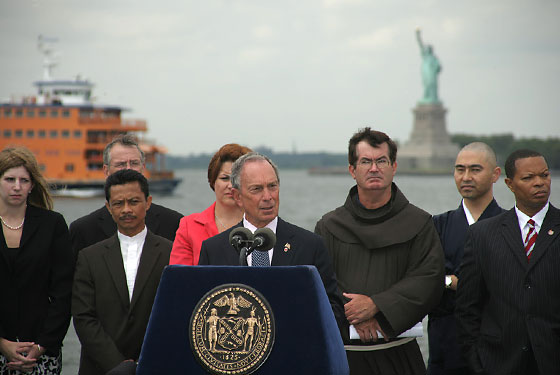
The Health Nazi says: No soda for You!
Mayor Michael Bloomberg (Mayer Bloomingdales) of New York City, said that the City's food stamp recipients should not be able to buy soda (pop, tonic) or carbonated beverages.
Mayor Michael Bloomberg (Mayer Bloomingdales) of New York City, said that the City's food stamp recipients should not be able to buy soda (pop, tonic) or carbonated beverages.
Here's an article on the story:.
.
No Soda for You!
Jonathan H. Adler • October 7, 2010 9:07 am
The WSJ reports:
Mayor Michael Bloomberg and Gov. David Paterson have asked the federal government to bar New York City food-stamp recipients from using the benefit to buy sugary drinks, an effort to determine if the move would decrease obesity and diabetes problems.
The request, sent late Wednesday to the U.S. Department of Agriculture, could affect an estimated 1.7 million city residents who receive food stamps. As much as $135 million in federal nutrition benefits is used to buy sugar-sweetened drinks, the mayor’s office said. . .
Food-stamp users cannot use benefits to buy alcohol and cigarettes. The request asks that the USDA allow city officials to have two years to assess if sugary-drink purchases drop, as well as problems associated with diabetes and obesity, a mayoral spokeswoman said. The proposal would not affect the total benefits received, she said.
So is this an example of over-weening paternalism? Or is it a responsible limitation on government assistance?
.
.
No Soda for You!
Jonathan H. Adler • October 7, 2010 9:07 am
The WSJ reports:
Mayor Michael Bloomberg and Gov. David Paterson have asked the federal government to bar New York City food-stamp recipients from using the benefit to buy sugary drinks, an effort to determine if the move would decrease obesity and diabetes problems.
The request, sent late Wednesday to the U.S. Department of Agriculture, could affect an estimated 1.7 million city residents who receive food stamps. As much as $135 million in federal nutrition benefits is used to buy sugar-sweetened drinks, the mayor’s office said. . .
Food-stamp users cannot use benefits to buy alcohol and cigarettes. The request asks that the USDA allow city officials to have two years to assess if sugary-drink purchases drop, as well as problems associated with diabetes and obesity, a mayoral spokeswoman said. The proposal would not affect the total benefits received, she said.
So is this an example of over-weening paternalism? Or is it a responsible limitation on government assistance?
.
.
Thursday, March 04, 2010
Paterson demands: Facts, not fiction

Paterson demands:Facts, not fiction
Each day, since the New York Times began a series of articles on Gov. David Paterson’s aide David Johnson, accused of domestic violence, the situation gets a little graver for the embattled governor.
More of this story
Each day, since the New York Times began a series of articles on Gov. David Paterson’s aide David Johnson, accused of domestic violence, the situation gets a little graver for the embattled governor.
More of this story
Thursday, October 08, 2009
David Paterson Does the Right Thing and Drops the Rock

Posted: October 7, 2009 04:58 PM
Today is a historic day for New York, the day that the Rockefeller Drug Law reforms kicked in, setting in motion the release of 1,500 low-level nonviolent drug offenders. The new law also gives judicial discretion back to judges, who can now determine whether someone should get treatment for their addiction instead of a jail cell.
I went to Brooklyn's Supreme Court and attended a public event to mark the milestone. The court room was full of activists, politicians and service providers that have been working for years to make this reform happen.
As an activist who has felt the sting of the Rockefeller laws firsthand -- serving 12 years under a 15-years-to-life sentence for a first time nonviolent offense -- I understand the full meaning of these changes. For years the Rockefeller Drug Laws became a political hot potato that was thoroughly debated, but nothing was ever done. Bills were submitted, arguments were made and each political party blamed the other for the impasse. In the meantime, those imprisoned were rotting away in the gulags of New York state. No better off were the family members of the incarcerated, whose hopes and aspirations slowly died as nothing was done.
Governor Paterson deserves thanks and praise for getting the job done. He has been instrumental and worked tirelessly, first as a state senator from Harlem and then as governor, to make these reforms happen. He said that "today was a day for second chances." For me, the governor's statement summed up the purpose of the new reforms. For years the Rockefeller Drug Laws were a symbol of a purely punitive approach to the problems of the drug war in New York state, one based on the archaic and outdated criminal justice mentality of "lock 'em up and throw away the key." Now, under the guidance of Governor Paterson, New York has abandoned that failed strategy and committed itself to a new approach that emphasizes addiction treatment instead of incarceration.
Now that the laws have been reformed, we have to make sure the changes are done right. Advocates and service providers have jumped in and have been working diligently to prepare for implementation. Legal aid and public defender agencies are providing legal counsel. Hundreds of social service agencies around the state have volunteered to provide a broad range of services to individuals who will be released from prison as a result of drug law reform. In New York City alone, more than 100 social service groups have agreed to work with legal aid and public defender agencies to provide services such as housing, job training and drug treatment to people returning from prison as a result of the reform.
For 35 years, New York was known as the state with the worst drug laws. It's time to change directions and make New York known for having the best practices, based on public health and safety.
Anthony Papa is the author of 15 To Life and a communications specialist for the Drug Policy Alliance
I went to Brooklyn's Supreme Court and attended a public event to mark the milestone. The court room was full of activists, politicians and service providers that have been working for years to make this reform happen.
As an activist who has felt the sting of the Rockefeller laws firsthand -- serving 12 years under a 15-years-to-life sentence for a first time nonviolent offense -- I understand the full meaning of these changes. For years the Rockefeller Drug Laws became a political hot potato that was thoroughly debated, but nothing was ever done. Bills were submitted, arguments were made and each political party blamed the other for the impasse. In the meantime, those imprisoned were rotting away in the gulags of New York state. No better off were the family members of the incarcerated, whose hopes and aspirations slowly died as nothing was done.
Governor Paterson deserves thanks and praise for getting the job done. He has been instrumental and worked tirelessly, first as a state senator from Harlem and then as governor, to make these reforms happen. He said that "today was a day for second chances." For me, the governor's statement summed up the purpose of the new reforms. For years the Rockefeller Drug Laws were a symbol of a purely punitive approach to the problems of the drug war in New York state, one based on the archaic and outdated criminal justice mentality of "lock 'em up and throw away the key." Now, under the guidance of Governor Paterson, New York has abandoned that failed strategy and committed itself to a new approach that emphasizes addiction treatment instead of incarceration.
Now that the laws have been reformed, we have to make sure the changes are done right. Advocates and service providers have jumped in and have been working diligently to prepare for implementation. Legal aid and public defender agencies are providing legal counsel. Hundreds of social service agencies around the state have volunteered to provide a broad range of services to individuals who will be released from prison as a result of drug law reform. In New York City alone, more than 100 social service groups have agreed to work with legal aid and public defender agencies to provide services such as housing, job training and drug treatment to people returning from prison as a result of the reform.
For 35 years, New York was known as the state with the worst drug laws. It's time to change directions and make New York known for having the best practices, based on public health and safety.
Anthony Papa is the author of 15 To Life and a communications specialist for the Drug Policy Alliance


Wednesday, April 15, 2009
Paterson Will Introduce Same-Sex Marriage Bill

April 14, 2009, 8:52 am
By Jeremy W. Peters
Gov. David A. Paterson on Thursday will announce plans to introduce legislation to legalize same-sex marriage, according to people with knowledge of the governor’s plans.
Mr. Paterson’s move, which he first signaled last week after Vermont became the fourth state to allow gay and lesbian couples to wed, reflects the governor’s desire to press the issue with lawmakers in Albany as other states move ahead with efforts to grant more civil rights to homosexuals.
The action in Vermont, where state legislators overrode Gov. Jim Douglas’s veto of a bill legalizing same-sex marriage, came less than a week after the Iowa Supreme Court granted same-sex couples the right to marry.
Mr. Paterson has said in recent days that the State Legislature should move ahead now with the legislation regardless of whether it can muster enough votes. His reasoning, which some gay rights advocates have challenged, is that New York should make a statement that it is committed to treating same-sex couples the same way it treats opposite-sex couples.
The announcement will take place at 10 a.m. on Thursday at Mr. Paterson’s office in Midtown Manhattan, said people who were briefed on the governor’s plans but who asked not to be identified because they did not want to upstage the governor.
The fact that Mr. Paterson is introducing a bill does not, however, mean that action in the Legislature is imminent. It could take months — even longer — before the bill makes its way through the appropriate committees and onto the floor of the Senate and the Assembly.
“This is not a guarantee of anything,” said Assemblyman Micah Z. Kellner, a Democrat from the Upper East Side who noted that it took two months for legislation legalizing same-sex marriage to get through the Assembly in 2007 before it ultimately stalled. The Senate never acted on the bill.
The legislation is likely to have an especially bumpy ride in the Senate, where more lawmakers oppose same-sex marriage than support it. Gay rights advocates are now actively seeking more senators, both Democrats and Republicans, to vote for the bill.
While Mr. Paterson has said he would like to see lawmakers “fight it out” and debate the bill on the floor of both houses even if it fails, Albany tradition dictates that the bill is likely to come to a vote only when it has enough support to pass. Senator Thomas K. Duane, a Democrat and the bill’s chief supporter in the Senate, has said he opposes the governor’s notion of fast-tracking it. And the Senate majority leader, Malcolm A. Smith, has said he would bring the bill to the floor when it has enough support.
The same-sex bill Mr. Paterson plans to introduce is the same piece of legislation that former Gov. Eliot Spitzer introduced in 2007, said Assemblyman Daniel J. O’Donnell. The Assembly passed it by 24 votes, 85 to 61, a wider margin than expected.
Mr. O’Donnell said there was some discussion among lawmakers, gay rights lobbyists and the governor’s office about whether the legislation should include any new language that would, for example, allow city clerks to refuse to marry same-sex couples. But Mr. O’Donnell said that the decision was made to leave the bill as is.
“Whether or not the bill should be amended is a political question,” he said, “but it is a political question that would take more time than it’s worth to resolve. So we decided to leave it.”
Source:http://cityroom.blogs.nytimes.com/2009/04/14/paterson-will-introduce-same-sex-marriage-bill/?hp
Subscribe to:
Posts (Atom)