Showing posts with label government controlled media. Show all posts

Thursday, January 15, 2026

SCOTUS, the Paradigm Shift & ICE

As the U.S. Supreme Court debates whether men can compete in women’s sports, mainstream media has started using terms like “wife” and “husband” in ways once considered unconventional. After Renee N. Macklin Good was fatally shot by an ICE officer in Minneapolis on January 7, 2026, news outlets referred to her lesbian partner as her WIFE and eventually her WIDOW. It’s been a decade since the Supreme Court legalized same-sex marriage on June 26, 2015, expanding the definition of marriage beyond a man and a woman to include same-sex couples. In LGBT+ relationships, there can now be two WIVES or two HUSBANDS. As ICE continues detaining foreign nationals without legal authorization, discussions around gender roles and identities persist, with Media reinforcing newer uses of these terms, as seen in headlines like: “ICE detains man applying for green card at routine check-in, husband says.”

ICE detains man applying for green card at routine check-in, husband says

Story by Jason Lemon

A couple’s efforts to establish their life together have been disrupted after Elias Perez-Zuazo was detained by Immigration and Customs Enforcement (ICE) during what he and his husband believed to be a routine immigration check-in.

Jonathan Blanco Gallegos told WRC-TV in Washington that they were in process of applying for a green card for Perez-Zuazo but now face an uncertain future as legal proceedings unfold and questions remain over his detention.


Sunday, November 17, 2024

Republican senator accuses Dems, media of double standard on outrage over Trump's cabinet picks


'The Democrats are spending so much time talking about the scrutiny of President Trump’s picks and yet, did we spend this amount of time scrutinizing Biden’s picks?' Sen. Markwayne Mullin said

By Kristine Parks Fox News

Published November 17, 2024 8:00pm EST

GOP Senator rips media over scrutiny over Trump cabinet picks

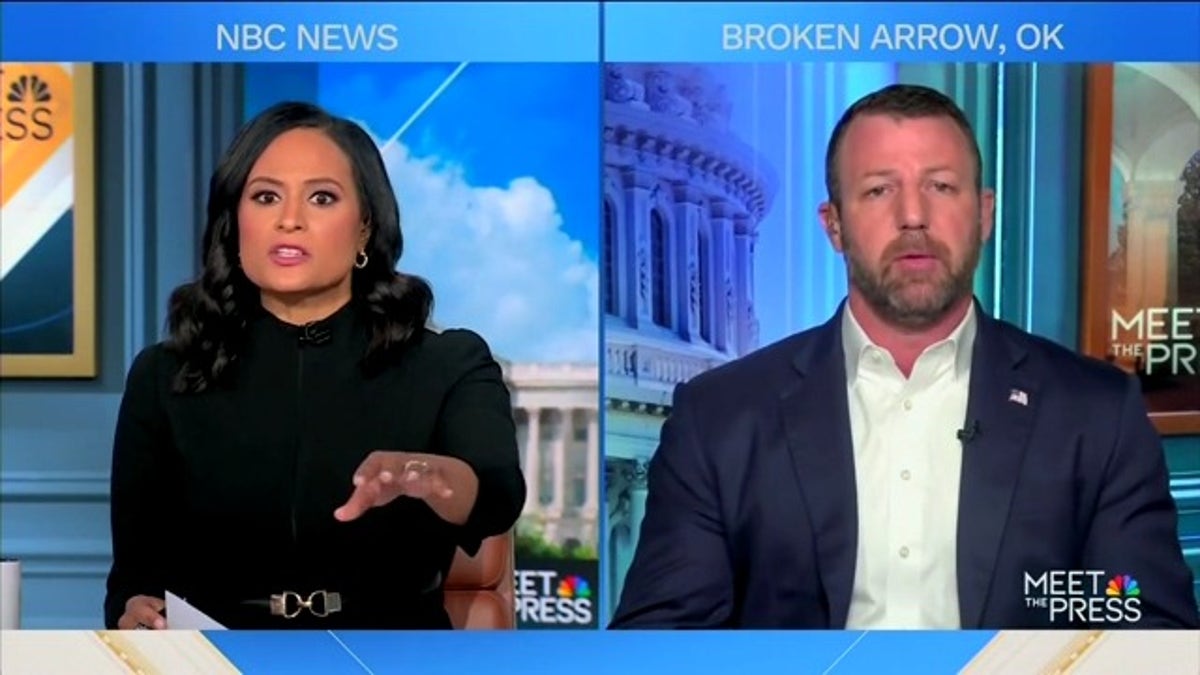
Sen. Markwayne Mullin, R-Okla., defended President-elect Donald Trump's cabinet picks and hit back at the media over their lack of scrutiny over President Biden's cabinet picks.

A Republican senator clashed with NBC anchor Kristen Welker in a Sunday interview after he pushed back against the scrutiny over President-elect Donald Trump's cabinet nominations, compared to their treatment of President Biden's more controversial staffing picks.

Democrats in Congress and in the media have blasted Trump's cabinet nominees over their qualifications, including combat veteran Pete Hegseth as secretary of defense; South Dakota Gov. Kristi Noem as secretary of homeland security; Rep. Matt Gaetz, R-Fla., as attorney general; and Robert F. Kennedy, Jr. as head of the Department of Health and Human Services (HHS), among others.

On NBC's "Meet the Press" on Sunday, Welker pressed Sen. Markwayne Mullin, a Republican from Oklahoma, if Kennedy's skepticism toward vaccines could be a "deal breaker" in confirming the Trump nominee to head the HHS.

Mullin denied this would be a dealbreaker for him before launching into a rebuke of Democrats and liberal voices in the media for not showing the same outrage over some of President Biden's more controversial cabinet and staffing picks at the start of his term.

DEMOCRATS' FUROR OVER ‘UNQUALIFIED' TRUMP NOMINEES PUTS BIDEN'S STAFFING DECISIONS BACK IN THE SPOTLIGHT


Tuesday, December 19, 2023

All agree: Media bias worst ever, Biden coverage condemned


by Paul Bedard, Washington Secrets Columnist
December 18, 2023 12:03 PM


Media bias, the poor coverage of the Biden White House by the liberal press, and the hiding of first son Hunter Biden’s scandals have reached a new level.

In the latest Rasmussen Reports survey, 10 times as many likely voters believe that bias has reached a low point than a high one.

The details of the survey shared with Secrets said that 60% of likely voters believe media bias has gotten worse, up 6 points from the last time Rasmussen asked. Just 6% said bias is getting better, and 30% said it was about the same as in March when the pollster asked about it.

Partisan politics is somewhat at play, but still, far more Democrats, Republicans, and independents than not said bias in the news is getting worse.

Democrats, 44%-11%, said bias is getting worse than better. Republicans said worse, 74%-2%. And independents said 63% worse than 4% better.

Rasmussen added that voter disgust with the media didn’t end there.

Asked to rate the media’s coverage of the Biden administration, 65% of likely voters said it is fair to poor. Less than half, 30%, said good to excellent.

When asked if the media have provided too much, not enough, or just the right amount of coverage of Hunter Biden’s scandals, 51% said not enough, 24% said too much, and 19% said just the right amount.

Rasmussen said that voters who support President Joe Biden feel the best about the media, which generally hold the same liberal views as the White House.

“President Joe Biden’s strongest supporters are most satisfied with the news media. Among voters who ‘strongly approve’ of Biden’s job performance as president, 61% rate the media’s coverage of his administration as good or excellent. By contrast, among those who ‘strongly disapprove’ of Biden’s performance, 77% give the media a poor rating for their coverage of the Biden administration,” Rasmussen said.


Monday, October 17, 2016

America's Secret Cerebral Campaign - Psychological and Informational Operations


AMERICA’S SECRET CEREBRAL CAMPAIGN – PSYCHOLOGICAL AND INFORMATIONAL OPERATIONS


04 OCT 2016 POSTED BY WILL BRENDZA


Propaganda comes in many shapes and sizes – and our government seems to employ each one with taciturn precision: from popular artwork, to political ads, news, media, television shows, film and even music. “Psychological and informational operations” they’re called, America’s secret cerebral campaigns.

In America’s recent past, psychological operations (or Psy-Ops) were not technically legal for the government to run in America against Americans, yet that did not always stop them, as our government had some exceptionally sly methods for working around that complication. Yet today, it has now become legal for such psychological operations to operate on American soil with the intention of manipulating the way Americans think, feel and act… for national security of course. And yes you heard that correct, it now legal.

Americans are constantly encouraged to participate in capitalism, instilled with the illusion of political choice, and convinced, swayed, or tricked into believing whatever our government wants. We are used to justifying their means with public “support” that they themselves sowed. Mind games. But our government runs Psy-Ops in almost every country they have a stake in, not just the good ol’ US of A.


Recently, news broke that, at the onset of America’s famous invasion of Iraq, the Pentagon hired PR firm Bell Pottinger to create fake al-Qaida propaganda videos – and they were paid almost a half-billion dollars (of US taxpayer money) for the product. Bell Pottinger was instructed to make the films in the style of Iraqi network news and insurgent videos, and disseminate them across the war-torn country to frame al-Qaida in negative light. They even wrote Arabic soap opera scripts criticizing al-Qaida, and showing positive consequences for rejecting terrorism.

Belle Pottinger really went all out for this project. And this is absolutely not the first time this PR firm has been involved with controversial, shady clients. Notably, one of their biggest clients is the Saudi government – Bell Pottinger Middle East was established in 2006, and evidence suggests that at that same time they were also working for the US government to create propaganda in Iraq. Which, in my humble opinion, stinks of war profiteering.

But why would the government pay such an exorbitant amount of money to externalize the content creation for its propaganda operations in the Middle East? Simply because, at the time, US law prevented them from creating it on their own – but if the propaganda is outsourced, and they can distance themselves from the people who actually made it, there is nothing stopping them from brainwashing whomever they want to however they feel like.


(Soldiers from the U.S. Army’s 350th Tactical Psychological Operations, 10th Mountain Division, drop leaflets over a village near Hawijah in Kirkuk province, Iraq, on March 6, 2008.)

The thing is, a lot of Americans won’t have a problem with our government using propaganda against our enemies during a time of war. It is a time-tested strategy that works effectively. Minds are malleable. And government institutions like the FBI, and CIA have a lengthy history of testing and using psychological warfare abroad and at home. If you’ve ever heard of MK-Ultra, the CIA’s secret program dedicated to mind-control, and hypnosis, then you know what I’m talking about.


And therein lies the rub: if our government was using sneaky measures to circumvent its own laws in order to create and disseminate propaganda, what is stopping them from doing the same thing at home, especially now that they are legally allowed to do so? They can justify psychological and informational operations against our enemies, but explaining mind manipulation operations against the American people, would be very difficult.

There are no positive outcomes for such a situation. If the government is running covert psy-ops against the American people, and we find out about it, there will likely be a revolution that erupts out of the ensuing rage. If we never find out about it, they will continue to manipulate us psychologically, to achieve whatever diabolical ends they can dream up.

In the coming weeks we will hopefully learn more about the relationship between Bell Pottinger and the US government, and the extent to which their propaganda operations influenced the events during the Iraq war. But neither the pentagon nor the PR firm is eager to comment. The operations they ran werehighly confidential, top secret exercises that were supposed to remain covert. Despite the secrecy surrounding Bell Pottinger’s work, the Pentagon has repeatedly asserted that the material produced by the PR firm was “truthful”…

I doubt that there will be any repercussions or serious outcomes in the wake of this revelation. The government will sweep it under the rug and it will be damned to be forgotten like so much of our important news issues. But propaganda is no trivial matter – the freedom of the American people will quietly disappear without anyone ever even noticing should the USA continue down the path to becoming a psy-op state. Our only hope of preventing that is to make it known that we, the American people, will not stand to be propagandized.

Sources: http://www.thedailybeast.com/articles/2016/10/01/pentagon-paid-for-fake-al-qaeda-videos.html, https://www.rt.com/usa/361385-pentagon-pr-firm-terrorist-videos/, http://labs.thebureauinvestigates.com/fake-news-and-false-flags/, http://www.bellpottinger.com/, http://www.bellpottinger.com/networks/middle-east, https://en.wikipedia.org/wiki/History_of_propaganda, http://www.motherjones.com/politics/2012/05/congress-propaganda, http://gizmodo.com/project-mkultra-one-of-the-most-shocking-cia-programs-1370236359, http://www.prweek.com/article/1410858/bell-pottinger-spotlight-creating-propaganda-videos-us-military-iraq


Tuesday, September 02, 2014

The Dubious Sources of Some Supreme Court ‘Facts’


Politics
 
Seeking Facts, Justices Settle for What Briefs Tell Them


SEPT. 1, 2014


Justice Antonin Scalia has criticized the court's acceptance of data found in amicus briefs. Credit Haraz N. Ghanbari/Associated Press


By ADAM LIPTAK


WASHINGTON — The Supreme Court received more than 80 friend-of-the-court briefs in the Hobby Lobby case. Most of these filings, also called amicus briefs, were dull and repetitive recitations of familiar legal arguments.

Others stood out. They presented fresh, factual information that put the case in a broader context.

The justices are hungry for such data. Their opinions are increasingly studded with citations of facts they learned from amicus briefs.

But this is a perilous trend, said Allison Orr Larsen, a law professor at the College of William and Mary.

“The court is inundated with 11th-hour, untested, advocacy-motivated claims of factual expertise,” she wrote in an article to be published in The Virginia Law Review.

Some of the factual assertions in recent amicus briefs would not pass muster in a high school research paper. But that has not stopped the Supreme Court from relying on them. Recent opinions have cited “facts” from amicus briefs that were backed up by blog posts, emails or nothing at all.

Some amicus briefs are careful and valuable, of course, citing peer-reviewed studies and noting contrary evidence. Others cite more questionable materials.

Some “studies” presented in amicus briefs were paid for or conducted by the group that submitted the brief and published only on the Internet. Some studies seem to have been created for the purpose of influencing the Supreme Court.

Yet the justices are quite receptive to this dodgy data. Over the five terms from 2008 to 2013, the court’s opinions cited factual assertions from amicus briefs 124 times, Professor Larsen found.

The phenomenon is novel. “The U.S. Supreme Court is the only American judicial entity that depends so heavily on amicus briefs to educate itself on factual matters,” Professor Larsen wrote.

The trend is at odds with the ordinary role of appellate courts, which are not supposed to be in the business of determining facts. That is the job of the trial court, where evidence is submitted, sifted and subjected to the adversary process.

Appellate courts traditionally take those facts, fixed in the trial court record, as a given. Their job is to identify and apply legal principles to those facts.

Justice Antonin Scalia made this point in a 2011 dissent chastising the majority for its blithe acceptance of “government-funded studies” that “did not make an appearance in this litigation until the government’s merits brief to this court.”

But “Supreme Court briefs are an inappropriate place to develop the key facts in a case,” Justice Scalia wrote. “An adversarial process in the trial courts can identify flaws in the methodology of the studies that the parties put forward; here, we accept the studies’ findings on faith, without examining their methodology at all.”

The net result, he said, is “untested judicial fact-finding masquerading as statutory interpretation.”

At least the studies that Justice Scalia complained about were submitted by a party to the case and thus were likely to be closely examined by the other side.

Most of the information from the amicus briefs recently cited by the justices was not subjected to even that level of adversary scrutiny. Only 28 percent of the cited materials drew a response from one of the parties in the case.

In the Hobby Lobby case, Justice Samuel A. Alito Jr. pushed back against the recent trend, refusing to consider “an intensely empirical argument” in an amicus brief. “We do not generally entertain arguments that were not raised below and are not advanced in this court by any party,” he wrote.

Not so, Professor Larsen wrote in a recent blog post. “This descriptive statement by Justice Alito about Supreme Court practice is simply incorrect,” she wrote.

Consider these examples.

In a 2011 decision about the privacy rights of scientists who worked on government space programs, Justice Alito cited an amicus brief to show that more than 88 percent of American companies perform background checks on their workers.

“Where this number comes from is a mystery,” Professor Larsen wrote. “It is asserted in the brief without citation.”

In a 2012 decision allowing strip searches of people arrested for even minor offenses as they are admitted to jail, Justice Anthony M. Kennedy cited an amicus brief to show that there are an “increasing number of gang members” entering the nation’s prisons and jails. The brief itself did little more than assert that “there is no doubt” this was so.

And in a 2013 decision, Justice Stephen G. Breyer cited an amicus brief to establish that American libraries hold 200 million books that were published abroad, a point of some significance in the copyright dispute before the court. The figure in the brief came from a blog post. The blog has been discontinued.

In an interview, Professor Larsen said she was struck by how often justices cited the amicus briefs themselves as sources of authority, as opposed to the materials collected in the briefs. “It really makes you wonder how much digging the justices are doing,” she said.

Kannon K. Shanmugam, a lawyer with Williams & Connolly who argues frequently before the court, said the justices’ quandary was a common one.

“The Supreme Court has the same problem that the rest of us do: figuring out how to distinguish between real facts and Internet facts,” he said. “Amicus briefs from unreliable sources can contribute to that problem.”


Source
.


Related
.
Adventist Church files amicus brief for workplace religious freedom case at top U.S. court


Church hopes Supreme Court will take case of Muslim girl who was denied job

August 27, 2014 | Silver Spring, Maryland, United States | Ansel Oliver/ANN

The Seventh-day Adventist Church filed an amicus brief today urging the United States’ top court to accept the case of a Muslim girl who was denied a job because her hijab—a head-covering—violated a company’s policy.

The Adventist Church’s “friend-of-the-court” brief is joined by seven other faith groups for the case Equal Employment Opportunity Commission vs. Abercrombie & Fitch Stores, Inc. The U.S. Supreme Court will decide in October whether to accept the case.

The Church’s move follows a decision last year by a federal appeals court that ruled against the girl and created additional statutes that violate protections of the U.S. Civil Rights Act. That ruling, by the 10th Circuit Court of Appeals in Denver, said the religious observance or practice in question must be mandatory, not just encouraged by the employee’s religious beliefs.

The brief claims last year’s ruling also mandates undue responsibility on applicants to raise concerns over religious observance. Applicants might not always know the employer’s requirements.

Church legal counselors said the ruling then allows an employer’s ignorance to eliminate protections for religious-observant applicants, which violates Title VII of the Civil Rights Act.


Read more
.
.
P.S. 
The real fact about the honorable U.S. Supreme Court in 2014, is that 6 out of the 9 "justices" are Roman Catholic.
There is nothing 'DUBIOUS' about that!

It's blatantly overt for anyone with half a brain to notice that tangible fact. It's peculiar, it's prophetic...
The rest of the faux-facts are gibberish.

Arsenio
.