Showing posts with label B. Black. Show all posts

Saturday, February 07, 2026

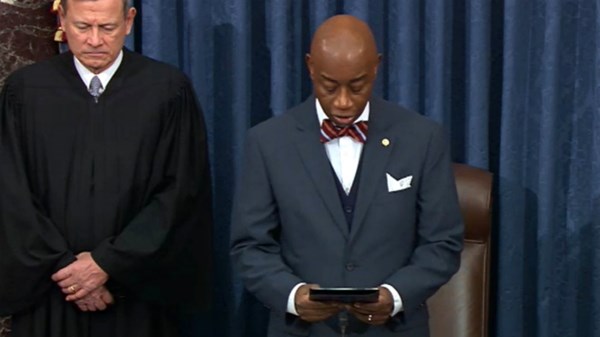
The Hidden Power of the Senate Chaplain’s Prayers in Nation’s Crises

 
For if thou altogether holdest thy peace at this time, then shall there enlargement and deliverance arise to the Jews from another place; but thou and thy father's house shall be destroyed: and who knoweth whether thou art come to the kingdom for such a time as this? Esther 4:14.

Is Barry Black giving the trumpet a certain sound?

As a Seventh day Adventist and 20 years as a CHAPLAIN (a Catholic concept) to the U.S. Senate, has he preached the Three Angels' Messages to the nation's legislators?

Thursday, February 06, 2020

Split Down the Aisle by Impeachment, Senate Still United in Prayer


Chaplain balances bipartisan alliances with trust in God’s will.


KATE SHELLNUTT

FEBRUARY 05, 2020 4:50 PM


Image: Getty

Your daily news briefing from the editors of CT:


While elected officials from either party don’t agree on the outcome of the impeachment trial, they could agree on how to pray for the proceedings, according to Barry Black, a Seventh-day Adventist minister and the longtime chaplain of the US Senate.

So what do you pray after the US Senate votes to acquit Trump on two articles of impeachment, as it did on Wednesday afternoon?

You pray that God’s will be done.

“I think the prayer of Jesus in Gethsemane provides us with the model,” Black told CT. “The preamble to saying, ‘Let your will be done’ can be ‘Father, all things are possible for you. If it is possible, let the impeachment trial come out this way, nevertheless, not as I will but let your will be done.’ That’s the basic setup, but the dominant thematic focus should always be ‘Let your will be done.’”

The minister, with his signature bow tie and deep preacher’s cadence, says that in the middle of the polarization and partisan sniping, he has urged senators and staff on both sides to seek God’s will.

People have been listening closely to Black’s prayers as the Senate has battled over the historic impeachment vote. He draws powerful phrases from his daily devotions and hours of scriptural studies.


Sunday, February 17, 2019

U.S. Senate chaplain urges 'unconditional benevolence' in talk in Providence church


By Kevin G. Andrade
Posted Feb 16, 2019 at 9:38 PM
Updated Feb 17, 2019 at 1:37 AM


U.S. Senate Chaplain Barry Black speaks at the Central Congregational Church, in Providence, on Saturday night. [The Providence Journal / Kevin G. Andrade]▲


Barry Black spoke about integrating citizenship and faith for the 2019 Darrell West Lecture Series on Religion and Politics.

PROVIDENCE — When you hear U.S. Senate Chaplain Barry Black speak, you might be struck by how many Bible verses and citations he knows by heart, but he has a simple explanation for his ample mental reserve of sacred text.

"Five cents a verse," he said, eliciting a laugh from the roughly 200 people gathered at the Central Congregational Church Saturday night to hear him speak. "That is all it took."

That pocket change came from his mother, who handed over the money for every Bible verse he and his siblings committed to memory, Black said during his talk on integrating citizenship and faith for the 2019 Darrell West Lecture Series on Religion and Politics.

"I cannot imagine what his job is like," West, a former Brown University professor of political science and current senior vice president at the Brookings Institution, said of Black. "I know that he manages to be meaningful and neutral at the same time, which is quite important in his position."

Black framed his conversation in terms of a concept that has become an ideological battleground in the United States — citizenship.


Wednesday, January 17, 2018

Congressional Gold Medal Ceremony Honoring Senator Bob Dole


P.S. 

Chaplain of the U.S. Senate Barry Black (SDA) closing prayer;

@ 1:09:15 mins.

open-
Eternal Lord God...

close-
We pray this in your great Name... Amen.


Chaplain Barry Black has forgotten how to pray to Our Heavenly Father, and doing it in JESUS' Name.

Saturday, May 02, 2015

Senate Chaplain Prayer for Baltimore and Nepal


APRIL 28, 2015


Chaplain Barry Black opened the Senate session with a prayer for Baltimore, where protests and rioting erupted the previous day after a funeral for an African-American who died of a severe spinal cord injury while in police custody, and for Nepal, which suffered a 7.8-magnitude earthquake during the prior weekend. He also prayed for senators to work together to solve those problems.


Source

.

Wednesday, October 16, 2013

No Deal On Tuesday Leads To Day 16 Of Shutdown On Wednesday


October 16, 2013 4:11 AM

4 min 34 sec


With the threat of a government default looming, House leaders tried to take the upper hand in the standoff with a bill appealing to their most conservative members. They failed, resulting in chaos in the House and giving the initiative back to the Senate...


Source


.. .. . . .

Friday, October 11, 2013

Senate Chaplain: Death Benefits Delay Is ‘Incomprehensible’


Thursday, October 10, 2013


(To listen to podcast go to link)


Senate Chaplain Barry Black poses for a portrait in his office on Capital Hill in Washington Friday, July 9, 2010. (Drew Angerer/AP)

As the government shutdown continues, Barry Black, the 62nd Chaplain of the United States Senate and a rear admiral in the United States Navy, is no longer straddling the middle.

He calls the delay of death benefits to the families of recently killed service members “incomprehensible.”

Black told Here & Now‘s Robin Young that his 27-year service as a chaplain in the Navy and Marines has made the issue of death benefits resonate with him. One of his duties was to tell the family when a soldier died.

“I know what it feels like to be reading the newspapers searching for an understanding of what kind of support and back up you’re receiving from your government, so the idea of adding wait to the burden of grieving families is, to me, unthinkable,” Black said. “There comes a time when it doesn’t matter who is right or wrong.”

Guest
Barry Black, chaplain of the United States Senate.

More in Politics

What Would A Debt Default Mean For US Bond Holders?

October 10, 2013

Transcript


ROBIN YOUNG, HOST:

Well, the private foundation Fisher House has stepped in to make up for those stalled benefits to families of service members killed in action. The group will be reimbursed when the shutdown ends. And the Tampa Bay Special Ops Warrior Foundation will also present an additional $20,000 to the families of troops killed in Afghanistan over the weekend.

There has been outrage over the delay of the so-called death gratuities to help families, and yesterday the Senate chaplain, retired Navy Rear Admiral Barry Black, let loose on lawmakers in his opening prayer.

BARRY BLACK: Lord, when our federal shutdown delays payments of death benefits to the families of children dying on faraway battlefields, it's time for our lawmakers to say enough is enough.

YOUNG: And Chaplain Barry Black joins us now. Chaplain Black, you've been gently scolding lawmakers in the prayer over the shutdown but this was specific.

BLACK: Well, I think it engendered an empathy more intense than anything I've felt so far. I spent 27 years serving in the Navy and Marine Corps. One of my responsibilities was to inform the next of kin when there was a loss of the loved one. I know the trauma that that causes.

I also have been deployed. I've been in harm's way. I know what it feels like to be reading the newspapers searching for an understanding of what kind of support and backup you're receiving from your government. So the idea of adding weight to the burden of grieving families is, to me, unthinkable. It's just an absolutely incomprehensible thing for me.

So it does engender an intense empathy because I've been there, I've done that, and I have the T-shirt.

YOUNG: What would you say to people who say look, they have to see what it is, that this is what government is: it's payments to the families of dead troops, it's inspectors being called back because of a salmonella scare. You can't cherry-pick which you're going to restore? And then there are the other people who say the shutdown is good because we have too much government. What do you say to them?

BLACK: Well, the French philosopher and mathematician Pascal once said the heart has reasons that the mind can't understand. There comes a time to get beyond logic. There's a wonderful Bible verse in the Jewish scriptures, Isaiah Chapter 1, Verse 18, where God says to human beings come down, let us put an end to reason.

There are boundaries that are so sacrosanct that you don't cross them. And the care of our children who are giving the last full measure of devotion, you don't cross that boundary. I was saying to one journalist, I was talking about "The Godfather" movie and the back-and-forth and brinksmanship that took place in that very violent movie. But then the son of the don was killed, Santino, and the don said, the Marlon Brando character, he said this war is over.

There comes a time when it doesn't matter who is right or wrong, as Tina Turner sang in one of her songs, I don't care who's right or wrong, I don't want to fight anymore.

Don Corleone is right: this war should end.

YOUNG: Boy, it's rare when I hear references to Tina Turner, "The Godfather," Isaiah and Pascal in the same paragraph. We just did. By the way, have senators come to you for private consultation on the shutdown?

BLACK: Yes, yes, I've had - sitting in the office for over an hour talking to individual senators. And then there's a weekly prayer breakfast where 20 to 25 senators come together from both sides of the aisle and fellowship together and listen to a lawmaker talk about his or her personal faith pilgrimage and actually pray together at the end of each of the prayer breakfasts. And so...

YOUNG: Well, then, what's wrong, then, Chaplain, that we don't ever feel that they are doing anything together?

BLACK: Well, the legislative process can be cumbersome. It is adversarial by nature. But at some point in the legislative process, you know, hopefully you're going to have bipartisan cooperation. Hopefully you're going to have enough people saying let's find some common ground, and let's get this thing done.

YOUNG: By the way, do you think in the coming days you might get up and pray that legislators restore Head Start benefits? Because they seem to be, you know, listening to you. Harry Reid, who of course would want that to happen, he wants the shutdown to end, but he was said to be really listening intently to you, and he got up and he commented on what you said. And do you think you might pick other issues?

BLACK: Well, I'm not going to cherry-pick in my prayers, if that's what you're asking. No, I mean, you're not going to delay the death benefits of young people giving their lives and have a chaplain who spent 27 years serving them and have him get up and pray a now-I-lay-me-down-to-sleep-I-pray-the-lord-my-soul-to-keep prayer, I'm sorry.

You know, no, I apologize if that looked like I was isolating, you know, one issue, but that is just too important to me. It's the death of Santino for me. It's the this war should end for me. It's the enough is enough for me.

YOUNG: By the way, we should mention you're a federal employee. You're not being paid.

BLACK: No, that's correct.

YOUNG: Admiral Barry Black, chaplain for the United States Senate. Chaplain Black, thanks for speaking with us.

BLACK: Thank you so much, Robin, it's my pleasure.

YOUNG: And when we come back, Jeremy Hobson has the view of the shutdown from Phoenix, Arizona. You're listening to HERE AND NOW. Transcript provided by NPR, Copyright NPR.


Source
.

Monday, February 04, 2013

The Chaplains of the U.S. Congress


Dr. Barry Black Chaplain of the U.S. Senate (the first Seventh-day Adventist, and the first military chaplain to hold the office of chaplain to the United States).


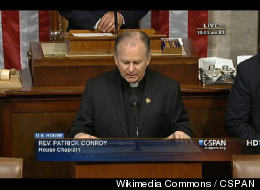
The Reverend Patrick J. Conroy, Chaplain, U.S. House of Representatives (is a Jesuit Priest who is serving as the 60th Chaplain of the House of Representatives).


What a dichotomy? 

An Adventist Chaplain and a Roman Catholic Jesuit priest as spiritual advisors on Capitol Hill?


.

In Whose Name?

I see an aversion to using the name of Jesus in Dr. Barry Black's (Chaplain of the U.S. Senate)  prayer as I view these 2 recent 'prayers' on video.

Does anyone else see this?
.
.
1. Prayer during Fiscal Cliff Negotations


2. Prayer for Sandy Hook Victims


.

Wednesday, February 29, 2012

Congress honors slaves who helped build U.S. Capitol

February 28, 2012 - 09:45 pm

WASHINGTON (AP) - Congressional leaders and
the chaplains of the House and Senate have dedicated a new stone marker to the slaves who helped build the U.S. Capitol building.


Today's ceremony was held on the next to last day of Black History Month.

The House chaplain, Father Patrick Conroy, noted that the Bible's book of Jeremiah says, "Woe to him who builds his palace by unrighteousness, making his countrymen work for nothing, not paying them for their labor."

Conroy called the historic marker in the Capitol's Visitor Center's Emancipation Hall "a small acknowledgement of those sins."

Senate Chaplain Barry Black, who is African American, said the ceremony should be a reminder that "in eternity, many who are now first will be last, and many who are now last will be first."


http://www.wjla.com/articles/2012/02/congress-honors-slaves-who-helped-build-u-s-capitol-73162.html
.

Monday, January 16, 2012

Congress’s Chaplains Try to Instill Civility in a Quarrelsome Flock

ON RELIGION


WASHINGTON — The Rev. Patrick J. Conroy invited all the members of the House of Representatives and their families to the holiday reception he was hosting last month as the chamber’s chaplain. He put out hot cider, cookies and a not-quite-functional chocolate fountain, and for the benefit of the children he picked up his folk guitar to perform “The House at Pooh Corner.”


Stephen Crowley/The New York Times

The Rev. Patrick J. Conroy, the House of Representatives chaplain.


Stephen Crowley/The New York Times

The Rev. Dr. Barry C. Black, the Senate chaplain.

Amid the well-organized cheer, though, Father Conroy noticed one subtly disquieting scene. It was apparent that two of his guests, representatives from opposite sides of the partisan aisle, and both sent to Washington to do the nation’s business, had never even spoken directly to each other before.

Nearly five months before that Christmas party, the chaplain of the Senate, the Rev. Dr. Barry C. Black, offered the opening prayer for a rare Sunday session. The Senate was deadlocked along partisan lines on a measure to raise the nation’s debt ceiling. The imminent prospect of a default on government bonds or a downgrade of the federal credit rating had not been enough to overcome the fierce dispute between Democrats and Republicans.

“Save us, O God,” Dr. Black pleaded in his prayer, “for the waters are coming in upon us. We are weak from the struggle. Tempted to throw in the towel. But quitting is not an option.”

In these two episodes, one private and the other very public, one can grasp the unusual and supple roles being played by the House and Senate chaplains. At a time when Congress is stunningly unpopular, with approval ratings in various recent polls around 12 percent, Father Conroy and Dr. Black serve as pastors to what must be one of the most reviled congregations in the country.

That harsh reality puts these clergymen in the position of trying to nurture civility within this fractious flock and trying to explain to a skeptical public that all is not as dire and broken as much of the citizenry plainly believes. They encounter senators and representatives not through speeches and sound bites but as participants in prayer breakfasts and Bible studies, or in casual moments in the Capitol’s cloakroom or restaurant or gym.

Very different paths brought the ministers to their respective roles. Dr. Black, 63, a Seventh-day Adventist, spent 27 years as a Navy chaplain, rising to the rank of rear admiral, before being appointed to the Senate position in 2003. He is the first African-American to be a Congressional chaplain. Father Conroy, 61, a Roman Catholic from the Jesuit order, had devoted much of his career to college chaplaincy and social-justice work. Named to his House post last May, he is even newer to the job than the chamber’s 87 first-term members.

“I’m dealing with a Crock-Pot,” Dr. Black put it, referring to the Senate’s reputation for deliberation. “He’s got a microwave.”

In the current session of Congress, the contrast between the appliances has been less evident, with showdowns over the debt ceiling and the payroll tax extension and dozens of filibusters and cloture votes. A deeply divided electorate seems to agree only on its disdain for Congress, and President Obama appears to be designing a re-election campaign that will cast Congress as villain.

“I’m a little more philosophical,” Dr. Black said in an interview last month. “I have a long view of history. We’ve had secession from the Union. I was in Alabama in the 1960s, drinking water from fountains labeled ‘Colored.’ It took 50 years to pass meaningful civil rights legislation. So I see things as cyclical in terms of polarization.”

Over in the House, Father Conroy prepared for his job in part by reading “American Lion,” Jon Meacham’s best seller about Andrew Jackson. The bitter rivalry between Jackson and Henry Clay in Congress has provided him with some assurance that “it’s not an unprecedented thing in American politics for there to be recriminations and a lack of civility.”

Particularly as a Jesuit, though, Father Conroy said he looked to the order’s founder, St. Ignatius of Loyola, who taught the importance of recognizing “godliness in the other.” (In the saint’s time, that meant Protestants, not the Tea Party or liberals.) The chaplain has also been striving to understand why the House can seem so resistant to that generosity of spirit.

“One of the things that’s true today that hasn’t been true of the past 30 years is that there are fewer civilizing forces,” he said in a mid-December interview. “The members’ families don’t live here. It’s easier on Friday to get on a plane and go home. So Congressman A’s spouse isn’t friends with Congressman Z’s. Or their kids don’t play together. You have no social bonding at all. The only relationship those congressmen have is as opponents.”

With its six-year terms and polite protocols, the Senate is at least in theory constructed for friendship and compromise. But it is also, as Dr. Black pointed out, the arena for two parties, two philosophies, two historical narratives, two analytical lenses. Its rules regarding filibuster and cloture put obstructive power in the hands of a determined minority.

“I’m amazed there’s as much civility as there is,” Dr. Black said. “I am gratified to see people of faith, who may be re-enacting the Thrilla in Manila in the chamber, holding hands at a prayer breakfast. I have a unique window that the general public doesn’t have.”

What both chaplains yearn for is a public with perspective on itself. The warring senators and representatives of Washington did not wind up there by accident or coincidence. Somebody elected them. To put it scripturally, Father Conroy said he finds himself thinking of Luke 6:41: “Why do you see the speck that is in your brother’s eye but do not notice the log that is in your own eye?”

“The American Congress,” he said, “represents the American people. Is it any surprise they got what they voted for? It’s easier to blame Congress than to look in the mirror.”

Email: sgf1@columbia.edu


Source
.

Sunday, September 25, 2011

Senate chaplain preaches peace to cantankerous flock

Drew Angerer/ASSOCIATED PRESS - Senate Chaplain Barry C. Black.

The Senate doesn’t do it on purpose, but it begins every day by acting out a drama in three parts and with the moral arc of a Shakespeare tragedy.

Act one is a prayer. Barry C. Black, the Senate’s chaplain, asks God for unity, wisdom and cooperation, pleading for the Senate in a voice as slow and solemn as a hearse.

Act two is the pledge. Lawmakers from both parties both pledge allegiance to the flag of one nation, indivisible.

Act three is the plot twist. After all the talk about unity and cooperation, the leaders of both parties stand up for their part of the morning ritual.

Which is denouncing one another as enemies of progress, abusers of the public trust, and raw sewage in the great river of American ideas.

Do nothing, and protect the millionaires.” That was Sen. Richard J. Durbin (Ill.), the Senate’s number-two Democrat, one day this week. He was accusing Republicans of abandoning the middle class during the economic crisis.

This whole thing is a charade.” That wasMinority Leader Mitch McConnell (R-Ky.). He stood stood up after Durbin, to ridicule the Democratic plans for economic recovery. “I think the American people deserve better.”

The bitter turn of this daily ritual has been particularly notable this week, as the two parties returned to fighting after an ultra-brief experiment with cooperation. Both had pledged to find common ground on the issue of jobs. Then both remembered there was almost no common ground to find.

In his office, tucked away down a quiet Senate hallway, the Senate’s chaplain said he doesn’t take it personally — this week or any other — when his flock goes back to squabbling.

“I don’t take it as any kind of litmus test on the efficacy of my intercession,” Black said.

The Senate has begun its working sessions with prayer since 1789. It has never been an easy job preaching peace to a flock whose main job is to fight one another: Peter Marshall, chaplain in the 1940s, said he was the Senate’s equivalent of parsley — mainly there for decoration.

Black, who has the job today, is a Seventh-Day Adventist who rose to the rank of rear admiral as a Navy chaplain. His job now is bigger than giving the Senate’s morning prayer: He counsels senators privately and leads Bible studies for the Capitol’s cooks, cops and janitors.

But Black still takes the parsley role very seriously. He writes his opening prayers in a Capitol office with stunning views of the Mall’s monuments — reminders, for him, of how God has helped America through past crises.

“There’s something about this view that drives home to me the sovereignty of God, and the unstoppable nature of providence,” Black said in an interview. “Like the coming of morning, [it] will not be restrained.”

His prayers, generally, ask God to instill senators with virtues of good government. Often, there are nudges toward bipartisan cooperation — in a Congress that has seen very little of it so far.

“Lord, infuse them with a spirit of reconciliation,” Black prayed Sept. 13, “that will break down divisive walls, bringing harmony and cooperation.”

“Give them also a spirit of unity,” Black said the next day. “And the wisdom to have respect, one for the other.”

“Today, enable the members of this body to experience your presence, and to receive your wisdom,” Black said Wednesday. “May they receive these blessings — aware of your counsel that to whom much is given, much is required.”

But often, there are few senators in the chamber to hear him. And those that are there often don’t seem to have listened.

The proof of that usually comes in “Leader Remarks,” when the two parties’ bosses come out to utter the first complaints, accusations and deprecations of a long day. This tradition of tit-for-tat “Leader Remarks” dates to about 1986, when C-Span cameras began broadcasting from the Senate.

Up in that office overlooking the Mall, Black said — slowly, solemnly — that he never feels as though he failed when he hears the day’s debate turning bitter again.

“These statements that are usually being read,” he said, “have obviously been prepared before the prayer.”

On Thursday, the Senate’s prayer was done by a guest chaplain, Silvester S. Beaman of Bethel African Methodist Episcopal Church in Wilmington, Del. Beaman, like Black, also called on God to awaken the Senate’s better angels: “Use the collective resolve of our United States Senate as your instrument, bringing wholeness and peace.”

Then, right on schedule, the Senate demonstrated that wholeness and peace were not on its agenda.

Senate Majority Leader Harry M. Reid (D-Nev.) stood up to give a speech denouncing House Republicans for a budget bill that would cut more funds than Democrats want. It was “so wrong,” Reid said, and “very, very unfair.”

“We really are at an impasse here,” Reid said, talking about the bill. Continuing disagreements threatened to shut down the federal government at the end of the month. “Not just because of what we’re doing. But because of what they’re doing.”

As soon as he finished, McConnell was waiting to speak.

Source

P.S.
1. Bolds added for emphasis
2. Boy, this sure sounds like a onesided leak, a prolonged whine!
3. Could this really be a political ad of the Democratic Party persuasion?

.

Saturday, January 23, 2010

Senate Chaplain: Religious Leader For Secular Flock

by Audie Cornish
January 23, 2010

Audio for this story from Weekend Edition Saturday will be available at approx. 12:00 p.m. ET


Walter Ray Watson/NPR
Senate Chaplain Barry Black (second from right) prays with his staff before delivering the prayer to open the legislative day of the U.S. Senate.


January 23, 2010


Most mornings, after the gavel is struck in the Senate chamber on Capitol Hill, a prayer is offered in that most secular body — a practice that goes back to the founding fathers at the Continental Congress in 1774.

Chaplain Barry C. Black delivers the prayer, offering up some of the first words heard each day in the chamber.

Black works from an office in the Capitol building, a well-appointed room with high, arched ceilings and wall-to-wall mahogany bookcases. Compared with the number of people working for senators, the chaplain's staff is downright humble. He has an executive assistant, a director of communications and a chief of staff.

But from this third-floor perch in the Capitol building, Black enjoys one of the best views of the National Mall's mosaic of cherry trees, museums and monuments.

Biblical Analysis For Earthly Decisions

The role the chaplain performs for the Senate stands almost at the meeting point between church and state. He's a religious leader and shepherd to what is essentially a secular flock. This includes the Senate lawmakers, their families and their staffs, as well as all the other people who work on the Senate side of the Capitol — nearly 6,000 people in all.


When the health care bill was being debated in the chamber, the people at my Bible study were from both sides of the aisle.

- Chaplain Barry Black


His job entails coordinating events with other spiritual leaders throughout the year, from rabbis to Muslim imams. He officiates at weddings, funerals and christenings for lawmakers, their families and their staffs, and offers one-on-one counseling on matters both spiritual and private.

He also leads five Bible study groups each week, including one that is made up of just senators. Black says he thinks that for almost any issue the Senate is debating, there are biblical aspects that can be discussed in the study groups he holds.

"For instance, when the health care bill was being debated in the chamber, the people at my Bible study were from both sides of the aisle," Black says. "And though we did not talk directly about the health care bill, I did a study on euthanasia and what the Bible says about 'end of life.' "
That particular Bible study he led for senators occurred around the time last year that the term "death panels" was bandied about by opponents of the health care legislation. Black addressed the death panels discussion, he says, because the Bible addresses it.

"My Bible themes come from what is actually going on, on Capitol Hill," Black says.

A Job Backed By The Founding Fathers

Though pending legislation sometimes informs the topics of his teachings, the chaplain says his position is nonpartisan and nonsectarian. While offering prayers on the floor of the Senate and in leading Bible study groups, he says he doesn't give his personal opinion on public policy or legislation. But if a senator asks him, Black will speak his mind, behind closed doors.

This raises a question: How appropriate is this practice of chaplains giving senators their opinions? Is it inappropriate to have this extraordinary access? Access that citizens — voters who elected senators — don't enjoy?

Black says the framers of the Constitution intended that guidance be available to the nation's lawmakers.


Walter Ray Watson/NPR
Black reads from a prayer book in his office. He is the 62nd Chaplain of the U.S. Senate


"And remember, the establishment clause says: 'Congress shall make no law respecting the establishment of a religion or prohibiting the free exercise thereof,' " Black says. "So to have the opportunity of being advised from an ethical perspective, the framers basically said we think we should be there."

The Path To Senate Chaplain

The chaplain is full of nuggets, quotes from speeches, verses from the Gospels, passages from Longfellow and even the wisdom of Barney Fife.

"Your children are not your children," he recites from The Prophet without notes. "They are the sons and daughters of life's longing for itself. They come through you, but not from you, and though they are with you, they do not belong to you."

Black learned the practice of memorizing from his mother, Pearline Buck Black, a devout Christian and Seventh-day Adventist. She raised her eight children in Baltimore's public housing with her husband, Lester Black, who was a truck driver.

In Pearline's home, any of her children could earn a nickel for memorizing a Bible verse. But it was young Barry who began memorizing the sermons of famous preachers, including Peter Marshall, a Scottish-born Presbyterian minister who also served as Senate chaplain.

But Black says he didn't even know Congress had chaplains until he was in his 20s in college.

Black picked up several college degrees before he became a preacher. He was told he was too young to be assigned his own congregation within the Seventh-day Adventist church, so he became a traveling minister.

In the 1970s, he was preaching in North Carolina when he encountered two young black servicemen who visited from the Norfolk, Va., area, regularly driving three to four hours to hear him. When he asked why they'd come so far, they mentioned that in the Navy, they'd never seen an African-American chaplain.

This planted a seed — and inspired Black to join the Navy shortly after.

Two decades later, he was Rear Adm. Barry Black, and a chief of chaplains — the first African American to hold the position.

In 2003, he was appointed to the Senate, where he says his job has given him "a pleasant surprise."

"The level of spirituality of many of the senators was greater than I expected [it] to be," Black says.
.
.
Source:http://www.npr.org/templates/story/story.php?storyId=122872399
.

Wednesday, December 23, 2009

Adventists Played Important Role in Obama Inaugural Events


Washington D.C./USA, 25.01.2009 / APD

Seventh-day Adventist Christians played important, visible roles in the inaugural festivities and early celebrations for President Barack Hussein Obama, the first African-American elected as chief executive of the United States of America.

Moments after President Obama’s inaugural address, Seventh-day Adventist pastor and U.S. Senate Chaplain Barry C. Black gave the invocation at the inaugural luncheon held in the Capitol’s Statuary Hall on January 20. The next morning, Wintley Phipps, a noted soloist and Seventh-day Adventist pastor, sang at the Inaugural Prayer Service at Washington National Cathedral.

U.S. Senate Chaplain Barry C. Black Black’s two-minute, 148-word prayer was broadcast live. "Lord of all nations, Whose Kingdom is above all earthly kingdom, and Who judges all lesser sovereignties," Black began, "look with favour upon President Barack Obama, Vice President Joseph Robinette Biden, and members of the Cabinet. Empower them with the wisdom, courage and strength needed for our times. And protect them from any moral arrogance that obstructs the making of a world of justice, peace and righteousness."

He continued, "Infuse them with a passion to act in ways pleasing to You. Lord, preserve their families in health and strength by Your mercy and power and may they find Your grace sufficient for every need. We ask also that You would shower Your blessings upon the American people. Give us the wisdom to support our new President with our prayers, patience, and perseverance."

Black concluded, "Bless now this luncheon and the nourishment we receive from Your bounty. We pray in Your Sovereign name, Amen."

Before the ceremonies, Black noted that an inaugural prayer isn't something to take a red pen to, he said. Unlike speeches, prayers are not "another act in the drama," said Black, former chief of chaplains for the U.S. Navy and a retired Naval Rear Admiral. Rather, he said, prayers ought to be reflective and deeply sincere. "I would be very concerned if someone or some committee was standing by to scrutinize what someone had passionately felt compelled to say to God on behalf of the people for a particular occasion," Black said.

Black said those on Capitol Hill have heard him pray enough -- he opens every session of the Senate with a prayer -- to be assured he won't say anything "out in left field."

Black said some might argue that prayer during state events, such as inaugurations, is little more than a formality or tradition -- George Washington initiated the first such prayer after he was sworn in by a chaplain who used the Book of Common Prayer. Others have gone so far as to claim that an inaugural prayer is unconstitutional and violates the separation of church and state.

However, Black said the country's need for prayer is as crucial as ever. "The Framers, despite their commitment to keep church and state separate, recognized the need for a spiritual dimension of government." Black's position itself was established in 1789, at the suggestion of Framers such as Benjamin Franklin, who Black said is credited with saying that it was "highly unlikely" for a nation to rise without God's assistance if a "sparrow cannot fall without [His] notice."

Black noted as many as 35 of the country's 100 senators -- from both sides of the aisle -- regularly attend weekly prayer breakfasts and Bible studies. Among those who attended, when they were each Senators, were Obama and Vice President Joseph Robinette Biden, both of whom Black said are "very spiritual individuals."

Black said he's had the opportunity to interact on a regular basis with Obama, whom he considers a friend. The then-Senator from Illinois provided an endorsement printed on the back cover of Black's 2006 book, From the Hood to the Hill.

The chaplain, whose office overlooks the National Mall, said the "awe-inspiring" view contributes to the "sense of wonder" he experiences each time he enters the nation's Capitol.

"I have the opportunity to interact with some of the brightest people I know of, and they're interested in my opinions on the ethical dimensions of the issues they're debating in the chamber. That privilege -- that responsibility -- is sobering, and very, very exciting," Black said.
Wintley Phipps, Pastor and Solist Another Seventh-day Adventist who was featured during the early hours of the Obama administration was Wintley Phipps, a soloist at past inaugurals who sang "Amazing Grace" at the Washington National Cathedral, site of the Presidential Inaugural Prayer Service on January 21. Phipps was the only soloist.

"What was particularly interesting was that the Secretary of State, Mrs. Hillary Rodham Clinton and [former] President Bill Clinton were present," Phipps told Adventist Review in a telephone interview. "A number of members of the Cabinet and Sen. John McCain [President Obama’s 2008 rival] and Sen. Joe Lieberman were also there. It was a very powerful service. It’s an awesome place to sing at."

Phipps, whose U.S. Dream Academy works with children who need help succeeding in challenging environments, also reflected on what the new President will mean to a particular segment of American society.

"We have no idea of the impact that President Obama’s ascendency is going to have on the hearts and in the minds of young African-American children. It is beyond anything we can really calculate or imagine," he said.


Source: http://www.stanet.ch/apd/news/2057.html

P.S.

I. Bary Black why did you leave Jesus' name out of your PRAYER?

And whatsoever ye shall ask in my name, that will I do, that the Father may be glorified in the Son. .....John 14:13

II. Chaplain B. Black: Alumni of Salve Regina University in Newport - Rhode Island?

14Be ye not unequally yoked together with unbelievers: for what fellowship hath righteousness with unrighteousness? and what communion hath light with darkness?

15And what concord hath Christ with Belial? or what part hath he that believeth with an infidel?

16And what agreement hath the temple of God with idols? for ye are the temple of the living God; as God hath said, I will dwell in them, and walk in them; and I will be their God, and they shall be my people.

17Wherefore come out from among them, and be ye separate, saith the Lord, and touch not the unclean thing; and I will receive you.

18And will be a Father unto you, and ye shall be my sons and daughters, saith the Lord Almighty.

II Corinthians 6:14-18.
.

Sunday, February 01, 2009

Historic inauguration preserves tradition of prayer

[Photo ANN Files]

Historic inauguration preserves tradition of prayer

U.S. Senate chaplain on spirituality of nation's leaders; an Adventist's privilege

January 20, 2009 Washington, D.C., United States

Elizabeth Lechleitner/ANN

As spiritual guide for members of the U.S. Senate, Chaplain Barry C. Black says he's impressed by the level of spirituality present on Capitol Hill. Black will deliver a prayer for the traditional luncheon immediately following today's inaugural ceremonies.

Government officials and United States citizens who have gathered in the nation's Capitol today for the inauguration of president-elect Barack Obama will celebrate many firsts, but they'll also rely on a framework preserved for more than 200 years, bolstered by such standbys as the inaugural prayer, says United States Senate Chaplain Barry C. Black.

A prayer isn't something to take a red pen to, he says. Unlike speeches, prayers are not "another act in the drama," says Black, a Seventh-day Adventist and former U.S. Navy chaplain. Rather, prayers ought to be reflective and deeply sincere. "I would be very concerned if someone or some committee was standing by to scrutinize what someone had passionately felt compelled to say to God on behalf of the people for a particular occasion," Black says.

Black, who will deliver the invocation for the traditional inaugural luncheon immediately following today's inauguration, says those on Capitol Hill have heard him pray enough -- he opens every session of Senate with a prayer -- to be assured he won't say anything "out in left field."

Plus, Black says, the vetting process for hiring a chaplain or, in the case of Rick Warren and Joseph Lowry -- both of whom are offering prayers during today's inaugural ceremony -- is "sufficiently rigorous that you have confidence that the individual will offer an appropriate prayer."

Black says some might argue that prayer during state events, such as inaugurations, is little more than a formality or tradition -- George Washington initiated the first such prayer after he was sworn in by a chaplain who used the Book of Common Prayer. Others have gone so far as to claim that an inaugural prayer is unconstitutional and violates the separation of church and state.

However, Black says the country's need for prayer is as crucial as ever. "The Framers, despite their commitment to keep church and state separate, recognized the need for a spiritual dimension of government." Black's position itself was established in 1789, at the suggestion of Framers such as Benjamin Franklin, who Black says is credited with saying that it was "highly unlikely" for a nation to rise without God's assistance if a "sparrow cannot fall without [His] notice."

The post of Senate chaplain continued a tradition established during the first Continental Congress in 1774. Today, the chaplain's duties include providing spiritual care and counseling for senators, their families and their staffs, as well as opening each day's session with prayer.

The acknowledgement of God's leading in the rise and fall of nations still echoes in the chambers of the U.S. Congress today, Black says.

"I think what Paul says in Philippians 4 -- 'They're saints in Caesar's household' -- could be said of many working on Capitol Hill," Black says, adding that as many as 35 of the country's 100 senators -- from both sides of the aisle -- regularly attend weekly prayer breakfasts and Bible studies. Among those who attend are Obama and vice president-elect Joseph Biden, both of whom Black says are "very spiritual individuals." The former chief of Navy chaplains say's he's had the opportunity to interact on a regular basis with Obama, whom he considers a friend. The then senator from Illinois provided an endorsement for the back cover of Black's 2006 book, From the Hood to the Hill.

Working on Capitol Hill, "particularly the ponderous, deliberative nature" of the legislative process and the significance of handling that level of responsibility, can be draining, leaving senators "spiritually vulnerable," Black says. "Whatever level of spirituality you bring to the job is doubled, I think, as you discover an intense need to nurture that connection [with God]."

During his years as a spiritual guide to the nation's leaders, Black says he has observed the impossibility of completely separating "the spirituality of an individual from the work that he or she does." Certainly, he adds, in certain circumstances Senators must vote against their personal convictions for the good of their constituents, but "the spirituality that so many of our lawmakers possess permeates them sufficiently enough that it's going to impact their judgment, their worldview and how they go about making decisions."

Black, whose office overlooks the National Mall, says the "awe-inspiring" view contributes to the "sense of wonder" he experiences each time he enters the nation's Capitol.

"I have the opportunity to interact with some of the brightest people I know of, and they're interested in my opinions on the ethical dimensions of the issues they're debating in the chamber. That privilege -- that responsibility -- is sobering, and very, very exciting," Black says.

"Source: Adventist News Network"

Saturday, January 03, 2009

Dr. Barry Black receives Bill Bright Scripture Impact Award


During the kickoff weekend, the Bill Bright Scripture Impact Award was given to Dr. Barry Black, Chaplain of the U.S. Senate. After the award was presented, Dr. Black spoke. He did a marvelous job of articulating the power of God’s Word in his own life, tying that into the ministry of Wycliffe and to the urgency of the Last Languages Campaign.(Listen to Dr. Black's message: Part 3)


* On Moody Broadcasting Network: Prime Time Florida (Week of December 29th)