Showing posts with label GEORGETOWN. Show all posts
Showing posts with label GEORGETOWN. Show all posts
Monday, September 25, 2023


Wednesday, May 04, 2022
Wednesday, March 23, 2022
Sen. Ted Cruz questions Jackson in Supreme Court confirmation hea...
Related
Tuesday, February 01, 2022
Wednesday, May 19, 2021
Pandemic Preparedness in the Next Administration: Keynote Address by Ant...
In the above video @ 3:23 Mins. Fauci boldly foretells that during Trump's Administration a SURPRISE Pandemic would occur...
Saturday, March 06, 2021
A Discussion with Ganoune Diop,..Berkley Center, Georgetown Univ.
A Discussion with Ganoune Diop, Director of the Public Affairs and Religious Liberty Department, Seventh-day Adventist Church
With: Ganoune Diop
Berkley Center Profile
August 28, 2020
Background: Ganoune Diop is a leading intellectual within interfaith circles and has been part of the G20 Interfaith Forum since its inception in 2014, focusing on issues of religious freedom. He is currently leading the Association’s working group on religious dimensions of racism. He and Katherine Marshall spoke (by zoom) on July 27, to explore various dimensions of his path from Rufisque, Senegal to the Seventh Day Adventist headquarters in Silver Spring, Maryland. This has involved a constant focus on freedom and a remarkable intellectual journey crossing multiple disciplines and topics.
“I realized a core in my calling in this world, which is human solidarity, a deep respect for other people's choices that leaves aside our differences. That is freedom of conscience: conscience to believe or not to believe. If I genuinely believe in that, then that means I must genuinely embrace others…I confident that, through my journey, God has placed me to be a person of reconciliation, a person bringing people together, a person genuinely respecting and embracing the humanity of others.”- Ganoune Diop
What was the heart of the work you are doing in several quite distinct roles at the Seventh Day Adventist Church?
Several doors have opened to me and, walking through them, I have realized a core in my calling in this world, which is human solidarity, a deep respect for other people's choices that leaves aside our differences. That is freedom of conscience: conscience to believe or not to believe. If I genuinely believe in that, then that means I must genuinely embrace others This, I think, is one of the reasons why, providentially, I'm positioned to be there as the secretary of one the largest Christian organizations, the Conference of Secretaries of Christian World Communions, entrusted with the privilege to meet the top leaders of all denominations, developing friendships, with genuine interest in all. I was also asked to be part of the board for the Global Christian Forum, that, again, brings together different Christian streams: Orthodox, Catholics, Anglicans and many other Christians. I believe that, through my journey, God has placed me to be a person of reconciliation, a person bringing people together, a person genuinely respecting and embracing the humanity of others.
The prerogative to choose what to believe and what not to believe, without being boxed into any allegiances, that can be more tribal or ethnic or this or that, has connected freedom of conscience and my own journey. My primary commitment is to God. I have also a deeper commitment to the whole human family. Commitment to God also materializes in the embrace of human beings to whom God shows solidarity. When I became the director of public affairs and religious liberty, I was also asked to be the secretary general of the International Religious Liberty Association. Cole Durham, for example, and many others of different faith traditions come to our meetings.
The core of who I am is connected to the belief in this sacredness of humans, human beings, whoever they are, whatever their journey or their life experiences. I deeply feel that is where I belong. I would betray my own being by not showing solidarity with the whole human family, and when I say with the human family, I mean without exception, anywhere. That is connected to the first theme of freedom, which is where, interestingly, my spiritual journey of conscience began. Therefore, the idea of freedom is constitutive to my spiritual journey. Now, as secretary general of the International Religious Freedom Association, my work is connected to the heart of my life trajectory.
I am interested to learn more about the Adventist church. There seem to be quite distinct silos: the church itself, ADRA, and the whole medical side. How do these relate, within the Adventist and the outside worlds?
Officially, from a theological or from an ecclesiological perspective, Adventists position ourselves as part of the continuation of the Reformation. That doesn't mean that this is the only church: absolutely not, but we are a continuation of the reformation. Most Christian denominations claim to champion some aspects of the Christian faith they consider core to their faith. The term “Seventh Day” or Sabbath, connects creation, human dignity, human rights, and equality and other principles. Adventists insist on God's sovereignty, to say that creation means that we are not just the result of chance. Nobody is an accident. The other part of the name, Adventist, reflects a focus on a Christian belief that most Christians share: the second coming of Jesus. This aspect is more about hope: things as they are right now in the world may look bad, but God promised that he will come back to restore God's sovereignty, his kingdom.
Among some Adventists, for example, you find people who insist on the signs of the times: that some terrible thing will happen. Some Adventists at the fringe of the mainstream faith may develop a rather sectarian understanding, that “we are the best”. To me, that is totally misconstrued, a misunderstanding. To a large degree, without diminishing the dignity of these people, I might say it's misinformation about God's purposes for the world. The gospel is the good news about God's first coming and good news about the second coming, meaning the coming of the savior to deliver people from the human predicament: suffering, disease and death.
Without question, the Seventh Day Adventist church has a wide portfolio of various services. You find the medical world: hospitals, and clinics all over the world. Education is also widespread, with universities and colleges. A third section would be humanitarian, like ADRA, a strong component of the church engagement to be an asset to society. Human rights is a fourth important area, and this is where I have worked most as a leader. The International Religious Liberty Association (IRLA) was chartered in 1889. The Seventh Day Adventist Church was officially organized in 1863, during what they call the second great awakening. Because the Adventists celebrate the Sabbath, like the Jews, for example, the question of the Sabbath soon brought issues of how to negotiate that within society. This was probably the initial step towards a large consciousness about the importance of religious freedom, including the freedom to choose which day to worship and so on. Human rights and religious freedom came into focus in that sense. There are also other services, like women ministries, youth ministries, children ministries, and even more recently special needs or what is now called “possibility ministries”. In many ways you see an engagement in society, which is something admirable about Adventists. It's making a difference around the world, all of which is good.
No church is monolithic, and every church is basically a mosaic. We find that also among Adventists. Some tend to create silos of sorts, but that’s hopefully a minority among Adventists. What I am trying to promote personally is a more universal, more accepting approach. I meet everyone, including Adventists who are less welcoming, again a minority. Some can be even anti-Catholic (as some Catholics can be anti-many things). I position myself as a part of the human family, wanting to make a difference in this world, respecting people's consciences, because to me, that's like an inner sanctum where basically people ought to be. People are sacred, like temples, and therefore, ought to be respected.
With the current polarization around religious freedom issues, what are your thoughts about how that came about and how it might be addressed in a practical way?
August 28, 2020
Background: Ganoune Diop is a leading intellectual within interfaith circles and has been part of the G20 Interfaith Forum since its inception in 2014, focusing on issues of religious freedom. He is currently leading the Association’s working group on religious dimensions of racism. He and Katherine Marshall spoke (by zoom) on July 27, to explore various dimensions of his path from Rufisque, Senegal to the Seventh Day Adventist headquarters in Silver Spring, Maryland. This has involved a constant focus on freedom and a remarkable intellectual journey crossing multiple disciplines and topics.
“I realized a core in my calling in this world, which is human solidarity, a deep respect for other people's choices that leaves aside our differences. That is freedom of conscience: conscience to believe or not to believe. If I genuinely believe in that, then that means I must genuinely embrace others…I confident that, through my journey, God has placed me to be a person of reconciliation, a person bringing people together, a person genuinely respecting and embracing the humanity of others.”- Ganoune Diop
What was the heart of the work you are doing in several quite distinct roles at the Seventh Day Adventist Church?
Several doors have opened to me and, walking through them, I have realized a core in my calling in this world, which is human solidarity, a deep respect for other people's choices that leaves aside our differences. That is freedom of conscience: conscience to believe or not to believe. If I genuinely believe in that, then that means I must genuinely embrace others This, I think, is one of the reasons why, providentially, I'm positioned to be there as the secretary of one the largest Christian organizations, the Conference of Secretaries of Christian World Communions, entrusted with the privilege to meet the top leaders of all denominations, developing friendships, with genuine interest in all. I was also asked to be part of the board for the Global Christian Forum, that, again, brings together different Christian streams: Orthodox, Catholics, Anglicans and many other Christians. I believe that, through my journey, God has placed me to be a person of reconciliation, a person bringing people together, a person genuinely respecting and embracing the humanity of others.
The prerogative to choose what to believe and what not to believe, without being boxed into any allegiances, that can be more tribal or ethnic or this or that, has connected freedom of conscience and my own journey. My primary commitment is to God. I have also a deeper commitment to the whole human family. Commitment to God also materializes in the embrace of human beings to whom God shows solidarity. When I became the director of public affairs and religious liberty, I was also asked to be the secretary general of the International Religious Liberty Association. Cole Durham, for example, and many others of different faith traditions come to our meetings.
The core of who I am is connected to the belief in this sacredness of humans, human beings, whoever they are, whatever their journey or their life experiences. I deeply feel that is where I belong. I would betray my own being by not showing solidarity with the whole human family, and when I say with the human family, I mean without exception, anywhere. That is connected to the first theme of freedom, which is where, interestingly, my spiritual journey of conscience began. Therefore, the idea of freedom is constitutive to my spiritual journey. Now, as secretary general of the International Religious Freedom Association, my work is connected to the heart of my life trajectory.
I am interested to learn more about the Adventist church. There seem to be quite distinct silos: the church itself, ADRA, and the whole medical side. How do these relate, within the Adventist and the outside worlds?
Officially, from a theological or from an ecclesiological perspective, Adventists position ourselves as part of the continuation of the Reformation. That doesn't mean that this is the only church: absolutely not, but we are a continuation of the reformation. Most Christian denominations claim to champion some aspects of the Christian faith they consider core to their faith. The term “Seventh Day” or Sabbath, connects creation, human dignity, human rights, and equality and other principles. Adventists insist on God's sovereignty, to say that creation means that we are not just the result of chance. Nobody is an accident. The other part of the name, Adventist, reflects a focus on a Christian belief that most Christians share: the second coming of Jesus. This aspect is more about hope: things as they are right now in the world may look bad, but God promised that he will come back to restore God's sovereignty, his kingdom.
Among some Adventists, for example, you find people who insist on the signs of the times: that some terrible thing will happen. Some Adventists at the fringe of the mainstream faith may develop a rather sectarian understanding, that “we are the best”. To me, that is totally misconstrued, a misunderstanding. To a large degree, without diminishing the dignity of these people, I might say it's misinformation about God's purposes for the world. The gospel is the good news about God's first coming and good news about the second coming, meaning the coming of the savior to deliver people from the human predicament: suffering, disease and death.
Without question, the Seventh Day Adventist church has a wide portfolio of various services. You find the medical world: hospitals, and clinics all over the world. Education is also widespread, with universities and colleges. A third section would be humanitarian, like ADRA, a strong component of the church engagement to be an asset to society. Human rights is a fourth important area, and this is where I have worked most as a leader. The International Religious Liberty Association (IRLA) was chartered in 1889. The Seventh Day Adventist Church was officially organized in 1863, during what they call the second great awakening. Because the Adventists celebrate the Sabbath, like the Jews, for example, the question of the Sabbath soon brought issues of how to negotiate that within society. This was probably the initial step towards a large consciousness about the importance of religious freedom, including the freedom to choose which day to worship and so on. Human rights and religious freedom came into focus in that sense. There are also other services, like women ministries, youth ministries, children ministries, and even more recently special needs or what is now called “possibility ministries”. In many ways you see an engagement in society, which is something admirable about Adventists. It's making a difference around the world, all of which is good.
No church is monolithic, and every church is basically a mosaic. We find that also among Adventists. Some tend to create silos of sorts, but that’s hopefully a minority among Adventists. What I am trying to promote personally is a more universal, more accepting approach. I meet everyone, including Adventists who are less welcoming, again a minority. Some can be even anti-Catholic (as some Catholics can be anti-many things). I position myself as a part of the human family, wanting to make a difference in this world, respecting people's consciences, because to me, that's like an inner sanctum where basically people ought to be. People are sacred, like temples, and therefore, ought to be respected.
With the current polarization around religious freedom issues, what are your thoughts about how that came about and how it might be addressed in a practical way?
Thursday, April 23, 2020
Monday, February 17, 2020
Georgetown University Library Bans Books that Offend Students

Videologia/Getty
TOM CICCOTTA 14 Feb 2020
The library system at Georgetown University announced this week that it is banning several books that students have deemed “offensive.”
According to a report by the College Fix, Georgetown University officials have removed hundreds of books from campus libraries after students argued that they were riddled with bigotry.
Student Alexandra Bowman complained to administrators after noticing that a book in one campus library prominently featured a Native American on its cover. Shortly thereafter, Georgetown’s Reynolds and McCarthy libraries were almost cleared out.
“While some were simply raucous crime noir murder mysteries representative of the literary and cultural time in which they were written, other books included extremely problematic and damaging elements, including the glamorization of rape, including that of underage girls,” Bowman said in a short comment. “Completely naked women of all races were frequently featured on these books’ covers. Further, many books fetishized young nonwhite women.”
“Upon looking further at the collection of books in the library, we noticed other serialized books, most published in the mid-20th century, with similar pornographic, racially derogatory themes,” Bowman wrote during correspondence with a Georgetown student newspaper. “Ultimately, the removal of the books was what we expected to come as a result of our inquiry.”
The Georgetown Review, an independent student newspaper associated with Georgetown University, also contributed to the university’s decision to remove the books from the library. After hearing of Bowman’s complaint, the newspaper published a report detailing the most offensive books in the two campus libraries. Some of the books featured sexually provocative cover pictures. The seemingly innocuous book included in the report was Legion, William Peter Blatty’s sequel to The Exorcist was included in the list.
A Georgetown spokesperson told a student reporter that the decision to remove the books from the libraries was made out of concern for the sensitivity of the university’s students and staff.
Administrators “led an investigation into the content of both libraries’ collections” following outreach from the crack research team at the Hilltop and Review. The Residential Life team removed books whose “titles, topics, and images … raised concerns for students and staff,” the spokesperson said.
Sunday, February 02, 2020
Friday, June 21, 2019
Wednesday, May 15, 2019
His wealthy dad admitted bribing his way into Georgetown. Now he's suing to block expulsion
By Richard Winton
May 15, 2019 | 2:35 PM
California businessman Stephen Semprevivo departs federal court May 7 in Boston after pleading guilty to charges that he bribed the Georgetown tennis coach to get his son admitted to the school. (Steven Senne / Associated Press)
The son of a Los Angeles executive who admitted paying a $400,000 bribe to secure a spot at Georgetown for his child as a tennis recruit sued the university to prevent it from kicking him out and nullifying his college credits.
Ten hours after the lawsuit landed in the federal court system early Wednesday, Georgetown University informed Adam Semprevivo, a junior at the college and the son of Stephen Semprevivo, it was rescinding his offer of admission.
“I guess the dean of admissions stayed up all night conducting the entire investigation,” said David Kenner, the student’s attorney.
“If they get to do this, he will lose his credits for three years at Georgetown,” Kenner said, noting he had paid $200,000 for three years of classes. The attorney said the lawsuit will be amended to prevent any action by the university and to note his client’s lack of due process.
The lawsuit alleges the college was seeking to academically discipline him even though he knew nothing of the bribe his father paid college consultant William “Rick” Singer.
Singer, in turn, paid Georgetown’s then-tennis coach to fake documents indicating that Adam Semprevivo was a tennis recruit and let him into the elite university. The student is the first among dozens of wealthy families ensnared in the far-reaching college admissions scandal to sue a university in connection with the scam.
Semprevivo offered to withdraw from Georgetown if he could keep his credits for his work there over three years. According to the lawsuit filed in Washington, D.C., federal court, Georgetown’s legal counsel told Semprevivo on Tuesday the school would not agree to that deal. The lawsuit seeks an injunction preventing the school from expelling him.
Georgetown declined to comment on the pending litigation but a spokeswoman said Wednesday that two students were informed of the university’s intent “to rescind their admission and dismiss them from Georgetown.”
Sunday, December 30, 2018
Pelosi announces former DOJ official as new House general counsel
House Democratic Leader Nancy Pelosi (Calif.), who is slated to take over as Speaker next month, announced Friday that former Justice Department official Douglas Letter will succeed Thomas Hungar as general counsel of the House of Representatives come January.
The House general counsel is responsible for providing nonpartisan legal advice and assistance to lawmakers, committees and staffers. They also provide legal representation for the lower chamber in the case of litigation.
"Douglas Letter has an outstanding and highly decorated record of achievement in service of America," Pelosi said in a statement. "He will bring deep experience and legal expertise to the House, as he counsels and represents our institution, Members and staff as House General Counsel."
Letter - who graduated from the University of California, Berkeley Law School - currently serves as a senior litigator at the Institute for Constitutional Advocacy and Protection at the Georgetown University Law Center, where he also teaches law. Prior to that, he served as the director of the Civil Division appellate staff at the Department of Justice.
"I look forward to serving the interests of the House of Representatives and its Members," Letter said in a statement Friday. "I am eager to apply my litigation experience as I take on the challenges and opportunities that come with the important position of House General Counsel."
Wednesday, October 10, 2018
Georgetown prof who wished death on Kavanaugh supporters placed on ‘research leave’

Calvin Freiburger
Mon Oct 8, 2018 - 4:38 pm EST
WASHINGTON, D.C., October 8, 2018 (LifeSiteNews) – A Georgetown University professor who wished “miserable deaths” on defenders of now-Supreme Court Justice Brett Kavanaugh will be taking a leave of absence ahead of schedule, following the university’s initial attempt to quell the controversy by invoking academic freedom.
The Senate voted 50-48 on Saturdayto confirm Kavanaugh’s appointment, following a bitter three-month battleover his abortion views and unsubstantiated, last-minute allegations of sexual assault. Kavanaugh was privately sworn inhours later, and President Donald Trump plans to hold a public swearing-in ceremony Monday evening.
Georgetown security studies professor Christine Fair ignited controversy starting September 29 when she called Kavanaugh’s defenders “entitled white men justifying a serial rapists’ arrogated entitlement,” who “deserve miserable deaths while feminists laugh as they take their last gasps.” She concluded by suggesting “we castrate their corpses and feed them to swine.”
Fair was suspended — "in error" — from the platform after tweeting the following She is a professor at Georgetown University pic.twitter.com/0R31SNa746— Jon Levine (@LevineJonathan) October 2, 2018
Saturday, September 29, 2018
The G20 Interfaith Forum in Buenos Aires: Religious Perspectives for the 2018 Global Agenda
September 20, 2018
10:30 a.m. - 12:00 p.m.
Location: Berkley Center Third Floor Conference Room
The G20 Interfaith Forum, now in its fifth year, will take place in Buenos Aires, Argentina, from September 26 to 28. Participants explored the central global issues at the heart of the 2018 G20 agenda, focusing on areas where the ethical and practical leadership of religious communities has special importance.
Meeting shortly before the forum convenes, experts previewed the Interfaith Forum agenda and explored possible recommendations that may emerge. Panelists addressed how religious leaders are involved, actually and potentially, in the G20 agenda focal issues, namely, the future of work, education, and food security. They also explored topics of central concern to religious communities, notably approaches to violence and extremism, the fight against modern slavery, fighting corruption, and reducing the negative effects of refugee flows on children. Broadly, the session explored how religious communities can help combat the core global challenges of inequality. In addition to highlighting recommendations to the G20 leadership for this year, participants discussed issues that will likely be at the heart of the 2019 G20 agenda—such as universal healthcare—when Japan assumes leadership.
Saturday, June 02, 2018
Adjunct Professor Holly Hollman has been named the recipient of the 16th Annual Religious Liberty Dinner National Award

General Counsel and Associate Executive Director, Baptist Joint Committee for Religious Liberty; Adjunct Professor of Law
B.A., Wake Forest; J.D., University of Tennessee
Holly Hollman is general counsel and associate executive director of the Baptist Joint Committee for Religious Liberty in Washington, D.C., where she provides legal analysis of church-state issues that arise before Congress and the courts through publications, speaking engagements, and congressional testimony. Professor Hollman leads the organization’s amicus involvement in religious liberty cases, including more than 35 amicus briefs in the U.S. Supreme Court and other courts since 2001. She regularly consults with the media and makes presentations at conferences, congressional staff briefings, educational institutions, and denominational gatherings. Established in 1936, the Baptist Joint Committee works through education and advocacy to protect the free exercise of religion and defend against its establishment by government.
Prior to joining the Baptist Joint Committee, Professor Hollman worked as a labor and employment attorney at McGuireWoods in Washington, D.C., and Waller Lansden Dortch & Davis in Nashville, Tennessee, where she represented employers in federal and state courts and provided day-to-day advice to management clients in all aspects of employment law.
Professor Hollman earned a B.A. in politics cum laude from Wake Forest University and a J.D. from the University of Tennessee College of Law, where she was a member of the Tennessee Law Review and the National Moot Court Team.
In The News
May 22, 2018
Adjunct Professor Holly Hollman has been named the recipient of the 16th Annual Religious Liberty Dinner National Award. The award will be presented on May 22, 2018.
Thursday, May 10, 2018
Global Christian Forum


Global Christian Forum
The Global Christian Forum aims to bring together churches and Christian traditions who have not been engaged together in ecumenical dialogue, especially those rooted in the evangelical and Pentecostal movements. Since 1998 its Continuation Committee has organized a series of regional meetings, culminating in the November 2007 global forum in Nairobi, Kenya. Participants included (but were not limited to) representatives of the World Alliance of Reformed Churches, the World Evangelical Alliance, Baptist World Alliance, and Pentecostal World Fellowship; a second global meeting will be held in Indonesia in October 2011. As a relative newcomer, the Global Christian Forum embodies a spirit of enthusiasm and hope, though participants acknowledge that more substantive dialogue will likely exacerbate latent tensions.
Wednesday, February 07, 2018
Tuesday, February 06, 2018
Georgetown University's 'The Bridge Initiative'

About Us
Based in Georgetown University's Prince Alwaleed bin Talal Center for Muslim-Christian Understanding, The Bridge Initiative is a multi-year research project that connects the academic study of Islamophobia with the public square. This pioneering "crossover" initiative brings together celebrated faculty, subject-matter experts, and seasoned researchers to examine attitudes and behaviors towards Muslims; dissect public discourses on Islam; and uncover the operational mechanisms of engineered Islamophobia in an effort to raise public awareness and enrich public discourse on this pernicious form of prejudice. Through its website, The Bridge Initiative disseminates original and accessible research, offers engaging commentary on contemporary news, and hosts a repository of high-caliber studies, polls, articles, and other informational resources. By wedding rigorous research and analysis with the accessibility and reach of the Internet, the Bridge Initiative seeks to fulfill Thomas Jefferson's dream of a "well-informed citizenry."
Our Mission
To highlight the problem of Islamophobia, challenge the discourses that contribute to it, and offer an alternative narrative based on research that is accessible to the public.
Our Vision
Recognition of Islamophobia as an obstacle to strong pluralistic societies and therefore a threat to human dignity and civil liberties.
Why The Bridge Initiative?
The Bridge Initiative was born out of recognition that the age of the Internet-with its democratization of communications-presents unique challenges and opportunities for those seeking to educate the public and inform popular culture. In recent decades, anti-Islam and anti-Muslim bigotry and discrimination has increased exponentially in the United States and Europe, with national and global consequences. Pseudo-scholars and polemicists peddle their writing online, are viewed by many as credible and reliable voices, and therefore strongly impact popular culture. The emergence of a well-funded organized Islamophobic network (OIN) has spawned websites and false narratives on the Internet that seep from the web into media and popular culture. As a result, Americans - the majority of whom look to the Internet for information and answers on pressing questions - miss credible empirical information and are bombarded with pseudo-scholarship that fosters prejudice and fear. This pioneering "crossover" initiative brings faculty, subject-matter experts, and researchers together to examine attitudes and behaviors towards Muslims: to dissect public discourses on Islam; to uncover the operational mechanisms of engineered Islamophobia; to develop and disseminate alternative narratives that raise public awareness and enrich public discourse on this dangerous form of prejudice.
Why ACMCU?
The mission of Georgetown University's Center, since its founding in 1993, has been to build stronger bridges of understanding between the Muslim World and the West, focusing on Islam AND the West and Islam IN the West. Based in Washington, D.C., ACMCU has played a significant role informing and educating not only about Islam and Muslims but also, since the late 1990s, about the emergence and impact of Islamophobia. Faculty have published books and articles, participated in conferences nationally and internationally, and been visible in media and social media. ACMCU has convened major international conferences on Islamophobia, which resulted most recently in Islamophobia and the Challenge of Pluralism in the 21st Century (Oxford University Press 2011).
What is Islamophobia?
Islamophobia Defined : Islamophobia is prejudice towards or discrimination against Muslims due to their religion, or perceived religious, national, or ethnic identity associated with Islam. Like anti-Semitism, racism, and homophobia, Islamophobia describes mentalities and actions that demean an entire class of people. Jews, African-Americans, and other populations throughout history have faced prejudice and discrimination. Islamophobia is simply another reincarnation of this unfortunate trend of bigotry. What Islamophobia Isn't : Rational criticism of Islam or Muslims based on factual evidence is not intrinsically Islamophobia, just as criticism of the tenets or followers of other religions or ethnic groups does not necessarily indicate bigotry or prejudice. Read more about the term "Islamophobia" and the origins of the word here.
Sunday, January 21, 2018
Descendants of 272 Slaves Sold By Georgetown Say They Want Reparation$$$ Now!

Angela HelmToday 1:00pm
Filed to:GEORGETOWN
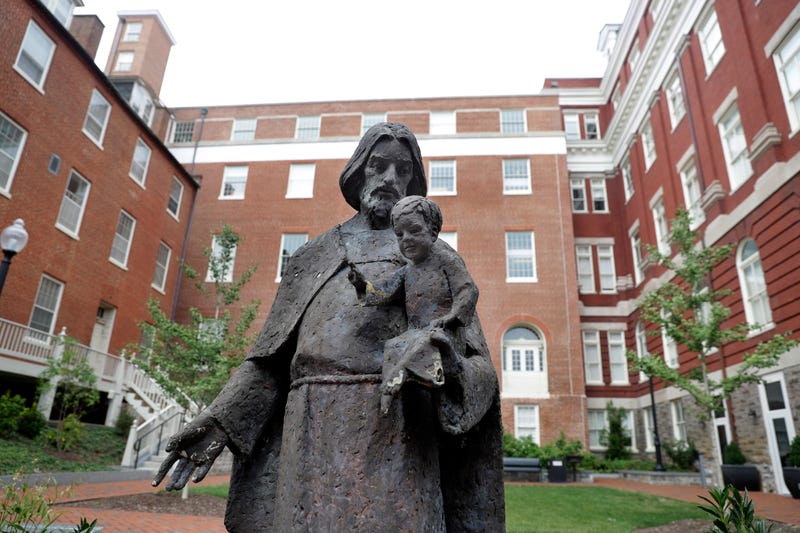
A Jesuit statue is seen in front of Freedom Hall, formerly named Mulledy Hall, on the Georgetown University campus, Sept. 1, 2016, in Washington, D.C. After renaming the Mulledy and McSherry buildings at Georgetown University temporarily to Freedom Hall and Remembrance Hall, Georgetown University will give preference in admissions to the descendants of slaves owned by the Maryland Jesuits as part of its effort to atone for profiting from the sale of enslaved people. (AP Photo/Jacquelyn Martin)
As reported by The Root when the story first broke, the storied academic institution of Georgetown owes its entire existence to the sale of enslaved black men women and children. The sale of these humans by Jesuit priests saved the school from bankruptcy; to this day it remains a thriving academic institution, thick with a rich endowment.

What Does Georgetown University Owe the 272…
Read more
And although Georgetown has apologized, and even offered an admissions advantage to the descendants of the 272 slaves it sold (talk about a “legacy” edge), some of those descendants are saying it’s not nearly commensurate for what their ancestors gave to the school.
Georgia Goslee, lead counsel for the GU272 Isaac Hawkins Legacy group, which includes 200 people, says her clients “do not believe Georgetown has fully atoned for the wealth it unjustly accumulated off the back of unpaid slave labor,” according to the Washington Post.
The GU272 Isaac Hawkins Legacy group has asked for a direct benefit for descendants. The Post reports that Thomas Craemer, an associate professor at the University of Connecticut, helped the group calculate their request for restitution, based on the idea that forced labor created wealth for others than the enslaved people. He also said descendants would otherwise have inherited money earned through their foreparents’ wages and interest.
In other words, gimme the loot.

Georgetown University’s ‘Reparations’ Plan…
Read more
Georgetown spokesman, Meghan Dubyak, recently said that the school has “taken initial steps” to right the wrong including a formal apology remaining two buildings for the descendants, and the admissions advantage. It has also offered professional-level genealogy for the offspring.
And Georgetown’s president, John DeGioia, doesn’t seem to want to really discuss the “r” word (i.e., “reparations”) and has already proposed amends that are linked to more education, even partnering with HBCUs.
Subscribe to:
Posts (Atom)