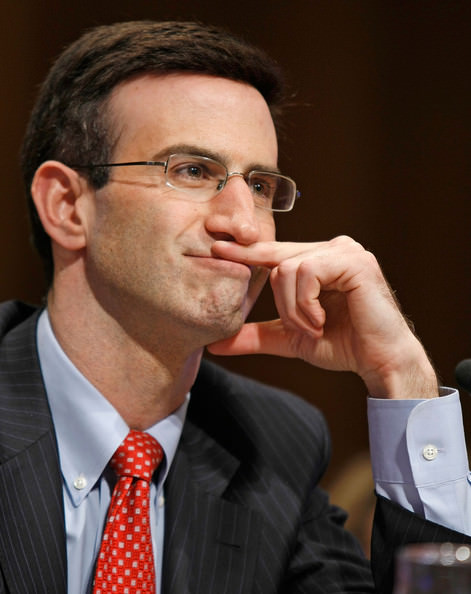
Michael Greenstone, director of the Hamilton Project, was formerly the chief economist for the Council of Economic Advisers. (Brendan Hoffman/bloomberg)
By Neil Irwin
Washington Post Staff Writer
Thursday, April 22, 2010
In the late years of the George W. Bush administration, a group of veterans of the Clinton White House's economics shop launched the Hamilton Project, a research effort aimed at developing policies to strengthen the nation's long-term economic prospects.
The Brookings Institution-based group's ideas -- which included reducing income inequality, developing a more sustainable fiscal course and making health coverage more available and affordable -- were widely discussed among policy wonks. But the efforts held little sway in the Bush White House.
Ironically, once an administration more open to the group's views arrived in January 2009, the Hamilton Project went dormant, as key staff members went to work in government. The project got a second wind this week, with a relaunch and a new director, and the reasonable expectation that this time around, the relationship to the White House will be much cozier. In fact, Hamilton could emerge as a key source of economic thinking for the Obama administration and the Democratic Congress.
"My experience from inside the government is that Hamilton ideas were pervasive," said Michael Greenstone, the new director of the program and formerly chief economist for the White House Council of Economic Advisers. "That's partially because several people in the administration were previously affiliated with the group, but even in meetings where there was no one in the room that had anything to do with Hamilton, a lot of the very sensible solutions to the country's problems seemed to be emanating from Hamilton."
Peter Orszag, the first director of the program, is now Obama's budget director, Orszag's successor at Hamilton, Jason Furman, is now a key White House aide, and Furman's successor at Hamilton, Doug Elmendorf, is director of the Congressional Budget Office.
Vice President Biden spoke at the group's relaunch Tuesday. Greenstone cited medical cost controls in the new health-care law and a budget that freezes discretionary spending as examples of the group's ideas showing up in public policy.
Clinton Treasury Secretary Robert Rubin and Deputy Treasury Secretary Roger Altman were among the key founders of the Hamilton Project, which is named for Alexander Hamilton, the first U.S. treasury secretary.
Some liberal critics have viewed the group as a place for centrist economic thinkers within the Democratic coalition to bide their time. "It has, at times, seemed like a platform for Bob Rubin and Roger Altman and Larry Summers, more than anything else" said Lawrence Mishel, president of the liberal Economic Policy Institute, though he argued that there is now less ideological distance between the left and center on economic policy than there was during the 1990s.
Still, some Hamilton Project ideas, such as a proposal to privatize unemployment insurance, have gotten a cold reception from the left. "That would have been a disaster," Mishel said.
The group published a paper Tuesday outlining its research agenda. It argued that a sustainable economic recovery requires a national investment in education, more government support for research and development, and a reduction of carbon dioxide emissions to combat global warming.
Produced by Rubin, Altman, Greenstone and Sarah Cannon, the paper argues that those investments must be combined with a serious deficit-reduction effort. Greenstone described that basic challenge -- strengthening the U.S.'s long-run growth prospects in a difficult budget environment -- as the core of the group's focus.
"It's clear that we're going to have to focus on providing proposals to help the recovery take hold," Greenstone said. "That said, one thing Hamilton has always been focused on is a sustainable deficit position. And if anything, the circumstances that have been thrust upon the world" -- giant deficits from the recession -- "make that ever more timely."
.
.
Source: http://www.washingtonpost.com/wp-dyn/content/article/2010/04/21/AR2010042105188.html
,