Showing posts with label Internet. Show all posts

Friday, June 12, 2026

A number of people have flocked to social media, reporting issues with the platform


Updated 15:07 12 Jun 2026 GMT+1Published 14:44 12 Jun 2026 GMT+1
Facebook is currently down for millions of users


Rhiannon Ingle


Facebook is currently down for millions of users across the globe.

IsDown reported earlier this afternoon (12 June) that 'users are reporting an outage with Facebook'.

"IsDown is reporting that Facebook is having issues. IsDown last checked Facebook status on 12 June 2026 at 2:42 pm BST. We've received 4959 user reports in the past 24 hours," the site added.


Facebook is down for millions of users across the globe (NICOLAS TUCAT / Contributor / Getty Images)

The outage appears to have impacted Facebook Messenger as well as the main app and website.

Users were automatically logged out of their accounts and found themselves unable to log back in.

They were then shown an error message stating that 'an unexpected error occurred'.

Visitors on the main Facebook website were told that 'something went wrong' and that the company is 'working on it and we'll get it fixed as soon as we can'.

People have since flocked to other social media channels to share their reactions to the reportage outage, with one X user writing: "I thought I was hacked."

"I thought I'd lost my page.. yes, there is def a problem with it," a second commented as a third chimed in: "Logged me right out lol."'

Sunday, November 30, 2025

The Inevitable Rabbit Hole: Countering Satan’s Impact on Young People Through Social Media


The Inevitable Rabbit Hole: Countering Satan’s Impact on Young People Through Social Media

by Christian Standard | 3 July, 2025

By Ricky Altmiller

“Social media. It’s just a tool, right? It is not bad in and of itself. The issue is how you use it.” But what if social media and cultural influences are having a greater impact than we realize?

We have all been there. Seconds turn into minutes, minutes turn into hours, and down the inevitable rabbit hole we go. We fall into a digital information and social spiral that takes us places we never thought we would go, landing in a foreign metaverse. We spend vast amounts of time on clicks, videos, articles, and reels, ending up in an unknown realm. Everything looks the same but feels very different. Sometimes we come out feeling discombobulated and other times we come out feeling empowered and enlightened. Most Generation Z teens (born between 1999 and 2015), many of whom are in middle school and high school, take this journey multiple times a day.

The Battle of the Mind

The primary battle zone resides in the mind. This makes sense, as the mind is the communicator and controller of all aspects of our bodies. Control the mind, control the body. In Genesis 3, Satan proposed a thought of doubt or distorted truth. The serpent said, “Did God really say?” Eve confirmed the statement, but Satan replied, “You will not certainly die.” It was at this moment Eve shifted from a foundation of truth to a foundation of a perversion of truth. “When the woman saw that the fruit of the tree was good for food and pleasing to the eye, and also desirable for gaining wisdom, she took some and ate it. She also gave some to her husband, who was with her, and he ate it. Then the eyes of both of them were opened” (Genesis 3:1-7, New International Version).

Is this not the same spiritual war we are facing today? Satan’s conniving ways have not changed. Teens are engulfed in a culture and landscape the Barna Research Group describes as “Digital Babylon.” This is where we find ourselves as we attempt to make disciples of teens who will also make disciples.

When we think of spiritual warfare, the spectrum can run from subtle questioning of truth to the extremes of demonic possession and Satan worship. All are prominent in our culture and world. We need to be prepared to face all fronts. But the broader, more detrimental impact on our teens today is psychological manipulation through social media platforms. Here is where culture, politics, fluidity of truth, pornography, misinformation, greed, and so much more collide.

Sunday, May 31, 2020

A Cybersecurity Firm’s Sharp Rise and Stunning Collapse

A Reporter at Large


Tiversa dominated an emerging online market—before it was accused of fraud, extortion, and manipulating the federal government.


By Raffi Khatchadourian

October 28, 2019


In a few years, Robert Boback went from chiropractic work to advising Congress on computer crime. Then things turned bad.Illustration by Ori Toor


I. THE FOOTBALL

Before Robert Boback got into the field of cybersecurity, he was a practicing chiropractor in the town of Sewickley, Pennsylvania, twelve miles northwest of Pittsburgh. He was also selling used cars on eBay and flipping houses purchased at police auctions. The decision to branch out into computers came in 2003, after he watched a “60 Minutes” report by Lesley Stahl about pirated movies. For years, while digital piracy was devastating the music industry, Hollywood had largely been spared; limitations on bandwidth curtailed the online trade in movies. But this was changing, Stahl noted: “The people running America’s movie studios know that if they don’t do something, fast, they could be in the same boat as the record companies.”

Boback was thirty-two years old, with a Norman Rockwell haircut and a quick, smooth, entrepreneurial manner. Growing up amid the collapsing steel industry, he had dreamed of making it big, hanging posters of high-priced cars—a Lamborghini, a Porsche—on his bedroom wall and telling himself that they would one day be his. After high school, he trained to be a commercial pilot, imagining a secure, even glamorous, life style—but then the airline industry began laying off pilots, and he switched to chiropractic, inspired by a well-off practitioner his family knew.

Watching “60 Minutes,” Boback saw a remarkable new business angle. Here was a multibillion-dollar industry with a near-existential problem and no clear solution. He did not know it then, but, as he turned the opportunity over in his mind, he was setting in motion a sequence of events that would earn him millions of dollars, friendships with business élites, prime-time media attention, and respect in Congress. It would also place him at the center of one of the strangest stories in the brief history of cybersecurity; he would be mired in lawsuits, countersuits, and counter-countersuits, which would gather into a vortex of litigation so ominous that one friend compared it to the Bermuda Triangle. He would be accused of fraud, of extortion, and of manipulating the federal government into harming companies that did not do business with him. Congress would investigate him. So would the F.B.I.

But as Boback was watching “60 Minutes” all he saw was a horizon of possibility. Stahl pointed out that pirated music and movies were spreading primarily on peer-to-peer networks—an obscure precinct of the Internet that was sometimes called the Deep Web. The networks were made up of hundreds of thousands of decentralized connections, in which one computer was linked to no more than five others, and then through those five computers to many more, expanding exponentially like the branches of a large tree. These connections were invisible to search engines like Google. Even the software that allowed users to browse them had only a limited field of vision—glimpsing just random fragments of the tree at a time. Boback wondered if it was possible to design a system that could scan the whole tree at once, then block people from sharing files on it. Certainly, this capability would be worth a lot.

Boback had no idea how to build such a thing, but he knew someone who might: a patient of his, Sam Hopkins, whose girlfriend had persuaded him to pursue chiropractic treatment after a car crash. Hopkins was in his thirties, too. He was soft-spoken, with a childlike disposition, a wispy physique, and a goatee. He had grown up in inner-city Pittsburgh, in a home where money was scarce. As a boy, he had taught himself how to program on a Commodore 64 that was on display at Sears. Bored with school, he dropped out, and built an Internet-service provider, which was sold to a local telecom company. By the time of his car accident, he was designing high-speed computer networks for Marconi Communications.


Wednesday, May 15, 2019

Trump administration declines to join Christchurch Call to Action


Push aims to end use of social media in terrorism


By Betsy Klein, CNN Posted: 12:55 PM, May 15, 2019 Updated: 12:55 PM, May 15, 2019


Getty Images via CNN

The United States will not be joining the Christchurch Call for Action, a push by New Zealand and France to encourage tech companies and countries to work together to end the use of social media in acts of terrorism, the Trump administration…


(CNN) - The United States will not be joining the Christchurch Call for Action, a push by New Zealand and France to encourage tech companies and countries to work together to end the use of social media in acts of terrorism, the Trump administration announced Wednesday.

"While the United States is not currently in a position to join the endorsement, we continue to support the overall goals reflected in the call. We will continue to engage governments, industry and civil society to counter terrorist content on the internet," the White House said in a statement.

New Zealand Prime Minister Jacinda Ardern and French President Emmanuel Macron announced the Christchurch Call earlier Wednesday in Paris at a meeting of digital leaders for the G7 nations, just two months after the March 15 mass shootings on two mosques in Christchurch, New Zealand, left 51 dead and many wounded.

Facebook removed 1.5 million videos of the Christchurch attacks in the first 24 hours after the massacre. It also blocked 1.2 million of them at upload, meaning they would not have been seen by users.

"When it came to the way this attack was specifically designed to be broadcast and to go viral, (responding) to that needed a global solution, so that was why we immediately got in contact with international counterparts," Ardern told CNN Tuesday.

Facebook has signed on to the agreement, introducing new rules for live-streaming. Under the new policy, the alleged Christchurch shooter would not have been able to livestream the massacre from his account in March, a Facebook spokesperson told CNN Business.

The US thanked Ardern and Macron "for organizing this important effort" in its Wednesday statement, noting that the administration "(agrees) with the overarching message" in the nonbinding agreement.

The statement condemned terrorist and violent extremist content online "in the strongest terms," however, it cited freedom of expression and freedom of the press as reasons it would not be joining the agreement.

"We encourage technology companies to enforce their terms of service and community standards that forbid the use of their platforms for terrorist purposes. We continue to be proactive in our efforts to counter terrorist content online while also continuing to respect freedom of expression and freedom of the press," the statement read.

It continued: "Further, we maintain that the best tool to defeat terrorist speech is productive speech, and thus we emphasize the importance of promoting credible, alternative narratives as the primary means by which we can defeat terrorist messaging."

The Trump administration has been involved in efforts to end online terrorist content, including its September 2017 endorsement of the Zurich-London Recommendations on Preventing and Countering Violent Extremism and Terrorism Online.

CNN's Tara John and Heather Kelly contributed to this report.

The-CNN-Wire ™ & © 2019 Cable News Network, Inc., a Time Warner Company. All rights reserved.


The Christchurch “Call To Action” Summit in Paris Exposed! They’re Comin...

censo

Wednesday, May 02, 2018

Pope Francis: Catholic media must not fall behind in digital age


MENU

Newsletter

POLITICS & SOCIETYNEWS

Pope Francis: Catholic media must not fall behind in digital age


Junno Arocho Esteves - Catholic News Service

May 01, 2018


Visitors look at the digital media offerings at the booth of technology giant Google at the Republica 17 digital conference May 8, 2017, in Berlin. (CNS photo/Filip Singer, EPA)


VATICAN CITY (CNS) -- In an age when technology is ever-evolving, Catholic news organizations must be willing to adapt to effectively proclaim the Gospel to all, Pope Francis said.

Speaking to directors and employees of Avvenire, the daily newspaper of the Italian bishops' conference, the pope said that the use of new digital platforms not only requires significant technological updates but also a willingness to accept that "the attachment to the past may prove to be a dangerous temptation."

"Authentic servants of tradition are those who, while keeping memory alive, know how to discern the signs of the times and open new paths," he said May 1.

Pope Francis said that the use of new digital platforms requires a willingness to accept that "the attachment to the past may prove to be a dangerous temptation."
Tweet this


Saturday, February 10, 2018

The new surveillance capitalism


Corporate giants have created an entirely new surveillance capitalism. And we're too hooked to care

by John Naughton / January 19, 2018 /


Published in February 2018 issue of Prospect Magazine


©MARTIN PUDDY/GETTY IMAGES


The “dust of exploded beliefs,” the English aphorist Geoffrey Madan once wrote, “may make a fine sunset.” We’re beginning to see that glow over the internet which, if you count back to the design phase in the autumn of 1973, is now over four decades old.

From the moment the internet first opened for semi-public use in January 1983, it evoked utopian dreams. It was easy to see why. Cyberspace—the term coined by the novelist William Gibson for the virtual space behind the screen—really did seem to be a parallel universe to “meatspace,” the term invented by Grateful-Dead-lyricist-turned-essayist John Perry Barlow for the messy physical world that we all inhabit. Cyberspace in the 1980s was a glorious sandpit for geeks: a world with no corporations, no crime, no spam, no hate speech, relatively civil discourse, no editorial gatekeepers, no regulation and no role for those meatspace masters whom Barlow called the “weary giants of flesh and steel.”

But then, gradually, the internet was commercialised and those two parallel spaces merged to create our networked world, in which the affordances of cyberspace combine with surveillance and corporate control. Of course, the internet has brought huge benefits in terms of access to information and efficiency of communication: try imagining our home or work lives without it. But there are serious worries. The online world is populated by several billion mostly passive addicts of devices, apps and services created by a handful of corporate giants. Prying governments and giant companies have acquired the capacity to surveil our every move, both on the internet and, now that so many devices have built-in GPS, in the real world too. Through their ability to monitor our searches these companies—as well as the governments they co-operate with—are able to see our innermost thoughts and desires. (Yes, even our desires: what people search for on Google is incredibly revealing.)

It all creates the potential for unprecedented manipulation, and—rather suddenly—worries are piling up about how that network technology is disrupting our society, warping our children’s development, our politics and our lives. Even the digital evangelists are having second thoughts. In November 2017, Sean Parker, the first President of Facebook, accused the social network of exploiting “vulnerability,” with “God only knows” what effects on “our children’s brains.” In the same month, Chamath Palihapitiya, a former Facebook Vice-President, said social media firms had created “tools that are ripping apart the social fabric of how society works.”


Sunday, December 03, 2017

China’s Top Ideologue Calls for Tight Control of Internet


DEC. 3, 2017


Wang Huning spoke Sunday at the opening of the fourth World Internet Conference in Wuzhen, China. Credit Aly Song/Reuters


WUZHEN, China — Little heard from but hugely influential, the professor-turned-Communist theoretician who has been a major adviser to three Chinese leaders finally stepped out of the shadows on Sunday.

Known as the brain behind President Xi Jinping, Wang Huning made his first major speech since joining the Politburo Standing Committee, the seven-member group that rules China, at a conference created to show off the country’s technological strengths to the world.

Well known for his icy remove and support of authoritarianism, Mr. Wang called for security and order on the internet as part of five proposals he made to guide the future of cyberspace. He also emphasized China’s technological prowess, and said more should be done by the government to guide the development of new industries like artificial intelligence and quantum computing.

Mr. Wang stepped onto the world stage before an audience that included Tim Cook, the chief executive of Apple, along with an all-star cast of Chinese tech entrepreneurs, such as Jack Ma of Alibaba.

Mr. Wang, 62, had emerged as the ideological counselor to Chinese leaders and the wordsmith of Mr. Xi’s more authoritarian style before being tapped to join the Standing Committee at a Communist Party congress in Beijing two months ago. A close confidant of Mr. Xi and the two previous Chinese presidents, Mr. Wang was promoted despite never having governed a province or run a state ministry.


Thursday, November 30, 2017

Web Bot


Web Bot


From Wikipedia, the free encyclopedia

This article is about the prediction software. For internet-based programs, see Internet bot.

Web Bot is an internet bot computer program whose developers claim is able to predict future events by tracking keywords entered on the internet. It was developed in 1997, originally to predict stock market trends.[1] The creator of the Web Bot Project, Clif High, along with his associate George Ure, keep the technology and algorithms largely secret and sell the predictions via the website.


Friday, October 21, 2016

WHAT WE KNOW ABOUT FRIDAY’S MASSIVE EAST COAST INTERNET OUTAGE


AUTHOR: LILY HAY NEWMAN.LILY HAY NEWMAN SECURITY

DATE OF PUBLICATION: 10.21.16.10.21.16

TIME OF PUBLICATION: 1:04 PM.1:04 PM


GETTY IMAGES


FRIDAY MORNING IS prime time for some casual news reading, tweeting, and general Internet browsing, but you may have had some trouble accessing your usual sites and services this morning and throughout the day, from Spotify and Reddit to the New York Times and even good ol’ WIRED.com. For that, you can thank a distributed denial of service attack (DDoS) that took down a big chunk of the Internet for most of the Eastern seaboard.

This morning’s attack started around 7 am ET and was aimed at Dyn, an Internet infrastructure company headquartered in New Hampshire. That first bout was resolved after about two hours; a second attack began just before noon. Dyn reported a third wave of attacks a little after 4pm ET, and called the overall situation a “very sophisticated and complex attack” stemming from tens of millions of IP addresses. In all cases, traffic to Dyn’s Internet directory servers throughout the US—primarily on the East Coast but later on the opposite end of the country as well—was stopped by a flood of malicious requests disrupting the system. Still ongoing, the situation is a definite reminder of the fragility of the web, and the power of the forces that aim to disrupt it.


Sunday, October 09, 2016

Internet Space: A New Moral Geography


An excerpt from an article of the current America Magazine (October 17, 2016 Issue):

The internet enables our eyes to see around the world, but it does not extend the reach of our hands in the same way. Whereas physical space holds knowledge and action together, the internet separates them. The problem here is not disembodiment but the particular construction of moral space. Disembodiment is nothing new. Written text, phone calls, radio and television are all disembodied. Each communication medium constructs a particular form of presence and absence and mediates a certain type of encounter. In order to understand how the internet transforms moral geography we have to look at the details of how it works.

Technologists likes Jaron Lanier point to the importance of the internet’s underlying “packet switching” network architecture. This architecture was inspired in part by the Cold War-era need to build networks that could withstand nuclear attack. The standard networks of the time were hierarchical, like the first telephone systems. They routed data through central switchboards. Attack the switchboard and you disconnect all its connected nodes (e.g., radar sites and missile silos). This weak link could be targeted to disable an entire system. Packet switching addresses this weakness. In such a network, data does not require a fixed connection between two points. Instead, messages are broken into packets, and those packets are sent out into a web of routers that passes them on to other routers on multiple and varied paths to their final destination, with the final recipient reassembling them into the original message. If part of the network is compromised, the packets can be routed through the remaining sections.

What do missile silos have to do with our experience of the internet? This network architecture was designed to free data from the contingencies of geographical space. No particular pathway through the network is crucial; if one is blocked, finding another path is automatic. Once a packet has arrived, the particular route it took is unimportant, and indeed that information is generally discarded. This architecture creates a nonlocal space where the Silicon Valley mantra “information wants to be free” is a fundamental law. As a result, data comes to us from everywhere and our sight is extended far beyond the reach of our hands.

But the internet as we know it is built in many layers on top of this underlying spatial geometry. The search services, social media and apps we use employ this underlying spatial freedom to facilitate individual choice. This is a result of particular historical decisions. When internet companies were seeking a business model that could convert clicks into profits, they chose to offer “free” services paid for by advertising revenue. Thus began the monitoring of our preferences, messages and social circles in order to personalize the ads we are shown. Google tracks the results we choose so it can filter search results in the future—to better give us what we are searching for. This threatens to structure the information we receive according to our preferences and prejudices. All of this is symbolized well by the empty search engine box: what do you want?

As we receive more and more news through our social media feeds, our informal social circles become de facto editorial boards. In a group of about 20 mostly white young people at a recent lecture, all were familiar with an image of Omran Daqneesh, and about two-thirds had watched the video. Far fewer were familiar with Philando Castile, and only one had watched the video of his death. Both were featured prominently in traditional, edited media sites like newspapers and broadcast networks.

We spend time in internet space even when we are out in the world rather than sitting at a computer. The smartphone was no small revolution. Through mobile phone networks, the internet’s reach expanded into just about all spaces and its depth into the capillary times of our lives. Notifications chime and buzz, calling us to turn to this space and attend to social networks constructed by its logic of choice. As a result, the internet writes over the physical geography in which we as embodied persons ostensibly dwell. We are free to choose to be elsewhere by simply glancing at our phones—and we do much more than glance. The very same day that Philando Castile was killed this summer saw the release of Pokémon Go, the augmented reality sensation that literally overwrites physical reality with an engrossing world of intriguing monsters and engaging competition. Parks and public spaces are now filled with people walking about literally viewing the world through smartphone screens.

Read more


The Geography of Mercy

October 17, 2016 Issue

Vincent J. Miller

On the internet, we encounter suffering from afar. How do we respond?

Thursday, September 29, 2016

Meet the New Authoritarian Masters of the Internet


Getty Images

by John Hayward
29 Sep 2016886


President Barack Obama’s drive to hand off control of Internet domains to a foreign multi-national operation will give some very unpleasant regimes equal say over the future of online speech and commerce.

In fact, they are likely to have much more influence than America, because they will collectively push hard for a more tightly controlled Internet, and they are known for aggressively using political and economic pressure to get what they want.

Here’s a look at some of the regimes that will begin shaping the future of the Internet in just a few days, if President Obama gets his way.

China

China wrote the book on authoritarian control of online speech. The legendary “Great Firewall of China” prevents citizens of the communist state from accessing global content the Politburo disapproves of. Chinese technology companies are required by law to provide the regime with backdoor access to just about everything.

The Chinese government outright banned online news reporting in July, granting the government even tighter control over the spread of information. Websites are only permitted to post news from official government sources. Chinese online news wasn’t exactly a bastion of freedom before that, of course, but at least the government censors had to track down news stories they disliked and demand the site administrators take them down.

Unsurprisingly, the Chinese Communists aren’t big fans of independent news analysis or blogging, either. Bloggers who criticize the government are liable to be charged with “inciting subversion,” even when the writer in question is a Nobel Peace Prize winner.

Chinese citizens know better than to get cheeky on social media accounts, as well. Before online news websites were totally banned, they were forbidden from reporting news gathered from social media, without government approval. Spreading anything the government decides is “fake news” is a crime.

In a report labeling China one of the worst countries for Internet freedom in the world, Freedom House noted they’ve already been playing games with Internet registration and security verification:


The China Internet Network Information Center was found to be issuing false digital security certificates for a number of websites, including Google, exposing the sites’ users to “man in the middle” attacks.

The government strengthened its real-name registration laws for blogs, instant-messaging services, discussion forums, and comment sections of websites.

A key feature of China’s online censorship is that frightened citizens are not entirely certain what the rules are. Huge ministries work tirelessly to pump out content regulations and punish infractions. Not all of the rules are actually written down. As Foreign Policy explained:


Before posting, a Chinese web user is likely to consider basic questions about how likely a post is to travel, whether it runs counter to government priorities, and whether it calls for action or is likely to engender it. Those answers help determine whether a post can be published without incident — as it is somewhere around 84 percent or 87 percent of the time — or is instead likely to lead to a spectrum of negative consequences varying from censorship, to the deletion of a user’s account, to his or her detention, even arrest and conviction.

This was accompanied by a flowchart demonstrating “what gets you censored on the Chinese Internet.” It is not a simple flowchart.

Beijing is not even slightly self-conscious about its authoritarian control of the Internet. On the contrary, their censorship policies are trumpeted as “Internet sovereignty,” and they aggressively believe the entire world should follow their model, as the Washington Post reported in a May 2016 article entitled “China’s Scary Lesson to the World: Censoring the Internet Works.”

China already has a quarter of the planet’s Internet users locked up behind the Great Firewall. How can anyone doubt they won’t use the opportunity Obama is giving them, to pursue their openly stated desire to lock down the rest of the world?

Russia

Russia and China are already working together for a more heavily-censored Internet. Foreign Policy reported one of Russia’s main goals at an April forum was to “harness Chinese expertise in Internet management to gain further control over Russia’s internet, including foreign sites accessible there.”

Russia’s “top cop,” Alexander Bastrykin, explicitly stated Russia needs to stop “playing false democracy” and abandon “pseudo-liberal values” by following China’s lead on Internet censorship, instead of emulating the U.S. example. Like China’s censors, Russian authoritarians think “Internet freedom” is just coded language for the West imposing “cultural hegemony” on the rest of the world.

Just think what Russia and China will be able to do about troublesome foreign websites, once Obama surrenders American control of Internet domains!

Russian President Vladimir Putin has “chipped away at Internet freedom in Russia since he returned to the Kremlin in 2012,” as International Business Times put it in a 2014 article.

One of Putin’s new laws requires bloggers with over 3,000 readers to register with the government, providing their names and home addresses. As with China, Russia punishes online writers for “spreading false information,” and once the charge is leveled, it’s basically guilty-until-proven-innocent. For example, one of the “crimes” that can get a blogger prosecuted in Russia is alleging the corruption of a public official, without ironclad proof.

Human-rights group Agora estimates that Russian Internet censorship grew by 900% in 2015 alone, including both court orders and edicts from government agencies that don’t require court approval. Censorship was expected to intensify even further throughout 2016. Penalties include prison time, even for the crime of liking or sharing banned content on social media.

Putin, incidentally, has described the entire Internet as a CIA plot designed to subvert regimes like his. There will be quite a few people involved in the new multi-national Internet control agency who think purging the Web of American influence is a top priority.

The Russian government has prevailed upon Internet Service Providers to block opposition websites during times of political unrest, in addition to thousands of bans ostensibly issued for security, crime-fighting, and anti-pornography purposes.

Many governments follow the lead of Russia and China in asserting the right to shut down “extremist” or “subversive” websites. In the United States, we worry about law enforcement abusing its authority while battling outright terrorism online, arguing that privacy and freedom of speech must always be measured against security, no matter how dire the threat. In Russia, a rough majority of the population has no problem with the notion of censoring the Internet in the name of political stability, and will countenance absolutely draconian controls against perceived national security threats. This is a distressingly common view in other nations as well: stability justifies censorship and monitoring, not just physical security.

Turkey

Turkey’s crackdown on the Internet was alarming even before the aborted July coup attempt against authoritarian President Recep Tayyip Erdogan.

Turkey has banned social media sites, including temporary bans against even giants like Facebook and YouTube, for political reasons. Turkish dissidents are accustomed to such bans coming down on the eve of elections. The Turkish telecom authority can impose such bans without a court order, or a warning to offending websites.

Turkey is often seen as the world leader in blocking Twitter accounts, in addition to occasionally shutting the social media service down completely, and has over a 100,000 websites blacklisted. Criticizing the government online can result in anything from lost employment to criminal charges. And if you think social-media harassment from loyal supporters of the government in power can get pretty bad in the U.S., Turks sometimes discover that hassles from pro-regime trolls online are followed by visits from the police.

Turkish law infamously makes it a crime to insult the president, a law Erdogan has already attempted to impose beyond Turkey’s borders. One offender found himself hauled into court for creating a viral meme – the sort of thing manufactured by the thousands every hour in America – that noted Erdogan bore a certain resemblance to Gollum from Lord of the Rings. The judge in his case ordered expert testimony on whether Gollum was evil to conclusively determine whether the meme was an illegal insult to the president.

The Turkish example introduces another idea common to far too many of the countries Obama wants to give equal say over the future of the Internet: intimidation is a valid purpose for law enforcement. Many of Turkey’s censorship laws are understood to be mechanisms for intimidating dissidents, raising the cost of free speech enough to make people watch their words very carefully. “Think twice before you Tweet” might be good advice for some users, but regimes like Erdogan’s seek to impose that philosophy on everyone. This runs strongly contrary to the American understanding of the Internet as a powerful instrument that lowers the cost of speech to near-zero, the biggest quantum leap for free expression in human history. Zero-cost speech is seen as a big problem by many of the governments that will now place strong hands upon the global Internet rudder.

Turkey is very worried about “back doors” that allow citizens to circumvent official censorship, a concern they will likely bring to Internet control, along with like-minded authoritarian regimes. These governments will make the case that a free and open Internet is a direct threat to their “sovereign right” to control what their citizens read. As long as any part of the Internet remains completely free, no sector can be completely controlled.

Saudi Arabia

The Saudis aren’t too far behind China in the Internet rankings by Freedom House. Dissident online activity can bring jail sentences, plus the occasional public flogging.

This is particularly lamentable because Saudi Arabia is keenly interested in modernization, and sees the Internet as a valuable economic resource, along with a thriving social media presence. Freedom House notes the Internet “remains the least repressive space for expression in the country,” but “it is by no means free.”

“While the state focuses on combatting violent extremism and disrupting terrorist networks, it has clamped down on nonviolent liberal activists and human rights defenders with the same zeal, branding them a threat to the national order and prosecuting them in special terrorism tribunals,” Freedom House notes.

USA Today noted that as of 2014, Saudi Arabia had about 400,000 websites blocked, “including any that discuss political, social or religious topics incompatible with the Islamic beliefs of the monarchy.”

At one point the blacklist included the Huffington Post, which was banned for having the temerity to run an article suggesting the Saudi system might “implode” because of oil dependency and political repression. The best response to criticism that your government is too repressive is a blacklist!

The Saudis have a penchant for blocking messaging apps and voice-over-IP services, like Skype and Facetime. App blocking got so bad that Saudi users have been known to ask, “What’s the point of having the Internet?”

While some Saudis grumble about censorship, many others are active, enthusiastic participants in enforcement, filing hundreds of requests each day to have websites blocked. Religious figures supply many of these requests, and the government defends much of its censorship as the defense of Islamic values.

As with other censorious regimes, the Saudi monarchy worries about citizens using web services beyond its control to evade censorship, a concern that will surely be expressed loudly once America surrenders its command of Internet domains.

For the record, the Saudis’ rivals in Iran are heavy Internet censors too, with Stratfor listing them as one of the countries seeking Chinese assistance for “solutions on how best to monitor the Iranian population.”

North Korea

You can’t make a list of authoritarian nightmares without including the psychotic regime in Pyongyang, the most secretive government in the world.

North Korea is so repressive the BBC justly puts the word “Internet” in scare quotes, to describe the online environment. It doesn’t really interconnect with anything, except government propaganda and surveillance. Computers in the lone Internet cafe in Pyongyang actually boot up to a customized Linux operating system called “Red Star,” instead of Windows or Mac OS. The calendar software in Red Star measures the date from the birth of Communist founder Kim Il-sung, rather than the birth of Christ.

The “Internet” itself is a closed system called Kwangmyong, and citizens can only access it through a single state-run provider, with the exception of a few dozen privileged families that can punch into the real Internet.

Kwangmyong is often compared to the closed “intranet” system in a corporate office, with perhaps 5,000 websites available at most. Unsurprisingly, the content is mostly State-monitored messaging and State-supplied media. Contributors to these online services have reportedly been sent to re-education camps for typos. The North Koreans are so worried about outside contamination of their closed network that they banned wi-fi hotspots at foreign embassies, having noticed information-starved North Korean citizens clustering within range of those beautiful, uncensored wireless networks.

This doesn’t stop South Koreans from attempting cultural penetration of their squalid neighbor’s dismal little online network. Lately they’ve been doing it by loading banned information onto cheap memory sticks, tying them to balloons, and floating them across the border.

Sure, North Korea is the ultimate totalitarian nightmare, and since they have less than two thousand IP addresses registered in the entire country, the outlaw regime won’t be a big influence on Obama’s multi-national Internet authority, right?

Not so fast. As North Korea expert Scott Thomas Bruce told the BBC, authoritarian governments who are “looking at what is happening in the Middle East” see North Korea as a model to be emulated.

“They’re saying rather than let in Facebook, and rather than let in Twitter, what if the government created a Facebook that we could monitor and control?” Bruce explained.

Also, North Korea has expressed some interest in using the Internet as a tool for economic development, which means there would be more penetration of the actual global network into their society. They’ll be very interested in censoring and controlling that access, and they’ll need a lot more registered domains and IP addresses… the very resource Obama wants America to surrender control over.

Bottom line: contrary to left-wing cant, there is such a thing as American exceptionalism – areas in which the United States is demonstrably superior to every other nation, a leader to which the entire world should look for examples. Sadly, our society is losing its fervor for free expression, and growing more comfortable with suppressing “unacceptable” speech, but we’re still far better than anyone else in this regard.

The rest of the world, taken in total, is very interested in suppressing various forms of expression, for reasons ranging from security to political stability and religion. Those governments will never be comfortable, so long as parts of the Internet remain outside of their control. They have censorship demands they consider very reasonable, and absolutely vital. The website you are reading right now violates every single one of them, on a regular basis.

There may come a day we can safely remand control of Internet domains to an international body, but that day is most certainly not October 1, 2016.


Source

 

Thursday, June 23, 2016

Taking the pulse of the federal government's web presence


An official website of the U.S. government 


June 2, 2015


by Eric Mill, Julia Elman, Gray Brooks, and John Tindel

The U.S. federal government is launching a new project to monitor how it's doing at best practices on the web.

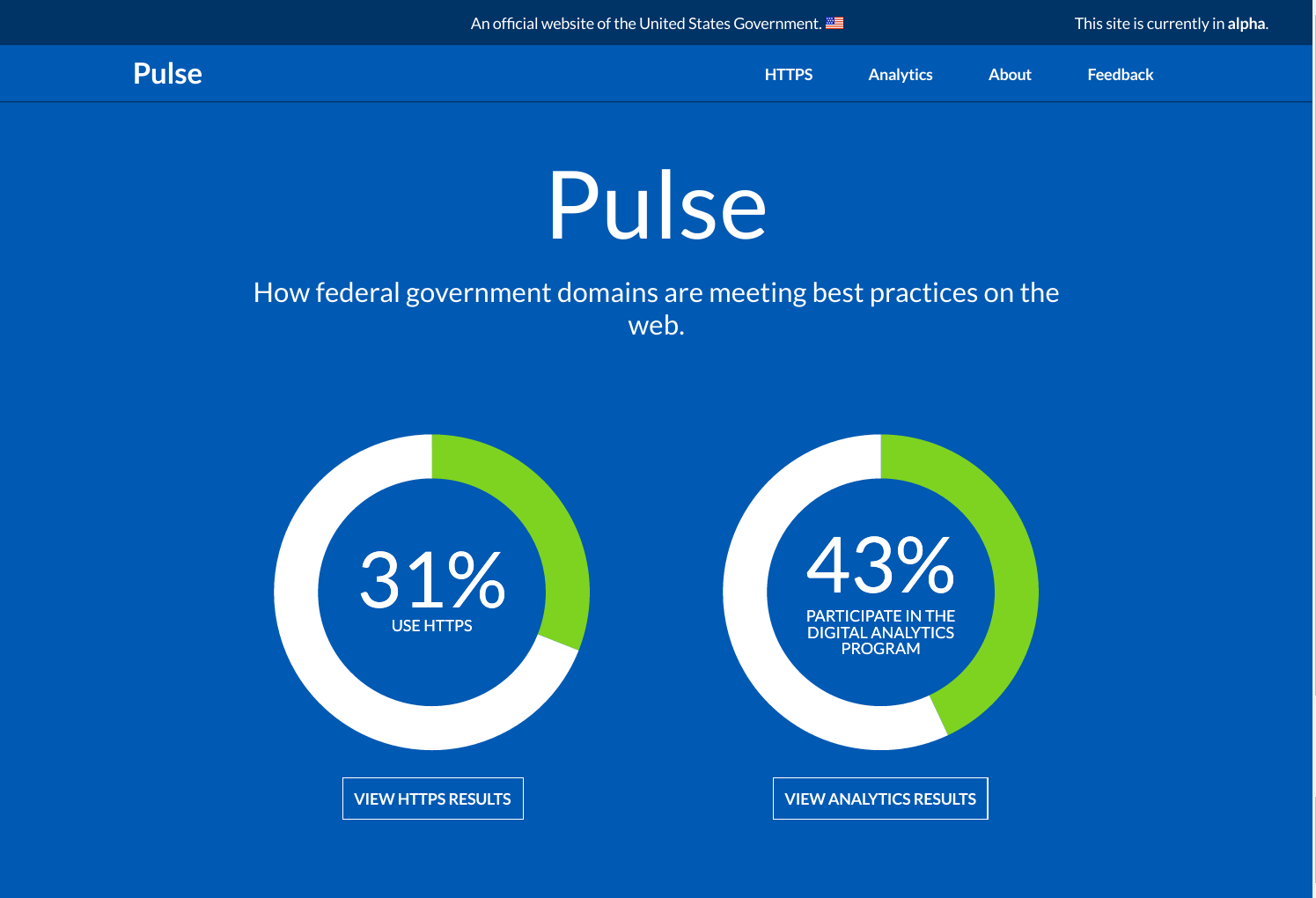
A sort of health monitor for the U.S. government's websites, it's called Pulse, and you can find it at pulse.cio.gov.


Pulse is a lightweight dashboard that uses the official .gov domain list to measure two things:
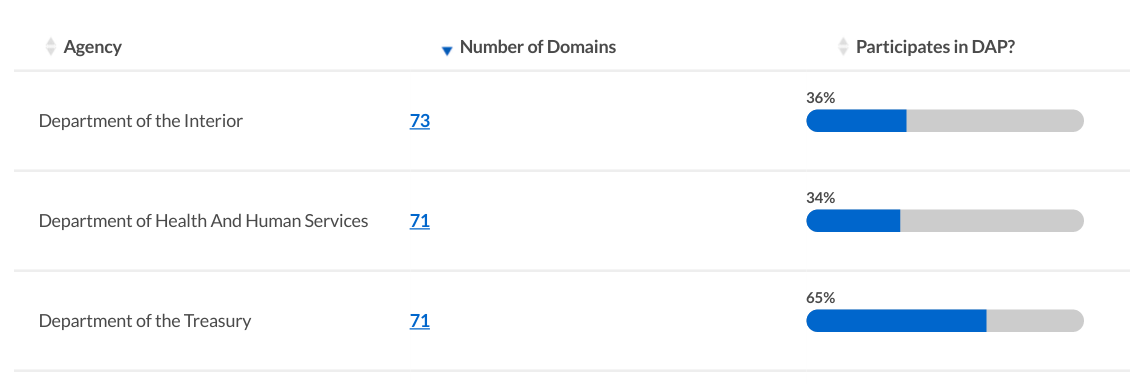
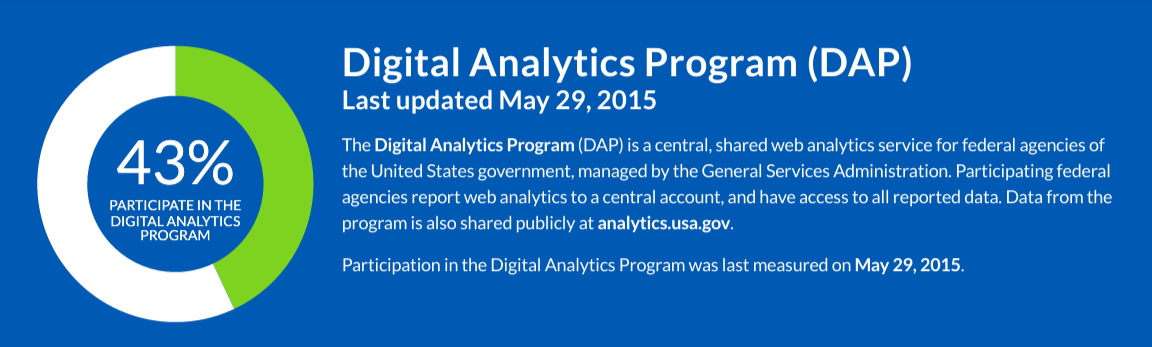
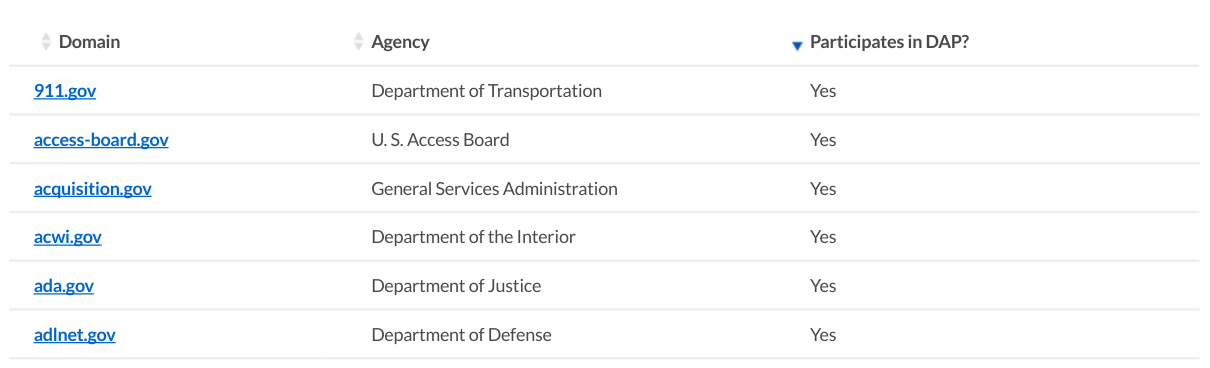
Analytics: Whether federal executive branch domains are participating in the Digital Analytics Program that powersanalytics.usa.gov.
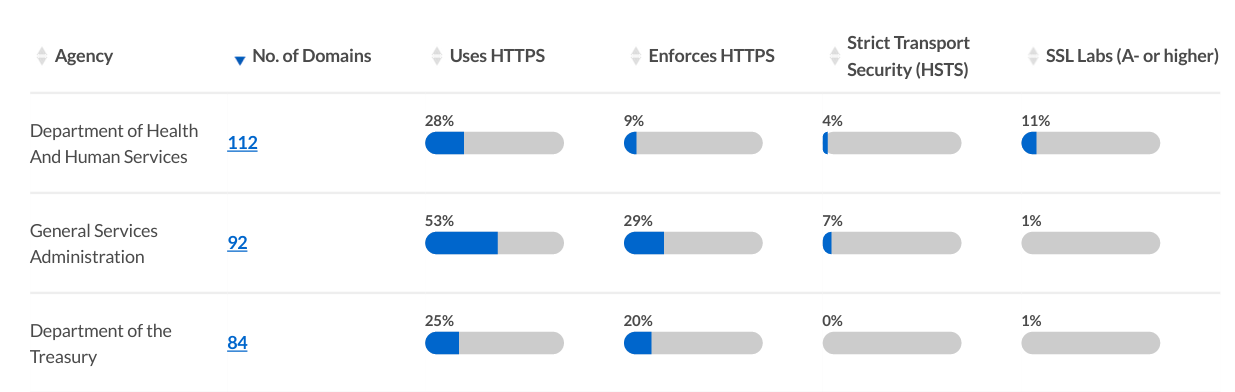
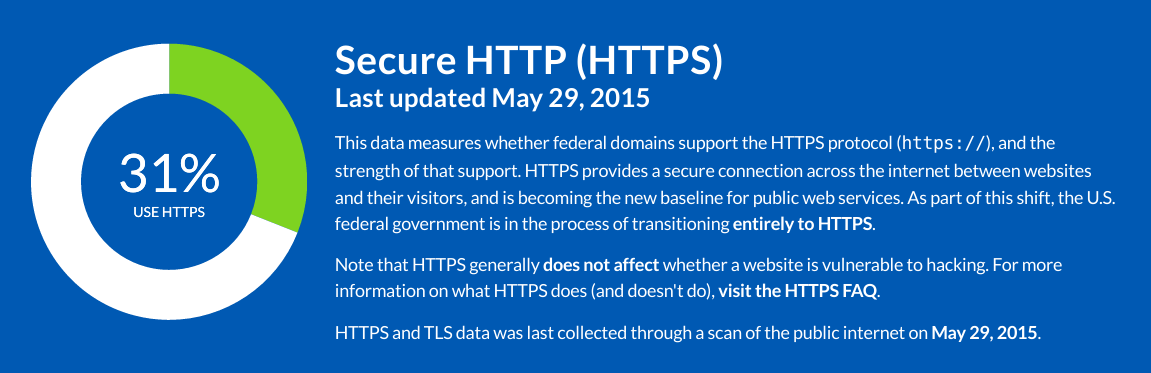
HTTPS: Whether federal domains have deployed the HTTPS protocol, and how well they've done it.

These two things are just a start — there are a lot of other important things worth measuring! It's also important to note that Pulse is currently only measuring parent domains (e.g. agency.gov) and is not measuring subdomains (e.g.portal.agency.gov).

The project will hopefully expand over time to measure more best practices and more websites. In the meantime, Pulse is a commitment by the U.S. government to build a world-class analytics program and to transition entirely to HTTPS.
Background


Pulse is a collaboration between 18F and the Office of Government-wide Policy (OGP).

Like 18F, OGP is an office of the U.S. General Services Administration. Among many other things, OGP operates the .gov domain registry and the CIO Council, an interagency forum of Chief Information Officers.

18F previously partnered with OGP in December to release the complete .gov domain list. Since then, 18F has worked with the Digital Analytics Program to build analytics.usa.gov, and has coordinated with a number of agencies to strengthen HTTPS for federal .gov domains. We're deeply gratified that we've had the opportunity to work with OGP to create a platform that continues this momentum.
How pulse.cio.gov works


Pulse was created in around six weeks. We built the project in the open from Day 1, obtained our domain name and relevant cybersecurity approvals in our first couple weeks, and released new versions of the dashboard topulse.cio.gov early and often throughout the process.

We also gathered usability feedback throughout development from users both inside and outside of the government, and repeatedly incorporated the results of that feedback into our work. Even though Pulse is only a handful of pages and puts most of its data into a simple table, we wanted to pay attention to detail and take the same user-centered approach 18F takes with our larger projects.

Pulse is a static website whose data is created from a combination of sources:
The official .gov domain list. This is currently exported manually by GSA staff on a roughly quarterly basis.
The list of websites which participate in the Digital Analytics Program. This is also currently exported manually by GSA staff on a roughly quarterly basis.
Data collected from a public scan of how federal domains respond to HTTP and HTTPS, using an open source tool by Ben Balter called site-inspector.
Data collected from a public scan of HTTPS configuration details for federal domains, using the SSL Labs API.

To coordinate the data collection process, we created domain-scan, a small Python command line tool that runs domains through site-inspectorand the SSL Labs API and produces CSV reports.

We then run these CSVs through a final step, where we take the low-level primitives we gathered during the scanning process and create some higher-level conclusions and save them in a format that Pulse can automatically render into a table.

The process is not fully automated, and so Pulse isn't updated every day. There's work to do on all of the above to get to the point of showing fully up-to-date data without human intervention.
Measuring participation in the Digital Analytics Program


The Digital Analytics Program is a free, shared web analytics service for U.S. federal agencies.

To participate, agencies place some JavaScript on their websites that report to a combined analytics account. The Digital Analytics Program has privacy controls that anonymize visitor addresses and restrict data sharing.

Access to the account is shared within the federal government, and much of its data is shared publicly on analytics.usa.gov. The Digital Analytics Program also regularly publishes a list of around 4,000 participating websites that have reported visitor data in the preceding 2 weeks.


Pulse measures participation in the simplest way possible: by comparing the .gov domain list to the list of participating websites published by the Digital Analytics Program. It's not rocket science, but in the future we'd like to automate this process using theanalytics-reporter tool we created for analytics.usa.gov.
Measuring HTTPS in .gov


Enforcing strong HTTPS is an important baseline for government websites, and is in the process of becoming the baseline for the web at large.

HTTPS is simple enough to detect, but characterizing HTTPS support for a domain, precisely and reliably, is trickier than you might expect.

We lean heavily on the open sourcesite-inspector, a command line tool written in Ruby. site-inspectormeasures various useful things about websites, and was originally written by Ben Balter to analyze .gov domains.


To get the precision we wanted, we needed to take into account several subtle things about domains:
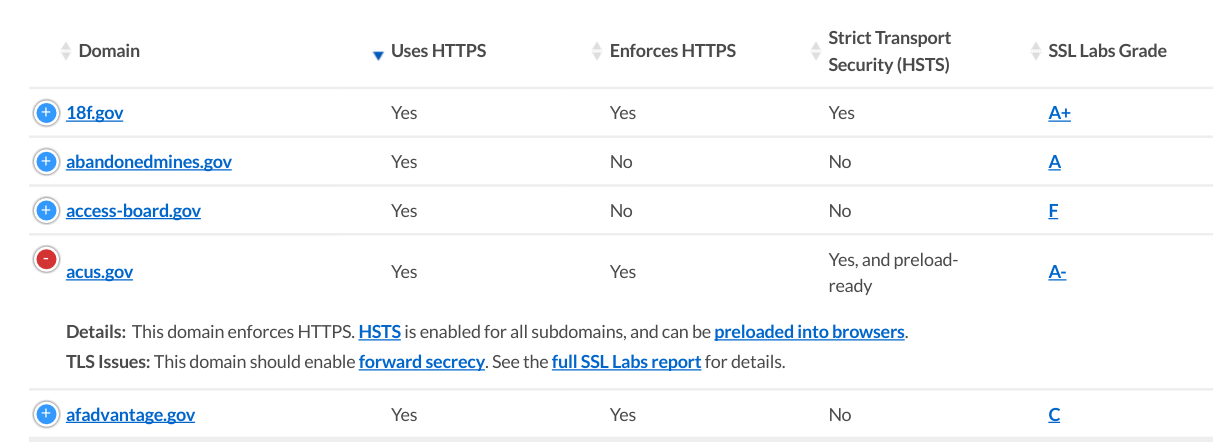
Domains have 4 possible "endpoints" — https://www,https://, http://www, andhttp:// — which may each exhibit very different behavior. Describing a domain's HTTPS support means detecting which endpoint is "canonical," as well as looking holistically at which endpoints redirect to others.
A domain's HTTPS certificate might be issued for an invalid hostname (e.g. a248.e.akamai.net). In this case, HTTPS is likely anunsupported way to access the domain.
A domain's HTTPS certificate might have an incomplete or untrusted chain (e.g. missing intermediates, or a private root certificate), in which case HTTPS is likely asupported way to access the domain.
A domain might set an HSTS policy for www, but neglect to apply one to the bare domain, negating HSTS policy for its other subdomains.
A domain might support HTTPS with a valid certificate, but have a policy of "downgrading" users by redirecting away from HTTPS to HTTP.

We use site-inspector to look at all of the above factors (and many more) and calculate a bunch of helpful things about a domain's HTTPS support. If you really want to dive deeply into the methodology, you can read the original work discussion.

To measure HTTPS quality, we lean onSSL Labs. SSL Labs' grading systemhas become a widely respected, universally referenced gauge of HTTPS quality. (Here's the report for Pulse itself.)

We used ssllabs-scan, an open source client for the SSL Labs API, to collect the top-level grade along with some common relevant issues that are worth addressing (such as forward secrecy, or the use of SHA-1 signatures).
Looking forward

We're still in the process of fully documenting the tools we used. If you're interested in using any of it in your own work, and you have questions about how to get started, ring in on GitHub. We're an open source team, and we'd love your contributions!

Pulse is clearly a small and simple website, but we think it's a promising foundation for celebrating (and motivating) the U.S. government's progress on making world-class websites and online services.

We're thrilled we had the opportunity to work with the Office of Government-wide Policy here at GSA to get Pulse started, and we hope others find it useful. Feel free to leave feedback on the project so far, and where to take Pulse next!

Source

.

Thursday, October 29, 2015

The Internet is getting less and less free


The Switch


By Brian Fung October 28


(Amanda Slater / Flickr)

Surveillance, attacks on digital speech, outright censorship and imprisonment are making the Internet less and less free, an annual Freedom House study has concluded.

The organization's latest Internet freedom report marks the fifth year in a row that digital civil liberties around the world have been curtailed. Of the 65 countries Freedom House looked at, 29 percent are considered "not free," while even fewer — 27 percent — are said to have a "free" Internet.

In other words, there are now more countries with an un-free Internet than there are countries with a free Internet. (Last year's rankings showed 19 countries as "free" and 15 as "not free.")


(Freedom House)


Some surprising findings: France's score dropped by four points, one of the most dramatic declines of the past year. That's due in part to what Freedom House said was a "problematic" crackdown on free speech and a rise in government surveillance after the attacks on the staff of the newspaper Charlie Hebdo.

Cuba's standing, on the other hand, rose by eight points amid warming relations with the United States and a decision by state telecom operators to slash the price of Internet access in half. Even though the cost of Internet in Cuba is still prohibitively high for many, the Obama administration recently made it legal for U.S. Internet providers to start doing business there, opening a door to better, faster, cheaper broadband — if the Cuban government cooperates.

In the United States and Europe, political battles over encrypted Internet traffic cast a shadow over the free and open Web, according to Freedom House. Tech companies have accused law enforcement of trying to undermine user privacy and security by demanding that they install "back doors" into their software; authorities argue that the concessions are necessary to fight crime and terrorism.

Freedom House calculates its index as a composite of several factors, such as the amount of access to Internet a country enjoys, the extent to which authorities restrict content on the Web, and whether the government punishes Internet users.


Brian Fung covers technology for The Washington Post, focusing on telecommunications and the Internet. Before joining the Post, he was the technology correspondent for National Journal and an associate editor at the Atlantic.


Source
.