Showing posts with label Tveit. Show all posts

Wednesday, January 24, 2018

Pope Francis and World Council of Churches head address Davos participants


Peter Kenny |Tuesday, January 23 2018


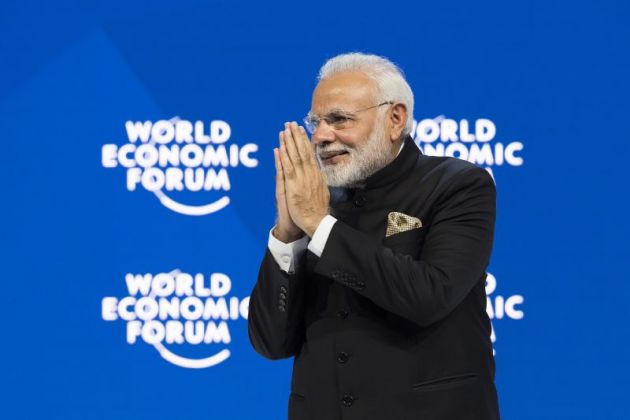
(Photo: World Economic Forum)India's Prime Minister Narendra Modi opens the World Economic Forum (WEF) in Davos, Switzerland on Jan. 23, 2018.


Pope Francis has urged participants at the World Economic Forum meeting to take bold steps to build a sustainable, human-centered future while World Council of Churches leader Olav Fykse Tveit has called on the world to say no to nuclear weapons.


Related


The Pope echoed the theme of the meeting, Creating a Shared Future in a Fractured World, calling on participants to build "inclusive, just and supportive societies."

The 48th World Economic Forum Annual Meeting is taking place Jan. 23-26 in snow-besieged Davos-Klosters, Switzerland and U.S. President Donald Trump who is expected to deliver the closing speech is drawing most attention due to his isolationist rhetoric.

Davos was opended on Jan. 23 by Indian Prime Minister Narendra Modi said the world is facing many new and serious challenges from the rise of anti-globalization to technological changes and the environment.


Saturday, October 05, 2013

World churches' leader raises Syria interfaith summit at Pope's meeting


Peter Kenny

Saturday, October 05 2013


World Council of Churches general secretary, Rev. Olav Fykse Tveit, with Pope Francis in an audience at the Vatican on October 3, 2013.Photo: Osservatore Romano


The leaders of the Catholic Church and the World Council of Churches represent a majority of the world's Christians so their meeting in Rome this week was important for global peace.

Related


World church group aims to bring all faiths to Syria peace meeting
World churches leader urges US and Russia to talk on Syria
Pope asks other faiths to join day of prayer for peace in Syria


They met during discussions on an important doctrinal letter on peace from a man who is now on the verge of becoming a saint.

Pope John XXIII's Cold War era Encyclical Pacem in Terris or "Peace on Earth," remains "extremely contemporary. It can act as a guide to peace-building in today's world said Pope Francis at the meeting.

Pope Francis met participants and spoke on October 3 at the three day Vatican conference celebrating the 50th anniversary of the John XXIII's 1963 Encyclical Letter.

As well as the general secretary of the World Council of Churches, Rev. Olav Fyske Tveit, experts from the United Nations, Catholic universities and institutions, the Council of Europe, the African Union, and the Organization of American States were invited to Rome by the Pontifical Council for Justice and Peace to discuss the relevance of Pacem in Terris today.

Francis noted the document was written in the most critical period of the Cold War, when humanity feared it was on the brink of a worldwide atomic conflict due to the lingering confrontation between the two superpowers, the United States and the Soviet Union.

John XXIII, who will be elevated to sainthood in 2104, launched his dramatic appeal for peace to world leaders.

"It was a cry to mankind, but also a plea to Heaven.

"The dialogue that opened, with some difficulty, between the two great opposing blocs led them to overcome this phase during the pontificate of the other blessed pope, John Paul II, and to open up space for freedom and dialogue," said Francis.

SEEDS OF PEACE

"The seeds of peace sown by blessed John XXIII bore fruit but, despite the fall of walls and barriers, the world continues to hunger for peace and the appeal made in 'Pacem in terris' retains a powerful current relevance."

When he addressed the discussions Tveit noted that much had been written about the context of the encyclical in the 1960s when the world was on the brink of a nuclear war, peoples were overcoming colonial rule and joining the United Nations, and the civil rights movement was changing the United States.

"Surely," he said,"the encyclical responds to the contemporary context and is, indeed, reading the signs of the times.

"We can discern the consequences of Pacem in Terris today when His Holiness Pope Francis calls for a peaceful solution in Syria and condemns the proliferation of wars and conflicts.

This was where Francis' words mesh with what the WCC sought at a September 18 meeting held on Syria in Geneva with church leaders from Syria, Russia, United States, Britain, France, Germany and Turkey.

At that meeting they issued a call for an inter-faith peace meeting on Syria after talks with Kofi Annan, former United Nations general secretary, and Lakhdar Brahimi, UN-Arab League joint representative for Syria.

"We discussed with one another and with Mr. Annan and Mr. Brahimi from the U.N., listening to their advice on what we could do to contribute to peace and reconciliation in Syria.

"Our joint communiqué said, 'Churches worldwide have spoken out against the war in Syria [and] must continue to raise their voices in their congregations and with their governments.

"We must strengthen the public outcry so that those in power will protect the common interest of humanity."

In Rome, Tveit called on the churches to be congregations of peacemakers.

He invited the Roman Catholic Church and the Pontifical Council to join in the "ecumenical pilgrimage for justice and peace," saying that "churches are included in God's work for peace."


Source
.
Friday, August 16, 2013

Pope and world churches leader join call for dialogue in Egypt


Peter Kenny


Friday, August 16 2013


Coptic Christians run from tear gas fired by police inside the main cathedral during clashes with Muslims standing outside the Cathedral in Cairo, April 7, 2013. Clashes broke out between Coptic Christians and Muslims in central Cairo on Sunday after the funeral of four Copts killed in sectarian violence outside the Egyptian capital on Friday night, witnesses said.Photo> REUTERS / Asmaa Waguih


Pope Francis and the head of the World Council of Churches, Rev. Olav Fykse Tveit, have joined the United Nations and international leaders in issuing pleas for peace and dialogue in strife-torn Egypt where at least 638 people have been killed since Wednesday.

"Let us pray together for peace, dialogue and reconciliation in that dear nation and throughout the world," said the Pope Francis after a service at the papal summer residence of Castel Gandolfo southeast of Rome on Thursday.


Related


Obama administration blasted for silence on Middle East persecution
Egypt forces assault protest camp, many scores shot dead
Egyptian Christians happy Mursi is gone but remain wary
In rural Syria, a rare peace threatened by sectarian war
World church groups concerned at Egypt situation, urge restraint
Egyptian Christians face upsurge in attacks after coup


Francis lamented the "painful news" coming from Egypt following the bloody crackdown there by security forces on protesters and appealed for "peace, dialogue and reconciliation."

U.S. President Barack Obama called on the Egyptian authorities to respect the universal rights of the people.

"We call on those who are protesting to do so peacefully and condemn the attacks that we've seen by protesters, including on churches.

"We believe that the state of emergency should be lifted, that a process of national reconciliation should begin, that all parties need to have a voice in Egypt's future, that the rights of women and religious minorities should be respected, and that commitments must be kept to pursue transparent reforms of the constitution and democratic elections."

Later Thursday, the U.N. Security Council urged all parties in Egypt to exercise maximum restraint.

The World Council of Churches general secretary Tveit, said, "The only way forward is for mutual recognition as equal citizens within Egypt, sharing responsibilities and authority, accepting the diversity of political opinions and religious beliefs."

The bloodbath was triggered after Egypt's military regime began a forceful clearance of two Cairo sit-ins where protesters were demanding the reinstatement of deposed Islamist president Mohamed Morsi who is backed by the Muslim Brotherhood, but was ousted by the military on July 3.

The Egyptian newspaper Ahram Online reported churches across Egypt came under frenzied attack Thursday as the country became convulsed in the violent turmoil.

This came after security forces forcibly broke up two major Cairo protest camps held by supporters of Morsi who was ousted by the military on July 3.

Ahram reported that Morsi loyalists launched nationwide assaults on Christian targets, wreaking havoc on churches, homes, and Christian-owned businesses throughout the country.

It quoted Coptic rights group the Maspero Youth Union (MYU) saying that as many as 36 churches were "completely" devastated by fire across nine Egyptian governorates.

The Christian Post quoted Bishop Angaelos, the Cairo-born head of the Coptic Orthodox Church in the United Kingdom, saying he had heard that 52 churches had been attacked.

The largest Christian community in the Middle East, Copts, account for about 10 percent of Egypt's 84 million people.

Their leader Pope Tawadros II initially spoke in support of the coup that ousted Morsi.

This followed the marginalization and increased attacks on Christians, but his support seemed to have exacerbated the situation for Egypt's Christians.

In a letter to the WCC member churches in Egypt the WCC's Tveit said, "Since 25 January 2011 Egypt has been experiencing a critical moment in its history.

Tveit noted, "The Egyptian people showed on different occasions their belief in a multi-religious and multi-cultural society where all parties join hands in facing the current challenges and building a better future based on social justice and human dignity.

"The World Council of Churches and its member churches are greatly concerned by the violent turn of events in Egypt and call for an immediate end of violence from all sides."

The WCC is a grouping of mainly Anglican, Orthodox and Protestant churches representing more than 500 million Christians. While the Roman Catholic Church is not a member, it serves of WCC bodies and works closely with it.

United Nations High Commissioner for Human Rights Navi Pillay noted comments of UN Secretary-General Ban Ki-moon that violence and incitement from any side will not solve anything in Egypt.

"What is needed is genuinely inclusive reconciliation. I therefore appeal again to all sides to engage in urgent dialogue to avoid further violence and hate speech, with the aim of restoring constitutional order through free and democratic elections," she said from Geneva on Thursday.


Source
.