Showing posts with label confessions. Show all posts
Showing posts with label confessions. Show all posts
Tuesday, June 09, 2026
Sunday, March 15, 2026
Pope Leo suggests Christian leaders who start wars should go to confession

Mar 13, 2026
Pope Leo XIV said Christian leaders who bear responsibility for armed conflicts should examine their consciences and seek confession. "Do those Christians who bear serious responsibility in armed conflicts have the humility and courage to make a serious examination of conscience and to go to confession?" Leo said during a speech on Friday.
The pope did not name any specific conflict or individual, but he has repeatedly appealed for peace in Iran and the Middle East, describing the situation as "deeply disturbing." In January, Leo lamented that "war is back in vogue and a zeal for war is spreading."
via CNN
Friday, October 31, 2025
Friday, January 19, 2018
Why I Confessed My Sins to a Jesuit Priest
Why I Confessed My Sins to a Jesuit Priest
Even though I’m a Protestant pastor.
Rachel Triska

“Forgive me, Father, for I have sinned. It has been 31 years and I have never practiced confession.”
If I had followed the traditional formula, perhaps that is what I would have said to the priest who took my confession in November of 2014. But I’m a Protestant and we didn’t bother with formalities. I think he and I were both a little surprised to be sitting across from one another.
Last year, I took a five-week sabbatical. Part of that time I spent in silent retreat at Montserrat House, a Jesuit Retreat Center. I needed rest—I knew that. What I did not know was, while there, God would introduce me to the transformative power of private confession.
Feeling forgiveness
On the last night of my retreat, the Jesuits made themselves available to anyone who wanted to practice confession. Father John had led the retreat so I caught up with him, breaking the silence to ask, “Can I come to confession tonight. I’m Protestant.” Father John smiled and answered, “Of course.”
Father John had led the retreat so I caught up with him, breaking the silence to ask, 'Can I come to confession tonight. I’m Protestant.'
I stood in line with 60 other retreatants waiting to make our confession. When it was my turn, I entered a small study and sat in a hardback wooden chair across from Father John. He recognized me as his Protestant retreatant and immediately launched into an explanation of how confession works.
I interrupted.
“Umm, Father, I understand how it works in theory. I wanted to practice confession. I’m Protestant, but can you take my confession?”
“Well, it’s not customary,” he responded, “but it’s not prohibited.”
So there I was, a Protestant pastor sitting across from a Jesuit priest. And I laid my soul bare before him. I confessed that my relationship with the Lord had devolved into a work relationship. I confessed to showing favoritism among members of my congregation. I confessed to struggles with pride and selfishness, to sinning in anger and causing others grief. All this and more I said in halting sentences.
Friday, December 22, 2017
Bring peace on earth and in hearts by going to confession, pope says
World
By Carol Glatz
Posted: 12/21/2017
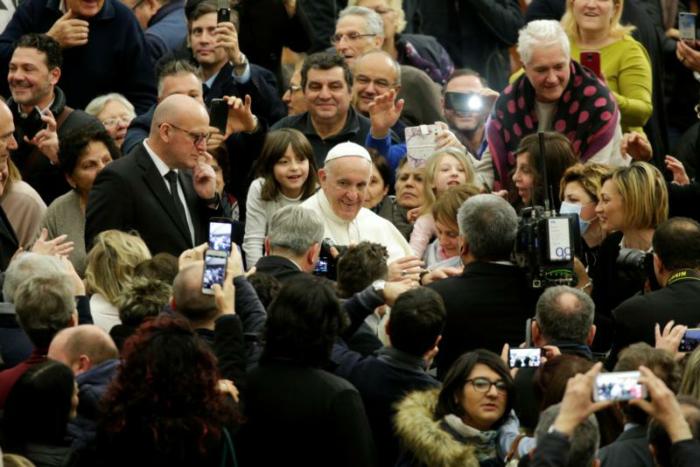
Pope Francis greets guests as he arrives to deliver his Christmas wishes to Vatican employees and their families during a special audience Dec. 21 in Paul VI hall at the Vatican. (CNS photo/Max Rossi, Reuters)
VATICAN CITY (CNS) -- Head to confession so Christmas can be a time of peace in your hearts, Pope Francis told Vatican employees and their families.
"Yesterday I went to confession for Christmas ... and it did me good," he told the employees during a special audience in the Vatican's Paul VI hall Dec. 21.
Continuing a tradition he began in 2014, the pope invited people who work at the Vatican, along with their family members and loved ones, to receive pre-Christmas greetings. The now-annual meeting follows a longer-held tradition of the pope meeting with members of the Roman Curia -- the church's central administrative offices -- as well as cardinals living in Rome and members of the papal household.
On his way into the audience hall, the pope blessed, hugged, kissed and high-fived some of the many children who were present. Some offered gifts or notes to the pope, who celebrated his 81st birthday Dec. 17.
The pope thanked the employees for being an important part of the church's universal mission, and for helping run "this train that is the Vatican, the Holy See, that seems so heavy, so big with so many problems."
One pressing problem he wanted to fix was the continued existence of precarious employment at the Vatican and jobs that were "off the books," he said to applause.
"I don't want any under-the-table employment at the Vatican," he said.
He asked for their help in addressing a current Vatican law that allows for temporary contracts. It is acceptable to allow for temporary work contracts during a trial period, he said, but only for one year, maybe two, but no longer than that.
"We have to work so that there will never be any precarious employment and employees here anymore," he said, asking their forgiveness that the situation still exists.
"For me it's a problem of conscience because we cannot preach the social doctrine of the church and then do these things that are not right," he said.
The pope urged couples and families to seek help in times of trouble or crisis and to never argue in front of the children. Seeing parents fight makes the children suffer and they do not always understand the circumstances behind the arguments, he said.
"Take care of families," he said, because they are "an immense jewel."
Acknowledging that most employees had heard him talk about gossip on many occasions, Pope Francis said he still thought it was important to mention. He urged employees, especially those who should be setting a good example for others, to "bite your tongue" instead of tearing other people down.
And lastly, the pope again asked for their forgiveness, saying, "I'm sorry because we do not always set a good example."
By "we," he said he meant other clergy and himself because he, too, sometimes loses his patience.
"There are mistakes we clergy make in life, sins, injustices, or sometimes we treat people badly, (we are) a bit neurotic," he said. "Forgive us for all these examples that are not good."
And, he told them, do not be afraid to ask for forgiveness, too, and to go to confession if their conscience was bothering them.
The Christmas season "is a good time to create peace inside ourselves, too. We are all sinners. All of us," he said.
"Let's do a good housecleaning of the heart this Christmas so as to be at peace and happy," he said, wishing them all a Merry Christmas.
Saturday, October 14, 2017
Confessions of a Christian Prepper
My hope shouldn’t lie in survival skills and stockpiles.


Image: CatLane / iStock / Getty
“You could be forgiven for thinking apocalyptic thoughts,” writes The New York Times in response to recent disasters.
With multiple earthquakes, successive hurricanes, fires raging in the Northwest and California, as well as escalating tensions with North Korea, the last few months have brought an onslaught of natural and man-made chaos.
The less obvious threat for Americans is the vulnerability of our electrical grid—which, in the opinion of some experts, is imminently hackable.
Vanity Fair publishes regularly on the topic (see Michael Lewis’s latest story). Even Ted Koppel, the calm, unflappable former news anchor, says it’s a matter of if, not when the electrical grid goes down and leaves us suspended in a strange, uneasy darkness.
This “confluence of disastrous events” brings out our most basic instinct: the urge to survive.
The “prepping” trend has grown in response, from basic emergency preparedness (extra water and bags of dried beans) to fully furnished underground bunkers packed with freeze-dried rations. (Costco offers options for both groups.) According to Google Trends, searches for “prepper” and “survivalism” have reached record highs in the last few months.
At a deeper level, these dangers and disasters bring us face to face with the fragility of human life. Lurking beneath our well-socialized exteriors is an intense, primitive need to protect ourselves and those around us from existential threats. Parents fear the possibility that one day we’ll wake up and find ourselves unable to keep our kids safe from famine or fire. One way or another, we all have to contend with the fundamental tension between readiness and relinquishment: When do we accept our mortality, when do we fight against it, and when do we give it up to God’s providence?
Existential dread comes easily to me—although I fear disaster more than death. By some standards, I’m a doomsday prepper in waiting. If I had a more fragile, paranoid psyche, there’s a good chance I’d be living “off the grid” in an abandoned brick warehouse with a small herd of cats and a stack of canned food. I’d hunker down with a ham radio while my children scuttle around like Dickensian street urchins.
As it is, I sublimate my anxieties into more socially acceptable form by skimming prepper websites and organizing canned food and water in the back of my pantry. After the recent Harvey hurricane, I sent a donation to a Houston-based nonprofit and then joined my fellow Austinites lined up at fueling stations to fill portable gas cans in case of a shortage. (The cans now sit in two neat rows on a shelf in my garage.)
Saturday, July 23, 2016
Saturday, April 11, 2015
Daredevil’s Greatest Superpower Is His Catholicism
It’s also his greatest enemy.
By Charles Moss

Charlie Cox stars in the Netflix series Marvel’s Daredevil.
Photo by Barry Wetcher
Netflix’s latest series, Marvel’s Daredevil—all 13 episodes of which began streaming Friday—opens with the titular blind lawyer Matt Murdock (Charlie Cox) in confession. As he babbles about the complicated state of his family, the priest interrupts him, suggesting it might be easier if he just confessed what he’s done. Murdock responds: “I’m not seeking forgiveness for what I’ve done, Father. I’m asking forgiveness for what I’m about to do.”
To really understand Daredevil—both the comic book and the new show—you need to understand his Catholicism.
Created by Stan Lee, Bill Everett, and Jack Kirby, Daredevil No. 1, which was published in 1964, told the story of Matt Murdock, a boy blinded by a radioactive chemical while saving an old man from being hit by a car. Though he lost his sight, Murdock’s other senses were heightened to superhuman standards, giving him a radarlike ability. After his mother left when he was a baby, his father, a down-and-out boxer who worked as an enforcer for the mob, raised him. His father was eventually murdered by that same mob, and Murdock grew up to become a lawyer by day and a rooftop-leaping vigilante by night—fighting for justice to avenge his father’s death. But the Netflix show takes a lot of cues from Frank Miller’s Man Without Fear comic book series, his retelling of the classic Daredevil origin story.
Miller—who’s known for 300, Sin City, and The Dark Knight Returns—worked on Daredevil in the 1980s and again briefly in the ’90s, redefining the character from a Spider-Man–like wise guy swinging from rooftops, quipping funnies, and beating up bad guys, to a dark, violent hero. By adding these elements as well as a spotlight on Murdock’s conflicted Catholicism—particularly in the 1986 Catholic-themed story arc Born Again—he turned a poorly selling comic series on the verge of cancellation into one of the top-selling Marvel titles of the ’80s. Miller wasn’t the first to claim Daredevil was Catholic. But he was the first to bring Murdock’s religion to the forefront, making it essential to his identity.
Netflix’s version understands this, which is what makes the show work: It tries to reconcile the lawyer who defends the law with the Daredevil who breaks it. Murdock’s brutal justice is more than his way of taking personal responsibility for the sins of others; it’s his way of atoning for his own. Murdock’s real superpower, and also his biggest foe, is his Catholicism.
In the documentary The Men Without Fear: Creating “Daredevil,” a DVD special feature that goes along with the maligned 2003 film starring Ben Affleck, Miller says, “Along the way, I decided he needed to be Catholic because only a Catholic could be a vigilante and an attorney at the same time.” Miller’s idea in Born Again was to deconstruct the character and reinvent him by putting him through his own personal hell. The mobster Kingpin beats him nearly to death, he loses his law firm and becomes homeless, and his ex-girlfriend, Karen Page, becomes a drug addict and porn star who sells his secret identity to Kingpin for another fix. Miller uses these plot devices as a way for Murdock to re-emerge a stronger, better hero, born again. The illustrations mimic the imagery, putting Murdock, who is out of costume for much of the story, in various poses clearly reminiscent of the death and rebirth of Jesus.
For Miller, this decision was personal. Later in The Men Without Fear, he says, “Matt’s been the character I punish for all my mistakes and sins. Because he really is a flawed hero, in that he’s a man who intends to do good and causes much damage. Matt should have been a villain. He had a horrible childhood, his romantic life was the worst … but somehow he redeems himself and moves ahead. He just doesn’t give up.”
Another Daredevil writer who appears in the documentary and mined the Catholic theme of redemption through weakness is Kevin Smith, he of Clerks, Mallrats, and Dogma fame. Smith wrote the eight-issue storyline Guardian Devil, in which Daredevil finds himself caring for a newborn baby who may or may not be the Antichrist, as more or less a continuation of Miller’sBorn Again, and it is arguably the most in-your-face story about Daredevil’s Catholicism to date, due to Smith’s own struggles with the denomination.
“[Daredevil’s] not a dude going to church every Sunday and receiving the host, but he had a very Catholic streak running through him,” he says. “I really appreciated that. I played with that a lot more in my storyline, actually putting him in the confessional and whatnot. I really steeped it in Catholicism a bit more because it lent itself to it based on the work that had gone before. I think the angst that goes along with being raised Catholic is quite obvious in that character and inherent to how powerful that character is and can be.”
The Netflix show drives home the idea that Murdock can’t ever be absolved from sin, because he fears that admitting what he’s doing as Daredevil will risk his capture. Midseason, the priest he half-confessed to in the first episode offers his ear once again, in case Murdock wants to tell his secret, but Murdock plays coy. Not only does he feel he can’t confess, he doesn’t want to. Being Daredevil (or, at this early stage of his career, the Man in Black, as he’s called before his dons his iconic red costume), sacrificing himself over and over again each night he goes out to fight crime, is his way of dealing with the guilt he feels about the murder of his father.
Cox’s Daredevil is no saint. He breaks bones. He uses excessive force. He almost murders a man. But what stops him from going too far are not wise words from an Uncle Ben–like character or a sacred oath made at the graves of his murdered parents; it’s his faith.
Daredevil is far from the perfect superhero. He makes mistakes. He doesn’t have “an iron suit or a magic hammer.” And his relentless sacrifice night after night, his ability to gain strength from his weaknesses, and his guilt over the terrible things he does to bring justice to Hell’s Kitchen may not make him the perfect Catholic either, but they do make his faith an ever greater superpower than his heightened senses.
Charles Moss is a freelance writer based in Chattanooga, Tennessee. He’s written for theAtlantic, Paste, Tablet, and the Week. Follow him on Twitter.
Source
.
.
Photo by Barry Wetcher
Netflix’s latest series, Marvel’s Daredevil—all 13 episodes of which began streaming Friday—opens with the titular blind lawyer Matt Murdock (Charlie Cox) in confession. As he babbles about the complicated state of his family, the priest interrupts him, suggesting it might be easier if he just confessed what he’s done. Murdock responds: “I’m not seeking forgiveness for what I’ve done, Father. I’m asking forgiveness for what I’m about to do.”
To really understand Daredevil—both the comic book and the new show—you need to understand his Catholicism.
Created by Stan Lee, Bill Everett, and Jack Kirby, Daredevil No. 1, which was published in 1964, told the story of Matt Murdock, a boy blinded by a radioactive chemical while saving an old man from being hit by a car. Though he lost his sight, Murdock’s other senses were heightened to superhuman standards, giving him a radarlike ability. After his mother left when he was a baby, his father, a down-and-out boxer who worked as an enforcer for the mob, raised him. His father was eventually murdered by that same mob, and Murdock grew up to become a lawyer by day and a rooftop-leaping vigilante by night—fighting for justice to avenge his father’s death. But the Netflix show takes a lot of cues from Frank Miller’s Man Without Fear comic book series, his retelling of the classic Daredevil origin story.
“I decided he needed to be Catholic because only a Catholic could be a vigilante and an attorney at the same time.” Frank Miller
Miller—who’s known for 300, Sin City, and The Dark Knight Returns—worked on Daredevil in the 1980s and again briefly in the ’90s, redefining the character from a Spider-Man–like wise guy swinging from rooftops, quipping funnies, and beating up bad guys, to a dark, violent hero. By adding these elements as well as a spotlight on Murdock’s conflicted Catholicism—particularly in the 1986 Catholic-themed story arc Born Again—he turned a poorly selling comic series on the verge of cancellation into one of the top-selling Marvel titles of the ’80s. Miller wasn’t the first to claim Daredevil was Catholic. But he was the first to bring Murdock’s religion to the forefront, making it essential to his identity.
Netflix’s version understands this, which is what makes the show work: It tries to reconcile the lawyer who defends the law with the Daredevil who breaks it. Murdock’s brutal justice is more than his way of taking personal responsibility for the sins of others; it’s his way of atoning for his own. Murdock’s real superpower, and also his biggest foe, is his Catholicism.
In the documentary The Men Without Fear: Creating “Daredevil,” a DVD special feature that goes along with the maligned 2003 film starring Ben Affleck, Miller says, “Along the way, I decided he needed to be Catholic because only a Catholic could be a vigilante and an attorney at the same time.” Miller’s idea in Born Again was to deconstruct the character and reinvent him by putting him through his own personal hell. The mobster Kingpin beats him nearly to death, he loses his law firm and becomes homeless, and his ex-girlfriend, Karen Page, becomes a drug addict and porn star who sells his secret identity to Kingpin for another fix. Miller uses these plot devices as a way for Murdock to re-emerge a stronger, better hero, born again. The illustrations mimic the imagery, putting Murdock, who is out of costume for much of the story, in various poses clearly reminiscent of the death and rebirth of Jesus.
For Miller, this decision was personal. Later in The Men Without Fear, he says, “Matt’s been the character I punish for all my mistakes and sins. Because he really is a flawed hero, in that he’s a man who intends to do good and causes much damage. Matt should have been a villain. He had a horrible childhood, his romantic life was the worst … but somehow he redeems himself and moves ahead. He just doesn’t give up.”
Another Daredevil writer who appears in the documentary and mined the Catholic theme of redemption through weakness is Kevin Smith, he of Clerks, Mallrats, and Dogma fame. Smith wrote the eight-issue storyline Guardian Devil, in which Daredevil finds himself caring for a newborn baby who may or may not be the Antichrist, as more or less a continuation of Miller’sBorn Again, and it is arguably the most in-your-face story about Daredevil’s Catholicism to date, due to Smith’s own struggles with the denomination.
“[Daredevil’s] not a dude going to church every Sunday and receiving the host, but he had a very Catholic streak running through him,” he says. “I really appreciated that. I played with that a lot more in my storyline, actually putting him in the confessional and whatnot. I really steeped it in Catholicism a bit more because it lent itself to it based on the work that had gone before. I think the angst that goes along with being raised Catholic is quite obvious in that character and inherent to how powerful that character is and can be.”
The Netflix show drives home the idea that Murdock can’t ever be absolved from sin, because he fears that admitting what he’s doing as Daredevil will risk his capture. Midseason, the priest he half-confessed to in the first episode offers his ear once again, in case Murdock wants to tell his secret, but Murdock plays coy. Not only does he feel he can’t confess, he doesn’t want to. Being Daredevil (or, at this early stage of his career, the Man in Black, as he’s called before his dons his iconic red costume), sacrificing himself over and over again each night he goes out to fight crime, is his way of dealing with the guilt he feels about the murder of his father.
Cox’s Daredevil is no saint. He breaks bones. He uses excessive force. He almost murders a man. But what stops him from going too far are not wise words from an Uncle Ben–like character or a sacred oath made at the graves of his murdered parents; it’s his faith.
Daredevil is far from the perfect superhero. He makes mistakes. He doesn’t have “an iron suit or a magic hammer.” And his relentless sacrifice night after night, his ability to gain strength from his weaknesses, and his guilt over the terrible things he does to bring justice to Hell’s Kitchen may not make him the perfect Catholic either, but they do make his faith an ever greater superpower than his heightened senses.
Charles Moss is a freelance writer based in Chattanooga, Tennessee. He’s written for theAtlantic, Paste, Tablet, and the Week. Follow him on Twitter.
Source
.
.
Monday, September 08, 2014
Supreme Court asked to defend Seal of Confession in La. case
By Matt Hadro

United States Supreme Court.
Baton Rouge, La., Sep 6, 2014 / 07:32 am (CNA/EWTN News).- The Diocese of Baton Rouge, Louisiana, is appealing to the U.S. Supreme Court to review a ruling that a diocesan priest may be forced to break the Seal of Confession.
“This case concerns who – the Church or the state – gets to determine the meaning, content, and requirements of the Catholic Sacrament of Reconciliation – one of the Church’s most sacred and central practices,” the diocese’s appeal read.
Back in May, the Louisiana Supreme Court ruled that a priest of the Baton Rouge Diocese, Father Jeff Bayhi, could be forced to testify in court about a supposed confession made by a minor allegedly regarding her sexual abuse at the hands of a parishioner.
A state appeals court initially ruled that the alleged confession was “confidential” and thus Fr. Bayhi did not have to testify in court as to its alleged contents or whether it even took place.
However, the state Supreme Court reversed that decision, saying that the seal of confession did not shield Fr. Bayhi from mandatory reporting laws.
Louisiana law states that a “member of the clergy” must report allegations of sexual abuse, except in the case of “confidential” conversations made in private “and not intended for further disclosure except to other persons present in furtherance of the purpose of the communication.” In addition, a priest “is presumed to have the authority to claim the privilege” of confidentiality “on behalf of the person or deceased person.”
However, the high court ruled that Fr. Bayhi can only invoke confidentiality if the girl refuses to disclose their conversation, and since she waived her confidentiality privilege, he is subject to the mandatory sexual abuse reporting laws.
In the appeal, the diocese stated that even to admit the conversation took place – much less reveal its alleged contents – would involve Fr. Bayhi breaking the Seal of Confession, which no priest is allowed to do, even under threat of civil penalty or imprisonment.
The existence and/or contents of the alleged conversation is “knowledge that under church law he [Fr. Bayhi] is absolutely forbidden to share with others for any reason under penalty of automatic excommunication,” the appeal stated.
“The Louisiana Supreme Court’s decision cannot stand,” the appeal stated. “It conflicts with long-standing authority of this and other courts and threatens church autonomy.”
The diocese has previously emphasized that the priest is under the gravest of oaths not to reveal the contents of a confession or if the confession even took place.
“If necessary, the priest would have to suffer a finding of contempt in a civil court and suffer imprisonment rather than violate his sacred duty and violate the seal of confession and his duty to the penitent.”
“A foundational doctrine of the Roman Catholic Church for thousands of years mandates that the seal of confession is absolute and inviolable,” the diocese stressed, also saying that the “matter is of serious consequence to all religions, not just the Catholic faith.”
In a September 4 statement, the diocese said the court’s ruling “strikes a very hard blow against religious freedom, and one which the diocese and Father Bayhi feel compelled to vigorously protest.”
The diocese also spoke out against the court’s “unprecedented” ruling that the trial court decide “whether or not a sacrament actually took place.”
“Doing so allows the state to override the religion’s own determination of what its beliefs and practices require and destroys the sacred seal of confession in the process,” the appeal stated.
Baton Rouge, La., Sep 6, 2014 / 07:32 am (CNA/EWTN News).- The Diocese of Baton Rouge, Louisiana, is appealing to the U.S. Supreme Court to review a ruling that a diocesan priest may be forced to break the Seal of Confession.
“This case concerns who – the Church or the state – gets to determine the meaning, content, and requirements of the Catholic Sacrament of Reconciliation – one of the Church’s most sacred and central practices,” the diocese’s appeal read.
Back in May, the Louisiana Supreme Court ruled that a priest of the Baton Rouge Diocese, Father Jeff Bayhi, could be forced to testify in court about a supposed confession made by a minor allegedly regarding her sexual abuse at the hands of a parishioner.
A state appeals court initially ruled that the alleged confession was “confidential” and thus Fr. Bayhi did not have to testify in court as to its alleged contents or whether it even took place.
However, the state Supreme Court reversed that decision, saying that the seal of confession did not shield Fr. Bayhi from mandatory reporting laws.
Louisiana law states that a “member of the clergy” must report allegations of sexual abuse, except in the case of “confidential” conversations made in private “and not intended for further disclosure except to other persons present in furtherance of the purpose of the communication.” In addition, a priest “is presumed to have the authority to claim the privilege” of confidentiality “on behalf of the person or deceased person.”
However, the high court ruled that Fr. Bayhi can only invoke confidentiality if the girl refuses to disclose their conversation, and since she waived her confidentiality privilege, he is subject to the mandatory sexual abuse reporting laws.
In the appeal, the diocese stated that even to admit the conversation took place – much less reveal its alleged contents – would involve Fr. Bayhi breaking the Seal of Confession, which no priest is allowed to do, even under threat of civil penalty or imprisonment.
The existence and/or contents of the alleged conversation is “knowledge that under church law he [Fr. Bayhi] is absolutely forbidden to share with others for any reason under penalty of automatic excommunication,” the appeal stated.
“The Louisiana Supreme Court’s decision cannot stand,” the appeal stated. “It conflicts with long-standing authority of this and other courts and threatens church autonomy.”
The diocese has previously emphasized that the priest is under the gravest of oaths not to reveal the contents of a confession or if the confession even took place.
“If necessary, the priest would have to suffer a finding of contempt in a civil court and suffer imprisonment rather than violate his sacred duty and violate the seal of confession and his duty to the penitent.”
“A foundational doctrine of the Roman Catholic Church for thousands of years mandates that the seal of confession is absolute and inviolable,” the diocese stressed, also saying that the “matter is of serious consequence to all religions, not just the Catholic faith.”
In a September 4 statement, the diocese said the court’s ruling “strikes a very hard blow against religious freedom, and one which the diocese and Father Bayhi feel compelled to vigorously protest.”
The diocese also spoke out against the court’s “unprecedented” ruling that the trial court decide “whether or not a sacrament actually took place.”
“Doing so allows the state to override the religion’s own determination of what its beliefs and practices require and destroys the sacred seal of confession in the process,” the appeal stated.
.
Monday, March 17, 2014
The Straight Testimony Produces a Shaking

There are those among us who will make confessions, as did Achan, too late to save themselves.
... They are not in harmony with right. They despise the straight testimony that reaches the heart, and would rejoice to see everyone silenced who gives reproof.—Testimonies for the Church 3:272 (1873).
The Lord calls for a renewal of the straight testimony borne in years past. He calls for a renewal of spiritual life. The spiritual energies of His people have long been torpid, but there is to be a resurrection from apparent death. By prayer and confession of sin we must clear the King’s highway.—Testimonies for the Church 8:297 (1904).
Last Day Events, pp.175,176
.
.
. Wednesday, January 08, 2014
Democracy Needs Whistleblowers — That's Why I Broke into the FBI in 1971
The Guardian / By Bonnie Raines
Like Snowden, we broke laws to reveal something that was more dangerous, and we wanted to hold J Edgar Hoover accountable.

Photo Credit: Wikimedia Commons
January 7, 2014 |
I vividly remember the eureka moment. It was the night we broke into an FBI office in Media, Pennsylvania, in March 1971 and removed about 1,000 documents from the filing cabinets. We had a hunch that there would be incriminating material there, as the FBI under J Edgar Hoover was so bureaucratic that we thought every single thing that went on under him would be recorded. But we could not be sure, and until we found it, we were on tenterhooks.
A shout went up among the group of eight of us. One of us had stumbled on a document from FBI headquarters signed by Hoover himself. It instructed the bureau's agents to set up interviews of anti-war activists as "it will enhance the paranoia endemic in these circles and will further serve to get the point across there is an FBI agent behind every mailbox."
That was the first piece of evidence to emerge. It was a vindication.
Looking back on what we did, there are obvious parallels with what Edward Snowden has done in releasing National Security Agency documents that show the NSA's blanket surveillance of Americans. I think Snowden's a legitimate whistleblower, and I guess we could be called whistleblowers as well.
A look back at what happened
I was 29 when my husband John and I decided to join six other people to carry out the break-in. I was a mother of three children, aged eight, six and two, and I was working on a degree in education at Temple University, where John was a professor of religion.
We had both been heavily involved in the civil rights movement. John had been a freedom rider, and in Philadelphia we participated in anti-war protests against Vientnam. Through that activity we knew that the FBI was actively trying to squelch dissent, illegally and secretly. We knew that they were sending informants into university classrooms, infiltrating meetings, and tapping phones. The problem was that though we knew all this, there was no way to prove it.
A physics professor at Haverford College named Bill Davidon called a few of us together at his home. Bill, who died last November, floated the idea of doing something to obtain evidence. He just came out with it: "What do you think about breaking into an FBI office to remove the files?" If it hadn't been for Bill, who was so smart and strategic, I'm not sure we would have taken it seriously. But we did.
Bill articulated for all of us the frustration over the foment of those times, and the feeling that we all had of being compelled to do something as ordinary citizens because no one in Washington was holding Hoover accountable. We started looking into the feasibility of a break-in. Right away, we found out the main FBI office in Philadelphia was in a high-rise in the center of the city, and that it was impregnable. Then we learned there were other field offices in the suburbs, and that lead us to Media.
John and I lived in a big old house in the Germantown area of Philadelphia, and we set aside a room in the third floor to be our base of operations. We lined the walls with maps of Media. We had to tell our elder children not to talk to anyone about the maps on the walls. Even though they knew nothing of our plans, we worried the detail might give something away.
We cased the FBI office in Media for about three months. Two of us would go and watch activity in and around that building, record people going in and out and the patterns of police patrols.
I was chosen to carry out the last piece of casing, which involved getting into the office during business hours to check out its security systems. I called and made an appointment to interview the head of the office, under the ruse that I was a Swarthmore College student researching opportunities for women in the FBI.
I tried not to arouse suspicions, tucking up my long hippy hair in a hat, wearing glasses and gloves throughout the interview even though I was taking notes. Through that visit I learned there was no security, none at all, in the office – even the filing cabinets were left unlocked.
I think it was Bill Davidon's idea to choose 8 March 1971 as the operation's date. It was the night of Muhammad Ali's fight against Joe Frazier, and we thought people would be listening on their radios and that the police would perhaps be a little less vigilant.
As the day approached, we both grew anxious. We had three children, there was a lot at jeopardy. We knew that if things went wrong and we were convicted, we could go to federal prison for a long time. We talked to my husband's brother and to my parents, without telling them the details, and asked them to take care of our children if the worst happened.
John wasn't sleeping well. I was a little more bold and determined, a little gung-ho I guess. My association with good people in the movement gave me strength, and the idea that citizens have to take responsibility for when our rights are being abused.
Four of us broke into the FBI office. Keith Forsyth had trouble picking the lock, which was daunting. My job that night was to distract any patrolling police cars by pretending my own vehicle had broken down. Luckily, no police drove by.
We spent a week going through the documents and then mailing them out anonymously to congresspeople and some progressive journalists. All the journalists, including the New York Times, returned the documents to the FBI under pressure from the Nixon White House. Everyone was afraid of Hoover, except the Washington Post. After the Post published the documents, everyone else jumped on board.
We were so happy that, finally, the right kind of information was getting out, and that it was accurate information that could stir things up. It had that effect, too – it really did stir things up. Senator Frank Church from Idaho, head of the Senate intelligence committee, called for hearings on the FBI and the intelligence. We felt our work was done.
Democracy needs whistleblowers
Democracy needs whistleblowers. Snowden was in a position to reveal things that nobody could dispute. He has performed a legitimate, necessary service. Unlike us, he revealed his own identity, and as a result, he's sacrificed a lot.
On our part, you could accuse us of being criminals – and Hoover did just that: he was apoplectic and sent 200 agents to try and find us in Philadelphia. "Find me that woman!" he screamed at them.
But to us there didn't seem to be an alternative at that point. No one was going to be hurt. We hoped for the outcomes that we wanted. We knew, of course, that we were breaking law, but I think that sometimes you have to break laws in order to reveal something dangerous, and to put a stop to it.
For five years we lived under the threat of arrest. There was a sketch of me that the FBI circulated from when I impersonated a Swarthmore student, though I didn't know it at the time. And the FBI interviewed John, luckily while I was out of the house. After five years, the statute of limitations fell for the burglary and we knew we were safe. We didn't celebrate on the fifth anniversary, though after that we were more relaxed. We now know they closed the case in 1976 for lack of any physical evidence.
Eventually, we told the children, and the story became part of family lore. We wanted them to know about that chapter in our history, and besides, you can't ask your children to act according to their conscience unless you show them what you have done in your life, too.
I still worry a great deal about the state of our democracy. Back in 1971, the country was so divided, there was so much foment, but there was also much determination to change things, and people felt empowered to do so.
Nowadays, the country is divided once again, but I don't see much concern about the abuses that are happening today, like the surveillance of mosques in America, using agent provocateurs. I hear people say, "I don't care," the government can do what it needs to do as long as it protects me from terrorism …" To me, that's giving the authorities blanket permission to cross the line again.
Dissent and accountability are the lifeblood of democracy, yet people now think they just have to roll over in the name of "anti-terrorism". Members of government thinks it can lie to us about it, and that they can lie to Congress. That concerns me for the future of my children and grandchildren, and that too makes me feel I can talk about, at my age, doing something as drastic as breaking-in to an FBI office in the search for truth.
Bonnie Raines was one of eight Americans who committed burglary on the FBI office in Media, Pennsylvania on March 8, 1971.
Source
.
Like Snowden, we broke laws to reveal something that was more dangerous, and we wanted to hold J Edgar Hoover accountable.
Photo Credit: Wikimedia Commons
January 7, 2014 |
I vividly remember the eureka moment. It was the night we broke into an FBI office in Media, Pennsylvania, in March 1971 and removed about 1,000 documents from the filing cabinets. We had a hunch that there would be incriminating material there, as the FBI under J Edgar Hoover was so bureaucratic that we thought every single thing that went on under him would be recorded. But we could not be sure, and until we found it, we were on tenterhooks.
A shout went up among the group of eight of us. One of us had stumbled on a document from FBI headquarters signed by Hoover himself. It instructed the bureau's agents to set up interviews of anti-war activists as "it will enhance the paranoia endemic in these circles and will further serve to get the point across there is an FBI agent behind every mailbox."
That was the first piece of evidence to emerge. It was a vindication.
Looking back on what we did, there are obvious parallels with what Edward Snowden has done in releasing National Security Agency documents that show the NSA's blanket surveillance of Americans. I think Snowden's a legitimate whistleblower, and I guess we could be called whistleblowers as well.
A look back at what happened
I was 29 when my husband John and I decided to join six other people to carry out the break-in. I was a mother of three children, aged eight, six and two, and I was working on a degree in education at Temple University, where John was a professor of religion.
We had both been heavily involved in the civil rights movement. John had been a freedom rider, and in Philadelphia we participated in anti-war protests against Vie
A physics professor at Haverford College named Bill Davidon called a few of us together at his home. Bill, who died last November, floated the idea of doing something to obtain evidence. He just came out with it: "What do you think about breaking into an FBI office to remove the files?" If it hadn't been for Bill, who was so smart and strategic, I'm not sure we would have taken it seriously. But we did.
Bill articulated for all of us the frustration over the foment of those times, and the feeling that we all had of being compelled to do something as ordinary citizens because no one in Washington was holding Hoover accountable. We started looking into the feasibility of a break-in. Right away, we found out the main FBI office in Philadelphia was in a high-rise in the center of the city, and that it was impregnable. Then we learned there were other field offices in the suburbs, and that lead us to Media.
John and I lived in a big old house in the Germantown area of Philadelphia, and we set aside a room in the third floor to be our base of operations. We lined the walls with maps of Media. We had to tell our elder children not to talk to anyone about the maps on the walls. Even though they knew nothing of our plans, we worried the detail might give something away.
We cased the FBI office in Media for about three months. Two of us would go and watch activity in and around that building, record people going in and out and the patterns of police patrols.
I was chosen to carry out the last piece of casing, which involved getting into the office during business hours to check out its security systems. I called and made an appointment to interview the head of the office, under the ruse that I was a Swarthmore College student researching opportunities for women in the FBI.
I tried not to arouse suspicions, tucking up my long hippy hair in a hat, wearing glasses and gloves throughout the interview even though I was taking notes. Through that visit I learned there was no security, none at all, in the office – even the filing cabinets were left unlocked.
I think it was Bill Davidon's idea to choose 8 March 1971 as the operation's date. It was the night of Muhammad Ali's fight against Joe Frazier, and we thought people would be listening on their radios and that the police would perhaps be a little less vigilant.
As the day approached, we both grew anxious. We had three children, there was a lot at jeopardy. We knew that if things went wrong and we were convicted, we could go to federal prison for a long time. We talked to my husband's brother and to my parents, without telling them the details, and asked them to take care of our children if the worst happened.
John wasn't sleeping well. I was a little more bold and determined, a little gung-ho I guess. My association with good people in the movement gave me strength, and the idea that citizens have to take responsibility for when our rights are being abused.
Four of us broke into the FBI office. Keith Forsyth had trouble picking the lock, which was daunting. My job that night was to distract any patrolling police cars by pretending my own vehicle had broken down. Luckily, no police drove by.
We spent a week going through the documents and then mailing them out anonymously to congresspeople and some progressive journalists. All the journalists, including the New York Times, returned the documents to the FBI under pressure from the Nixon White House. Everyone was afraid of Hoover, except the Washington Post. After the Post published the documents, everyone else jumped on board.
We were so happy that, finally, the right kind of information was getting out, and that it was accurate information that could stir things up. It had that effect, too – it really did stir things up. Senator Frank Church from Idaho, head of the Senate intelligence committee, called for hearings on the FBI and the intelligence. We felt our work was done.
Democracy needs whistleblowers
Democracy needs whistleblowers. Snowden was in a position to reveal things that nobody could dispute. He has performed a legitimate, necessary service. Unlike us, he revealed his own identity, and as a result, he's sacrificed a lot.
On our part, you could accuse us of being criminals – and Hoover did just that: he was apoplectic and sent 200 agents to try and find us in Philadelphia. "Find me that woman!" he screamed at them.
But to us there didn't seem to be an alternative at that point. No one was going to be hurt. We hoped for the outcomes that we wanted. We knew, of course, that we were breaking law, but I think that sometimes you have to break laws in order to reveal something dangerous, and to put a stop to it.
For five years we lived under the threat of arrest. There was a sketch of me that the FBI circulated from when I impersonated a Swarthmore student, though I didn't know it at the time. And the FBI interviewed John, luckily while I was out of the house. After five years, the statute of limitations fell for the burglary and we knew we were safe. We didn't celebrate on the fifth anniversary, though after that we were more relaxed. We now know they closed the case in 1976 for lack of any physical evidence.
Eventually, we told the children, and the story became part of family lore. We wanted them to know about that chapter in our history, and besides, you can't ask your children to act according to their conscience unless you show them what you have done in your life, too.
I still worry a great deal about the state of our democracy. Back in 1971, the country was so divided, there was so much foment, but there was also much determination to change things, and people felt empowered to do so.
Nowadays, the country is divided once again, but I don't see much concern about the abuses that are happening today, like the surveillance of mosques in America, using agent provocateurs. I hear people say, "I don't care," the government can do what it needs to do as long as it protects me from terrorism …" To me, that's giving the authorities blanket permission to cross the line again.
Dissent and accountability are the lifeblood of democracy, yet people now think they just have to roll over in the name of "anti-terrorism". Members of government thinks it can lie to us about it, and that they can lie to Congress. That concerns me for the future of my children and grandchildren, and that too makes me feel I can talk about, at my age, doing something as drastic as breaking-in to an FBI office in the search for truth.
Bonnie Raines was one of eight Americans who committed burglary on the FBI office in Media, Pennsylvania on March 8, 1971.
Source
.
Monday, November 18, 2013
The true battle is for life
At the General Audience Pope Francis calls the faithful to pray for victims in Damascus and the Philippines
The true battle is for life
Continuing his catechesis on the Creed he describes Baptism as the Christian's identity card
Baptism is the "identity card of the Christian, his birth certificate". The Pope said this during his catechesis at the General Audience on Wednesday, 13 November, in St Peter's Square. He also made an appeal to pray for the victims of mortar attacks in Damascus and for those suffering in the Philippines from the typhoon that devastated the country. He called people to pray for victims and join forces with those working to save lives in the aftermath: "These are the true battles to fight. For life! Never for death!". The following is a translation of the Pope's catechesis, which was delivered in Italian.
Dear Brothers and Sisters, Good morning!
In the Creed, through which we make our Profession of Faith every Sunday, we state: "I confess one Baptism for the forgiveness of sins". It is the only explicit reference to a Sacrament contained in the Creed. Indeed, Baptism is the "door" of faith and of Christian life. The Risen Jesus left the Apostles with this charge: "Go into all the world and preach the Gospel to the whole of creation. He who believes and is baptized will be saved" (Mk 16:15-16). The Church's mission is to evangelize and remit sins through the Sacrament of Baptism. But let us return to the words of the Creed. The expression can be divided into three points: "I confess"; "one Baptism"; "for the remission of sins".
1. "I profess". What does this mean? It is a solemn term that indicates the great importance of the object, that is, of Baptism. In fact, by pronouncing these words we affirm our true identity as children of God. Baptism is in a certain sense the identity card of the Christian, his birth certificate, and the act of his birth into the Church. All of you know the day on which you were born and you celebrate it as your birthday, don't you? We all celebrate our birthday. I ask you a question, that I have already asked several times, but I'll ask it again: who among you remembers the date of your Baptism? Raise your hands: they are few (and I am not asking the Bishops so as not to embarrass them...). Let's do something: today, when you go home, find out what day you were baptized, look for it, because this is your second birthday. The first birthday is the day you came into life and the second birthday is the one on which you came into the Church. Will you do this? This is your homework: find out the day on which you were born to the Church, and give thanks to the Lord, because at Baptism he has opened the door of his Church to us. At the same time, Baptism is tied to our faith in the remission of sins. The Sacrament of Penance or Confession is, in fact, like a "second baptism" that refers back always to the first to strengthen and renew it. In this sense, the day of our Baptism is the point of departure for this most beautiful journey, a journey towards God that lasts a lifetime, a journey of conversion that is continually sustained by the Sacrament of Penance. Think about this: when we go to confess our weaknesses, our sins, we go to ask the pardon of Jesus, but we also go to renew our Baptism through his forgiveness. And this is beautiful, it is like celebrating the day of Baptism in every Confession. Therefore, Confession is not a matter of sitting down in a torture chamber, rather it is a celebration. Confession is for the baptized! To keep clean the white garment of our Christian dignity!
2. The second element: "one Baptism". This expression refers that of St Paul: "one Lord, one faith, one Baptism" (Eph 4:5). The word "Baptism" literally means "immersion", and in fact this Sacrament constitutes a true spiritual immersion in the death of Christ, from which one rises with Him like a new creation (cf. Rom 6:4). It is the washing of regeneration and of illumination. Regeneration because it actuates that birth by water and the Spirit without which no one may enter the Kingdom of Heaven (cf. Jn 3:5). Illumination because through Baptism the human person becomes filled with the grace of Christ, "the true light that enlightens every man" (Jn 1:9) and dispels the shadows of sin. That is why in the ceremony of Baptism the parents are given a lit candle, to signify this illumination; Baptism illuminates us from within with the light of Jesus. In virtue of this gift the baptized are called to become themselves "light" - the light of the faith they have received - for their brothers, especially for those who are in darkness and see no glimmer of light on the horizon of their lives.
We can ask ourselves: is Baptism, for me, a fact of the past, relegated to a date, that date which you are going to go look for today, or is it a living reality, that pertains to my present, to every moment? Do you feel strong, with the strength that Christ gave you by his death and his Resurrection? Or do you feel low, without strength? Baptism gives strength and it gives light. Do you feel enlightened, with that light that comes from Christ? Are you a man or woman of light? Or are you a dark person, without the light of Jesus? We need to take the grace of Baptism, which is a gift, and become a light for all people!
3. Lastly, a brief mention of the third element: "for the remission of sins". In the Sacrament of Baptism all sins are remitted, original sin and all of our personal sins, as well as the suffering of sin. With Baptism the door to an effectively new life is opened, one which is not burdened by the weight of a negative past, but rather already feels the beauty and the goodness of the Kingdom of Heaven. It is the powerful intervention of God's mercy in our lives, to save us. This saving intervention does not take away our human nature and its weakness - we are all weak and we are all sinners - and it does not take from us our responsibility to ask for forgiveness every time we err! I cannot be baptized many times, but I can go to Confession and by doing so renew the grace of Baptism. It is as though I were being baptized for a second time. The Lord Jesus is very very good and never tires of forgiving us. Even when the door that Baptism opens to us in order to enter the Church is a little closed, due to our weaknesses and our sins. Confession reopens it, precisely because it is a second Baptism that forgives us of everything and illuminates us to go forward with the light of the Lord. Let us go forward in this way, joyfully, because life should be lived with the joy of Jesus Christ; and this is a grace of the Lord.
SPECIAL GROUPS I offer an affectionate greeting to all the English-speaking pilgrims and visitors present at today's Audience, including those from England, Scotland, Denmark, Australia, Japan, Taiwan and the United States. May Jesus Christ confirm you in faith and make you witnesses of his love and mercy to all people. God bless you all!
The Pope made the following appeal:
Dear Brothers and Sisters, I learned with great sorrow that two days ago in Damascus mortars rounds killed several children returning home from school as well as the school bus driver. Other children were left wounded. Please, these tragedies must never happen, ever! Let us pray intensely! In these days we are praying and joining forces to help our brothers and sisters in the Philippines, struck by a typhoon. These are the true battles to fight. For life! Never for death!
(©L'Osservatore Romano - 15 November 2013)
Source
.
.
Monday, October 14, 2013
Admission by Pastor Gambetta that the Pope's (Bergoglio) brother being Adventist was incorrect
El hermano del Papa (Admission by Gambetta that the Pope's brother being adventist was incorrect).

jumanous
Published on Aug 12, 2013
Finally the truth on this topic is out. Thank you for all who have sought for the truth on this topic. If you can't understand Spanish, click the closed captions button. But this story is now confirmed incorrect by the brother who presented the video.
http://www.godslastwarning.com
.
.
Tuesday, February 08, 2011
Hail Mary! Catholic Church Blesses iPhone App
February 8, 2011 01.14pm EST
Hail Mary! Catholic Church Blesses iPhone App
By William Fenton

On the first day he created a YouTube channel. On the second day he embraced social networking. On the third day, the Pope went mobile.
The Catholic Church has blessed "Confession," a new iPhone app, according to a report from Reuters. Billed as the "perfect aid for every penitent," the $2 app from Little iApps helps worshippers track sins and pay penance.
In addition to a step-by-step guide to the sacrament, Confession explores your conscience through a personalized examination of your sex, age, and marital status. Password-protected profiles mean than more than one sinner can confess with privacy.
Despite looking almost as much fun as the real thing, the app doesn't aim to replace traditional confession—instead, it's a tool to help users understand their actions before visiting their priest. To this, the church approves: in what appears to be a first, senior officials in America bestowed their seal of approval to a mobile phone application.
Granted, this isn't the first time the church has embraced technology. In early 2009, the church launched a Vatican YouTube channel. At last month's 45th World Communications Day, Pope Benedict also urged Catholics to expand their relationships by embracing social-networking sites like Facebook. In this context, the church's e-embrace of Confession computes.
"Our desire is to invite Catholics to engage in their faith through digital technology," explained Patrick Leinen, developer at Little iApps. "Taking to heart Pope Benedict XVI's message from last years' World Communications Address, our goal with this project is to offer a digital application that is truly 'new media' at the service of the word."
Confession is available now through the iTunes App Store for $1.99. I for one plan to indulge, if only to see if the app scales to the demands of a devout sinner.
.
Source
.
Hail Mary! Catholic Church Blesses iPhone App
By William Fenton

On the first day he created a YouTube channel. On the second day he embraced social networking. On the third day, the Pope went mobile.
The Catholic Church has blessed "Confession," a new iPhone app, according to a report from Reuters. Billed as the "perfect aid for every penitent," the $2 app from Little iApps helps worshippers track sins and pay penance.
In addition to a step-by-step guide to the sacrament, Confession explores your conscience through a personalized examination of your sex, age, and marital status. Password-protected profiles mean than more than one sinner can confess with privacy.
Despite looking almost as much fun as the real thing, the app doesn't aim to replace traditional confession—instead, it's a tool to help users understand their actions before visiting their priest. To this, the church approves: in what appears to be a first, senior officials in America bestowed their seal of approval to a mobile phone application.
Granted, this isn't the first time the church has embraced technology. In early 2009, the church launched a Vatican YouTube channel. At last month's 45th World Communications Day, Pope Benedict also urged Catholics to expand their relationships by embracing social-networking sites like Facebook. In this context, the church's e-embrace of Confession computes.
"Our desire is to invite Catholics to engage in their faith through digital technology," explained Patrick Leinen, developer at Little iApps. "Taking to heart Pope Benedict XVI's message from last years' World Communications Address, our goal with this project is to offer a digital application that is truly 'new media' at the service of the word."
Confession is available now through the iTunes App Store for $1.99. I for one plan to indulge, if only to see if the app scales to the demands of a devout sinner.
.
Source
.
Tuesday, March 24, 2009
The Priest, the Woman, and the Confessional
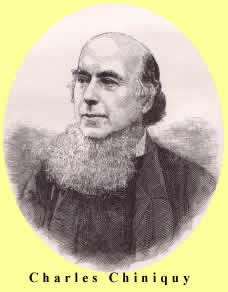
The Priest, the Woman, and the Confessional
By CHARLES CHINIQUY
By CHARLES CHINIQUY
A former priest warns of the dangers of the confessional
"Charles Chiniquy (1809-1899) a Canadian Prysbyterian convert from Roman Catholicism, born at Kamouraska, Quebec, Canada of Roman Catholic parents, and studied at the college of Nicolet, Canada, professor of belles-lettres there after graduation until 1833. in 1833 ordained a Roman Catholic priest, and until 1846 was vicar and curate in the province of Quebec where he established the first temperance society, winning the title "Apostle of Temperence of Canada." In 1851 established an extensive Roman Catholic colony at Kankakee, Illinois. In 1858 left the church of Rome and joined the Canadian Presbyterian Church taking his congregation at Kankakee with him. Lectured in England and in Australia (1878-1882). Published a number of books and tracts on temperance and anti-Romanism, some of which became very popular and were translated into several languages." (From "The Wycliffe Biographical Dictionary of the Church," page 90, Elgin S. Moyer, 1982, ©Moody Press, Chicago, IL)
Also available for online reading: "Fifty Years in the Chuch of Rome" by Chiniquy
If you wish to find out how to order a copy of this book, please click here...
-----------------------------------------------------------------
CONTENTS
CHAPTER I. The Struggle before the Surrender of Womanly Self-respect in the Confessional.
CHAPTER III. The Confessional is the Modern Sodom.
CHAPTER IV. How the Vow of Celibacy of the Priests is made easy by Auricular Confession.
CHAPTER V. The highly-educated and refined Woman in the Confessional What becomes of her after unconditional surrender Her irreparable Ruin.
CHAPTER VII. Should Auricular Confession be tolerated among Civilized Nations?
CHAPTER IX. The Dogma of Auricular Confession a Sacrilegious Imposture.
CHAPTER X. God compels the Church of Rome to confess the Abominationsof Auricular Confession.
CHAPTER XII. A Chapter for the Consideration of Legislators, Husbands, and Fathers Some of the matters on which the Priest of Rome must question his Penitents.
.


Subscribe to:
Posts (Atom)