Showing posts with label Fundamentalism. Show all posts

Saturday, August 29, 2026

I Went No Contact with My Parents. I Regret It.


A therapist told me my mom and dad were causing all my problems—so I cut them off for five years.


In 2008, Christina Buttons took the advice from her therapist to cut off her parents completely. (Illustration by The Free Press)

By Christina Buttons
08.12.26 —Culture and Ideas

Book reviews, cultural critiques, essays on the zeitgeist, and profiles of the avant-garde.

“We have two adult children, a son aged 30 and a daughter aged 27. We are estranged from them both,” wrote a 60-year-old mom.

“Our oldest son, 27, has gone no contact with our entire family,” wrote a 57-year-old mom.

“It seems like she’s been influenced by the “no contact” movement too common in her generation, which rejects normal parents as toxic,” wrote yet another mom, this one 55, whose daughter doesn’t speak to her.

I’ve read so many messages from people who are desperately sad that their adult children don’t talk to them. That’s because I’m the editor of Tough Love with Abigail Shrier, our weekly advice column, so it’s my job to sort through the letters she gets. You ask: How do you rebuild a relationship with your son when you’ve been cut off? If your daughter’s decided you’re toxic, how do you cope with the pain?

At the heart of these questions is another, even deeper one: How could my own child reject me like this?

In her essay today, Christina Buttons answers that question—explaining why she went no contact with her parents for five years, at the age of 19, and why she’ll always regret it.

If you’re one of the many people who’s told us that your child isn’t speaking to you right now: This is proof that there’s always hope.
—Freya Sanders

***

Tuesday, November 19, 2019

Religious fundamentalism is a ‘plague,’ pope says


Junno Arocho Esteves

Nov 19, 2019

CATHOLIC NEWS SERVICE


Pope Francis greets Father Guillermo Marco, Muslim leader Omar Abboud and Rabbi Daniel Goldman, co-presidents of the Argentine Institute for Interreligious Dialogue, Nov. 18, 2019, in the apostolic palace of the Vatican. (Credit: CNS photo/Vatican Media.)


ROME - Interreligious dialogue is an important way to counter fundamentalist groups as well as the unjust accusation that religions sow division, Pope Francis said.

Meeting with members of the Argentine Institute for Interreligious Dialogue Nov. 18, the pope said that in “today’s precarious world, dialogue among religions is not a weakness. It finds its reason for being in the dialogue of God with humanity.”

Recalling a scene from the 11th-century poem, “The Song of Roland,” in which Christians threatened Muslims “to choose between baptism or death,” the pope denounced the fundamentalist mentality which “we cannot accept nor understand and cannot function anymore.”

“We must beware of fundamentalist groups; each (religion) has their own. In Argentina, there are some fundamentalist corners there,” he said. “Fundamentalism is a plague and all religions have some fundamentalist first cousin.”

According to its website, the Institute for Interreligious Dialogue was founded in Buenos Aires in 2002 and was inspired by then-Cardinal Jorge Mario Bergoglio as a way “to promote understanding among men and women of different religious traditions in our city and the world.”

The pope welcomed the members of the institute who are in Rome to reflect on the document on “human fraternity” and improving Christian-Muslim relations, which was signed Feb. 4 by Francis and Sheikh Ahmad el-Tayeb, the grand imam of al-Azhar and a leading religious authority for many Sunni Muslims.

Saturday, January 13, 2018

Why Seventh-day Adventists Are Not Fundamentalists


Marcos Paseggi

Senior Correspondent, Adventist Review

18 January 8, 2018


Adventist historians conference opens with enlightening presentations.


By: Marcos Paseggi, Adventist Review

“Seventh-day Adventists are not fundamentalists,” said Andrews University Church History professor Nicholas Miller in the opening plenary of the “Situating Adventist History” conference on the campus of Washington Adventist University in Takoma Park, Maryland, United States, on Jan. 8. The Association of Seventh-day Adventist Historians event, sponsored by the Office of Archives, Statistics, and Research and Washington Adventist University, brought dozens of Seventh-day Adventist historians, researchers, and professors together for two days of presentations, Q&A sessions, and discussions.

“All of this makes Adventism a different religious stream than fundamentalism.”

Miller’s presentation, entitled “Adventism, Fundamentalism, and the Bible,” provided historical evidence that shows how Adventism, while a Conservative movement, has for the most part being able to steer away from some of the fundamentalist pitfalls, adopting a more balanced approach to various issues, including the inspiration of Scripture. It is something, said Miller, that is rooted in the ideas that influenced the early history of the denomination, something that underlines the importance of researching Adventist history.

Why Adventists Should Care About History

Seventh-day Adventist world church Director of Archives, Statistics, and Research David Trim agreed. In his opening remarks, he said that while research in Adventist history has skyrocketed in the last few decades, it is essential to provide context to many of those studies. “Adventist history is being transformed,” he said, “but we need to contextualize, to put it in a wider context.”


Seventh-day Adventist author, researcher, and professor Nicholas Miller, in the opening presentation of the "Situating Adventist History" conference in Washington Adventist University, in Takoma Park, Maryland, United States, on Jan. 8. Miller said that Seventh-day Adventists, while Conservative, are not historically Fundamentalists. [Photo: Marcos Paseggi, Adventist Review]

Thursday, May 19, 2016

Pope Francis: ISIS’ Terrorists No Different Than Jesus and His Disciples. Implications For SDAs?


May 19, 2016


“And I saw when the Lamb opened one of the seals, and I heard, as it were the noise of thunder, one of the four beasts saying, Come and see. And I saw, and behold a white horse: and he that sat on him had a bow; and a crown was given unto him: and he went forth conquering, and to conquer” Revelation 6:1 and 2. The opening of the first seal brings to view the apostolic days when Christ’s apostles went forth spreading the gospel to every creature under heaven (see Colossians 1:23) and also typifies the final triumph of God’s people carrying the gospel message to the world as a witness. This commission to go forward conquering and to conquer through the spreading of the gospel was not only given to the apostles directly following Christ’s ascension, but is to be carried forward to the close of this earth’s history by God’s chosen and faithful messengers, those who keep the Commandments of God and have the Testimony of Jesus Christ. See Revelation 12:17 and Revelation 14:6-12.

The institution that Satan is primarily working through in these last days to entrap the people in darkness and prevent the spreading of the everlasting gospel is the Papacy, the Roman Catholic hierarchy. This system has a problem with anyone or any group save its own, carrying forward the gospel commission, conquering and to conquer; and Pope Francis has made that abundantly clear in an interview conducted by a French Catholic newspaper published May 17, 2016. Comparing Jesus’ commission to His followers to spread the gospel, which he terms conquest, to Islamic wars of conquest or Jihads (holy wars initiated by Muslims to maintain their religion), Pope Francis is sending the message that evangelizing with any other message than that which coincides with the Papacy’s, must be feared and met with war, just as one fears Jihadists and the activities of ISIS.

“In an interview published Tuesday with France’s La Croix, Pope Francis argued that Jesus’ call to spread the Gospel differs little from the jihad waged by radical Islamic terrorists. The pope explained how ISIS’ ‘war of conquest’ has bred a non-justified fear of Islam among Western countries. ‘I don’t think that there is a fear of Islam as such but of ISIS and its war of conquest, which is partly drawn from Islam,’ he told La Croix. ‘It is true that the idea of conquest is inherent in the soul of Islam.’ ‘However, it is also possible to interpret the objective in Matthew’s Gospel, where Jesus sends his disciples to all nations, in terms of the same idea of conquest.’”1

By differentiating between Islam and ISIS and also by drawing the comparison between Jesus sending forth his disciples, and ISIS extremists, Pope Francis is insinuating his disdain for the spreading of the everlasting gospel of Revelation 14:6-12, just as he has left no ambiguity as to his position concerning ISIS activities, calling their violence genocide and supporting the use of force against them. Pope Francis is clearly the hypocrite of hypocrites as his mission since the onset of his pontificate has been evangelization, and the primary reason that he has appointed the Extraordinary Year of Jubilee, which opened on December 8, 2015. This date was not randomly selected it was strategically chosen by Pope Francis because of its ecumenical significance. Out of his own mouth: “I have chosen the date of 8 December because of its rich meaning in the recent history of the Church. In fact, I will open the Holy Door on the fiftieth anniversary of the closing of the Second Vatican Ecumenical Council. The Church feels a great need to keep this event alive…The walls which for too long had made the Church a kind of fortress were torn down and the time had come to proclaim the Gospel in a new way. It was a new phase of the same evangelization that had existed from the beginning.2

While Pope Francis is aggressively evangelizing, he is prohibiting others from doing the same, as his goal is to unite every denomination, nation, and religion as one under his headship. On church unity, “Pope Francis said on Sunday that the way ahead is for various denominations to reject ‘proselytism and competition’ among themselves. The trick, he said, is for Christians to stop being ‘self-enclosed’ and “exclusive…Although Francis has repeatedly called on Christians to invite others to the faith, he has also condemned ‘proselytism’ on multiple occasions, by which he means coercive or aggressive missionary techniques…Christian unity, Francis said, won’t be achieved by subtle theoretical discussions in which each party tries to convince the other of the soundness of their opinions.”3

He has also declared that Christians must stop evangelizing Jews in December of 2015,4 which is not difficult to discern considering his assertion that Jews are saved even without accepting Christ.5 What blasphemy! Not surprising coming from the Roman Catholic Church however, taking into account that they do not believe in Christ as the only way to salvation. Additionally, Pope Francis has declared his “Year of Mercy” as a time to learn about Islam and even calling Christians and Muslims brothers. In other words, people should leave the work of evangelism to the Roman Catholic Church, unite with her, and they will be welcomed as brothers, or more accurately, daughters; otherwise, they will be viewed as threats to the “common good” and individuals who believe that they alone possess the absolute truth.

What can all of this mean for faithful Seventh-day Adventists who have committed their very lives to the service of Christ in conducting evangelism, calling people out of darkness into Christ’s marvelous light, who also refuse to unite with ecumenical bodies that tend to the surrendering of peculiar, distinctive doctrines and beliefs? While ISIS is waging war with literal sword, and has incited the nations with fear and has thus caused the nations to draw their swords to contest them, God’s faithful people, represented by the rider atop the white horse conquering, are wielding the spiritual sword, the undiluted Word of God, the sword of the Spirit, and will be looked upon with fear. The implication is that God’s messengers will be labeled and treated as fundamentalists who are divisive and despise unity, especially as they lay open the sins of Babylon and her daughters and bear an even more pointed testimony than that of John the Baptist. They will be viewed with suspicion and fear and have their rights infringed upon and finally revoked. Yet the people of God should not allow any danger or threat of such to dissuade them from living out their convictions and sharing the gospel with whomever they come in contact. They do not have to pick up literal swords as did Peter the night of Jesus’ capture, they must stand still and allow the Captain of the Lord’s Host, Jesus Christ, fight for them and indeed they will be more than conquerors! “And I saw, and behold a white horse: and he that sat on him had a bow; and a crown was given unto him: and he went forth conquering, and to conquer” Revelation 6:1 and 2.

Sources
1. http://dailycaller.com/2016/05/18/pope-francis-spreading-the-gospel-is-no-different-than-waging-jihad/
2. https://w2.vatican.va/content/francesco/en/apost_letters/documents/papa-francesco_bolla_20150411_misericordiae-vultus.html
3. http://www.cruxnow.com/church/2015/01/26/pope-says-christian-unity-means-rejecting-proselytism-and-competition/
4. http://www.christianitytoday.com/ct/2015/december-web-only/orthodox-rabbis-and-vatican-exchange-olive-branches.html
5. http://www.christianpost.com/news/jews-saved-heaven-salvation-without-jesus-christ-vatican-claims-pope-francis-israel-152306/


Hilari Henriques

Source
.

Saturday, September 25, 2010

Appeal of the Religious Right


A Sense of Belonging

The goal of dominion is alien to moderate Republicans and may not be shared by many members of fundamentalist, Pentecostal and charismatic churches. These church members should be made aware of how they are being politically manipulated by their leadership.

It's important to note that there are good reasons why so many people join fundamentalist, Pentecostal and charismatic churches. First of all, many of the churches I visited had very lively services which I enjoyed; that is until the preacher started talking about Satan, the role of women, the biblical call to beat children, the Rapture, or God's mandate to get involved politically.

These churches have been very successful in helping people give up drug addictions. And people have told me that the quality of their lives improved significantly once they took Jesus Christ as their Savior. This personal relationship with Christ can be a very positive experience, especially when it infuses one's life with a sense of a loving light.

And most of all, the churches offer practitioners a real sense of belonging. Whenever I attended church services, I was always warmly greeted by people who gave me a sense that if I joined, I would never feel alone. This sense of belonging goes right to the core of one of the most troubling aspects of our modern, affluent society - a feeling of alienation. It is this need to belong and have a higher purpose to life which is, unfortunately, being politically exploited by the Religious Right.

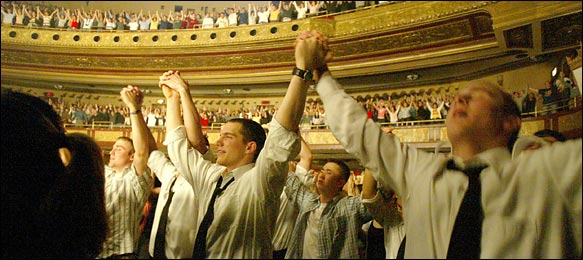
Some of the Church services I have attended have been very emotional. Sometimes members seem to be ecstatic. Some of the churches appear to offer a kind of group catharsis, not unlike some forms of therapy. In a time of great stress, the Holy Laughter Movement, which encourages deep belly laughing and weeping, is growing rapidly. The Holy Laughter Movement makes me think of the physician, Patch Adams who advocates healing through laughter. There is a reason so many people are drawn to these ministries, and it's useful to understand the appeal.

Read story by Joan Bokaer called Getting Saved in Amarillo.

This article about the popularity of the Passion Experience for young people demonstrates the appeal of the form of worship found in Pentecostal and charismatic churches. This worship can be a positive experience if it is not overlain with a political message that is anti-women, anti-environment, anti-arms control, anti-social justice, and anti-democratic. Unfortunately, a joyful experience becomes grounds for political manipulation. Photographer: Michelle V. Agins/The New York Times.

.