Showing posts with label JUBILEE. Show all posts
Showing posts with label JUBILEE. Show all posts
Sunday, May 17, 2026


Saturday, May 16, 2026
Thursday, October 02, 2025
“Migrants, missionaries of hope” | Jubilee of Migrants 01 Oct 2025

On this Jubilee Year dedicated to Pilgrims of Hope, JRS invites you to welcome refugees and migrants and the gifts they bring us.
On the weekend of 4–5 October 2025, the Church will celebrate the Jubilee of Migrants in Rome in the presence of Pope Leo XIV. Two days of encounters, activities, and prayers will honour our brothers and sisters on the move.
The same weekend, as part of the Jubilee of Migrants, the 111th World Day of Migrants and Refugees (WDMR) will be celebrated with the theme: Migrants, missionaries of hope.
In his message, Pope Leo XIV reminds us that, in a world wounded by war, injustice and climate crises, migrants, refugees and displaced persons are privileged witnesses of hope. They demonstrate this each day “through their resilience and trust in God, as they face adversity while seeking a future in which they glimpse that integral human development and happiness are possible”.
The Pope also recognises migrants as missionaries of hope, as they can help to revitalise the spirituality of those who welcome them. At the same time, communities that receive migrants can themselves become witnesses of hope by “recognising migrants as brothers and sisters, part of a family in which they can express their talents and participate fully in community life”.
In a world that is turning away from refugees, don’t be afraid to be different and to make a difference. Make a choice to stand with refugees and build inclusive communities.
[Photo: Venezuelans crossing the border with Colombia (George Castellanos/JRS)]
Thursday, September 11, 2025
Monday, August 04, 2025
Pope Leo exhorts crowd of million Catholic youth to spread their faith |...

ANC 24/7
Aug 4, 2025
Pope Leo celebrated the largest event yet of his nearly three-month tenure on Sunday (August 3), encouraging a crowd of more than a million Catholic young people gathered in a field on the outskirts of Rome to spread their faith. Amid shouts of "Viva il Papa" (Long live the Pope) from young people dressed in colourful t-shirts at the Tor Vergata field, Leo led a Mass that capped a special week of events meant to energize Catholic youth -- marked by faith, flags and Chicago's deep-dish pizza.
Thursday, June 05, 2025
Monday, January 06, 2025
Jesus our Only Savior or Francis' Jubilee?
...how will you choose?
Aubrey L Duncan
Jan 6
The Foundation
The Jewish Jubilee, known as the Yovel in Hebrew, is a concept from the Torah, specifically outlined in Leviticus 25. It is a sacred year that occurs every 50 years, following seven cycles of seven years (each of which culminates in a sabbatical year, or Shmita). The Jubilee has profound religious, social, and economic significance in Judaic thought.
While the Jubilee is not observed in its biblical form in contemporary Judaism, its principles inspire discussions about economic justice, environmental stewardship, and societal fairness.
The book of Leviticus informs us on the requirements and administration of this ancient Judaic practice: “And thou shalt number seven sabbaths of years unto thee, seven times seven years; and the space of the seven sabbaths of years shall be unto thee forty and nine years. Then shalt thou cause the trumpet of the jubile to sound on the tenth day of the seventh month, in the day of atonement shall ye make the trumpet sound throughout all your land.
And ye shall hallow the fiftieth year, and proclaim liberty throughout all the land unto all the inhabitants thereof: it shall be a jubile unto you; and ye shall return every man unto his possession, and ye shall return every man unto his family.
A jubile shall that fiftieth year be unto you: ye shall not sow, neither reap that which groweth of itself in it, nor gather the grapes in it of thy vine undressed. For it is the jubile; it shall be holy unto you: ye shall eat the increase thereof out of the field. In the year of this jubile ye shall return every man unto his possession” (Leviticus 25: 8-11.
The Jubilee was a Proclamation of Liberty. The Jubilee year begins on Yom Kippur (the Day of Atonement) with the sounding of the shofar (ram's horn) throughout the land. This signals a time of liberation for individuals and the land.
Aubrey L Duncan
Jan 6
The Foundation
The Jewish Jubilee, known as the Yovel in Hebrew, is a concept from the Torah, specifically outlined in Leviticus 25. It is a sacred year that occurs every 50 years, following seven cycles of seven years (each of which culminates in a sabbatical year, or Shmita). The Jubilee has profound religious, social, and economic significance in Judaic thought.
While the Jubilee is not observed in its biblical form in contemporary Judaism, its principles inspire discussions about economic justice, environmental stewardship, and societal fairness.
The book of Leviticus informs us on the requirements and administration of this ancient Judaic practice: “And thou shalt number seven sabbaths of years unto thee, seven times seven years; and the space of the seven sabbaths of years shall be unto thee forty and nine years. Then shalt thou cause the trumpet of the jubile to sound on the tenth day of the seventh month, in the day of atonement shall ye make the trumpet sound throughout all your land.
And ye shall hallow the fiftieth year, and proclaim liberty throughout all the land unto all the inhabitants thereof: it shall be a jubile unto you; and ye shall return every man unto his possession, and ye shall return every man unto his family.
A jubile shall that fiftieth year be unto you: ye shall not sow, neither reap that which groweth of itself in it, nor gather the grapes in it of thy vine undressed. For it is the jubile; it shall be holy unto you: ye shall eat the increase thereof out of the field. In the year of this jubile ye shall return every man unto his possession” (Leviticus 25: 8-11.
The Jubilee was a Proclamation of Liberty. The Jubilee year begins on Yom Kippur (the Day of Atonement) with the sounding of the shofar (ram's horn) throughout the land. This signals a time of liberation for individuals and the land.
Wednesday, December 25, 2024
Saturday, December 21, 2024
Wednesday, November 16, 2016
Tuesday, November 15, 2016
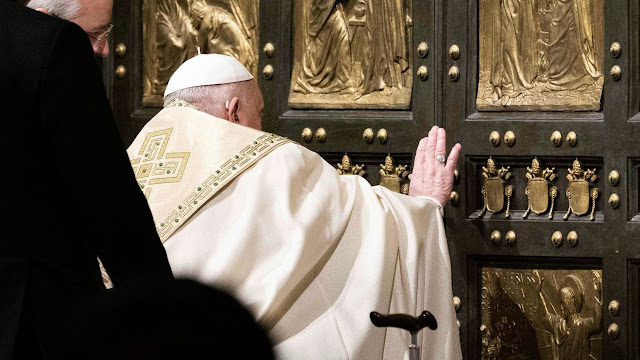
As Year of Mercy ends, Holy Doors close around the world

A holy door closes at Saint Paul Outside the Walls church in Rome. Nov. 13, 2016. Credit: Daniel Ibáñez/CNA.

By Hannah Brockhaus
Vatican City, Nov 13, 2016 / 01:09 pm (CNA/EWTN News).- As Holy Doors close in churches and basilicas around the world, including in Rome, it is estimated that over 20 million people participated in the Church’s Jubilee Year of Mercy at the Vatican – and a billion people may have participated in churches worldwide.
According to Msgr. Rino Fisichella, President of the Pontifical Council for the Promotion of the New Evangelization, it is estimated that 20.4 million people attended Year of Mercy events at the Vatican over the course of this year.
Vatican City, Nov 13, 2016 / 01:09 pm (CNA/EWTN News).- As Holy Doors close in churches and basilicas around the world, including in Rome, it is estimated that over 20 million people participated in the Church’s Jubilee Year of Mercy at the Vatican – and a billion people may have participated in churches worldwide.
According to Msgr. Rino Fisichella, President of the Pontifical Council for the Promotion of the New Evangelization, it is estimated that 20.4 million people attended Year of Mercy events at the Vatican over the course of this year.
Archbishop Welby: ‘The Year of Mercy inspired all Christians’
by Staff Reporter
posted Tuesday, 15 Nov 2016

Cardinal Nichols and Archbishop Welby at Vespers (Mazur/catholicnews.org.uk)
The Archbishop of Canterbury joined Cardinal Vincent Nichols for the closing of the Door of Mercy at Westminster Cathedral
The Archbishop of Canterbury has said that the Year of Mercy has “caught the imagination” of all Christians in a homily at Westminster Cathedral for the closing of the Door of Mercy.
Archbishop Justin Welby joined Cardinal Vincent Nichols at Vespers on Sunday. It was the first time the Anglican leader had preached at the Cathedral. Also present were bishops from throughout England and Wales, members of the Chapter of Canons, and other ecumenical guests.
“The Year of Mercy has caught the imagination not only in the Catholic Church but in all churches,” Archbishop Welby said. He cited Blessed John XXIII’s “visionary address” to the Second Vatican Council, in which the pope spoke of the Holy Spirit helping the Church move away from “acting in severity against error and sin to acting in mercy”.
“This great Year of Mercy 50 years after the end of the Council has been received as water in the desert for global churches sadly lacking mercy, and must be offered as the way of living to a world which sees mercy only in terms of exchange, and never as the excess of abundant love,” the archbishop said.
The Archbishop of Canterbury joined Cardinal Vincent Nichols for the closing of the Door of Mercy at Westminster Cathedral
The Archbishop of Canterbury has said that the Year of Mercy has “caught the imagination” of all Christians in a homily at Westminster Cathedral for the closing of the Door of Mercy.
Archbishop Justin Welby joined Cardinal Vincent Nichols at Vespers on Sunday. It was the first time the Anglican leader had preached at the Cathedral. Also present were bishops from throughout England and Wales, members of the Chapter of Canons, and other ecumenical guests.
“The Year of Mercy has caught the imagination not only in the Catholic Church but in all churches,” Archbishop Welby said. He cited Blessed John XXIII’s “visionary address” to the Second Vatican Council, in which the pope spoke of the Holy Spirit helping the Church move away from “acting in severity against error and sin to acting in mercy”.
“This great Year of Mercy 50 years after the end of the Council has been received as water in the desert for global churches sadly lacking mercy, and must be offered as the way of living to a world which sees mercy only in terms of exchange, and never as the excess of abundant love,” the archbishop said.
Cardinal Nichols follows Archbishop Welby to the Holy Door (Mazur/catholicnews.org.uk)
Mercy was a “word of immense beauty”, he said, and “when we walk through the Door of Mercy and allow its meaning to enter our hearts we become different people . . . It works in us like a benevolent acid, dissolving the hardness of our hearts and the selfishness of our lives.”
The archbishop added: “The Door of Mercy calls us through, but like the doors into Narnia in the CS Lewis series, what we find on the other side of the door is another world, where the deep magic of the Kingdom of God is what prevails.”
Archbishop Welby also described the frequent absence of mercy in everyday life.
“Whether it is in elections and referendums, or in the international politics of refugees, of trade and commerce, and even in our own lives and expressions through social media, mercy is often absent,” he said.
The Door of Mercy at Westminster Cathedral was opened by Cardinal Nichols last December and has stayed open throughout the Year of Mercy, receiving pilgrims from around the country.
The Jubilee Year will conclude on Sunday when Pope Francis will close the Holy Door at St Peter’s Basilica.
Meanwhile, in a separate address to head teachers last week, Archbishop Welby said Government officials knew so little about religion that
conservative Evangelicals would be counted as extremists by the officials’ own definition.
Cardinal Nichols and Archbishop Welby pray at the Holy Door (Mazur/catholicnews.org.uk)
The Government, he said, could see no difference between Muslim extremists and traditionalist Christians, so both groups were dismissed as “a bit bonkers”. He made the remarks to headteachers of Church of England schools in the Anglican Diocese of Bath and Wells.
The Telegraph quoted Archbishop Welby as saying: “Our Government generally is desperately trying to catch up, to understand a world in which they have no grip on what it is to be religious at all; where religious illiteracy is prevalent and extremely destructive of understanding and where they can’t really see the difference between an extremist Muslim group like the Muslim Brotherhood and a sort of conservative Evangelical group in a Church of England church.”
He added: “It’s fine to reject many of the things done in the name of religion, but you still need to understand what it is that can so catch hold of someone that they think life itself is not worth living if that contradicts what they believe.”
Angelus Address: On Awaiting the End Times
“Jesus in the Gospel exhorts us to have clear in our minds and hearts the certainty that God guides our history”
NOVEMBER 13, 2016
ZENIT STAFFANGELUS/REGINA CAELI, PAPAL TEXTS

Here is a ZENIT translation of the address Pope Francis gave today before and after praying the midday Angelus with those gathered in St. Peter’s Square.
__
Dear brothers and sisters, good morning!
The Gospel for today gives us the first part of Jesus’ words on the end times, as related by St. Luke. Jesus speaks about this while in front of the Temple of Jerusalem, drawing from the people’s exclamations of admiration at the beauty of the sanctuary and its decorations. Jesus then says, “All that you see here — the days will come when there will not be left a stone upon another stone that will not be thrown down.”
We can imagine the effect of these words on Jesus’ disciples. He doesn’t want to offend the temple but rather to make them understand, and us today as well, that human constructions — even the most sacred — are passing, and we shouldn’t place our securities in them.
Saturday, November 12, 2016
Thursday, November 03, 2016
Wednesday, September 21, 2016
Jubilee: 700 years seeking forgiveness
From: ROME REPORTS
Genres: Documentary
Duration: 48 minutes
Availability: Worldwide
We will travel next to experts in history and cultural leaders of the four basilicas, they had to visit by the pilgrims to get indulgence and we will show that the significance of each of the four holy doors.
Observe that because of two floods and a fire had to change the place, in the various holy years, of worship planned for that year jubilee. The Colosseum is one of the protagonists.
The documentary focuses especially in the main jubilee took place in history, it was one of the year 2000. It will be Joaquin Navarro-Valls, spokesman for Pope John Paul II, who will tell us firsthand details until now unknown.
Monday, September 12, 2016
Pope reflects on redemption and mercy
Catholic World News
September 12, 2016
On September 10, Pope Francis devoted his special monthly Saturday audience for the jubilee year of mercy to the theme of redemption.
“God has redeemed all humanity, liberating us by the precious blood of his Son Jesus (1 Pet. 1:18-21),” the Pope told the crowds gathered in St. Peter’s Square, according to the official English-language synthesis of his remarks. “How many ways we can be enslaved by false freedom; how much we need God to truly free us.”
“We are called to a new life, raised to the dignity of children of God,” the Pope continued. “Jesus, the sinless Lamb of God, was sacrificed for us, that we might receive forgiveness, love and joy.”
He added:
And so when we suffer and are put to the test, we are called to look intently upon the crucified Jesus: it is he who suffers for us and in us, reveals God’s boundless love for us and never abandons us. The Lord knows well our weaknesses and our sins: yet where our needs abound, his mercy abounds all the more and fills our hearts.
References:
- Pope Francis' Jubilee Audience 2016.09.10 (YouTube Vatican)
- L’Udienza Giubilare, 10.09.2016 (Holy See Press Office)
- Jubilee audience: the relationship between mercy and redemption, 10.09.2016 (Holy See Press Office)
Source
Monday, December 07, 2015
Pope: Conversion is for believers and non-believers alike
December 6, 2015 11:03 AM

Vatican City, Dec 6, 2015 / 09:03 am (CNA/EWTN News).- In his Angelus address for the second Sunday of Advent, Pope Francis spoke against the presumption that the need for conversion applies only to non-believers, and that Christians are somehow exempt.
“No one can say: 'I am holy, I am perfect, I am already saved',” the Pope said Dec. 6 to the crowds in St. Peter's Square. “No. We must always welcome this offer of salvation.”
Stressing that salvation is offered to everyone, the pontiff explained that this is the reason for the Year of Mercy: “to go ever forward along this path of salvation, that path which Jesus taught us. God wants all men to be saved through Jesus Christ, the only Mediator.”
“It is a pressing invitation to open our hearts and welcome the salvation which God incessantly, almost stubbornly, offers us, because he wants us to be freed from the slavery of sin,” the Pope said.
The Jubilee of Mercy is an Extraordinary Holy Year that will open this year on Dec. 8 – the Solemnity of the Immaculate Conception – and will close Nov. 20, 2016 with the Solemnity of Christ the King.
Speaking two days ahead of the official start of the Jubilee of Mercy, the pontiff centered his pre-Angelus address on the theme of conversion, as shown in Gospel reading from the second Sunday of Advent in which John the Baptist proclaimed a “baptism of repentance for the forgiveness of sins” (Luke 3: 3).
He challenged Christians to examine whether their sentiments are in line with those of Jesus'.
For instance, in the face of wrongdoing, “are we able to react without animosity, and forgive from the heart he who asks forgiveness?” the Pope asked, stressing how difficult forgiveness can be.
“When we must share joy or sorrow, do we know how to weep with those who weep and rejoice with those who rejoice? When we must express our faith, do we know how to do so with courage and simplicity, without being ashamed of the Gospel?”
John the Baptist's words ring true in modern “deserts of humanity,” which are closed minds and hardened hearts, the Pope said, adding that the words of Isaiah cited in Sunday's Gospel to “prepare the way of the Lord” are relevant today.
We are therefore called “to make Jesus known to those who still do not know him,” the Pope said. However, this is done by opening “a door,” rather than by proselytizing.
He explained that this door is opened by the conviction shown by Christians who are truly in love with Jesus, and challenged the faithful as to whether they have this love and conviction.
“If the Lord Jesus has changed our life, and if there is change every time we go to Him, how can we not be passionate about making him known to everyone we meet at work, school, in our apartment building, in hospital, in places we find ourselves?”
“However, we must be brave: lower the mountains of pride and rivalry, refill the gullies dug up by indifference and apathy, straighten the path of our laziness and our compromises.”
Before leading those present in the Marian Angelus prayer, Pope Francis called on Mary's intercession to break down the “barriers and obstacles which impede our conversion” thereby allowing for our encounter with Jesus, who alone can give fulfillment to “all the hopes of man!”
After leading the crowds in St. Peter's Square in the Angelus, Pope Francis acknowledged the climate summit currently underway in Paris.
Referencing his encyclical on the environment, “Laudato, Si,” the Pope said: “For the sake of the common home of all of us and future generations, every effort in Paris should be aimed at mitigating the impacts of climate change,” while at the same time combating poverty in order to help human dignity to thrive.
The fight against climate change and the fight against poverty go together, the pontiff said.
“Let us pray that the Holy Spirit enlighten all who are called to take such important decisions and give them the courage to keep as a criterion of choice for the greater good of the whole human family.”
Pope Francis also remarked on the 50th anniversary of the Second Vatican Council's Joint Declaration between Blessed Paul VI and Ecumenical Patriarch Athenagoras, which took place on Dec. 7, 1965 on the eve of the council's conclusion. The Joint Declaration is considered a major step in promoting reconciliation between the Holy See and the ecumenical Patriarchate of Constantinople after the Great Schism of 1054.
The Pope said it is “providential” that this “historic gesture of reconciliation” is remembered at the opening of the Year of Mercy.
He asked for prayers for current ecumenical patriarch Bartholomew I, and said for there to be an “authentic journey toward God” there is the need to “to ask forgiveness from God and from one another for the sins of division.”
“We ask the Lord that relations between Catholics and Orthodox be always inspired by fraternal love.”
.
Sunday, October 25, 2015
Pope at Synod's End: 'Today Is a Time of Mercy'

EUROPE
By THE ASSOCIATED PRESS
OCT. 25, 2015, 6:36 A.M. E.D.T.
VATICAN CITY — Pope Francis declared Sunday that "Today is a time of mercy!" as he closed out a historic meeting of bishops that approved an important new direction in welcoming divorced and civilly remarried Catholics into the church.
The synod's endorsement, by a single vote, of Francis' call for a more merciful, less judgmental church was a clear victory for Francis and progressive prelates who have been seeking wiggle room in church teaching to allow these remarried Catholics to receive Communion. Conservatives had objected, citing church doctrine, but they couldn't muster the votes needed to block passage of the final document.
With the badly divided church hierarchy before him in St. Peter's Basilica on Sunday, Francis took veiled aim at those in the church who place more importance on doctrine and law than on God's mercy and forgiveness.
He warned them of the risk of "becoming habitually unmoved by grace," of turning a cold shoulder to God's most wounded children and of a "spiritual illusion" that doesn't let them see the reality of their flock before them and respond to it.
"A faith that does not know how to root itself in the life of people remains arid and, rather than oases, creates other deserts," he said, adding that moments of suffering and conflict are precisely the occasions for God to show mercy.
"Today is a time of mercy!"
Without changing church doctrine, the 275 synod "fathers" on Saturday approved a 94-point final document on responding better to the needs of today's Catholic families. The text covered a host of issues — migration, poverty, single parents and polygamy — but the most disputed section of the document concerned whether civilly remarried Catholics can receive Communion.
Church teaching holds that without an annulment, these Catholics are essentially committing adultury and cannot receive Communion.
While the document doesn't chart any specific path to receiving the sacraments as originally sought by liberal prelates — and doesn't even mention the word Communion — it opens the door to case-by-case exceptions by citing the role of discernment and individual conscience in spiritual direction.
The key paragraph 85 says a case-by-case approach is necessary when dealing with remarriage since not everyone bears the same responsibility for the preceding divorce. It passed with only one vote more than the two-thirds majority necessary.
Its passage will give Francis the room to maneuver that he needs if he wants to push the issue further in a future document of his own. German Cardinal Reinhard Marx, who spearheaded the German theological initiative that was decisive to getting the majority, said he hoped that Francis would issue it during his upcoming Jubilee Year of Mercy, which starts Dec. 8.
Speaking to thousands of people in St. Peter's Square after Mass Sunday, Francis recalled that the word "synod" means to "walk together" — a key concept for the pope, who has called for the church to walk with the faithful and accompany them through life's ups and downs.
.
Subscribe to:
Posts (Atom)