Showing posts with label mafia. Show all posts

Sunday, May 17, 2026

Operation Gladio - The Unholy Alliance Between the Vatican, the CIA, and the Mafia - Paul L Williams


alltheworldsastage


Operation Gladio - The Unholy Alliance Between the Vatican, the CIA, and the Mafia Paul L Williams

Google Play Books

https://www.youtube.com/watch?v=jNgcE1yAU58&t

Operation Gladio: The Unholy Alliance Between… by Paul L. Williams · Audiobook preview

PURCHASE ON GOOGLE PLAY BOOKS ►► https://g.co/booksYT/AQAAAIDIiWoJsM


Operation Gladio: The Unholy Alliance Between the Vatican, the CIA, and the Mafia

Authored by Paul L. Williams

Narrated by Michael Prichard


BOOK DESCRIPTION

In this disturbing expose, journalist Paul L. Williams describes a secret alliance forged at the close of World War II by the CIA, the Sicilian and U.S. mafias, and the Vatican to thwart the possibility of a Communist invasion of Europe. Williams presents evidence suggesting the existence, in many European countries, of "stay-behind" units consisting of five thousand to fifteen thousand military operatives. The initial funding for these guerrilla armies came from bogus British bank notes and the sale of large stocks of SS morphine that had been smuggled out of Germany and Italy. As the Cold War intensified, the units were used not only to ward off possible invaders but also to thwart the rise of left-wing movements in South America and NATO-based countries by terror attacks. Williams argues that Operation Gladio soon gave rise to the toppling of governments, wholesale genocide, the formation of death squads, financial scandals on a grand scale, the creation of the mujahideen, an international narcotics network, and, most recently, the ascendancy of Jorge Mario Bergoglio, a Jesuit cleric with strong ties to Operation Condor (an outgrowth of Gladio in Argentina) as Pope Francis I.


Saturday, May 03, 2025

The Shocking Events That Led to the Dawn of the Cold War | Operation Gladio

Operation Gladio: Unholy Alliance Between Vatican, CIA and The Mafia


WebDesk
Updated: November 23, 2020 9:11

This exposé by Paul L. Williams describes a secret alliance forged at the close of World War II by the CIA, the Sicilian and US mafias, and the Vatican to thwart the possibility of a Communist invasion of Europe. Williams presents evidence suggesting the existence of “stay-behind” units in many European countries consisting of five thousand to fifteen thousand military operatives. According to the author’s research, the initial funding for these guerilla armies came from the sale of large stocks of SS morphine that had been smuggled out of Germany and Italy and of bogus British bank notes that had been produced in concentration camps by skilled counterfeiters. As the Cold War intensified, the units were used not only to ward off possible invaders, but also to thwart the rise of left-wing movements in South America and NATO-based countries by terror attacks.

Williams argues that Operation Gladio soon gave rise to the toppling of governments, wholesale genocide, the formation of death squads, financial scandals on a grand scale, the creation of the mujahideen, an international narcotics network, and, most recently, the ascendancy of Jorge Mario Bergoglio, a Jesuit cleric with strong ties to Operation Condor (an outgrowth of Gladio in Argentina) as Pope Francis I.

Sunday, September 22, 2024

Operation Gladio: The Unholy Alliance Between the Vatican, the CIA, and ...

Note: Video contains Vulgar Language (in one sentence)
○○○
 
Operation Gladio: The Unholy Alliance Between the Vatican, the CIA, and the Mafia (Full Audiobook)

BLUE SQUARE

Dec 24, 2023
In this disturbing exposé, journalist Paul L. Williams describes a secret alliance forged at the close of World War II by the CIA, the Sicilian and US mafias, and the Vatican to thwart the possibility of a Communist invasion of Europe...

Sunday, November 17, 2013

Vatican plays down mafia threat to Pope


1:54am November 16, 2013


Pope Francis delivers a speech during a meeting of the world's cardinals. (AAP)


The Vatican has downplayed a warning that Pope Francis could be targeted by the mafia because of his reforms to Holy See financial bodies.

"There is no reason for concern, and there is no need to feed alarmism," Vatican spokesman Father Federico Lombardi said.

He added that the Vatican - and, by extension, the Pope - was "extremely calm" regarding the alleged threat.

The warning was voiced by Nicola Gratteri, a respected state prosecutor in the southern Calabria region, who said the vicious local mafia, the 'Ndrangheta, is "nervous" the Pope is threatening its interests.

"Those who up to now have fed off the power and wealth coming directly from the Church are nervous, upset," he said in an interview published by the newspaper Il Fatto Quotidiano this week.

The Pope, Gratteri said, "is dismantling the Vatican's economic centres. If the mafia bosses can trip him up, they won't hesitate."

Gratteri didn't substantiate his warning. But his words reverberated through the Italian and foreign media, sparking fears for the pontiff's safety.

Initially the Vatican tried to dismiss the allegation. But from Thursday it started saying it was simply taking the warning in its stride.

Implied in Gratteri's comments is that Italy's mafia has its tentacles in the Vatican's obscure financial dealings and agencies, some of which have been marred by scandal.

Since taking the papacy in March, Pope Francis has set about cleaning up the Holy See's vast holdings and making them more transparent.

One of his first steps was to install a special commission tasked with investigating the Vatican's bank and another to probe Vatican finances in general.

The Pope has also called in a US consultancy, Promontory Financial Group, to conduct an external review of the Vatican bank's money-laundering rules and, more recently, to look into the internal agency handling its many real estate holdings.

The Vatican's bank, known as the Institute for Religious Works, was notably the main shareholder of the Banco Ambrosiano, which collapsed in 1982 amid accusations of laundering money for the mafia.

Banco Ambrosiano's chairman Roberto Calvi - dubbed "God's Banker" - was found hanging from a London bridge that year in a suspected murder by mobsters.

The Vatican's agency handling its real estate assets, the Administration of the Patrimony of the Apostolic See, came under scrutiny when a prelate, Nunzio Scarano, was arrested in June on suspicion of acting as a front for dubious international payments made through the Vatican bank.

Scarano wrote to the Pope to defend himself, accusing cardinals of covering up irregular financial activities carried out by his superiors.

Italy's various crime syndicates have been held responsible for several high-profile assassinations and abductions.

Although the Sicilian mafia Cosa Nostra is perhaps the best-known, the Calabrian 'Ndrangheta, whose name comes from the Greek for courage or loyalty, is considered by many as more dangerous and difficult to predict.

It has a tight clan structure which has made it famously difficult to penetrate, and specialises in drug and arms trafficking, prostitution, extortion and illegal construction.

The 'Ndrangheta runs an international crime network from its base in Calabria and has been linked to operations across western and northern Europe and as far afield as the Americas and Australia.


Source
.

Friday, July 26, 2013

A web of greed and power grabs


Published on National Catholic Reporter (http://ncronline.org)


Brian Roewe | May. 11, 2012


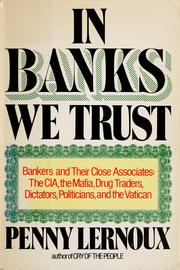
IN BANKS WE TRUST: BANKERS AND THEIR CLOSE ASSOCIATES: THE CIA, THE MAFIA, DRUG TRADERS, DICTATORS, POLITICIANS AND THE VATICAN

By Penny Lernoux

Published by Anchor Press Doubleday, 1984


Penny Lernoux’s scathing In Banks We Trust is almost 30 years old, yet when I read it I could not help but think of present times. She offers an exhaustive look into the whirlwind of risky investments, careless gambles and unquenchable greed. In Banks We Trust defines the industry during the late 1970s and into the ’80s; yet it rings all too similar to today’s stories and headlines that analyze the 2008 banking debacle responsible for deepening the recession the country is still trying to escape.

I was unprepared for Lernoux’s scenario. The connections and the details of the corrupt practices initially shocked me. Her thorough investigation begins as she unearths the careless and reckless practices at Chase Manhattan Bank and Citibank. But her investigation doesn’t end there, for the seedy practices aren’t limited to the usual suspects.

Before the book’s end, the Mafia, drug traffickers, politicians, regimes in Latin America and the Middle East, the CIA and the Vatican have all participated in a messy, intertwined web of risky investments, selfish power grabs and money laundering. Lernoux’ web is woven as the names of banks and people she writes about overlap and intertwine across chapters and stories. Her quick-paced writing captures the normalcy with which the illegal acts were practiced.

 As I kept reading the continuing stories of cons and illegal practices, I kept thinking,  “How is this allowed to happen?”

Lernoux is quick to point out that everyone is culpable.

The lack of oversight by and apathy of regulators, auditors and federal agents fed the culture that allows such immoral practices. Through her intensive research, Lernoux starkly reveals the egos that guided many of the decisions made in search of power and wealth, with little regard for the greater good.

 Lernoux’s final sentence made me cringe as I read a warning for the future. A warning disregarded? She wrote:  “Indeed, when it comes to sharing the blame, the federal government and its central bank, the Federal Reserve, must bear the largest responsibility, not only for promoting the money recycling game of the 1970s but also for refusing to stop the money-go-round after it spun out of control.”

Through those final words, In Banks We Trust maintains its relevancy to today’s newer bailouts. Lernoux reminds us that change cannot come from an overhaul of a single group or entity, but through a dramatic shock affecting an entire culture.

Mere dissatisfaction with greed is insufficient.

The works of Penny Lernoux
  • Re-encountering Lernoux [1], Hearts on Fire: The Story of the Maryknoll Sisters (Centennial Edition) reviewed by Chris Herlinger
  • A web of greed and power grabs [2], In Banks We Trust: Bankers and Their Close Associates: the CIA, the Mafia, Drug Traders, Dictators, Politicians and the Vatican reviewed by Brian Roewe
  • 32 years later, book on Latin America still challenges us [3], Cry of the People: United States Involvement in the Rise of Fascism, Torture, and Murder and the Persecution of the Catholic Church in Latin America reviewed by Zoe Ryan
  • A document of Vatican II's undoing [4], People of God: The Struggle For World Catholicism reviewed by Joshua J. McElwee
 

Source URL (retrieved on 07/25/2013 - 16:15): http://ncronline.org/news/people/web-greed-and-power-grabs


Links:

[1] http://ncronline.org/node/30682


[2] http://ncronline.org/node/30686


[3] http://ncronline.org/node/30689


[4] http://ncronline.org/node/30691


Source
.

Monday, February 18, 2013

Was the Pope pushed? An abuse scandal, corruption and the dark intrigue behind Benedict's shock resignation


By GUY ADAMS

PUBLISHED: 18:13 EST, 15 February 2013 | UPDATED: 19:05 EST, 15 February 2013


The room full of people was still in shock at the news of his resignation when Pope Benedict XVI tottered across the marble floor towards a tall, heavy-set man in the red robe and skullcap of a cardinal.

As cameras rolled on Monday in the gilded Sala del Concistoro at the Apostolic Palace in Rome, Benedict grabbed the man by his shoulders, looked deep into his eyes and — struggling to hold back tears — shared a long embrace.

It was a public show of affection to one of the Pope’s most important fratres carissimi or ‘dear brothers’.


Dark intrigue: Benedict's decision to become the first leader of the Catholic Church to step aside since the Middle Ages has left a slew of unanswered questions

It was also a display of respect. For the man was Cardinal Angelo Sodano, who as Dean of the College of Cardinals will organise the coming conclave at the Sistine chapel where 117 cardinals from across the world choose the next pontiff.

Yet in these ancient hallways, things are never entirely as they seem.

Dust may still be settling on Benedict XVI’s unexpected resignation, at the age of 85, but cynical eyes have begun to turn towards his relationship with Sodano the power-broker.

Sodano has lost little time in expressing his ‘sense of loss and almost disbelief’ at Benedict’s decision to quit, telling reporters that Monday’s announcement felt ‘like a lightning bolt in a clear blue sky’. But Vatican insiders smell a rat about those widely reported comments. They point out that, far from being surprised at Benedict’s announcement, Sodano had been told the previous Friday. And far from a ‘sense of loss’, previous form suggests the ambitious cardinal would have been delighted at the news.


More...
Pressure grows on Pope to leave Rome after he retires so he does not interfere with successor's work
'You don't get down from the cross': Polish cardinal provokes fury by suggesting Pope should have died in office
The Papal Apocalypse! Doomsday fanatics claim next pontiff will be the last according to 12th century Prophecy of the Popes
A liberal Pope? Not a prayer: Benedict’s successor will feel the shadow of his continuing presence in Vatican City


Benedict’s decision to become the first leader of the Catholic Church to step aside since the Middle Ages has left a slew of unanswered questions. In the official statement, the German-born Pope blamed his resignation on advancing years, saying declining health had left him unable to properly lead the world’s 1.2 billion Catholics.

‘Having repeatedly examined my conscience before God, I have come to the certainty that my strengths, due to an advanced age, are no longer suited to an adequate exercise of the Petrine ministry,’ he said.

An official spokesman later added that Benedict is suffering from a ‘decline in vigour, both of the body and spirit’.

To a degree, that’s probably true. Italian newspapers have revealed Benedict suffered a ‘serious fall’ this year and underwent heart surgery in November to replace a pacemaker fitted after an earlier heart attack.


Dust may still be settling on Benedict XVI's unexpected resignation, at the age of 85, but cynical eyes have begun to turn towards his relationship with Cardinal Angelo Sodano (pictured) - the power-broker

But in a world governed by tradition, serving Popes don’t step aside, no matter how ailing.

Benedict’s predecessor, John Paul II, served for 27 years, surviving an assassination attempt. After being diagnosed with Parkinson’s in 2001, he suffered severe difficulties speaking and even sitting up. But he carried on until his death in 2005.

The last pope who failed to carry on until the bitter end was Gregory XII, who was forced out in 1415.


The last to go voluntarily was Celestine V, who resigned in 1294.

But if the fact of the Pope’s departure is unusual, its timing looks downright suspicious.

The Vatican claims he’d been considering the move for almost a year, praying intensively as he decided whether to quit.

But if so, why did he recently allow officials to schedule an official tour of Brazil for July?

Why, too, insiders wonder, shortly before Christmas did Benedict promote one of the Vatican’s most glamorous figures, fellow German Georg Ganswein, to Archbishop and the high-profile position of Prefect of his Pontifical Household?

At the time of his appointment, the 56-year-old — who is known as ‘the Black Forest Adonis’ and ‘Gorgeous George’ on account of his good looks — was billed as the perfect right-hand man to protect an ageing Pontiff from the daily grind of Vatican politics.


Benedict promoted Georg Ganswein (pictured) to Archbishop and the high-profile position of Prefect of his Pontifical Household

Ganswein then appeared on the cover of last month’s Italian Vanity Fair, billed as the ‘George Clooney of Catholicism’.

The article pointed out that papal aides are promoted to archbishop when an ailing Pope wishes to create an unofficial ‘gatekeeper’. But if Benedict knew he was about to quit, why appoint Ganswein to this position?

The Pope’s departure also comes at a time of scrutiny over the Vatican’s alleged links to the world of organised crime.

Last summer saw the scandalous trial of Paolo Gabriele, his butler, who was sentenced to 18 months in prison for stealing confidential documents from his master’s desk and passing them to a journalist.

The papers were given to Gianluigi Nuzzi, a reporter whose ‘Vatileaks’ scoop alleged corruption at the Vatican Bank, including the laundering of £160 million on behalf of the Mafia.

In the wake of Nuzzi’s revelations, the bank’s president was forced to resign. A replacement is due to be announced in the coming months.

His identity is of great concern to organised criminals, who fear the ‘wrong’ appointee will attempt to wipe clean the tarnished bank’s slate by confessing a raft of previous financial misdeeds.

Benedict was expected to usher in just such a new broom; his successor may not. The fact his departure is good news for the mafia has left many suspicious.

But the most curious figure in the shock resignation is Cardinal Sodano.

The Pope and the cardinal are hardly allies. Indeed, for years they have been regarded as bitter rivals, clashing repeatedly as they each climbed the slippery pole of the hierarchy.

Months after Benedict became Pope, Sodano resigned as the Vatican’s Secretary of State, its most senior political and diplomatic post, after 12 years in the high-profile job. This hardly makes him an obvious candidate for a public papal embrace.

The second source of suspicion is Sodano’s professed surprise at Monday’s news.

Several Vatican insiders, including Nigerian Cardinal Francis Arinze, a top contender to be the next Pope, say Sodano learned of the coming resignation in Benedict’s private quarters the previous Friday.


Not allies: For many years, the Pope (right) and Cardinal Sodano (left) have been regarded as bitter rivals, clashing repeatedly as they each climbed the slippery pole of the hierarchy


If that is the case, then why did the Cardinal describe Benedict’s departure, three days later, as a bolt from the blue?

And what really happened at the Friday meeting? Though held in secret, reports in the Italian press claim there was a heated argument between the men over the fraught question of how the Church should deal with clergy accused of sexual abuse.

In recent years, Benedict has taken a relatively hard line on dealing with paedophile priests, an issue that has damaged the hierarchy’s reputation.

Not only has he apologised publicly to victims, he has also insisted that the Vatican, rather than individual diocese, should be in charge of investigating future abuse complaints, referring them to the police whenever possible.

Sodano takes a different view. The cardinal has been reluctant to proceed with investigations into suspect priests over the years, and famously used a prayer during Easter Mass in 2010 to describe the complaints of victims of abuse as ‘petty gossip’.

He has clashed with Benedict over this issue several times over the years. In 1995, they fell out over how to deal with Cardinal Hans Hermann Groer, who resigned as Archbishop of Vienna after being accused of molesting young men.


While it seems Sodano had several reasons to seek the Pope's resignation, that doesn't mean he had the ability to execute such an audacious plot

Benedict advised the then Pope, John Paul II, to issue an apology over the appalling allegations, which were later proven. Sodano, as the Vatican’s Secretary of State, chose to over-rule him.

Then, in 1998, Sodano instructed Benedict — then Cardinal Joseph Ratzinger — to drop an investigation into multiple counts of abuse by Fr Marcial Maciel Degollado, founder of a holy order called The Legionaries of Christ. In a plot twist worthy of a Dan Brown novel, a Catholic journal uncovered evidence that Sodano had issued the order after receiving $15,000 from the order for being its ‘cheerleader’.

Benedict waited eight years for revenge. In 2006, he removed Maciel — later revealed to have fathered several children by different women — from his post. Sodano’s resignation from Vatican Secretary of State came soon afterwards.

Yet while it seems Sodano had several reasons to seek the Pope’s resignation, that doesn’t necessarily mean he had the ability to execute such an audacious plot.

A hostile cardinal seeking to bring down a Pope would have to unearth a catastrophically devastating scandal from his past.

With Benedict’s childhood in the Hitler Youth and long career in a Church ridden with sex abuse allegations, there are avenues for attack. But eight years of scrutiny from the media has left little mud sticking to him.

There is a dubious incident from 1980, when as Archbishop of Munich he transferred a paedophile priest to another parish. And there have been complaints that during the Eighties and Nineties, in his role as head of the Vatican’s Congregation for the Doctrine of the Faith, he ignored complaints of abuse.

Getting the Pope to resign would have taken something more damning. Did Sodano stumble on a scandal? It seems unlikely.

A more plausible explanation is perhaps that constant exposure to Vatican politics had left the monkish and cerebral Benedict tired and desperate to find an escape.

‘Maybe an unpleasant meeting with Sodano pushed him over the edge,’ says a veteran insider. ‘The Vatileaks scandal showed the place to be completely dysfunctional. It’s been that way throughout history.’

As for Sodano, he’s no doubt hoping one piece of Vatican history repeats itself. The last time a College of Cardinals chose a new Pope was in 2005 and Benedict was Dean of the College of Cardinals. This time, of course, the dean is none other than Cardinal Angelo Sodano.


.
.

Monday, December 13, 2010

The Mafia, The CIA, and The Vatican's Intelligence Apparatus


The Mafia, The CIA, & The Vatican's Intelligence Apparatus
By David G. Guyatt
© 2000 by David G. Guyatt
http://www.nexusmagazine.com/smokemirrors.html
Extracted from Nexus Magazine, Volume 7, Number 5
September-October 2000 in the USA only.
From our web page at: http://www.nexusmagazine.com/
12-21-00


In its zeal to stamp out communism, the Vatican set up alliances during World War II with various secret societies, fascist groups and spying agencies and has maintained these networks ever since.

By David G. Guyatt © 2000 by David G. Guyatt http://www.nexusmagazine.com/smokemirrors.html Extracted from Nexus Magazine, Volume 7, Number 5 September-October 2000 in the USA only. From our web page at: http://www.nexusmagazine.com/


Albert Vincent Carone is one of those people who spent his life dancing between raindrops and turning invisible wherever a shadow lingered. He existed and also didn't exist. Al Carone--unlike his near namesake, Al Capone--truly was a paradox wrapped in a mystery concealed behind an enigma.

Carone was a detective in the New York Police Department, but this didn't stop him from becoming a "made" man in the Genovese crime family. He knew all the leading Mafiosi of his day, including Vito Genovese, Sam Giancana, Santos Trafficante, Joe Colombo and Pauley Castellano amongst others. To Carone's daughter, Dee, they were all known as "Uncle". When she got married, her father arranged two different reception rooms to separate the Mob guests from the NYPD guests. But this was more window-dressing than anything else. One of Carone's principal functions in the NYPD was to act as the "bagman" in protecting shipments of CIA drugs to the various Mafia families.

Carone died in 1990 under mysterious circumstances. This followed a period of great personal disenchantment with his life, following a secretive mission to Mexico in 1985 when a large number of innocent women and children died unnecessarily. His death was horrific, reports Mike Ruppert, editor of From The Wilderness newsletter, who has investigated Carone's life story and written a special report on it (see acknowledgements).

Meanwhile, another "Uncle" was Bill Casey, Director of the Central Intelligence Agency during the Reagan Administration. Casey had been with the Office of Strategic Services (OSS) during World War II. During the 1970s, he became Chairman of the Securities and Exchange Commission (SEC) which regulates the US investment industry. During his tenure in that role, Casey used Carone as a "cut out" to pass sensitive insider information to Mob capo Pauley Castellano, says his daughter, Dee.

Carone was also a Full Colonel in the US Army, where he had operated in the Army's Counter Intelligence Corp (CIC). Unsurprisingly, in view of his close friendship with Bill Casey, he was also a covert operative for the CIA. But that wasn't half of it. Carone was also a Grand Knight of the Sovereign Military Order of Malta (SMOM), which historically has been the military arm of the Vatican and is regarded as a separate State with full powers of statehood, including issuing its own diplomatic passports.

In more recent decades SMOM has acted as a funding conduit, a black market gold channel and money laundry for the CIA, amongst others, and is known to act as the Vatican's intelligence arm. It was alleged to be involved in, for example, the disappearance of Russia's gold reserves--over 2,000 metric tonnes--which vanished during 1991, around the time that Soviet Premier Mikhail Gorbachev was ousted from office.

Malta knighthoods are awarded to many leading individuals who are part of the military and intelligence community. The CIA's Bill Casey, for example, was a Knight of Malta. Former NATO General and later US Secretary of State Alexander Haig is also a Malta Knight. Another is General Vernon Walters, the former Deputy Director of the CIA under DCI George Bush, and later appointed a roving ambassador during the Reagan Administration. The legendary head of the OSS (the WWII precursor of the CIA), "Wild" Bill Donovan, was made a Knight along with his wartime compatriot and later CIA Chief of Counterintelligence, James Jesus Angleton. And John McCone, another prominent member of the US "spook" agency, was also distinguished with a Malta knighthood. The list goes on. Most interesting is Reinhard Gehlen, the former Nazi intelligence expert recruited by the US in 1945&endash;46 to head the Gehlen Org--a secret, German-based intelligence arm of the United States that was composed of former SS and Gestapo agents, many of whom, including Klaus Barbie, were wanted Nazi war criminals. The foregoing names amount to a listing of some of the most powerful and influential members of the Western intelligence community over the last five decades.

One Vatican group that has extremely close ties to the Knights of Malta is the ultra-right-wing Opus Dei. This is an immensely powerful faction in the Vatican today, and its public "do good" activities eclipse a plethora of the darkest political and financial machinations known to man. It will not come as a surprise, perhaps, that Carone was closely associated with Opus Dei and, in particular, with a covert operation that had its origin back in 1944. This was Operation Amadeus.


FROM RATLINES TO DRUG SMUGGLING ROUTES

This highly secretive operation was part of the Operation Sunrise negotiations conducted between Allen Dulles--the then senior wartime OSS officer in Switzerland, but later to become the Director of the CIA--and SS General Karl Wolff. This debonair and well-connected SS officer commanded the SS and Gestapo contingents in Italy at the time.

The result of these negotiations (at least those parts that are now known about) was an agreement affording amnesty toan extensive roster of SS&endash;Gestapo forces, in exchange for their agreement to shift their allegiance to the West in the pre-planned, covert battle aimed at defeating the Soviet communist "menace"--in other words, the "Cold War".

One spin-off of these Dulles&endash;Wolff arrangements were the Vatican-run "ratlines" that aided wanted Nazi war criminals to slink to safety. Tens of thousands of SS and other Nazis escaped capture as a result of the ratlines. These included such figures as Franz Stangl, commandant at Treblinka extermination camp, and his friend Gustav Wagner, who ran the Sobibor death camp. Others to escape in this manner included Adolf Eichmann, the architect of the Holocaust. Eichmann was later captured by Israeli intelligence agents, smuggled to Tel Aviv where he stood trial and was eventually executed. In comparison, Dr Joseph Mengele--known as "the White Angel", a war criminal wanted for his cruel and inhuman experiments on death camp inmates at Auschwitz--escaped to Argentina and lived a long life.

Operation Amadeus was exclusively concerned with the flight of SS and Nazi war criminals to the South American continent and their later ferocious covert actions against the indigenous populations justified under the banner of "anti-communism". One individual engaged in Amadeus activities was former Gestapo officer Klaus Barbie, known to the world as "the Butcher of Lyon".

The principal means of funding Operation Amadeus activities was the hugely profitable narcotics business. Large stocks of SS morphia had been smuggled out of Europe and into "Catholic" South America at the end of the War in accordance with the Sunrise agreement. The morphia was accompanied by looted SS gold and large quantities of counterfeit British banknotes, forged in concentration camps by captive but skilled counterfeiters as part of an SS scheme known as Operation Bernhardt.

The escape "lines" used to move wanted men around South America, away from the prying eyes of Israeli agents, also proved ideal as smuggling routes for drugs. Decades later, the stocks of heroin smuggled into the United States for distribution by the CIA-protected Mafia would be complemented with locally grown cocaine.

One of the figures to emerge into the spotlight during the 1980s who was deeply involved in this narcotics traffic was Colonel Oliver North, who authorised the exchange of guns for drugs to finance Contra operations. Oliver North was known to Al Carone under his "work" name, "John Caffrey". This was the time when Carone was engaged in CIA-controlled cocaine transactions with Joe "Pickles" Percilia, a member of the Colombo crime family.

These curious and usually concealed connections between governments (in the form of the military and intelligence community), organised crime, the Vatican and Nazi war criminals have some significant history. Not least was the secret agreement reached between US Naval Intelligence officers and Mafia don Charles "Lucky" Luciano during World War II. This resulted in the Mafia's decision to aid and assist the Allies by contacting Mob figure Vito Genovese in 1943 to prepare the way for the Allied landing in Sicily. As earlier outlined, it was primarily those SS&endash;Gestapo units located in Italy under command of SS General Wolff that were initially concerned in the Operation Sunrise negotiations.

And while large numbers of former Nazis were fleeing south to fight the communist menace in Latin America--and, more importantly, to profit personally from their involvement in the lucrative drug and gun business--in Europe, the spadework was being laid to overthrow or thwart democratically elected governments via a network of fascist-manned "Stay Behind units", organised under the aegis of Operation Gladio. Not surprisingly, this would also lead to certain involved figures making personal fortunes out of other people's misery--a circumstance that is so commonplace it is barely worth mentioning.

These neo-fascist activities would come to prominence in the early 1980s following the collapse of Banco Ambrosiano and the death of Italian banker Roberto Calvi, who was "suicided" and left hanging under London's Blackfriars Bridge. This would lead to sensational disclosures about the role of the Vatican Bank, the IOR, in Calvi's financial empire and would quickly grow to include the activities of Mafia financier Michele Sindona--whose activities, in turn, would implicate leading blue-blood banks in Europe and America in Mafia activities. Both Sindona and Calvi were close to Opus Dei, which lost around $55 million when Sindona's empire crashed. According to his family, Roberto Calvi was deeply engrossed in helping Opus Dei take control of the IOR when he was killed.

Meanwhile, both Calvi and Sindona were members of the secretive Propaganda Due (P2) masonic lodge, which is said to have been a "parallel government" in waiting and which planned to effect a coup d'état in Italy following a Communist Party victory at the polls.

P2 was run by former Italian fascist and member of the Nazi SS, Licio Gelli--dubbed "the Puppet Master" by the Italian press. Gelli's connections to the ultra-hard-right and fascists in Europe and Latin America were extensive. In fact, he had been deeply involved in establishing the Vatican-run ratlines that aided the worst Nazi war criminals to escape Allied justice at the end of WWII. All told, an estimated 50,000 Nazis were helped to freedom.

Gelli had numerous powerful friends, including former Italian dictator Benito Mussolini. He was also a personal friend of Argentina's General Juan Perón, and his close associations with Argentina would later lead him to be a key figure in shipping a supply of French Exocet missiles to sink British Task Force ships during the Falklands War. In this endeavour he worked closely with Ronald R. Rewald, founder of the Hawaiian-based financial institution Bishop, Baldwin, Rewald, Dillingham & Wong--a CIA proprietary company and forerunner of the CIA-owned Nugan Hand Bank.

The involvement of a CIA front company engaged in financing and providing weapons to be used against a key American ally (Britain) with the wholehearted public support of the US Government may seem somewhat duplicitous. However, in the world of "black ops", "friends" and "enemies" are interchangeable words and working both sides of the fence is accepted practice.

In terms of hierarchy, Gelli reported to Umberto Ortolani, described by one writer as "the great Vatican door-opener" and "secret chamberlain of the papal household". In addition to his P2 connections, Ortolani is also a member of the inner council of the Knights of Malta and has military intelligence connections that date back to WWII.


THE OCTOPUS AND THE SPIDER

There are numerous other masonic groups and secret societies in Europe which move in and out of focus at various times. Almost all of them are Catholic in nature.

One of these is the Priory of Sion (Prieuré de Sion)--a secretive order that first came to public attention via the best-selling book, The Holy Blood And The Holy Grail, published in 1982. The Priory is closely connected with the alleged treasure of Solomon which is said to have found its way to the small village of Rennes-le-Château in southwestern France, where it is said to have been buried by the Knights Templars, forerunners of the Knights of Malta.

The Priory, whose headquarters were located at Annemasse, near Geneva on the Swiss border, are styled as the "guardians" of Solomon's treasure, but, most interestingly, they have numerous subterranean connections to fascists and those on the far right that date back to WWII. Meanwhile, it has to be noted in passing that Annemasse is said to have been the centre for the anti-communist Stay Behind units of Operation Gladio.

If this is not intriguing enough, another fact stretches coincidence to the point of bursting. In recent years, the Priory of Sion has moved its headquarters to Barcelona and now boasts a Spanish Grand Master. This, one could conclude, is to enable it to be physically closer to the historical heartland of Opus Dei, which was founded in Spain in 1928.

If Otto Skorzeny was a leading force in running the SS Brotherhood escape routes--Der Spinne, the Spider--after the war, and SS General Karl Wolff was the lead negotiator with OSS Swiss Chief, Allen Dulles, then another Nazi, Walter Rauff, head of the Milan SD, was one of two liaisons with the Vatican involved in the establishment of the Nazi-smuggling system. Earlier in his career, Rauff had overseen the development of the Nazis' mobile gas vans, known as "Black Ravens", which gassed to death around 100,000 Jews, mostly women and children, by pumping exhaust fumes into the back of an hermetically sealed van.

Another important link between the Vatican and SS escape routes was Friedrich Schwendt, who was also the man in charge of laundering forged SS banknotes. Before WWII, Schwendt was an international arms dealer who shipped weapons to China and Russia. He was also the investment manager of the family fortune of his first wife's aunt, Baroness Gemmingen-Guttenberg, of the vastly wealthy Argentina-based Bunge family, of the massive transnational firm Bunge Corporation that is also known as "the Octopus".

This title is interesting, for it may connect to the so-called "Octopus" that ties in to murdered freelance journalist Danny Casolaro, who at the time of his death in 1991 was investigating a number of high-level illegalities including the theft by the Department of Justice of a "tracking" computer program known as "PROMIS". Casolaro was writing a book about what he had discovered. He originally titled it "Behold, A Pale Horse", but later modified it to "The Octopus". In a draft page of the book, he described this group as an "international cabal whose freelance services covered parochial political intrigue, espionage, sophisticated weapon technologies that included biotoxins, drug trafficking, money laundering and murder-for-hire". Casolaro further stated that this cabal was "spawned thirty years ago in the shadow of the Cold War".

After Casolaro's death, journalist Carol Marshall (a pen name) followed up his investigation and wrote an (as yet) unpublished manuscript, titled "The Last Circle". In this, Marshall describes her investigation of Robert Booth Nichols--one of the central figures of the Octopus, whom she describes as being part of a secretive group known as "the Chosen Ones" and who wore "skull and crossbones rings and shared a common interest, if you could call it that, in the old German SS occultism, its tribal and inner circle rites".

During her continuing investigation into the Octopus, Marshall found that the SS occultism outlined above was connected to Lt. Col. Michael A. Aquino, a former US Green Beret who is a self-professed Satanist and who held a Top Secret security clearance for his work in military intelligence and on classified psychological warfare matters. Aquino officiated at SS black-magic ceremonies held at Wewelsburg, the castle once used by SS chief Heinrich Himmler to create an SS order of Teutonic knights based on the Knights Templars.

The foregoing connections lend themselves to a larger picture of global, interlocking, right-wing fascist groupings that operate in the shadowland of deniable military and intelligence operations associated with profit during WWII and, later, throughout the Cold War.

In this respect, it is intriguing to note that the Priory of Sion, one of the foremost Catholic groups under discussion, uses as a symbol something that is variously described as an octopus or a spider (araignée) on its documents. The Priory's association with the octopus could easily relate to the so-called Octopus described above, where organised crime works hand in glove with operatives from US intelligence and the military. If one decides, on the other hand, that the Priory symbol is a spider, there is the intriguing notion of the Vatican-run Nazi escape lines of Austrian Catholic Otto Skorzeny and his SS Brotherhood's Der Spinne (the Spider).


THE BUSINESS OF GOD

Al Carone was, as mentioned earlier, a "made" man of the Genovese Mob in addition to his other associations. It is curious, therefore, to note that one of the leading lights of the Octopus, according to writer Carol Marshall, was ultra-right-wing oil tycoon Clint Murchison, owner of the Dallas Cowboys football team. Murchison's oil company, Murchison Oil Lease Company, was 20 per cent owned by Gerardo Catena, the chief lieutenant of the Genovese crime family.

Throughout the Second World War and thereafter there was, according to author Charles Higham in his book, Trading With The Enemy, a "general agreement of certain major figures of American, British and German commerce to continue their relations and associations after Pearl Harbor". Higham adds that he also learned that "certain figures of the warring governments had arranged to assist in this [activity]". Higham's subsequent research proved that this high cabal--which he dubbed "the Fraternity"--not only existed but benefited handsomely throughout WWII. This led the author to ask:

What would have happened if millions of Americans and British people, struggling with coupons and lines at the gas stations, had learned that in 1942 Standard Oil of New Jersey managers shipped the enemy's fuel through neutral Switzerland and that the enemy was shipping Allied fuel? Suppose the public had discovered that the Chase Bank in Nazi-occupied Paris after Pearl Harbor was doing millions of dollars' worth of business with the enemy with the full knowledge of the head office in Manhattan? Or that Ford trucks were being built for the German occupation troops in France with authorisation from Dearborn, Michigan? Or that Colonel Sosthenes Behn, the head of the international American telephone conglomerate ITT, flew from New York to Madrid to Berne during the war to help improve Hitler's communications systems and improve the robot bombs that devastated London? Or that ITT built the Focke-Wulfs that dropped bombs on British and American troops? Or that crucial ball-bearings were shipped to Nazi-associated customers in Latin America with the collusion of the Vice-Chairman of the US War Production Board, in partnership with Göring's cousin in Philadelphia, when American forces were desperately short of them? Or that such arrangements were known about in Washington and either sanctioned or deliberately ignored?

Higham's "Fraternity" has similar characteristics to the so-called "Octopus", and also shows certain similarities to Colonel Oliver North's "Enterprise". All have engaged in the most dubious and illegal activities for profit, and all operate hand in glove with organised crime. All lean so far to the right, ideologically speaking, that the word "fascist" can be used without reservation. Meanwhile, none of them cares very much for the woes of humanity and, indeed, they appear committed to stomping on ethics and moral values wherever they meet them.

The octopus--or "Oct Opus", as one European documentary film producer renders the spelling when referring to Opus Dei (which began life on 2 October 1928)--has eight arms that surround its mouth (ensuring a constant supply of food) and three hearts, and is therefore not prone to starving or dying. But it can also be identified by these oddities. Opus Dei, the group that is now in control of the Vatican, is undoubtedly one arm of this global criminal network, in this writer's view. Or are the three hearts of the octopus more vital to identify? Could they be analogous to the "Church, State and Mafia, the forces that prevail beneath the play of the shadows of the world" (as described by Nick Tosches in his book, Power On Earth, which tells the life story of murdered Mafia financier Michele Sindona)?

There is yet another interesting twist to this accumulation of associations: Prince Bernhard of The Netherlands. The Prince was the founding chairman of the publicity-shy Western power elite, the Bilderbergers. This shadowy and secretive group meets over a weekend in May/June each year, under an almost total media blackout [see deBriefings this issue]. Powerful and very influential figures from the world of banking, business, politics, the media, trades unions and academia are invited. Included regularly, for example, are Dr Henry Kissinger, David Rockefeller, and Italy's "king-maker", Gianni Agnelli. The first meeting took place in May 1954.

This, strangely, was the same year that Prince Bernhard became head of the Johanitter Orde in Nederland, one of four orders that make up the Chivalric Alliance of Orders of Saint John (Alliance de Chevalerie des Hospitaliers de Saint Jean de Jérusalem). The stated purpose of these four, known as "the Alliance"--which is composed of northern European nations Germany, The Netherlands, Sweden and Great Britain, the latter being an ancient order known as "the Most Venerable Order"--is "to reduce to silence the enemies of Christ". The headquarters of the Alliance are located in Switzerland.

These are Protestant orders rather than Catholic, but it is of significance that, on 26 November 1963, the Alliance was"consolidated with the signing of a joint declaration between the Sovereign Military Order of Malta and the Most Venerable Order, at St John's Gate, London, by the Grand Chancellor of the SMOM, the Prince of Resuttano, and Lord Wakehurst, Lord Prior of the Most Venerable Order". In other words, the Catholic and Protestant orders bound themselves to work together to "silence the enemies of Christ"--a clear reference to communism.

Interestingly, it has been suggested that the Knights Templars were "infected" with the Johannite or Mandaean heresy that denounced Jesus as a "false prophet" and in his place recognised John the Baptist as the true Messiah. Meanwhile, two early Grand Masters of the Priory of Sion are said to have had Johannite tendencies: Leonardo da Vinci and Sir Isaac Newton. Notwithstanding that, the famous founder of the Knights Templars, Hughes de Payens, has been accused by the Vatican of being a Johannite.

Leaving aside this brief foray into esoteric history, it is as well to note that Prince Bernhard, in addition to his Bilderberg role and as head of the Dutch Johannite Order, was also an honorary member of Himmler's SS and worked in NW7, the global intelligence arm of I.G. Farben which acted in the interests of the Nazi cause. The activities of NW7 in Latin America before, during and after World War II are deeply interwoven in this story.

In facilitating and aligning itself with many of the foregoing activities, the Vatican aimed to help eradicate a communist ideology that despised Christianity. Opus Dei and a host of other Catholic-cum-fascist secret groups engaged in a litany of murder, money laundering, drug peddling, arms trafficking, concealment of WWII loot, embezzlement, manipulation of financial markets and many other consummate illegalities. The purpose of all these activities was, arguably, to allow the Vatican to remain the spiritual bulwark of the Christian West.

But if such business is the business of a Church preaching of a God in Heaven, then Caesar on Earth had better watch out. A new landlord has fallen into town.


Acknowledgements

In preparing this essay, I drew upon an indispensable group of published/unpublished work and sources, as follows:

¥ The full account of the unique story of Al Carone, by Mike Ruppert (available to order online at www.copvcia.com). ¥ Trading With The Enemy, by Charles Higham (St Edmundsbury Press, Suffolk, UK, 1983). ¥ Their Kingdom Come, by Robert Hutchison (St Martin's Press, New York, 1997). ¥ Web of Gold, by Guy Patton and Robin Mackness (Sidgwick & Jackson, London, 2000). ¥ Ratlines, by Mark Aarons and John Loftus (Mandarin, London, 1991). ¥ The Bormann Brotherhood, by William Stevenson (Arthur Baker, London, 1973). ¥ Unpublished manuscript by Peter Dale Scott on Barbie, Dulles and Operation Sunrise. It details how the OSS&endash;SS preserved each other while serving their true masters: transnational corporations. ¥ The Last Circle, an unpublished manuscript by Carol Marshall, which investigates the so-called "Octopus". ¥ My thanks also go to Catherine Austin Fitts (www.solari.com) for her invaluable help. -- David G. Guyatt


About the Author:

Following a 28-year career as a professional international banker based in the City of London, David Guyatt now pursues a career researching, writing and producing material for TV documentaries, films and magazines. His feature articles have appeared in diverse publications including BusinessAge, NEXUS, Fortean Times, The X Factor and Lobster.

In addition to his commercial writing, David has prepared background papers on anti-personnel electromagnetic weapons for the International Committee on the Red Cross (ICRC), as well as for Scientists for Global Responsibility. He has also written for the World Development Movement on his "insider" knowledge of international weapons financing.

David was engaged as an expert consultant for the two-part World in Action TV documentary, broadcast in the UK in April 1997, that exposed Britain's weapons trail to Indonesia; and he assisted Swiss TV in a documentary on non-lethal weapons, also broadcast in early 1997. At present, he is pursuing an in-depth investigation into the real secrets surrounding the enigma of Nazi gold and WWII treasure looted by both German and Japanese "plunder teams". It will also unravel some of the more enduring secrets of the gold market.


Extracted from Nexus Magazine, Volume 7, Number 5 (August-September 2000) or September-October 2000 in the USA only. PO Box 30, Mapleton Qld 4560 Australia. editor@nexusmagazine.com Telephone: +61 (0)7 5442 9280; Fax: +61 (0)7 5442 9381 From our web page at: http://www.nexusmagazine.com/

Correspondence c/- NEXUS UK Office 55 Queens Road East Grinstead, W. Sussex RH19 1BG United Kingdom E-mail: goldbug@goldbug99.freeserve.co.uk


.

Monday, August 09, 2010

A FINANCIAL EMPIRE SECOND TO NONE


Whenever anyone writes on conspiracy money is always given a prominent place. In this regard the Vatican certainly does not take a back seat to anyone. The wealth of the Vatican, as we will see, is so vast that in all probability its true worth will never be known.We are going to examine in some detail what various writers, who have tried to research the wealth of the Vatican, have said. Several of these writers are members of the Roman Catholic church. It is surely interesting to every Protestant that when Pope Paul brought his entourage from Milan to the Vatican, they were dubbed by Roman Catholic writers as the Milan Mafia.1
.
It is not within the bounds of this study to examine the Mafia in detail. But the Cosa Nostra, the Family, or The Mafia are a 100% Roman Catholic outfit. They originated in Sicily where Michele Sindona was also born. They control vast holdings in Italy and North America. They have gone what they call "legit" in many enterprises and were able to close down an entire cheese plant in Wisconsin. They did this to establish a monopoly in the Pizza business. This incident made the national news. Businessmen came in and brought the cheese factory. After they bought it, they closed it down. It was only later that Mafia involvement was discovered. As far as we know, the factory, which employed most of the town's work force, is still closed down as of this writing. It is interesting to notice the timing of the move by the Mafia to control the cheese and pizza business in the United States. Panatella, a Vatican controlled company dealing mainly in flour and pasta, lost two and a half million dollars just prior to the Mafia takeover and required financing of 4.8 million dollars to keep it afloat.
Martin discloses that by the late sixties both the Institute for Religious Words (whose assets were conservatively put at 3 billion dollars) and the Special Administration of Holy See Property were invested in every sector of Italian industry and commerce. He went on to say, "On the boards of directors of companies in which theVatican had an interest there always sat a Vatican ' family ' man, somebody like Massimo Spada or Luigi Mennini."2
.
Martin also pointed out that the Special Administration of Holy See Property, which was run by competent lay bankers, was advised by J. P. Morgan, Hambros Brothers of London, and the Rothschilds of Paris. Ostling recounts the story of Boys' Town, a Roman Catholic charity. Boys Town now has a worth of well over $200 million, including a securities portfolio valued (very conservatively) at $157 million. Although the interest on such a nest egg is ample to operate the Town, it still spends millions to send the traditional tearjerker fund appeals to 34 million people and raises nearly $18 million a year. This means Boys Town has about three times the endowment of Notre Dame University, raises more money than the Greater New York United Fund, and would rank 372nd in assets on the Fortune 500 if if were a business corporation. All this for 700 boys.3
.
All this came to light after much digging by a weekly newspaper in Omaha, Nebraska. According to Lo Bello, a Roman Catholic journalist, the Vatican is the only sovereign state that never publishes a budget. He was accused of exaggeration in his estimates of Vatican wealth, but suffice it to say, the wealth of the Vatican must be immense, for a simple honest disclosure of its holdings, if they do not constitute great wealth, would lay to rest all the "extravagant" estimates of various writers, but such a disclosure has not been forthcoming. The Sindona debacle, which the Vatican sought to hide from thegeneral public, resulted in a loss of close to one billion dollars. Yet the Vatican carried on as before, demonstrating its reservoir of financial reserves as nothing else could. Very few companies could sustain such a loss and carry on without so much as a whisper.(Chrysler Corporation lost half a billion and would have gone under but for the U. S. government.) The financial tentacles of the Vatican reach into numerous banks in different countries. Yallop says that the Rothschilds in Paris have been doing business with the Vatican since early in the 19thcentury.4
,
He goes on to point out that, "Credit Suisse, Hambros, Morgan Guaranty, Bankers Trust, Chase Manhattan, and Continental Illinois among others became Vatican partners."5
.
This financial empire which finances the Vatican conspiracy is filled with murder and mayhem. Yallop states, "The murder of Luciano-Pope John Paul I was to stop him from removing Marcinkus who was the foundation holding up Calvi, Sindona, and Celli."6
,
When the dust had cleared from John Paul's mysterious death, it left in its aftermath a series of murders, assassinations and "suicides" that only the Mafia could match for cold bloodedness. Of the main players in the scene only Marcinkus and Celli still remain in control. Yallop recounts in detail each one of the murders and "suicides," and his pages, which are very difficult to refute, make grim reading. His book, IN GOD'S NAME," merits close reading by all who are concerned about freedom.Because of the criticism that no disclosure is ever made of its wealth, the Vatican has in recent years tried to reform some of its monetary policies, but much still remains to be done. No estimate can be given of the immense wealth of the Vatican, but one canget some glimpses of the multi-billion dollar enterprise through various works that have appeared in recent years. Ostling, in his work, "Secrecy in The Church," written from the standp oint of one sympathetic to the Church, does give some interesting insights into the wealth of the Papacy. He recounts that the late Bishop James A. Pike (a convert from Romanism to Episcopalianism) wrote what he calls a sensational article in which he said that the Jesuits had a controlling interest in the Bank of America, the nation's largest, and that they earned 250 million dollars a year from their investments (a quarter of a billion). He goes on to say that the Jesuits "sputtered, but they have never made a full accounting of their holdings."7
,
Gollin, a freelance writer who tried to research Papal wealth, figured the securities and commercial properties of the Dioceses of the U.S.at almost "one billion dollars."8
,
Nino Lo Bello put "the American Jesuit's annual income at $250 million." He claims that all Catholic units in the U.S. and Canada combined have assets of more than $80 billion and an annual income of nearly $12.5 billion."9
.
It was none other than Cardinal Vagnozzi who observed concerning the Vatican's finances:It would take a combination of the KGB, the C.I.A. and Interpol to obtain just an inkling of how much and where the monies are.10
,
According to this Cardinal three of the most powerful agencies in the world could only obtain an inkling of how much the Vatican is worth. Yallop points out that the "Vatican bought into General Motors, Shell, Gulf Oil, General Electric, Bethlehem Steel, IBM and TWA." He went on to say that "the Vicar of Christ had acquired a new unofficial title: Chairman of the Board."11
,
The Vatican also acquired "controlling interest in companies, in fields of insurance, steel, financing, flour and spaghetti, industry,cement and real estate."12
,
It owns sections of downtown Montreal,Canada, sections of Mexico City in Mexico, many of the major hotels in Italy, blocks of real estate on the Champs D'Elysee in Paris, the Watergate area in Washington, D.C., real estate in New York City, and the entire satellite city of Lomas Verdes in Mexico.This is only the tip of the iceberg, for much of the Vatican's wealth is hidden in holding companies so that it is difficult to come even close in an estimate of its vast wealth. It is interesting to observe also that Pope John Paul, who was murdered in the Vatican, intended to reform the Vatican's finances. Yallop in his work claims that this could have been one of a half dozen reasons why he was murdered right in the Vatican. Another very interesting fact is that Pope John Paul confessed to Father Dezza. Even the Pope has a prelate to whom he confesses, and poor Pope John Paul for some reason chose the head of the Jesuits as his "Father Confessor." If for any reason he chose to confide some of his proposed changes to Dezza, he may have unwittingly sealed his own death warrant. Malachi Martin, former Jesuit professor at the Pontifical Biblical Institute in Rome, in his new book, "RICH CHURCH POORCHURCH," puts the wealth of the "church" at 300 billion dollars. He points out that the Vatican is the:largest single stockholder in the world with about $20 billion dollars traceably invested (but much more untraceably invested) with gold deposits exceeding those of most medium sized countries, and with a worldwide real estate operation.13
,
He goes on to say in another place:a list of the companies and banks in Italy and abroad in which the Vatican acquired a controlling interest before the outbreak of World War II, when added to the list of those in which itacquired a minor but substantial interest, would fill some sixty or seventy pages of this book.14
,
Even Martin, who still classes himself as a Roman Catholic, is appalled at the extent of the Vatican's wealth when contrasted with the impoverished millions of Roman Catholics around the world.The present Pope speaks much about economic justice. Although much has been written about the present Pope in glowing terms,Yallop does not share the international newsmen's accolade.Yallop states candidly: the papacy of John Paul II has been a case of business as usual. The business has benefitted immeasurably not only from the murder of Albino Luciana, but also from the murders that have followed that strange lonely death in the Vatican.15
.
He goes on to say: Many millions of words have been written since the election of Karol Wojtyla in attempts to analyze and understand what kind of man he is. As can be seen, he is the kind of man who could allow men like Villot, Cody, Marcinkus, Mennini, De Strobel and Poletto to remain in office.16
,
He adds:"It is a papacy of double standards, one for the Pope and one for the rest of mankind. "There can be no defense on the grounds of ignorance, Marcinkus is directly answerable to the Pope."17
,

REFERENCES
I.Martin, Malachi, THE FINAL CONCLAVE, Stein and Day, New
York, 1978. p. 18
2. Ibid., p. 26
3. Ostling, Richard, SECRECY IN THE CHURCH, Harper and
Row, N.Y. 1974, p. 51
4.Yallop, David, IN GOD'S NAME, Bantam Books, N.Y., N.Y.
1984, p 97
5. loc. cit.
6. Ibid., p. 103
7. Ostling, p. 49
8. loc.cit.
9. Ibid., p. 50 10.Yallop,p. 105
11. Ibid., p. 99
12. Ibid., p. 98
13. Martin, Malachi, RICH CHURCH POOR CHURCH, G. P. Putnam's
Sons, N.Y., N.Y. 1984, p. 14
14. Ibid., p. 40
15.Yallop, p. 264
16. Ibid, p. 265
17. Ibid., p. 264

An excerpt of:
The Vatican Jesuit Global Conspiracy
by Dr. Ronald Cooke .

.

Sunday, March 22, 2009

David Ferrie


Mugshot of David Ferrie. It should be noted that Ferrie was never convicted of any serious crime.


David William Ferrie (March 28, 1918 - February 22, 1967) was a pilot who was alleged by New Orleans District Attorney Jim Garrison to have been involved in the Assassination of President John F. Kennedy.

Ferrie was born in Cleveland, Ohio. A Roman Catholic, Ferrie attended John Carroll University, St. Mary Seminary, where he studied for the priesthood, and Baldwin-Wallace College. He next spent three years at the St. Charles Seminary in Carthagena, Ohio. He suffered from alopecia areata, a skin condition which causes the loss of body hair in clumps.


Picture of Ferrie standing outside St. Charles Seminary.

In 1944 Ferrie left St. Charles after suffering a nervous breakdown. He obtained a pilot's license and began teaching aeronautics at Cleveland's Benedictine High School. He was fired from the school for several infractions, including taking boys to a house of prostitution and flipping a car over in the driveway of the school. He then became an insurance inspector, and in 1951 he moved to New Orleans where he worked as a pilot for Eastern Air Lines until losing his job in August, 1961 after being arrested on morals charges.

Ferrie was involved with the Civil Air Patrol in several ways: He started as a "senior" with the Fifth Cleveland Squadron at Hopkins Airport in 1947. The Squadron Commander tried unsuccessfully to bounce him in 1949. When he moved to New Orleans, he "transferred" to the New Orleans Cadet Squadron at Lakefront Airport, first as instructor and later as Commander. After a Ferrie-trained cadet pilot perished in a December 1954 crash, Ferrie's annual re-appointment was declined. He was asked to be a guest lecturer at the smaller squadron at Moisant Airport, and he did so, lecturing from June to September 1955. On July 27, 1955, 15-year-old Lee Harvey Oswald joined this squadron. In March 1958, a former cadet-turned-commander invited Ferrie back to the New Orleans Cadet Squadron. He served unofficially for a time and was reinstated as Executive Officer in September 1959. Ferrie quit the squadron in a huff in June 1960 after a disagreement during a bivouac. In September 1960, he started his own unofficial squadron, called the Metairie Falcon Cadet Squadron. An offshoot of this group was the Internal Mobile Security Unit, a group formed for the fight against Castro's Cuba. Over the years, he used both his official and unofficial squadrons to develop improper relations with post-pubescent (age 14-18) boys (called ephebophilia), and his August 1961 arrests caused the Falcons to fold.

According to friends and family, Ferrie had a mixed bag of political views. As a young man he was described as antinomian, having no adherence to established moral codes. While he actively avoided the draft in 1941, his younger brother went on to become something of a war hero. Perhaps owing to this, Ferrie became stridently anti-Communist by 1950. When Fidel Castro opposed Fulgencio Batista in Cuba, Ferrie initially approved of him, but he became convinced Castro was a Communist by the summer of 1959. In November 1960, he became associated with the New Orleans office of the Frente Revolucionario Democratico, a CIA-backed organization. This association changed after his morals arrests. In the early 1960s he was an associate of Guy Banister, a former FBI agent, New Orleans police official, political activist and private investigator.

In 1962 Ferrie began working for the lawyer G. Wray Gill and his client, Mafiosi Carlos Marcello. This involved attempts to block Marcello's deportation to Guatemala.

On the afternoon of November 22, 1963, Guy Banister and Jack Martin went drinking together. On their return to Banister's office the two men got involved in a dispute about a missing file. Banister became so angry that he drew his Magnum revolver and hit Martin with it several times. Martin was so badly injured that he had to be detained in the local Charity Hospital.

Over the next few days Martin told reporters and authorities that Ferrie had been involved in the assassination of John F. Kennedy. According to Martin, Ferrie had known Lee Harvey Oswald from their days in the New Orleans Civil Air Patrol, had given him lessons on how to use a rifle with a telescopic sight, had flown Oswald to Texas and had threatened JFK and outlined plans to kill him. He also said that Oswald had Ferrie's library card in his possession when arrested, but later added that this was a misunderstanding of something he had seen in the news.

On November 25, Martin was contacted by the Federal Bureau of Investigation. He told them that he thought Ferrie had hypnotized Oswald into assassinating Kennedy. The FBI considered Martin's evidence unreliable. Nevertheless, they interviewed Ferrie twice and interviewed about 20 other people in connection with the allegations. They were unable to develop a substantial case against Ferrie.

This information reached Jim Garrison, the district attorney of New Orleans who, by 1966, was very interested in the New Orleans aspects of the assassination. In December 1966 he interviewed Martin about these accusations. Martin claimed that during the summer of 1963 Ferrie and Guy Banister were involved in something very sinister with a group of Cuban exiles.

Jim Garrison now became convinced that a group of right-wing activists, including Ferrie, Guy Banister, Carlos Bringuier and Clay Shaw, were involved in a conspiracy with the CIA to kill John F. Kennedy. Garrison claimed this was in retaliation for his attempts to obtain a peace settlement in both Cuba and Vietnam.

On February 22, 1967 Ferrie was found dead in his apartment. Two typed letters were found: The first, found in a pile of papers, was a screed about the justice system, beginning with "To leave this life is, for me, a sweet prospect." The second note was found in an envelope taped under a table, marked "To be opened in the event of my death", along with a will and a list of people to be contacted. It was to a close friend whom he named executor of his estate, and began "When you read this I will be quite dead, so no answer will be possible." New Orleans Metro Crime Commission director, Aaron Kohn believed that Ferrie was murdered. The New Orleans coroner officially reported that the cause of death was a cerebral hemorrhage.

Ferrie was portrayed by actor Joe Pesci in the Oliver Stone film JFK (1991), and by Tobin Bell in the motion picture Ruby.
.

.

Tuesday, February 10, 2009

Mafia millions buoying banks: UN


Mafia millions buoying banks: UN


By Mark Heinrich , ReutersFebruary 9, 2009


VIENNA — Cash-rich Mafia groups have been channelling funds into banks desperate to survive the global credit crisis, the UN anti-crime chief said on Monday.

Antonio Maria Costa of the UN Office on Drugs and Crime said he had collected ample evidence to make such accusations.

"Consultations I've had with prosecutors and law-enforcement officials around the world show there is ample evidence that the banking system's illiquidity is providing a unique opportunity for organized crime to launder their money," Costa told Reuters.

"Just about every financial centre can be characterized as part of the problem," Costa said in the interview, but declined to name countries or banks involved, saying that was for prosecutors and other law-enforcement bodies to do.

Costa said a Vienna conference next month marking the 10th anniversary of a UN General Assembly special session on drugs would mull ways to boost steps against money laundering and ease the impact of drug gang profits on the integrity of states.

He said the multilateral Financial Action Task Force (FATF) formed in 1991 did much to help drive mafia money out of banks over the ensuing decade but that achievement was being challenged by the global hemorrhaging of legitimate credit.

"You have the supply — an organized crime industry with enormous amounts of cash, estimated at $322 billion in 2005, not any more stored in banks — and the demand, a banking sector strapped for liquidity," said Costa.

"This is a supply- and demand-driven situation. Our intuition, based on logic, is now supported by ample evidence."

Asked where cases were occurring, he said: "Traditionally, Europe and North America are the places where, as financial centres, most money would be laundered.

"What we are seeing," Costa said, "is the weakening of the strongest instrument embedded in the FATF campaign, and that is, 'Know your client'. That is, accept resources only from those you know, and if you don't do so, inform the authorities.

"It has been quite widely documented that because of the difficult financial situation of banking institutions, that principle has been weakened to the point of being indirect evidence of what we are (talking about)." Costa said many member states in his UNODC agency were saying the time was not yet right for additional measures against money launderers taking advantage of struggling banks.

"I insist that the (globalized) crime industry has become so gigantic, destabilizing so many countries, that it is emerging in areas where we have not seen it before. They're buying more than just industry, real estate, elections, power," he said.

"We will present some concepts and lines of action for member states to consider when ministers meet next month, related to the size and shape of organized crime and the threat it is now posing."

Costa raised the appearance of links between the liquidity crunch and organized crime cash flows at a closed gathering of financial industry professionals in Frankfurt in November.

Britain said in December that financial sector fraud had risen alarmingly, fifteen-fold, since its credit markets began seizing up but was typically committed by internal managers and suppliers rather than organized crime.

© Copyright (c) The Calgary Herald


Friday, November 07, 2008

The Gay Mafia That's Redefining Liberal Politics


Illustration by C.J. Burton for TIME


By John Cloud / Beverly Hills Friday, Oct. 31, 2008


A few weeks before Virginia's legislative elections in 2005, a researcher working on behalf of a clandestine group of wealthy, gay political donors telephoned a Virginia legislator named Adam Ebbin. Then, as now, Ebbin was the only openly gay member of the state's general assembly. The researcher wanted Ebbin's advice on how the men he represented could spend their considerable funds to help defeat anti-gay Virginia politicians.


More Related
The Episcopal Property War
Mark Warner
American Notes

Ebbin, a Democrat who is now 44, was happy to oblige. (Full disclosure: in the mid-'90s, Ebbin and I knew each other briefly as colleagues; he sold ads for Washington City Paper, a weekly where I was a reporter.) Using Ebbin's expertise, the gay donors — none of whom live in Virginia — began contributing to certain candidates in the state. There were five benefactors: David Bohnett of Beverly Hills, Calif., who in 1999 sold the company he had co-founded, Geo-Cities, to Yahoo! in a deal worth $5 billion on the day it was announced; Timothy Gill of Denver, another tech multimillionaire; James Hormel of San Francisco, grandson of George, who founded the famous meat company; Jon Stryker of Kalamazoo, Mich., the billionaire grandson of the founder of medical-technology giant Stryker Corp.; and Henry van Ameringen, whose father Arnold Louis van Ameringen started a Manhattan-based import company that later became the mammoth International Flavors & Fragrances.

The five men spent $138,000 in Virginia that autumn, according to state records compiled by the nonprofit Virginia Public Access Project. Of that, $48,000 went directly to the candidates Ebbin recommended. Ebbin got $45,000 for his PAC, the Virginia Progress Fund, so he could give to the candidates himself. Another $45,000 went to Equality Virginia, a gay-rights group that was putting money into many of the same races.

On Election Day that year, the Virginia legislature stayed solidly in Republican hands; the Democratic Party netted just one seat. But that larger outcome masked an intriguing development: anti-gay conservatives had suffered considerably. For instance, in northern Virginia, a Democrat named Charles Caputo (who received $6,500 from Ebbin's PAC) had beaten a Christian youth minister, Chris Craddock, by an unexpectedly large margin, with a vote of 56% to 41%. Three other candidates critical of gays were also defeated, including delegate Richard Black, who had long opposed gay equality in Richmond. Black had had no single donation as large as the $20,000 that Ebbin's PAC gave his opponent. "This was my ninth election campaign, and it wasn't unusual to have homosexuals involved," says Black, who now practices law. "But it was different, certainly, in degree. There had not been a concerted influx of money from homosexuals as a group before."

The group that donated the money to use against Black and the others is known as the Cabinet, although you won't find that name on a letterhead or even on the Internet. Aside from Bohnett, 52; Gill, 55; Hormel, 75; Stryker, 50; and Van Ameringen, 78, the other members of the Cabinet are Jonathan Lewis (49-year-old grandson of Joseph, co-founder of Progressive Insurance) and Linda Ketner, 58, heiress to the Food Lion fortune, who is running for Congress against GOP Representative Henry Brown Jr. of South Carolina.

Ketner's is something of a long-shot bid — her district has been reliably Republican for years — but recently Congressional Quarterly described her "suddenly strong run" against Brown as "the biggest surprise" in this year's House races. Ketner, who was invited to join the all-male Cabinet as a way of diversifying it, declined to discuss her role in the group.

Among gay activists, the Cabinet is revered as a kind of secret gay Super Friends, a homosexual justice league that can quietly swoop in wherever anti-gay candidates are threatening and finance victories for the good guys. Rumors abound in gay political circles about the group's recondite influence; some of the rumors are even true. For instance, the Cabinet met in California last year with two sitting governors, Brian Schweitzer of Montana and Kathleen Sebelius of Kansas, both Democrats; political advisers who work for the Cabinet met with a third Democratic governor, Wisconsin's Jim Doyle. The Cabinet has also funded a secretive organization called the Movement Advancement Project (MAP), which a veteran lesbian activist describes as the "Gay IRS." MAP keeps tabs on the major gay organizations to make sure they are operating efficiently. The October 2008 MAP report notes, for example, that the National Gay & Lesbian Task Force fails to meet Better Business Bureau standards for limiting overhead expenses.


See TIME's Pictures of the Week.

See pictures of how Obama's election energized the heart of the civil rights movement.